What is WebGL Shader Iridescent (2023)?
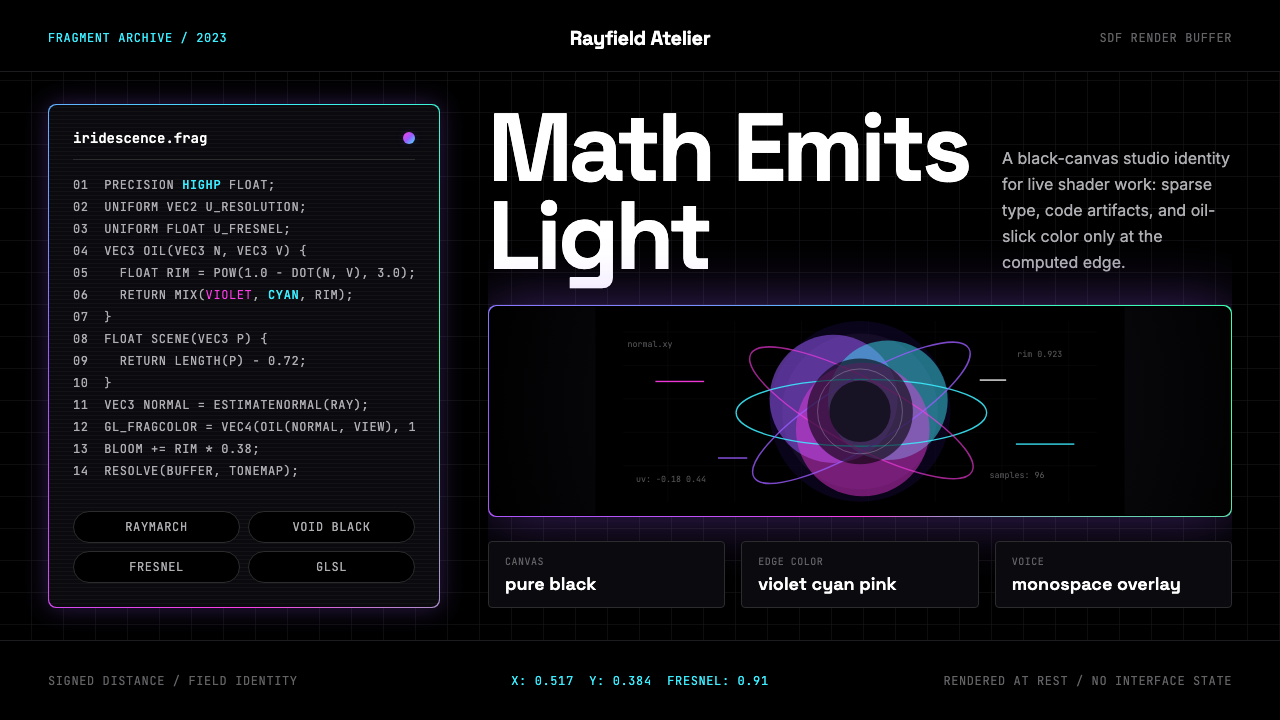
When GPU mathematics meets the browser canvas, colour stops obeying physics and starts obeying poetry — violet spilling into cyan, cyan bleeding into rose, all of it alive on a void-black ground.
WebGL Shader Iridescent (2023) in brief
WebGL Shader Iridescent is a computational aesthetic that renders living, shifting colour directly on the graphics card and delivers it to the browser without any conventional design tools touching the result. The visual signature is unmistakable: deep black grounds, saturated violet-cyan-pink gradients that behave like oil on water, mathematical primitives — spheres, toruses, metaballs — that seem to breathe, and monospace code overlays that remind the viewer they are watching mathematics in performance.
The style draws its colour logic from Fresnel equations, the same physics that describe why a soap bubble shifts colour as you tilt it. Instead of painting a static hue, the shader calculates how much light bounces back at each viewing angle and maps that calculation to the visible spectrum. The result is iridescence that feels genuinely physical yet unmistakably synthetic — richer than any flat gradient, more controlled than any photograph of a real surface.
What makes the style culturally distinct is its transparency about process. The monospace code fragments, the SDF geometry, the mathematical constants floating in the corner — these are not decoration applied after the fact. They are the material. The aesthetic says: the code IS the art, the algorithm IS the form. This places it in a long lineage of generative and computational art, but the WebGL variant is uniquely of the browser era: it runs in real time, at interactive frame rates, inside a tab anyone can open.
Where does WebGL Shader Iridescent (2023) come from?
The lineage begins in the 1980s demoscene — a subculture of programmers, especially on the Amiga and later the PC, who competed to produce the most spectacular real-time visuals within absurdly tight hardware constraints. A four-kilobyte executable that generated minutes of animated geometry and colour was not a curiosity; it was a craft tradition with its own hierarchy, heroes, and annual competitions. The demoscene taught a generation of developers that the constraint itself was the medium, and that pushing hardware to its expressive limit was a legitimate artistic act.
Signed Distance Functions — the mathematical technique that defines geometry by measuring how far any point in space is from a surface — emerged as a central demoscene tool in the 1990s and were popularized for the web by Inigo Quilez, whose contributions to compact SDF formula-writing became foundational references. Quilez, based in Barcelona and later San Francisco, wrote extensively about rendering techniques and published his shader experiments openly, creating a shared vocabulary for a global community of practitioners.
Shadertoy, launched in 2013 by Quilez and Pol Jeremias, became the platform that crystallized the aesthetic. It is a browser-based editor where anyone can write a fragment shader and share it publicly; the community that formed around it established the canonical visual conventions — dark grounds, Fresnel iridescence, SDF primitives, glitch elements — that define the style today. Ricardo Cabello, known online as Mr.doob, made Three.js the accessible on-ramp that brought shader thinking into mainstream web development without requiring low-level WebGL knowledge.
Patricio Gonzalez Vivo, author of The Book of Shaders, translated the mathematical and perceptual theory behind fragment shaders into prose that reached designers and artists who had never written a line of GPU code. His work anchored the style in visual art history — connecting it to Op Art, Impressionism, and early computer graphics — while making its technical foundations legible to a much wider audience. The 2023 renaissance accelerated when tools like Spline offered shader-graph interfaces that let designers produce Fresnel-iridescent surfaces without writing GLSL directly, bringing the aesthetic into portfolio sites, product landing pages, and startup pitch decks at a scale the demoscene community could never have anticipated.
What defines the WebGL Shader Iridescent (2023) look?
Void-Black Ground
The canvas is pitch black — not charcoal, not navy, not deep grey, but an absolute absence of light. This is not an aesthetic choice made for moodiness; it is a technical and conceptual foundation. A GPU shader begins with nothing and emits light; the black ground is the default state of the hardware before any computation fires. Every colour in the composition is therefore light that has been generated, not pigment that has been laid. The darkness makes the iridescent bloom appear to glow from within rather than reflecting from a surface.
Fresnel Iridescence
The defining colour behaviour of the style is iridescence derived from Fresnel reflectance calculations — the same equations that describe how light behaves at the boundary between two media. As a viewer's angle to a surface changes, so does the proportion of light reflected versus transmitted, and this angular relationship is mapped to hue. The result is colour that shifts continuously from violet through cyan to rose and back, with transitions that feel physically motivated rather than arbitrarily decorative. No two viewing angles produce the same colour, and no static screenshot fully captures the effect.
SDF Geometry
Forms in this aesthetic are not drawn as polygons but defined mathematically as signed distance functions — each point in space returns a number representing its signed distance to the nearest surface. Spheres, toruses, capsules, metaballs, and twisted or blended combinations of these primitives are the vocabulary. Because SDF geometry is computed per pixel rather than approximated by triangles, the results have a particular quality: they are perfectly smooth at any scale, they can be blended together like soft clay, and they can be raymarched through at low resolution to achieve a characteristic slightly hazed, volumetric quality that polygon-based rendering cannot replicate.
Monospace Code Overlay
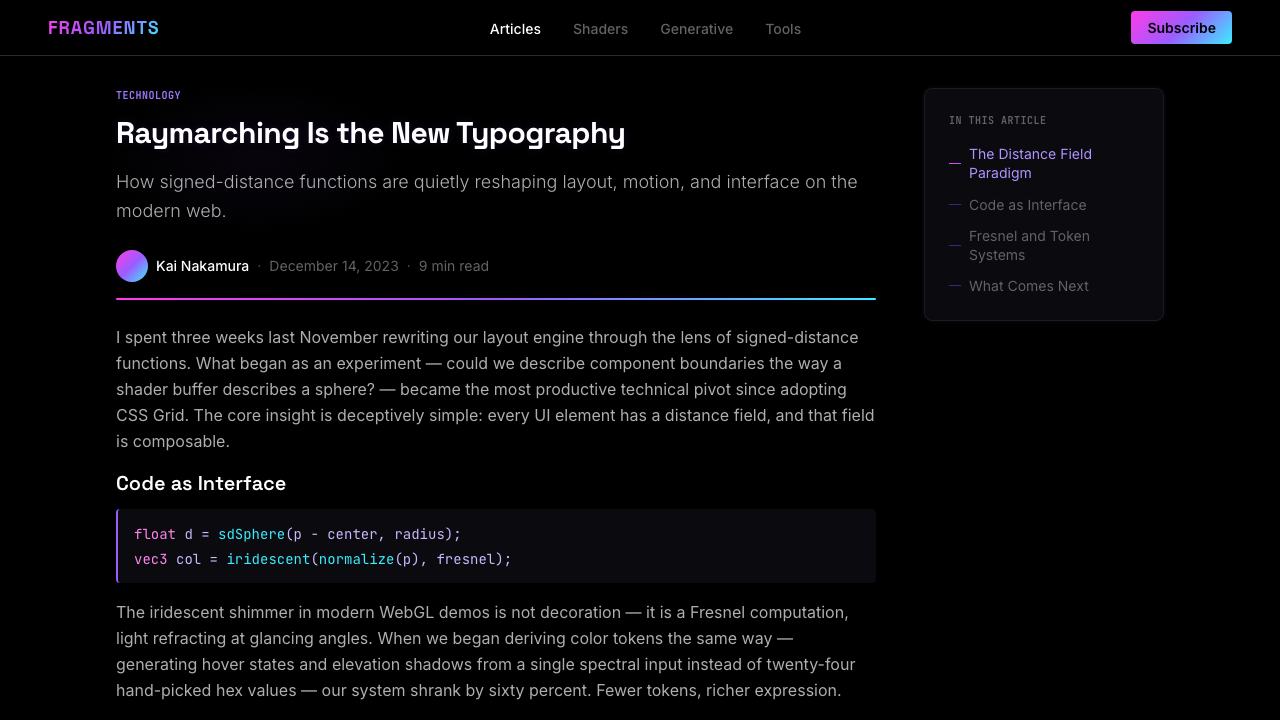
Monospace text — fragments of actual shader code, mathematical constants, coordinate values — appears as a compositional element floating above or behind the geometry. This is not documentation; it is declaration. The code fragments make the process legible without explaining it, affirming that what the viewer is watching was made by someone typing numbers rather than someone painting with a brush. The typographic treatment is always unadorned: white or dim-tinted characters, no visible container, no decorative alignment. The text breathes the same mathematical air as the geometry behind it.
Volumetric Bloom and Glow
Light in this style does not stop at the surface of a form; it spills, blooms, and diffuses into the surrounding black. This volumetric glow is not a post-process filter applied like a lens flare in a photo editor — it emerges from the density and scattering calculations within the shader itself. The bloom gradient moves from saturated core to near-invisible edge, creating depth on a flat canvas without conventional perspective. Objects feel like they are suspended in a medium — not floating in front of a black wall, but luminous within a dark space.
Real-Time Animation
Still images of this style are approximations. The fundamental mode is animation — gentle rotation, pulsing bloom, continuous colour cycling, slow drift of geometric forms. Because the shader runs on the GPU each frame, the motion is not interpolated between keyframes but recalculated from scratch continuously. This gives the animation a quality of infinite resolution: there is no compression artefact, no dropped frame manifesting as a jump, no looping seam. The motion feels organic in a way that traditional frame-by-frame animation cannot achieve, even though the rules governing it are entirely mathematical.
Mathematical Transparency
Unlike most design styles that conceal their construction, WebGL shader iridescent makes the making visible. The SDF formula is the shape. The Fresnel angle is the colour. The noise function is the texture. Nothing is simulated; everything is derived. This transparency extends to a particular humility about resolution and performance: the aesthetic often accepts visible raymarching steps, slight pixel undersampling, or deliberate banding as part of the visual character rather than flaws to be hidden. The computational substrate is not something to overcome but something to celebrate.
Who shaped WebGL Shader Iridescent (2023)?
Quilez is the central figure of the shader art movement. Working from Barcelona and later San Francisco, he developed and documented the core SDF formula library that the entire community uses — primitives, boolean operations, smooth blending functions — and published each discovery as open mathematical writing rather than proprietary code. His co-founding of Shadertoy in 2013 gave the community a shared stage, and his own contributions to that platform — hundreds of shaders demonstrating techniques from ambient occlusion to procedural terrains — set the aesthetic and technical standard that practitioners continue to measure themselves against.
Gonzalez Vivo wrote The Book of Shaders, an open, illustrated guide to fragment shader programming that made the mathematics of light and colour accessible to artists who had no prior GPU programming experience. By connecting shader mathematics to art history — to Impressionism, Op Art, and early computer graphics — he reframed shader coding as a form of mark-making rather than engineering. His work was instrumental in expanding the audience for this aesthetic beyond the demoscene and competitive shader communities to designers, illustrators, and fine artists.
Cabello created and continues to lead Three.js, the JavaScript library that abstracts WebGL into an interface designers and developers can use without mastering the underlying GPU API. Three.js did not invent the shader aesthetic, but it massively lowered the barrier to producing it: iridescent materials, SDF-like post-processing, and Fresnel shading became available to anyone comfortable writing JavaScript. The library's maturity by the early 2020s, combined with an enormous community of examples and extensions, was a key enabling condition for the 2023 mainstreaming of the style.
Jeremias co-founded Shadertoy alongside Quilez and was responsible for much of the platform's technical architecture. By building a browser-based shader editor that required no installation, no build step, and no graphics driver configuration, he made real-time GPU art accessible to anyone with a modern browser. The platform's design — a code editor on the left, a live rendering on the right, a public gallery — established the social and collaborative norms that shaped how shader art was shared and iterated on for the next decade.
How do you use WebGL Shader Iridescent (2023) today?
The WebGL shader iridescent aesthetic is one of the most potent visual signals in contemporary technology culture — it communicates GPU-native computation, mathematical depth, and creative technical ambition in a single frame. Applied well, it commands attention and signals that a product belongs to the frontier of its category. Applied carelessly, it reads as trend-chasing without substance, because sophisticated viewers will immediately notice when a composition is borrowing the surface vocabulary without understanding the underlying logic.
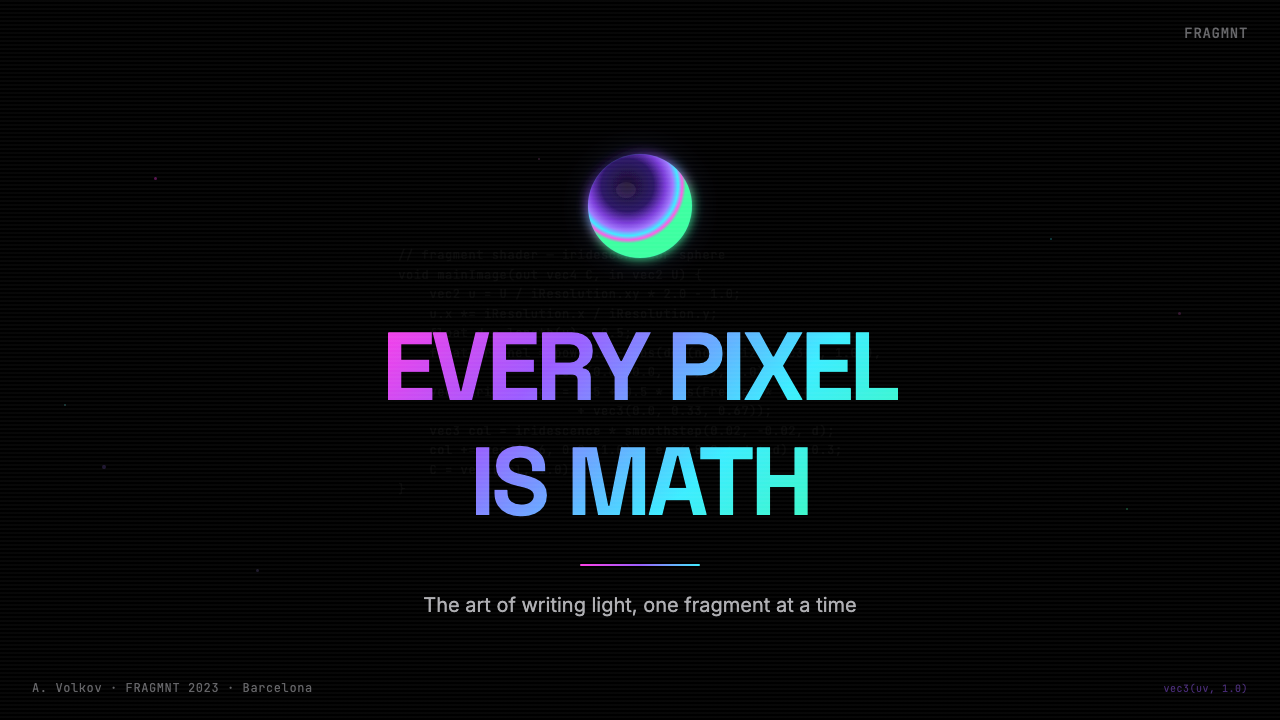
For presentation slides, the style works powerfully on title and transition slides but demands restraint on content slides. A cover built around a single iridescent SDF form on pure black, with the presentation title set in clean light monospace type, creates immediate presence. Transition slides can use animated shader loops as full-bleed backgrounds. Content slides, however, should strip back to text on black or very dark near-black — attempting to run full shader compositions behind readable text creates visual competition that neither element wins. Data visualizations can echo the colour palette (violet, cyan, rose) as discrete categorical colours against dark grounds, maintaining tonal coherence without requiring live GPU rendering.
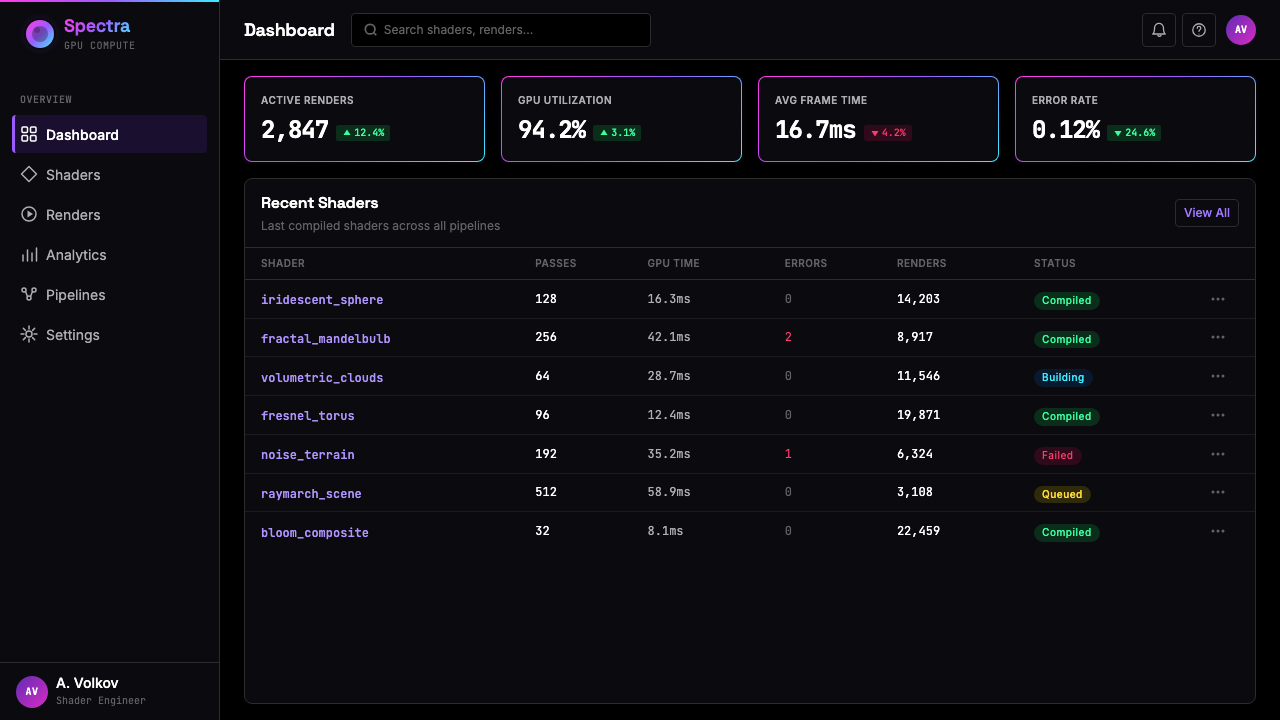
For web interfaces and product landing pages, the style is most effective when it is concentrated in a single high-impact hero zone rather than distributed across the entire layout. A full-width shader canvas in the hero, followed by conventional dark-mode content sections below, allows the page to signal technical sophistication at the entrance and shift to legibility as the user scrolls. Dashboard products in the GPU, AI, or developer tooling space can use small shader elements — animated material badges, Fresnel-tinted cards — as systematic accents without overwhelming the data-focused interface. The critical constraint is performance: a shader running in a hero canvas should be profiled on mid-range hardware, not just developer machines.
For editorial and marketing work, the aesthetic is especially effective for product launches, conference branding, and annual reports in technology sectors. A print-oriented adaptation requires a translation: because Fresnel iridescence depends on real-time angle calculation, static print work substitutes a hand-crafted violet-cyan-rose gradient that mimics the colour sequence without the dynamism. The monospace code overlay translates cleanly to print as a typographic texture. Marketing campaigns can use still-frame extractions from shader animations as hero images, accepting that the static version is a reduced form of the full experience while retaining the aesthetic signature.
A common mistake is applying the Fresnel colour sequence — violet, cyan, pink — as a flat gradient on conventional shapes (rectangles, background fills, button states) without the underlying SDF geometry and mathematical transparency that give the palette its meaning. This produces something that looks like a generic gradient trend rather than shader art. The palette only carries its weight when the geometry and colour are derived from the same computational process. Similarly, adding monospace code overlay to a composition that does not otherwise follow the aesthetic's logic makes the code feel like costume rather than content — a shorthand that signals nothing to viewers who understand the tradition.
WebGL Shader Iridescent (2023) — FAQ
What is the difference between a WebGL shader and a regular CSS gradient or filter effect?
A CSS gradient is a pre-specified colour interpolation computed by the browser's layout engine; it is static (or animated via keyframes between fixed states). A WebGL fragment shader is a small program that runs on the GPU and is called once for every pixel in the canvas at every frame, computing each pixel's colour from scratch based on its coordinates and a time variable. This means a shader can produce effects that are genuinely infinite in variation — no two frames need be identical — and can respond to the viewer's mouse position, scroll depth, or audio input in real time. CSS filters approximate physical optics; shaders simulate them from first principles.
Is this style appropriate for dark-mode interfaces, or does it require a fully black background?
The canonical form uses void black, but the style can be adapted to very deep dark backgrounds without losing its character, provided the value difference between background and bloom remains extreme. What breaks the aesthetic is raising the background brightness to a mid-dark level — at that point the iridescent forms lose their appearance of emitting light and start to look like shapes sitting in front of a coloured wall, which undercuts the entire visual logic. If a product requires a softer dark (for eye comfort or brand reasons), the shader elements should be isolated in contained zones — a hero canvas, a feature card — rather than integrated into the overall background colour.
How does this aesthetic relate to the broader Y2K revival and holographic trends in contemporary design?
They share a colour family — violet, cyan, and rose appear in all three — but the underlying logic is entirely different. Y2K holographic design uses surface textures that reference physical holographic foil: the effect is decorative, applied to shapes, and does not claim any mathematical provenance. Shader iridescence is generated from Fresnel equations; it is mathematically derived colour, not a texture map. The contemporary holographic trend in fashion, packaging, and UI design is nostalgic and materialist — it evokes a physical object. Shader iridescence is computational and dematerialized — it evokes a process. Using them interchangeably mistakes surface appearance for structural meaning.
Can this style work for brands that are not in the technology sector?
It can, but it requires careful anchoring. The style carries very strong associations with computation, technical depth, and the culture of GPU-native creativity — these associations are baked into the aesthetic at the level of the monospace code overlays, the mathematical geometry, and the demoscene lineage. A luxury fashion brand, a music artist, or a scientific research institution could adopt the visual language without the code overlay and without referencing the computational tradition explicitly, using only the Fresnel colour palette and void-black ground. The result would be striking and distinctive, but it would be drawing on the style without endorsing its full cultural meaning. That trade-off is legitimate; it just requires clarity about which elements are load-bearing and which are optional.
What distinguishes authentic shader art from a shader-aesthetic imitation?
The primary distinction is whether colour and form are co-derived from the same mathematical process. In authentic shader art, you cannot separate the Fresnel colour from the SDF geometry because they are outputs of the same program — change the geometry and the colour behaviour changes with it. In an imitation, a violet-cyan gradient is applied to a shape that was designed by entirely conventional means and then decorated with the palette. The imitation may be visually similar at a glance, but it lacks the particular quality of colour that changes continuously with angle, the soft SDF blending between forms, and the sense that the image is alive rather than composed. Sophisticated viewers — particularly those familiar with Shadertoy — will recognise the difference immediately.
Related design styles
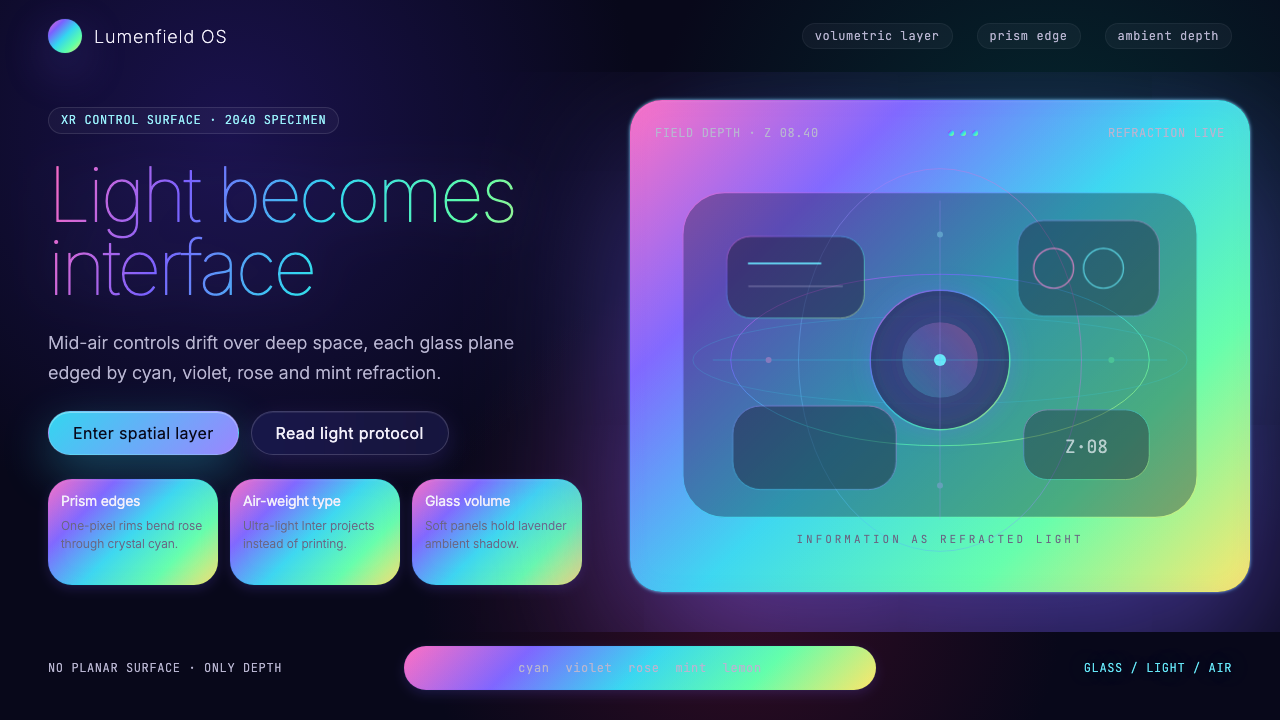 Holographic UI 2040Information made of light. Deep-space black, ultra-light Inter and prismatic…
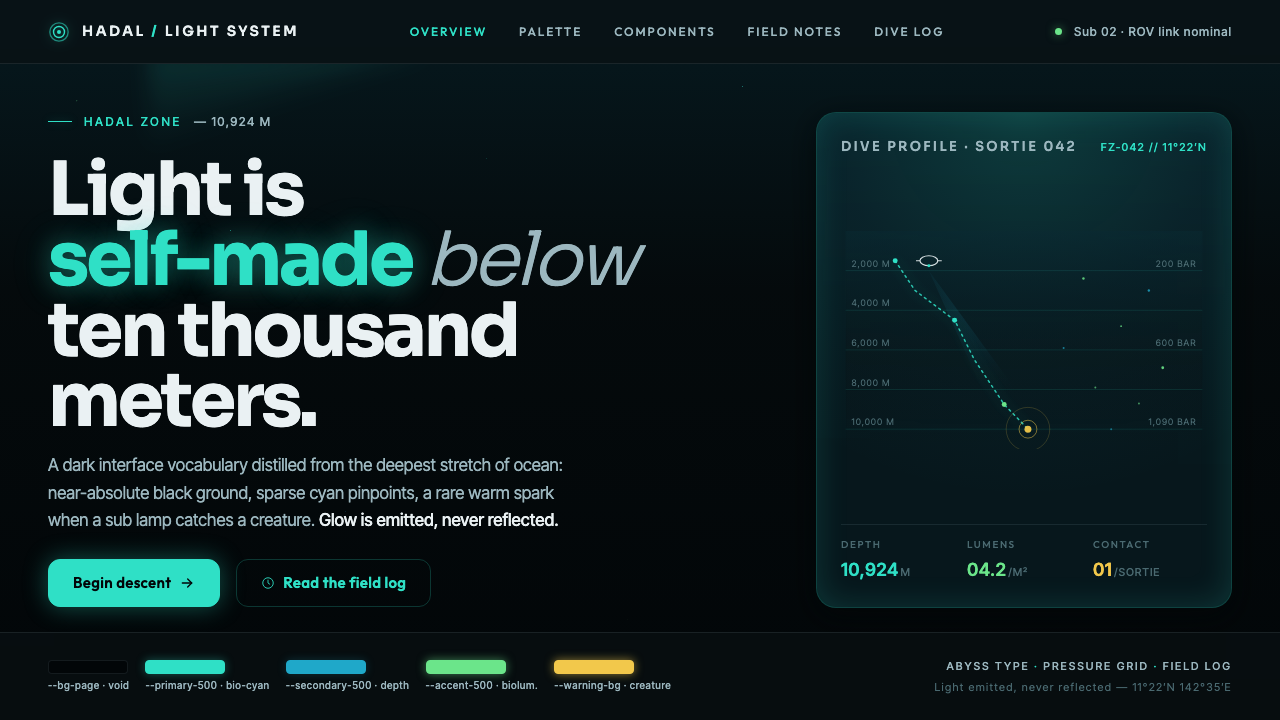 Mariana TrenchLight is self-made below ten thousand meters. Hadal-black ground, cyan pinpoi…
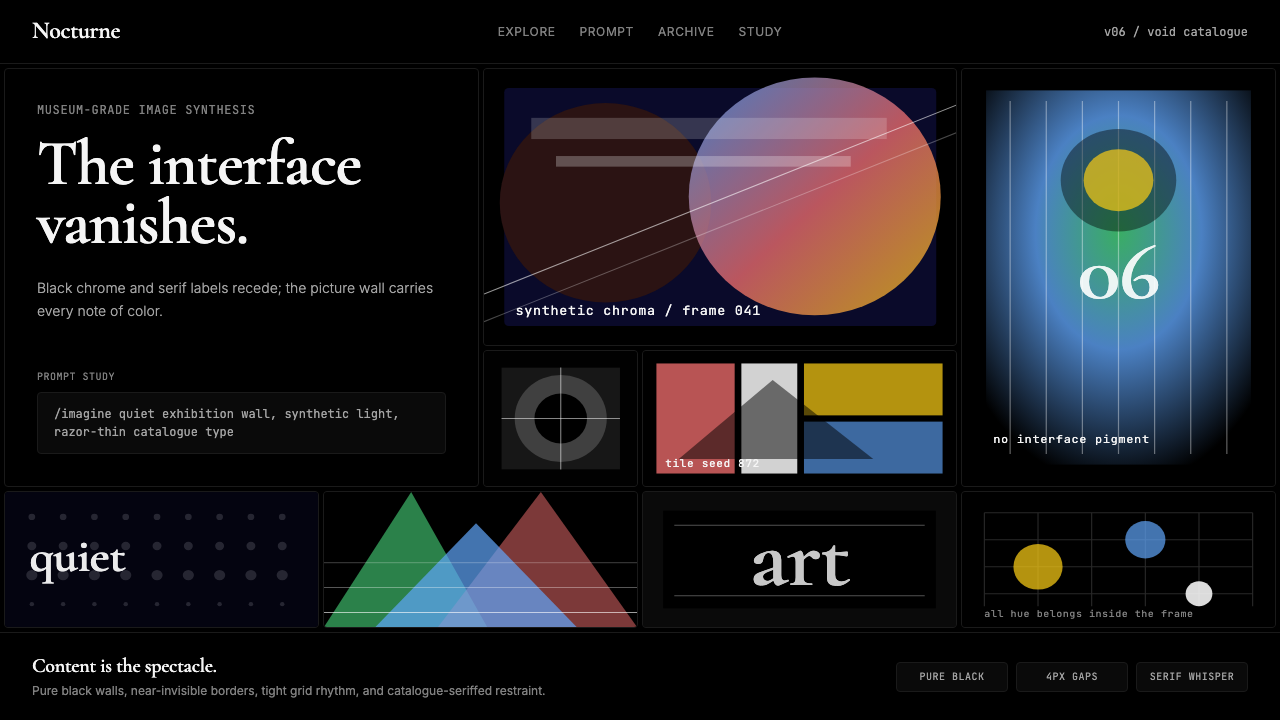 MidjourneyInvisible chrome, visible art. Pure black grid and Cormorant serif give color…
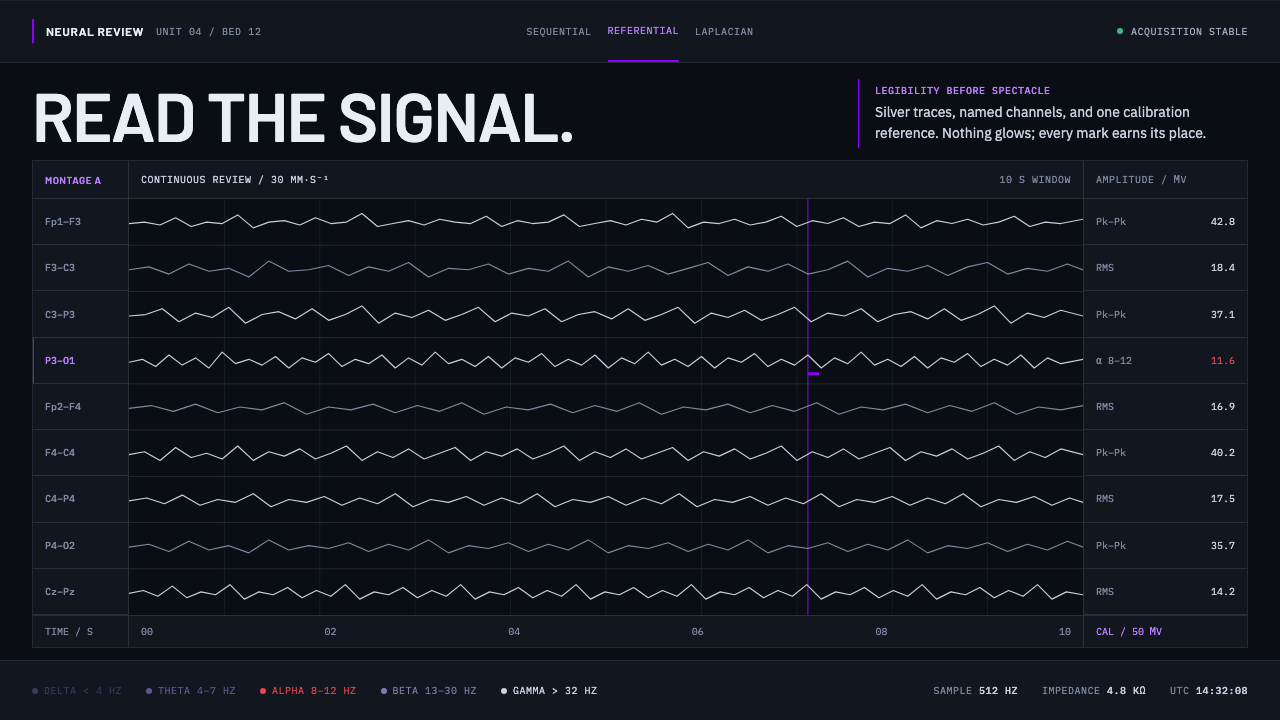 Neural Interface ClinicalClinical restraint makes signals legible. Silver traces cross near-black; vio…
 Cash App 2024Fintech that talks like a record label. Pure black, dollar-bill green, type a…
 Edgerunners NeonNeon overload. Fluorescent yellow, cyan HUD grids, and magenta glitches burn…