What is Tesla Cybertruck Stainless (2023)?
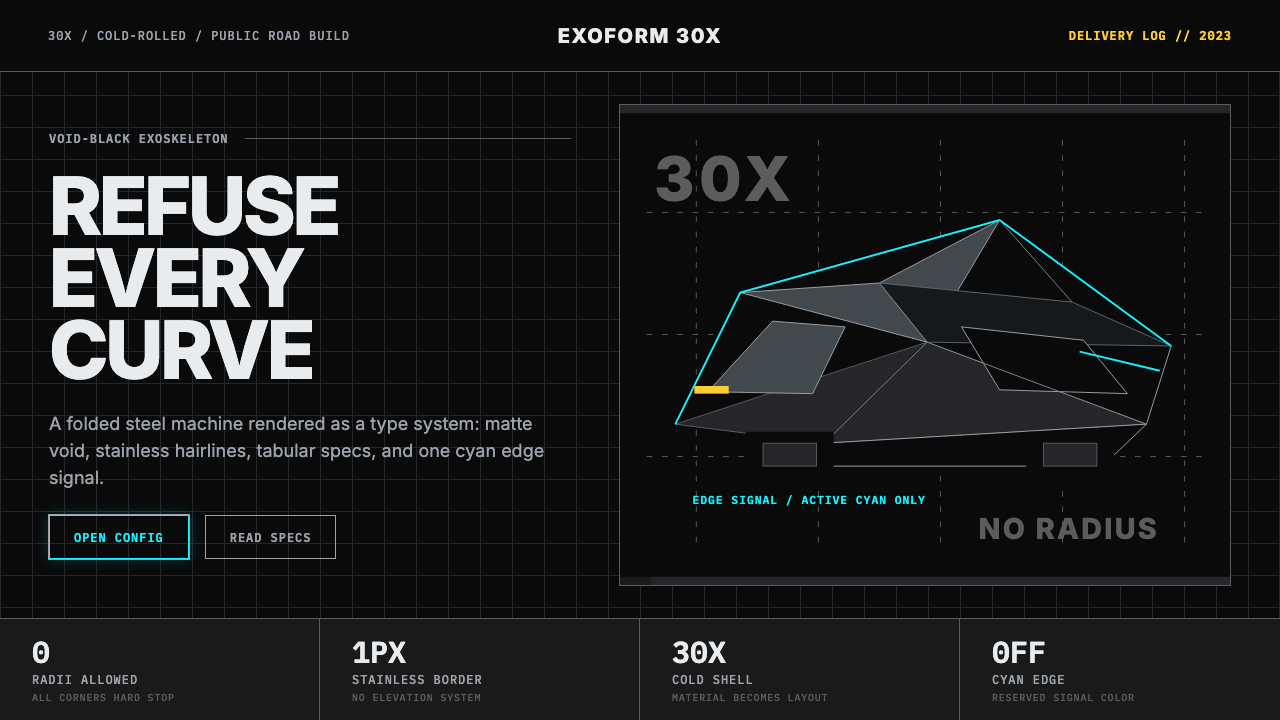
The Cybertruck didn't borrow a design language — it refused every existing one, and in doing so forced a truck into becoming a typeface.
Tesla Cybertruck Stainless (2023) in brief
The Tesla Cybertruck Stainless design system is, at its core, an act of industrial refusal translated into visual grammar. Where conventional automotive brands reach for warmth, roundness, and aspirational chrome, the Cybertruck makes the opposite every choice: void-black surfaces, hairline metallic borders, a single electric-cyan accent reserved exclusively for interactive affordances, and an all-caps typographic voice that admits no softening. It is the first automotive design language in decades to genuinely disturb the conventions it inherits.
What makes the system coherent rather than merely aggressive is its internal consistency. Every element answers to the same governing logic: the exoskeleton of thirty-X cold-rolled stainless steel is not disguised or wrapped — it is translated directly into the digital brand. Borders that echo a hairline industrial weld, surfaces that refuse gradient and shadow softness, accents the color of an electrical arc — these are not styling choices laid over an object but principles extracted from the object's material nature and restated in every context where the brand appears.
The result reads simultaneously as brutalist and futurist, as spare as a circuit diagram and as confrontational as a warning sign. The Cybertruck design language does not court the viewer; it presents itself as a structural fact. This combination of material honesty, geometric severity, and restrained chromatic logic gives it a quality rare in contemporary brand design: it cannot be mistaken for anything else.
Where does Tesla Cybertruck Stainless (2023) come from?
The Cybertruck's design history begins not with a sketch but with a constraint: Elon Musk's 2017 mandate that the vehicle use a cold-rolled stainless-steel monocoque body. Traditional automotive steel is stamped — shaped under enormous pressure into curved panels. Stainless steel of the grade required for structural rigidity cannot be stamped in the same way; it must be bent along straight lines. The flat faceted geometry of the Cybertruck is not an aesthetic choice made by a designer looking at a mood board — it is the visual consequence of a materials decision made by an engineer.
Franz von Holzhausen, Tesla's chief designer, worked with this constraint as a generative condition rather than a limitation. The precedents he cited publicly included the Lotus Esprit submarine from the 1977 film 'The Spy Who Loved Me' and the Giorgetto Giugiaro-designed wedge vehicles of the 1970s and 1980s — forms already tilted toward the polygonal and the angular. The Blade Runner visual universe, with its wet industrial surfaces and cold-spectrum lighting, provided a chromatic and atmospheric reference. But neither of these fully explains the Cybertruck's specific visual grammar; that emerged from the decision to make no attempt to disguise what the truck actually is.
Unveiled in November 2019 in Hawthorne, California — with the notorious live demonstration in which its 'armored glass' immediately cracked — the Cybertruck became an immediate cultural event. The design was polarizing precisely because it violated every existing expectation for the category: pickup trucks are typically designed to appear capable and approachable, often deploying chrome, sculptural curves, and warm earth tones. The Cybertruck offered flatness, silver-gray, and a silhouette that referenced construction equipment more than consumer vehicles.
First deliveries of the production vehicle began in November 2023, four years after the reveal, and the brand visual system that had been developed around the truck was consolidated and deployed across Tesla's Cybertruck-specific digital touchpoints during 2023 and 2024. The Austin, Texas Gigafactory, which manufactures the vehicle, became a secondary reference point in the brand's visual vocabulary — industrial scale, corrugated steel, the aesthetic of a place built for a purpose rather than for appearance. The design language that had started as a consequence of materials engineering had, by this point, become a fully articulated brand system with its own internal logic, chromatic vocabulary, and typographic register.
What defines the Tesla Cybertruck Stainless (2023) look?
Surface and Ground
The dominant surface is absolute black — not charcoal, not dark navy, but a void that reads as the absence of color rather than a color in its own right. Against this ground, every other element registers with surgical clarity. The stainless-steel hairline borders that trace edges and panel breaks echo the physical material of the vehicle itself: fine, precise, and cold. There are no gradients on these surfaces, no soft-to-hard transitions, no atmospheric perspective. The ground is a decision, not a background.
The Accent Color
A single electric cyan — the hue of cathode-ray light, of a neon arc discharge, of early-digital phosphor screens — serves as the system's sole accent. It appears on interactive affordances: active states, selection indicators, progress markers, the illuminated trim lines on the physical vehicle. It never appears decoratively and never appears in multiples simultaneously. Its scarcity is what gives it authority; overuse would collapse the system's chromatic logic. Alongside this, amber is reserved specifically for beta states and warnings — a secondary signal rather than a design element.
Typography
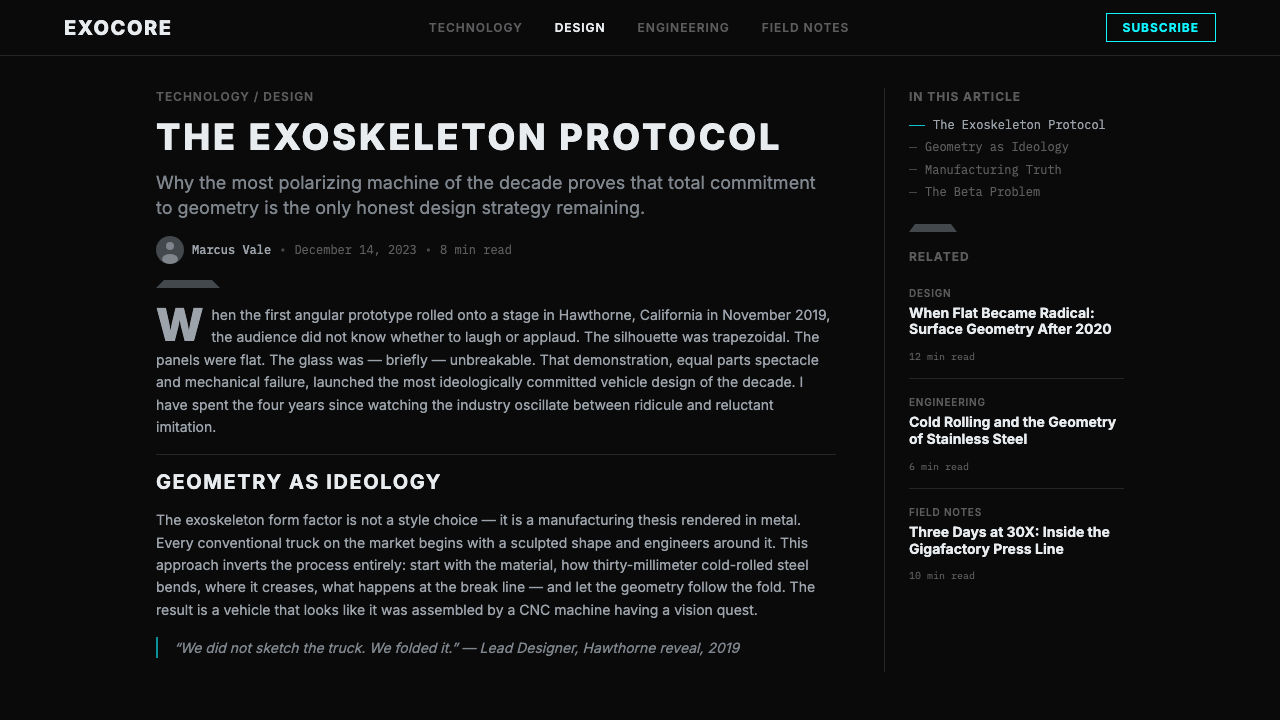
All type is set in capitals or in tabular figures — there are no lowercase letters in primary communications, and numbers are always monospaced so that data columns align with mechanical precision. The underlying typeface is geometric and humanist in equal measure, pushed to extremes that the original designers probably did not intend: tracking is wide, weight is heavy, and the letters carry a faceted quality that mirrors the polygonal surfaces of the vehicle. Reading this system, one gets the impression that the text was machined rather than written.
Geometry and Edge
Every form is bounded by a straight line or a consistent bevel — no soft radii, no organic curves, no transitions that dissipate into ambiguity. Corners are decisions. Panels meet at angles that recall the industrial bending of sheet metal. Interface elements — cards, containers, dividers — inherit this angularity and treat it as structural rather than decorative. The visual vocabulary is closer to architectural drawing than to conventional digital UI: what you see are forms, not suggestions.
Photography Register
Photography in this system uses low angles, industrial environments, and conditions that emphasize scale and material surface. The vehicle appears in desert or coastal locations where ambient light is cold and directional, where the stainless surface can be seen to reflect horizon and sky rather than warmth or comfort. There are no lifestyle photographs, no smiling occupants, no domesticated settings. When humans appear, they are typically in silhouette or at a distance that reduces them to scale figures against the mass of the object. The environment frames the vehicle as an artifact of the landscape, not a consumer product within it.
Data and Information
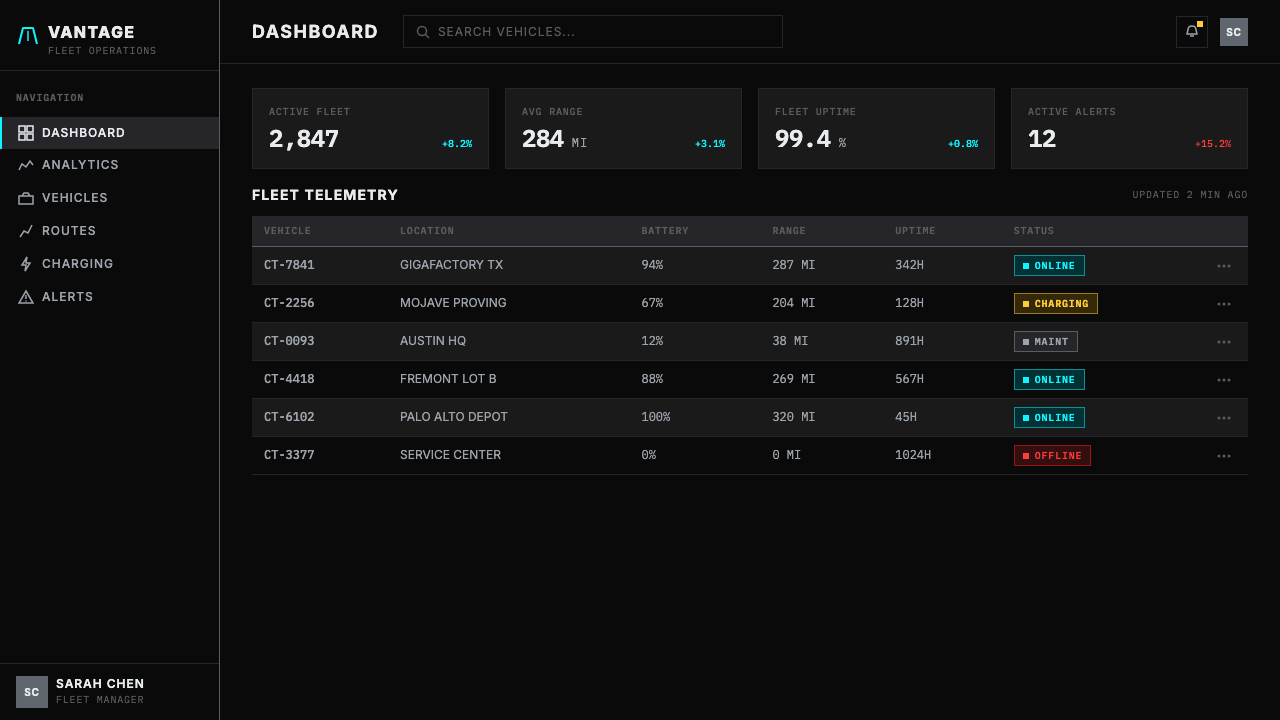
Numeric and performance data are treated as primary visual content, not secondary annotation. Specifications — range, payload, acceleration figures — are set in large tabular type and presented with the visual weight ordinarily reserved for headlines. The implication is that the numbers are the product's core argument, and the design system's job is to make that argument as legible and undeniable as possible. Graphs and data visualizations, where they appear, are hard-edged and flat, using the system's chromatic rules without softening.
Absence as Principle
What is not present in this design system is as defining as what is present. There are no warm earth tones, no soft drop shadows, no rounded corners, no decorative iconography, no gradient fills, no textures simulating natural materials. The restraint is not minimalism in the contemporary digital sense — a careful curation of pleasing emptiness — but rather a systematic exclusion of every visual element that might soften, domesticate, or normalize the object. Each omission reinforces the same argument: this vehicle is not interested in making you comfortable, and neither is its brand.
Who shaped Tesla Cybertruck Stainless (2023)?
As Tesla's chief executive and the driving force behind the Cybertruck program, Musk established the founding constraint — stainless-steel exoskeleton — that determined the vehicle's geometry and, by extension, its visual brand. His public references to Blade Runner and to first-principles engineering thinking as design methodology provided the cultural and conceptual framework within which the design team operated. Musk also personally approved the polarizing design against internal pressure to soften or conventionalize it, making his aesthetic judgment as much a part of the system's origin as any formal design decision.
Tesla's chief designer since 2008, von Holzhausen translated Musk's material mandate into an articulated visual language. His background includes Volkswagen, General Motors, and Mazda — mainstream automotive design environments — which makes the Cybertruck's departure from automotive convention particularly deliberate. Von Holzhausen has described the design process as collaborative and iterative, with the stainless-steel bending constraint continuously reshaping formal choices. His ability to extract a coherent design language from a production engineering constraint — rather than decorating the constraint away — distinguishes the Cybertruck's visual system from conventional automotive brand design.
As Tesla's vice president of vehicle engineering during the Cybertruck development period, Moravy's team was responsible for the structural and manufacturing decisions that gave the vehicle's design language its defining constraints. The choice to use ultra-hard stainless steel — and the tooling decisions that followed from it — were engineering achievements that made the flat faceted body panels not just possible but necessary. In this sense, Moravy occupies a position in the Cybertruck's visual history similar to the structural engineer who constrains an architect: the form is not imposed on the engineering, but extracted from it.
The director of Blade Runner (1982) never worked on the Cybertruck, but the visual vocabulary of that film — industrial brutalism, cold blue-cyan lighting against absolute darkness, surfaces that are both metallic and wet, text that is sparse, monospaced, and transactional — is the closest visual precedent for the Cybertruck's aesthetic register. The influence is acknowledged rather than documented: Musk and von Holzhausen cited the Blade Runner world as a reference, and the resulting design system could plausibly serve as a digital-native extension of that film's production design. Scott's vision of a future that is industrial, inhospitable, and visually severe provided the chromatic and atmospheric DNA from which the Cybertruck brand was partly derived.
How do you use Tesla Cybertruck Stainless (2023) today?
The Cybertruck Stainless design system is among the most difficult contemporary styles to apply correctly because its power depends entirely on commitment. Half-measures destroy it. A layout that borrows the void black but then softens its cards with rounded corners and drop shadows is not a Cybertruck-inflected design — it is a conventional dark-mode interface that has borrowed an accent color. Applying this system means accepting its constraints in full: hard edges, no gradients, no organic warmth, a single accent that appears sparingly, and type that is capitalized and tabular wherever data or identity is communicated.
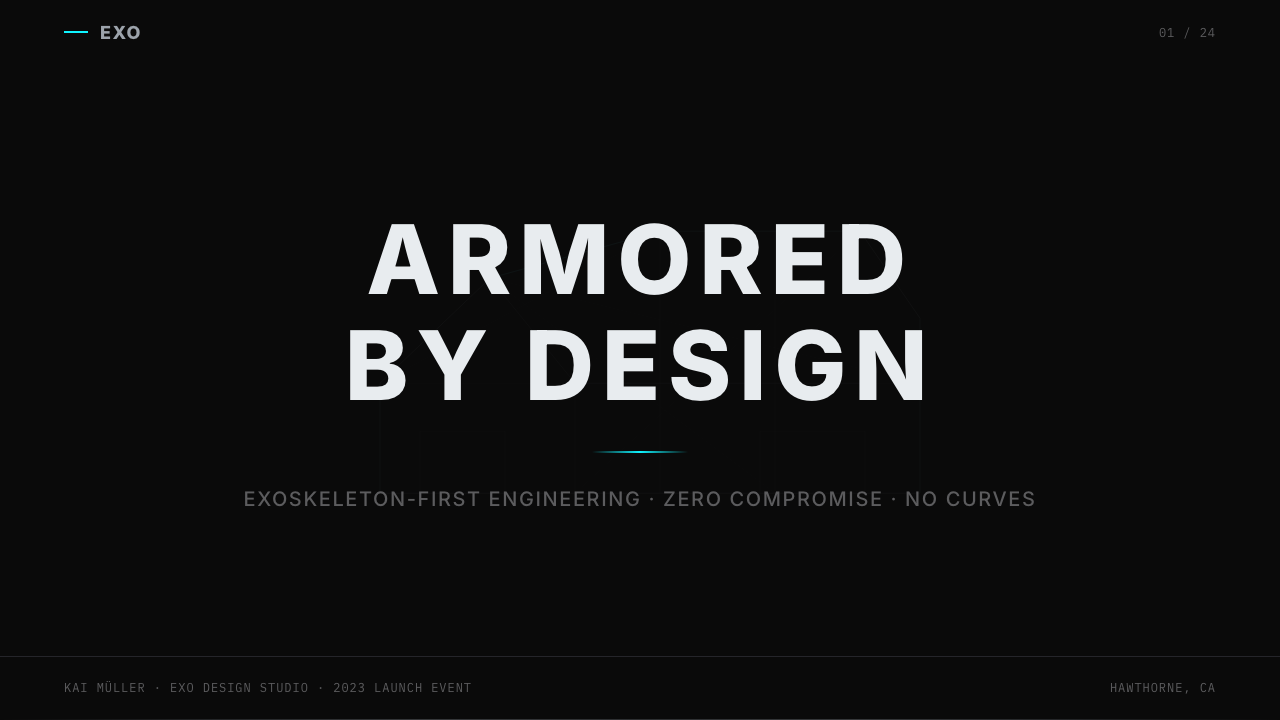
For presentation slides, this system is exceptionally well suited to technical product reveals, engineering demonstrations, and performance data communications. Cover slides should function as single-image statements: a nearly full-bleed asset — ideally photographic — with the title set in heavy, widely tracked capitals against a void-black field, and perhaps a single hairline rule to separate identity from content. Content slides should treat the grid as absolute, with data presented in tabular figures at a weight that declares it primary. The cyan accent should appear once per slide at most, used to mark the single most important number or element. Avoid warm photography, illustrated icons, and any element that implies hospitality.
For web interfaces, this system is best deployed in contexts where authority and technical credibility are the primary signals: product specification pages, performance dashboards, configuration tools, and checkout flows for high-consideration purchases. The approach requires a strict grid with no decorative break-outs, a dark or near-black background throughout, and interface elements — buttons, inputs, tabs — that are hard-bordered and flat-shadowed rather than soft. Navigation should be typographic rather than icon-driven. Any use of card components should treat the card border as a deliberate structural line, not a gentle container.
For editorial and marketing work, the system's poster-like severity lends itself to hero sections and full-width feature blocks where a single bold statement is the entire message. Alternating blocks between void-black and a deep neutral gray provides rhythm without introducing warmth. Pull quotes and key statistics should be set at headline scale in capitals, with the cyan accent reserved for the single most important figure. Avoid multi-column body text with generous leading — this system communicates through density and confrontation, not invitation and ease.
The most common failure mode when applying this system is aesthetic timidity: the instinct to add warmth, to soften edges, to introduce a secondary warm accent, to use lowercase for approachability. Every one of these modifications weakens the system's core claim. The Cybertruck design language works because it is internally consistent and because it refuses to apologize for itself. If the product context cannot support that refusal — if warmth, approachability, or cultural familiarity are required signals — then this system is simply the wrong choice, and a different visual language should be selected rather than this one softened.
Tesla Cybertruck Stainless (2023) — FAQ
Is the Cybertruck design system appropriate for products that aren't technology or automotive?
It is appropriate for any product where severity, technical authority, and anti-conventional positioning are genuinely desired signals — not just visually borrowed ones. High-performance physical goods (industrial tools, sporting equipment, architectural hardware), software products in security or infrastructure categories, and brands deliberately positioning themselves against incumbent comfort are all plausible applications. Where it fails is in contexts that require the product to feel accessible, warm, or culturally familiar. A children's educational platform, a food brand, a wellness application, or any consumer product that depends on trust built through warmth would be fighting against this system rather than using it. The question is not whether the style can be applied — it can be applied anywhere — but whether the product's actual values match the system's claims.
How does this system differ from other dark-mode design systems?
Most dark-mode design systems are inverted light-mode systems: they take conventions developed for light backgrounds — soft shadows, rounded corners, gradient fills, warm accent colors — and reverse the polarity of the ground. The result is a dark interface that is still fundamentally comfortable and human-scaled. The Cybertruck system does not invert a light convention; it starts from darkness as the primary state. Its geometry, typography, and chromatic logic are all developed for the dark ground and would not translate coherently to a light inversion. The cyan accent, the hairline metallic borders, the absolute black — these only work as a system when the ground is dark. This distinction matters in practice: the Cybertruck system is not interchangeable with dark mode, and cannot be toggled like one.
Can the cyan accent be replaced with a different color without breaking the system?
Technically yes, but the replacement must satisfy the same constraints: it must be a cold-spectrum hue (warm accents undermine the system's chromatic logic), it must be sufficiently distinct from the void black to read clearly at small scales, and it must be used with the same discipline — sparingly and exclusively for interactive affordances. Possible substitutions include a cool magenta or a sharp electric green. What does not work is substituting a warm color: orange, coral, gold, and warm yellow all break the system's cold industrial register and immediately signal a different aesthetic world. The accent's specific hue can shift; its temperature cannot.
How does this system handle accessible design requirements?
The system's high-contrast character — white or cyan on absolute black — is naturally compliant with contrast requirements for text legibility. This is one of the few cases where a design system's aesthetic commitments and accessibility requirements point in the same direction: the extreme contrast that makes the system visually severe also makes it highly readable for users with visual impairments. The areas that require attention are interactive states — ensuring that the cyan accent is not the sole distinguishing signal for state changes, since it is unavailable to users who cannot distinguish it from the background — and data visualization, where the single-accent approach may require augmentation with pattern or shape to distinguish data series for colorblind users.
Is the Cybertruck design language a lasting style or a moment-specific trend?
The style's durability depends on whether the underlying principles — material honesty, refusal of ornament, chromatic restraint — are legible as timeless values or as period markers. The argument for durability is that these principles are structural rather than decorative, and structural principles age differently than surface trends. Industrial design systems built on similar logic — Braun's systematic functionalism, early Apple minimalism, the visual language of precision instruments — have demonstrated that severity, when genuinely principled, does not date as quickly as warmth-seeking aesthetics. The argument against is that the specific implementation — void black, electric cyan, stainless hairlines — is closely tied to a particular cultural moment in technology aesthetics and may read as dated when that moment passes. The principles are likely to outlast the specific palette.
Related design styles
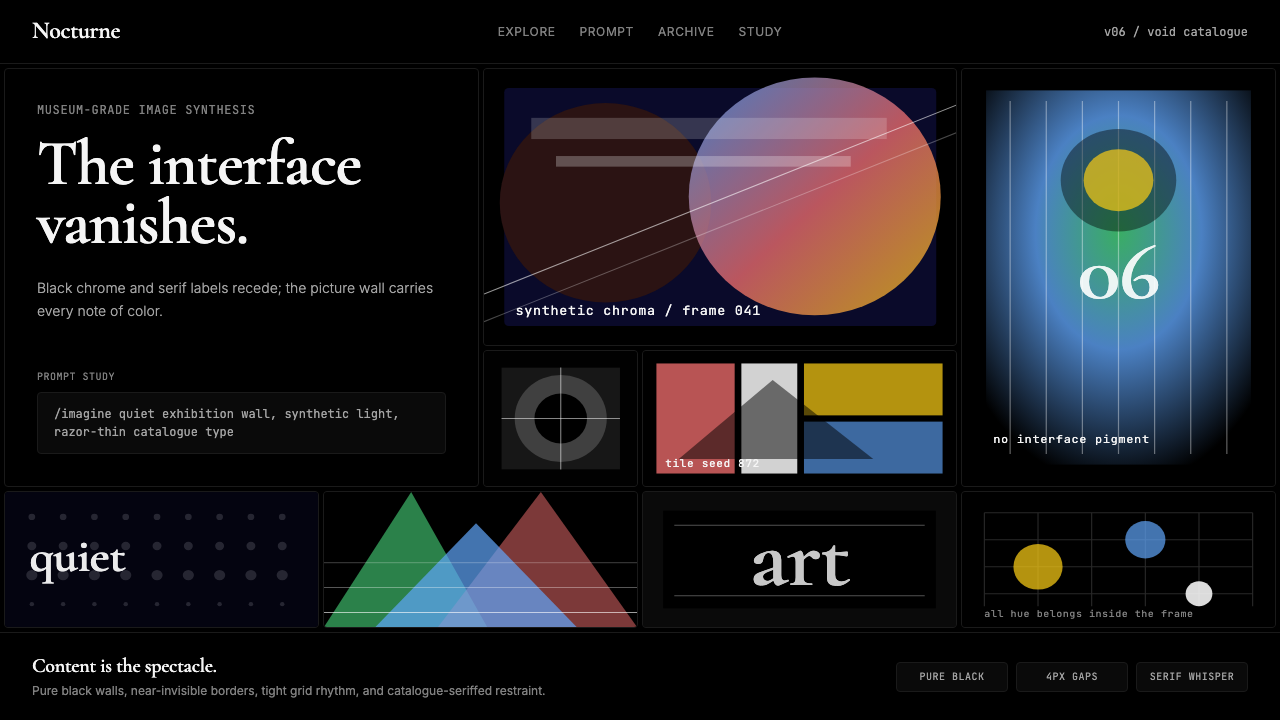 MidjourneyInvisible chrome, visible art. Pure black grid and Cormorant serif give color…
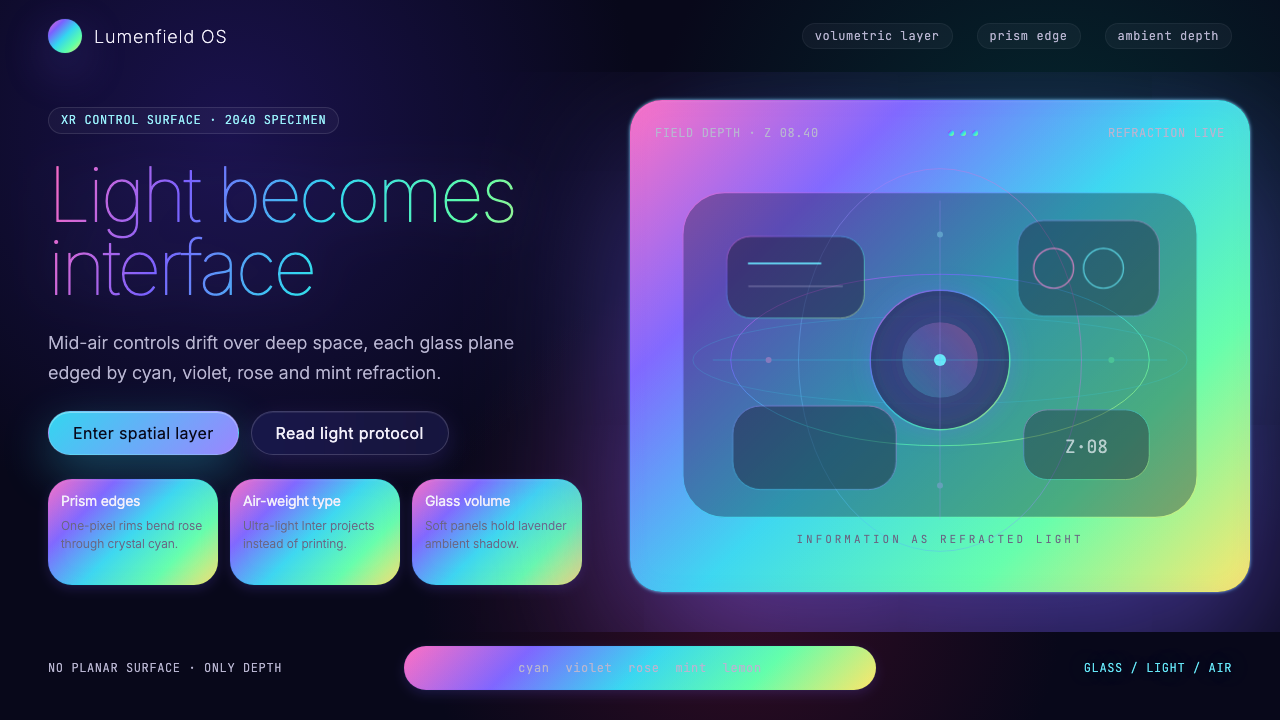 Holographic UI 2040Information made of light. Deep-space black, ultra-light Inter and prismatic…
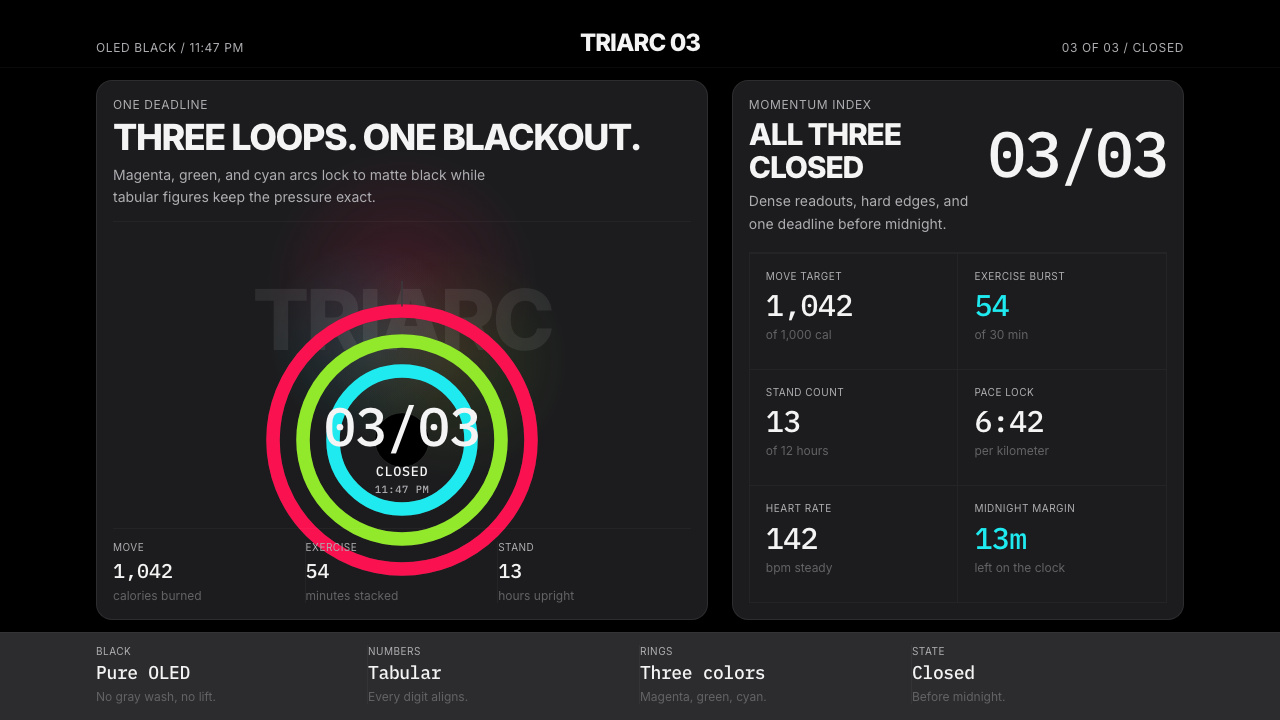 Apple Fitness Rings Closed (2024)Midnight feels exact. Magenta, green, and cyan rings lock onto OLED black.
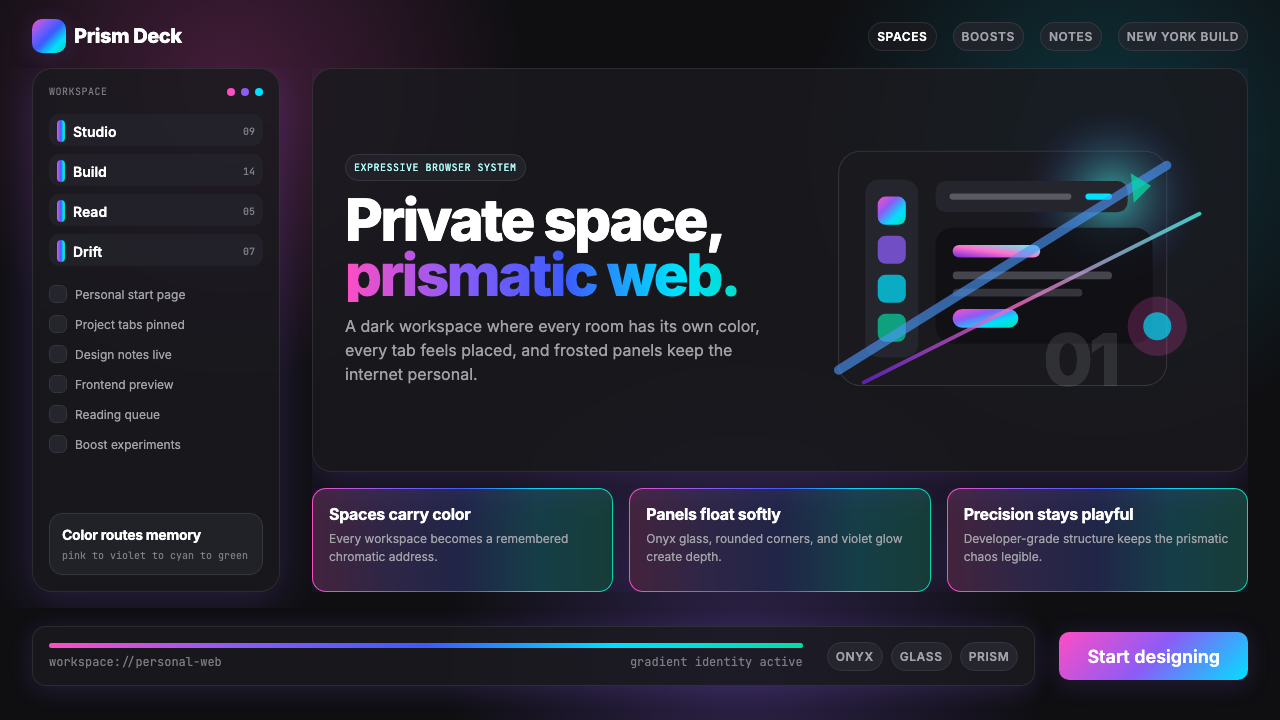 Arc Browser Prismatic (2023)Color is architecture. Pink-violet-cyan ribbons glow over onyx glass and roun…
 Cash App 2024Fintech that talks like a record label. Pure black, dollar-bill green, type a…
 Dyson Sphere MegastructureCold void, captive heat. Molten orange core caged by brown lattice and orbita…