What is Apple Fitness Rings Closed (2024)?
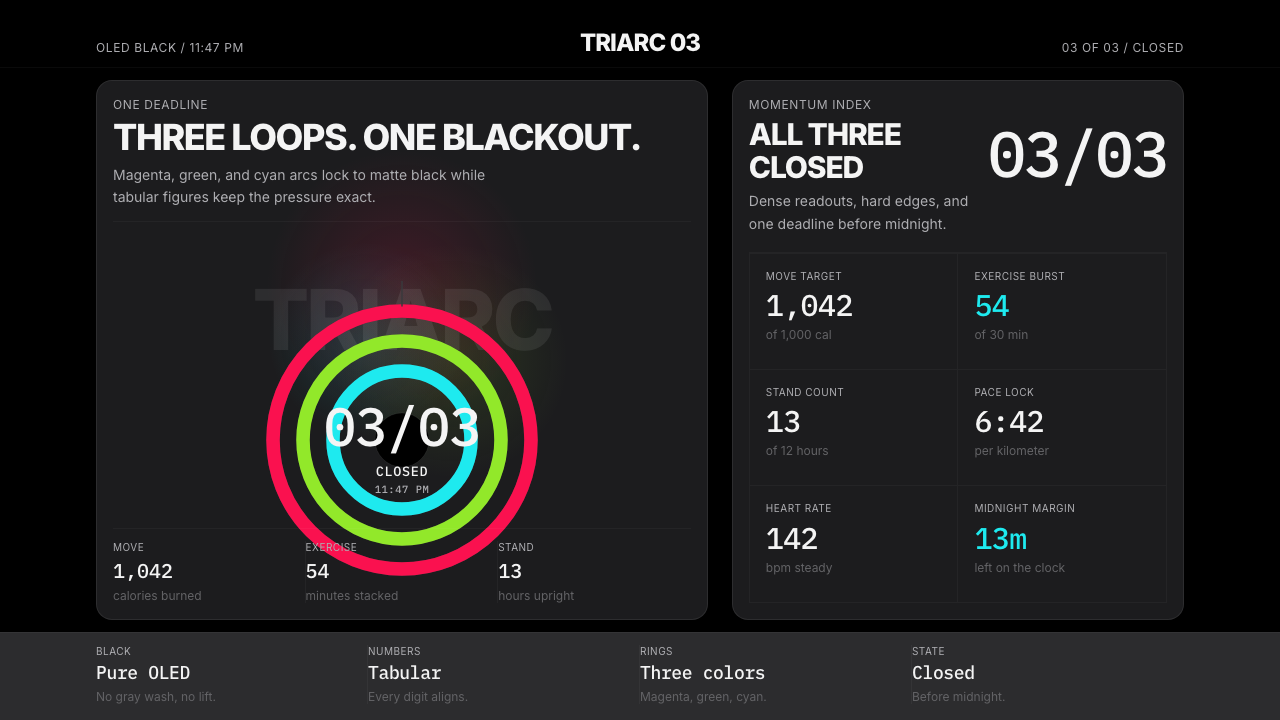
Three arcs on pure black — magenta, green, cyan — turned closing a fitness ring into the most satisfying micro-ritual of the wearable era.
Apple Fitness Rings Closed (2024) in brief
Apple Fitness Rings Closed (2024) is the consolidated visual language of Apple's Activity and Fitness system as it matured through a decade of Apple Watch hardware and the Fitness+ subscription service. At its core are three concentric arcs — Move in magenta, Exercise in green, Stand in cyan — drawn on a ground of pure OLED black so dark it reads as the absence of light rather than a color choice. The rings are not decorative: each one is a real-time progress indicator, and the visual reward of closing all three before midnight is the emotional engine that drives the entire system.
The design system extends far beyond the rings themselves. It encompasses a typographic vocabulary of large, tabular, caps-locked figures displaying calories, minutes, and hours in a style that fuses sports-timing instrumentation with the confidence of Apple's hardware-grade typefaces. Metric dashboards tile vertically, each card carrying a single ring arc alongside a sharp numeric readout. The overall impression is of data made visceral — health statistics rendered with the same precision and visual weight as industrial gauges, yet instantly legible on a display the size of a postage stamp.
By 2024, this visual language had spread well beyond the watch face. Fitness+ workout screens, iPhone and iPad Activity summaries, and even marketing materials all share the same OLED-black foundation, the same saturated ring palette, and the same typographic register. The system is dark-mode native: every design decision assumes a self-lit display, and the rich, almost luminescent quality of the ring colors is a direct consequence of OLED's ability to make pigment appear to glow against true black.

Where does Apple Fitness Rings Closed (2024) come from?
The three-ring Activity system was unveiled alongside the original Apple Watch on September 9, 2014, and launched publicly with the device in April 2015. The concept of a circular progress indicator for daily movement was not invented by Apple, but the specific combination of three discrete goals — a calorie-burn target, a dedicated exercise-minutes goal, and a stand-once-per-hour requirement — represented a deliberate attempt to translate the multidimensional recommendations of exercise science into a single glanceable graphic. Jeff Williams, Apple's chief operating officer and the executive most closely associated with the health platform, has described the ring model as the result of extensive collaboration with public-health researchers who argued that even light standing activity spread across the day had measurable cardiovascular benefits.
Jay Blahnik, a fitness consultant who joined Apple in 2014 and eventually became vice president of fitness technologies, was instrumental in shaping the behavioral and motivational logic behind the rings. Blahnik's background in exercise science and his previous work advising Nike on its own fitness-tracking products informed the decision to make ring-closing a social and competitive mechanic — users can share their rings with friends, receive notifications when a friend closes all three, and compete in weekly activity challenges. This gamification layer transformed what could have been a passive health dashboard into an active behavioral-change tool.
Jony Ive's design team at Apple was responsible for the visual execution. The choice of a pure black ground was constrained by the hardware: the first Apple Watch used an OLED display, and OLED pixels that display black consume no power. Building the visual system around a true-black background was therefore both an aesthetic decision and a power-management decision. The magenta-green-cyan palette was chosen to maximize perceptual contrast between the three rings while remaining distinguishable to users with common forms of color deficiency — the three hues sit at sufficient distance on the perceptual color space to survive most partial color-blindness conditions.
Kevin Lynch, Apple's vice president of technology and the engineering lead for watchOS, guided the platform's expansion into Fitness+ when the service launched in December 2020. Fitness+ extended the ring visual language from the watch face to the television, iPad, and iPhone screen, requiring the design team to scale the compact watch-face system into full-screen workout overlays, instructor-led progress displays, and multi-metric summaries. The visual consolidation that makes the 2024 system feel coherent across all surfaces — watch, phone, tablet, television — is largely the result of the systematic expansion undertaken during Fitness+ development between 2020 and 2024.
What defines the Apple Fitness Rings Closed (2024) look?
OLED-Black Ground
The foundational surface is not dark gray or near-black — it is true black, achievable only on a self-emissive display where inactive pixels produce no light whatsoever. Every color and every typographic element gains luminosity from contrast with this ground in a way that is impossible to replicate on traditional LCD-backlit surfaces. Designing for OLED black is designing for absence: the background is not a color but a void, and the ring arcs appear to float in it.
Saturated Tricolor Ring Palette
Magenta, green, and cyan are each pushed to their maximum perceptual vibrancy against the black ground. The three hues are not adjacent on the color wheel — they are spaced to maximize discrimination — and each carries a semantic assignment that has become culturally fixed through a decade of use: magenta for movement and caloric output, green for dedicated exercise, cyan for hourly standing. The palette is non-negotiable within the system; substituting hues breaks the semantic contract.
Circular Progress Arc
Each ring is rendered as a circular arc with a uniform stroke width, a rounded terminal cap at the progress point, and a subtle gradient from the start point through the arc's length that deepens the sense of depth without introducing explicit lighting. Rings nest concentrically, with the Move ring on the outside, Exercise in the middle, and Stand innermost. When a ring completes, the arc tip overlaps the starting point with a soft bloom effect — the sole moment of visual celebration in an otherwise restrained system.
Tabular, Caps-Locked Typography
Numeric readouts across the system use a tabular figure variant — each digit occupies equal horizontal space — so that columns of changing numbers do not shift their neighbors. All contextual labels (MOVE, CAL, MIN, HRS) appear in full uppercase, reinforcing the system's register of precision instrumentation. Type hierarchies are established entirely through scale and weight contrast: headline figures are dramatically larger than their labels, with no reliance on decorative borders, color banding, or iconographic support.
Metric Card Density
Dashboard surfaces tile multiple metric cards vertically, each card presenting a miniaturized ring arc alongside a single headline figure and a brief label. The density is deliberate: packing multiple health metrics into a compact vertical stack respects the small-screen context of the watch while also creating a visual rhythm of contained units. Cards are separated by hairline rules or minimal spacing rather than colored borders or box shadows, maintaining the flat, surface-less quality of the overall system.
Gamified Completion State
The visual system is structured around a binary completion state: rings are either open (incomplete) or closed. This binary lends the design an inherent narrative tension that most health dashboards lack. The approaching-midnight urgency is reinforced through subtle animation — arcs animate incrementally as activity is logged — and through notification design that treats ring-closing as an event worthy of acknowledgment rather than a passive update. The achievement state (all three rings closed) has its own distinct visual signature, with the rings briefly overlapping in a triumphant visual lock.
Hardware-Grade Restraint
The overall visual character of the system is one of calibrated restraint. Decorative elements are absent: no background textures, no illustrative motifs, no ambient fills softening the black ground. Every element — arc, numeral, label — earns its presence by carrying specific informational weight. This discipline comes directly from Apple's hardware design culture, where surface treatments and finishes are justified by material properties rather than by aesthetic preference. The digital interface is held to the same standard as the physical enclosure.

Who shaped Apple Fitness Rings Closed (2024)?
Blahnik joined Apple in 2014 as a fitness consultant after years advising Nike on its FuelBand and running products, and eventually rose to vice president of fitness technologies. He is the key figure in translating exercise-science research into the behavioral mechanics of the ring system — particularly the decision to make ring-closing a social and competitive activity visible to friends, and the specific three-goal structure (caloric burn, dedicated exercise minutes, hourly standing) that distinguishes the Apple system from simpler step-counting approaches. His influence on the motivational architecture of the rings is comparable to a product designer's influence on form.
As Apple's chief operating officer and the executive most directly responsible for the health and fitness platform, Williams has been the public face of Apple Watch's health ambitions since its launch. He has consistently framed the Activity rings not as a fitness-tracking feature but as a public-health intervention — citing epidemiological research on sedentary behavior and cardiovascular risk to justify the design choices. His operational role at Apple also means he oversees the partnerships with health insurers, corporate wellness programs, and medical institutions that have extended the rings' reach beyond consumer use into clinical and institutional contexts.
As Apple's chief design officer until 2019, Ive's design philosophy — that the surface quality of a digital interface should meet the same standard of material honesty as the physical device it runs on — shaped the visual system's foundational discipline. The choice to treat OLED black as a design material in its own right, and to build every other visual element around that specific substrate quality, reflects a design culture Ive cultivated over two decades at Apple. While Ive did not lead the fitness system's design personally, his team and his principles are embedded in every surface of the watchOS visual language.
Lynch joined Apple in 2013 and became vice president of technology, taking primary engineering responsibility for watchOS. His role in the visual system's development was most consequential during the Fitness+ era: when the service launched in December 2020, Lynch's team had to scale the compact, watch-native ring language into full-screen workout overlays for television and tablet that retained the system's visual identity without losing legibility at radically different sizes and viewing distances. The cross-platform coherence of the 2024 visual system is substantially his engineering team's achievement.
How do you use Apple Fitness Rings Closed (2024) today?
The Apple Fitness Rings Closed visual language is a purpose-built system for displaying real-time progress data on self-emissive dark displays, and its transferability to other contexts depends entirely on understanding what the system is actually doing. It is not a dark-mode aesthetic — it is a data-visualization grammar organized around circular progress, saturated color, and dense tabular typography. Applied wholesale to an unrelated product, it will read as fitness-branded rather than generically modern. Applied selectively, with attention to what the original system solves, it yields a compelling visual language for any product where tracking, urgency, and goal completion are central experiences.
For presentation slides, the rings-closed language works best on covers and section dividers where emotional impact matters more than information density. A cover slide on true black with a single large arc element in one of the three ring colors — occupying the full height or width of the slide — communicates precision and momentum with minimal complexity. Content slides should adopt the metric-card model: each slide as a dense vertical stack of contained units, with large numeric headlines and brief uppercase labels, no decorative borders. Data slides become natural applications of the arc motif: circular progress indicators replace conventional bar charts for percentage or completion metrics, giving quantitative data the same visual weight as the ring arcs in the source system.
For web interfaces and dashboards, the system is directly applicable to any product with a progress-tracking or goal-completion mechanic. A user-health dashboard, a project-management summary, a sales-performance overview, or a subscription-management interface can all adopt the arc-on-black visual language and the tabular numeric register. The key structural decisions are: commit to a near-black or true-black background only if the display context guarantees a self-emissive screen (OLED phones, modern monitors); use the arc motif for circular metrics and reserve horizontal progress bars for linear ones; establish a strict typographic hierarchy of one headline size, one label size, and one supporting-detail size. For pricing pages, the style communicates premium and precision — use one ring-system color as the tier-differentiation accent while keeping the surrounding layout typographic and undecorated.
For editorial and marketing work, the fitness-rings language lends itself to campaign visuals around achievement, momentum, and personal transformation. A marketing spread featuring large arc elements over black, with milestone statistics set in the tabular typographic style, will carry the system's emotional resonance without requiring explicit Apple branding. The style is particularly effective for annual-review or data-story formats — year-in-review graphics, fitness-brand campaign assets, and health-data editorial spreads all benefit from the combination of saturated arcs, dense numerics, and the implied narrative of progress-toward-completion that the ring model encodes.
A common mistake when applying this visual language is treating it as a color palette rather than as a structural system. Putting magenta, green, and cyan on a dark background without the arc motif, the tabular typography, and the metric-card density produces a result that has the colors but not the meaning. Similarly, reducing the background to dark gray rather than committing to true black destroys the perceptual effect that makes the ring colors appear luminescent — gray backgrounds make the same saturated hues look flat and aggressive rather than vibrant and precise. A second common mistake is over-density: the ring system achieves its impact partly through the contrast between dense data zones and the absolute emptiness of the surrounding black. Filling the background with texture, additional graphic elements, or secondary color fields eliminates the negative space that gives the data its visual authority.

Apple Fitness Rings Closed (2024) — FAQ
Can this visual language be used on a light background?
Technically yes, but the result is a fundamentally different system. The luminescent quality of the ring colors — the sense that the arcs are self-emitting light — depends on the absolute contrast with a true-black or near-black ground. On a white or cream background, the same saturated magenta, green, and cyan read as bright but not luminous; they lose the OLED-glow effect that gives the original system its distinctive character. A light-background variant can still use the circular arc motif and the tabular typographic register, but it should be understood as a family member of the system rather than a direct application — and it will likely benefit from desaturating the ring colors slightly to avoid the hues reading as harsh against a light ground.
How does this style differ from a generic dark-mode design?
Generic dark mode typically inverts a light-mode layout — replacing white backgrounds with dark gray, swapping black text for white, softening shadows into dark surfaces. The Fitness Rings visual language is not an inversion; it was designed from scratch for true black as its native ground. The key differences are: the background is absolute black rather than dark gray; the ring colors are maximally saturated rather than adapted for legibility on dark surfaces; the typography uses tabular, caps-locked figures rather than proportional body-text conventions; and the compositional logic is based on contained metric cards rather than flowing content columns. Applying soft-shadow card components or gradient fills immediately marks a design as generic dark mode rather than Fitness Rings language.
Is it appropriate to use all three ring colors together in a non-fitness context?
Using all three simultaneously carries inherent risk: the magenta-green-cyan combination is immediately associated with Apple fitness branding, and audiences familiar with Apple Watch will read it as a fitness-product reference whether or not that is intended. For products where that association is desirable — health technology, wearables, sports analytics — using all three is a legitimate choice. For products where the association is distracting or inappropriate, it is better to select one of the three as a primary accent color and use it independently. Magenta alone reads as bold and energetic; green reads as progress or health; cyan reads as precision and data. Any one of the three can operate as a standalone accent without triggering the fitness-brand recognition.
Why do the ring colors look different in print than on screen?
The Fitness Rings visual language was designed for additive color — light emitted from pixels — rather than subtractive color — light reflected from pigment on paper. On a self-emissive OLED display, the ring colors are produced by pixels generating their own light, which is why they appear luminescent against true black. In print, the same colors must be reproduced using ink or toner that absorbs and reflects light; the OLED-black background becomes a printed black that is inherently less deep, and the ring colors lose their sense of internal illumination. For print applications, it is necessary to recalibrate the palette: slightly adjusting hue and saturation to account for the gamut differences between screen and print. Expecting a printed version to match an on-screen reference directly will always result in disappointment.
What products or contexts is this visual language NOT well-suited for?
The Fitness Rings language is strongly associated with effort, urgency, and goal-completion pressure. Products or brands that want to communicate relaxation, warmth, sensory pleasure, or organic naturalism will find the system actively working against those values. A meditation app, a food brand, a children's platform, a hospitality product, or any service whose value proposition centers on slowing down and being present will be poorly served by a visual grammar that encodes acceleration and deadline. The style also assumes a technically literate audience comfortable with data density and numeric precision; consumer products targeting broad or non-technical audiences may find that the metric-card density reads as clinical or intimidating rather than reassuring. Finally, any context where the Apple-product association itself is problematic — competing consumer electronics, brand-parity health services — should approach the style with caution.
Related design styles
 CircleCI Pipeline-GreenConfidence goes green. Emerald status lines cut through terminal-black pipeli…
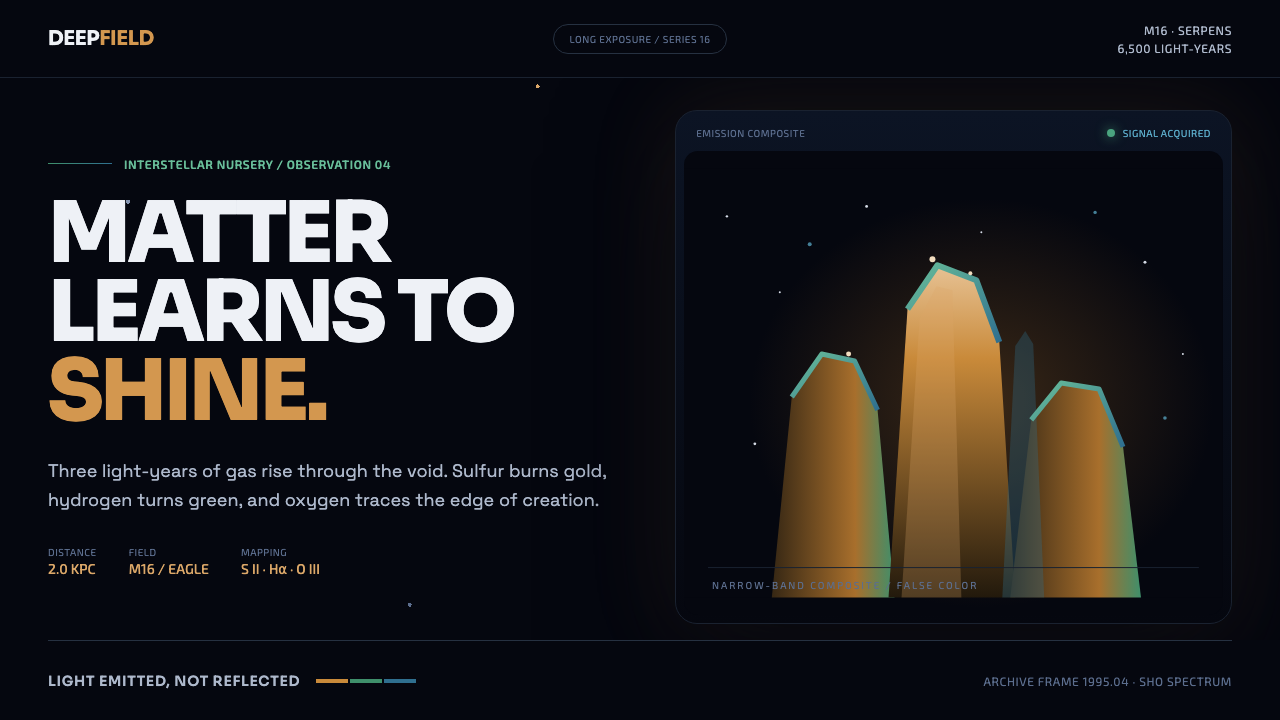 Hubble Pillars of CreationCreation glows from within. Amber towers rise through a cyan-green rim into t…
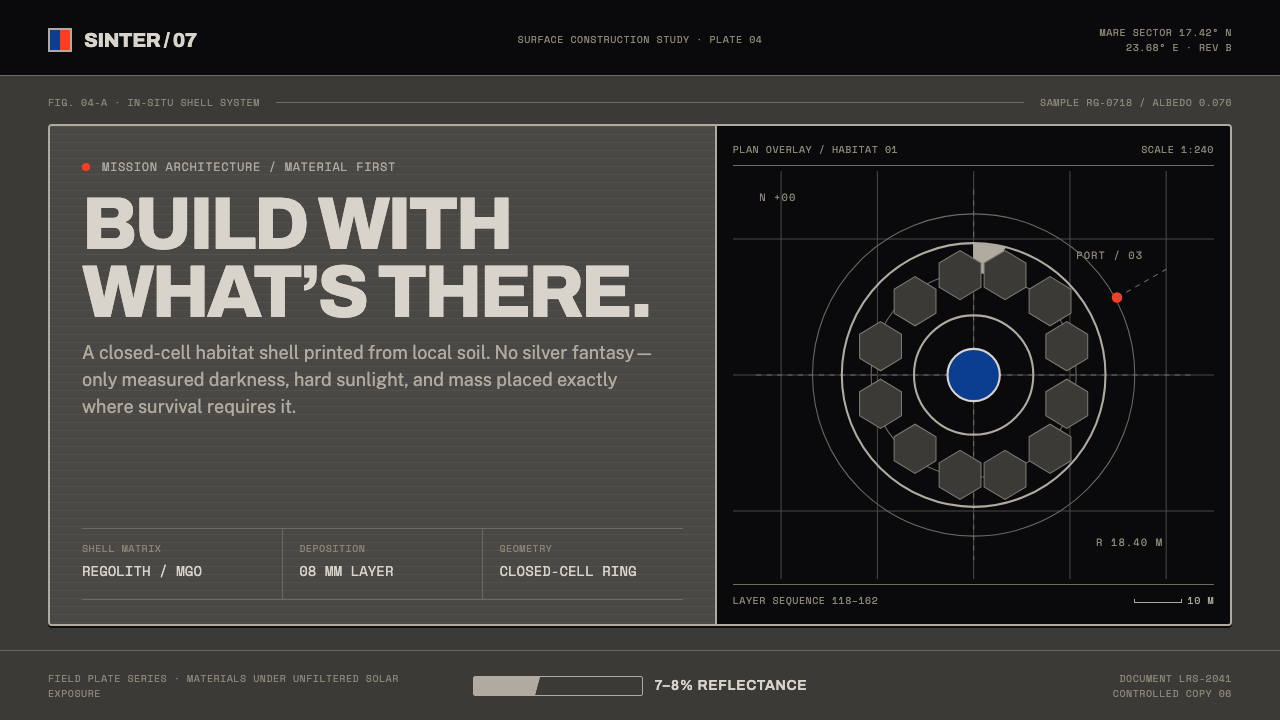 Lunar Regolith SettlementMoonlight without the myth. Regolith gray, hard terminators, and a strict tec…
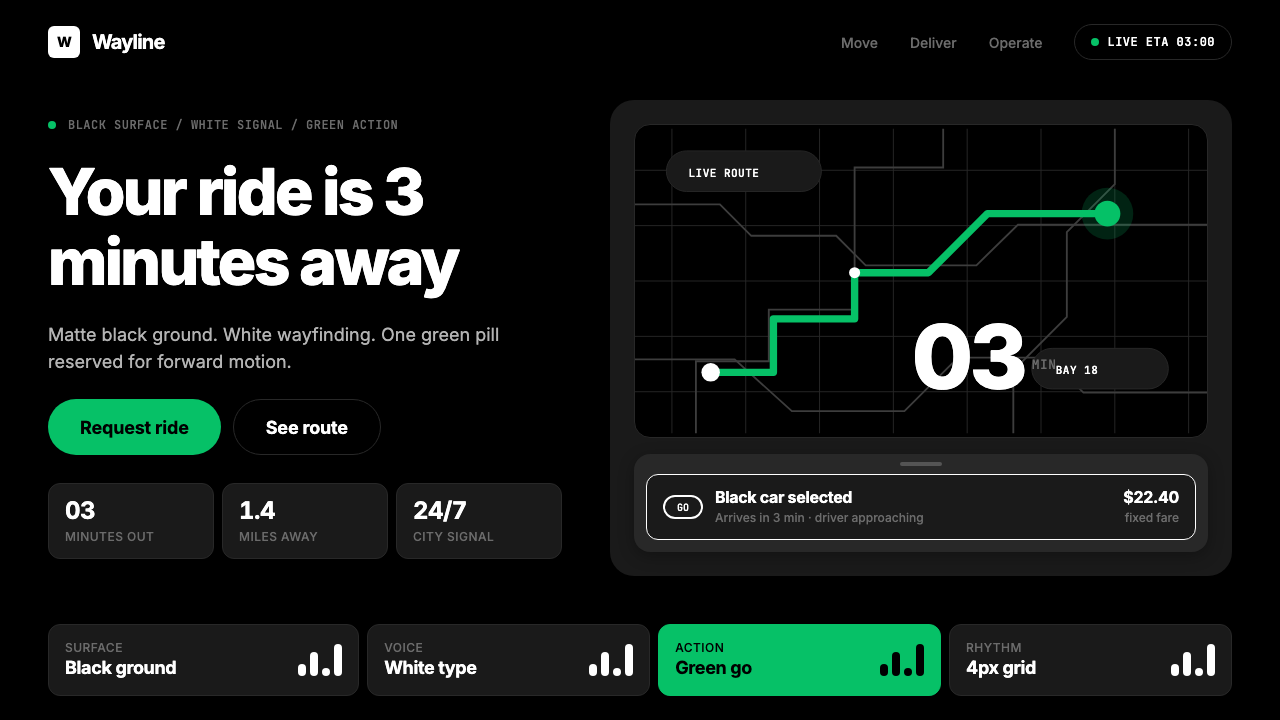 Uber 2024Motion made severe. Black surfaces, white Inter, one green pill turns the who…
 Autonomous Cargo Ship BridgeColour is protocol. Near-black chart grids reserve orange for decisions that…
 Benthic Research OutpostLight is an instrument. Lamp cyan and hard-racked hairlines measure the abyss.