What is Uber 2024?
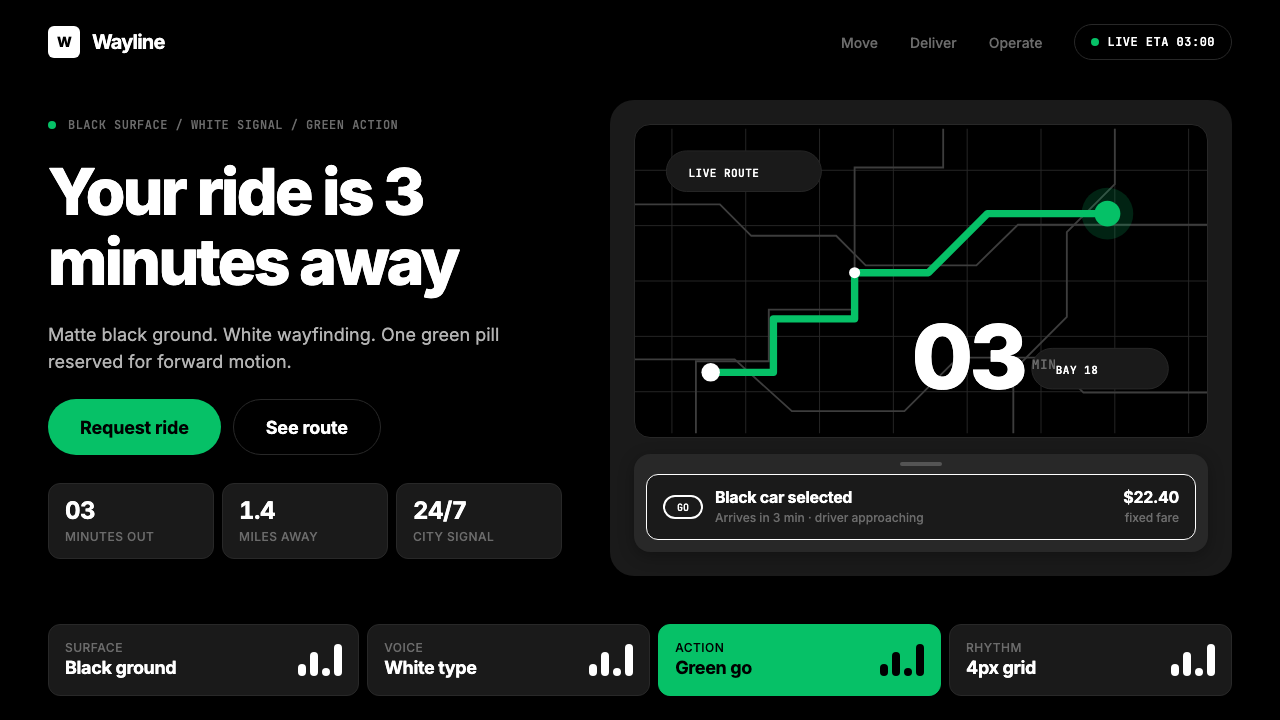
Uber's 2018 redesign compressed an entire mobility platform into three ruthless ingredients: a near-black surface, white wayfinding type, and one green pill that says go.
Uber 2024 in brief
Uber's visual identity — as it crystallized through the 2018 Wolff Olins rebrand and evolved into its current form — is one of the most uncompromising dark-first systems in consumer product design. Its palette is a near-binary: deep matte black grounds, white text, and a single vivid green reserved exclusively for the primary call-to-action. Everything else is subordinated to this hierarchy. There are no secondary accent colors competing for attention, no decorative gradients softening the edges, no illustrative flourishes softening the interface.
At the center of the system is the custom Uber Move typeface, designed specifically to perform at the miniature scale of ETA counters and map labels. Where other mobility apps relied on adopted system fonts or generic geometric sans-serifs, Uber Move was tuned for wayfinding clarity — the kind of legibility demanded when a passenger glances at a screen for half a second to confirm their driver is two minutes away. The letterforms are rational and neutral, carrying no personality beyond precision.
The result is a visual proposition about speed and reliability rather than warmth or delight. The system communicates one thing: your ride is coming, and here is exactly when. This single-mindedness is what makes the Uber 2024 aesthetic coherent — and transferable. Stripped of its brand marks, the underlying logic of a dominant dark field, a restrained typographic hierarchy, and a single reserved signal color is a design system applicable well beyond ride-hailing.

Where does Uber 2024 come from?
Uber was founded in San Francisco in 2009 by Travis Kalanick and Garrett Camp. Its earliest visual identity was informal and startup-rough — an era when the company was more focused on regulatory battles and geographic expansion than on design coherence. The brand changed repeatedly through the early years, tracking the company's shift from a luxury black-car service to a mass-market global platform. By the mid-2010s, Uber had accumulated a fragmented visual identity that reflected its chaotic growth rather than any coherent design philosophy.
The decisive change came in 2018, when incoming CEO Dara Khosrowshahi commissioned the London consultancy Wolff Olins to lead a comprehensive rebrand. The brief was effectively a reset: Uber needed to shed the reputation for cultural toxicity that had accumulated under Kalanick and project a new identity — disciplined, global, and operationally serious. Wolff Olins, known for identity work that prioritizes systemic thinking over surface decoration (their earlier clients include the 2012 London Olympics and Orange telecom), delivered a system built around reduction. The new logomark became a simple wordmark. The color system was collapsed to black, white, and the distinctive green action color. The Uber Move typeface was commissioned as a proprietary wayfinding tool.
Michael Gough, who joined Uber as Vice President of Design, was instrumental in translating the Wolff Olins brand foundation into the product design system that users interact with daily. The challenge was applying a radically simplified brand language to a highly complex product — a map-centric interface that had to communicate driver location, route, price, estimated arrival time, and safety information simultaneously, across hundreds of regional markets and multiple operating conditions. The design system that emerged from this process was not minimalism as aesthetic preference but minimalism as functional necessity.
Between 2020 and 2024, the system refined itself iteratively. The dark-mode-first approach, which had been a differentiator in 2018, became increasingly legible as the broader design industry shifted toward dark interfaces. The green action color became one of the most recognizable single-use accent colors in consumer product design — not through variety, but through absolute consistency. Every time a user sees that particular shade of vivid green in the Uber app, it means exactly one thing: tap here to start your ride. This trained association, built over years of consistent application, is itself a design achievement distinct from the visual system's surface qualities.
What defines the Uber 2024 look?
Dark-First Surface
The foundational decision of the Uber system is to treat deep matte black not as a dark-mode variant but as the canonical ground state. Every other visual element is designed against this dark field first and adapted to light contexts secondarily. The darkness is not a stylistic preference — it serves the map-centric interface, where a dark surround recedes and allows the map's geographic data to read as the primary layer. On dark grounds, the white type hierarchy achieves maximum contrast with minimal visual noise.
Single Reserved Signal Color
The vivid green that Uber applies exclusively to its primary action — the go button, the confirm button, the ride-request trigger — is a lesson in color discipline. It appears nowhere else in the interface. No secondary UI elements share this hue; no data visualizations borrow it; no decorative accents approximate it. This absolute reservation transforms the color from a palette choice into a semantic signal: green means exactly one thing, and that thing is the core transaction of the entire product.
Wayfinding Typography
The Uber Move typeface was designed from the outset for legibility at the smallest practical sizes — the kind of text that appears on map pins, ETA counters, and driver name labels. Its letterforms are rationally constructed: strokes are consistent in weight, apertures are open to prevent crowding at small sizes, and the overall texture is neutral enough that it does not compete with the geographic data it labels. Type hierarchy in the system is established through scale and weight contrast rather than color or decorative differentiation.
Map-Centric Spatial Logic
Unlike interfaces designed around content feeds or card layouts, the Uber product is organized around a persistent geographic layer. All UI panels — bottom sheets, overlays, action surfaces — are understood as additions to the map rather than replacements of it. This spatial logic disciplines the entire component system: panels appear from edges, overlays are kept shallow and semi-transparent where possible, and the dominant visual hierarchy is always the geographic data beneath the UI chrome. The design system is literally a frame around live geographic reality.
Zero Decorative Ornamentation
The Uber visual system contains no decorative elements that exist for aesthetic enrichment alone. There are no illustrative icons rendered in a distinctive artistic style, no gradient washes applied for visual warmth, no patterned backgrounds adding texture, no animated transitions that extend beyond their functional purpose. Every visual element justifies its presence through function. This constraint is not a creative limitation — it is the mechanism by which the system achieves its distinctive severity and clarity, and it is what allows a single green button to carry the entire emotional weight of the interface.
Operational Information Hierarchy
In the Uber interface, the information hierarchy is entirely determined by operational urgency rather than by content interest or brand storytelling. The most operationally critical data — your driver's name and arrival time — is the largest and most prominent. Secondary data — vehicle type, license plate, rating — appears at a reduced scale. Tertiary information — support links, trip history — is tucked into secondary navigation. This hierarchy is strictly maintained and never compromised for promotional content, partnership messaging, or brand personality expression.
Component Austerity
The component library of the Uber design system tends toward the architecturally minimal. Cards are flat or near-flat, using defined borders or subtle elevation rather than soft diffuse shadows. Inputs are clearly bounded and never ghost-styled. Bottom sheets and modals use sharp-edge containment rather than rounded-corner softening. This austerity creates a consistent material grammar across the interface — every component feels like it belongs to the same system, because they all share the same commitment to hard edges, high contrast, and functional presence over decorative finish.

Who shaped Uber 2024?
The London-based brand consultancy was engaged by Uber in 2018 to lead the comprehensive visual rebrand that defines the current identity system. Wolff Olins brought their characteristic approach of systemic reduction — building brand identity from a small number of strongly defined principles rather than from surface visual richness. Their work with Uber compressed the brand into black, white, and green, established the Uber Move typeface as a proprietary wayfinding tool, and created a framework rigorous enough to operate coherently across hundreds of markets and multiple product lines including Uber Eats.
The CEO who commissioned the 2018 rebrand, Khosrowshahi came to Uber from Expedia in 2017 following the turbulent departure of founder Travis Kalanick. His mandate was to professionalize and stabilize the company, and the visual rebrand was a direct expression of this agenda. The decision to invest in a comprehensive design system — including a proprietary typeface — signaled that Uber intended to operate as a mature global brand rather than a growth-stage startup. Khosrowshahi's operational priorities shaped the system's defining characteristic: reliability and clarity over personality.
As Uber's Vice President of Design during the critical post-rebrand implementation period, Gough was responsible for translating the Wolff Olins brand foundation into the operational product design system that users encounter in the app. This translation work — from brand identity to product design language — is where most rebrands succeed or fail, and Gough's team's work is notable for maintaining the system's austerity principles under the intense complexity of a real-time mobility product. His background included significant experience in interaction design systems at scale, which shaped the rigor of the component and pattern library.
Uber's founding CEO from 2009 to 2017, Kalanick built the company's original visual identity during a period of hypergrowth in which design coherence was secondary to market capture. The fragmented, informal visual language of the Kalanick era — which went through at least two significant rebrands during his tenure — was as much a product of the company's chaotic culture as of any deliberate aesthetic choice. Paradoxically, the severity of the eventual Wolff Olins system can be understood partly as a reaction against the instability and informality of the founding era.
Uber Move is the proprietary typeface commissioned as part of the 2018 rebrand, designed specifically for the performance demands of a mobility product rather than general editorial or marketing use. Its design parameters prioritized legibility at very small display sizes, optical consistency across the range from map label scale to display headline scale, and neutrality of personality — qualities that allow the typeface to recede behind the content it labels. The decision to develop a proprietary typeface, rather than license an existing geometric sans-serif, reflects the degree to which the 2018 rebrand treated design as operational infrastructure rather than surface decoration.
How do you use Uber 2024 today?
The Uber 2024 aesthetic is one of the most directly transferable dark-interface design systems for professionals working on mobility, logistics, or operational dashboards. Its core logic — a dominant dark ground, a single reserved signal color, a restrained typographic hierarchy, and zero decorative elements — is a structural system, not a brand imitation. Applying it correctly means internalizing why each decision was made, not just reproducing its surface appearance.
For presentation slides, the system works powerfully on both cover and content pages. A cover slide in this idiom uses deep near-black as the full-bleed background, white as the primary type color for the title, and the reserved signal color for a single highlighted word or action phrase. The composition is often asymmetric and spare: a large numeral, a minimal rule line, or a small logo mark may anchor a corner while the primary title occupies a clean horizontal band. Content slides treat the dark field as a precision grid: information is placed with deliberate whitespace (or rather dark-space) between elements, type hierarchy is established through size contrast alone, and no slide should contain more visual elements than its information strictly requires. Data slides benefit from the system's binary clarity — charts and graphs plotted against dark grounds with the signal color used exclusively for the primary data series or the key insight bar.
For web interfaces and dashboards, the Uber approach is well-suited to operational tools, analytics platforms, and any product where the user's primary mode is scanning and acting rather than reading and reflecting. Define a strict grid — either a fixed-column layout or a modular unit system — and hold it rigidly. Keep the background deep and matte. Use the primary signal color for one and only one element type: the primary call-to-action button, the active state indicator, or the primary metric highlight. All other interactive states — hover, focus, selected — should be expressed through tonal variation within the dark palette rather than through additional hues. For pricing pages and tier differentiation, the system works by using the signal color as the tier-highlight marker, with all other tiers presented in high-contrast neutral type.
For editorial and marketing applications, the style's severity is both its strength and its constraint. Editorial layouts benefit from the system's typographic discipline: a narrow body measure, generous lateral margins, section breaks marked by a minimal horizontal rule rather than decorative ornament, and a typographic hierarchy that never requires a second typeface. The dark ground allows photography to be integrated as high-contrast, near-silhouetted images rather than full-color windows — a treatment that unifies photographic and typographic elements within the same visual grammar. Marketing pages work well with the poster-like quality of the system: full-width sections alternating between dark-ground and light-ground, with the signal color appearing no more than twice per page view to preserve its impact.
A common mistake when adapting this aesthetic is misidentifying the signal color as a general accent color and applying it liberally to icons, link text, decorative rules, and secondary interactions. In the Uber system, the signal color derives its meaning entirely from its exclusivity. The moment it appears on a decorative element, it loses its semantic force and the entire hierarchy collapses. Equally, the temptation to soften the system by adding a secondary warm accent — a muted orange, a dusty gold — undermines the near-binary logic that gives the aesthetic its distinctive character. If a design problem seems to require a second accent color, that is a signal to reconsider the information architecture rather than to expand the palette.

Uber 2024 — FAQ
Is the Uber 2024 aesthetic the same as generic dark mode design?
No. Generic dark mode design typically inverts a light-mode system — swapping light backgrounds for dark ones while preserving the same color palette, component styles, and interactive patterns. The Uber system was designed dark-first from the ground up, which means its spatial logic, component geometry, and color system were all conceived for dark grounds rather than retrofitted. The most significant difference is the single-signal-color discipline: generic dark interfaces routinely use multiple accent colors for different semantic purposes, while the Uber system reserves its green exclusively for the primary action. This difference alone produces a fundamentally different visual experience.
Can this aesthetic work for a product that is not in the mobility or logistics space?
Yes, but the fit is not universal. The system works best where the user's primary goal is operational — executing a transaction, monitoring a status, acting on information — rather than exploratory or emotional. Financial trading platforms, developer tools, real-time analytics dashboards, and command-line-adjacent interfaces all benefit from the system's severity. It works less well for consumer products where warmth, personality, or delight are core values — food brands, creative tools, social applications, and wellness products will likely need a different base aesthetic even if they borrow individual components from the system.
How should the signal color be treated when adapting this system to a different brand?
Choose a single color that is visually distinct from the dark background — high in saturation and lightness — and assign it exclusively to the primary action in the interface. The specific hue matters less than the exclusivity rule. The color should not appear in any decorative context, any secondary interactive state, or any data visualization. If your brand has an established primary color, evaluate whether it has sufficient contrast against a very dark background before committing to it; some brand colors that read well on white grounds become murky or low-contrast on near-black. Consider whether the hue reads as active and urgent at small sizes — this is where Uber's green performs well, and where some cooler or darker brand colors struggle.
Why does the Uber system avoid illustrative icons in favor of minimal geometric markers?
Illustrative icons carry inherent cultural specificity — they are drawn in a style that communicates personality, era, and cultural register. In a product operating across hundreds of markets and cultural contexts, any stylistic specificity in iconography risks reading as foreign or inappropriately playful in some markets while feeling natural in others. Minimal geometric markers — circles, chevrons, simple glyphs — have no stylistic personality to clash with local expectations. They are also more legible at the small sizes demanded by a mobility interface. The trade-off is expressiveness for universality, and for a product like Uber, universality wins.
How does this system handle data visualization without introducing additional colors?
The Uber visual system handles data visualization through tonal range within the dark palette rather than through multiple hues. A primary data series uses the signal color; secondary series use progressively lighter or more muted tonal steps within the white-to-dark range; tertiary data becomes near-invisible, used for context rather than emphasis. When categorical distinction is required between several data series, the system relies on pattern fill and weight variation rather than color variety. This approach limits the number of categories that can be cleanly distinguished — approximately three to four at most — which is itself a design discipline: if a chart requires more than four distinguishable categories, that is usually a sign the data needs to be restructured rather than the palette expanded.
Related design styles
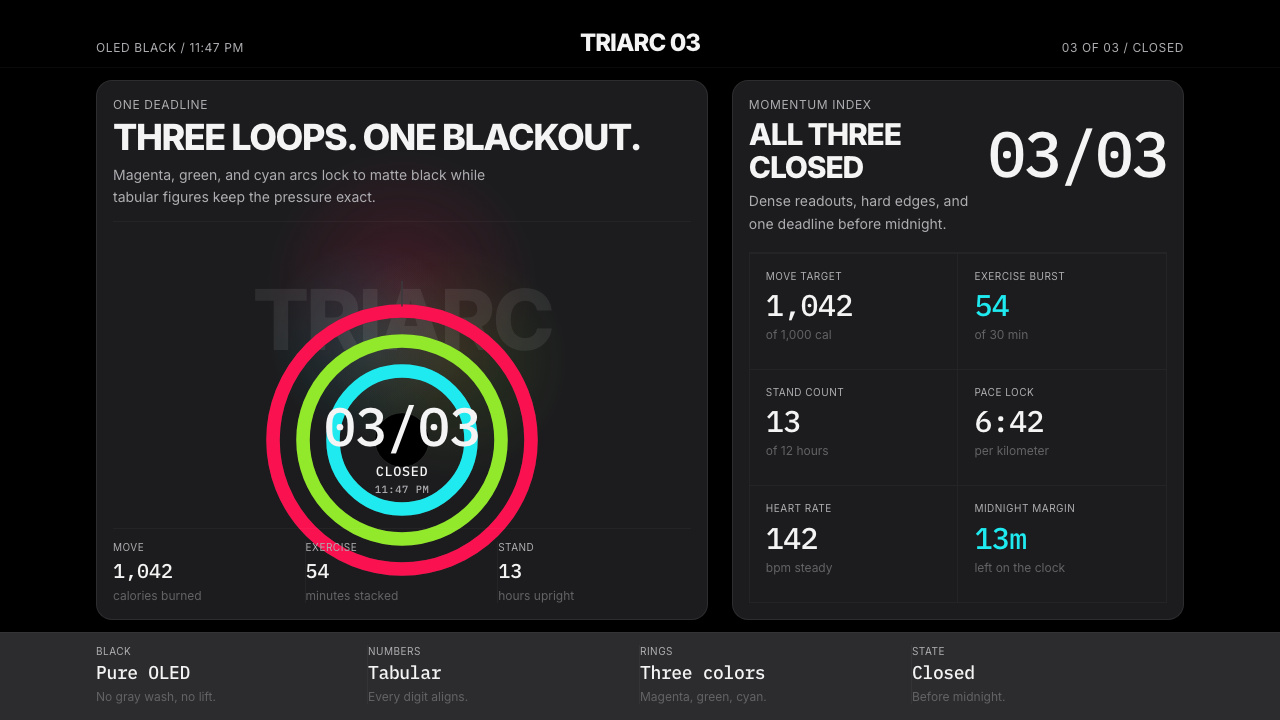 Apple Fitness Rings Closed (2024)Midnight feels exact. Magenta, green, and cyan rings lock onto OLED black.
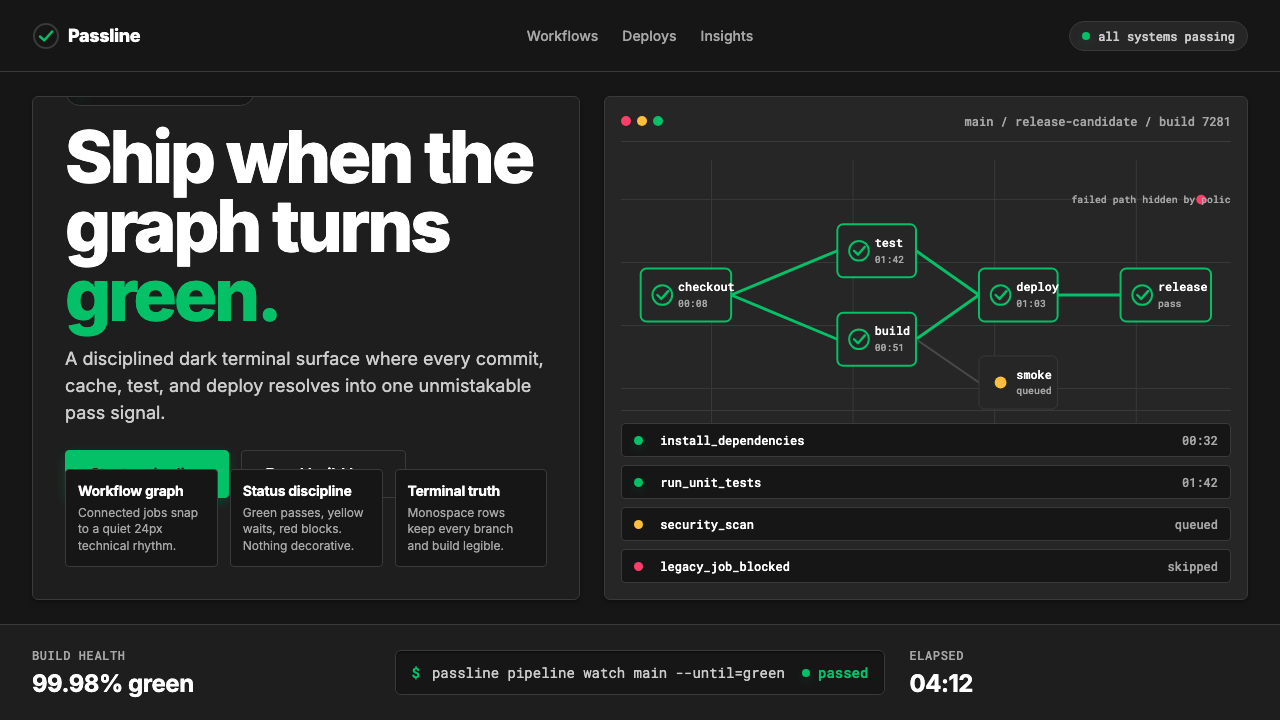 CircleCI Pipeline-GreenConfidence goes green. Emerald status lines cut through terminal-black pipeli…
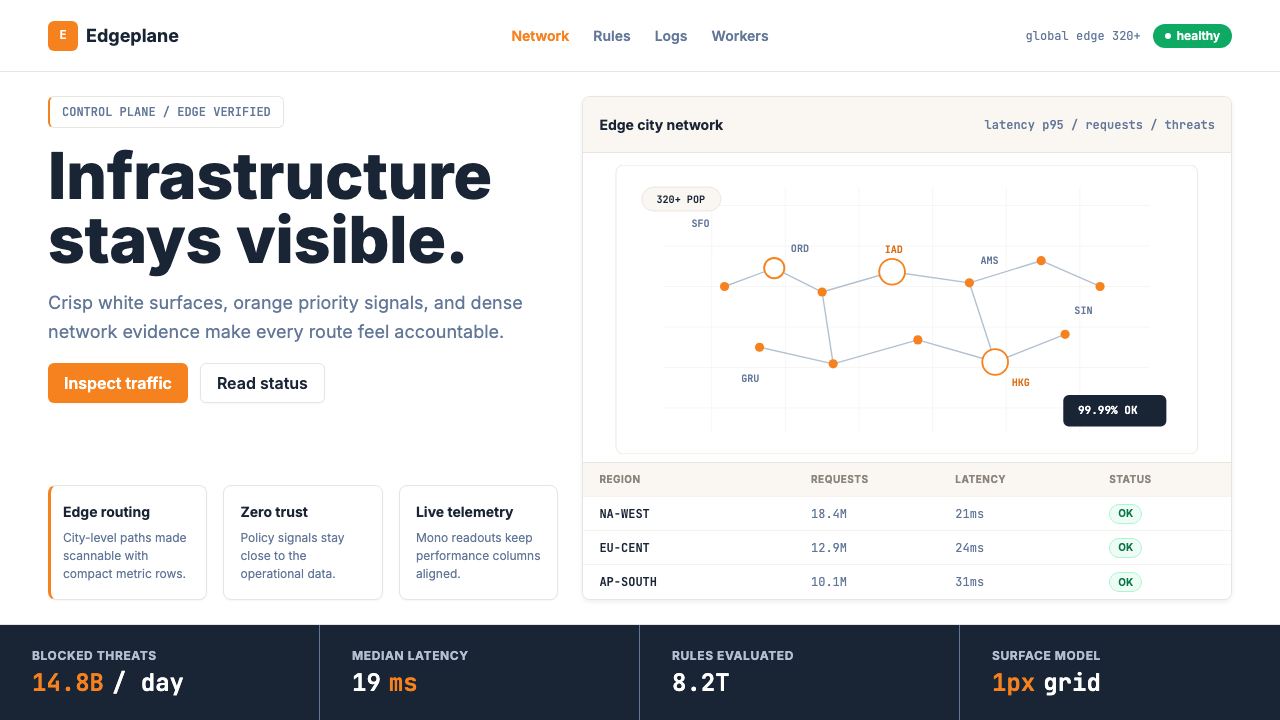 Cloudflare Orange EdgeOperational clarity wins. Orange accents, hairline grids, and mono metrics ma…
 Netflix 2024Cinema UI goes dark. Near-black chrome, poster rails, and one surgical red ac…
 Olympic ArcheryPrecision is the drama. Gold-red-blue rings snap from a dark stadium grid.
 Strava Orange FitnessData becomes trophy. Inter numerals, gray metric grids, and one orange route…