What is Runway ML?
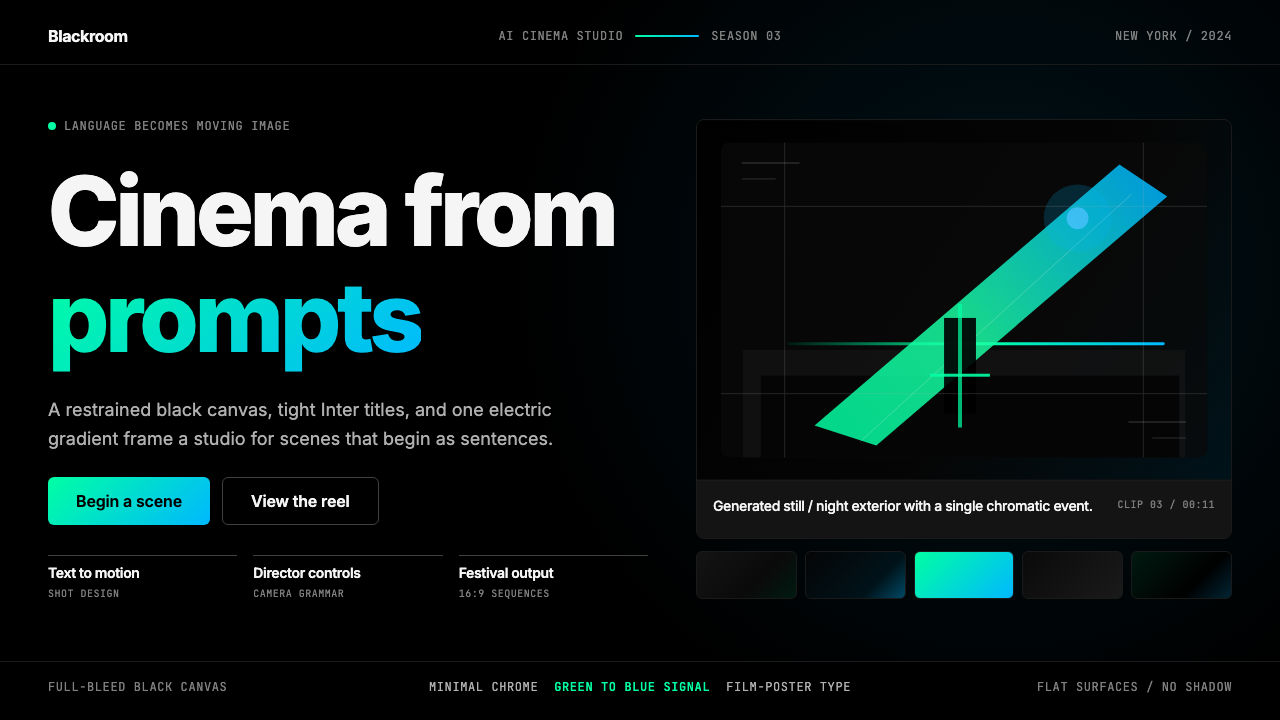
Runway ML borrowed its visual language from A24 posters and festival title cards — not SaaS dashboards — making AI feel like auteur cinema.
Runway ML in brief
Runway ML is the visual identity system developed by the New York–based generative video company of the same name, reaching its mature form around 2023 and 2024. Where most AI product brands communicate through light-mode dashboards, data-dense interfaces, and the cool blues of enterprise software, Runway's system is built on deep black canvases, cinematic full-bleed imagery, and a single luminous green-to-blue gradient that functions as the brand's electric heartbeat.
The aesthetic is best understood as a deliberate inversion of the SaaS playbook. Runway positions itself not as a productivity tool for enterprises but as a filmmaker's studio — a creative environment for artists, directors, and storytellers who happen to use artificial intelligence as their medium. Every surface decision serves this fiction: the darkness makes video content glow, the restrained typography feels like a title card, and the gradient reads like the shimmer of a cinema screen warming up.
The result is a rare thing in AI product design: a system with a strong point of view. Runway's visual identity argues that the future of storytelling belongs to people who treat computation as craft, and the brand language is the proof of that argument. It is disciplined, auteur-driven, and entirely coherent — a visual system in which every absence is as meaningful as every presence.

Where does Runway ML come from?
Runway was founded in 2018 by Cristóbal Valenzuela, Anastasis Germanidis, and Alejandro Matamala — three collaborators who had met while studying at New York University's Interactive Telecommunications Program. The company's initial focus was on making machine learning accessible to creative practitioners, a mission that shaped not only its product direction but eventually its entire visual posture. From the beginning, Runway framed itself in the language of creativity rather than the language of technology.
The brand's visual language evolved through several phases as the company grew. Early Runway communications were relatively conventional for a developer-facing AI tool — documentation-heavy, utilitarian in layout, functional above all. The decisive shift came as the company moved toward consumer-facing generative video products, most notably with the development of its Gen-1 and Gen-2 video synthesis models in 2022 and 2023. As the product became about creating moving images, the brand followed: it became cinematic.
The cultural references that shaped the mature Runway aesthetic are specific and intentional. The company drew on the visual language of A24 — the American independent film studio whose identifiable typographic restraint and dark-ground poster design established a recognizable house style for prestige cinema. It borrowed from film festival programs, title sequences, and the spare graphic language of institutions like MOMA or the Criterion Collection. These are not SaaS references; they are art world references, and their presence in a technology brand signals a deliberate repositioning of AI as a creative medium rather than an enterprise tool.
The post-Stable-Diffusion wave of generative AI (roughly 2022 onward) created an extraordinarily competitive landscape for AI creative tools, with dozens of companies competing on largely similar technical capabilities. Runway's brand strategy in this context was to compete on identity rather than capability alone — to occupy a visual and conceptual territory that none of its competitors could easily replicate. The cinematic darkness, the electric gradient, the restraint of the typographic system: these choices created a brand that felt categorically different from Midjourney's community-forum aesthetic, Adobe Firefly's professional-tools neutrality, or Stability AI's open-source technical identity. By 2024, Runway's visual system was recognized by designers and brand observers as one of the more distinctive identities in the AI product space.
What defines the Runway ML look?
Deep Black Ground
The foundation of the Runway system is an absolute, near-opaque black that functions not as a background color but as a void — a cinematic darkness into which content is placed rather than against which it sits. This black is not the muted charcoal or dark navy of typical dark-mode interfaces; it is committed and total, in the tradition of film exhibition or the black interior of a theater. Every luminous element — a gradient, a white headline, a glowing video thumbnail — gains intensity precisely because the surrounding black is so complete.
Electric Green-to-Blue Gradient
Runway's signature gradient moves from a vivid, slightly acid green through an electric cyan toward a saturated blue — a range that evokes digital signal, bioluminescence, and the particular glow of high-quality screens. This gradient is used with great restraint: it appears on primary calls to action, key brand moments, and occasionally as a border or accent light on featured video content. Its scarcity is the source of its power. When it appears, it reads as a marker of significance — the thing on the page most worth attending to.
Restrained Typographic System
The typography in the Runway system operates at tight tracking — letters sit close together, giving headlines a compressed, deliberate feeling akin to a film title card or festival program. Hierarchy is established through weight and scale contrast rather than through color differentiation or decorative devices. Body text is small and quiet, almost self-effacing, ensuring that attention remains with the video content. The overall effect is that of a museum label or critical essay rather than a marketing claim — the type defers to what it introduces.
Full-Bleed Cinematic Imagery
Video stills and generated images are treated as the primary content of any layout — they extend to the edge of the frame, they are not containerized in cards or bordered boxes, and they are presented at a scale that allows them to be experienced rather than merely inspected. This is an unusual approach for a product interface, which typically subordinates imagery to UI chrome. In Runway's system, the relationship is inverted: the interface is the minimal frame around a window into what the tool can create. This approach both showcases the product and reinforces the brand's creative identity.
Minimal Chrome and Interface Restraint
Navigation, controls, and interface elements in the Runway system are kept visually thin and quiet — hairline borders, small labels, minimal button weight. Nothing in the chrome competes with the content it surrounds. This restraint is common in high-end editorial design and museum installation practice, where the presentation infrastructure is engineered to disappear. Applied to a product interface, it creates a sense that the tool itself is unobtrusive — that the creative output is the real substance, and the interface is merely what you touch to get there.
Cinematic Cultural Register
Beyond specific colors and type choices, Runway's system carries a consistent cultural register drawn from the film world: the proportions of festival program layouts, the spare authority of distributor wordmarks, the gravity of awards season marketing. This register is communicated through composition choices — wide margins, deliberate negative space, text placed as if it were a caption rather than a call to action — and through the overall tone, which is serious, even solemn, in contrast to the playful or energetic tone of many AI product brands.
Purposeful Gradient Scarcity
Unlike many technology brands that use gradients as a general atmospheric effect applied across backgrounds and decorative elements, Runway treats its signature gradient as a scarce resource — more like a wax seal than a wallpaper pattern. This scarcity is what gives the gradient semantic weight: it is not decoration but designation. The discipline required to maintain this scarcity — to resist applying the brand's most visually arresting element to every surface — is one of the harder aspects of working within this system and one of the most important.

Who shaped Runway ML?
Valenzuela is the co-founder and chief executive of Runway, and the primary public voice of the company's creative and philosophical vision. His framing of Runway as a tool for storytellers rather than engineers — consistent across interviews, essays, and public appearances from the company's earliest days — established the cultural register that the visual system was eventually built to match. Valenzuela's background in both computer science and media arts at NYU shaped his insistence that artificial intelligence should be evaluated by what it enables creatively, not merely by benchmark performance.
Germanidis co-founded Runway and has served as its chief technology officer, driving the technical architecture behind the generative video models that made the brand's cinematic positioning credible. The technical depth of the company's models — Gen-1 and Gen-2 among the most discussed in the field — gave the brand's cinematic language something real to stand behind: Runway's visual identity claims the future of AI filmmaking, and the models delivered enough capability to make that claim defensible.
Matamala, the third co-founder, brings a design and product sensibility to Runway's leadership that is visible in the coherence of the brand's visual system. The integration of product design and brand identity at Runway — the sense that the interface and the marketing feel like they were designed by the same mind — is an achievement that reflects deliberate creative direction at the leadership level. Matamala's role in shaping the product experience contributed to the system's internal consistency.
Though not a Runway employee or collaborator, the New York independent film studio A24 — known for distributing and producing films including 'Hereditary,' 'Moonlight,' and 'Everything Everywhere All at Once' — is the most important single cultural reference behind Runway's visual identity. A24's house style: dark grounds, tight typographic restraint, prestige-cinema proportions, and the studied absence of typical Hollywood marketing excess. Runway adopted this register wholesale, signaling that it was a company of that world — the world of serious, auteur-driven filmmaking — rather than the world of enterprise software.
The graduate program at New York University where all three Runway co-founders met — known informally as ITP — has a distinctive educational culture that blends technical making with artistic ambition, critical theory, and conceptual practice. ITP alumni have founded a disproportionate number of creative technology companies, and the program's ethos — that technology is most interesting when it is in the hands of artists — maps almost perfectly onto Runway's brand identity. The company's origin in ITP is not merely biographical; it explains the values that the visual system was built to express.
How do you use Runway ML today?
The Runway ML aesthetic is among the most specific and demanding contemporary styles to apply correctly, because its authority depends entirely on restraint. The system works through subtraction — every element that could be added and is not adds to the system's power. Designers accustomed to treating dark-mode interfaces as license for atmospheric gradients, glowing effects, and decorative blur will need to unlearn those habits. Runway's darkness is absolute and quiet, not moody and decorated.
For presentation slides, the Runway approach yields cover pages of genuine visual force. A full-bleed video still or generated image occupies the entire slide, with a single line of tight, white-on-black type placed as a film title card rather than a headline. No subtitle, no company logo competing for attention — just the image and the name. Content slides follow a different logic: black background, white type in a restrained hierarchy, and a single instance of the gradient used as a section indicator or highlight. Data slides work best when they are stripped to their structural minimum — white or light-gray charts on black grounds, no decorative axes or backgrounds, with the gradient reserved for the single most important data point.
For web interfaces and dashboards, the style suits dark-mode product experiences where the content being shown is itself visual — video feeds, generated imagery, media libraries. The approach: commit fully to the dark ground rather than offering a light-mode toggle as the default experience, use the gradient sparingly on primary interactive elements only, keep all supporting type small and self-effacing, and size content areas generously so that images and video can breathe. Pricing pages benefit from the style's inherent sense of authority: tier names in large, tight type, feature lists in minimal prose, with the recommended tier indicated by a gradient accent rather than a colored card background.
For editorial and marketing applications, the Runway system's film-world references make it well-suited to creative agency work, festival or event branding, and any context where a sophisticated, art-adjacent audience is being addressed. An editorial layout in this style uses wide margins generously, places pull quotes as if they were subtitles, and never fills negative space out of nervousness. Marketing pages work through the accumulation of full-bleed imagery broken by restrained typographic moments — not through hero sections, feature grids, and testimonial carousels. The effect is closer to a film distribution campaign than a SaaS product launch.
The most common mistake when applying the Runway aesthetic is treating the gradient as decoration rather than designation — spreading it across backgrounds, card borders, and hover states until it loses all semantic meaning. A second common error is softening the darkness: introducing slightly lighter backgrounds, adding blur effects, or reaching for the familiar comfort of soft shadows. These choices dissolve the system's authority. A third mistake is typographic timidity — using too large a point size, too loose a tracking, or too many hierarchical levels, creating layouts that feel informational rather than cinematic. Committing to the system means accepting its severity and trusting that the content will carry the emotional weight the interface deliberately withholds.

Runway ML — FAQ
Is the Runway gradient the same as a generic neon-on-black aesthetic?
No, and the distinction matters. Neon-on-black aesthetics — common in gaming, crypto, and nightlife branding — use multiple high-saturation colors simultaneously, combine glow effects and bloom with patterned backgrounds, and aim for visual density and sensory stimulation. The Runway system uses exactly one gradient, deploys it rarely, places it against an absolutely dark and otherwise undecorated ground, and surrounds it with typography and negative space that communicate authority rather than excitement. The Runway gradient is a quiet claim; neon aesthetics are a shout. Applying neon conventions to a Runway-style project destroys the system's character instantly.
Can this aesthetic work for a product that is not about video or AI?
The system can transfer to any product that benefits from the associations it carries — creative seriousness, auteur identity, dark-mode sophistication, a suggestion that what the product enables is more art than task. Music tools, photography platforms, high-end editorial publications, and design tools for professional practitioners are all natural fits. It is less suited to products that need to communicate friendliness, accessibility, or corporate reliability. The deeper question is not whether the aesthetic can transfer but whether its values — severity, restraint, the subordination of interface to content — match what the product is actually trying to be.
How do you handle the gradient in print or physical contexts?
The green-to-blue gradient that anchors the Runway identity is screen-native — its luminosity and the particular quality of its cyan tones are properties of emissive display light, and they do not transfer with full fidelity to print. In print contexts, the system's most transferable elements are the deep black ground, the typographic restraint, and the full-bleed cinematic imagery. The gradient can appear in print but should be treated as a muted accent rather than a luminous signal — the print version should be understood as a low-key translation of the digital original rather than a reproduction of it. For physical applications like event signage or festival programs, the cinematic register of the typography and layout composition carries the identity even when the gradient's luminosity cannot be fully replicated.
What is the right amount of color beyond the gradient in this system?
Very little. The Runway color system at its most characteristic is essentially two-toned: absolute black and pure white, with the gradient as a single chromatic accent. This means that anything colored beyond the gradient — additional accent colors, tinted backgrounds, colored type — introduces noise into a system that depends on quiet. If a second color is needed for functional reasons (error states, success indicators, tier differentiation in a pricing table), it should be used at minimal saturation and confined to its functional role, never appearing in decorative contexts. The discipline is the same as the gradient scarcity rule: every additional color presence weakens the impact of the one that is supposed to matter.
How is Runway's approach different from other dark-mode AI product aesthetics?
Most dark-mode AI product aesthetics use darkness as atmosphere — a way to feel technical, futuristic, or premium, while still organizing information through the same dashboards, cards, and navigation patterns of their light-mode counterparts. The darkness is cosmetic. Runway's darkness is structural: it is the entire logic of the system, not an overlay applied to a conventional layout. The difference is visible in how imagery is treated — most dark-mode AI products use imagery as supporting illustration, placed in cards or grid cells; Runway uses imagery as the primary architectural element of every layout. This makes the Runway system genuinely harder to apply correctly but also genuinely distinctive when done well.
Related design styles
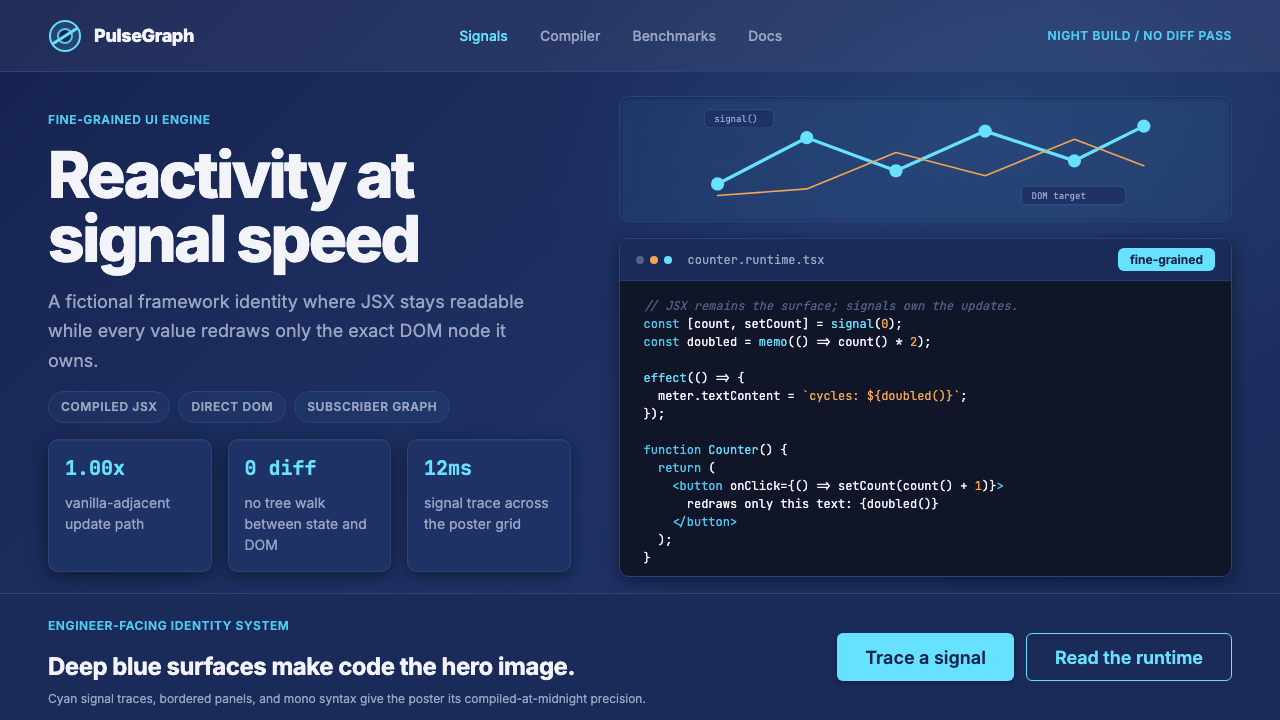 SolidJS Reactive FrameworkCode is the hero. Deep indigo panels, cyan signal arcs, and mono JSX carry th…
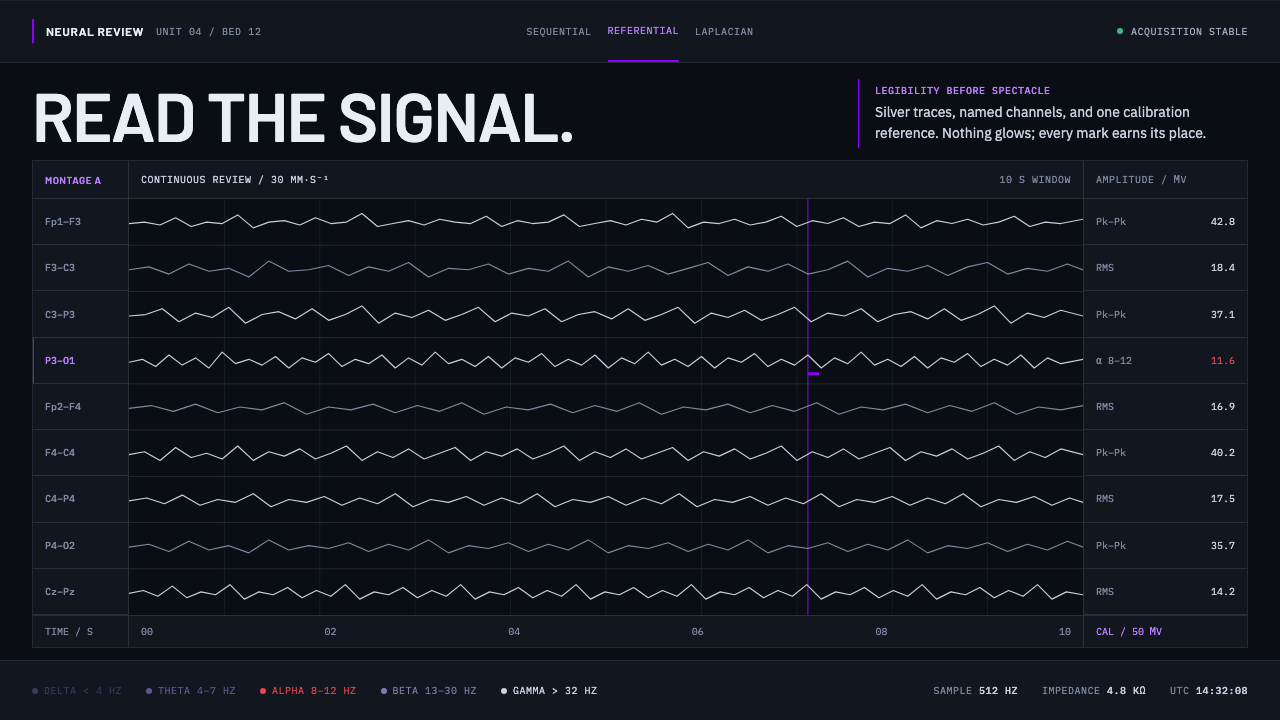 Neural Interface ClinicalClinical restraint makes signals legible. Silver traces cross near-black; vio…
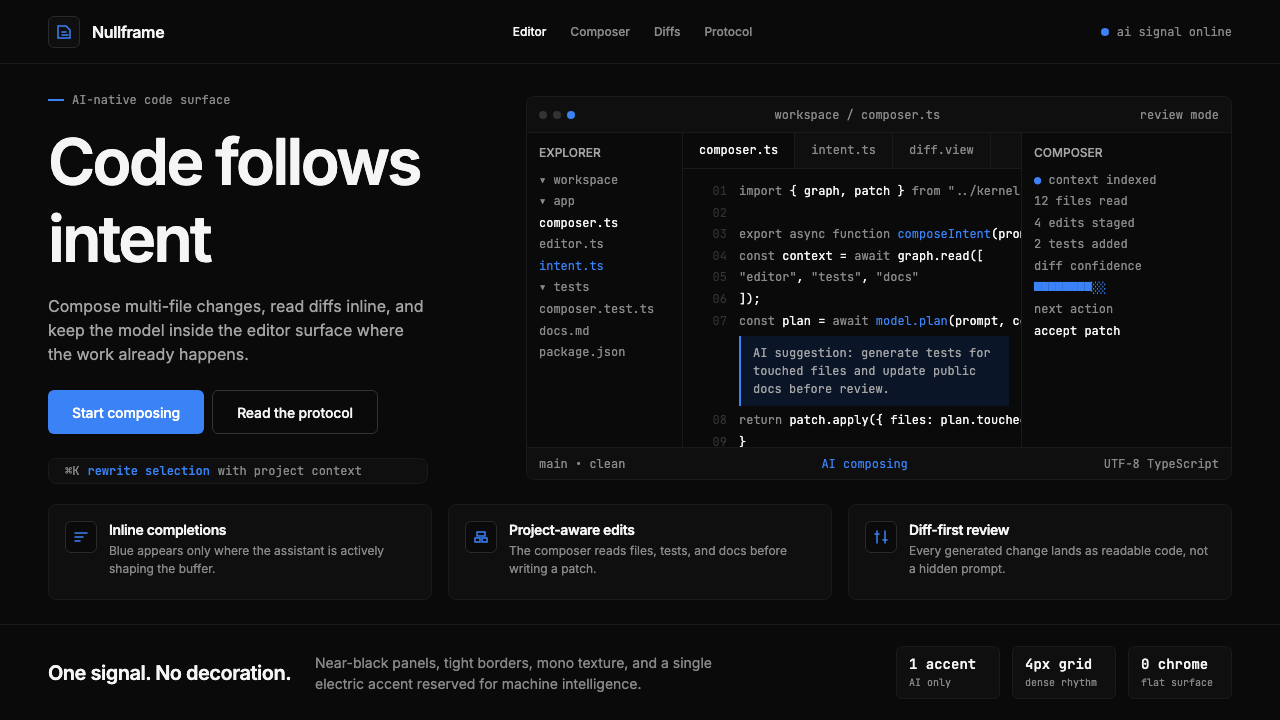 Cursor IDEAI-first code editor. Pure dark surfaces, off-white text, electric blue reser…
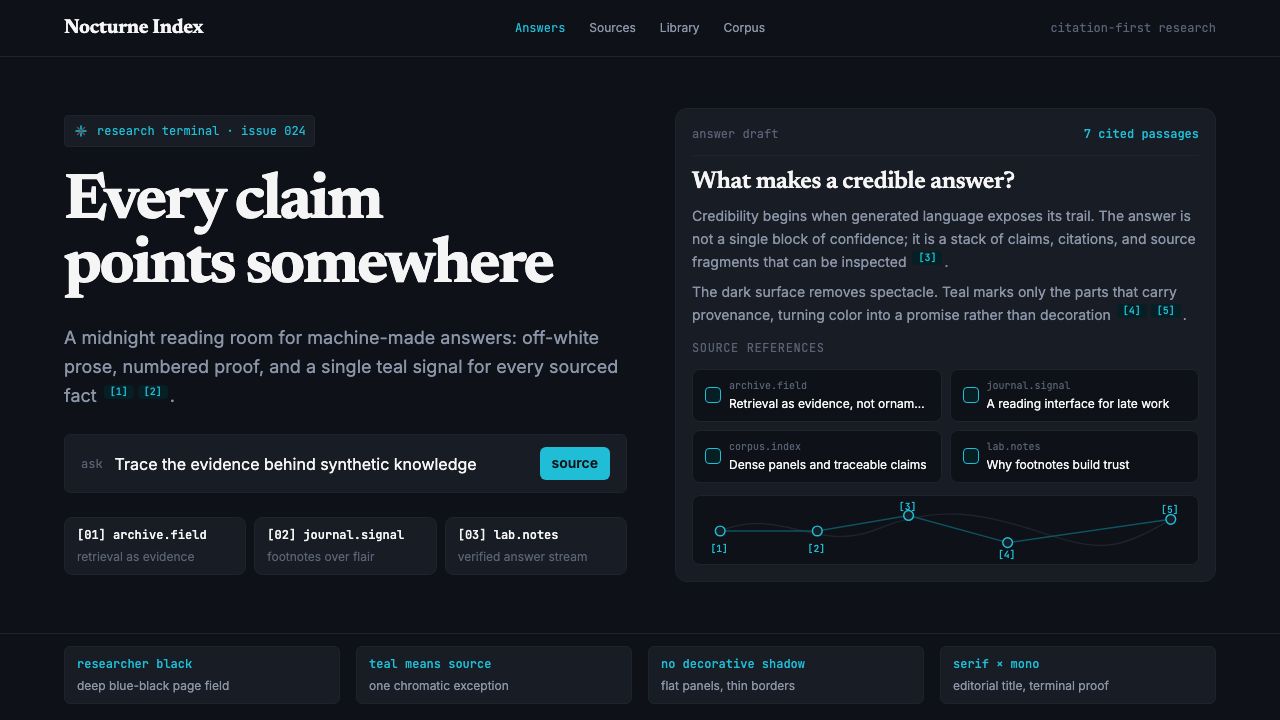 Perplexity AISerious search after midnight. Teal citations cut through black panels and de…
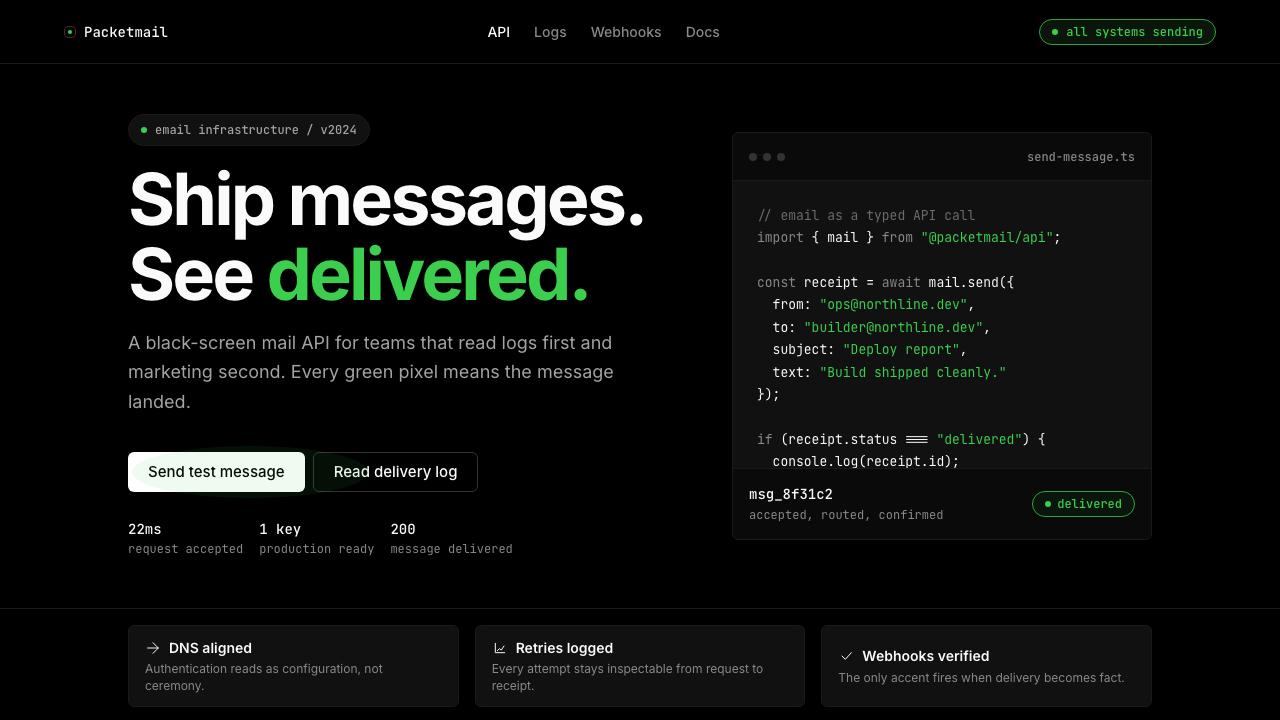 Resend 2024Clean code becomes brand. Pure black, JetBrains Mono, and one green delivered…
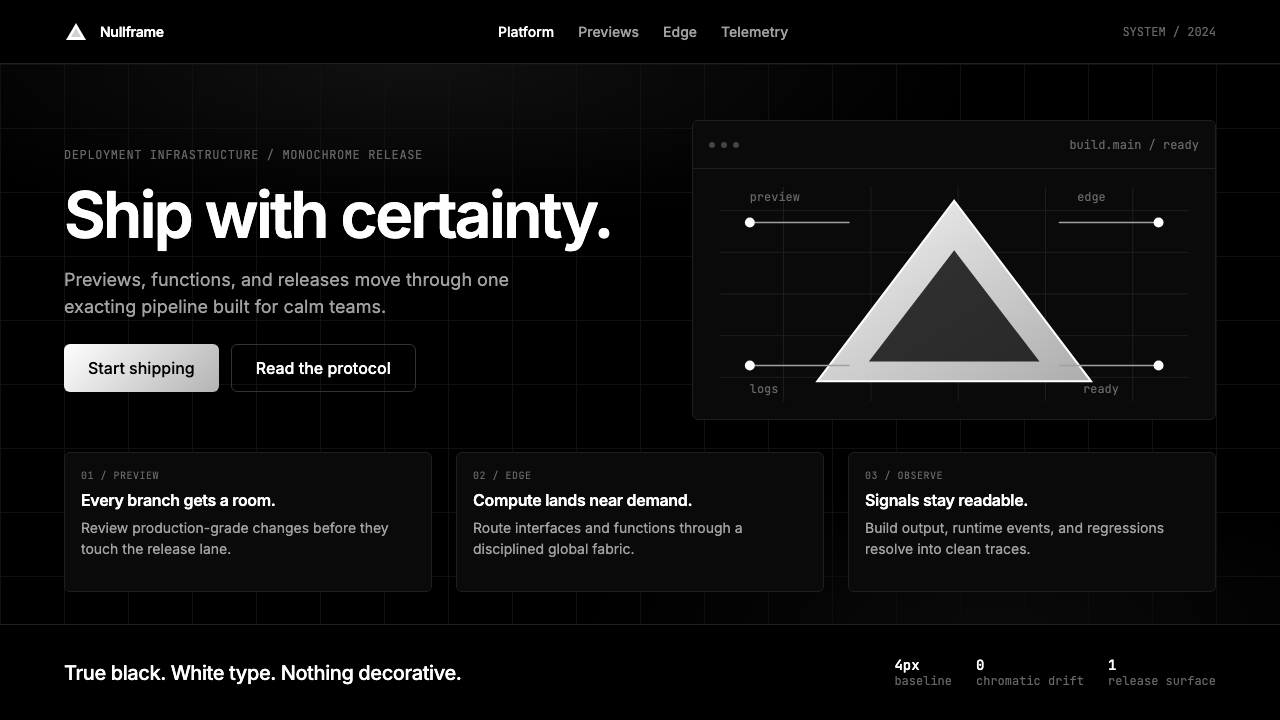 Vercel 2024Developer luxury by subtraction. Pure black, white Inter, rigid grid, triangu…