What is Resend 2024?
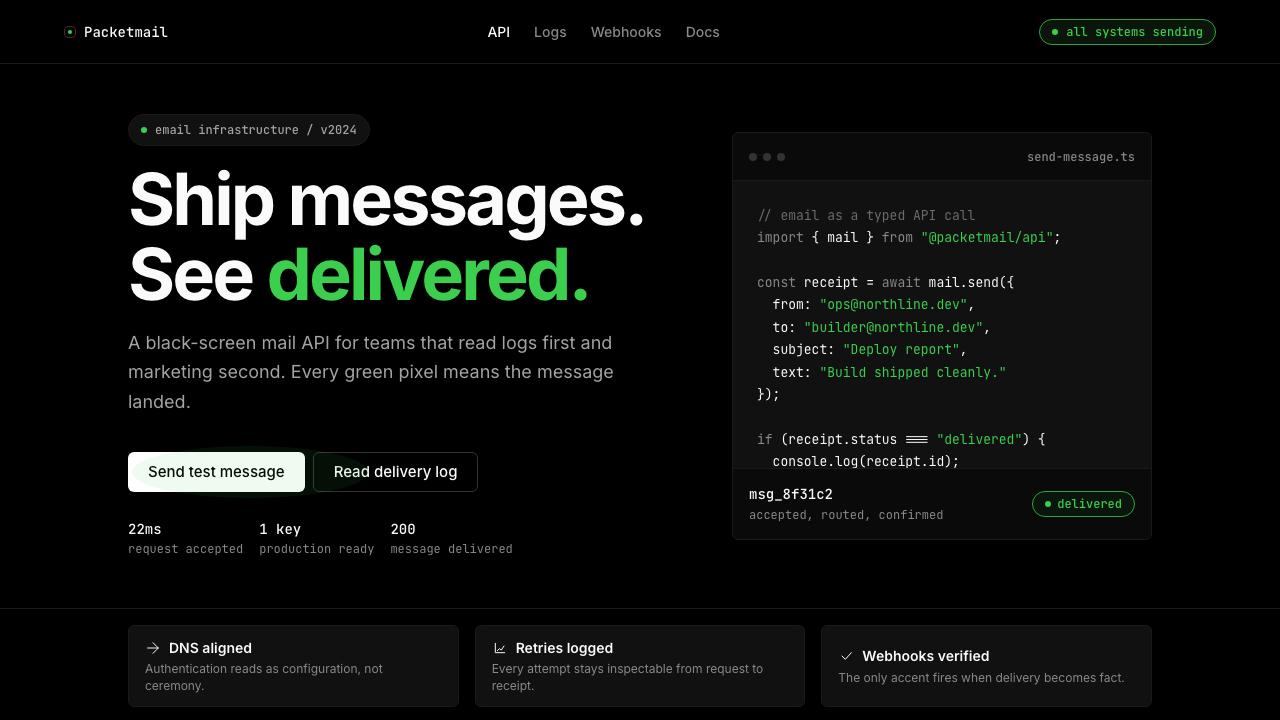
Resend turned email infrastructure into a brand statement by treating every pixel the way good engineers treat code — ruthlessly removing anything that doesn't earn its place.
Resend 2024 in brief
Resend 2024 is the visual language of a developer-first email API company, built on the conviction that a product aimed at engineers should look like something engineers would write: precise, purposeful, and entirely free of ornament. The system deploys a near-black background as its permanent canvas, off-white monospace typography as its primary voice, and a single chromatic accent — a green that appears only when an email has been successfully delivered. Every other design decision flows from those three commitments.
The aesthetic borrows the confident spareness of a well-formatted terminal session and translates it into a complete brand and product identity. Cards are defined by crisp borders rather than drop shadows. Buttons hold their shape as pills or rectangles and never reach for gradients. The typeface selection is deliberately bifurcated: a neutral sans-serif handles interface labels and prose, while a monospace face carries everything code-adjacent — which in Resend's world means API keys, delivery logs, status indicators, and most of the data that actually matters to the developer using the product.
What distinguishes this system from generic dark-mode design is its internal logic. The darkness is not atmospheric; it is structural. The single green accent is not decorative; it is semantic — it means the email landed. Monospace type is not an affectation; it signals parity between documentation and product, between the code a developer writes and the interface they navigate. The result is a brand that communicates its values through its visual choices rather than through copy alone.

Where does Resend 2024 come from?
Resend was founded in 2022 in San Francisco by Zeno Rocha and Bu Kinoshita as a response to what they saw as a broken developer experience in the email sending market. The incumbent providers — built in an era of marketing campaigns and bulk newsletters — had accumulated decades of complexity: visual builders, campaign managers, subscriber lists, and interfaces designed for marketers rather than for the engineers who had to integrate these systems into their applications. Resend's founding thesis was that email sending, stripped to its essence, is an API problem, and should be treated with the same clarity that the best developer infrastructure companies bring to their products.
The design language that stabilized between 2023 and 2024 drew directly on the visual vocabulary of the developer-tooling ecosystem that had been reshaped by companies like Vercel, Linear, and Raycast. This was a cohort of products — sometimes called Vercel-adjacent dev marketing — that applied the conventions of high-craft consumer software to developer infrastructure: considered typographic hierarchies, dark interfaces that felt intentional rather than incidental, and a willingness to invest in visual quality as a signal of engineering quality. Resend absorbed these influences and pushed them further toward the terminal aesthetic that its specific audience would find most legible.
The choice of a monospace face as the dominant typographic voice was a deliberate positioning decision. In most software products, monospace type is quarantined to code blocks — a specialist register set apart from the rest of the interface. Resend inverted this hierarchy. If the product is fundamentally about code — about API calls and delivery receipts and programmatic email — then the interface should speak the same language as the code. The monospace face is not a code block; it is the voice of the product itself.
The single-green accent system reflects a broader semantic discipline. Resend is in the business of deliverability: the fundamental promise of the product is that an email sent through its API will arrive. The green accent carries that promise visually. It appears on success states, on confirmed delivery indicators, on the moments in the product flow where the system has done what it was asked to do. Using it sparingly — and only in those contexts — prevents it from becoming wallpaper and preserves its meaning. This is brand as signal engineering: the color means something because it is the only color.
What defines the Resend 2024 look?
Near-Black Canvas
The foundation of the entire system is a background that stops just short of absolute black — a darkness with enough warmth to feel considered rather than defaulted. This is not dark mode as an accessibility toggle; it is dark mode as the primary designed state. Every other element is calibrated against this ground: borders appear as fine distinctions in dark value, type achieves its contrast without resorting to pure white, and the single green accent reads as a point of light rather than a color swatch.
Monospace as Primary Voice
Where most software interfaces reserve monospace type for code blocks and terminal snippets, Resend promotes it to the role of primary typeface across large portions of the product and marketing surface. The effect is an interface that reads like a conversation between the product and the developer's mental model — both speaking the same register. Monospace carries semantic weight here: when you see that letterform, you know you are looking at something real, something the system computed and returned, not interface furniture.
Single Chromatic Accent
The system permits exactly one chromatic color: a deliverability green that is associated exclusively with success states. All other interface elements live in the achromatic range — blacks, near-blacks, dark grays, light grays, and off-whites. This constraint is not stylistic minimalism but semantic discipline. The green cannot mean many things; it means one thing. This is unusually strict even among developer-focused brands, which often allow multiple accent colors for different notification types or interactive states.
Border-Defined Components
Cards, panels, input fields, and interactive elements are bounded by visible borders rather than shadows or elevation cues. This is a direct translation of a terminal or code editor's visual logic, where containers are marked by explicit delimiters rather than lighting simulation. The borders are fine and consistent, producing an interface that feels architectural rather than atmospheric — every container exactly where it says it is, no soft edges implying depth that is not there.
Semantic Typography Switching
The system uses two typeface registers with distinct semantic roles: a neutral proportional sans-serif for prose, labels, navigation, and UI chrome, and a monospace face for anything data-adjacent — API responses, delivery records, code samples, status fields, and numeric identifiers. The switch between them is not stylistic decoration; it is a reading cue. When the typeface changes, the nature of the content has changed. This binary system produces more clarity than a single typeface could at multiple weights, because the contrast is categorical rather than tonal.
Zero-Gradient Discipline
No surface in the Resend system fades from one value to another. Buttons are flat-filled. Backgrounds are uniform. Any highlighting is achieved through a step change in value — a border becoming lighter, a background shifting one level — not through a smooth transition. This absolute avoidance of gradients is both a brand statement and a semantic one: gradients signal decoration; flat fills signal structure. The discipline extends to icons and illustrations, which are rendered as flat geometric constructions rather than multi-tonal illustrations.
Purposeful Negative Space
The layouts breathe generously. Sections are separated by substantial whitespace — or in this dark system, darkspace — rather than rules or dividers. This spatial discipline serves the reading pattern of a developer scanning for specific information: ample margins and padding allow the eye to parse hierarchy quickly without needing decorative scaffolding. The negative space is not emptiness but containment — it tells you where one block of meaning ends and another begins.

Who shaped Resend 2024?
Co-founder and CEO of Resend, Zeno Rocha is the primary author of the product's developer experience philosophy. With a background in open-source tooling and developer advocacy, he shaped Resend's core positioning: that email infrastructure should be as well-designed as the best developer tools, and that visual quality is not separate from product quality but an expression of it. The decision to treat the brand's dark terminal aesthetic as a first-class design system rather than a stylistic shortcut reflects his insistence on craftsmanship as a differentiator in a commodity market.
Co-founder of Resend, Bu Kinoshita brought engineering rigor to the product's architectural decisions, including the API-first design that the visual identity mirrors. The symmetry between Resend's technical architecture — lean, explicit, no hidden complexity — and its visual language — lean, explicit, no decorative complexity — reflects a founding team in which engineering values and design values were never treated as separate disciplines. The visual system's semantic logic, where every color and typeface choice carries a specific meaning, is a direct consequence of this integrated approach.
Resend did not emerge in a vacuum; it was shaped by the visual conventions that Vercel and its orbit established for what developer infrastructure products could look like. The Vercel design system — dark backgrounds, crisp borders, monospace accents, minimal color — demonstrated that a product aimed at engineers could achieve a level of visual craft previously associated with consumer applications. Resend adopted and intensified this vocabulary, doubling down on the terminal aesthetic and pushing the single-accent discipline further than most products in this category. The relationship is less direct influence than shared aesthetic conviction within a community of practice.
Designed by JetBrains and released in 2020, JetBrains Mono was built specifically for reading code in integrated development environments — with letterforms optimized for the character combinations that appear most frequently in programming languages and a rhythm designed for long sessions of dense reading. Resend's adoption of it as a primary brand typeface elevates it from a developer utility into a voice. The choice sends an immediate signal to its audience: this product was designed by people who spend their days in terminals and editors, and it respects the visual language you already know. The typeface is doing positioning work, not just typographic work.
Resend 2024 is one expression of a broader design movement that emerged in the early 2020s around companies building infrastructure for software developers. Linear, Planetscale, Fly.io, Railway, Render, and others in this cohort shared a set of convictions: that developer tools had been visually underinvested for decades, that dark interfaces were native to the developer context rather than a trendy option, and that the quality of a product's visual design communicated something true about the quality of its engineering. This movement has no formal name or manifesto, but its aesthetic conventions — dark grounds, border-bounded components, monospace accents, single chromatic signals — constitute a recognizable visual language that Resend refined into its most distilled form.
How do you use Resend 2024 today?
Resend 2024 is a high-specificity style: it carries strong associations with developer infrastructure, terminal interfaces, and the engineering culture of the mid-2020s tech ecosystem. Applied well, it signals precision, technical competence, and a respect for the developer audience. Applied carelessly, it reads as generic dark mode with a code aesthetic bolted on. The difference lies in whether the system's semantic logic — every visual choice carrying a specific meaning — is honored throughout.
For presentation slides, the style works best when treated as a terminal-inspired document rather than a conventional deck. Cover slides should commit to the dark canvas with a single accent-colored element — a status indicator, a bordered card containing the title, or a sparse grid of bordered containers. The single chromatic accent, if used, should appear only where it would appear in the product itself: marking something successful, confirmed, or resolved. Content slides thrive on typographic hierarchy alone: a large monospace headline, a proportional sans-serif body, generous breathing room, and no decorative dividers. Data slides are where the system earns its keep — charts and tables rendered as bordered components on a dark ground, with the accent color marking the key metric rather than decorating every bar in the series.
For web interfaces — dashboards, API documentation sites, developer portals, and pricing pages — the Resend vocabulary translates almost directly. Implement a strict grid, use borders rather than shadows to define containers, and constrain color to one accent used only for success states and primary calls to action. Navigation should be typographically simple: a wordmark, a handful of text links, nothing that requires an icon to understand. The monospace register should activate wherever real data appears: numbers, identifiers, status values, code samples. Pricing tiers work well in this system when each tier is presented as a bordered card with no background-color differentiation between tiers — only the recommended tier receives the accent-color border.
For editorial and marketing work, the system's poster-like confidence translates to strong section breaks and feature callouts. A marketing page using this vocabulary should alternate between full-dark and near-dark sections rather than introducing light backgrounds, keeping the overall impression cohesive and intentional. Feature callouts work as bordered cards with a sparse monospace label and a one-line description in proportional type. The single chromatic accent can be used to mark the single most important call to action on any given page — but only one, preserving the semantic weight that makes it meaningful. Illustration, if used, should be geometric and flat: line-art diagrams of API flows or infrastructure topology fit the register naturally.
A common mistake when applying this style is decorating with dark mode rather than designing in it. The most frequent errors: introducing a second accent color for variety, using soft drop shadows on components instead of borders, reaching for gradients to suggest depth on hero sections, or making the monospace register purely cosmetic by using it for prose text where it carries no semantic signal. The system works because every element earns its presence through meaning. Designers treating it as a collection of visual tropes rather than a semantic system will produce work that looks surface-similar but communicates nothing specific — and a developer audience, more than most, will notice the difference.

Resend 2024 — FAQ
Is Resend 2024 just dark mode with a code font?
The surface similarity to generic dark mode is real but the logic underneath is different. Dark mode as typically implemented is a color-scheme adaptation — a light-mode interface with its backgrounds and foregrounds inverted. Resend 2024 is designed from the dark ground up: the near-black canvas is the primary state, not an inversion. The monospace typeface is not a stylistic accent but a semantic register activated by specific content types. The single green accent is not a brand color applied for visual interest but a signal with a precise meaning. A generic dark mode interface looks dark; the Resend system means something specific by being dark.
Can this style work on a light background?
Technically yes, but with significant trade-offs. Much of what makes the Resend system coherent depends on the dark ground: the single green accent reads as a point of light in a dark field, the borders that define components have a specific value relationship with the background, and the overall atmosphere of terminal-like intentionality requires the darkness as context. A light-background adaptation would need to rebuild these relationships from scratch. The monospace-heavy typography and the border-defined components translate reasonably well; the single-accent semantic discipline translates perfectly; but the overall register — the sense that you are looking at something engineered rather than designed — loses much of its conviction without the dark ground.
How strictly should the single-accent rule be followed?
As strictly as possible for anything claiming to apply this specific system. The semantic weight of the green accent depends entirely on its scarcity. Once a second color is introduced for notifications, a third for warnings, and a fourth for errors, the system collapses into conventional color-coded status design — which works fine but is no longer meaningfully different from any other developer dashboard. If your product genuinely requires multiple distinct state signals — success, warning, error, neutral — and you want to apply this vocabulary, the honest path is to adopt the structural elements of the system (dark ground, borders, monospace) while acknowledging that the single-accent discipline cannot be maintained, and designing the multi-color system with the same semantic rigor.
Is this style appropriate for non-developer audiences?
It is legible to non-developers — there is nothing technically inaccessible about dark interfaces with monospace type — but its associations are specific. The visual language reads immediately as developer tooling to anyone in the technology industry, and as a somewhat austere or technical aesthetic to audiences outside it. For products targeting general consumers, marketers, or executives who do not identify with engineering culture, the style can communicate coldness or excessive technicality. Products where the developer-tool association is an asset — signaling precision, reliability, or technical sophistication — benefit from the vocabulary even with mixed audiences. Products where warmth, accessibility, or broad appeal are primary values should look elsewhere.
How does Resend 2024 differ from other dark developer-tool aesthetics?
The defining difference is the single-accent discipline. Most developer tools using a dark aesthetic still employ multiple colors for interactive states, notification types, or brand differentiation — blues for links, oranges for warnings, greens for success, purples for premium tiers. Resend commits to achromatic for everything except one semantic signal, which makes that signal unusually legible. The second difference is the prominence of monospace type: where other dark-aesthetic products use monospace as a specialist register for code, Resend uses it as the dominant voice. The combination of these two disciplines — maximum chromatic restraint plus maximum monospace presence — produces a visual language more associated with the terminal itself than with conventional software UI, which is precisely the positioning Resend sought.
Related design styles
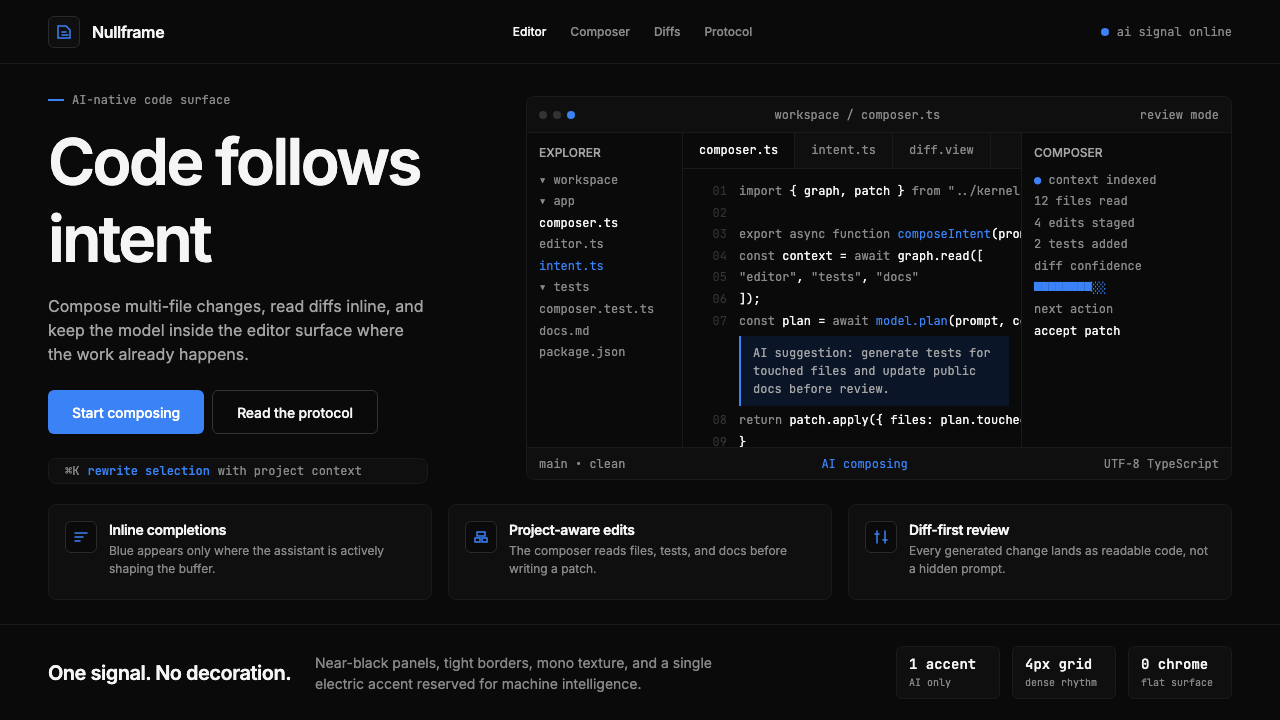 Cursor IDEAI-first code editor. Pure dark surfaces, off-white text, electric blue reser…
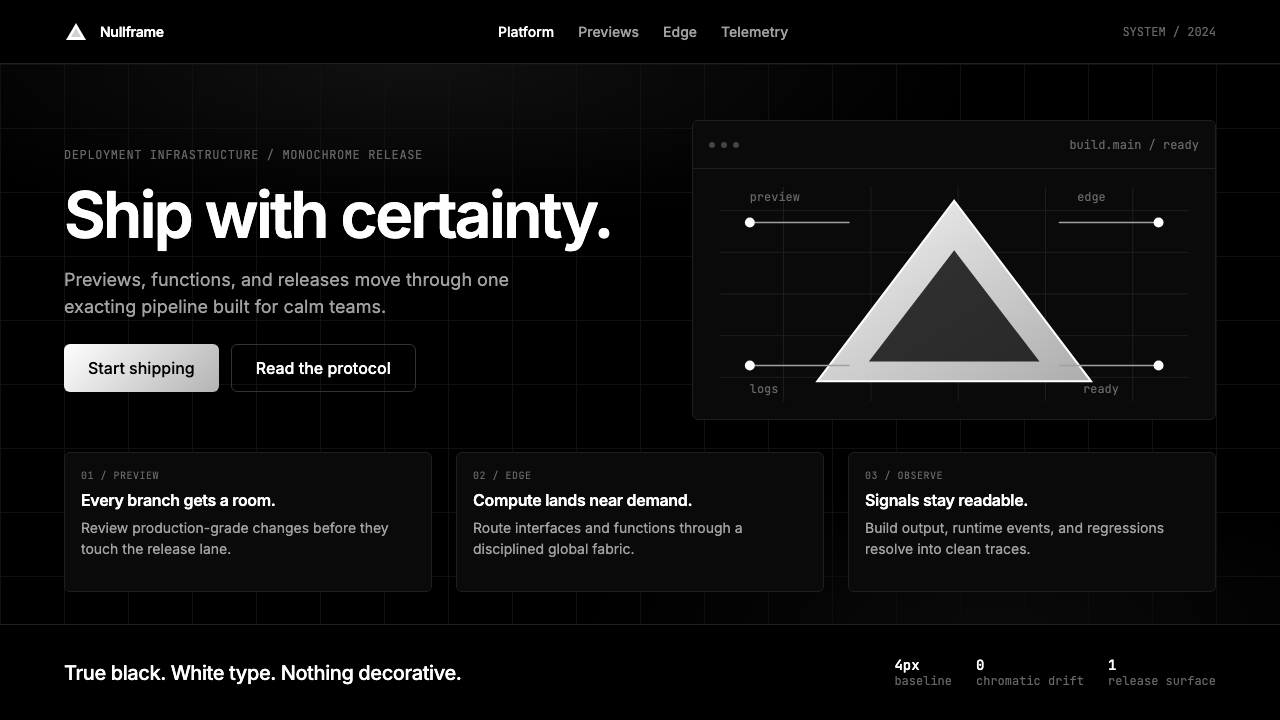 Vercel 2024Developer luxury by subtraction. Pure black, white Inter, rigid grid, triangu…
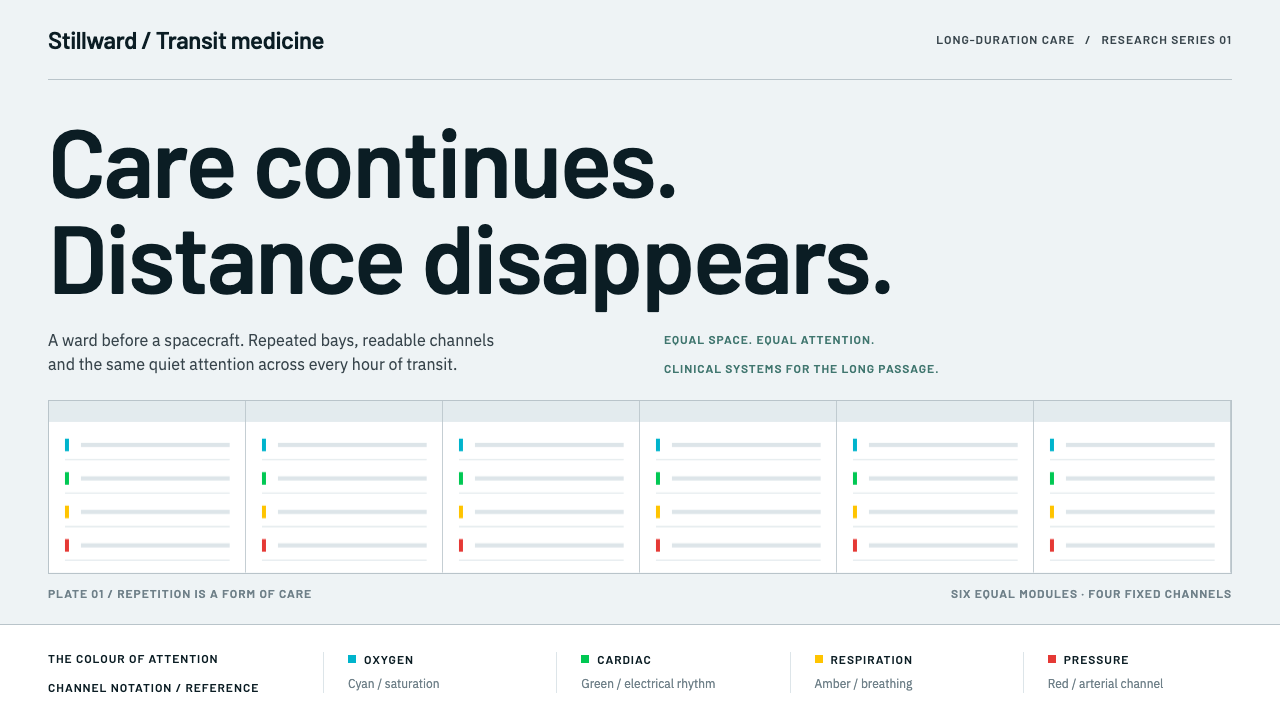 Cryosleep Transit WardCare without spectacle. Clinical white, equal bay grids and the fixed colours…
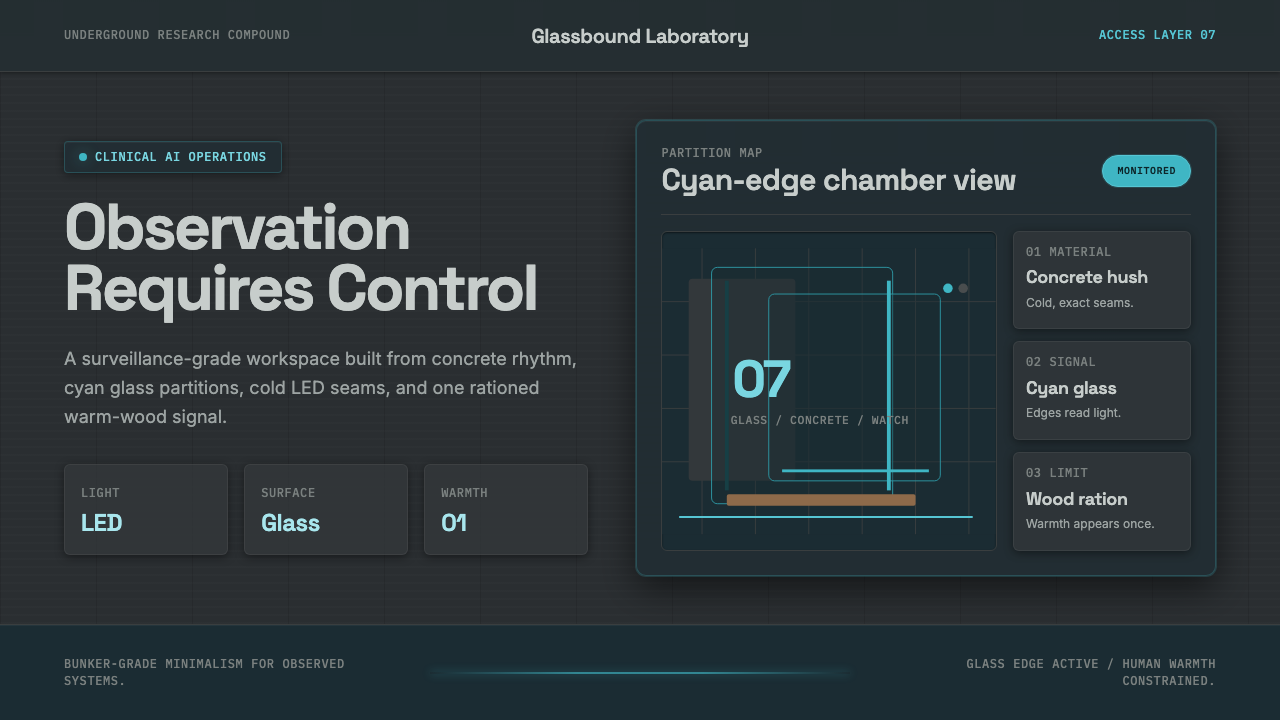 Ex MachinaClinical control, made visible. Concrete gray, cyan glass, LED seams, one woo…
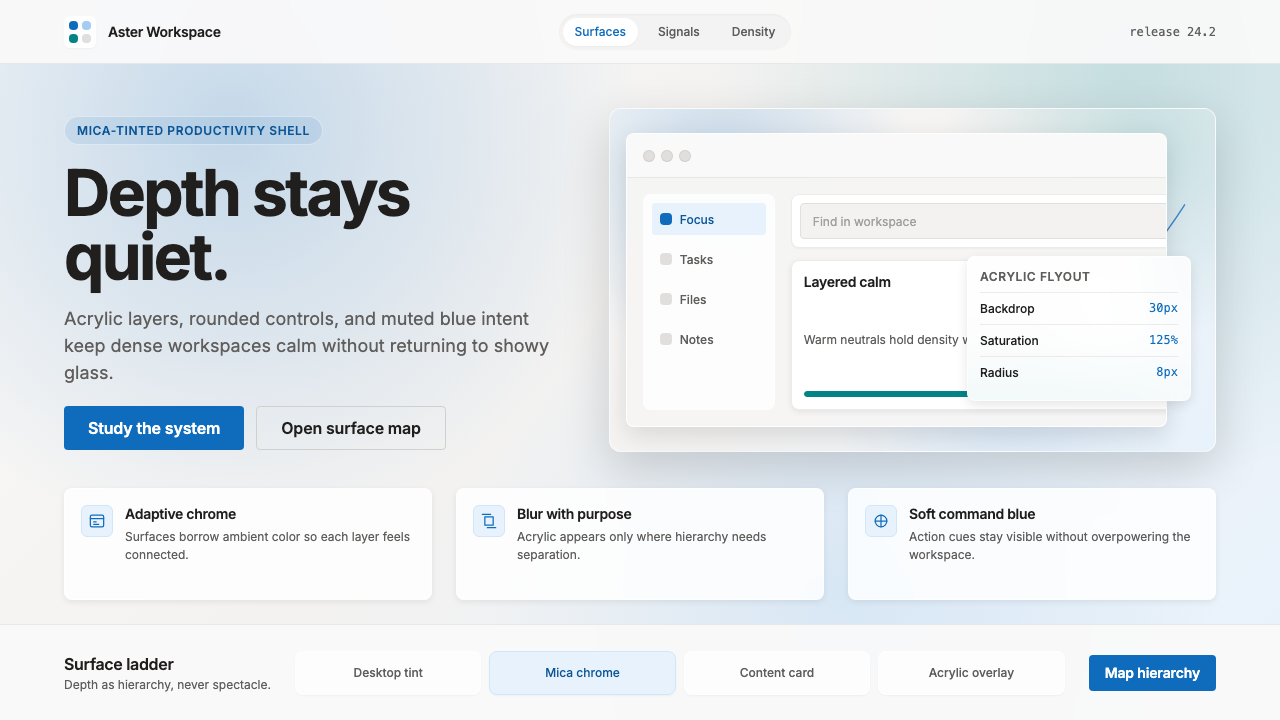 Microsoft Fluent 2Disciplined translucency. Warm Mica neutrals, acrylic blur, and muted blue cr…
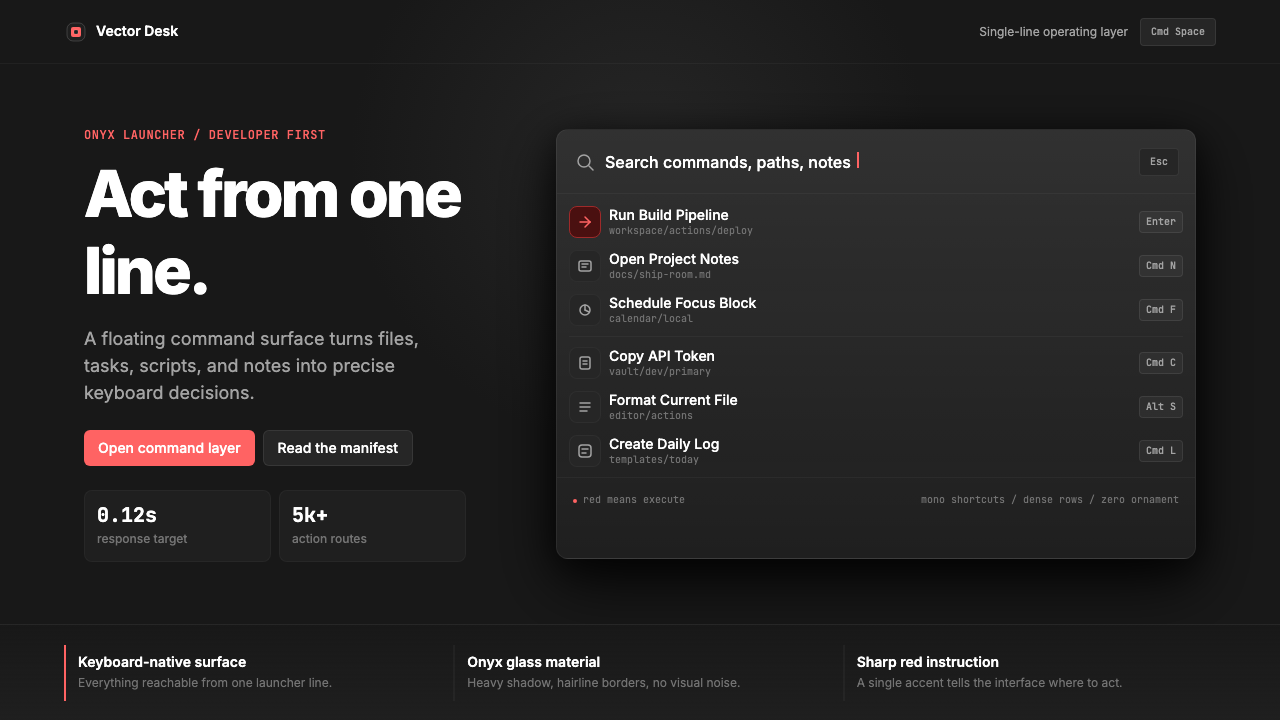 Raycast Spotlight Launcher (2023)Obsidian confidence. Sharp red cuts through Inter rows and mono shortcut chip…