What is Vaporware Future Product Render?
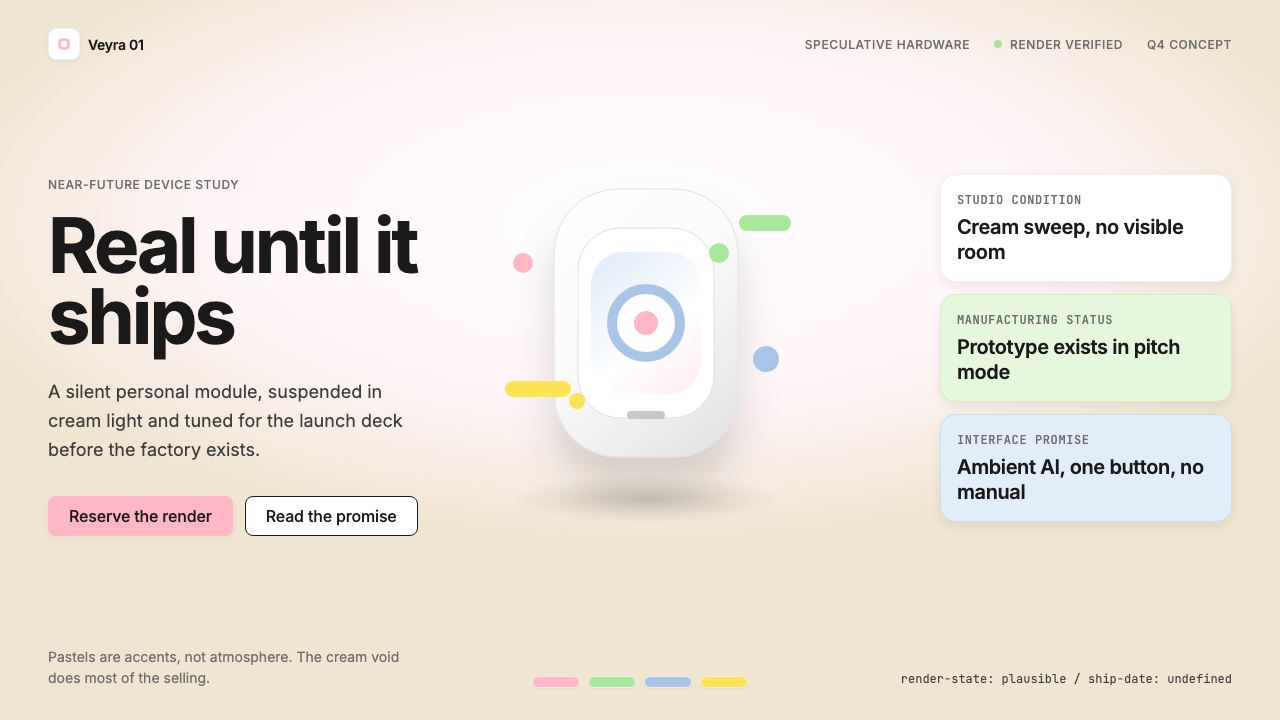
Vaporware Future Product Render is the visual language of hardware that may not exist yet — a cream studio sweep, a floating object rendered cleaner than reality, and pastel accents borrowed from the UI it promises to run.
Vaporware Future Product Render in brief
Vaporware Future Product Render is the speculative-tech launch aesthetic: a visual system built around the premise that a product render can create desire, attract investment, and establish a brand identity long before any physical unit ships. It combines the surgical stillness of high-end studio product photography with the weightlessness of photoreal three-dimensional rendering, producing images that look more pristine than any photograph of an actual object could ever be.
The style is immediately recognizable by its signature elements. A single warm-cream backdrop — neither stark white nor warm beige, but something precisely in between — provides the ground. Against it, one carefully modeled object floats without visible support, casting no distracting shadow, its surfaces catching light that seems to emanate from everywhere and nowhere. Saturated pastel chips — soft pink, icy mint, powder blue, lemon yellow — appear sparingly as interface details, label accents, or environmental reflections. Typography is tight, tracked-in, and whisper-quiet, reinforcing the impression that this object belongs to a world of refined restraint.
What separates this style from ordinary product photography is a quality of deliberate unreality. The geometry is too perfect, the highlights too even, the materials too pristine. This is not a flaw — it is the point. The render asserts that the product occupies a space beyond the contingencies of manufacturing tolerances and surface scratches. It exists, first and foremost, as a promise.

Where does Vaporware Future Product Render come from?
The genealogy of this style begins with Apple's product photography practice as developed and refined by Peter Belanger, the San Francisco-based commercial photographer who became Apple's primary product photographer in the 2000s. Belanger's approach — pure white or near-white sweep, carefully controlled rim lighting, no environment, no context, just the object — established the canonical grammar of the premium consumer electronics product image. The object became a jewel displayed against nothing, defined entirely by its own form and surface. Jony Ive's design philosophy, which prized the appearance of effortlessness and material purity above all other virtues, found its perfect photographic complement in Belanger's work.
The shift from photography to rendering began in earnest with the crowdfunding boom of the early 2010s. Kickstarter campaigns discovered that a high-quality render was both cheaper than a prototype photograph and visually superior: it showed the product in its ideal state, without the blemishes, jigs, and imperfect surface finishes that inevitably mark early prototypes. Founders who had no hardware to photograph could commission renders of hardware they intended to build, maintaining the visual confidence of an Apple-style launch deck while operating months or years away from actual production. The cream sweep migrated from photography studio to three-dimensional scene, and the floating-object composition became a template.
By the early 2020s, a distinct visual language had crystallized around a new wave of AI hardware startups. The Humane AI Pin, launched with considerable fanfare in 2023, exemplified the mature form: cream-warm renders, the device presented against body in lifestyle contexts and against the sweep in product contexts, pastel interface animations, and minimal sans-serif wordmarks. Rabbit Inc.'s R1, revealed the same year, pushed the palette into brighter oranges and reds while retaining the floating-object render logic. The Friend pendant, announced in 2024, stripped the form down further, foregrounding the render's sculptural quality above all else. Each of these products attracted significant preorder revenue from render alone, before hardware was in customers' hands — or, in some cases, before it was fully functional at all.
The style thus carries a double inheritance: the legitimate visual refinement of Apple's product photography tradition, and the promotional optimism of speculative crowdfunding. It is simultaneously the most aspirational and the most contested aesthetic in contemporary consumer technology, because it conflates the representation of a finished product with the product itself. Cultural critics began using the word 'vaporware' — originally a software industry term for announced products that never shipped — to describe both the hardware and the visual language that promoted it.
What defines the Vaporware Future Product Render look?
The Cream Sweep
The defining ground of this style is a warm, near-neutral background that reads as cream or ivory rather than pure white or gray. In photography this was a physical sweep — a curved seamless paper or acrylic surface that eliminates the horizon line between floor and backdrop. In rendering it is a simulated environment that bathes the subject in soft, directionless ambient light. The tone is specific: cool enough to feel clean and clinical, warm enough to avoid the harshness of pure white, and light enough to keep the product as the only figure. This backdrop is not empty space — it is a precision instrument for making objects appear to exist in a condition of refinement rather than in a physical location.
The Floating Object
Objects in this style are always presented without visible support, casting no shadow or only the faintest diffuse suggestion of one. This is a compositional choice with ideological weight: it implies that the product transcends material constraint, that it is lighter than physics allows, that it belongs to a category of objects above ordinary things. The render is typically centered or very slightly above center in the frame, with generous negative space on all sides. Scale cues are deliberately ambiguous — the object could be wallet-sized or room-sized. This ambiguity is not accidental; it removes the object from the mundane specificity of being a thing you would hold in your hand, and elevates it toward the abstract.
Saturated Pastel Accents
Where the Bauhaus tradition uses primary colors at full saturation, this style instead reaches for a palette of pastels that have been pushed toward higher saturation than the word 'pastel' typically implies — soft pink that almost reaches coral, mint that almost reaches aqua, powder blue that almost reaches periwinkle, lemon that almost reaches chartreuse. These accents appear sparingly: as interface chip colors on a rendered screen, as a colored cable against the cream ground, as a glow emanating from a hardware indicator. They communicate friendliness and approachability while the cream ground communicates luxury. The combination produces a tonal warmth that reads simultaneously as premium and inviting — an effect that neither pure pastels nor fully saturated colors could achieve alone.
Surgical Typography
Text in this style does the minimum required to identify the product and communicate one or two key claims, then disappears. Wordmarks are set in geometric sans-serif typefaces tracked tightly enough to read as a single visual unit rather than a sequence of letters. Point sizes are small relative to the render — the image is the argument; the type is merely the caption. Weight is almost always light or regular rather than bold; the style's confidence comes from composition and materiality, not from heavy type. When a tagline appears, it is a single short line, lowercase or mixed case, never shouting. This quietness is itself a signal: the product is so self-evidently good that it does not need to advertise itself.
Photoreal but Impossible Materials
The surfaces rendered in this style follow the physical rules of light reflection with precision — metal reads as metal, matte reads as matte, glass reads as glass. But the objects themselves exhibit a material perfection that no manufacturing process can actually deliver. There are no micro-scratches, no slight color inconsistencies from batch variation, no tooling marks, no assembly seams that drift by a fraction of a millimeter. Edges are exactly as sharp as they appear in the render file. This is not carelessness — renders of this quality require significant attention to subsurface scattering, fresnel falloff, and environmental lighting. The result is a material register that simultaneously feels credible and impossible: you believe the object could exist, but you sense that the one on screen never has.
Restrained Spatial Depth
Despite being three-dimensional in origin, the compositions in this style resist deep spatial recession. The object is typically presented at a three-quarter angle or straight-on, with a field of view that minimizes perspective distortion and keeps lines close to parallel. Backgrounds do not recede to a visible vanishing point — the cream sweep curves away into softness rather than into geometrically defined space. This keeps the image looking more like an icon than a scene, more like a diagram than a photograph. The controlled depth also reinforces the floating effect: without strong spatial cues, the object has no floor to rest on and no context to belong to.
Conceptual Interface Presence
When the product has a screen, the interface shown on it is never a real working state — it is a curated frame from a hypothetical interaction, designed to communicate the product's promise rather than its actual capability. Screen content in these renders typically features clean card layouts, the product's custom typeface, and the pastel accent palette mirrored back from the hardware. Sometimes the interface is partially revealed through a physical cutout or an edge-lit display, amplifying the sense of looking through a window into a more refined possible world. This layering of rendered hardware and rendered interface creates a recursive loop of speculation: the image of an image of what the product might become.

Who shaped Vaporware Future Product Render?
Belanger is the San Francisco-based commercial photographer who served as Apple's primary product photographer for much of the 2000s and 2010s. His studio methodology — pure sweep, controlled rim lighting, no environment, and meticulous post-processing to remove any surface imperfection — established the visual vocabulary that the vaporware render aesthetic directly inherited. When three-dimensional rendering replaced photography in speculative product launches, the spatial logic and tonal palette of Belanger's work served as the template. His images set the expectation that a premium technology object, when properly presented, should appear to exist in a state of absolute material purity.
As Apple's Chief Design Officer from 1996 to 2019, Ive presided over the design language that the vaporware render tradition aspires to emulate. His philosophy — materials honest to their nature, surfaces as smooth as human manufacture can achieve, forms that eliminate every element that does not need to exist — created the cultural benchmark against which all premium consumer hardware has since been measured. The floating-object render is, in part, an attempt to assert membership in the category of objects that Ive's work defined. After his departure from Apple, Ive founded LoveFrom, and his influence continued to circulate through the generation of designers who had grown up studying his work.
Chaudhri and Bongiorno, both former Apple designers, founded Humane and launched the AI Pin in 2023 with a presentation and visual campaign that became the defining example of the mature vaporware render aesthetic at scale. The Humane launch deck, promotional renders, and unveiling video demonstrated how thoroughly the Apple visual inheritance — cream grounds, pristine surfaces, hushed typography — could be translated into a product that had not yet been delivered to customers. The critical reception that followed, including widespread negative reviews of the actual hardware, made Humane's launch materials a reference point in cultural discussions about the gap between render and reality.
Rabbit's R1 device, revealed at CES 2024, demonstrated that the vaporware render vocabulary could absorb a bolder, more saturated color direction without abandoning its core spatial logic. The R1's vivid orange casing, rendered with the same floating-object composition and cream-adjacent background as its contemporaries, showed that the style's framework was flexible enough to support chromatic variation while remaining instantly legible as a member of the same visual family. Rabbit's launch generated significant preorder volume before units reached customers, reinforcing the style's proven ability to generate commercial momentum from rendered imagery alone.
The critical journalism and video review culture that emerged around vaporware-era hardware — exemplified by Fried's Axios coverage and the wave of early adopter reviews that followed the Humane AI Pin, Rabbit R1, and similar devices — became as structurally important to the aesthetic as the renders themselves. The negative review cycle created a cultural grammar for reading the gap between the render and the product: audiences learned to parse the visual confidence of a launch image as a signal requiring skepticism rather than only admiration. This critical framework is now inseparable from the aesthetic — any design that deploys the style inherits awareness of that interpretive layer.
How do you use Vaporware Future Product Render today?
Vaporware Future Product Render is most naturally at home in pitch decks and launch presentations for hardware products, but its visual logic transfers cleanly to any context that needs to communicate a premium product promise — software, services, and brand identities included. The key is understanding what the style is doing structurally: it creates desire through idealization, not through information density. Every design decision should serve that singular function.
For slide decks, the style works differently on cover slides versus content slides. A cover slide should feature the hero render — one object, centered or slightly elevated, against the cream ground, with the product name in tight tracking below or alongside. The render carries the emotional argument; the type does only the minimum. Content slides require more restraint: use the cream or near-white background as the consistent field, introduce a single pastel accent color as a structural device to mark key callouts or data points, and keep typographic hierarchy compressed — the difference between a section header and body copy should be expressed through scale and weight, not decoration. Data visualizations work well in this system when treated as clean diagrammatic forms against the light ground; avoid three-dimensional chart effects that compete visually with any hardware renders on adjacent slides.
For web interfaces, this aesthetic suits product landing pages, pricing pages, and onboarding flows for premium hardware or software products. The most effective applications maintain the cream-warm ground across the full viewport, use full-bleed hardware renders as visual anchors at section transitions, and apply pastel accents only to interactive states — hover effects, active selections, progress indicators — rather than to static decorative elements. Navigation should be typographic and minimal; the render does the selling. Dashboard contexts call for more restraint with the floating-object motif, which can read as decorative excess when surrounded by functional UI. In those contexts, carry only the color palette and typographic discipline into the interface, reserving renders for empty states or onboarding moments.
For editorial design, marketing materials, and social content, the style's strength lies in its poster-like compositional simplicity. A single marketing image in this style needs only a hero render, the cream ground, and one or two short lines of restrained type to function as a complete visual statement. Long-form editorial contexts — white papers, launch reports, detailed product documentation — can use the style's typographic logic (tight tracking, compressed hierarchy, generous white space) without the photorealistic render, which may feel too promotional for informational content. In those cases, replace the hardware render with a carefully composed lifestyle photograph in a similar tonal register: soft ambient light, warm-neutral backgrounds, precise but unshowy framing.
The most common mistake when working in this style is overloading the image with information in an attempt to justify its confidence. A product render page that lists twelve feature callouts, uses all four pastel accent colors simultaneously, and includes a background pattern or gradient has lost the style's defining quality — its willingness to let absence do the work. A second frequent error is applying the cream-and-pastel palette to a product or context that does not yet have a hardware render or a strong formal object to center the composition on; without the floating object as the anchor, the palette reads as generic rather than aspirational. The style requires a strong primary subject to organize around, and that subject must be rendered or photographed with a quality that matches the ambient precision of everything else on the page.

Vaporware Future Product Render — FAQ
Is this style appropriate for a product that actually exists and ships?
Yes, and in fact some of the most effective uses of this style are for products that do ship — the floating-object render is not inherently dishonest, only aspirational. Apple's own product imagery has used studio renders rather than photographs for many product generations. The style's association with speculation comes from context: if a launch campaign uses it before the product is available, audiences familiar with the aesthetic will apply skepticism. For products that are actually shipping, the key is to balance render imagery with tactile photography that shows the product in use, in real environments, held in real hands. The render communicates the ideal; the lifestyle photograph earns trust by acknowledging the real.
How do you distinguish this style from ordinary product photography?
The surest signal is material impossibility: a real photograph of a real object will always contain micro-imperfections — slight variations in surface finish, tool marks, assembly seams, dust, and the very slight distortions that lens optics introduce. A vaporware-style render eliminates all of these. Edges are geometrically perfect; highlights roll from dark to light in perfect physical simulation; there are no specks, no seams, no scratches. A second distinguishing signal is the ambient lighting environment: real studio photography has directionality — you can always identify where the key light is coming from. A render in this style uses environment lighting that appears to come from everywhere simultaneously, giving the object a glow that no physical lighting rig can replicate. If you are unsure, look at the shadow: a real object casts a real shadow; a floating-object render typically has none at all.
Can the style work in a dark-background or night-mode context?
A dark-mode variant exists and is used, but it operates under different logic. On a dark ground, the cream sweep becomes a deep charcoal or near-black, and the product render must carry its own luminosity — typically through glowing edges, emissive screen surfaces, or environmental lighting halos that make the object appear to self-illuminate. The pastel accents shift toward electric or neon intensities to remain readable against the dark field. The floating quality is easier to achieve on a dark ground because the lack of a visible backdrop is more convincing in low-light simulation. However, the style loses some of its core association with the luxury-cream sensibility; dark-mode renders read as more technical and less premium-domestic. They work well for products that want to emphasize power and sophistication over approachability.
What is the ethical dimension of using this aesthetic?
The style carries a reputation risk that designers should engage with honestly. Because it originated in and has been repeatedly associated with products that overpromised and underdelivered — or that took preorder capital without shipping — audiences who recognize the aesthetic have learned to discount the claims that accompany it. Using this style for a product that is genuine and available creates no ethical problem, but it inherits some of the reputational baggage. Using it for a product in early development, before manufacturing readiness is established, invites the comparison. Designers working in this style for speculative products should weigh whether the visual confidence the style projects is proportional to the certainty the team actually has about the product's viability. The style is not deceptive by nature, but it is designed to assert certainty, and that assertion should be made responsibly.
How do you combine this style with other contemporary aesthetics without losing its character?
The most compatible adjacent aesthetics are those that share the style's commitment to generous negative space and restrained color: Scandinavian editorial minimalism, Swiss-inflected typographic systems, and the quieter end of brutalist web design. The incompatible ones are those that depend on visual abundance — maximalism, dark glassmorphism, retro-ornamental revivals, and anything that uses texture or pattern as a primary compositional element. The cream-pastel palette and floating-object composition are fragile; introducing a single competing visual logic — a textured background, a heavily drop-shadowed card, a bright red notification badge — can break the system's tonal coherence. When borrowing from another style, take only one element at a time and test whether it reads as an intentional counterpoint or as an inconsistency. If it looks like something arrived from a different page, it probably did.
Related design styles
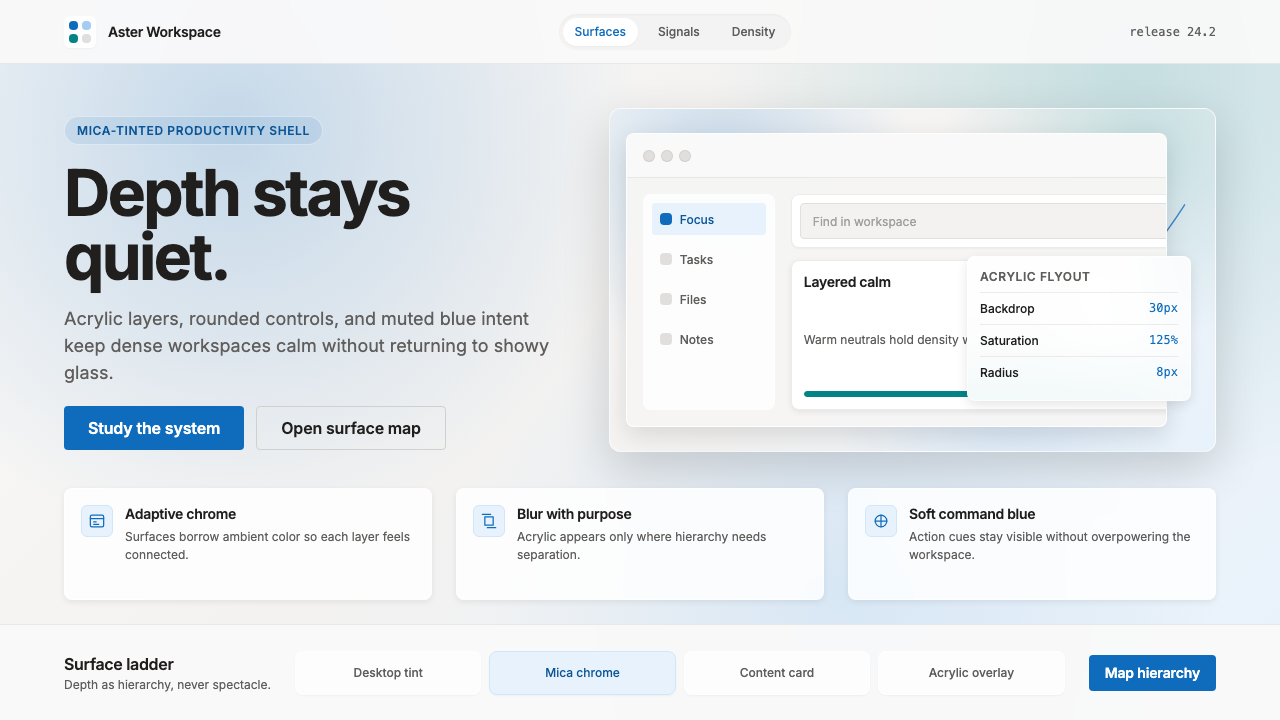 Microsoft Fluent 2Disciplined translucency. Warm Mica neutrals, acrylic blur, and muted blue cr…
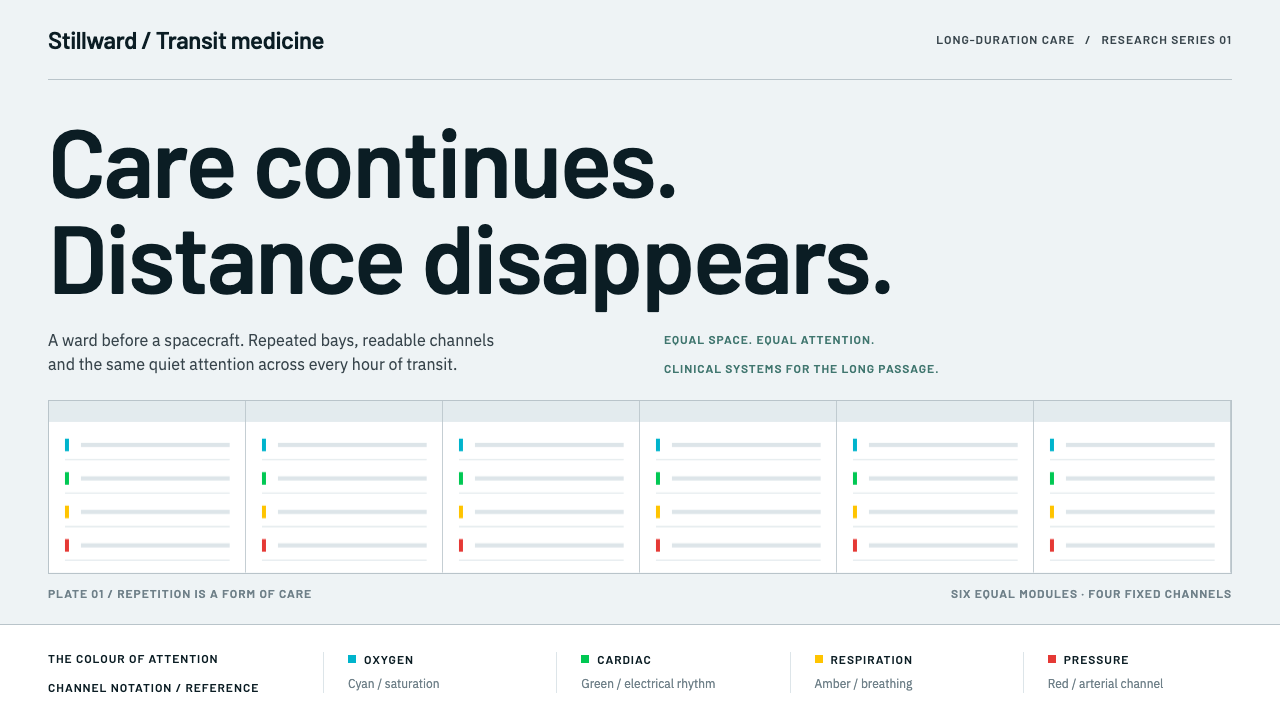 Cryosleep Transit WardCare without spectacle. Clinical white, equal bay grids and the fixed colours…
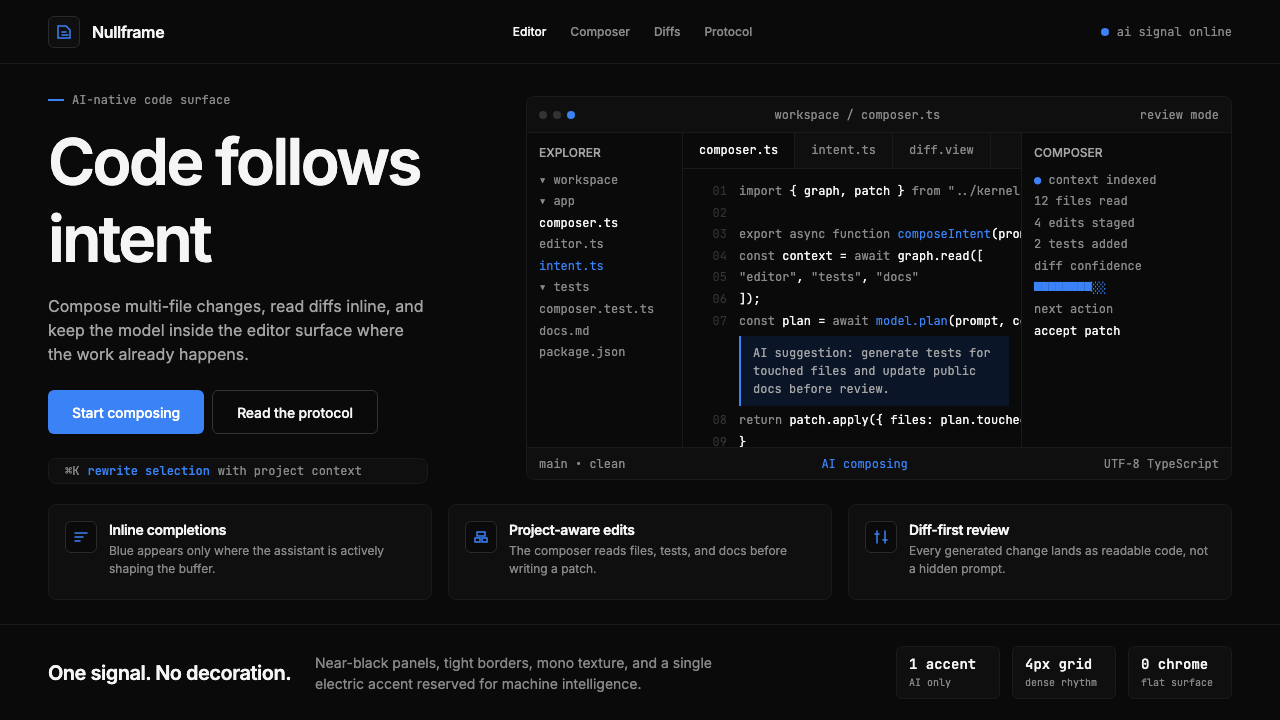 Cursor IDEAI-first code editor. Pure dark surfaces, off-white text, electric blue reser…
 Resend 2024Clean code becomes brand. Pure black, JetBrains Mono, and one green delivered…
 Vercel 2024Developer luxury by subtraction. Pure black, white Inter, rigid grid, triangu…
 Arctic Terraform StationEvery colour carries a duty. Sky-blue panels, coded modules and hard seams en…