What is Midjourney?
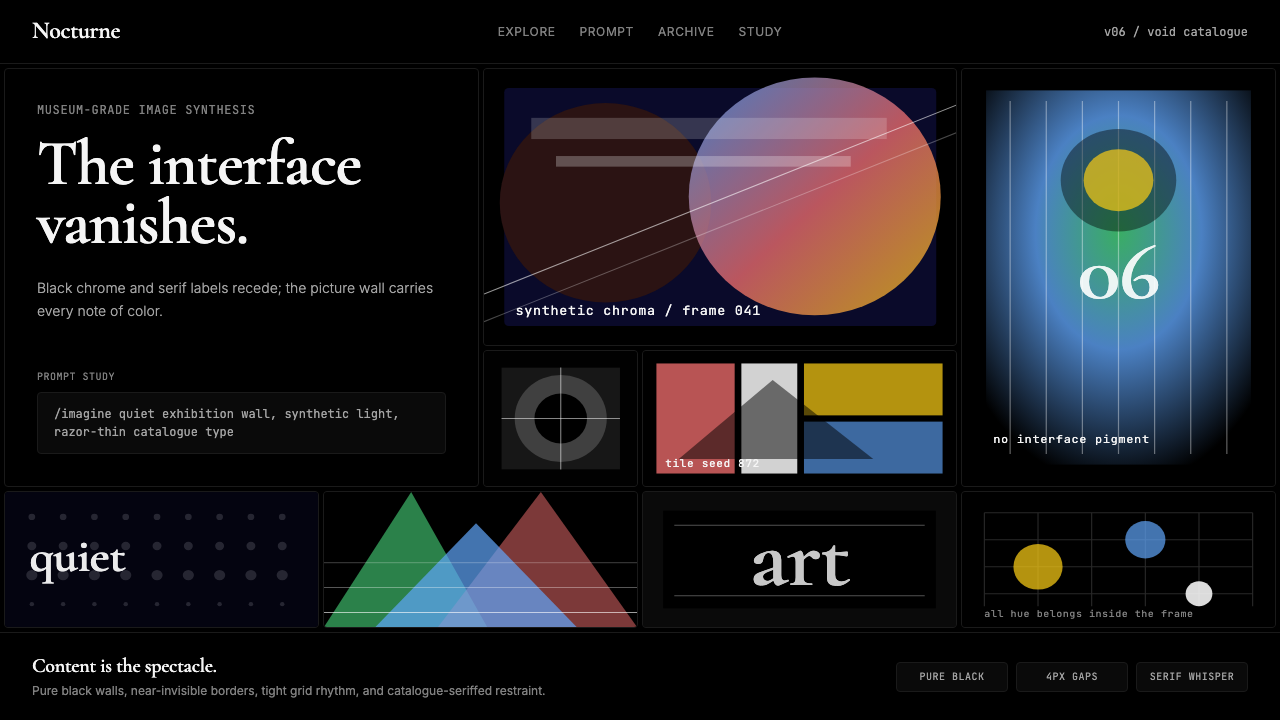
Midjourney made the interface invisible so the generated image could become the only spectacle — pitch-black canvas, razor-thin serif, zero chromatic branding.
Midjourney in brief
Midjourney is the AI image-generation platform that became a cultural-aesthetic force in the early 2020s. Its visual design philosophy is built on a single, radical premise: every pixel of color should come from the generated artwork itself, not from the interface surrounding it. The result is a system of pitch-black backgrounds, razor-thin serif letterforms, and an almost total absence of chromatic branding — a canvas that erases itself so the content can breathe.
The interface operates like a world-class contemporary art gallery with matte-black walls. In such a space, lighting, color, and spatial arrangement exist solely to frame and elevate the work on display — the architecture does not compete. Midjourney applies the same logic to software: the grid, the type, the controls, and the navigation are subordinated completely to the images they contain. This is sometimes called invisible-brand design — a philosophy in which the interface succeeds precisely when it is unnoticed.
Visually, the style is immediately recognizable. Dense galleries of generated images float on near-total darkness. A single elegant serif typeface — delicate in weight, refined in proportion — provides all navigational and labeling information. Interactive elements are minimal: subtle outlines, restrained hover states, tonal variations that never introduce color of their own. The aesthetic is simultaneously austere and luxurious, museum-grade in its restraint yet alive with the chromatic energy of the images it frames.

Where does Midjourney come from?
Midjourney launched in open beta in July 2022, initially operating entirely within Discord — the chat and community platform used by gamers, developers, and online communities. Users typed text prompts as Discord messages and received generated images in return. This unusual technical choice was not accidental: Discord's channel-and-thread structure created a publicly visible stream of prompts and outputs, turning every user's creative process into a shared spectacle. The platform grew virally not through advertising but through the curiosity generated by seeing other people's experiments in real time.
The company was founded by David Holz, who had previously co-founded Leap Motion, a company that built hand-tracking hardware interfaces. Holz assembled a small, research-oriented team based in San Francisco, California. Unlike many AI ventures of the era, Midjourney operated without institutional venture funding for much of its early period, growing primarily through subscription revenue. This financial independence shaped the product's character: decisions were made on aesthetic and research grounds rather than by growth metrics or investor pressure.
The visual identity of the platform evolved significantly between the Discord-only era and the launch of the full web interface in 2023 and 2024. In the Discord phase, the interface was almost entirely Discord's own — Midjourney contributed only the bot's response formatting and the grid layout of image options. When the web platform arrived, Midjourney's design team made a deliberate choice to build something that felt categorically different from mainstream SaaS products. Where most tools of the period used light backgrounds, rounded components, and colorful accents, Midjourney went dark, angular, and monochromatic.
The aesthetic lineage is not arbitrary. The pitch-black gallery wall is a convention borrowed from the physical art world, where dark wall colors became fashionable in contemporary and modern art museums precisely because they absorb rather than reflect ambient light, reducing visual competition with the works on display. The choice of a refined serif typeface — departing from the sans-serif conventions dominant in tech products since the 2010s — signals cultural alignment with editorial publishing, luxury fashion, and the fine arts rather than with Silicon Valley productivity software. Together, these choices position Midjourney not as a tool but as a cultural institution of sorts, a platform that takes visual seriousness seriously.
What defines the Midjourney look?
Background and Ground
The defining visual decision is the near-absolute dark ground. Backgrounds are not merely dark gray — they approach true black, providing maximum contrast for images of any color temperature and saturation. This ground absorbs ambient color rather than reflecting it, ensuring that a cool-toned photographic image and a warm painterly one can coexist on the same screen without either distorting the other. The darkness is not decorative; it is functional, the equivalent of a professional printing press that does not introduce its own color cast.
Typography and Typeface Character
The typographic system uses a refined serif — one characterized by delicate stroke contrast, tapered serifs, and proportions associated with classical editorial publishing rather than with digital interfaces. The choice is a deliberate counterstatement to the tech-industry convention of geometric or humanist sans-serif typefaces. Serif type in this context signals cultural seriousness: it references the fine-art catalogue, the literary journal, the auction-house brochure. Type weight is kept light throughout, never competing visually with the images. Size hierarchies are subtle; the interface speaks softly so the work can speak loudly.
Grid and Gallery Logic
Images are presented in dense, tightly packed grids — a layout closer to a contact sheet or museum study room than to a conventional app gallery. The grid's tight spacing maximizes the number of images visible simultaneously, turning the screen into an immersive field of visual information. Aspect ratios within the grid are allowed to vary, giving the layout an organic rhythm that avoids the rigid uniformity of standard photo-grid UIs. The grid itself is invisible — no colored cell backgrounds, no borders, no separators — so the negative space between images is pure black, part of the ground rather than a design element.
Chromatic Restraint
The interface introduces almost no color of its own. Navigation, labels, buttons, and controls are rendered in tones of near-white and dark gray. When color does appear in the UI — on a selected state, a loading indicator, or an interactive prompt — it arrives as a very faint tonal accent, never assertive. This chromatic discipline ensures that any image, regardless of its palette, reads as the dominant visual presence on screen. The interface is colorimetrically neutral so the art is never.
Spatial Depth and Elevation
Depth is implied through darkness rather than through traditional shadow systems. Modal overlays, panels, and drawers darken the content beneath them rather than casting shadows over it — a technique that creates separation using the same visual language of tonal variation rather than introducing simulated three-dimensionality. Elevation is expressed through contrast with the ground rather than through shadow offsets. The overall visual effect is flat in the technical sense — no drop shadows, no glows — but perceptually rich because the deep ground provides inherent spatial resonance.
Minimal Iconography
Icons and UI symbols are reduced to their geometric minimum — thin-stroked outlines, no fills, no decorative variations between icon families. Where text labels are possible, they are preferred over icons, reflecting the typographic primacy of the system. Interactive affordances rely on context and position more than on visual embellishment. This approach prevents the interface chrome from acquiring visual weight that might compete with the images; every mark on the screen that is not an image must earn its presence through strict functional necessity.
Invisible Brand Identity
Perhaps the most distinctive and philosophically significant choice: Midjourney has no chromatic brand color. There is no signature blue, no corporate accent, no branded gradient to associate the platform with. The product's identity lives entirely in the structural and typographic choices — the dark ground, the refined serif, the gallery density — rather than in a proprietary color or mark. This is the inverse of conventional brand strategy, which typically relies on consistent color as a primary recognition device. The philosophy is that the generated images collectively constitute the brand's visual identity, a rotating, user-generated canvas that is always different and always unmistakably Midjourney.

Who shaped Midjourney?
Holz co-founded Leap Motion before starting Midjourney, and his background in human-computer interaction shaped the platform's unusual attention to how users experience the act of image generation — not merely as a technical transaction but as a creative and aesthetic encounter. His decision to launch via Discord rather than a conventional web app was a defining strategic and cultural choice: it embedded Midjourney inside an existing community infrastructure, made the creative process socially visible, and allowed the platform to grow through network effects rather than paid acquisition. Holz has spoken publicly about the importance of building for long-term aesthetic coherence over short-term engagement metrics, a philosophy visible throughout the platform's visual design.
Unusually for a company of its influence, Midjourney has operated with a very small team — reportedly under one hundred people for much of its high-growth period. The research team is responsible for the underlying generative models, including the progression from early versions to later iterations that dramatically improved photorealism, compositional control, and stylistic coherence. The aesthetic sensibility of the models — their tendency to produce images with painterly light, cinematic framing, and rich tonal depth — reflects deliberate training decisions made by the research team that are as much curatorial as they are technical.
Discord's role in Midjourney's origin is so significant that it functions almost as a co-creator of the platform's early cultural identity. The chat platform's structure — public channels, visible conversation threads, real-time scrolling feeds — turned the prompt-and-generate workflow into a social performance. Users could see each other's prompts, learn from unexpected outputs, and develop a shared vocabulary of technique. This public creative environment shaped the aesthetics that users came to associate with Midjourney: exploratory, experimental, communal, and perpetually in motion. The eventual move to a private web interface retained the gallery density of the Discord grid while replacing its informal social energy with something closer to the contemplative quiet of a curated exhibition space.
The design of Midjourney's web interface draws explicitly on the visual conventions of contemporary art institutions — specifically the dark-walled gallery model that became widespread in international museums from the late twentieth century onward. Institutions including the Tate Modern in London, MoMA in New York, and the Centre Pompidou in Paris adopted dark or neutral mid-tone walls for contemporary and modern art displays, finding that this suppressed architectural noise and made the works' own light and color more legible. Midjourney applies this principle digitally, treating the interface as architecture in service of the work rather than as a designed object in its own right. The lineage connects the platform's visual character to a much longer tradition of art-world display practice.
How do you use Midjourney today?
Midjourney's visual language is one of the most transferable dark-aesthetic systems in contemporary design — not because darkness is universally appropriate, but because the specific logic underlying it (interface erasure, chromatic neutrality, typographic restraint) is structurally sound and can be applied wherever the content itself is the primary visual experience. Understanding that logic is essential before applying the style: this is not simply a dark color scheme overlaid on a conventional layout, but a complete rethinking of which elements deserve visual presence.
For presentation decks, the style works powerfully on both cover and section-break slides. A cover built in this register places a large, high-quality image — photographic, illustrative, or AI-generated — against near-total darkness, with a refined serif title in a very light weight occupying a corner or a narrow horizontal band. The title does not compete with the image; it anchors it. Content slides should maintain the dark ground and use type-only hierarchy: a light-weight serif heading, a body paragraph in a slightly smaller size, and nothing else. Data visualization slides translate naturally: charts and diagrams become bright objects against the dark field, their colors functioning as signal rather than decoration, the background giving them the visual equivalent of spotlighting.
For web UI — dashboards, analytics tools, portfolio platforms, creative software interfaces — the system is particularly well-suited. The approach begins with the ground: a true near-black background establishes the container. Content cards and panels are distinguished from the ground through very slight tonal elevation rather than border or shadow — they are darker or lighter versions of the same ground color rather than differently colored surfaces. Interactive elements use the lightest tonal values available — near-white for primary text and buttons, mid-tones for secondary controls. Accent color, if introduced at all, should be drawn from the content domain itself rather than from a brand palette. For pricing pages within this system, tier differentiation is achieved through contrast and type weight rather than through colored headers or background tinting.
For editorial and marketing contexts — editorial features, campaign landing pages, brand storytelling — the Midjourney aesthetic communicates cultural sophistication and creative credibility. A long-form editorial piece in this system uses a dark background with light body text set in a refined serif, generous vertical rhythm, and images that run edge-to-edge or bleed into the margin. Marketing pages use the same full-width image blocks and tonal alternation between slightly different dark values to create rhythm without introducing color. The serif typeface carries the page's sophistication; the images provide its emotional impact; the dark ground gives it weight and seriousness.
A common mistake when applying this system is treating it as simply a dark-mode version of a conventional light-background design. The Midjourney aesthetic is not achieved by inverting a light layout — it requires reconsidering every element from the ground up. Light-on-dark text demands tighter attention to type weight and size than dark-on-light, because the perceptual contrast is fundamentally different. Images need to be selected or created for dark-ground display: heavily vigneted images or those with very dark borders will disappear into the background; images that carry their own light will appear to float. The serif typeface choice must be genuinely refined — not any serif will work, because coarser or more utilitarian serifs will read as gothic or funereal rather than editorial and curatorial. The system rewards attention to detail and punishes casual application.

Midjourney — FAQ
Is the Midjourney aesthetic just dark mode with a serif font?
No — though that description captures two surface elements, it misses the underlying logic entirely. Dark mode as implemented in most operating systems and apps is a light-background layout inverted for reduced eye strain in low-light conditions; it preserves the same compositional hierarchy, the same color accent systems, and the same design decisions as the light version. The Midjourney aesthetic is built from the ground up around a different premise: the interface is a display substrate for other people's images, and its job is to introduce as little visual information of its own as possible. This produces specific decisions — no brand color, no decorative elements, typographic weight kept low, spatial density high — that have nothing to do with dark mode as a comfort feature.
Why use a serif rather than a sans-serif in a tech product?
The sans-serif convention in tech UI design is a historical artifact, not a functional requirement. Sans-serifs became dominant in digital interfaces partly because early low-resolution screens rendered serif details poorly, and partly because the minimalist design movements of the 2000s and 2010s — influenced by Swiss International Style and later by flat design — established clean geometric sans-serifs as the neutral, modern default. Midjourney's serif choice is a deliberate departure from that convention, and it communicates something precise: this platform belongs to the cultural domain of fine art, editorial publishing, and luxury goods rather than to productivity software. The serif is doing the same work that a dark gallery wall does — it signals that what is being displayed here deserves a different level of attention and seriousness.
Does this design system work for products that are not image-generation platforms?
Yes, but with important conditions. The core logic — minimal interface chrome, dark ground, chromatic restraint, content as the visual star — transfers well to any product where the primary content is rich and visual: portfolio platforms, photography tools, video editors, creative marketplaces, high-end e-commerce for visual goods, cultural institutions, and editorial publications. It is much less appropriate for products where the interface itself needs to guide action, communicate trust through familiar conventions, or support dense text-based interaction — accounting software, customer support tools, long-form reading apps, or products targeting audiences unfamiliar with fine-art or editorial aesthetics. The style assumes that users bring their own visual fluency to the experience; when that assumption fails, the restrained interface can feel cold, confusing, or incomplete.
How should color be introduced if the product needs it — for alerts, states, or branding?
Sparingly and purposefully. The system's logic is not that color is forbidden — it is that color introduced by the interface always competes with the content's color, so every chromatic decision must be justified by clear functional necessity. Alerts and error states can use red or amber tones — functional color has a long-established semantic meaning that users will not misread as branding. Loading and progress states can use a very desaturated teal or blue — again, functional rather than aesthetic. If a brand color must be present, it should appear only at the smallest possible scale: a thin line, a dot, a typographic accent — never a filled button, never a colored header. The test for any color introduced is: does this color carry information that cannot be conveyed through size, position, or typographic contrast alone? If the answer is no, remove it.
What is the biggest risk of applying this style incorrectly?
The biggest risk is producing a design that reads as pretentious or inaccessible — a dark interface that signals cultural seriousness without delivering it. This happens when the dark ground and refined serif are applied over a product whose content, function, or audience do not match the aesthetic's implied values. A task-management app styled like Midjourney will likely feel affected; a photography portfolio platform styled the same way will feel appropriate. The second major risk is accessibility: light text on a very dark background must meet contrast requirements, and the fine-stroked serifs that give the system its refinement can become illegible at small sizes on screens of ordinary quality. A typographically restrained system is not automatically an accessible one; the restraint must be balanced against legibility thresholds. The style succeeds when the aesthetic claim and the product reality are in genuine alignment.
Related design styles
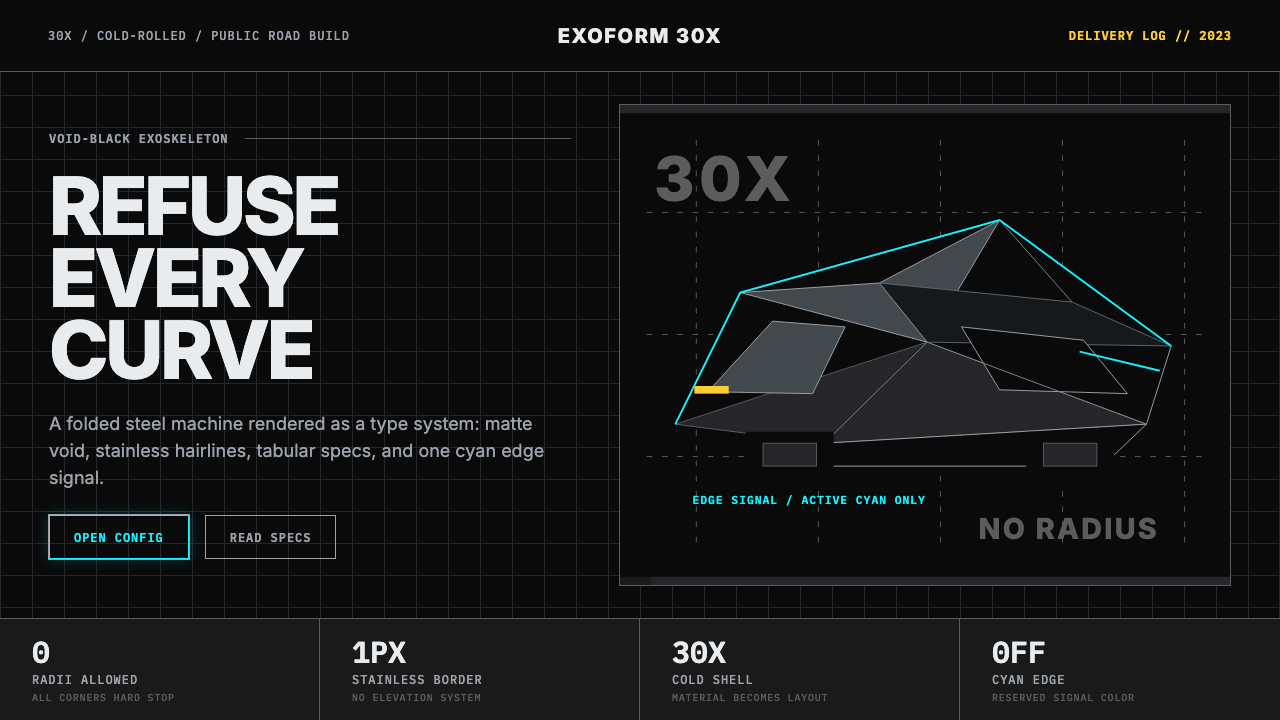 Tesla Cybertruck Stainless (2023)Refusal made material. Void black, stainless hairlines, cyan edges, faceted I…
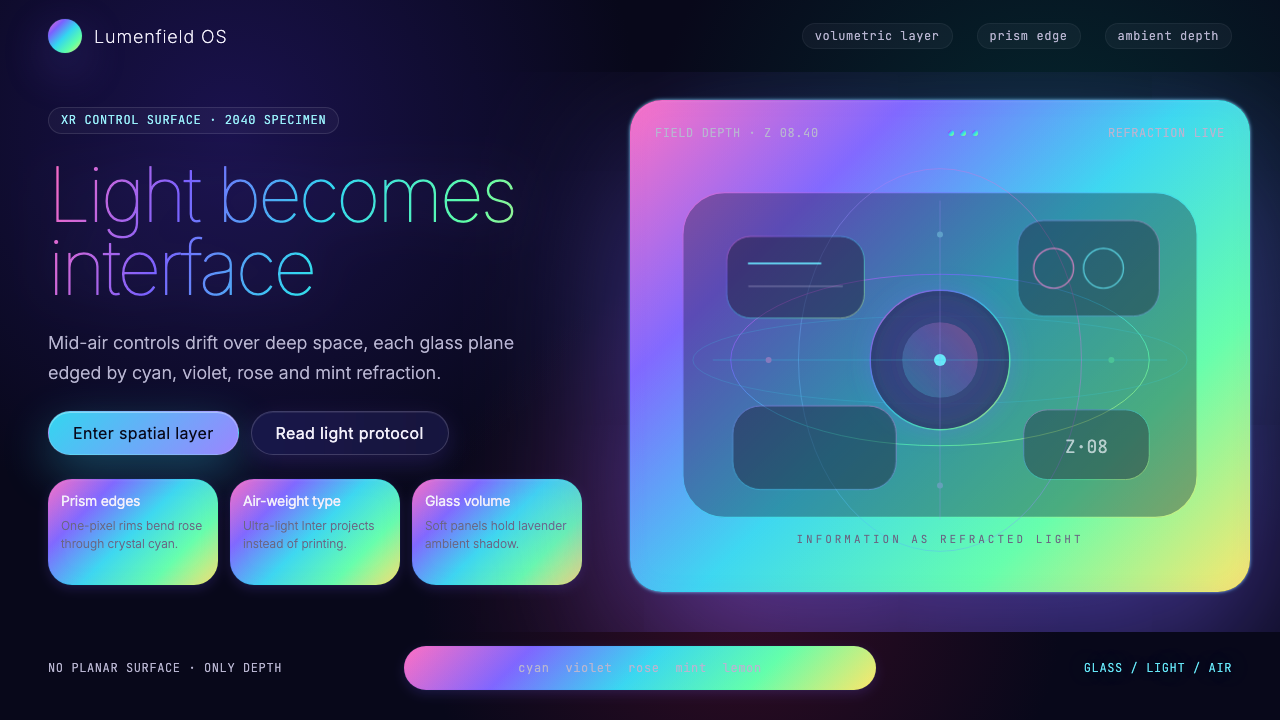 Holographic UI 2040Information made of light. Deep-space black, ultra-light Inter and prismatic…
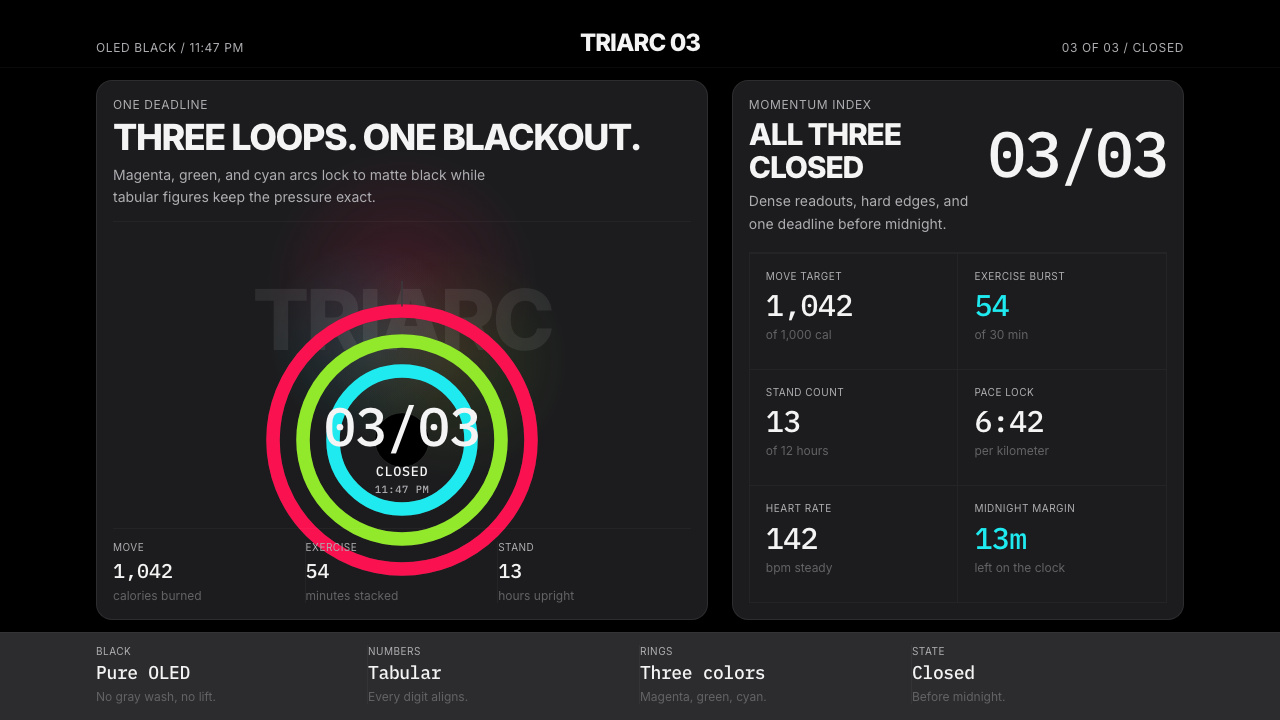 Apple Fitness Rings Closed (2024)Midnight feels exact. Magenta, green, and cyan rings lock onto OLED black.
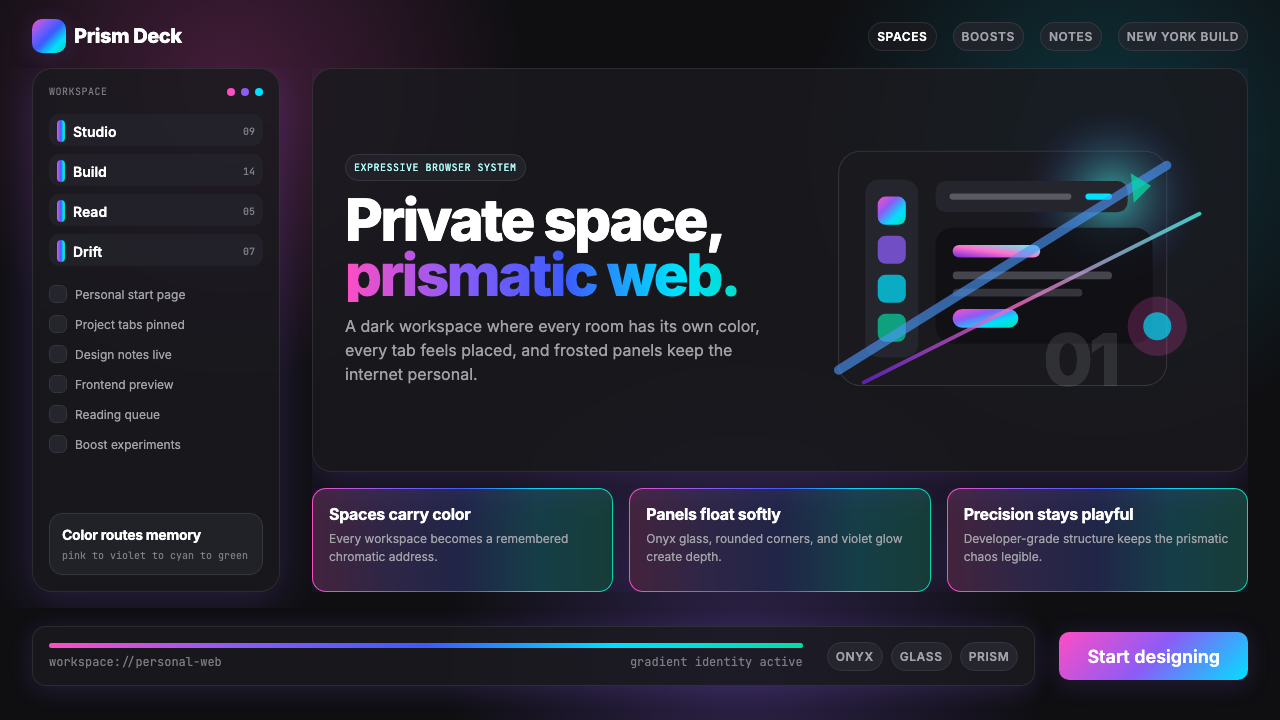 Arc Browser Prismatic (2023)Color is architecture. Pink-violet-cyan ribbons glow over onyx glass and roun…
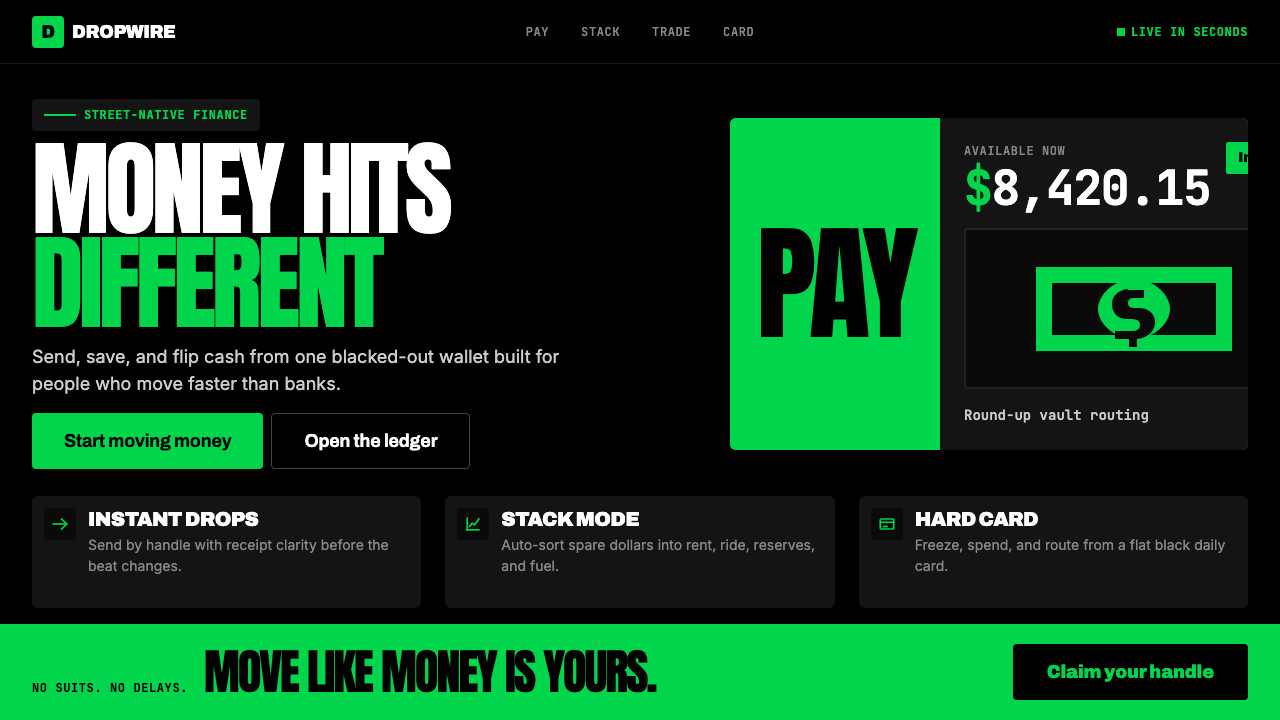 Cash App 2024Fintech that talks like a record label. Pure black, dollar-bill green, type a…
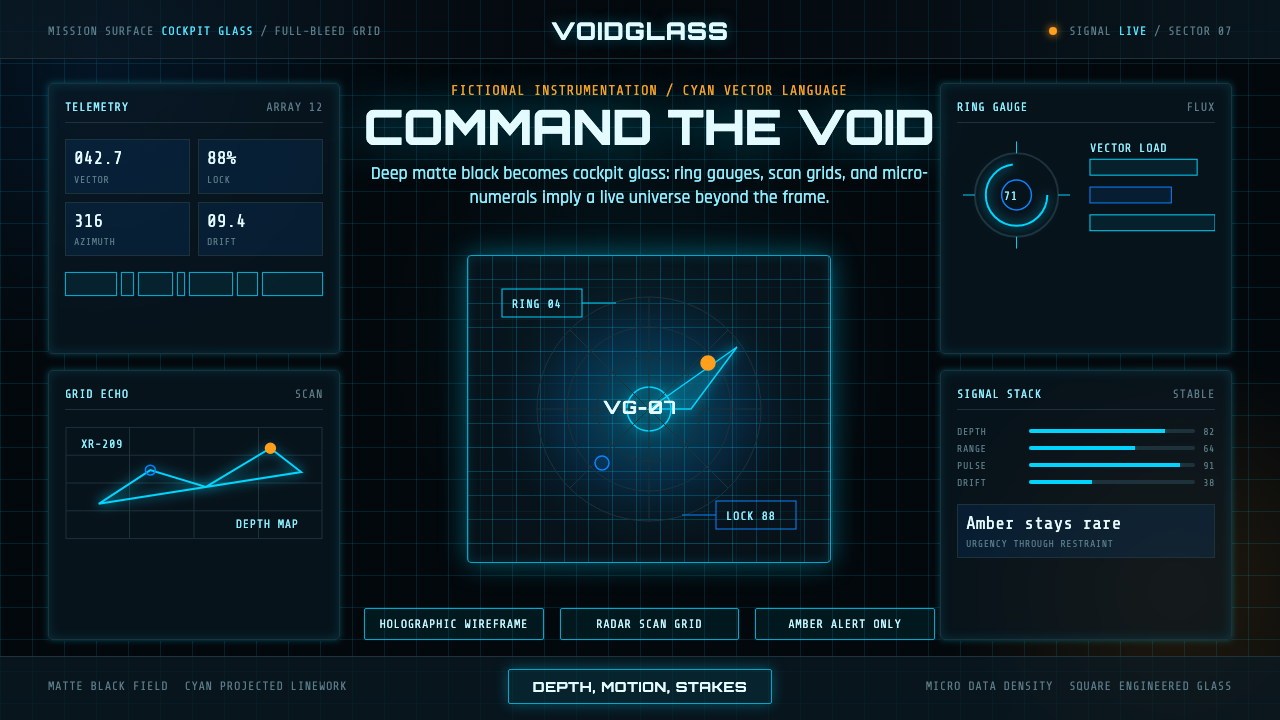 FUI Sci-Fi HUDBlack until it glows. Cyan wireframes, ring gauges, and radar grids sell live…