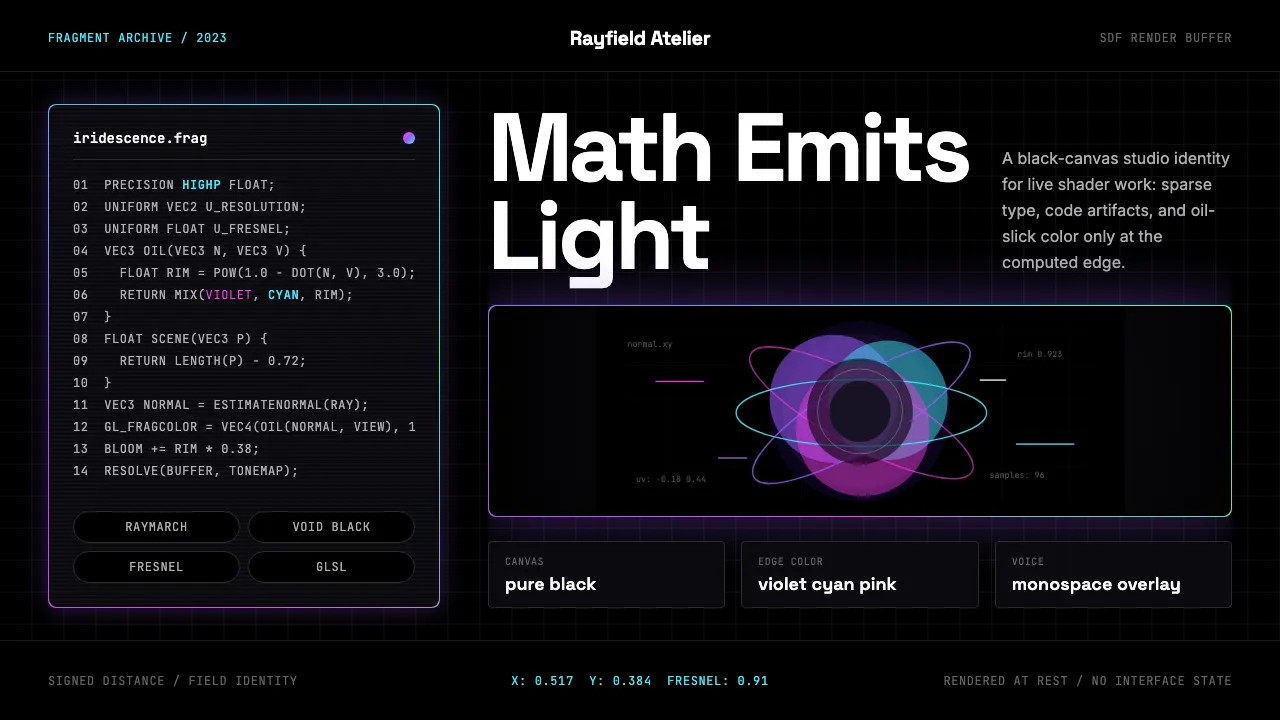
About WebGL Shader Iridescent (2023)
WebGL shader art distills GPU mathematics into pure visual experience. Born from the demoscene tradition and crystallized by Shadertoy's 2013 launch, this aesthetic renders signed-distance-function geometry on pitch-black canvases, wrapping forms in oil-slick iridescence derived from Fresnel equations.
The 2023 renaissance — fueled by Spline, Three.js maturity, and shader-graph tooling — brought fragment-shader visuals to mainstream web portfolios. The look is unmistakable: saturated violet-cyan-pink bloom against void-black, monospace code overlays, and mathematical primitives that feel alive.
- Origin
- International tech-creative diaspora — Barcelona, San Francisco, Berlin, Brooklyn
- Era
- 2013 Shadertoy launch; current visual ~2021–2024
- Key figures
- Inigo Quilez · Patricio Gonzalez Vivo · Ricardo Cabello (Mr.doob) · Pol Jeremias
- Movements
- WebGL shader art · Demoscene lineage · Generative-3D-on-web
WebGL Shader Iridescent (2023) design spec
Colors
Typography
The other 11 sections — buttons, cards, spacing, motion, techniques and more — open once you unlock. Download the DESIGN.md or send it to your AI in one click. Unlock once, yours forever.
Sign up nowStyles similar to WebGL Shader Iridescent (2023)
Also inspired by design movements, with a close feel.
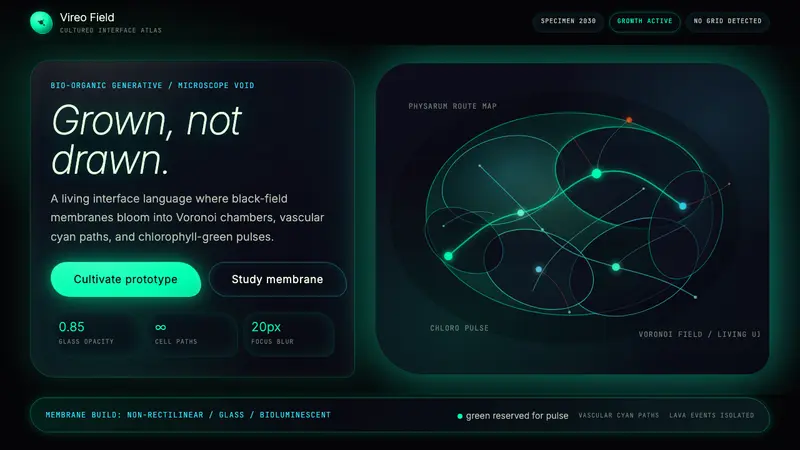 Bio-Organic GenerativeInterfaces feel cultured. Void black, Voronoi membranes, and neon chlorophyll pulses glow.
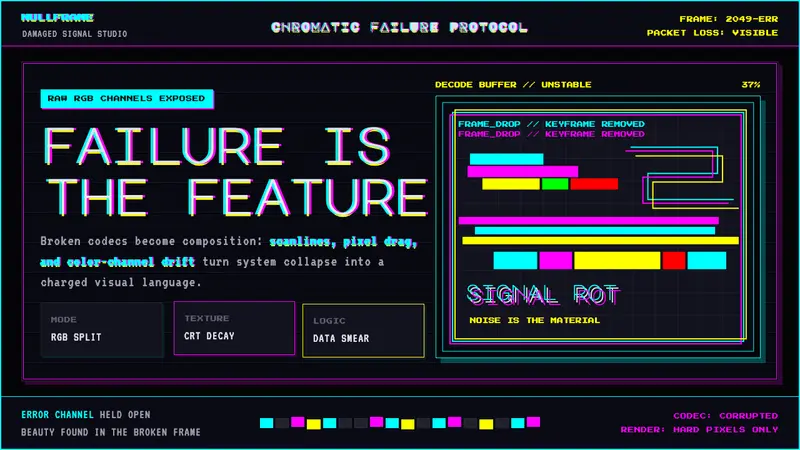 Glitch DatamoshErrors as composition. Corrupted JPEGs, RGB splits, scanlines — failure treated as feature.
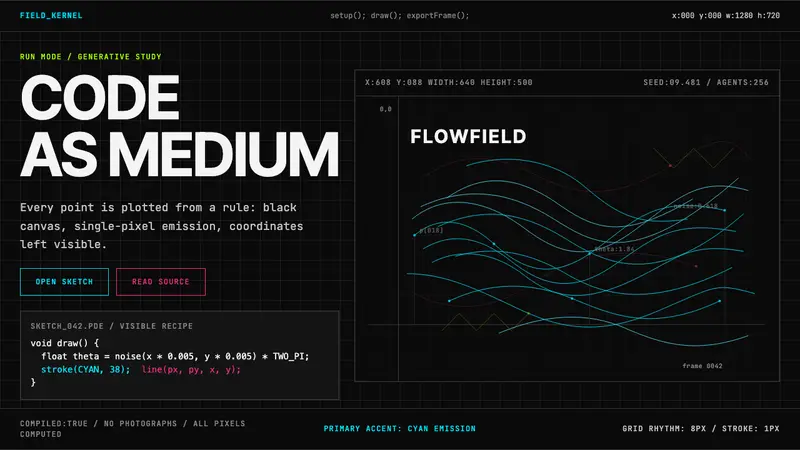 Processing / GenerativeCode becomes image. Cyan hairlines trace black-grid flowfields with mono coordinates.
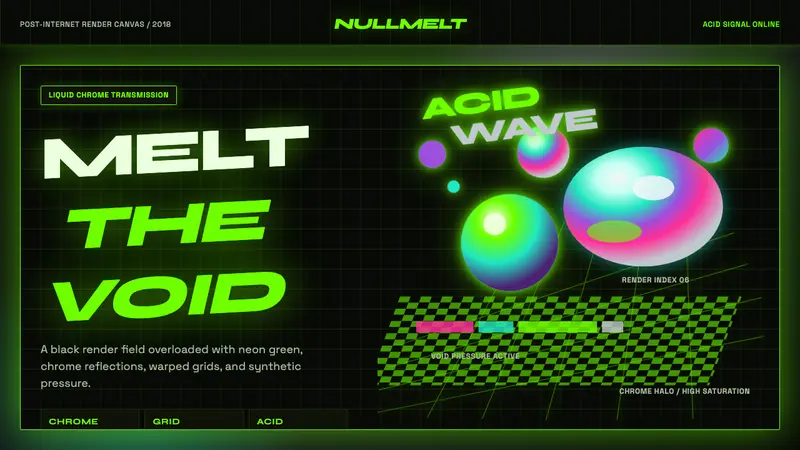 Acidwave 3D RenderPsychedelia hits the render engine. Neon green, chrome orbs, and warped grids burn over black.