What is Vaporwave (Tumblr 2012)?
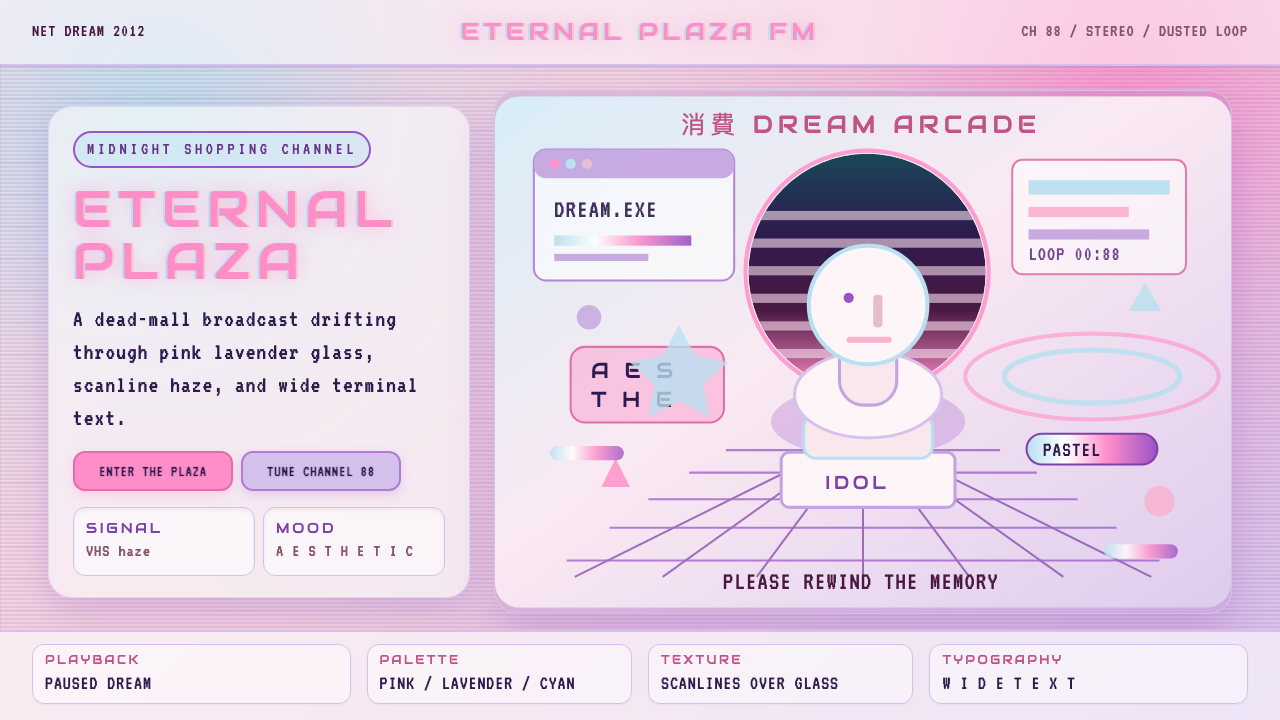
Vaporwave wraps late-capitalism's ghost in dusty pastels, VHS static, and a sunset gradient that has been setting since 1987.
Vaporwave (Tumblr 2012) in brief
Vaporwave (Tumblr 2012) is an internet-native aesthetic that emerged from a niche musical microgenre and crystallised into one of the most recognisable visual styles of the early 2010s. Its palette orbits pink, lavender, and soft teal — the colours of a cathode-ray sunset — laid over marble textures, wireframe grids, and classical Roman busts that appear stranded in digital space. Wide-spaced, all-caps display type coexists with the half-width katakana of A E S T H E T I C, and scan-lines ghost across every surface as a reminder that this world is transmitted, not real.
Where Bauhaus or Swiss International Style impose structural logic on visual chaos, vaporwave instead performs a kind of fond mourning: it treats the graphic detritus of 1980s and 1990s consumer culture — Windows 95 dialogue boxes, mall-atrium lighting, corporate stock-photo smiles — as archaeological artefacts worthy of reverent display. The aesthetic is simultaneously nostalgic and critical, sincere and ironic, which is precisely why it resonated so widely on Tumblr, a platform built for layered emotional registers.
As a design system, vaporwave is defined by controlled excess rather than restraint. Gradients are not avoided but embraced; transparency and layering create depth that feels both digital and dreamy. The mood is warm dusk rather than crisp morning: saturated but hazy, rich but soft. Glitch elements — horizontal tears, chromatic aberration, pixelation — appear not as errors to be corrected but as honest admissions of the medium's instability.

Where does Vaporwave (Tumblr 2012) come from?
The musical origins of vaporwave are traceable to a handful of experimental releases in 2010 and 2011. Daniel Lopatin, recording as Chuck Person, released 'Eccojams Vol. 1' in 2010 — a tape of looped, pitch-shifted fragments from 1980s pop and smooth jazz that transformed familiar pleasantness into something uncanny and adrift. James Ferraro's 'Far Side Virtual' (2011) went further, assembling ringtones, default system sounds, and corporate hold-music into an album that sounded like a shopping mall dreaming of itself. These releases circulated on SoundCloud and 4chan's music board, reaching a small audience who recognised something new: music that treated the consumer experience of the late twentieth century as raw material for critique.
The visual aesthetic coalesced in 2012, primarily on Tumblr. Vektroid (Ramona Xavier), releasing as Macintosh Plus, published 'Floral Shoppe' in late 2011 — an album whose cover art, featuring a marble bust set against pink and teal gradients with Japanese text overlaid, became the aesthetic's single most reproduced image. Tumblr users began reblogging edited versions: adding scan-lines, adjusting hues, inserting Windows 95 interface fragments, overlaying Greek columns and chessboard floors. Within months, a coherent visual grammar had assembled itself through collective iteration, without any single designer or manifesto directing it.
The style drew from several distinct source pools. Japanese city pop album covers of the late 1970s and 1980s — pastel, luxurious, depicting leisure and consumption — supplied the colour mood. Early-1990s Macintosh graphic design contributed the wireframe grids, teal interfaces, and geometric sans-serif type. Stock photography from the same era added marble surfaces, executive desk props, and generic landscapes. Classical sculpture — particularly busts of Greek and Roman figures — appeared as a recurring motif, functioning simultaneously as a symbol of high culture displaced into low commercial contexts and as a ready-made object with the right monochromatic surface quality.
By 2013 and 2014, vaporwave had spread beyond Tumblr into broader internet culture, spawning subgenres (mallsoft, hardvapour, future funk) and attracting academic commentary on hauntology and post-internet aesthetics. Its peak Tumblr period — roughly 2012 to 2014 — represents the aesthetic in its purest collective form, before it was adopted by commercial branding. The style has experienced multiple revival cycles since, including a significant resurgence around 2018 and ongoing enthusiasm through the mid-2020s, which speaks to its structural adaptability: the nostalgic grammar it established can be reapplied to each new generation's sense of a lost recent past.
What defines the Vaporwave (Tumblr 2012) look?
Pastel Gradient Palette
The defining colour territory is warm pastel — dusty pink, soft lavender, pale mint, and the deeper magenta that anchors the sunset end of the spectrum. These hues appear most characteristically in multi-stop gradients that shift from pink at the horizon through purple to deep indigo overhead, evoking the specific quality of light in a late-1980s television broadcast. Unlike the flat primaries of Bauhaus, vaporwave colour is always atmospheric: hues bleed into one another, surfaces glow rather than reflect, and the overall impression is of warmth suspended just before cooling.
Retro-Tech Display Typography
Type in vaporwave favours wide-tracked, geometric display letterforms — the kind that appeared in 1980s corporate logotypes and early desktop publishing. All-caps settings are common, with letter-spacing pushed to near-double the normal value, creating a deliberate sense of spaciousness and era-coded authority. Full-width Japanese katakana appears frequently alongside Latin text, not as a linguistic choice but as a graphic texture and cultural collage. The combination signals both the Japanese city-pop influence and the tendency of 1980s Western design to deploy Japanese characters purely as exotic signifiers.
VHS and Scan-line Texture
Horizontal scan-lines — thin dark bands repeating at regular intervals across an image — are among the most immediately recognisable marks of the vaporwave aesthetic. They reference the interlaced-scan display technology of analogue television and the visual degradation of magnetic tape, signalling that the content is mediated, recorded, and therefore slightly unreliable. Related textures include chromatic aberration (where colour channels shift out of alignment, producing ghost-colour fringes on edges), mild pixelation, and the vertical roll that occurs when a VHS tape degrades. These artefacts are applied intentionally as aesthetic marks rather than corrected as defects.
Classical Fragments in Digital Space
Marble busts, Greek columns, Roman statuary, and chessboard-tiled floors appear throughout vaporwave imagery, typically set against gradient skies or floating in featureless digital voids. This juxtaposition of ancient material culture with synthetic digital environments is central to the aesthetic's cultural commentary: civilisations built in marble are placed inside computers, rendered weightless, and offered for consumption alongside shopping-channel merchandise. The marble texture itself — cool, veined, monochromatic — also provides a visual counterweight to the warmth of the pastel palette, and the familiar classical forms serve as anchor points within otherwise abstract compositions.
Wireframe Grid and Infinite Floor
The perspective wireframe grid — a flat plane receding to a vanishing point in classic one-point perspective, rendered in thin glowing lines — is a signature vaporwave spatial motif. It references the primitive three-dimensional graphics of early computer games and visualisation software, where wireframe rendering was a technical necessity before texture-mapping became affordable. In vaporwave, this grid typically appears as a glowing magenta or cyan mesh extending to a horizon bisected by a stylised sun — the 'synthwave sun' — with horizontal bands cut into it. The grid converts digital space into something felt as real place, however artificial.
Layered Transparency and Glow
Unlike flat-colour styles that keep each element opaque and distinct, vaporwave compositions stack translucent layers — gradients, photography, texture, type — at varying opacities so that elements bleed through one another. Glow effects appear around type and geometric shapes: a soft outer radiance that suggests illumination from within rather than from an external source. This treatment gives the aesthetic its characteristic warmth and unreality, as though the entire composition exists slightly behind glass or within the phosphor persistence of a cathode-ray screen.
Dead-Mall Spatial Atmosphere
Beyond specific graphic elements, vaporwave carries a distinct spatial mood: the quiet of an empty atrium, escalators running for nobody, ambient music cycling through a deserted food court. This atmospheric register is achieved through generous negative space within compositions, deliberately low visual density in some zones, and the sense that depicted spaces are oversized for their current occupancy — a kind of architectural loneliness. When architectural or interior settings appear directly, they favour the materials and proportions of 1980s commercial construction: reflective floor tiles, pastel-painted cinder block, potted palms under skylights.

Who shaped Vaporwave (Tumblr 2012)?
Lopatin's 2010 cassette release under the Chuck Person alias, 'Eccojams Vol. 1', is widely regarded as the founding document of the vaporwave sound. By isolating short loops from 1980s smooth jazz and pop songs, slowing them down, and processing them through echo, he created music that treated nostalgia as raw material rather than emotion — studying the texture of a remembered decade rather than sentimentalising it. As Oneohtrix Point Never, Lopatin continued developing similar approaches at a higher level of compositional complexity, influencing successive waves of internet-based experimental music.
Vektroid's 'Floral Shoppe' (2011), released under the Macintosh Plus alias, supplied the visual template that defined vaporwave for most of its audience. The album cover — a marble bust of Helios set against a pink-to-teal gradient, Japanese text running vertically, the composition stripped to the essentials of colour and classical form — was reblogged tens of thousands of times on Tumblr and became the aesthetic's founding image. The track 'リサフランク420 / 現代のコンピュー' became vaporwave's most recognised musical moment. Vektroid's prolific output under multiple aliases also demonstrated the genre's range, from atmospheric mall-ambient to faster rhythmic variants.
Ferraro's 'Far Side Virtual' (2011) approached vaporwave's themes from a more conceptual angle than Lopatin's loop-based method. Rather than sampling existing music, Ferraro composed original pieces from scratch using ringtones, notification sounds, and corporate sonic signifiers — the sounds of smartphones and software rather than analogue recordings. The result was an album that sounded simultaneously utopian and deeply uncanny: the sonic landscape of a consumer paradise that had no humans in it. Ferraro's work made explicit the aesthetic's implicit critique of how digital technology had colonised ambient experience.
Though primarily known as a filmmaker and game designer rather than a graphic artist, OReilly's work in the early 2010s shares foundational aesthetic concerns with vaporwave: the use of low-fidelity three-dimensional rendering, the treatment of digital environments as emotionally loaded spaces, and a consistent interest in what computational aesthetics feel like from the inside. His animated short 'Please Say Something' (2009) and later the game 'Mountain' (2014) both explore the uncanny valley of digital experience that vaporwave approaches through collage. OReilly is representative of a broader cluster of artists who arrived at similar sensibilities through adjacent routes.
Unlike most design movements, vaporwave's visual language was not shaped by identifiable individual designers but by the anonymous collective behaviour of Tumblr's image-reblogging infrastructure. Users who edited and recirculated images — adding filters, overlaying text, adjusting saturation, combining elements from different sources — acted as a distributed creative engine. This anonymity is constitutive of the aesthetic, not incidental to it: vaporwave images circulate without clear authorship, which reinforces their feeling of being found objects rather than designed artefacts. Any historical account of the aesthetic must acknowledge this collective authorship as its primary creative mechanism.
How do you use Vaporwave (Tumblr 2012) today?
Vaporwave's visual grammar is more transferable than its reputation as internet subculture might suggest. Because the style is built from specific, learnable components — gradient direction and hue range, scan-line weight and opacity, type-spacing ratios, the particular spatial atmosphere of empty grandeur — it can be applied with precision to professional design contexts without collapsing into pastiche. The key is understanding which elements carry the emotional weight of the style and which are surface decoration that can be modulated without losing character.
For presentation slides, vaporwave works well on cover pages and section dividers that need to establish mood before content begins. A cover built in this style uses a full-bleed multi-stop gradient as background — moving from a warm pink at the lower edge through lavender to a cooler hue above — with a centred or offset title in wide-tracked display type, possibly complemented by a secondary line in katakana or a translucent classical motif. Section dividers can use the wireframe grid as a visual punctuation mark, with the grid fading into the gradient rather than sitting on top of it. Content slides should be clean and minimal — the style's excess belongs on structural frames, not on pages carrying dense information.
For web interfaces — particularly dashboards, pricing pages, and landing pages for creative or entertainment products — vaporwave offers an immediately distinctive alternative to the neutral design languages that dominate most SaaS products. A vaporwave-derived web palette uses the gradient as a hero-section background, type in pale cream or near-white against the saturated ground, and accent elements in bright magenta or warm gold. Card components work well with a frosted-glass treatment: a translucent light surface set against the gradient background, with a soft glow at the border rather than a hard shadow. Navigation and interactive elements should lean toward the type-forward aesthetic — large, widely-spaced labels — to prevent the decorative richness of the palette from competing with usability.
In editorial and marketing contexts, vaporwave's palette and spatial atmosphere adapt well to campaigns targeting audiences with cultural fluency around 1980s and 1990s aesthetics, internet nostalgia, or music and gaming culture. A magazine spread in this style might use the gradient as a full-page background for pull-quotes or section openers, set classical imagery at reduced opacity as an underlayer, and run display type in the foreground at a scale that makes the type itself a compositional element. Marketing materials benefit from the style's poster-like boldness: a single dominant gradient, one large typographic statement, and minimal additional elements. The risk in marketing applications is that the style reads as trend-chasing if applied without genuine understanding of its source culture — the irony and mourning that give vaporwave its depth are easily lost when only the colour palette is borrowed.
The most common mistakes when applying vaporwave in professional contexts fall into two categories. The first is over-literal adoption: including too many distinct vaporwave signifiers simultaneously — scan-lines, marble busts, wireframe grids, and katakana all in the same composition — which produces pastiche rather than a style-informed design. Professional application requires selecting one or two primary signals and trusting the gradient and type-spacing to carry the rest. The second mistake is treating the palette as if it were flat colour: applying pinks and purples without the characteristic blending and luminosity that make vaporwave colour feel atmospheric rather than merely colourful. The gradient transitions must be smooth and multi-stop, the glow effects must be present if subtle, and the overall lightness should suggest a glowing screen rather than printed ink.

Vaporwave (Tumblr 2012) — FAQ
What is the difference between vaporwave and synthwave visually?
Both styles draw from 1980s visual culture, but they operate from different emotional registers and with different graphic grammars. Synthwave is fundamentally a night aesthetic: dark backgrounds, neon colours that read as artificial light sources, angular chrome letterforms, and a high-contrast electric quality associated with action and speed. Vaporwave is a daylight-at-dusk aesthetic: soft pastel grounds, glowing rather than blazing colour, classical and consumer imagery, and a mood of stillness and mild disorientation rather than excitement. Synthwave is driving a sports car at night; vaporwave is standing alone in a shopping mall at closing time. They share a palette overlap in pink-to-purple gradients, but their emotional targets and spatial vocabularies are distinct.
Can vaporwave work in a professional or corporate context, or is it too subcultural?
Vaporwave can absolutely work in professional contexts, with calibration. The style is too visually loaded to apply wholesale to conservative industries like finance, healthcare, or legal services, where the aesthetic associations — internet subculture, irony, nostalgia — work against the authority signals those sectors require. But for creative industries, entertainment platforms, music and gaming products, youth-oriented consumer brands, and any context where distinctive visual character is a commercial advantage, a vaporwave-informed palette and spatial grammar can be highly effective. The strategy is to use the style's colour logic and typographic spacing while leaving out the most subcultural-coded elements (scan-lines, classical busts, katakana) unless the brand genuinely speaks that cultural language.
How do I apply vaporwave without it looking like a meme?
The meme-quality of vaporwave comes from its most literal and clustered applications — when every signifier is present simultaneously without editorial restraint. Avoiding this requires two disciplines. First, selection: choose one or two elements from the aesthetic vocabulary (the gradient, the wide-tracked type, the scan-line) and commit to those while leaving the rest out. Second, quality of execution: the gradient must be carefully crafted with considered colour stops and smooth transitions; the type-spacing must be intentional and consistent rather than simply 'a lot'; glow effects must be subtle enough that they read as atmosphere rather than filter. A professional vaporwave application looks like a designer who deeply understood the aesthetic and then made choices; a meme looks like someone applied a preset.
Does vaporwave work in print, or is it inherently a screen aesthetic?
Vaporwave is fundamentally a screen aesthetic — its defining qualities include luminous colour, glow effects, and the specific light behaviour of phosphor or liquid-crystal displays. Translating it to print requires acknowledging that several of its key effects do not survive the transition: glow effects flatten into tinted halos, the luminosity of gradient backgrounds becomes opaque, and scan-lines that read as atmospheric on screen become mechanical-looking dots in offset printing. Print applications work best when they lean into the pastel palette, the wide-tracked display type, and the compositional structure (gradient direction, classical motif placement) rather than attempting to reproduce the texture-based effects. A risograph or screen-printed application can capture some of the warmth and colour layering through ink transparency, though the effect will be more analogue than digital.
How does vaporwave relate to hauntology, and why does that matter for design?
Hauntology — the philosophical concept developed by Jacques Derrida and applied to popular culture most influentially by the critic Mark Fisher — describes the cultural condition of being haunted by a future that never arrived, or a past that cannot be fully processed. Fisher identified hauntology in British popular music that recycled the sound of the postwar welfare-state optimism long after that optimism had been dismantled by Thatcherism. Vaporwave is the American and internet-native version of this sensibility: it processes the broken promise of late-capitalist consumer utopia — the mall, the PC, the smooth-jazz soundtrack of corporate prosperity — through the act of aesthetic recreation. For design, this matters because it means vaporwave is not simply a retro style; it carries a specific emotional argument about the relationship between designed environments and the futures they promised. Applying the style effectively means understanding that undertone, which is what distinguishes design that feels genuinely evocative from design that merely looks pink and purple.
Related design styles
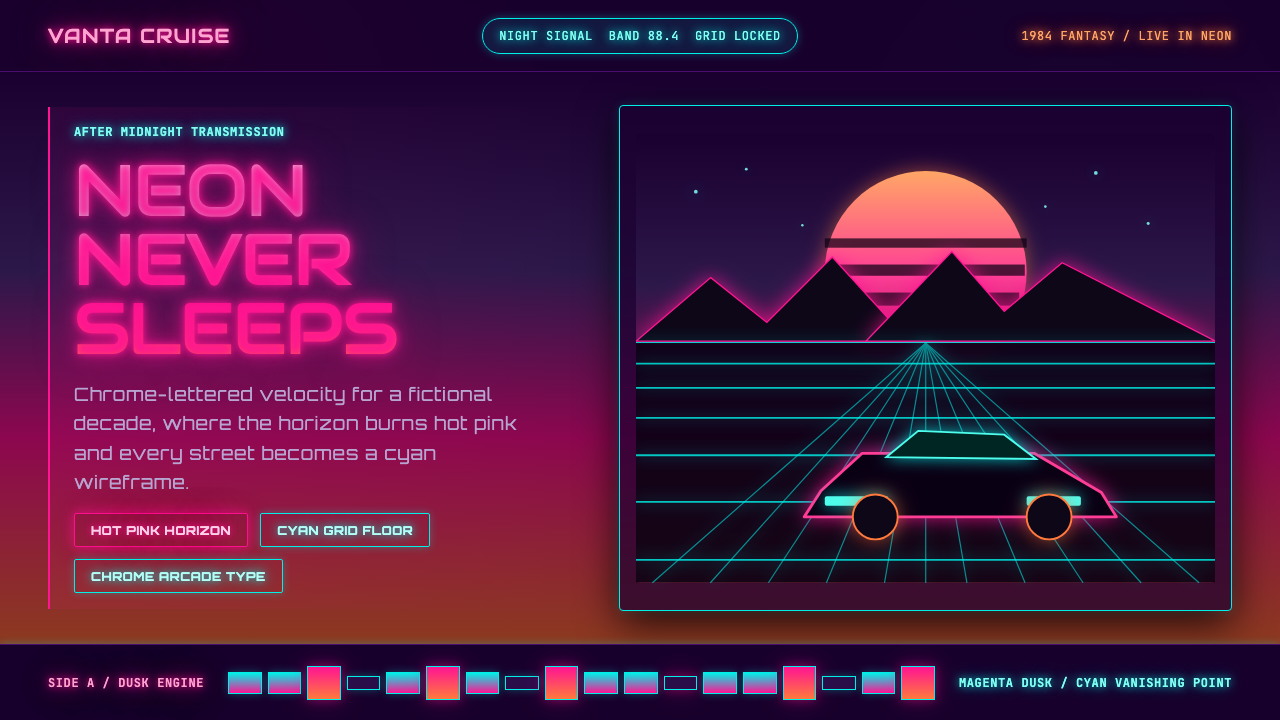 Synthwave Outrun 1984Sincere neon nostalgia. Hot pink sunset, cyan grid, chrome type against pure…
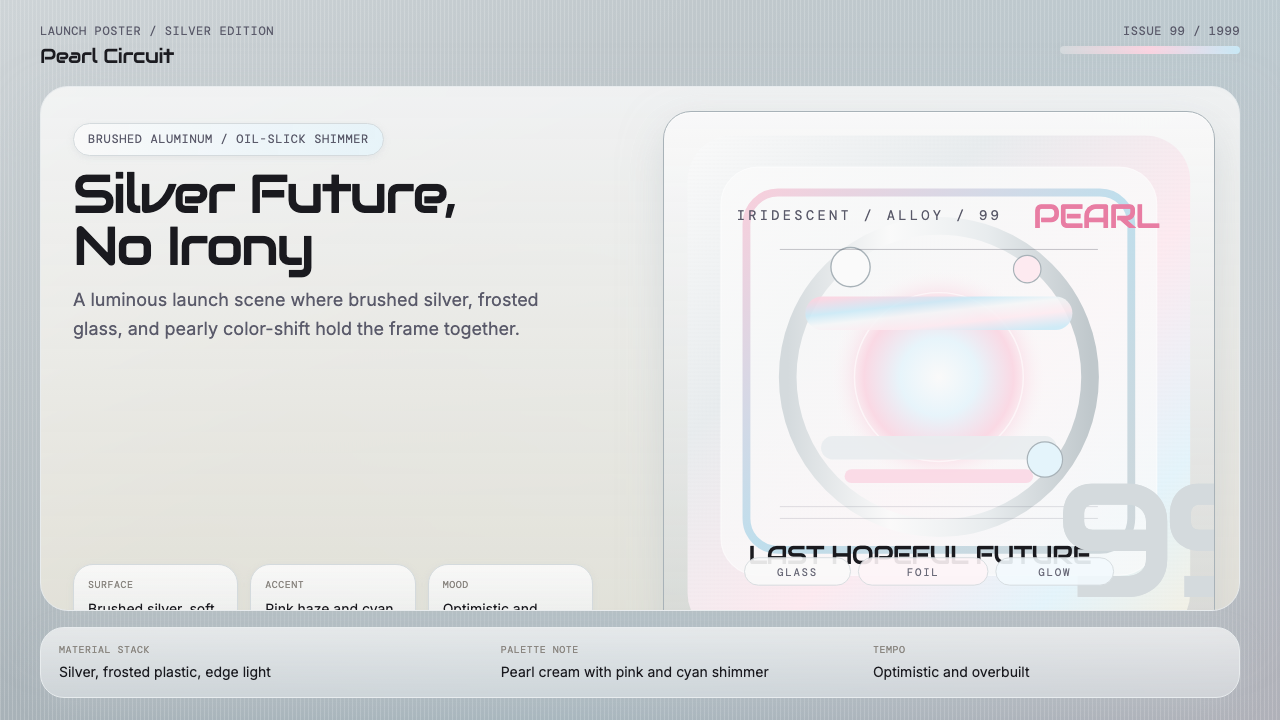 Y2K Aluminum Iridescent (1999)Silver future, no irony. Brushed aluminum with oil-slick pink and cyan shimme…
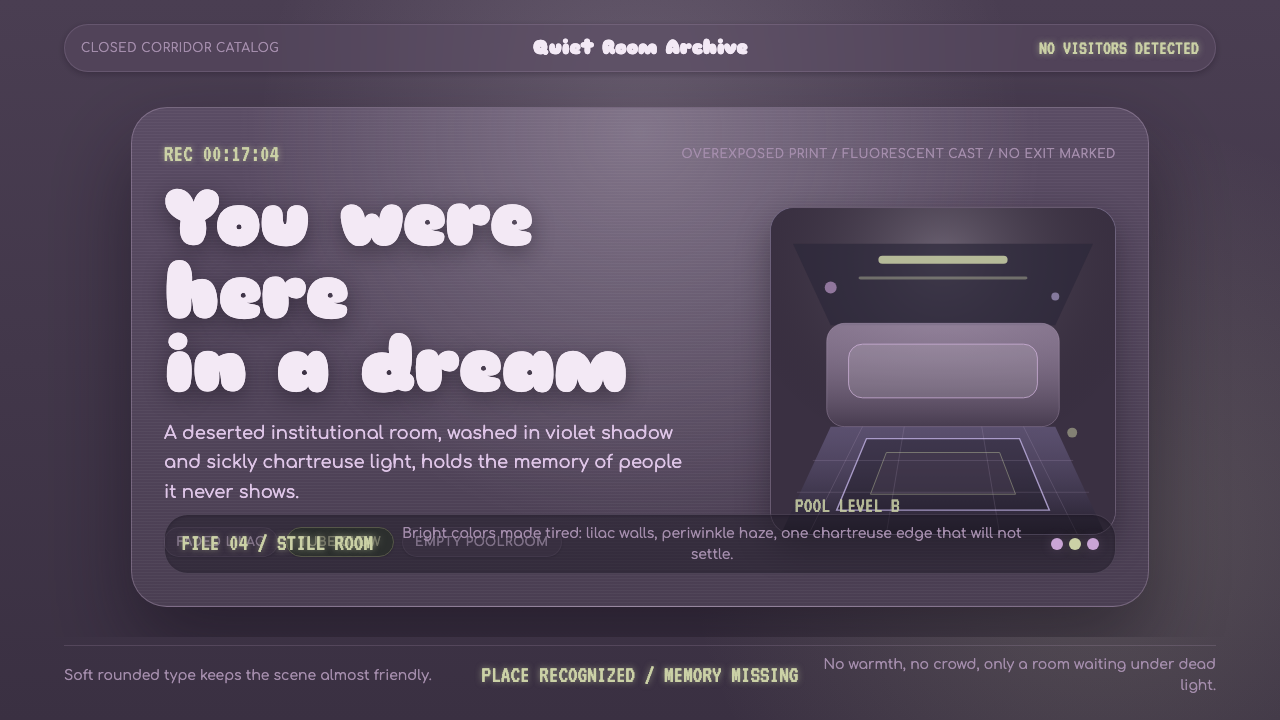 Dreamcore LiminalEmpty rooms feel remembered. Washed violet, Sniglet curves, and chartreuse tu…
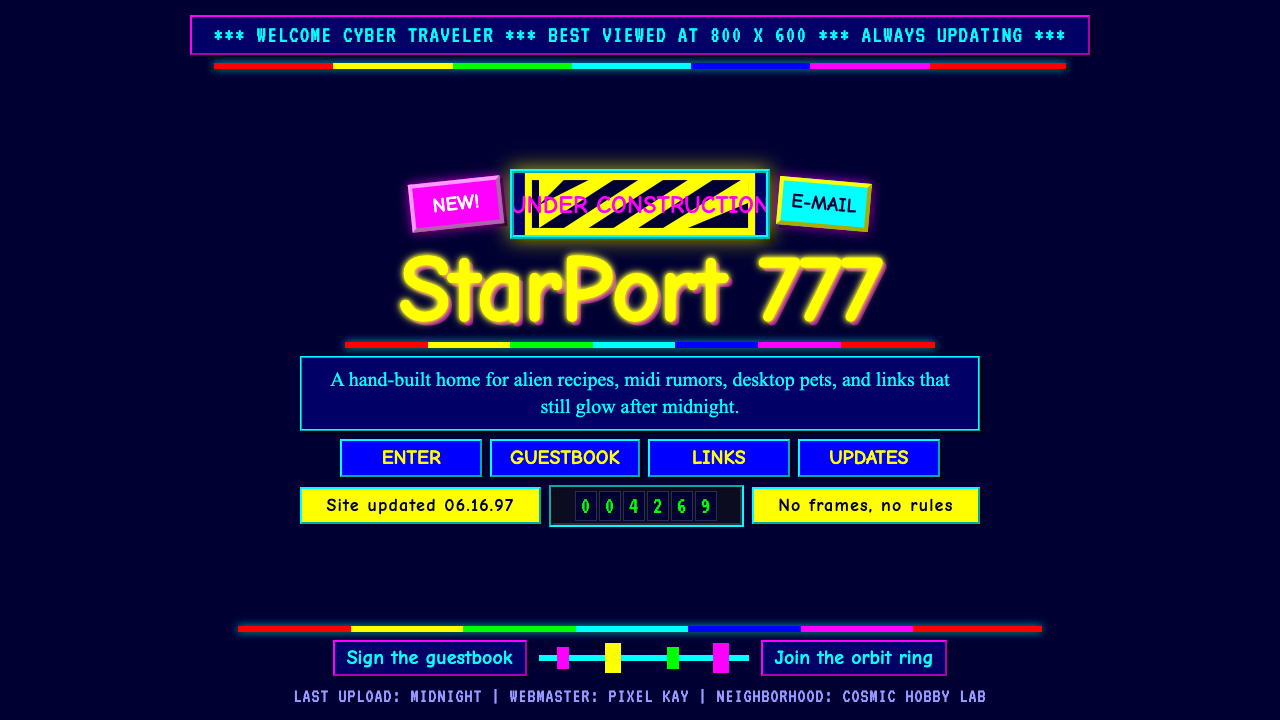 GeoCities Personal WebClutter is celebration. Starfield tiles, cartoon headings, rainbow rules, and…
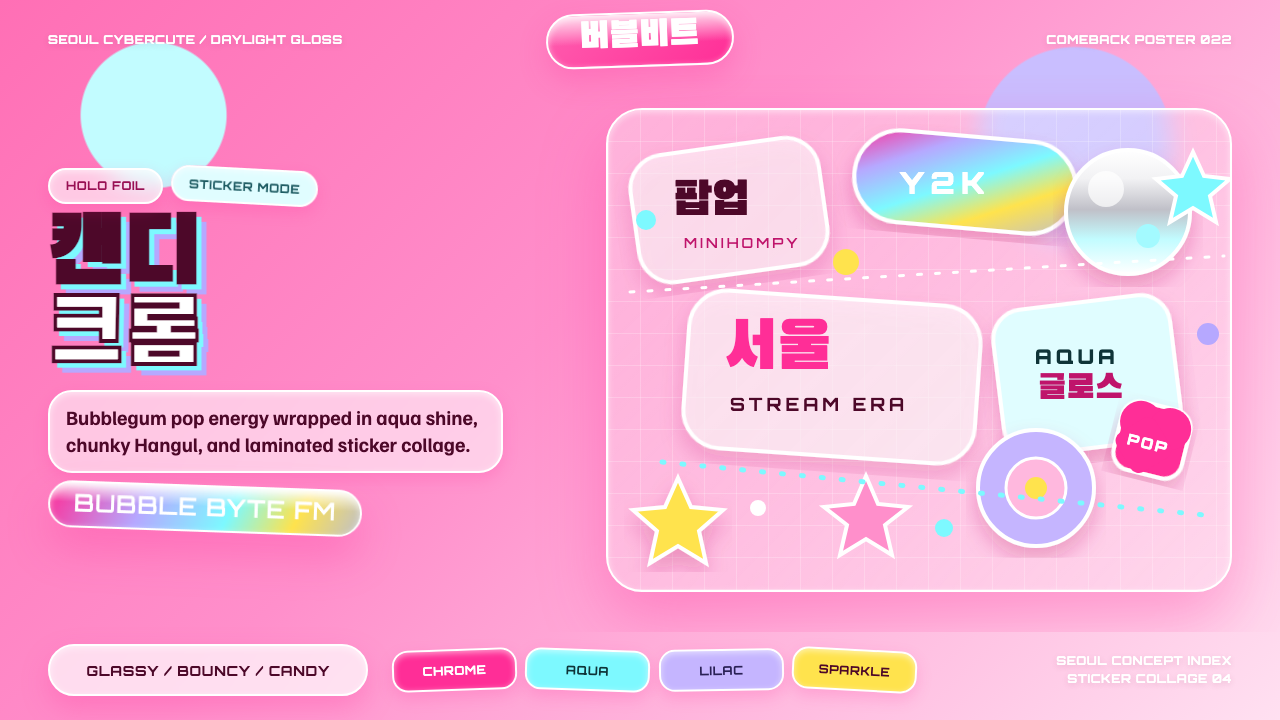 K-Pop Y2K SeoulCandy chrome goes maximal. Hot pink, aqua, Hangul type, and sticker collage s…
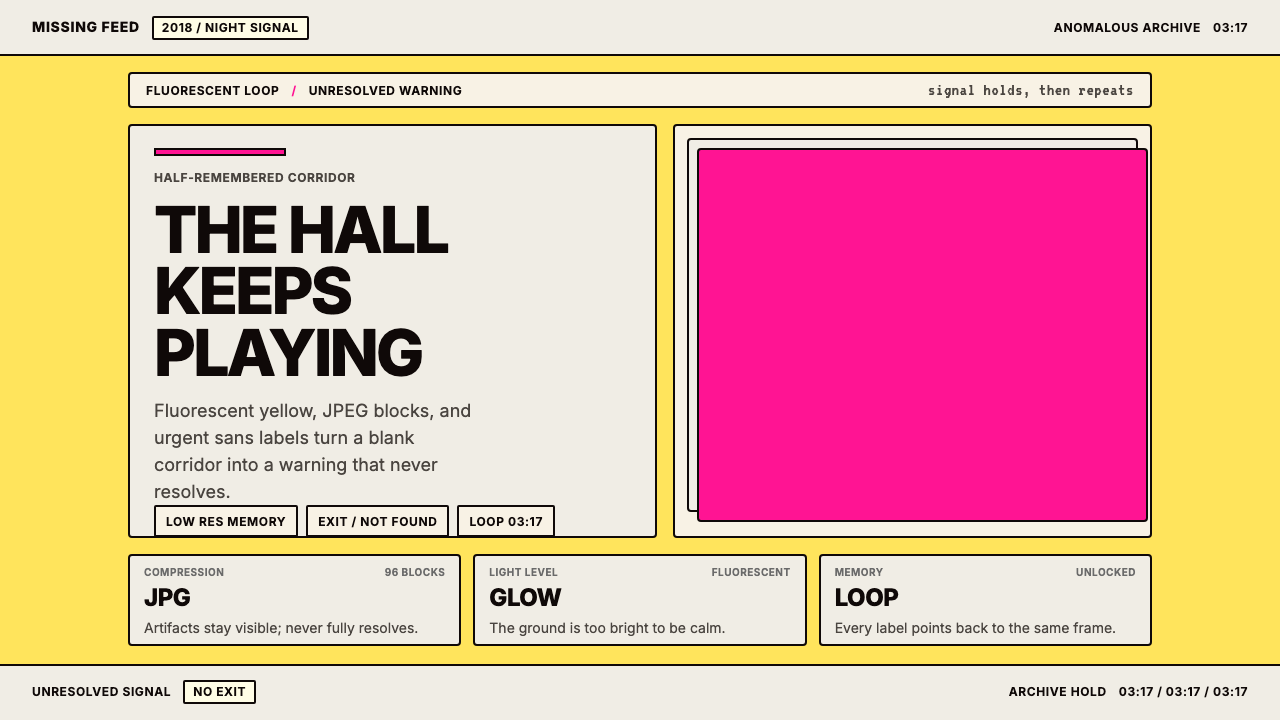 Weirdcore Internet (2018)Wrongness in fluorescent yellow. JPEG blocks and warning labels do the damage.