What is Synthwave Outrun 1984?
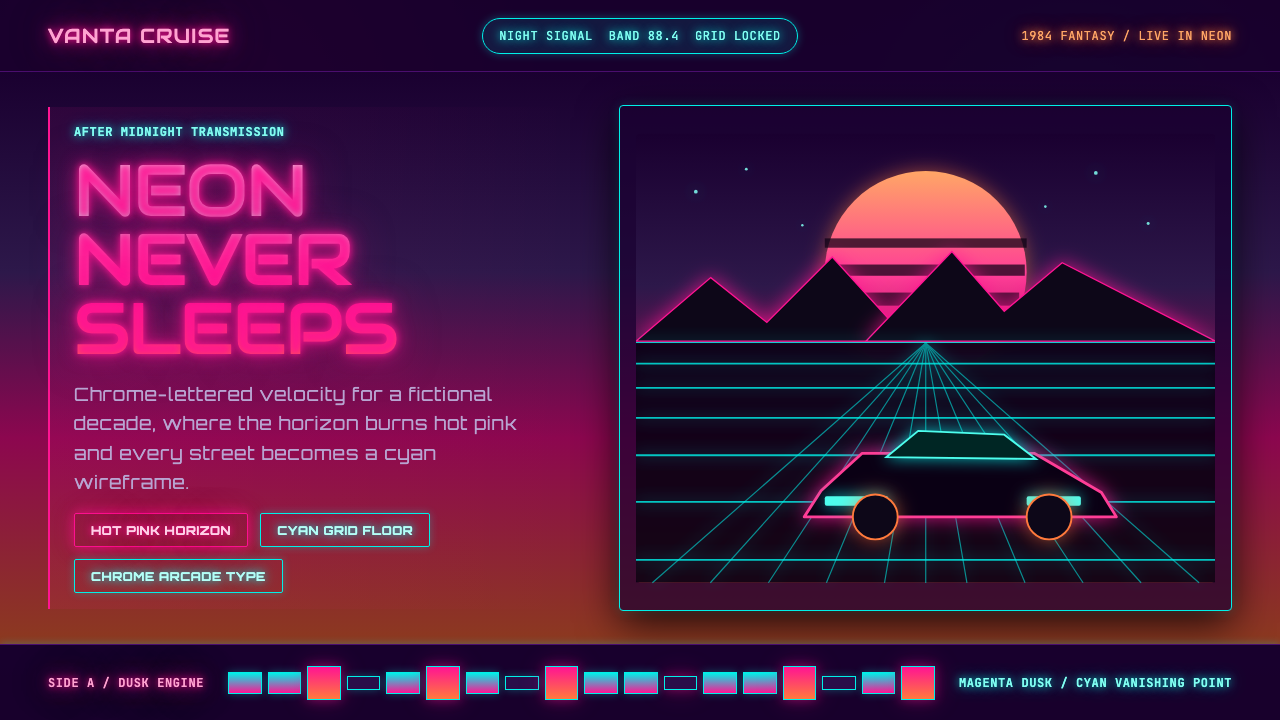
Synthwave Outrun is an earnestly nostalgic aesthetic that renders a fictional 1984 in hot-pink gradients, vanishing cyan grids, and chrome type glowing against absolute black.
Synthwave Outrun 1984 in brief
Synthwave Outrun is a retro-futurist visual style that romanticizes a 1980s that existed more in imagination than in reality — an era of neon-lit arcades, chrome sports cars cutting across open highways, and Miami sunsets saturated beyond what any film stock could hold. Its visual language is built from three primary elements: a hot-pink-to-deep-purple gradient sky, a perspective-grid floor rendered in electric cyan vanishing toward a horizon, and display typography treated as a gleaming metallic object rather than a flat mark.
Unlike vaporwave, which approaches 1980s corporate aesthetics with ironic detachment and deliberately degraded imagery, synthwave is sincere. It does not critique the excess of that era — it celebrates it. The palette runs hot and saturated. Surfaces glow. Chrome reflects imaginary light sources. Every composition reaches toward an idealized nocturnal landscape that feels at once familiar from a hundred science fiction paperback covers and entirely invented.
The style's visual identity is inseparable from the music that produced it. Synthwave as a musical genre emerged around 2010 on platforms like Bandcamp and SoundCloud, drawing on the synthesizer scores of John Carpenter, Tangerine Dream, and Giorgio Moroder. The album art and promotional graphics that accompanied this music — low-fi, often produced by musicians rather than professional designers — codified the aesthetic into a recognizable system: neon outline grids, retrowave sunsets, silhouetted palm trees, and chrome letterforms that the internet named Outrun.

Where does Synthwave Outrun 1984 come from?
The most direct visual ancestor of synthwave Outrun is Sega's 1986 arcade cabinet Out Run, designed by Yu Suzuki. The game's attract screen — a cherry-red Ferrari Testarossa convertible on an open road, a pink-orange horizon gradient behind it, a scrolling palm-lined coastal highway beneath — distilled into a few thousand pixels the entire fantasy of freedom, speed, and warm-climate leisure that the decade was selling to itself. The name 'Outrun' migrated from the arcade game to the aesthetic subcommunity that formed on Reddit's r/outrun around 2012, cementing the connection.
The broader source material runs deep into 1980s popular culture. Michael Mann's Miami Vice (1984–1989) established the visual grammar of pastel suits against blue-black water and neon-reflected wet pavement. The 1982 film Tron introduced the concept of a geometric digital frontier — a space defined entirely by glowing grid lines on a black ground — that became the most enduring motif of the aesthetic. Ridley Scott's Blade Runner (1982) contributed the idea of a nocturnal city drenched in neon, rain, and layered signage. John Hughes films, MTV's early broadcast identity, and the VHS cover art of countless straight-to-video action films provided additional texture.
The music came first, and with it the visual vocabulary. French producer Kavinsky released his early singles around 2006, presenting the persona of a zombie racing driver — a figure of chrome and speed returned from the dead. Perturbator, a French musician, began releasing aggressive synthwave in 2012, his album covers depicting chrome skulls and neon dystopias that drew directly on Outrun's visual language. The Midnight, an American duo, arrived in 2012 with a more melodic variant and sleeve art built from sunset gradients and palm tree silhouettes. These musicians became the de facto visual commissioners of the genre's aesthetic.
The style's internet codification happened simultaneously on multiple platforms. The r/outrun subreddit, founded around 2012, became a gallery and discussion space where artists refined what counted as canonical Outrun: strict horizon-line compositions, the specific pink-to-purple gradient range, chrome letterforms with internal glow, and the vanishing-point grid rendered in cyan against black. Graphic designer James White — working under the name Signalnoise — had been producing synthwave-adjacent work since the mid-2000s, and his painstakingly detailed chrome lettering and neon light treatments became widely cited reference points. By 2015, the aesthetic had crossed from underground music art into commercial gaming, fashion, and eventually mainstream advertising.
What defines the Synthwave Outrun 1984 look?
Gradient Sky
The defining chromatic move of the style is a sky that transitions from hot pink or magenta at the horizon through violet and deep purple toward the top of the frame. This gradient is never subtle — it occupies a large portion of most compositions and is rendered at full saturation, with no midtone graying. The horizon line itself is often marked by a large solar disc, bisected by the horizon, rendered as a flat circle with horizontal scan lines crossing it — evoking the visual artifacts of CRT television and early video games.
Perspective Grid
The lower half of a canonical Outrun composition is almost always a flat plane rendered as a perspective grid — a matrix of lines in electric cyan or magenta converging toward a vanishing point on the horizon. The grid has no texture, no variation, no shading; it is pure geometric information rendered against black. It simultaneously evokes the digital worlds of early videogames, the mathematical sublime of infinite space, and the physical experience of a highway receding toward a horizon. Variations include grids that pulse with animated glow or break apart at the edges, suggesting a world rendered in real time.
Chrome Typography
Display type in the Outrun style is treated as a three-dimensional metallic object rather than a flat graphic mark. Letters appear to be cast in chrome or brushed aluminum, with internal reflections suggesting a horizon line visible within the letterform itself. Outlines glow — typically in the same hot pink or cyan as the palette — creating a halo that separates the type from the black ground. Bevel effects simulate edge highlights. The result is letterforms that look like they belong on a physical trophy or hood ornament rather than on a screen, which is precisely the point: they are objects, not marks.
Neon Glow and Bloom
Every luminous element in the Outrun palette — outline strokes, grid lines, the solar disc, horizon glow — is treated as an actual light-emitting object rather than a colored shape. This is achieved through bloom: a soft, wide halo of color that bleeds outward from the saturated core of any bright element. The technique evokes the optical behavior of neon tubes, CRT phosphor overload, and long-exposure night photography. It gives the style its characteristic feeling of excess — nothing is merely present; everything radiates.
Silhouette and Nocturnal Landscape
Figurative elements in Outrun compositions — palm trees, city skylines, sports cars, motorcycles, mountains — almost always appear as pure black silhouettes against the gradient sky. No detail, texture, or internal shading is visible; only the outline reads. This technique creates maximum contrast between the warm gradient background and the figures in front of it, and it sidesteps the technical difficulty of rendering realistic objects in a style that depends on electronic, non-photographic light. The silhouettes also function as iconographic shorthand: a palm tree means Miami; a mountain range means Pacific Coast; a sports car means 1984.
Scan Lines and CRT Artifacts
A recurring textural layer in the Outrun style is the horizontal scan line — a pattern of very fine dark rules overlaid across the entire composition at regular intervals, simulating the way CRT monitors displayed images. Related artifacts include slight color fringing at high-contrast edges, subtle screen curvature, and vignetting at the corners. These elements do not originate from any specific source material but are abstractions of the physical behavior of cathode-ray display technology, applied wholesale to compositions that would never actually have appeared on a CRT. They serve as a signal of period authenticity — markers that locate the image historically within the technology of a specific decade.
Palette Discipline
Despite its saturated excess, Outrun maintains a surprisingly tight palette: hot pink and magenta for warm tones; electric cyan and teal for cool tones; deep violet and near-black for grounds; chrome and silver for metallic surfaces. Warm orange occasionally appears as a secondary sunset tone. The palette deliberately excludes muted or earthy colors — no beige, no brown, no desaturated grey. Everything reads as artificial, electronically generated, anti-natural. This restriction is what separates an authentic Outrun composition from a merely colorful one: the specific chromatic range signals the style as clearly as any compositional element.

Who shaped Synthwave Outrun 1984?
French electronic musician Romain Cassette, performing under the name Kavinsky, began releasing music in 2006 built around a persona of a zombie racing driver killed in a crash and resurrected as a machine. His 2013 album Outrun — whose title gave the aesthetic subcommunity its canonical name — features cover art and visual branding that became the most widely cited single touchstone of the genre: chrome letterforms, a red sports car at night, a gradient sky. His collaboration with Daft Punk member Guy-Manuel de Homem-Christo brought early attention to the synthwave sound in France and internationally.
Canadian graphic designer James White, working under the studio name Signalnoise, spent the mid-2000s through 2010s producing a body of illustration and typography that became the visual foundation of the synthwave Outrun aesthetic. His chrome lettering — metallic, beveled, internally reflective — and his neon glow treatments were produced using software layer effects at a time when most designers considered such techniques kitsch. His meticulous, technically demanding approach elevated the treatment to something approaching fine craft, and his publicly shared tutorials disseminated the technique across the design community.
Scottish producer Ryan Beveridge, releasing music under the name FM-84, became one of the most influential artists in defining synthwave's visual and sonic vocabulary in the mid-2010s. His 2016 debut album Atlas — featuring cover imagery of a figure in a windbreaker against a sunset gradient, with retrowave typography — crystallized the aesthetic's shift toward a more romantic, introspective register. The album's visual treatment demonstrated that the Outrun palette could support emotional nuance beyond chrome excess, broadening the style's application.
American duo Tyler Lyle and Tim McEwan, releasing as The Midnight, brought a more song-oriented approach to synthwave beginning in 2012. Their visual identity — warm sunset gradients, soft neon, nostalgic photography treated with color grading — occupies a slightly softer register than the harder-edged Outrun tradition, but their commercial success and their extensive collaboration with visual artists helped establish synthwave's legitimacy beyond the underground internet community. Their approach demonstrated that the aesthetic could carry mainstream emotional weight without sacrificing its period-specificity.
French musician James Kent, recording as Perturbator, contributed the darker, more aggressive register of synthwave visual culture. His album covers — typically featuring chrome skulls, dystopian cityscapes, and figures in neon-lit rain — drew the style toward industrial and cyberpunk adjacency. Perturbator's work demonstrated the breadth of the aesthetic's expressive range: the same palette of electric cyan, deep purple, and hot pink that reads as nostalgic romance in one artist's hands reads as menacing futurism in another's. This tension between warmth and threat is one of the style's most productive contradictions.
How do you use Synthwave Outrun 1984 today?
Synthwave Outrun is among the most visually distinctive styles available to a designer, which makes it both powerful and demanding: its chromatic intensity and period-specific references create instant atmosphere, but they also limit where the style can credibly land. Applied correctly, it suits products and contexts where nocturnal energy, retro-futurist aspiration, and a degree of dramatic excess are brand-appropriate. Applied carelessly, it risks reading as costume rather than design — a palette borrowed from album art without understanding the structural logic beneath it.
For presentation slides, the style's cover page is its strongest moment. A full-bleed gradient sky from hot pink to deep violet, bisected by a cyan grid floor vanishing toward the horizon, provides an immediately arresting background. Title text should be treated as a luminous object: enlarged to fill significant horizontal space, rendered with visible edge glow or a chrome treatment, set against the dark upper half of the gradient. Content slides require restraint — the full Outrun palette cannot sustain forty minutes of body text. Reduce to a near-black background with a single neon accent color for headings, thin horizontal rules in a cool tone for section breaks, and avoid the perspective grid on every slide or it becomes wallpaper. Data slides work well when chart elements — bars, lines, nodes — are rendered as glowing strokes rather than filled shapes, allowing the grid aesthetic to extend into the data visualization itself.
For web UI, Outrun is well-suited to dark-mode dashboards, gaming platforms, music streaming interfaces, and any product where a nocturnal, high-energy aesthetic aligns with user expectations. The approach: use a near-black or very deep violet ground throughout; deploy neon accent tones — one warm, one cool — for interactive states, active indicators, and calls to action; reserve gradient treatments for hero sections, modals, or empty states rather than applying them to every surface. Navigation and body text should remain clean and high-contrast against the dark ground; the neon palette is accent infrastructure, not ambient wallpaper. For pricing pages or feature tiers, the perspective grid floor motif can appear as a decorative panel below hero content without overwhelming the functional hierarchy.
For editorial and marketing work, Outrun functions best when it is used to establish a single dominant mood image rather than carried through every layout element. A campaign hero visual built on the full palette — gradient sky, grid, chrome type — reads as confident and cohesive; attempting to style body copy, callout boxes, and footer links in the same vocabulary creates visual noise. Marketing materials for music, gaming, automotive brands, and technology products with a retro-futurist positioning benefit most directly. The style also works well for event promotion — conference covers, festival posters, and speaker-series visuals — where the theatrical intensity matches the promotional objective.
The most common mistake when applying Outrun is treating the neon palette as decoration rather than structure. Authentic Outrun work uses glow to indicate luminosity — things that actually emit light within the composition. When glow is applied indiscriminately to text, borders, icons, and backgrounds simultaneously, the result is visual noise with no hierarchy. A second common error is flattening the gradient: using too short a transition from pink to purple, or using a gradient that shifts toward brown or grey rather than staying in the pure violet register, immediately reads as off-palette. Third: chrome typography is technically demanding and collapses at small sizes — it should be reserved for display-scale headlines only, with body text set in a clean, contemporary typeface at high contrast against the dark ground.

Synthwave Outrun 1984 — FAQ
Is Synthwave the same as Vaporwave?
They are distinct aesthetics with overlapping source material but opposite emotional registers. Vaporwave, which emerged around 2011–2012, approaches 1980s and early 1990s corporate and consumer culture with ironic detachment — pastel palettes, degraded imagery, elevator music slowed to a crawl, and a critique of late capitalism embedded in its sampling practice. Synthwave is sincere: it loves the 1980s without reservation and renders that love in hot, saturated color rather than washed-out pastels. Vaporwave looks at the era through the lens of cultural theory; synthwave looks at it through the windshield of a Ferrari at sunset.
Can Outrun work in light-background layouts?
With difficulty. The Outrun palette was born on black — electric cyan and hot pink glow because they are bright against darkness, and the chrome lettering reads as metallic because it reflects an implied dark environment. On a white or light-cream ground, neon tones flatten into ordinary saturated color, glow effects become impossible, and chrome letterforms read as garish rather than luminous. A partial exception exists for print-scale work where a warm cream ground can anchor a single neon accent color without the full palette, but this produces a style adjacent to Outrun rather than the genuine thing. If a light background is required, a different style will almost always serve better.
How do I prevent the style from looking like a Halloween or 1980s costume party?
By understanding the difference between the style's structural elements and its period markers. The structural elements — the gradient sky logic, the vanishing-point composition, the glow-as-luminosity principle, the tight palette discipline — can be deployed in contemporary work without evoking pure pastiche. The period markers — scan lines, chromatic aberration, CRT curvature, explicit retro typography — should be used selectively and purposefully, not layered simultaneously. The most effective contemporary Outrun work takes the chromatic and compositional logic seriously while exercising restraint with period signifiers. One scan line overlay reads as period-aware; five simultaneous retro effects read as costume.
What makes Outrun distinct from generic dark neon design?
Generic dark neon design uses neon tones as accent color against a dark background. Outrun is a complete compositional system: the gradient sky, the vanishing-point grid, and the chrome typography are not interchangeable decorative elements — they are specific conventions that reference specific source material (the arcade game's attract screen, the Miami Vice aesthetic, the Tron digital frontier). Using a dark background with cyan and pink accents produces a dark neon layout. Using a hot-pink-to-violet gradient sky, a cyan perspective grid floor, and chrome display type in a single composition produces Outrun. The referential specificity is what separates the style from generic neon darkness.
Is the style suited to professional or corporate contexts?
Only selectively. Outrun's theatrical intensity and explicit nostalgia make it unsuitable for contexts that require communicating authority, neutrality, or institutional trust — financial services, healthcare, legal, government, and most enterprise software. It works well where the product itself has a recreational, entertainment, or aspirational technology dimension: gaming companies, music platforms, event businesses, performance automotive brands, and consumer technology products with a design-forward identity. A conference or internal presentation that uses Outrun as a one-time expressive device — a bold cover, a memorable opening — can succeed; a company that adopts it as its primary brand language needs to be certain its audience skews toward audiences who find the aesthetic legible and appealing rather than dated or frivolous.
Related design styles
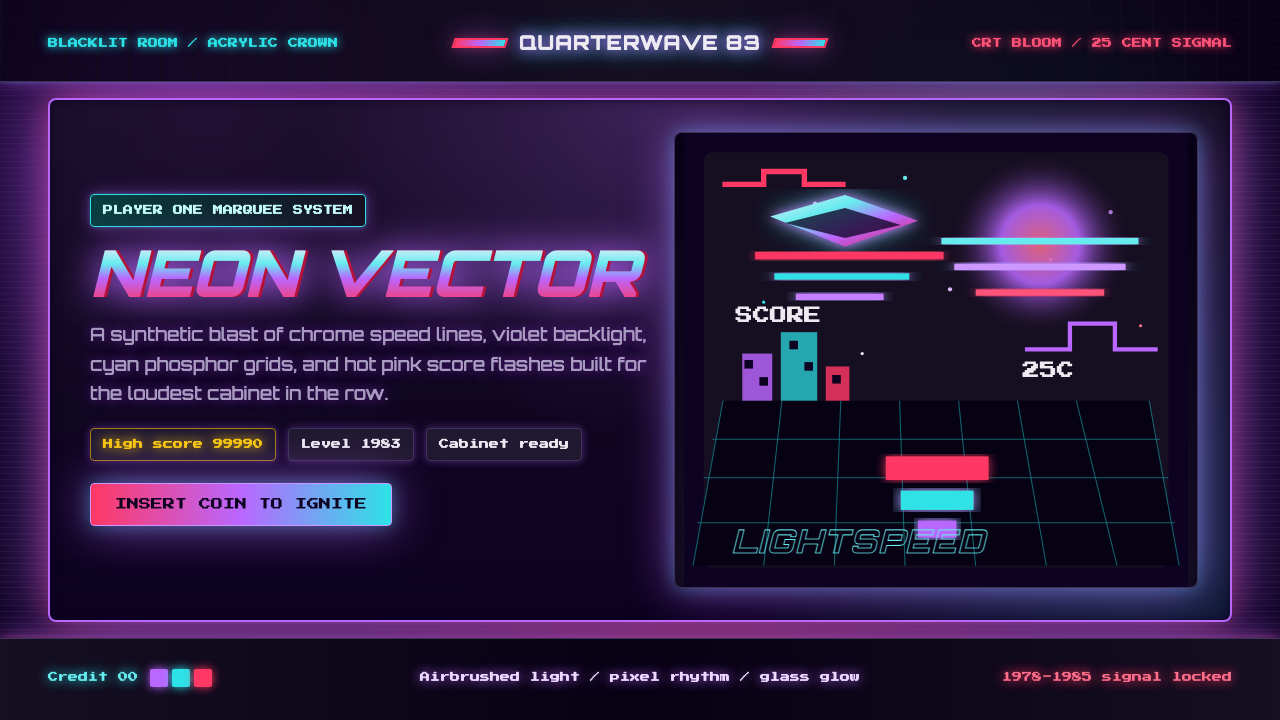 Arcade Cabinet MarqueeToo loud to ignore. Black-indigo glass, violet glow, cyan grids, hot-pink arc…
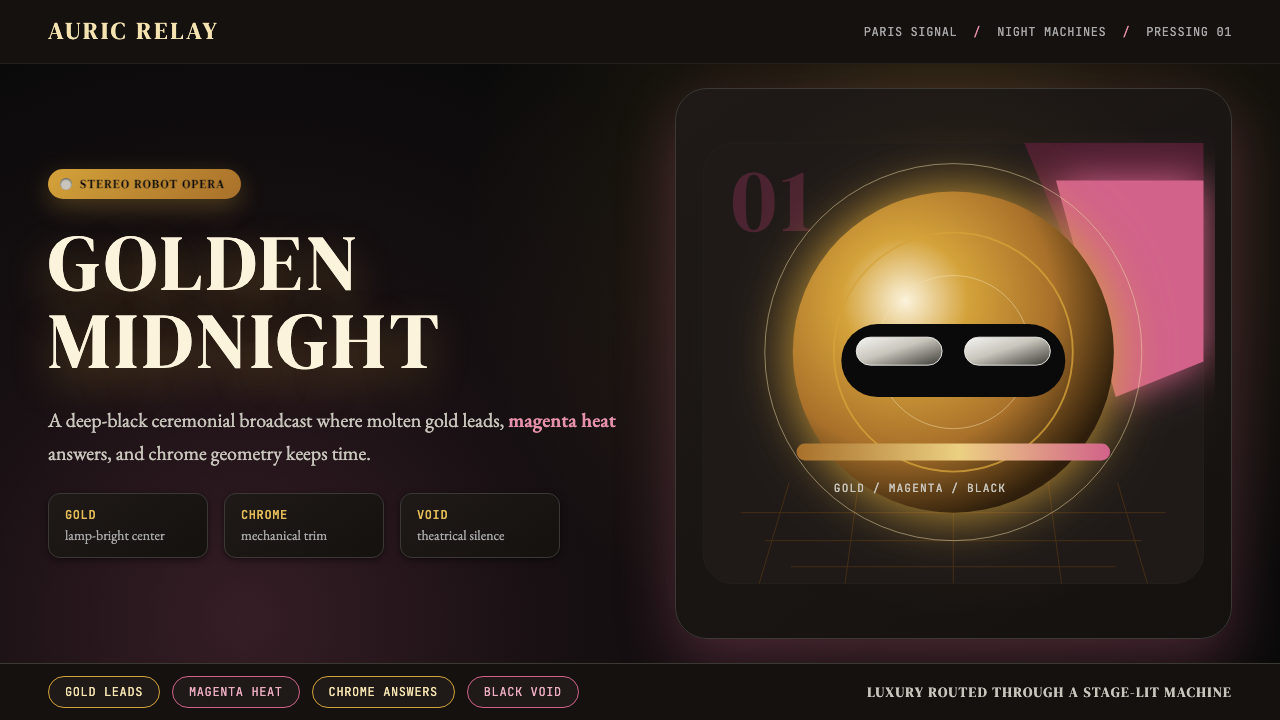 Daft Punk Discovery (Gold-Helmet)Warm sci-fi disco. Gold serif caps orbit a magenta void with chrome-disc geom…
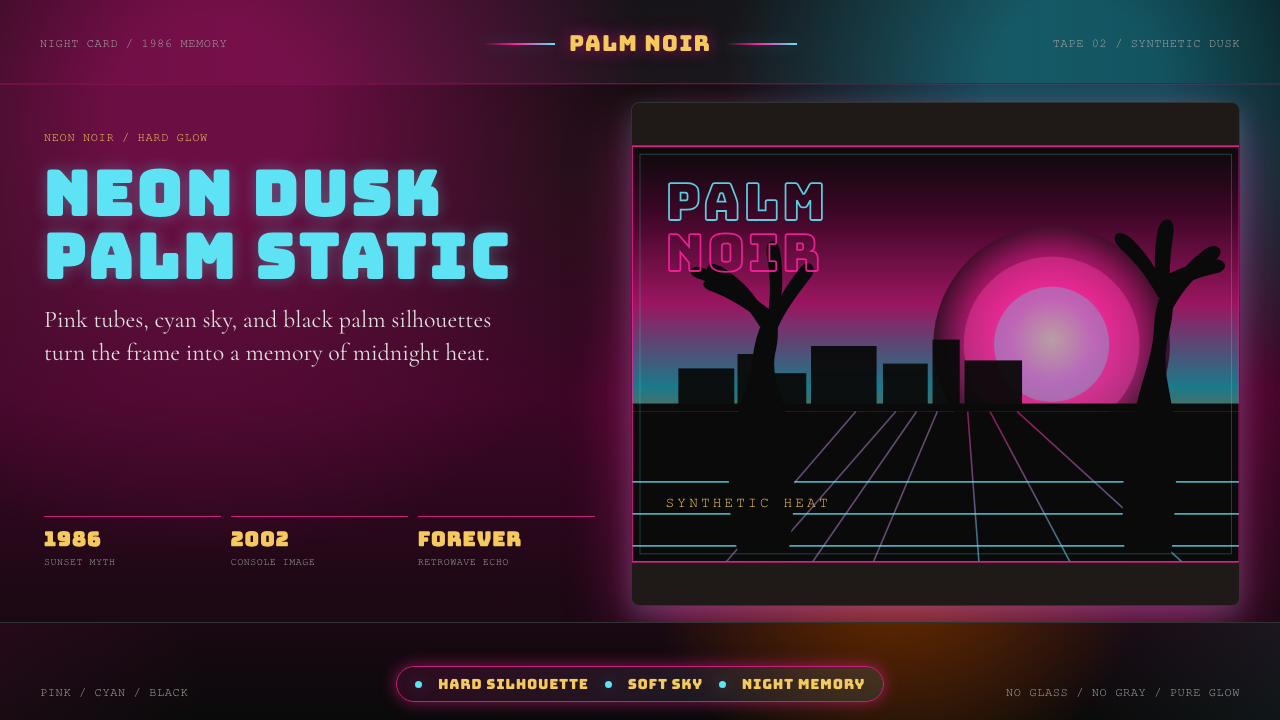 GTA Vice City (2002)Neon-noir nostalgia. Pink-cyan dusk, chunky type, and palm silhouettes.
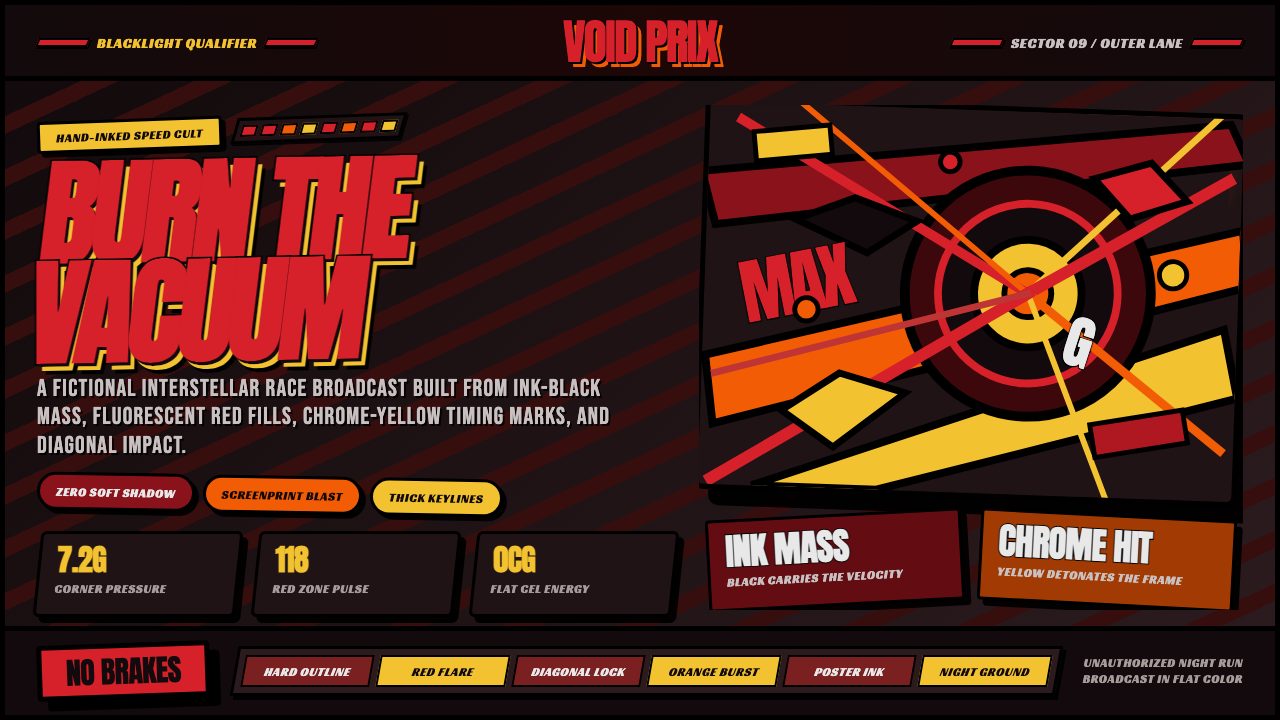 Redline Space RaceSpeed made violent. Ink-black mass, racing red, chrome yellow, and diagonal k…
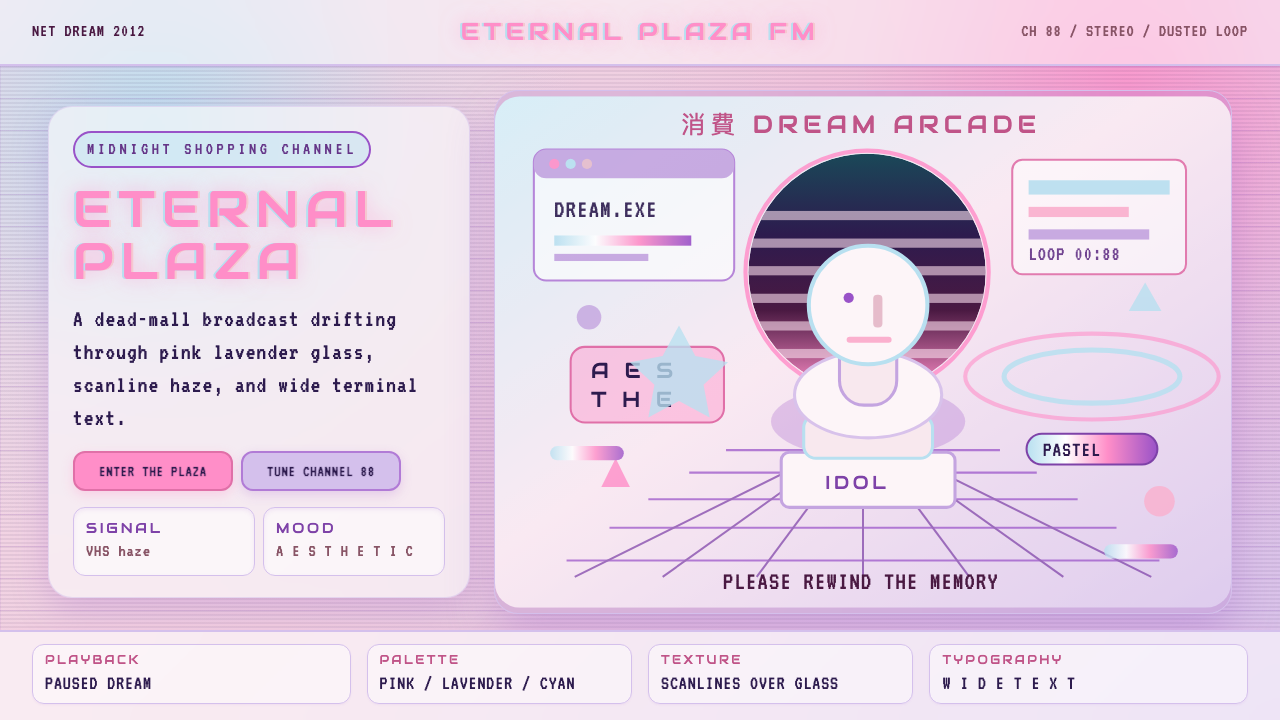 Vaporwave (Tumblr 2012)Dead-mall nostalgia glows. Pink-lavender glass, VHS scanlines, and wide retro…
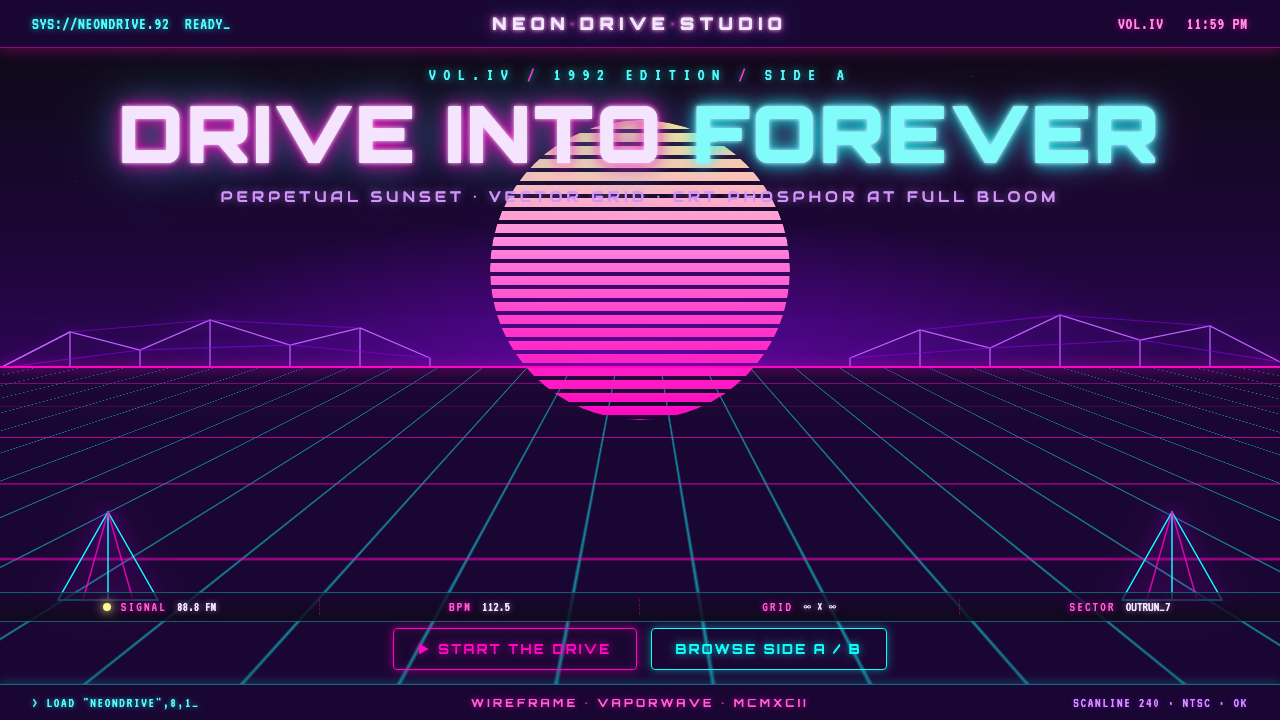 Wireframe VaporwaveDrive into forever. Magenta-cyan grid races to a vanishing point under a stri…