What is Mandelbrot Fractal?
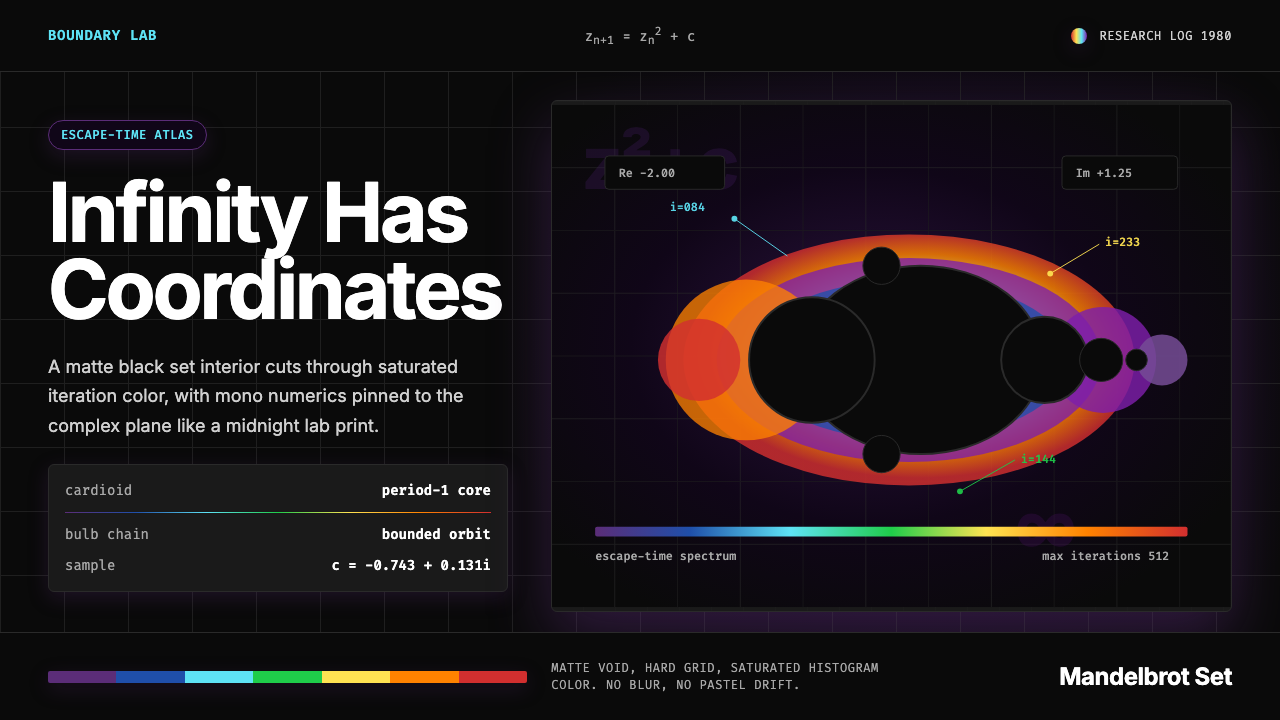
In 1980, a single equation rendered on a laboratory display became the founding image of generative art — and the most recognizable mathematical object ever drawn.
Mandelbrot Fractal in brief
Mandelbrot Fractal is a design aesthetic rooted in the visual language of the Mandelbrot set — the famous mathematical object defined by iterating a simple complex-number formula and recording whether each point escapes to infinity or remains bounded. The signature image is a deep, near-black void (the bounded interior of the set) surrounded by a luminous halo of saturated color bands, where each band maps a range of iteration counts before escape. The overall effect is simultaneously scientific and psychedelic: precision at the core, wild spectral energy at the boundary.
The aesthetic is organized around contrast — black against maximum saturation, hard geometric edges against infinitely complex fractal curves, the monospaced numerics of computation against the organic sprawl of iterative mathematics. Color is deployed as data, not decoration: the rainbow progression from deep violet through cyan, green, yellow, orange, and red encodes mathematical information about how quickly a region diverges. This is a palette that earns its vibrancy rather than applying it arbitrarily.
Because the Mandelbrot set is self-similar at every scale — zooming into any part of the boundary reveals structures that echo the whole — the aesthetic carries an implied sense of infinite depth. Design work that draws on this vocabulary naturally suggests complexity beneath the surface, systematic order underlying apparent chaos, and the idea that looking closer always reveals more rather than less.

Where does Mandelbrot Fractal come from?
The Mandelbrot set was not invented so much as discovered. Benoit Mandelbrot, working at IBM's Thomas J. Watson Research Center in Yorktown Heights, New York, had spent decades developing a mathematics of roughness — arguing that the irregular, fragmentary forms that classical geometry ignored (coastlines, clouds, market fluctuations, tree branching) were in fact the dominant geometry of the natural world. He coined the term 'fractal' in 1975, derived from the Latin 'fractus' meaning broken or irregular, to describe these self-similar structures at every scale.
The set that bears his name was first described mathematically by Pierre Fatou and Gaston Julia in the early twentieth century, but it could not be visualized without a computer. In 1980, Mandelbrot used the computing resources at IBM Yorktown Heights to generate the first printed image of the set on a Tektronix display — a coarse but unmistakable rendering of the cardioid-and-bulbs silhouette that would become one of the most reproduced scientific images in history. The following year, Mandelbrot published his landmark book 'The Fractal Geometry of Nature' (1982), which brought fractal mathematics to a broad audience and established the visual identity of the field.
The aesthetic development of fractal imagery accelerated rapidly through the 1980s as personal computing became more powerful. Programmers discovered that with a home computer and sufficient patience, they could generate their own Mandelbrot explorations. The introduction of color monitors transformed the images: what had been black-and-white mathematical diagrams became vivid, almost overwhelming spectacles. The iteration-count coloring algorithm — assigning a distinct hue to each escape-speed band — was not Mandelbrot's own invention but emerged from the broader community of fractal enthusiasts who shared algorithms through early bulletin board systems and magazines like Scientific American.
By the late 1980s and early 1990s, Mandelbrot fractal imagery had migrated into popular culture. It appeared on album covers, in film title sequences, in science fiction illustration, and as the canonical image of chaos theory in popular science books. The 1980s fractal aesthetic — deep dark backgrounds, rainbow iteration halos, monospaced coordinate readouts — became strongly associated with a particular moment in computing culture: the transition from purely textual interaction to visual computation, the excitement of seeing mathematics made visible for the first time.
What defines the Mandelbrot Fractal look?
Color as Data
The defining characteristic of the Mandelbrot aesthetic is that color is not decorative but informational. The rainbow spectrum — progressing from deep violet and indigo through cyan, green, yellow-green, yellow, orange, and red — maps the speed at which points near the set's boundary escape to infinity. Each band represents a measurable mathematical quantity. This means the palette is both visually extreme and rigorously justified: the saturation is earned by the underlying computation, not applied for effect.
The Deep Dark Interior
The bounded interior of the Mandelbrot set — the region of points that never escape — is rendered as a pure, near-featureless black or deep-space dark. This interior functions as the visual anchor of any composition that draws on the aesthetic: a hard, polished darkness against which the spectral halo radiates outward. In design applications, this translates to a dark background philosophy where the background is not merely unlit but actively absorptive — a void that makes surrounding color luminous by contrast.
Self-Similar Complexity
The Mandelbrot set is infinitely complex at its boundary: zooming in reveals new tendrils, spirals, and miniature copies of the whole set nested within the detail. This self-similarity at every scale gives fractal-derived design its distinctive quality of implied depth — the sense that the image rewards closer inspection indefinitely. In practice, this characteristic is evoked through layered detail, nested repetition of motifs at multiple scales, and compositions where the eye can travel from broad structure to fine detail without exhaustion.
Monospace and the Computational Voice
Typography in the Mandelbrot aesthetic draws from the computer terminal tradition: monospaced letterforms that carry the visual authority of machine output, numerical readouts of coordinates and iteration parameters, and a general sense that the text is data rather than prose. This typographic vocabulary signals scientific precision and computational origin. Numbers are treated as design elements — coordinates, zoom levels, and iteration counts rendered in a size and weight that makes them part of the composition rather than incidental labels.
Spectral Luminosity
The color halo surrounding the Mandelbrot set's interior is not merely colorful but actively luminous: the hues appear to emit light rather than reflect it. This quality arises from the extreme contrast between the near-black background and fully saturated foreground colors. In design work, this effect is achieved by pairing deep, absorptive backgrounds with colors pushed to the limit of their saturation — creating the impression that the light source is internal to the design rather than falling on it from outside.
Precision at Infinite Scale
The Mandelbrot set is defined by perfect mathematical precision — the same formula, applied recursively, generates all the complexity. This underlying precision gives the aesthetic its authority: despite the apparent wildness of the imagery, everything is the product of a deterministic rule. Design that draws on this quality combines visual intensity with structural rigor — elements that appear complex or energetic should have an underlying organizational logic, not be chaotic for its own sake.
Dark Mode as Native State
Unlike many historical design aesthetics that were adapted for dark contexts from an original light-ground conception, the Mandelbrot aesthetic is natively dark. The CRT displays of 1980 emitted light against darkness; the set's interior is mathematically black; the rainbow halo only achieves its full luminous effect against a dark surround. Any light-background application of this aesthetic is a translation rather than a native expression, and it requires significant adjustment to the color relationships to preserve the sense of luminosity and depth.

Who shaped Mandelbrot Fractal?
Mandelbrot (1924–2010) was a Polish-born French-American mathematician who spent most of his research career at IBM. His foundational insight was that irregular, fragmented shapes — long dismissed as mathematical curiosities or noise — were in fact a coherent geometry describing much of the natural world. His 1982 book 'The Fractal Geometry of Nature' synthesized decades of research and introduced the term 'fractal' to a popular audience. The Mandelbrot set, though described by earlier mathematicians, became the public face of his ideas because it so vividly demonstrated that enormous visual complexity could emerge from an elementary rule.
IBM's Thomas J. Watson Research Center provided Mandelbrot with the computational resources — rare and costly in 1980 — needed to generate the first high-resolution renderings of the set. IBM's institutional support was essential to the aesthetic's birth: without access to mainframe computing power and high-resolution plotters, the images would have remained purely mathematical abstractions. The center's culture of supporting fundamental research alongside commercial development made it one of the few places where this kind of exploratory visualization could happen in 1980.
The mathematical foundations for the Mandelbrot set were laid by French mathematicians Pierre Fatou and Gaston Julia in the years around the First World War. Working independently, both studied the iteration of complex functions and discovered the strange, infinitely intricate boundary regions — now called Julia sets — that appear when such functions are iterated. Julia, who had been severely wounded in the war and conducted much of his work while recovering, published his foundational memoir in 1918. Their work was largely forgotten until computers made visualization possible, at which point Mandelbrot's images brought their ideas to global attention.
Loren Carpenter was a Boeing engineer who in 1980 — the same year Mandelbrot rendered the set — demonstrated that fractal mathematics could generate photorealistic mountain landscapes for computer graphics. His short film 'Vol Libre,' shown at the SIGGRAPH conference, used recursive subdivision based on fractal principles to create terrain no artist had drawn. This demonstration helped establish that fractal geometry was not just a mathematical curiosity but a practical tool for synthetic imagery, opening a branch of computer graphics that influenced film, video games, and eventually generative design for decades.
A single article in Scientific American's 'Computer Recreations' column, written by A.K. Dewdney in August 1985, democratized fractal image generation. Dewdney provided a simple algorithm that readers could implement on home computers to generate Mandelbrot and Julia set images. The response was overwhelming: the magazine received more reader mail for this article than for almost any other in its history. This moment — when the fractal aesthetic became reproducible by anyone with a home computer — established the visual vocabulary that the 1980s computing culture would associate with mathematical beauty and generative art.
How do you use Mandelbrot Fractal today?
Mandelbrot Fractal is a high-intensity aesthetic that rewards deliberate application. Its power lies in its visual authority — the combination of scientific precision and overwhelming spectral energy communicates complexity, depth, and intelligence. These qualities make it well-suited to specific contexts: data science and analytics platforms, generative art and creative technology presentations, scientific visualization products, and any project where signaling computational sophistication is a core goal.
For presentation slides, the aesthetic works best on full-bleed dark backgrounds where the spectral color can achieve its full luminous effect. A cover slide should embrace the depth: a zoomed fractal detail as the background image, with a title set in monospaced or geometric type, light against the dark. The title can sit near the cardioid center or in a clear region of the fractal — the mathematical image provides natural compositional structure. Content slides benefit from restraint: pull back to a near-black background with a single luminous accent color rather than the full rainbow, using the spectral palette to highlight key data or call-outs rather than fill the entire field. Data visualizations — charts, graphs, network diagrams — fit naturally in this aesthetic when rendered with the iteration-count color logic: ordered categorical data mapped to a portion of the spectral progression, with the background dark and labels in a cool, light neutral.
For web interfaces, the aesthetic is well-matched to dashboards, analytics platforms, terminal-style developer tools, and computational or scientific products. The approach: commit to a dark-mode-first design, use deep space tones for backgrounds and surface layers, and introduce the spectral accent colors with discipline — one or two hues at a time, deployed to indicate activity, status, or hierarchy rather than applied broadly. Interactive elements can use the rainbow progression to encode states or data dimensions, maintaining the data-as-color logic of the source material. Text should stay in cool neutrals or near-white to remain legible against dark backgrounds; avoid warm whites that fight the cool spectral palette.
For editorial and marketing applications, the style suits contexts that want to evoke the edge between science and art: technology companies, AI products, data infrastructure, generative creative tools, and scientific publishing. A feature section designed in this aesthetic might use a dark full-width background with a fractal-inspired radial gradient or interference pattern, overlaid with clean geometric type. The rainbow accent should be used sparingly and consistently — perhaps reserved for a single product feature callout or a navigational highlight — rather than scattered across the page. Print applications such as posters or book covers can lean fully into the spectral depth: the combination of deep black and maximum-saturation spectral color prints with striking physical presence when production quality is high.
The most common mistake when applying Mandelbrot Fractal aesthetics is mistaking the rainbow palette for permission to use every hue simultaneously at full blast. The original images are compelling precisely because the color is ordered — a smooth, mathematically determined progression where each hue occupies its correct place in a sequence. Random multicolor combinations, neon palettes assembled by feel, or warm colors mixed into the spectral progression all break the underlying logic and produce noise rather than depth. Similarly, applying the dark background and spectral colors to a design that lacks structural rigor will feel chaotic rather than complex — the aesthetic requires clean underlying geometry, clear hierarchy, and disciplined use of space to communicate its characteristic sense of ordered infinity.

Mandelbrot Fractal — FAQ
Is this aesthetic only appropriate for dark backgrounds?
The Mandelbrot aesthetic is natively dark — the set's interior is mathematically black, and the spectral halo was first seen glowing against the darkness of a CRT screen. Light-background applications are possible but require significant adjustment. On a white or light ground, the spectral colors lose their luminous quality and can read as garish rather than radiant. If you must work light, reduce the palette to one or two spectral hues used as accent colors against a near-white field, treat the remaining elements in deep neutral tones, and avoid the full rainbow progression entirely. The result will be a softer interpretation that retains the computational vocabulary without the full depth effect.
How is Mandelbrot Fractal different from generic 'cyberpunk' or 'neon' aesthetics?
The superficial similarities — dark backgrounds, saturated bright colors — can make these aesthetics look related, but their underlying logics are entirely different. Cyberpunk and neon aesthetics are primarily atmospheric: they use color for mood, cultural signaling, and visual excitement without an underlying structural rationale. Mandelbrot Fractal derives its color from a precise mathematical rule — each hue encodes a quantity, and the progression is ordered and determined. This means authentic Mandelbrot aesthetic has an internal rigor that distinguishes it from neon decoration: the color is never arbitrary, the dark background is never just fashionable, and the complexity is always organized rather than chaotic.
Can the fractal image itself be used literally, or should the aesthetic be abstracted?
Both approaches are valid and serve different purposes. Using a literal fractal rendering — a zoom image of the Mandelbrot set or a Julia set — provides immediate scientific legibility and direct visual authority. It works best when the reference to fractal mathematics is intentional and meaningful, such as for mathematical software, a science communication project, or a generative art context. An abstracted approach — borrowing the dark background, the spectral color progression, and the sense of layered complexity without showing an actual fractal — is more versatile and avoids the risk of looking like a 1990s screensaver. The abstracted version suits commercial products that want to evoke mathematical depth without committing to a literal scientific aesthetic.
What kinds of products or brands should avoid this aesthetic?
The Mandelbrot aesthetic signals precision, complexity, and scientific authority — qualities that are virtues in some contexts and liabilities in others. Products that depend on warmth, approachability, or organic sensory appeal should avoid it: food and beverage brands, children's educational products, wellness and healthcare applications, fashion and lifestyle products, and anything whose user relationship depends on emotional intimacy rather than intellectual authority. The aesthetic's inherent darkness and spectral intensity can also make it inaccessible in contexts that require high legibility for diverse audiences, or where the visual intensity might create cognitive overload for users who are not already primed for a technical environment.
How should this aesthetic handle text legibility given the complexity of the backgrounds?
Text legibility is the primary practical challenge of working with fractal-inspired backgrounds, which are inherently variable in local contrast. The solution is zoning: separate the text from the complex imagery rather than overlaying them. Techniques include using the pure-black interior region of the fractal as the text zone, applying a semi-transparent dark panel behind text that sits over a complex region, and treating full-bleed fractal imagery as background-only while keeping layout content in clear, dark fields. Type should be set in cool light neutrals — blue-tinged whites or pale grays — rather than pure white, which can vibrate unpleasantly against highly saturated neighboring colors. Monospaced or geometric sans-serif letterforms echo the aesthetic's computational origins while maintaining the clean edges needed for legibility against complex surrounds.
Related design styles
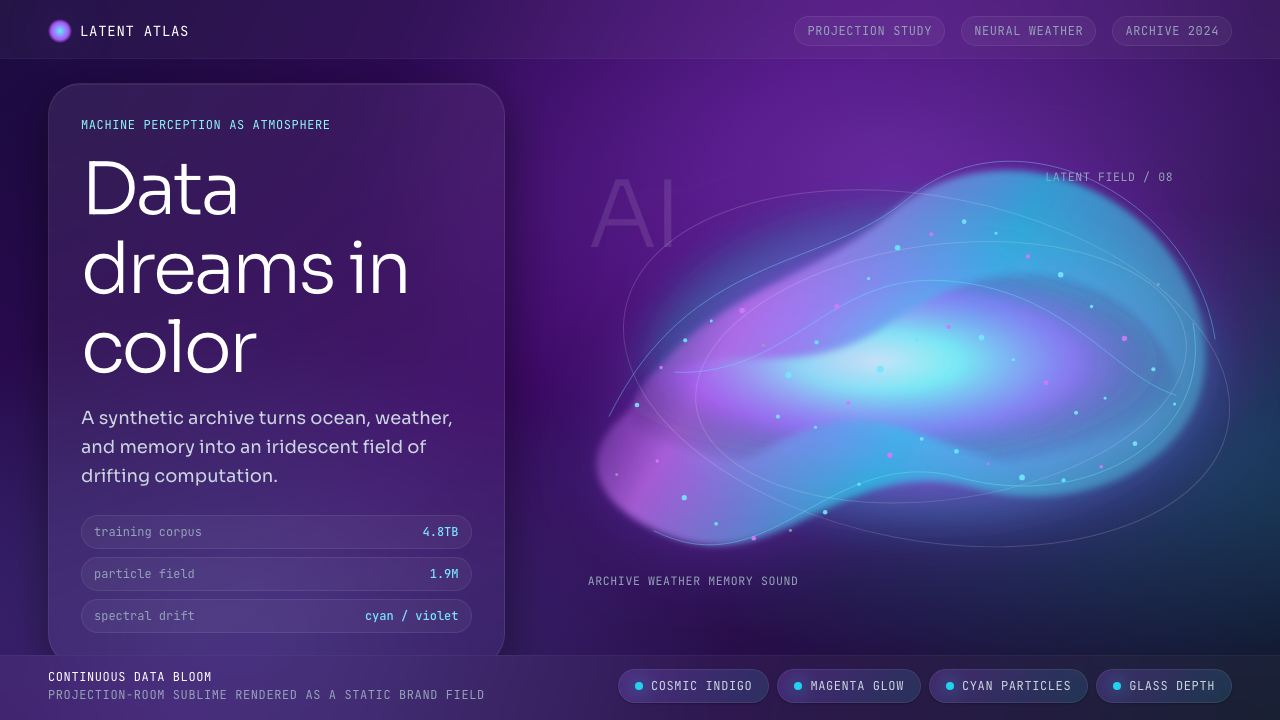 Generative AI Data Art (Refik Anadol era)Computational sublime. Indigo gradients and cyan-magenta particles make data…
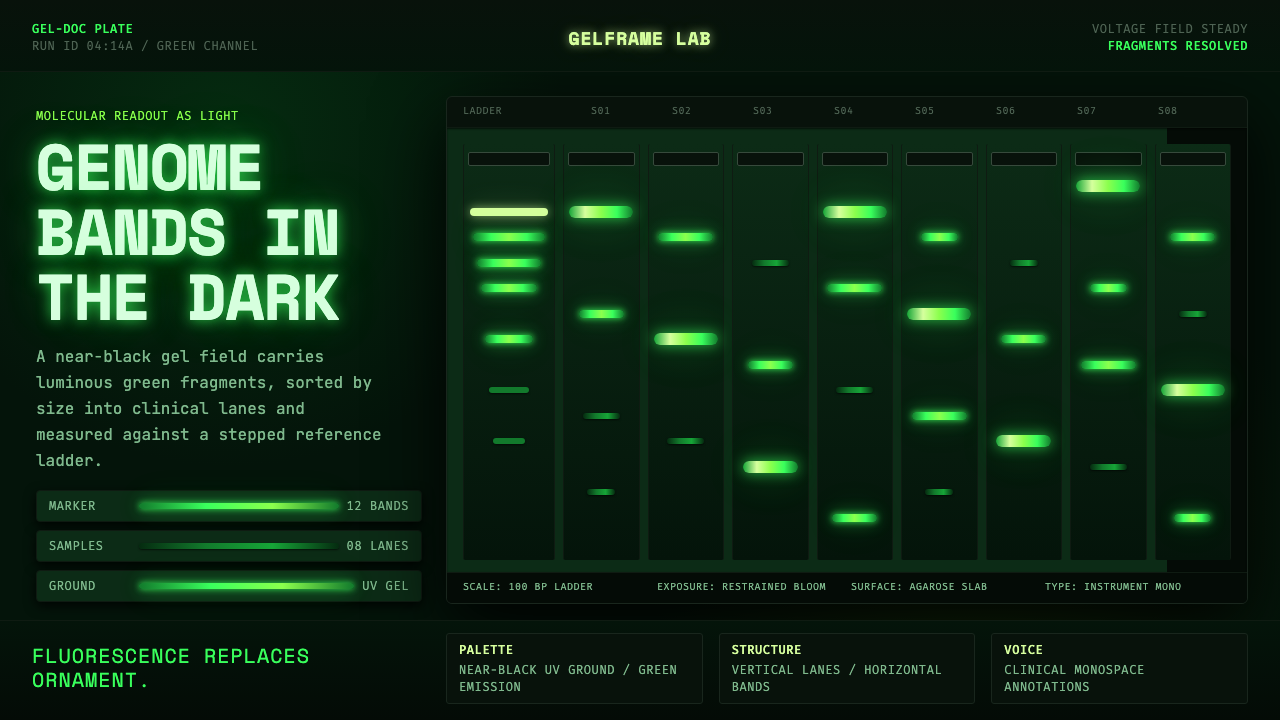 DNA Gel ElectrophoresisLab output becomes light. Green fluorescent bands stack down a near-black gel…
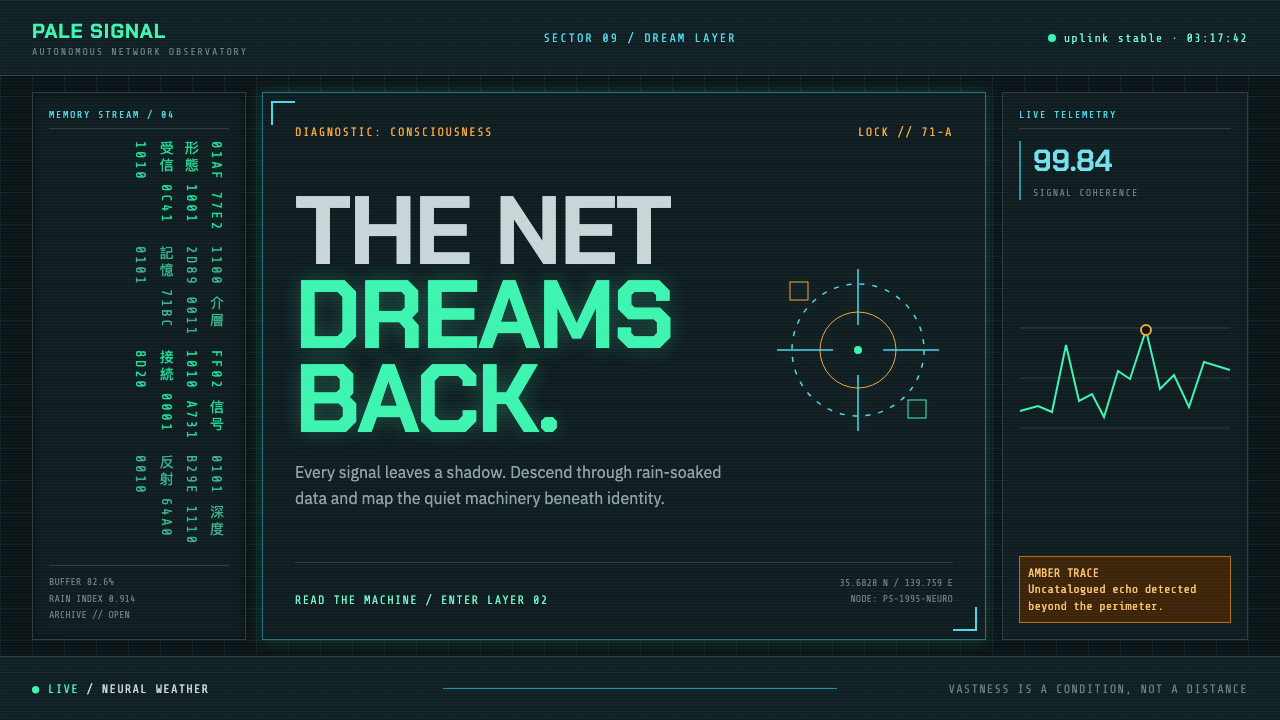 Ghost in the Shell (1995)A machine dreams in the rain. Phosphor green code burns through black-teal gl…
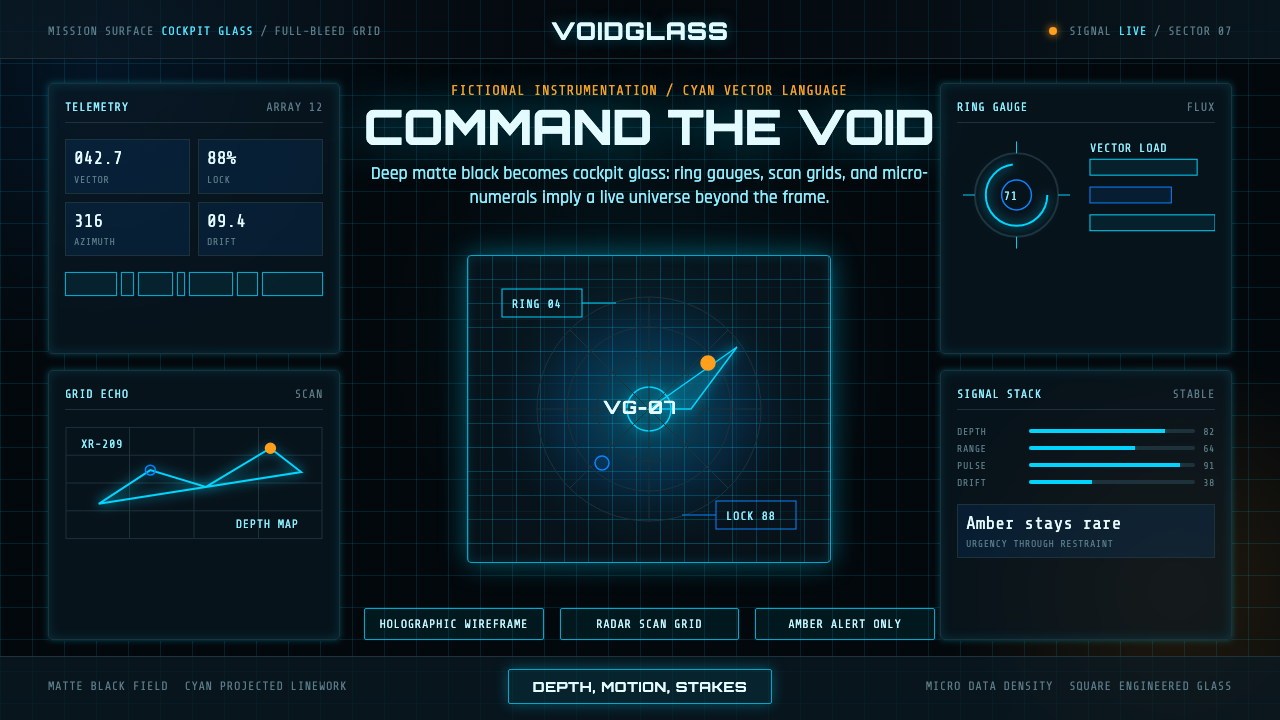 FUI Sci-Fi HUDBlack until it glows. Cyan wireframes, ring gauges, and radar grids sell live…
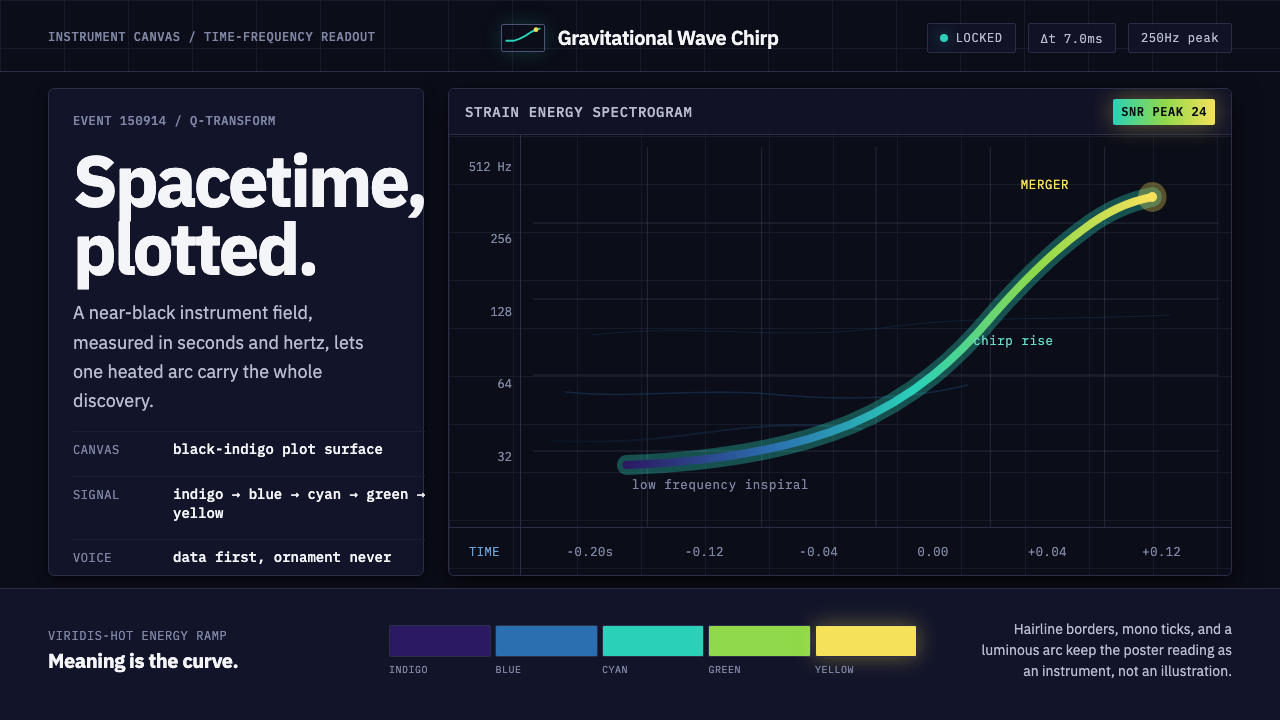 Gravitational Wave ChirpData makes the drama. Near-black grid, mono Hz ticks, and a viridis-hot chirp…
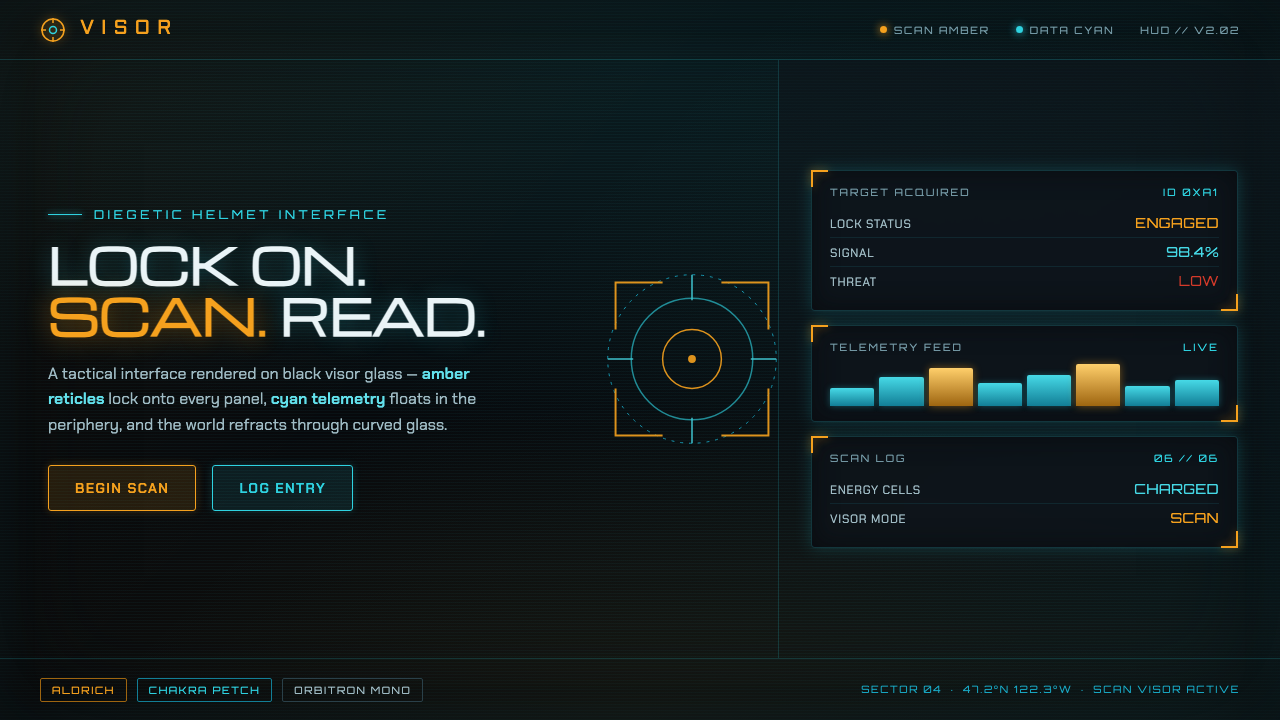 Metroid Prime Scan VisorDiegetic helmet HUD on black glass. Amber reticles lock content, cyan telemet…