What is Processing / Generative?
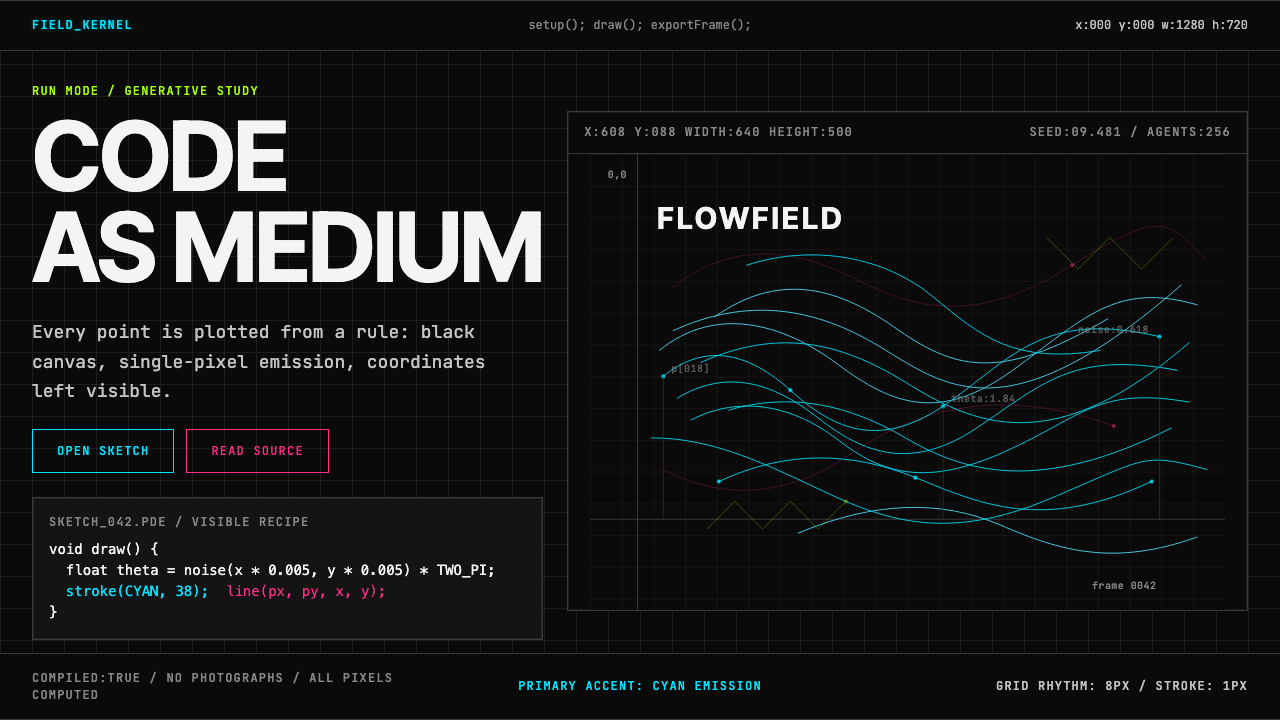
In Processing, the algorithm is the brush — every artwork is a runnable file, every form is mathematics made visible.
Processing / Generative in brief
Processing / Generative is the visual language that emerged from creative coding — a tradition in which the computer program is not a tool for making art, but the art itself. Founded in 2001 by Casey Reas and Ben Fry at MIT Media Lab's Aesthetics & Computation Group, Processing gave artists and designers a direct path from written code to rendered image, establishing an aesthetic vocabulary that has since spread across digital art, data visualization, interactive installation, and computational design.
The defining visual signature of this tradition is a deep, near-absolute black canvas on which luminous lines and particles seem to emit their own cold light. Where oil painting builds from darkness to light by layering pigment, generative art builds from darkness by adding single-pixel strokes of saturated cyan, magenta, or electric lime — colors that glow with an additive logic reminiscent of cathode-ray tubes. The forms themselves are never drawn by hand: they emerge from Perlin noise flow fields, particle simulations, recursive subdivision, agent-based behavior, and mathematical attractor systems. Regularity and irregularity coexist because both are products of the same underlying computation.
Monospace typefaces, coordinate readouts, and code annotations often appear at the margins of the work — not as decoration, but as evidence. They remind the viewer that the image has a source, that behind every curve there is an equation, and that the artwork and its algorithm are indistinguishable from each other. This is not a style borrowed from computation; it is a style produced by computation, from the inside out.

Where does Processing / Generative come from?
The roots of generative art reach back to the 1960s, when a small group of mathematicians and engineers began using plotters and mainframe computers to produce images governed entirely by algorithmic rules. Georg Nees, Frieder Nake, and Vera Molnár — working independently in Germany and France — exhibited computer-generated drawings as early as 1965, establishing the principle that systematic variation of mathematical parameters could be a legitimate creative act. These early practitioners worked in near-total isolation from the art world, and their work was often dismissed by galleries as mechanical rather than artistic. The conceptual foundation they laid, however, proved durable: the algorithm as author, the execution as performance, and the viewer as interpreter of a system rather than a representation.
By the 1980s and 1990s, personal computers had made programming accessible beyond university research labs, and a new generation of artists began exploring what could be made with BASIC, PostScript, and eventually C and Java. John Maeda at MIT was a pivotal figure in this transition. His Design By Numbers project (1999) proposed that visual designers should be literate in code, and his teaching at the MIT Media Lab directly shaped the environment from which Reas and Fry emerged. Maeda's influence was both pedagogical and philosophical: he argued that computation was not a medium among others but a new kind of thinking about form, time, and interactivity.
Processing itself was born in 2001 as a teaching tool — a simplified Java environment intended to make programming legible to visual artists and designers who found standard development environments hostile and abstract. Reas and Fry wanted the feedback loop between writing code and seeing its output to be as immediate as possible. The original Processing IDE showed a plain text editor on one side and rendered the sketch in real time on the other: a drawing surface that responded to every keystroke. This immediacy was transformative. Artists who had never thought of themselves as programmers began producing work that could not have been made any other way.
The open-source release of Processing and the subsequent launch of p5.js — a JavaScript port created by Lauren McCarthy with support from the Processing Foundation — expanded the community from a specialized art-school audience to a global network of practitioners. Daniel Shiffman's teaching, first through his book The Nature of Code (2012) and later through his YouTube series The Coding Train, made the aesthetic available to hundreds of thousands of learners worldwide. By the 2010s, generative aesthetics had migrated from gallery installations to music video production, brand identity systems, and interactive web experiences. The visual grammar — dark grounds, luminous lines, emergent structure — became one of the defining looks of digital culture.
What defines the Processing / Generative look?
Deep Black Ground
The canonical Processing canvas is near-absolute black — not the dark gray of a dimmed interface, but a true void that functions as an emission substrate. Every colored element appears to radiate rather than reflect light, mimicking the visual logic of phosphorescent screens and bioluminescent organisms. This ground is both an aesthetic choice and a structural one: against near-black, even the faintest single-pixel line registers with clarity, allowing extremely fine detail to coexist with large-scale compositional drama.
Additive Color Logic
Where traditional print and painting work subtractively — mixing pigments darkens toward black — generative work builds color additively, as light does. The palette leans toward highly saturated, spectrally pure hues: electric cyan, acid lime, hot magenta, and charged cobalt. These colors are rarely blended into intermediate tones; instead they are layered with low opacity so that overlapping strokes produce luminous secondary mixes that feel emergent rather than chosen. The overall effect is that color seems to belong to the light itself, not to any surface.
Algorithmic Form — Flow Fields and Emergence
The defining shapes of generative work are not drawn but grown. Perlin noise flow fields direct thousands of particles along smooth, organic trajectories that fill the canvas with sinuous curves no human hand could consistently replicate. Recursive subdivision produces branching structures that echo natural growth: coral, lightning, river deltas, lung tissue. Agent-based systems generate dense, tangled masses that read simultaneously as chaotic and ordered. The visual signature is that forms have memory — they accumulate, they collide, they leave trails — and no two runs of the same algorithm produce exactly the same image.
Monospace Typography and Code Annotation
Monospace letterforms — the typefaces associated with terminals, source code, and technical documentation — appear throughout generative work as labels, coordinate readouts, seed values, and system parameters. Their presence is not decorative but testimonial: they assert that the image is computational in origin, that its aesthetic properties are measurable, and that the viewer is looking at the output of a process rather than the expression of a hand. This typographic vocabulary distinguishes Processing-derived work from other dark-palette digital aesthetics that share some superficial visual qualities.
Iterative Time and Accumulation
Many Processing works are not static images but living systems captured at a particular moment — the canvas updates continuously, and the final frame is a record of thousands of incremental decisions made by the algorithm over time. Even when printed or exported as a still, the image carries the visual evidence of this accumulation: the density of overlapping lines, the gradual brightening of frequently visited regions, the slow emergence of structure from randomness. This temporal quality sets generative work apart from design styles where the final composition is planned and executed in a single pass.
Mathematical Structure as Composition
Generative compositions are rarely designed in the conventional sense — they are parameterized. The artist sets rules: how many agents, what force fields, what attraction strengths, what probability thresholds. The composition that results is the consequence of those parameters interacting over time. This means that visual balance, density, focal points, and movement all emerge from mathematical relationships rather than from intuitive gestural decisions. The resulting images often have a quality of inevitability — as though the form could not have been otherwise — because, within the parameter space, it could not.
System Transparency
A distinguishing ethical and aesthetic principle of the Processing tradition is that the system behind the work is understood to be visible, at least in principle. The source code is often published alongside the artwork. The random seed is frequently displayed. Parameters are documented. This transparency is in direct contrast to design traditions that conceal their methods to preserve the appearance of spontaneous creativity. In generative art, exposing the mechanism does not reduce the work's power — in many cases it amplifies it, because understanding how the image was made makes its complexity more, not less, astonishing.

Who shaped Processing / Generative?
Reas co-created Processing in 2001 alongside Ben Fry while both were graduate students at MIT Media Lab. His artistic practice explores software as a medium for visual form, with a sustained interest in how simple rule sets generate complex, seemingly organic imagery. His solo works — exhibited internationally at venues from the Whitney Museum to the Ars Electronica festival — frequently involve thousands of autonomous elements interacting on a shared canvas. As a professor and writer, Reas has shaped how an entire generation of artists and designers think about code as a creative substrate, most influentially through the book Processing: A Programming Handbook for Visual Designers and Artists, co-authored with Fry.
Fry co-created Processing and has spent his career at the intersection of data, design, and biology. His work is characterized by the use of large, complex data sets — genomic sequences, text corpora, network graphs — rendered as visual systems in which structure and pattern become legible through careful visual encoding. His doctoral dissertation at MIT, Computational Information Design, established many of the principles that would later define the field of data visualization as practiced by designers rather than statisticians. Fry's Visualizing Data (2007) translated those principles into accessible form for a generation of practitioners.
Maeda was the intellectual and institutional predecessor to Processing at MIT Media Lab, where he led the Aesthetics & Computation Group that Reas and Fry joined. His Design By Numbers project (1999) was an early attempt to create a simplified programming language specifically for visual artists, predating Processing by two years and demonstrating that the problem of the hostile development environment was real and solvable. His books — particularly The Laws of Simplicity (2006) and Design in Tech — influenced how technology companies began thinking about design as a strategic discipline rather than a finishing step.
Shiffman democratized generative aesthetics at a scale none of the original Processing founders could have anticipated. His book The Nature of Code (2012) translated complex simulation systems — physical forces, cellular automata, neural networks, genetic algorithms — into clear, example-driven explanations aimed at artists and designers with limited mathematical backgrounds. His YouTube channel The Coding Train, launched in 2015, extended this work into an ongoing series of live-coded tutorials that have collectively accumulated hundreds of millions of views. Shiffman's contribution is pedagogical above all: he made the visual grammar of Processing feel welcoming rather than exclusive.
Molnár is the foundational figure of algorithmic art, working with computer-generated imagery from 1968 onward — more than three decades before Processing existed. Her work established that the aesthetics of systematic variation, rule-based composition, and controlled randomness were legitimate artistic concerns independent of any particular technology. Working first with imagined machines she called 'machine imaginaire' before gaining access to actual computers, Molnár demonstrated that the conceptual framework of generative art preceded its technical means. Her long career — she continued producing work into her late nineties — made her the direct ancestor of the entire Processing tradition.
How do you use Processing / Generative today?
Processing / Generative is a high-specificity aesthetic — it carries strong associations with technology, mathematics, and digital culture, and works best when those associations align with what the product or message is actually about. Applied carelessly, it can read as generic tech-darkness or visual noise. Applied with precision, it communicates intelligence, complexity, and the kind of beauty that emerges from systems rather than from craft.
For presentation slides, the generative aesthetic works powerfully on cover and section-break pages, where a full-bleed composition — flow field, particle swarm, or recursive structure — establishes the visual register before any content appears. Cover slides should commit fully to the dark ground and let a single luminous form dominate; resist the temptation to over-annotate. Content slides are a different challenge: the aesthetic calls for restraint, with monospace type for data labels and coordinates, and a narrow palette limited to one or two accent colors drawn from the established composition. Data visualization slides are where the style reaches its natural home — charts, graphs, and network diagrams rendered in the generative palette become part of the same visual world rather than conventional office graphics dropped into a dark template.
For web interfaces and dashboards, the generative aesthetic reads as authoritative in contexts associated with technical sophistication: developer tools, analytics platforms, financial terminals, security dashboards, and scientific data products. The approach calls for a deep background, near-black with a trace of warmth or coolness to avoid pure void, with interface elements rendered in luminous accent colors that preserve the additive light logic. Typography should be monospace or geometric-grotesque at small weights — the texture of technical documentation. Interactive states — hover, active, focus — should feel like they are emitting rather than reflecting: a subtle glow rather than a fill change.
For editorial and marketing work, the style supports content about technology, science, complexity, and systems thinking. A feature article on artificial intelligence, climate modeling, or network infrastructure can use generative imagery to give abstract subject matter a concrete visual presence. Full-bleed generative covers work especially well for annual reports, conference programs, and publication issues where the theme is explicitly computational or systemic. Marketing pages for developer products, data platforms, and creative technology companies can use animated generative backgrounds as hero sections, provided the motion is slow and purposeful — flowing rather than flashing.
The most common mistake when applying this aesthetic is mistaking darkness and cyan for the style itself. A dark background with teal accents is not generative art — it is dark mode with an accent color. The generative aesthetic is defined by the quality of the forms: their emergence, their accumulation, their algorithmic origin. Using stock photography with a dark overlay, or drawing geometric shapes manually and coloring them cyan, produces a simulacrum that lacks the defining quality of the original. When the forms themselves are not products of computation — when they were drawn or placed by hand — the aesthetic collapses into pastiche. The second common mistake is applying this style to warm, human, or emotional contexts: wellness, food, children's products, community platforms. The mathematical clarity and cold luminosity that make the style powerful in technical contexts read as alienating in contexts that call for warmth.

Processing / Generative — FAQ
Is Processing / Generative a dark-mode aesthetic, or is a light-ground version possible?
The dark ground is not arbitrary — it is load-bearing. The additive color logic that gives generative work its luminous quality depends on a near-black substrate: colors that appear to glow only glow against darkness. A light-ground version is technically possible, and some computational artists have explored it, but the result is a fundamentally different aesthetic — closer to scientific illustration or information graphics than to the canonical generative tradition. If your context requires a light background, it is more honest to acknowledge that you are drawing on the graphic vocabulary of data visualization rather than claiming the full generative aesthetic. The two are related but distinct.
How does generative art differ from glitch aesthetic or cyberpunk visual style?
All three operate on dark grounds with high-saturation color, which accounts for the frequent confusion. The differences are substantive. Glitch aesthetic celebrates malfunction — it reproduces the visual artifacts of data corruption, signal failure, and hardware error: scan lines, pixel displacement, color channel separation. Cyberpunk aesthetic draws on urban decay, neon signage, and dystopian density — it is culturally narrative. Generative art, by contrast, is neither broken nor dystopian: it is orderly at the system level, even when locally complex. Its forms are the consequence of correct computation, not failed computation. Where glitch feels damaged and cyberpunk feels dangerous, generative work feels inevitable — the beauty of a system doing exactly what it was designed to do.
Can this aesthetic work for a brand that is not a technology company?
Yes, but the application requires genuine conceptual grounding rather than surface borrowing. The generative aesthetic works for any brand whose core proposition involves systems, emergence, complexity, or the intersection of natural and computational processes — scientific research organizations, financial data companies, environmental monitoring platforms, genomics companies, architecture and engineering firms working at scale. It also works for cultural institutions whose programming engages with digital art or computational creativity. What it does not work for is borrowing the visual vocabulary as a signifier of vague technological aspiration — a wellness startup deploying flowing cyan lines because it seems futuristic. The aesthetic is too specific to survive that kind of contextual mismatch without looking hollow.
What is the relationship between Processing and NFT / generative art markets?
Processing and p5.js became central tools in the generative NFT art movement that emerged between 2020 and 2022, particularly through platforms like Art Blocks, where collectors could mint unique outputs from a shared algorithm by providing different random seeds. This market moment brought generative aesthetics to a much wider audience and produced enormous amounts of work in the canonical visual vocabulary — dark grounds, flow fields, saturated emission colors, monospace annotations. It also produced a significant volume of derivative work that reproduced the surface appearance without the depth of system design. The market has since contracted, but the broader cultural familiarity with generative aesthetics that the period produced has persisted, making the visual language legible to audiences well beyond the art and technology worlds.
How do I know if my generative-inspired design is authentic or pastiche?
The clearest test is whether the forms in your design could have been produced by a system. If you drew the curves by hand, adjusted them visually until they looked organic, and colored them cyan on a dark background, you have made a pastiche — you have reproduced the appearance of generative work without the process that gives it meaning. Authentic application means either actually using a generative process to produce some or all of the visual elements, or — if using static elements — committing to forms that are explicitly algorithmic in character: grids, coordinates, mathematical curves, systematic variation. The second test is context: does the computational vocabulary mean something in your context, or is it purely decorative? If the answer is purely decorative, the honest choice is a different aesthetic.
Related design styles
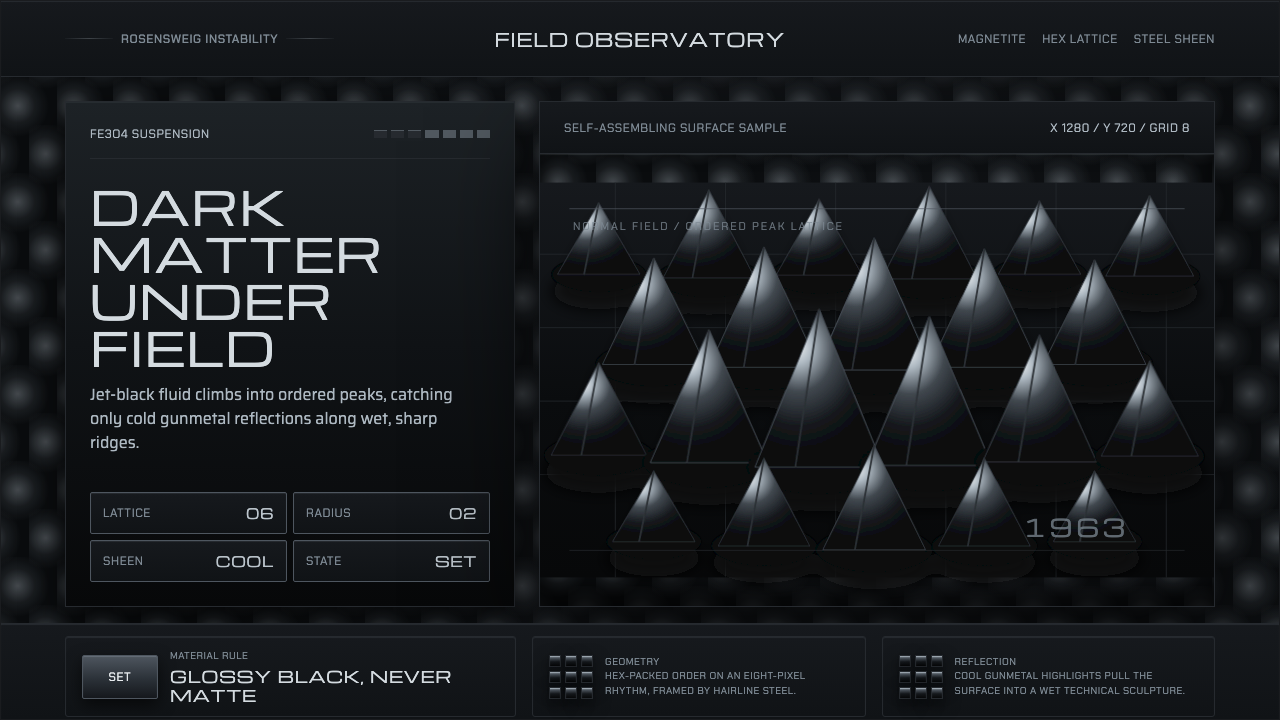 Ferrofluid Spike FieldPhysics turns sculptural. Jet black peaks, steel sheen, hex order.
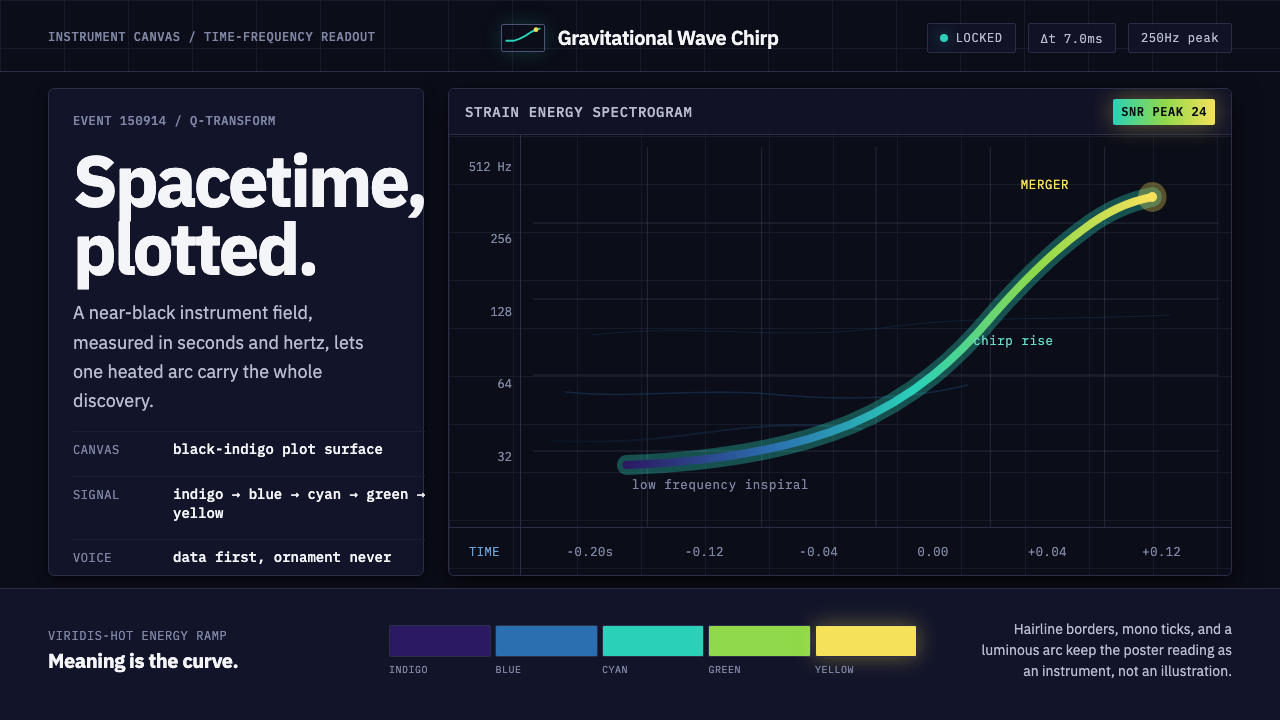 Gravitational Wave ChirpData makes the drama. Near-black grid, mono Hz ticks, and a viridis-hot chirp…
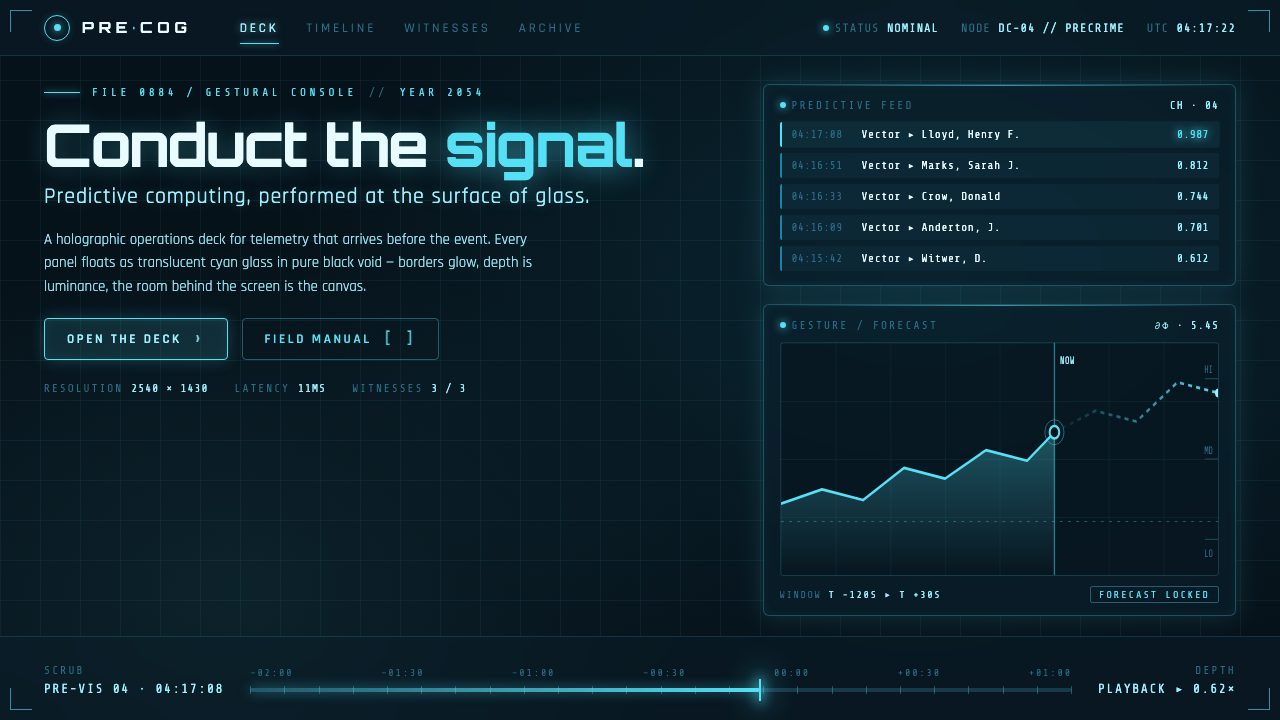 Minority Report Gestural UIPredictive computing, conducted on glass. Luminous cyan panels floating in pu…
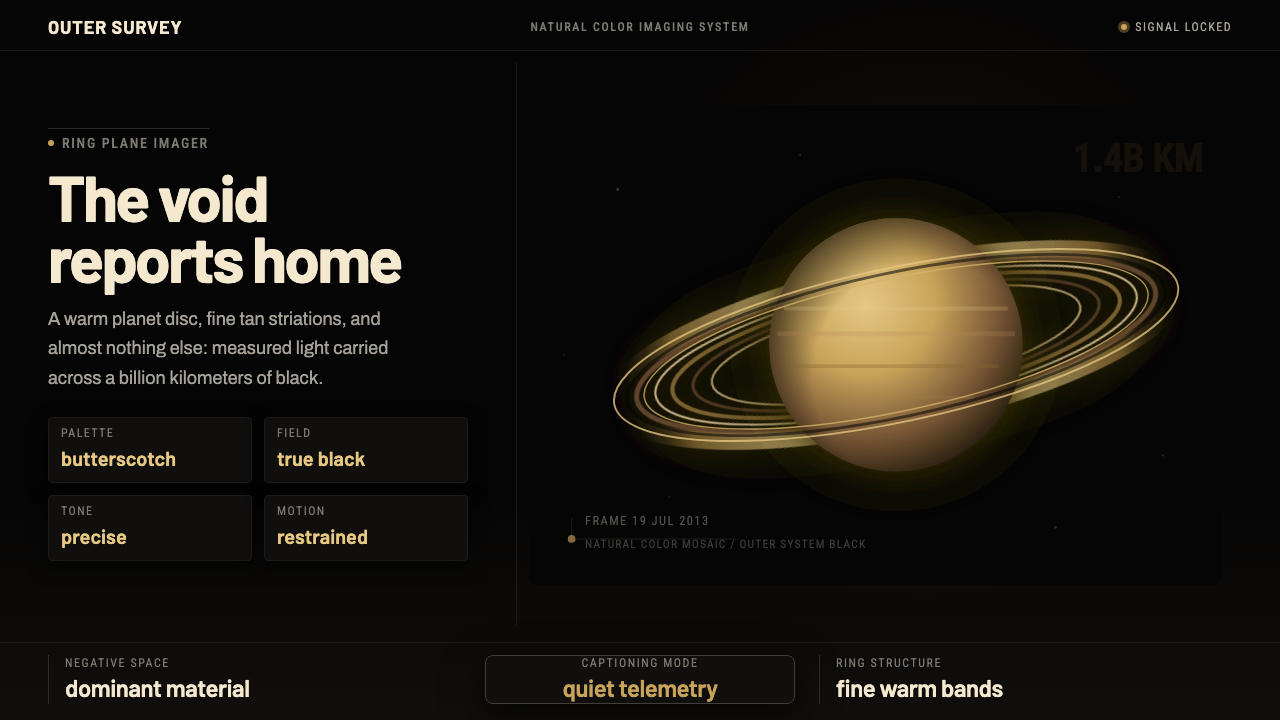 Cassini Saturn ImagingDeep space feels exact. Butterscotch Saturn floats in black with fine tan rin…
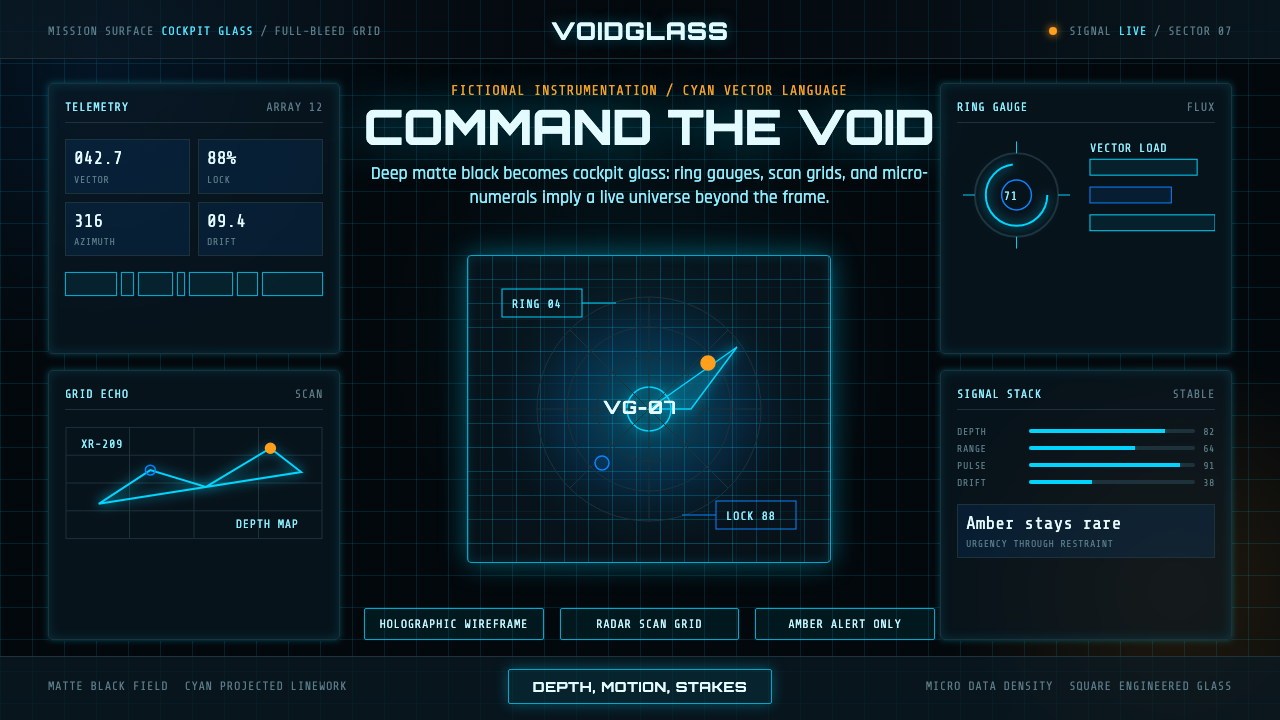 FUI Sci-Fi HUDBlack until it glows. Cyan wireframes, ring gauges, and radar grids sell live…
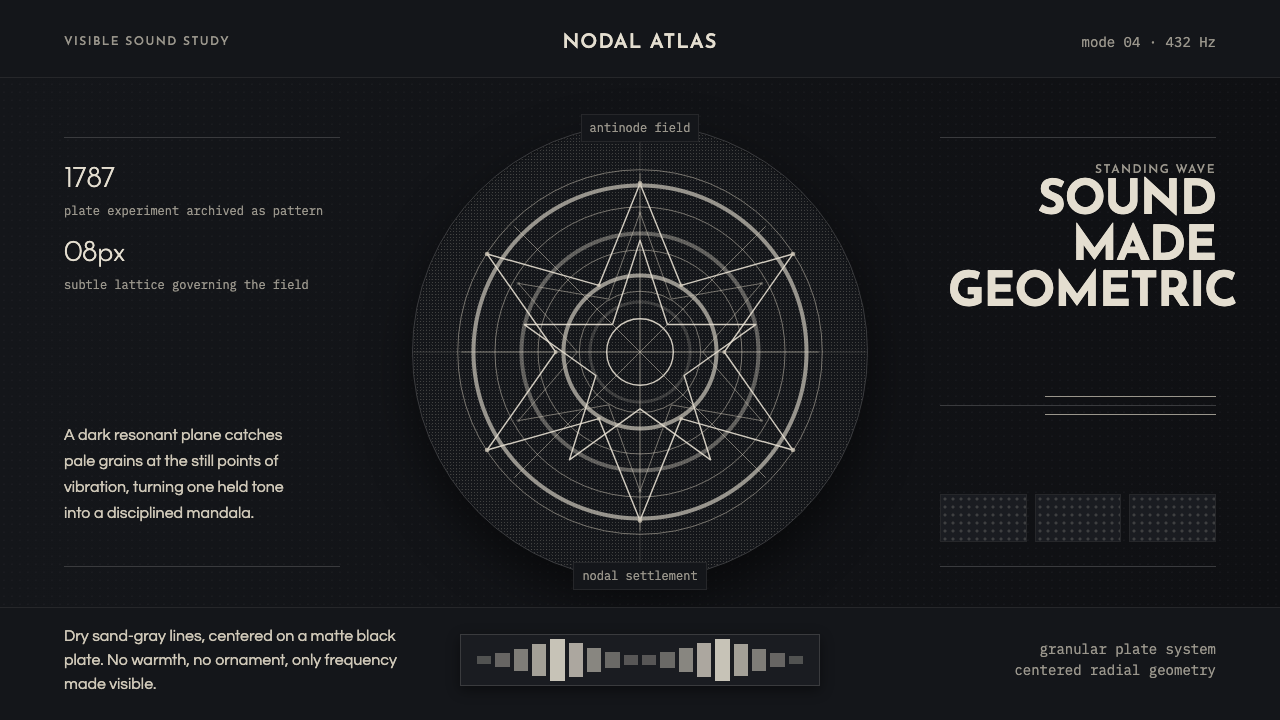 Cymatics Standing WaveSound becomes geometry. Sand-gray nodal rings settle on a dark resonant plate.