What is F1 Formula One Livery?
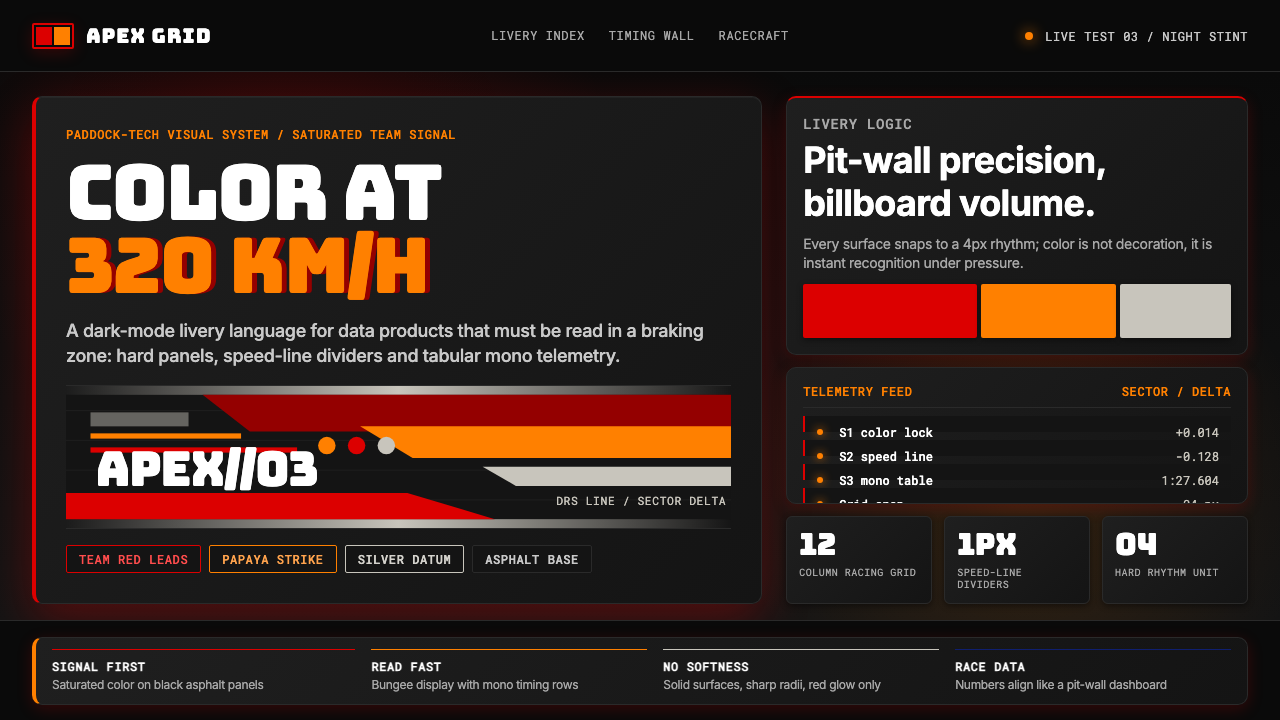
Ten saturated team colors, one black asphalt canvas — F1 livery design turns engineering identity into the fastest visual language on earth.
F1 Formula One Livery in brief
Formula One livery design is the visual identity system of international motorsport: ten competing constructors, each defined by a signature color so distinctive it must read in under a second at racing speeds exceeding three hundred kilometres per hour. Ferrari-red, McLaren-papaya, Mercedes-silver, and Red Bull-navy are not accent choices — they are institutional identities, applied with engineering precision to sidepods, halos, helmets, pit walls, hospitality suites, and broadcast graphics alike.
The aesthetic is built on extreme contrast. A saturated, almost aggressive team hue is set against the deep near-black of tarmac photography and dark panel backgrounds. Speed lines — thin diagonal stripes or sweeping aerodynamic curves — cut across livery surfaces to suggest motion even in a static image. Typography is chunky, tight-tracked, and purposeful: display letterforms that read at a glance from grandstand altitude, paired with monospaced numerals that recall telemetry readouts and pit-wall data screens.
Since Liberty Media's acquisition of the championship in 2017 and the accompanying 2018 rebrand by Wieden+Kennedy, the overarching Formula One brand has unified what was once a fragmented visual ecosystem. The new wordmark — aerodynamic, condensed, with an implied sense of forward thrust — set a typographic standard that the sport's marketing and broadcast graphics now follow consistently. The result is a design language that feels simultaneously technical and theatrical: the precision of a wind-tunnel report presented with the drama of a stadium event.

Where does F1 Formula One Livery come from?
Formula One's visual culture has its roots in the sport's founding in 1950, when the FIA World Championship was established and national racing colors — British racing green, Italian red, French blue, German silver — defined team identities before commercial sponsorship entered the picture. These colors were not designed; they were inherited from pre-war grand prix conventions and encoded into the sport's earliest iconography. Ferrari's rosso corsa, for instance, was the assigned national racing color of Italy and predated the Scuderia Ferrari identity by decades.
The sponsorship era that began in the late 1960s and expanded through the 1970s and 1980s transformed livery design from national heraldry into commercial media. When the Lotus team accepted tobacco sponsorship from Gold Leaf in 1968, the cars became rolling billboards, and the livery became a designed artifact for the first time — a negotiated surface where brand visibility, aerodynamic form, and racing heritage had to coexist. Through the 1980s, iconic liveries like McLaren's Marlboro-red and white, and Williams's Canon-blue, established the template of a dominant team color anchored by a primary sponsor's identity.
The 1990s introduced a generation of designers who treated liveries as total identity systems rather than sponsor collages. Jordan Grand Prix, Williams, and Benetton each developed liveries with distinctive graphic character — bold curves, high-contrast color blocking, and typographic discipline that held up across helmet, car, and paddock branding simultaneously. This era coincided with the global television broadcast explosion, which made the visual coherence of team identity a competitive commercial advantage.
The Liberty Media era beginning in 2017 and the Wieden+Kennedy rebrand of 2018 marked a structural shift. For the first time, Formula One itself — not just individual teams — invested in a unified visual language. The new F1 wordmark, the typographic system, the speed-line motif, and the telemetry-dashboard aesthetic of broadcast graphics created a coherent frame within which individual team liveries could express their own identities. The Drive to Survive documentary series, launched in 2019, brought this visual language to a mainstream audience of tens of millions globally, accelerating F1 livery aesthetics from motorsport niche to mainstream design reference.
What defines the F1 Formula One Livery look?
Saturated Team Color
Each team owns a single dominant hue dialed to near-maximum saturation — a color choice made not for subtlety but for instant recognition under broadcast lighting, across digital displays, and against the grey or dark backdrop of a racing circuit. The team color functions as a brand signature with the same logic as a national flag: it must be unambiguous at distance and at speed. Secondary colors play a strictly supporting role, usually confined to trim, sponsor panels, or typographic elements.
Deep-Black Contrast Ground
The team hue always performs against a dark anchor — the near-black of tarmac in racing photography, the dark carbon-fibre panels of modern cars, and the black backgrounds standard in F1 broadcast graphics and editorial design. This contrast maximizes the visual impact of the saturated team color and creates the high-drama, cinematic quality associated with F1 visual identity. Dark grounds also emphasize the reflective, metallic surface treatments frequently used on modern liveries.
Speed-Line Motif
Thin diagonal or sweeping curved lines — borrowed from the aerodynamic flow patterns visible in CFD visualizations and wind-tunnel smoke tests — function as the connective tissue of F1 livery composition. Speed lines suggest directional momentum even in still images, divide color zones without hard edges, and scale elegantly from a full car body to a social media thumbnail. In the overarching F1 brand, speed lines appear as dividers, background textures, and graphic transitions between content sections.
Aerodynamic Display Typography
F1 typography favors condensed, high-weight display letterforms — shapes that feel like they have been sculpted for minimum drag, with tight horizontal tracking that makes headlines read as a single solid mass. The W+K-designed wordmark established this standard: a letterform that tilts forward by implication, whose proportions feel engineered rather than calligraphic. Alongside this display style, monospaced numerals reminiscent of digital readouts and telemetry data appear in timing graphics, race standings, and data-heavy layout contexts.
Precision Color Blocking
Where two colors meet on a livery surface — or in associated graphic design — the boundary is typically hard and precise, not blended or gradated. This precision mirrors the engineering tolerance culture of motorsport, where surfaces are measured and components fitted to fractions of a millimetre. In graphic applications, hard color boundaries create a bold, poster-like quality: sections of a composition read as distinct flat planes, each with its own tonal weight, rather than as a continuous tonal field.
Telemetry and Data Aesthetics
A distinctive sub-language within F1 visual identity draws directly from the dashboards, readouts, and data visualization tools that populate the technical operations of a race weekend. Tabular data with minimal borders, thin rule lines organizing information into zones, blinking indicator states, and numerical hierarchies all recur in F1 editorial and marketing design. This aesthetic positions data not as documentation but as drama — the raw numbers of a sport where hundredths of a second separate outcomes.
Metallic and Reflective Surface Treatment
Modern F1 liveries frequently incorporate chrome, metallic paint, and holographic foil treatments that shift in hue and intensity as the viewing angle changes. In two-dimensional design contexts — slides, editorial layouts, digital advertising — this surface quality is evoked through high-contrast gradients applied to specific graphic elements rather than to backgrounds, metallic color choices in a muted-to-bright range, and image treatments that emphasize reflective surfaces in photography. The effect signals premium production value and technical sophistication.

Who shaped F1 Formula One Livery?
As the commercial rights holder of Formula One from the 1970s through 2017, Ecclestone shaped the economic structure within which F1 visual identity developed. His insistence on consistent, high-production broadcast presentation — global television deals, standardized circuit signage, and team uniform requirements — created the conditions under which team liveries became global brand assets rather than race-day practicalities. The commercial architecture he built made F1 team colors visible in over a hundred countries simultaneously, giving livery design an international stage matched by few other visual identities in sport.
Hamilton's seven world championships span two of the most distinctive livery eras in recent history: the silver Mercedes W-series cars that dominated the hybrid era from 2014 onward, and his own practice of personalizing his racing helmet each Grand Prix weekend. The helmet as rotating, event-specific graphic design object — a one-weekend limited edition applied at the scale of a wearable sculpture — has influenced how designers and fans understand livery as an expressive rather than purely functional identity system. Hamilton's championing of a matte black livery for the 2020 season, connected to his public advocacy, also demonstrated that livery choices could carry cultural and political weight beyond sponsorship.
Verstappen's dominance across the 2021–2024 seasons brought Red Bull's navy and yellow livery to global ubiquity during the sport's period of maximum mainstream expansion. The Red Bull livery — bold diagonal color split, heavily logotyped, with a graphic energy closer to extreme sports branding than traditional motorsport — became one of the most widely reproduced color combinations in contemporary sports design. Its influence can be observed in the visual language of gaming, energy drink marketing, and esports, demonstrating how a winning livery's aesthetic logic migrates far beyond its original motorsport context.
Senna's visual identity across his career at Lotus, McLaren, and Williams established the template for driver-as-brand within motorsport. His distinctive yellow helmet — derived from the Brazilian national flag — became one of the most recognizable objects in twentieth-century sport, demonstrating that a driver's personal livery element could achieve iconic status independent of the team identity it appeared alongside. The Senna brand, managed posthumously, remains active in licensing and design collaboration, and his yellow is now so historically charged that it functions as a form of shorthand for F1's golden era in contemporary editorial and documentary contexts.
How do you use F1 Formula One Livery today?
F1 livery aesthetics translate into designed artifacts — presentations, interfaces, editorial layouts, and marketing pages — most successfully when the core logic is understood rather than merely the surface appearance. The system works through three interlocking principles: a dominant saturated color establishes immediate identity, a deep-dark ground maximizes its visual impact, and speed-line or data-grid motifs provide compositional structure. Copying the colors without deploying the contrast logic, or adding speed lines without a coherent color hierarchy, produces work that reads as imitation rather than application.
For presentation slides, the style suits both cover and content pages with distinct approaches. A cover benefits from the poster-like boldness of the system: the team color fills a substantial portion of the layout — a large diagonal or full bleed — while the title appears in condensed display weight against the dark remainder. The relationship should feel asymmetric and kinetic, as if the color is moving through the frame. Content slides should take a more restrained approach, treating the dark ground as the base, using the team color sparingly for headings or accent bars, and organizing data into telemetry-style tabular arrangements with thin rule lines and monospaced numerals. Data and chart slides find their natural home here: treat bar charts and graph elements as graphic objects in the team color against dark grounds, with annotation in a lighter neutral.
For web interfaces, F1 aesthetics work exceptionally well in dashboards, analytics platforms, leaderboards, and any product where technical authority and real-time data are the primary value proposition. Apply the deep-dark background consistently across the interface, use the saturated accent color exclusively for interactive states, highlights, and primary calls to action, and structure content into tight grid zones separated by thin rule lines rather than card outlines or heavy borders. Pricing pages benefit from the system's natural capacity for tier differentiation: each tier occupies a color-coded zone, with the recommended tier in the dominant team color and alternatives in progressively muted variants. Navigation should be typographic and tight-tracked.
For editorial and marketing work, the F1 system delivers highest impact in hero sections, campaign headers, and event promotion — contexts where immediate visual authority is more valuable than sustained readability. Full-width feature blocks alternating between the team color on dark and dark on the team color create a rhythm that reads like a race weekend's visual language. For body text and longer reading contexts, pull back to a near-black or very dark neutral ground with light type, reserving the saturated team color for pull quotes, section markers, or data callouts. Marketing pages work best when the speed-line motif is used as a graphic divider between sections rather than as a background texture across the entire page.
A common mistake when applying F1 livery aesthetics is treating the style as pure color and ignoring the structural role of contrast and proportion. Using the saturated team color as a background for body text — rather than as a focal color against dark — immediately collapses the visual hierarchy that makes the style legible. A second common error is applying speed-line motifs at excessive density, which produces visual noise rather than the sense of precision and forward momentum the motif is meant to convey. The style rewards restraint in decoration and boldness in color commitment: one strong hue, one deep ground, and compositional elements used at scale rather than in busy accumulation.

F1 Formula One Livery — FAQ
Does F1 livery style require a dark background, or can it work on light grounds?
The dark ground is structural, not optional. The entire contrast logic of F1 livery aesthetics depends on a saturated, high-energy team color reading against a dark anchor. On a white or light ground, the same saturated colors lose the dramatic edge-contrast that makes them feel fast and authoritative — they begin to read as ordinary brand colors. A light variant is possible in secondary contexts (long-form editorial body text, documentation) but the hero, cover, and featured elements of any F1-styled work should commit to a deep dark ground. If light is required throughout, consider whether this style is the right fit.
Can I use multiple team colors in one design, or should I commit to one?
Commit to one dominant team color. The power of F1 livery design comes from the singular, territorial commitment to one hue — there is no ambiguity about which team you are looking at. Mixing multiple saturated hues at comparable intensity produces a carnival effect rather than the focused authority the style is built on. The exception is when designing a multi-team context — a race program, a comparative analytics dashboard — where each entity's color is systematically assigned to that entity alone and does not bleed across zones. Even then, each individual section reads as a single-color commitment against the shared dark ground.
How does F1 livery aesthetics differ from general sports branding?
General sports branding tends toward bold, friendly, and community-oriented visual expression — it is designed to be worn in crowds, celebrated in social contexts, and accessible to broad fan demographics. F1 livery aesthetics are technical, precise, and oriented toward performance authority. Where team sports branding emphasizes warmth and belonging, F1 aesthetics emphasize engineering discipline and speed. The telemetry data references, the hard color boundaries, the condensed technical typography — these signal a world of marginal gains and scientific precision rather than fan community. Designers should be aware that the F1 aesthetic can read as cold or inaccessible in contexts where human warmth is a design goal.
How should speed lines be used — and when do they become a mistake?
Speed lines work best as compositional elements used at a specific, intentional location: as a divider between two content zones, as a single directional accent crossing a cover image, or as a subtle grid texture confined to a background panel. They become a mistake when applied across the entire layout as a repeating background pattern — this reads as wallpaper rather than motion. They also fail when used at varying angles within the same composition, which undermines the sense of singular directional momentum. The correct application is sparse: one or two speed lines per spread, at a consistent angle, cutting across a defined zone rather than flooding the layout.
Is F1 livery style appropriate for luxury or fashion brand contexts?
There is a natural intersection between F1 aesthetics and premium positioning, since both worlds share an emphasis on technical excellence, precision, and aspirational exclusivity. The style works in luxury contexts when the product's identity is genuinely connected to performance, engineering, or speed — premium automotive, high-end watchmaking, technical sportswear, or professional equipment brands. It is less successful in luxury contexts defined by heritage craftsmanship, softness, or feminine sensibility — jewellery, couture, fragrance, or home goods — where the technical coldness of F1 aesthetics reads as a category mismatch. The key question is whether the luxury positioning is rooted in performance or in tradition.
Related design styles
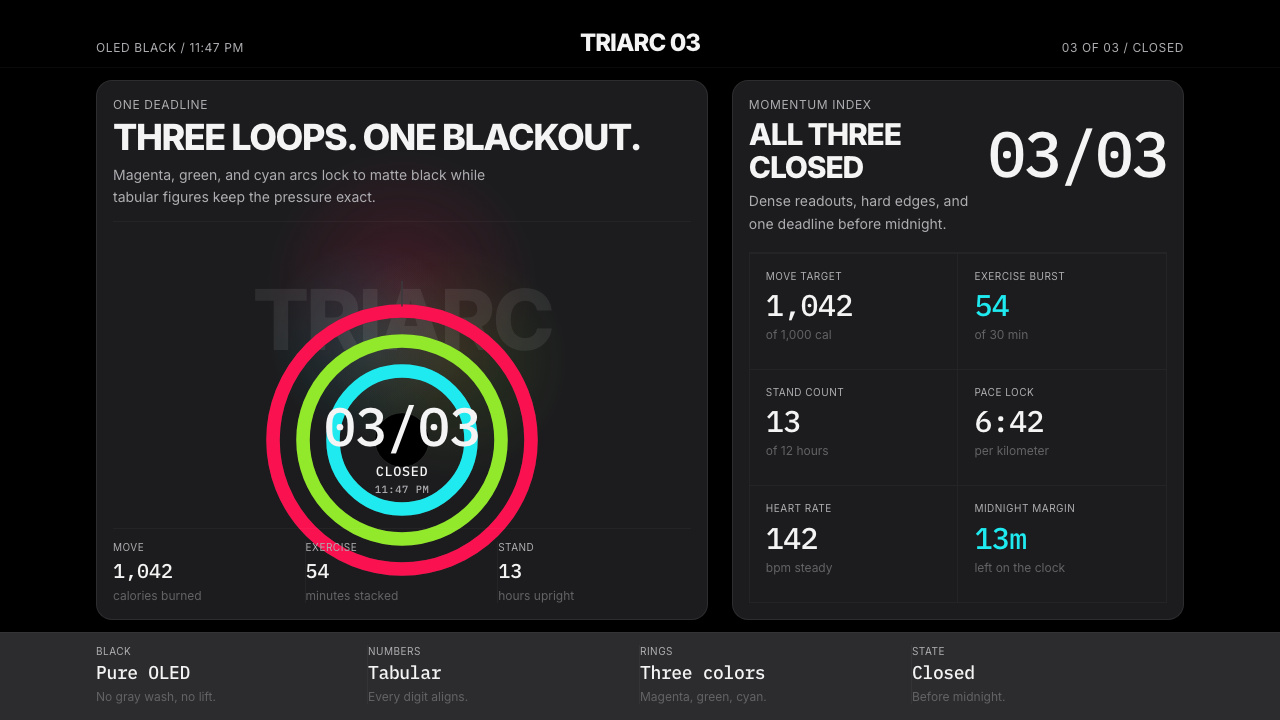 Apple Fitness Rings Closed (2024)Midnight feels exact. Magenta, green, and cyan rings lock onto OLED black.
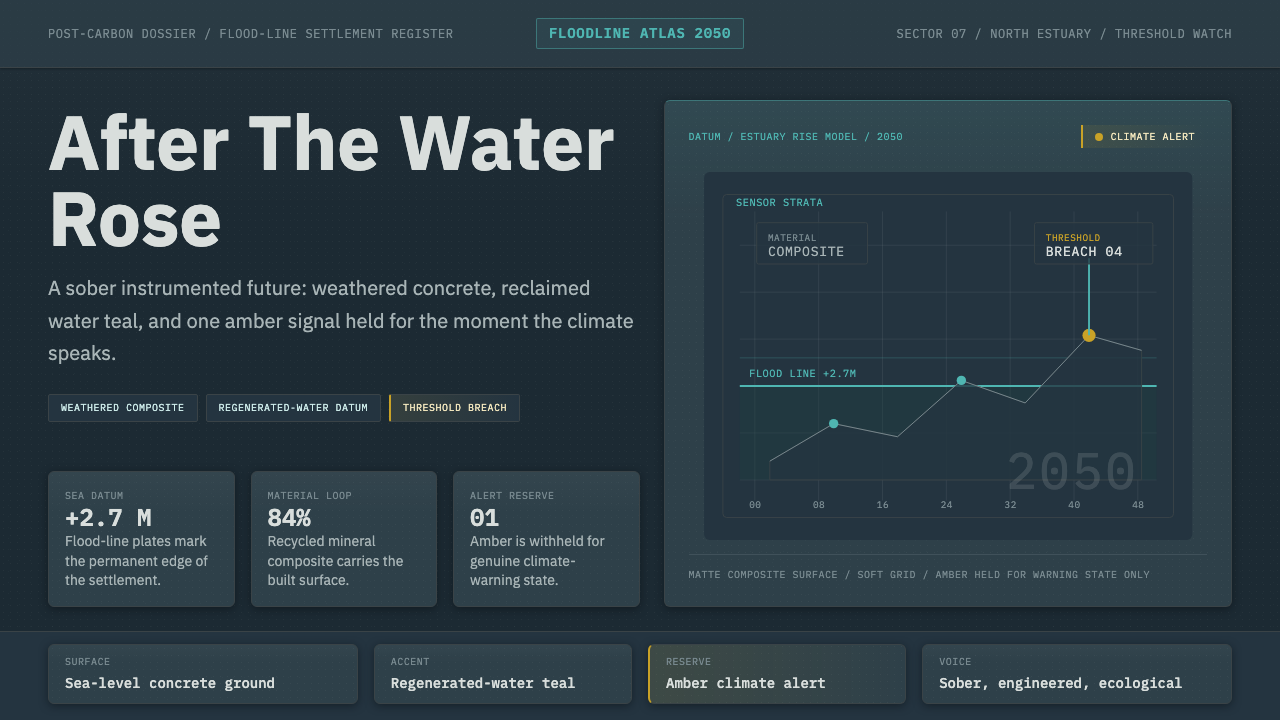 Cli-Fi 2050Pragmatic after the flood. Concrete blue-gray, muted teal, and one amber aler…
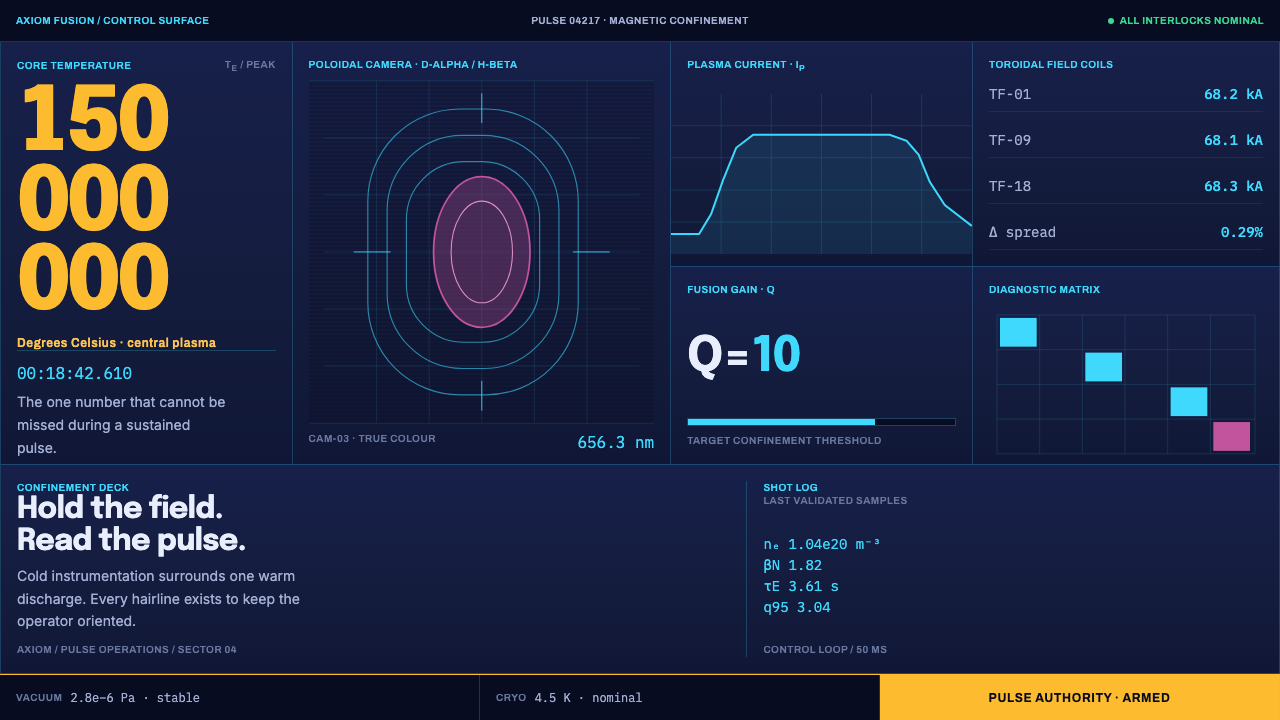 Tokamak Confinement DeckFusion control without softness. Navy panels isolate cyan telemetry, Noon Yel…
 Vertical Farm TowerFood production without daylight. Magenta LED tiers cut through a near-black…
 Brave Browser Lion OrangePrivacy gets loud. Lion-orange counters and shield geometry cut through warm…
 Cyberpunk 2077 Night City YellowCombat HUD on black. Sun-yellow chrome splits into magenta-cyan coordinate gr…