What is Dune Arrakis (Villeneuve)?
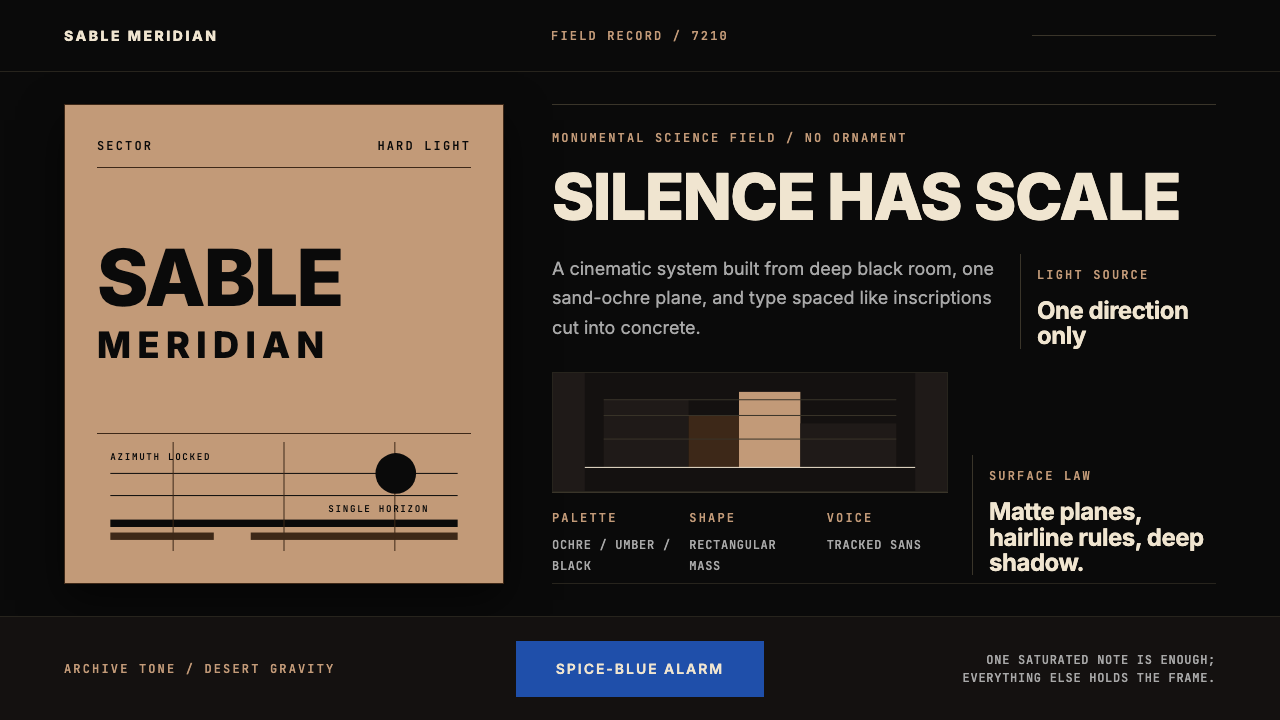
Denis Villeneuve's Dune gave science fiction a new visual law: monumental silence, sand-ochre plains, and a single cold spice-blue accent against infinite dark.
Dune Arrakis (Villeneuve) in brief
The Dune Arrakis visual style is the cinematic design language developed for Denis Villeneuve's 2021 and 2024 adaptations of Frank Herbert's novel. It is defined by three chromatic forces — the warm sand-ochre of the desert planet Arrakis, the deep saturated blue of the spice melange, and the near-absolute darkness that surrounds them both — combined with brutalist architectural forms, vast scaleless interiors, and letter-spaced geometric sans-serif typography that reads like carved stone.
What separates this aesthetic from generic dark science fiction is its studied restraint. There is almost no visual noise: no glowing readouts crowding the frame, no lens flare, no kinetic ornamentation. Every composition is organized around monumental flat planes — a sand dune that fills the frame edge to edge, a concrete wall that suggests a cliff face, a shadow line so precise it functions as a layout edge. Production designer Patrice Vermette and cinematographer Greig Fraser constructed an environment where scale itself is the primary expressive tool, and that same principle translates directly to interface and graphic design.
Applied to digital work, the style operates as a severe dark-ground system. A large field of deep near-black holds the composition; a measured band of sand-ochre introduces warmth and structure; a single spice-blue element signals urgency, interaction, or data. Typography is spaced wide and set in geometric forms with no serifs, evoking the inscribed titles in the film's opening sequences. Nothing competes for attention. Everything earns its place by mass and precision rather than by variety or decoration.

Where does Dune Arrakis (Villeneuve) come from?
Frank Herbert's Dune was published in 1965 and won the inaugural Nebula Award for Best Novel in 1966. Its visual world — the ochre deserts of Arrakis, the feudal-industrial architecture of House Atreides, the ceremonial robes of the Fremen — was described in precise ecological and anthropological terms rather than in the speculative-baroque vocabulary of most science fiction of the period. Herbert's Arrakis was austere by design: a planet where every calorie of moisture and every gram of resource was meaningful, and where that scarcity shaped culture, architecture, and clothing into forms that were functional before they were beautiful.
Denis Villeneuve began developing his adaptation in the mid-2010s with a deliberate mandate to reject the visual conventions of blockbuster science fiction. He assembled a core creative team centered on production designer Patrice Vermette and cinematographer Greig Fraser. Vermette drew on brutalist and modernist architecture — particularly the concrete monumentalism of Soviet-era civic buildings and the severe geometric forms of Louis Kahn and Marcel Breuer — to design the interiors and exteriors of Giedi Prime, Caladan, and Arrakis. The guiding principle was scale without ornament: surfaces that implied immense constructive effort while refusing decorative finish.
Greig Fraser's cinematography translated Vermette's sets into a color language of deliberate restriction. The Arrakis sequences were shot to emphasize a narrow warm spectrum — sandy ochres, burnt siennas, the pale gold of morning light — punctuated by the cold teal-blue of the spice itself or of interior artificial lighting. Fraser avoided digital color grading techniques that would introduce saturation complexity; the palette reads as austere because it was captured austerely. This approach earned Fraser the Academy Award for Best Cinematography for Part One in 2022.
Hans Zimmer's score extended the visual language into sound. Zimmer assembled non-Western instruments, invented new vocal techniques, and worked with artist Chas Smith to eliminate the harmonic richness associated with conventional orchestral science fiction scoring. The result was music that felt geological rather than emotional — a sound design parallel to Vermette's surfaces and Fraser's light. The integration of visual, architectural, and sonic restraint across all departments produced a coherent total aesthetic that was immediately recognizable and entirely unlike its predecessors. It is this total-system coherence — not any single element — that makes the Dune Arrakis style a genuinely referenceable design language.
What defines the Dune Arrakis (Villeneuve) look?
Color
The palette is built on three notes held in severe proportion: a deep warm near-black as the dominant ground, a sand-ochre drawn from Arrakis desert light as the primary structural accent, and a saturated spice-blue reserved for moments of urgency, highlight, or data signal. These three tones almost never appear in equal measure; the dark ground is always majority, the ochre is used structurally but sparingly, and the blue is a single note that commands attention precisely because it is rare. Secondary warm tones — dusty sienna, pale sand — can appear as subordinate surface variation, but they remain within the warm spectrum and never compete with the blue.
Typography
Type in this style is geometric and sans-serif, set at tracking levels wide enough to suggest engraved or architectural lettering rather than printed text. The spacing is not a casual style choice — it references the inscribed titling that appears in the film's chapter headings, which reads as stone-cut monument script. Hierarchy is achieved through scale contrast and weight, not through typeface variety: a headline stands at a dramatically larger size than body text, creating a relationship that feels architectural rather than editorial. All-capitals settings reinforce the monumental register. Type color is almost always the lightest available tone — near-white or pale sand — against the dark ground.
Form and Surface
Shapes are massive, rectilinear, and flat. The compositional language borrows directly from the film's brutalist architecture: horizontal bands of solid tone function as structural beams, large dark rectangles hold space the way a concrete wall holds a courtyard, and thin ruled lines serve as precise joints between planes. There is no rounding, no softening of corners, and no organic or curved form unless the curve is deliberate and large-scale — a dome that reads as monumental rather than decorative. Texture, where it appears, is subtle and material-honest: the grain of sand, the surface variation of aged concrete, never applied as decoration but as evidence of process.
Light and Shadow
Lighting in this style is highly directional and harsh — a single strong source that produces crisp shadow edges with minimal fill. There are no ambient glow effects, no soft diffused lighting halos, no gradient backgrounds that simulate atmospheric depth. Shadows read as solid dark shapes rather than as semi-transparent overlays. This mirrors Fraser's cinematographic approach: light comes from one direction, defines mass, and then steps off abruptly into dark. The result is a visual language where contrast does the work of both hierarchy and atmosphere.
Scale and Negative Space
Perhaps the defining characteristic of the Dune Arrakis style is its willingness to leave enormous areas of the composition empty. A figure at the base of a vast wall, a single line of type in the lower quarter of a page, a data point floating in a dark field — all of these reflect the film's compositional logic, in which human scale is persistently dwarfed by environmental scale. This is not minimalism for its own sake; it is a deliberate power relationship built into the layout. Empty space communicates weight, not absence. The viewer or user is meant to feel the scale of what they are encountering.
Zero Ornament
No decorative borders, no illustrative flourishes, no icon families, no badge shapes with rounded corners and gradient fills. If an element cannot be justified by structural or communicative necessity, it should not exist. This discipline is stricter than generic minimalism because it has a thematic rationale: the world of Arrakis does not permit waste. Every calorie of energy in the desert world is meaningful, and the design language inherits this ecology. What survives the edit is not sparse — it is necessary.
Monumental Alignment
Compositions are precisely aligned to an underlying structural grid with the rigidity of engineered architecture. Elements sit flush to implied vertical and horizontal axes; there are no casual placements or optical-only adjustments that would introduce softness. Asymmetry is permitted and common, but it is the asymmetry of a building floorplan — purposeful and non-negotiable — not the playful asymmetry of editorial design. This strictness is part of what gives the style its sense of authority and inevitability.

Who shaped Dune Arrakis (Villeneuve)?
The Quebec-born director came to Dune after Arrival (2016) and Blade Runner 2049 (2017), both of which demonstrated his commitment to austere visual environments in genre filmmaking. His directorial mandate for Dune was to create a science fiction film that felt as ancient and inevitable as myth rather than speculative and technological. This mandate governed every aesthetic decision: the refusal of visible technology for its own sake, the preference for mass and surface over gadgetry and detail, and the insistence that the audience feel the physical weight of the world.
Vermette served as production designer for both parts of Villeneuve's Dune. His approach was rigorously research-based: he studied brutalist and modernist architecture extensively, made reference visits to locations in the Middle East and North Africa, and developed a design vocabulary for each faction — the cold industrial geometry of the Harkonnen, the warm eroded monumentalism of the Atreides, the functional austerity of Fremen dwelling — that was architecturally coherent across every scale from cutlery to city. Vermette's work earned him the Academy Award for Best Production Design for Part One.
Fraser's cinematographic choices are responsible for the precise color language of the Dune films more than any other single decision. His choice to restrict the warm-to-blue contrast, to shoot with lenses that preserved diffraction and surface complexity rather than eliminating them, and to compose within extreme aspect ratios that emphasized horizontal scale, produced images that feel simultaneously intimate and vast. Fraser's work on Dune established a visual register for serious science fiction cinema that has since been widely referenced by directors and cinematographers seeking to move the genre away from the blue-and-orange blockbuster palette.
Zimmer's score for Dune is significant to the visual style because it demonstrates that the aesthetic restraint of the films extended beyond image. Zimmer's deliberate elimination of conventional harmonic richness — achieved through the use of non-Western instruments, invented vocal techniques, and close collaboration with experimental artist Chas Smith — produced a sonic environment that paralleled Vermette's surfaces and Fraser's light. The score does not swell with emotion at moments of spectacle; it recedes into frequency and texture, reinforcing the style's core principle that scale is expressed through subtraction, not addition.
How do you use Dune Arrakis (Villeneuve) today?
The Dune Arrakis style is well-suited to a specific category of high-stakes digital product: anything that benefits from projecting gravity, authority, and controlled precision. It works for enterprise software dashboards where density of information must coexist with visual calm, for premium pricing or feature-comparison pages where hierarchy and trust are paramount, and for any editorial or marketing context where the primary goal is to make the viewer feel the weight of what they are looking at before they read a word. It is not a warm style, a consumer style, or an approachable style — it is a style that communicates consequence.
For presentation slides, apply the Arrakis logic at both cover and content scale. A cover slide benefits from a near-full-bleed dark ground with a single band of sand-ochre anchoring the lower or upper third, and a title set in wide-tracked capitals at commanding scale, positioned with deliberate asymmetry — not centered. Content slides should treat each frame as a monumental surface: one dominant visual element (a chart, a photograph treated as a flat plane, a large number), one or two lines of supporting type at a fraction of the dominant element's scale, and large areas of dark ground left intentionally untouched. Data slides gain significantly from applying the spice-blue accent to highlight a single key data point, while keeping the rest of the chart in the sand-ochre and near-neutral range.
For web interfaces and dashboards, the style demands structural commitment. Define the grid tightly, use the dark ground as the default surface, and introduce sand-ochre as the primary navigation and structural tone — top bars, section dividers, key labels. Reserve spice-blue exclusively for interactive states, alerts, live data indicators, and primary call-to-action elements. Card components should have sharp edges and no border-radius rounding; divider lines should be precise and thin. Avoid icon libraries that introduce rounded or friendly forms — if icons are necessary, use geometric line forms that feel engineered rather than illustrated. The style works particularly well for financial data interfaces, monitoring systems, and any product where the user needs to trust that the information is authoritative and complete.
For editorial and marketing applications, the style supports long-form hierarchy with great efficiency. Feature pages work well with alternating full-width blocks — dark ground for body content and testimonials, brief sand-ochre bands to separate major sections — with spice-blue reserved for interactive links and primary navigation calls. Photography, when used, should be treated as a flat architectural element: cropped to strong geometric shapes, desaturated toward the warm palette, and positioned flush to layout edges rather than centered with breathing room. Marketing headlines benefit from the wide-tracked all-caps treatment; they should feel inscribed rather than typeset.
The most common mistake when applying this style is treating it as generic dark mode with a yellow or blue accent. Authentic Arrakis design is not dark mode — it is an entirely constructed visual ecology with specific tonal relationships that must be observed. Three failures recur: first, introducing rounded corners or soft shadows that break the brutalist hardness; second, over-saturating the spice-blue until it reads as an electric accent color rather than a cold, deep mineral tone; third, using the dark ground as an excuse to reduce contrast until type becomes difficult to read. The style demands that contrast be maintained at a high level — the dark ground is not murky, it is precise — and that every element be positioned with architectural deliberateness, not approximation.

Dune Arrakis (Villeneuve) — FAQ
Is this style the same as dark mode?
No. Dark mode is a system-level preference that inverts a light interface to preserve legibility in low-light environments. The Dune Arrakis style is a deliberate visual ecology in which the dark ground is expressive rather than accommodating — it communicates scale, gravity, and authority. The tonal relationships between the dark ground, the sand-ochre structural accent, and the spice-blue highlight are fixed and meaningful; they are not arbitrary color choices applied to a pre-existing light-mode layout. Applying the style correctly means designing from the dark ground up, not inverting a light design and calling it done.
Can the style be used for consumer-facing products?
With caution. The style's severity and monumental quality project authority and weight, which are valuable in contexts where the user needs to trust that what they are looking at is serious and complete. For consumer-facing products that prioritize warmth, playfulness, or invitation — food, wellness, lifestyle, children's services — the style will read as cold or alienating. It performs well in premium, technical, or high-stakes consumer contexts: luxury goods with a utilitarian ethos, high-end audio or optical equipment, financial services targeting a sophisticated audience, or travel and hospitality brands seeking to communicate scale and exclusivity rather than warmth.
How does this style differ from other sci-fi design aesthetics like Alien or Blade Runner?
The key difference is restraint in the warm direction rather than cool industrial complexity. Alien and its successors (the Ridley Scott industrial-gothic school) are rich in surface texture, mechanical detail, and a narrative of decay and organic threat — their palette is predominantly cool with warm accents used to signal danger. Blade Runner's neo-noir visual language is dense, layered, and heavily atmospheric, with glowing neon layered over rain and darkness. Dune Arrakis is none of these: it is vast, dry, and emptied of complexity rather than crowded with it. The ochre is warm and mineral, not cool; the forms are architectural and massive, not mechanical and intricate; the darkness is open and scaleless, not atmospheric and enclosed.
What is the correct role for the spice-blue accent?
Spice-blue is the system's alarm tone — its highest-urgency, highest-rarity signal. In the film, blue appears on the spice melange itself, in the Fremen's eyes after prolonged exposure, and in the artificial lighting of interior spaces that contrast against the desert exterior. In a digital product, it should function as the singular interactive and alert color: primary call-to-action buttons, active navigation states, critical data thresholds, live indicators. It should never be used for decoration, background fills, or general category differentiation. The ratio of spice-blue to dark ground in a composition should be low — close to the ratio of a single eye in a close portrait — and its saturation should remain in the deep, cold mineral range rather than the bright electric range.
Is the style appropriate for light-background layouts?
A light inversion is possible but changes the style's essential character significantly. On a pale sand or off-white ground, with dark type and ochre structural elements, the brutalist gravity largely disappears and the result reads closer to a warm modernist style than to Arrakis. If a light version is required — for print contexts, for accessibility reasons, or for mixed light-and-dark systems — the most faithful approach is to treat the light-ground version as a secondary surface only: use it for body text blocks and data tables, then return to the dark ground for headers, full-width feature sections, and any moment where the full authority of the style needs to be felt. A purely light Arrakis layout is a contradiction in terms: the darkness is not a preference, it is the desert night that makes the desert day meaningful.
Related design styles
 Fly.io Edge-Compute PurpleEdge-cloud with discipline. Electric purple nodes, Inter type, and terminal b…
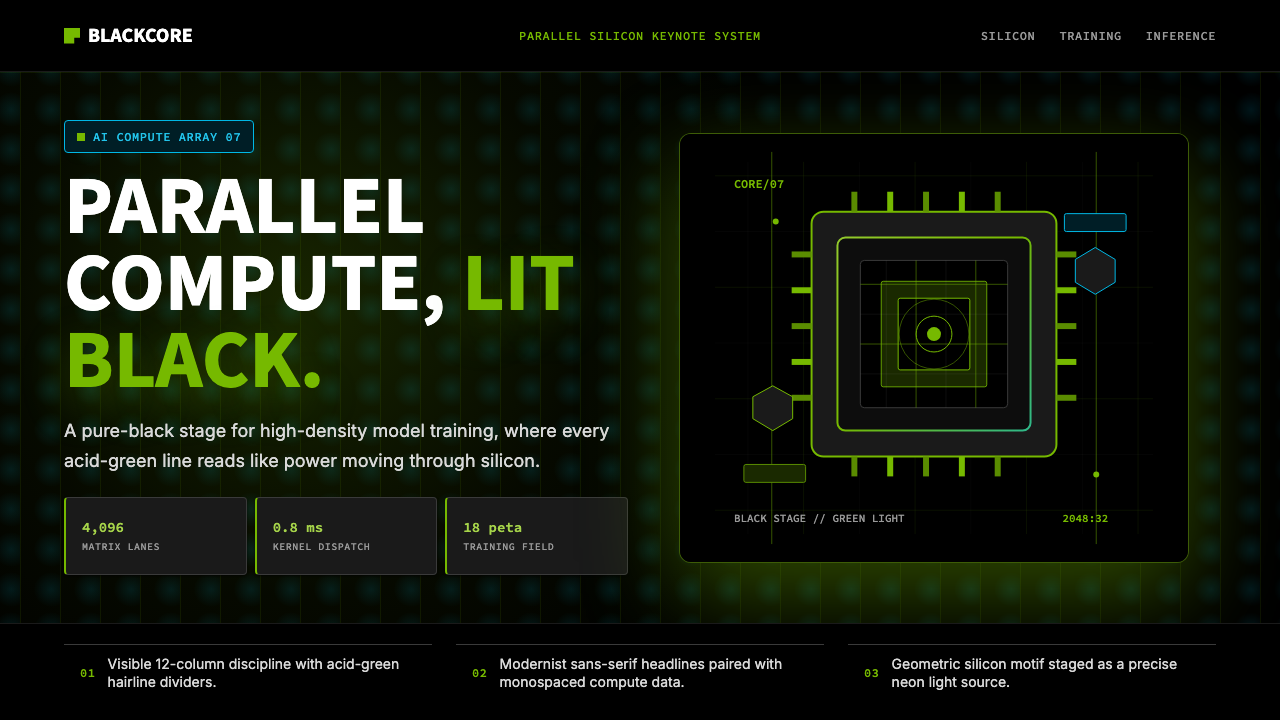 NVIDIA GPU Green-BlackPure black turns compute theatrical. Acid green hairlines and chip geometry s…
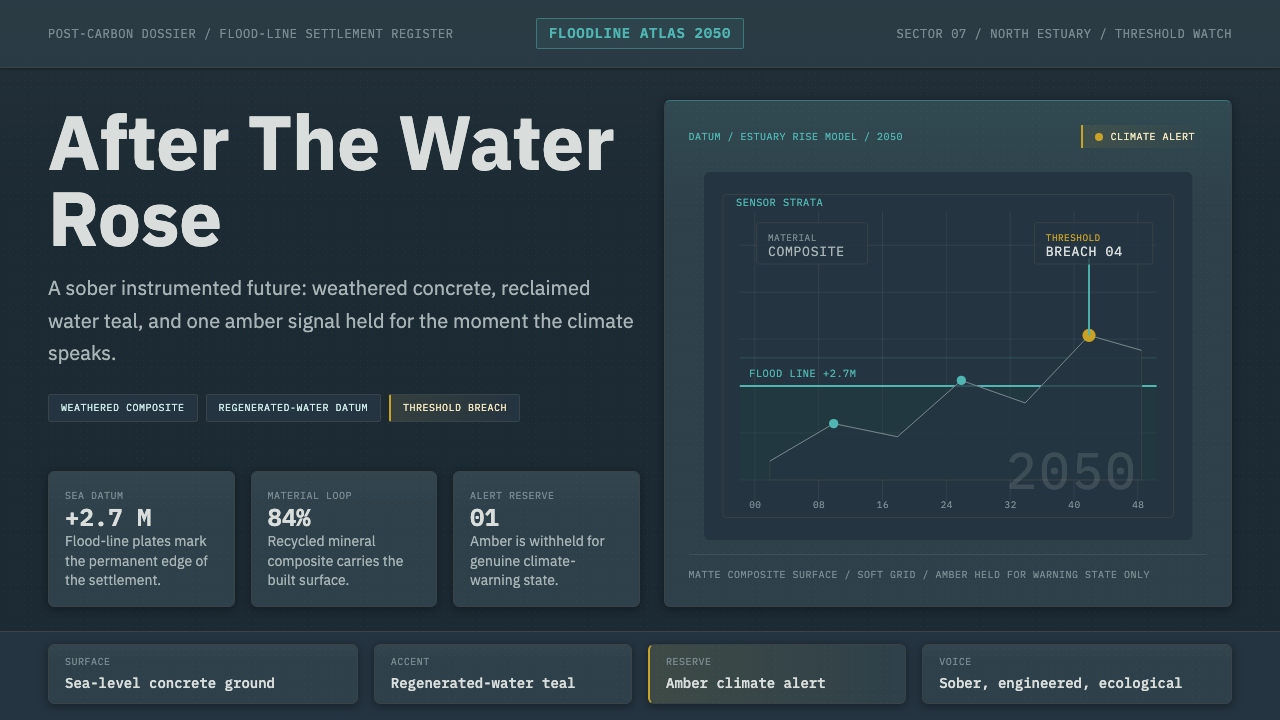 Cli-Fi 2050Pragmatic after the flood. Concrete blue-gray, muted teal, and one amber aler…
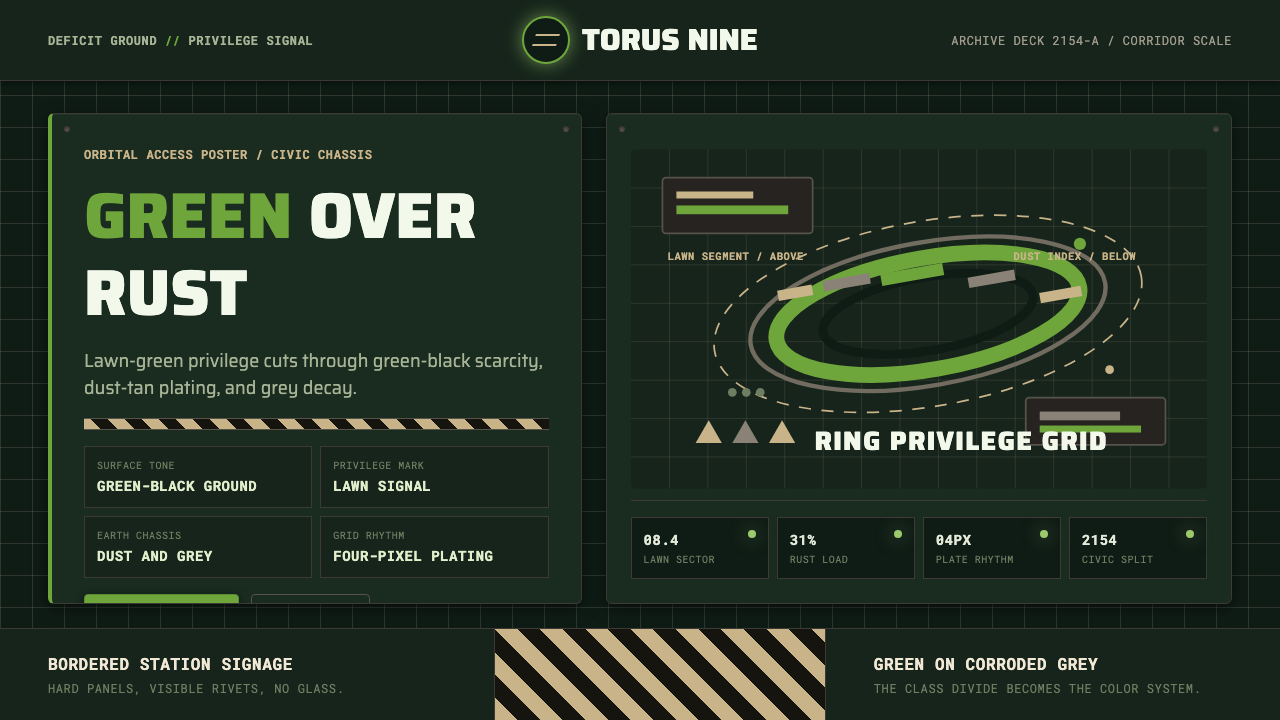 Elysium OrbitalClass divide made visible. Lawn green cuts through green-black plating and du…
 F1 Formula One LiverySpeed is legible. Ferrari red and papaya speed-lines cut through black teleme…
 Samsung GalaxyTech-luxury goes black. Electric blue cuts through AMOLED void and titanium-g…