What is NVIDIA GPU Green-Black?
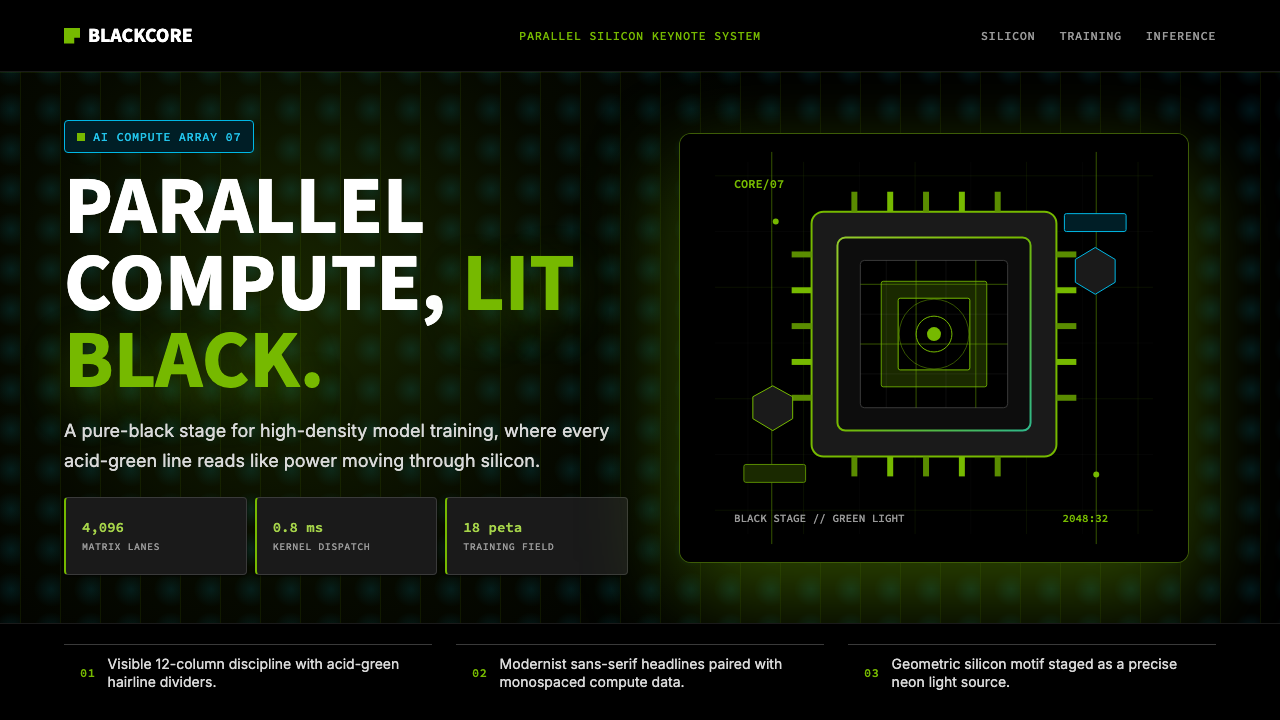
Pure black turns compute theatrical — acid green hairlines and chip geometry stage the glow of the AI era's most recognizable hardware brand.
NVIDIA GPU Green-Black in brief
NVIDIA GPU Green-Black is the visual identity system of the world's leading GPU and AI chipmaker — a strict two-tone discipline of acid green against pure black that has become the de facto aesthetic of high-performance computing, AI research, and the data-center era. It is a dark, cinematic, technically inflected style whose authority comes from its absolute commitment to a single chromatic relationship: the aggressive luminosity of the brand green floating against a field of total darkness.
The style is built on chiaroscuro. Everything that is not black is green, and everything that is not green recedes into black. Typographic elements are spare and geometric — a cold, rationalist sans-serif that reads more like instrument-panel labeling than editorial warmth. Where imagery appears, it is almost always rendered: three-dimensional silicon wafers, chip die photographs, particle-light glows, holographic architectural blueprints of GPU logic. Photography of people exists but is used sparingly; the dominant subject is the machine itself.
What distinguishes NVIDIA Green-Black from other dark tech aesthetics is its sense of contained spectacle. This is not the quiet darkness of a premium consumer product; it is the dramatic darkness of a concert stage or a particle accelerator visualization — an environment designed to make a single glowing element feel monumental. The palette and compositional logic communicate high-performance compute, engineering precision, and futuristic gravitas without ever relying on decoration. Every element earns its place by functioning as signal.

Where does NVIDIA GPU Green-Black come from?
NVIDIA was founded in 1993 in Santa Clara, California, by Jensen Huang, Chris Malachowsky, and Curtis Priem — three engineers who believed that the emerging market for 3D graphics processing would reshape computing. The company's early visual identity was conventional tech-company branding of the era: green was present but as part of a broader palette, not yet the monolithic discipline it would become. The GeForce line, launched in 1999, began to consolidate the green-and-black association in gaming hardware and marketing, as GPU boxes and product launches increasingly committed to the color pair as a signal of graphics power.
The decisive shaping event was CUDA, introduced in 2007. NVIDIA's parallel computing platform turned the GPU from a graphics chip into a general-purpose scientific computing engine, and the company began repositioning itself — both commercially and visually — as an infrastructure company rather than a consumer peripheral maker. The visual identity tightened: green became more saturated and specific, black became more absolute, and the typographic system leaned harder into geometric precision. The GTC (GPU Technology Conference), launched in 2009, became the annual stage on which this identity was performed at scale — a darkened arena filled with rendered chip architectures and Jensen Huang, almost always in his black leather jacket, presenting against vast green-lit backdrops.
The AI boom that began around 2017 — driven by deep learning breakthroughs and NVIDIA's hardware being the computational substrate — transformed the brand from a gaming-adjacent identity to a symbol of the AI era itself. H100 and A100 GPU launches in the early 2020s were accompanied by marketing materials that pushed the visual language to its most refined state: extremely dark backgrounds with near-zero ambient light, green glows that appeared to emanate from chip surfaces, and particle-light effects borrowed from cinematic visual effects pipelines. The style crossed over from product marketing into broader cultural visibility as NVIDIA became one of the world's most valuable companies.
David Kirk, NVIDIA's longtime chief scientist, and the broader engineering culture he represented, also shaped the aesthetic indirectly: the preference for technical exactness, for showing the actual hardware rather than metaphorical stand-ins, for treating chip architecture as something beautiful in its own right — all of this fed into a visual identity that treats rendered silicon as legitimate art. By the mid-2020s, the GTC keynote stage had become a recognizable cultural artifact in its own right, and the NVIDIA green-on-black system had been absorbed into the visual shorthand of AI and compute culture broadly.
What defines the NVIDIA GPU Green-Black look?
The Two-Color Absolute
The NVIDIA palette is structurally binary: the brand's signature acid green and pure black are not simply dominant colors — they are the only colors. The green is a concentrated, almost electric lime-adjacent hue that sits at the aggressive edge of visibility, engineered to read as luminous against any dark ground. Black is not a default or a neutral; it is the active negative space that gives the green its charge. Secondary colors — grays, whites, blues — appear only as typographic or structural elements and never compete with the primary relationship.
Cinematic Darkness
The black in NVIDIA's system is not a background color in the conventional sense — it is an environment. Compositions are staged as if under dramatic lighting: subjects emerge from darkness rather than sitting on a surface. This cinematic approach borrows from theatrical lighting design, where a performer is made monumental by the void around them. In NVIDIA's visual language, the chip, the render, or the headline is that performer. The darkness is not absence; it is context.
Glow and Particle Light
A defining characteristic of the mature NVIDIA aesthetic — particularly from the AI-boom years onward — is the presence of radiated light effects: soft green glows emanating from chip surfaces, particle streams suggesting energy or data in motion, and volumetric fog-like atmospheric depth. These are not decorative embellishments; they function as the system's version of warmth and dimensionality. The glow communicates that something powerful is active inside the object. It is performance made visible.
Geometric Modernist Sans-Serif
Typography in the NVIDIA system is cold, precise, and engineered — a geometric sans-serif that echoes instrument panels and technical documentation rather than humanist editorial traditions. Letter-spacing tends toward the open and deliberate; headlines are set with authority and weight. The typographic system communicates institutional precision: this is a company that measures in nanometers. Hierarchy is established through scale and weight contrast, not through decorative variation or color-coding beyond the two-color system.
Rendered Silicon as Subject
Unlike most technology brands, which use metaphorical imagery — abstract networks, speed lines, clouds — NVIDIA consistently foregrounds the actual hardware as its primary visual subject. Three-dimensional renderings of GPU die layouts, photographic close-ups of circuit board topography, and architectural visualizations of chip logic appear as the system's equivalent of portraiture. This choice is not incidental: it reflects the engineering culture's conviction that the hardware itself is the achievement, and that its geometry is beautiful.
Spectacle Composition
NVIDIA compositions frequently employ wide, cinematic aspect ratios and staged depth — a foreground element illuminated against a receding dark environment, with scale used to convey power. This is the compositional logic of the concert stage or the science fiction film frame: a single object or figure given monumental scale through its relationship to surrounding void. In marketing applications, this means full-bleed dark layouts where the product render or headline occupies a dramatically oversized portion of the available space.
Controlled Accent Discipline
Despite the visual drama, the NVIDIA system is extremely restrained in its use of the accent color. Green appears as hairlines, typographic highlights, glowing edges, and small geometric indicators — never as large filled areas competing with the black ground. When green does fill a larger region, it is almost always as a gradient dissolving back to black, maintaining the luminous-against-dark relationship rather than creating two equal-weight color fields. This discipline is what keeps the system from reading as garish rather than dramatic.

Who shaped NVIDIA GPU Green-Black?
Co-founder and long-serving CEO of NVIDIA, Huang has become as much a part of the brand's visual identity as the green-and-black palette itself. His signature black leather jacket — worn at nearly every GTC keynote and major product launch since the early 2010s — functions as a human extension of the brand's chromatic discipline. The jacket is not a costume; it is a consistent visual signal that collapses the distance between the brand and its leadership. Huang's theatrical presentation style — darkened arenas, dramatic pauses, reveals of chip architectures as if they were works of art — defined the GTC as a cultural event and established the cinematic register that NVIDIA's visual identity now operates in.
Co-founder and longtime hardware engineering leader at NVIDIA, Malachowsky represents the engineering culture that shaped the brand's insistence on treating actual silicon as a visual subject. The company's consistent choice to foreground chip architecture renderings — rather than abstract metaphors — in its marketing reflects the engineering team's conviction that the hardware is the story. This is a rare case where engineering culture directly determined aesthetic strategy.
NVIDIA's longtime Chief Scientist and a key figure in the CUDA architecture's development, Kirk exemplifies the technical intellectual culture that gave the brand its authority. His public presence — academic papers, technical talks, and explanations of GPU architecture to non-specialist audiences — helped position NVIDIA not merely as a manufacturer but as a knowledge institution. This institutional character is embedded in the visual identity's cold precision and its preference for showing technical truth rather than aspirational lifestyle.
The third co-founder, Priem served as NVIDIA's original chief technical officer and was instrumental in designing the company's first GPU architectures. His early technical decisions — particularly the commitment to a graphics-first architecture that would prove extensible to scientific computing — created the product line that would eventually generate the AI-era revenues making NVIDIA one of the world's most valuable companies. The brand's visual language is ultimately a representation of what his early engineering choices made possible.
How do you use NVIDIA GPU Green-Black today?
NVIDIA GPU Green-Black is among the most legible dark-mode design systems to borrow from, because its logic is structural: two colors, one relationship, one compositional principle. Applying it correctly requires absolute fidelity to the binary palette. The moment a third color enters the system — a warm gray, a blue accent, a white field — the acid-green-against-black tension dissipates and the look becomes generic dark tech. Before beginning any application of this style, establish the rule: background is black, type is green or white, everything else recedes.
For presentation slides, the style is best suited to cover pages, section dividers, and data visualizations — contexts where drama serves the communication. A cover slide in this style should treat the entire slide as a stage: title and subtitle in cold geometric type against a near-total black field, with a single green accent element (a hairline rule, a glowing chip render, a geometric mark) anchoring the composition. Avoid centering everything symmetrically; offset the title toward a third of the slide and let the dark space do work. Content slides require restraint — the full theatrical treatment is for moments of emphasis, not for every page of body text. Data visualizations thrive in this palette: bar charts and line graphs rendered in green against black read with immediate clarity and a sense of technical authority.
For web interfaces, the system is well-matched to dashboards, product specification pages, and developer-facing documentation where the user expects technical density and precision. The approach: commit fully to a dark background, use a cool near-white for body text rather than pure white (which can create too-harsh contrast at reading length), and deploy the green exclusively for interactive states, progress indicators, system-status signals, and primary calls to action. Navigation should be typographic and minimal — no decorative iconography beyond functional indicators. Pricing pages benefit from the style's implicit authority: plans and tiers differentiated by the presence or intensity of green accents rather than by color-coding with multiple hues.
For editorial and marketing work, the style is most powerful in large-format contexts: conference visuals, digital out-of-home, full-page advertisements, and event branding. The compositional logic of a massive dark field with a single luminous subject is precisely suited to large screens and physical signage. For editorial layouts, treat body text as a grid-bound element that the dark background serves rather than competes with — narrow columns of cool-toned type against darkness, with green reserved for pull quotes, section labels, or byline accents. Marketing materials should lean into the rendered-silicon aesthetic: show the actual product or its architectural representation rather than a lifestyle metaphor.
The most common mistake when applying NVIDIA Green-Black is treating the accent green as a fill color rather than a light source. In authentic applications, the green glows — it has soft halos at edges, it appears to emanate from surfaces rather than coat them. When the green is used as a flat fill over large areas — like a solid green button taking up a third of a card, or a green header bar — the system loses its distinctive luminous character and reads as a simple two-color scheme. The second common mistake is under-committing to darkness: adding gray gradients or secondary backgrounds to break up the dark field undermines the all-or-nothing drama that makes the style recognizable. Trust the black.

NVIDIA GPU Green-Black — FAQ
Is this style appropriate for non-tech industries, or is it too branded to NVIDIA?
The green-on-black system is strongly associated with NVIDIA, but the underlying visual logic — dark ground, single luminous accent color, cinematic composition, technical type — is a transferable design language used across gaming, cybersecurity, data analytics, financial technology, and defense industries. What you are borrowing is the general register of high-stakes technical authority in a dark environment, not a NVIDIA trademark. The specific acid green is the most brand-proximate element; substituting it with another high-saturation accent color — electric blue, deep amber, bright cyan — maintains the system's structural logic while moving away from direct NVIDIA association. The more you keep the exact hue, the more the viewer's eye will read NVIDIA.
How do you make this style work in a light-mode context?
The honest answer is that this style is fundamentally a dark-mode system, and a light-mode inversion compromises its essential character. The acid green that reads as luminous against black reads very differently — agitated, slightly acidic, hard to control — against white or cream. If a light-mode version is required, the most coherent approach is to treat it as a separate visual identity rather than a direct inversion: use the dark green as a type and structural-line color on a warm white background, reduce the glow effects entirely, and let the typographic precision carry the technical register. Expect a significantly different visual result — calm and technical rather than cinematic and dramatic.
Can this style work for a consumer product, or is it only for B2B and developer audiences?
NVIDIA itself has used the style successfully for consumer-facing gaming products — the GeForce RTX line, gaming laptops, and gaming accessories — demonstrating that the style can operate in consumer contexts when the consumer in question is a gaming enthusiast who equates darkness and green luminosity with performance and power. The style is aspirational for that specific consumer segment. It struggles with consumer audiences that prioritize approachability, warmth, or lifestyle aspiration over technical authority — health and wellness, food, family products, anything where the brand's job is to feel welcoming rather than impressive. The question to ask is whether your consumer audience reads darkness and technical precision as desirable signals or as barriers to entry.
What is the biggest mistake designers make when applying this style?
Over-greening. New practitioners see the NVIDIA palette and interpret it as permission to use the accent color generously — green headers, green card backgrounds, green filled buttons, green text at body size. The result is a layout that feels like a gaming peripheral accessory rather than the technical authority the brand represents. In NVIDIA's own best-executed work, the green is almost always a minority element by area: a thin hairline, a glowing edge, a small badge, a percentage of a gradient. The ratio of black to green is approximately what you would find between a concert stage and the spotlight on it. The spotlight is the point; it would not be the spotlight if it lit everything equally.
How does this style handle imagery of people, and should human subjects appear in compositions?
Human subjects appear in NVIDIA's visual system, but they are almost always subordinated to the technical drama rather than centered as lifestyle subjects. Jensen Huang himself is the most prominent exception — in keynote contexts, his presence is the event. For general marketing and communication work, people appear in ways consistent with the dark-cinematic compositional logic: lit dramatically against dark backgrounds, often photographed from angles that create geometric tension, and rarely smiling in the conventional consumer-advertising sense. If you are applying this style and need to include people, treat them as elements in the technical environment rather than as warm human anchors. Skin tones will shift under the green color grading, which is acceptable — the goal is integration with the system, not naturalistic reproduction.
Related design styles
 Fly.io Edge-Compute PurpleEdge-cloud with discipline. Electric purple nodes, Inter type, and terminal b…
 Samsung GalaxyTech-luxury goes black. Electric blue cuts through AMOLED void and titanium-g…
 Brave Browser Lion OrangePrivacy gets loud. Lion-orange counters and shield geometry cut through warm…
 Cursor IDEAI-first code editor. Pure dark surfaces, off-white text, electric blue reser…
 Resend 2024Clean code becomes brand. Pure black, JetBrains Mono, and one green delivered…
 Vercel 2024Developer luxury by subtraction. Pure black, white Inter, rigid grid, triangu…