What is SpaceX Starship / Falcon?
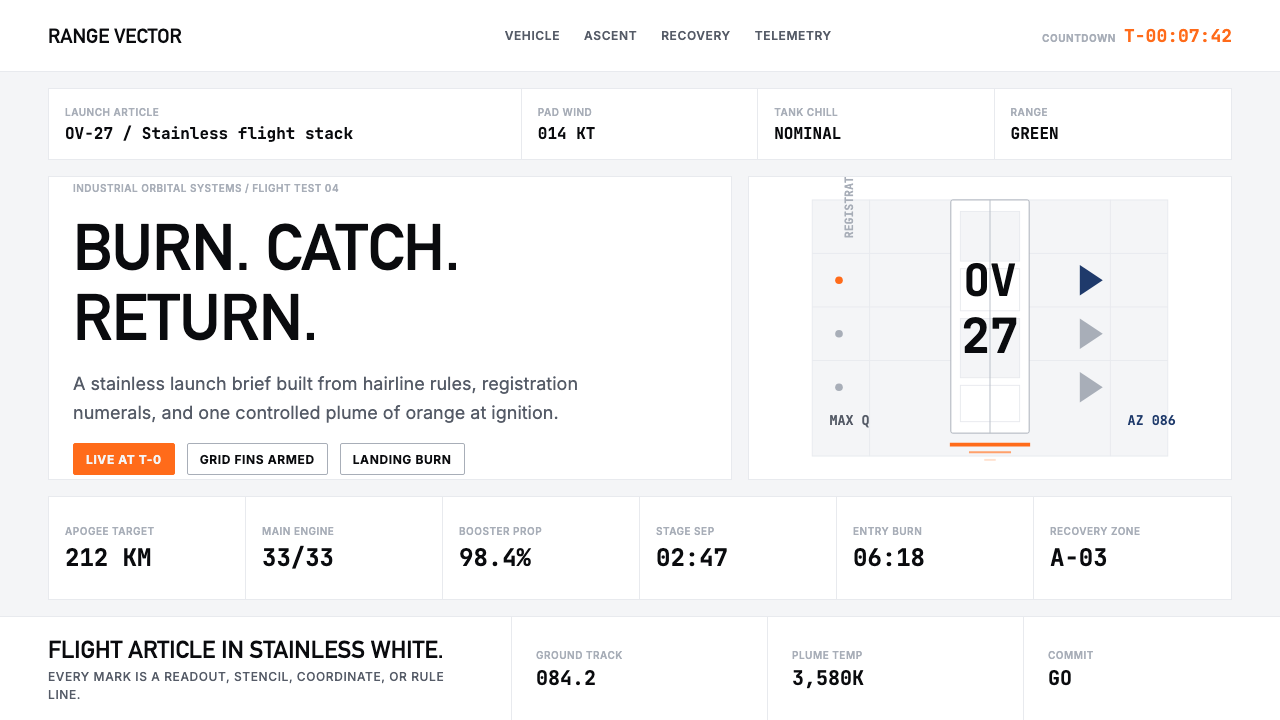
SpaceX turned orbital rocketry into a visual doctrine — industrial white, a single searing accent, and lettering precise enough to survive reentry.
SpaceX Starship / Falcon in brief
The SpaceX Starship / Falcon visual language is aerospace industrialism distilled into a design system. Its governing logic is engineering necessity: surfaces are white because thermal management and inspection demand it, lettering follows FAA stencil standards because legibility at distance matters, and the single orange accent traces the thermal signature of Raptor engines burning at full thrust. Nothing is applied for appearance alone.
This is a system built around restraint through constraint rather than restraint through taste. Where Bauhaus stripped ornament as a philosophical position, SpaceX stripped it as an operational requirement. The outcome looks similar — clean surfaces, tight geometry, one charged accent — but the logic underneath is empirical rather than ideological. The aesthetic did not precede the engineering; it emerged from it.
What makes the visual language remarkable is how coherently it reads across wildly different scales. The same grammar that governs a mission patch governs the entire flank of a two-hundred-meter-tall stacked vehicle: tight sans-serif stencil numerals, a high-contrast logo on uninterrupted white, and the concentrated heat of orange appearing exactly once. Scale amplifies the system rather than breaking it.

Where does SpaceX Starship / Falcon come from?
SpaceX was founded in 2002 in Hawthorne, California, by Elon Musk with the stated purpose of making humanity multiplanetary. The visual identity that emerged in the company's first decade was utilitarian to the point of austerity: a wordmark in compressed geometric type, white vehicles bearing registration numbers stenciled in sizes dictated by federal aviation regulation, and minimal graphic presence beyond what regulatory compliance demanded. The first Falcon 1 launches from Kwajalein Atoll in 2006 and 2008 established the visual template — brushed metal and matte white, numbers large enough to read from a ground station.
The Falcon 9, introduced in 2010, refined this language into something more deliberate. As reusability became the central engineering goal — the ambition to land a booster on a drone ship in the open ocean — the vehicle's visual identity began to carry more conscious weight. The drone ships themselves received names drawn from Iain M. Banks's Culture novels: Just Read the Instructions, Of Course I Still Love You. The naming convention signaled something about SpaceX's self-conception: technically serious but culturally aware, operating in a register where audacity and precision coexist.
The current visual identity crystallized around 2020 to 2024, as Starship entered active testing at Boca Chica, Texas — a stretch of Gulf Coast that SpaceX informally renamed Starbase. The Starship's stainless-steel hull, polished to a mirror finish, introduced a new visual element: the vehicle itself became reflective. Dawn photography of Starship on the pad — the hull catching pink light, frost condensing on cryogenic fuel lines — produced images that circulated globally and became inseparable from the brand. The visual language absorbed this photographic quality: the system now includes an awareness of how industrial materials perform under extreme lighting conditions.
Key context for understanding the aesthetic: SpaceX operates in parallel from three geographic poles — Hawthorne for engineering, Boca Chica for Starship testing and launch, Cape Canaveral for Falcon 9 and Falcon Heavy orbital operations. Each site contributes its own visual register to the brand's accumulated imagery. Hawthorne is machined aluminum and fluorescent-lit factory floor. Boca Chica is pre-dawn mist over the Gulf and a Starship catching sunrise. Cape Canaveral is nighttime launch photography, a booster threading back through the atmosphere in a controlled ballistic arc, twin sonic booms cracking over the coast as legs deploy. The visual system must work across all three contexts, and it does — because its core grammar has no contextual dependencies.
What defines the SpaceX Starship / Falcon look?
Surface and Palette
The dominant field is white — not the warm off-white of architectural minimalism, but the cool, slightly reflective white of industrial-grade coatings and polished stainless steel. Against this field, a single accent of deep, saturated orange appears: the color of a Raptor plume at full thrust, of heated ceramic tile edges, of hazard markings on launch-pad infrastructure. This two-tone restraint is absolute. Secondary colors — safety yellows, mechanical reds, corporate grays — appear only in documentary photography of the physical environment, never in the intentional graphic layer.
Typography
The letterforms are tight, compressed geometric sans-serifs — in spirit close to the highway and aviation signage tradition where character shapes must survive distance, speed, and variable lighting conditions. The typeface in use carries no historical sentiment; it reads as a functional specification rather than a stylistic choice. Numerals dominate the typographic texture of the vehicle surface itself: FAA registration stencils, mission numbering, countdown clocks. These are set at whatever size the regulatory or operational need dictates, which at Starship scale means characters that dwarf a standing human.
Geometry and Structure
The visual grammar is cylindrical and radial — a reflection of the vehicles themselves. Unlike the square-and-triangle vocabulary of Bauhaus, the SpaceX system is organized around circles and vertical columns. The Starship's diameter defines the compositional module; everything — logos, text, grid lines implied by panel seams — relates to this circular cross-section. In two-dimensional applications, this translates to centered radial compositions for mission patches and tightly vertical text stacks for infographics and vehicle designations.
Material Texture
The visual system is unusually material-aware. Stainless steel in multiple finishes — mirror-polished, brushed horizontal, brushed vertical — appears as a surface element with its own information density: weld seams, panel boundaries, thermal protection patterns. These are not decorative; they are the skin of a functional object made visible. In the design language, this principle extends to valuing visible production marks, structural joints, and finish variation as compositional elements rather than imperfections to be smoothed away.
Scale and Proportion
Few visual systems must operate coherently from the scale of a wristwatch mission patch to the scale of a fully stacked launch vehicle visible from fifty kilometers. The SpaceX system achieves this through extreme economy: almost no elements exist that do not scale cleanly. The wordmark, the vehicle registration, the mission number — each is a single typographic element with no accompanying texture or decoration that would degrade at either extreme. This scalar discipline is a product of real-world requirements, not design philosophy, but the effect is visually powerful.
Light and Photography
Perhaps uniquely among commercial design languages, the SpaceX system has been shaped by photography as much as by graphic intention. The dawn-on-stainless images — Starship reflecting a deep-orange sunrise against a blue Gulf horizon — created a visual idiom that the brand subsequently absorbed and reinforced. Cryogenic condensation, plume illumination, the hard shadow of a booster leg on a drone-ship deck: these photographic elements are now part of the brand's visual vocabulary. The design system implicitly acknowledges that its most powerful moments are not designed but captured.
Information Density
SpaceX mission graphics — patches, infographics, trajectory diagrams — operate at high information density but maintain visual clarity through disciplined hierarchy. A mission patch typically carries the vehicle type, mission number, payload operator, orbit type, and booster flight number within a compact circular field. The hierarchy is managed entirely through scale and placement: the largest element is always the mission-defining datum, the smallest are supporting metadata. No decorative borders, no tonal backgrounds, no gradient fills mediate between the data and the viewer.
Who shaped SpaceX Starship / Falcon?
As founder and chief executive, Musk established the visual and cultural register of SpaceX — the combination of technical seriousness and pop-cultural irreverence visible in drone-ship naming, mission patch humor, and the decision to launch a personal sports car as the Falcon Heavy test payload. His public communications about the company, conducted through social media at a pace and informality unusual for aerospace, extended the brand's visual language into a textual register: hyperbolic, data-dense, and visually punctuated by photography of vehicles rather than product renders.
Mueller founded SpaceX's propulsion department and led the development of the Merlin and Raptor engine families — the hardware whose visual signature most defines the aesthetic. The Raptor's distinctive plume coloration at different throttle levels, the thermal glow of engine bells during static fire tests at Boca Chica, and the ring-of-fire geometry of a Starship's full-engine-count ignition: these are Mueller's engineering translated into visual spectacle. The design language could not exist without the specific properties of the engines it represents.
Koenigsmann served as SpaceX's vice president of build and flight reliability and was the public face of mission control during many live broadcasts — an almost accidental contributor to the brand's visual identity through his on-camera presence at the console. The mission-control aesthetic, broadcast to millions via SpaceX's live streams, established a visual grammar for the company's working culture: banks of monitors, flight controllers in black jackets with the SpaceX wordmark, and the measured technical cadence of launch commentary that made industrial process legible as drama.
Krebs led SpaceX's design team during the period when the visual identity consolidated into its current form. The refinement of the wordmark — from earlier versions toward the present compressed geometric form — occurred under design leadership that understood the system's context: a brand whose primary visual output is live video of machinery operating at the edge of physical possibility, where graphic design must coexist with spectacle rather than compete with it. The discipline of not overdoing it is itself a design achievement.
The Scottish science fiction author whose Culture novel series provided the names for SpaceX's drone ships — Just Read the Instructions, Of Course I Still Love You, A Shortfall of Gravitas — is not a designer, but his influence on the brand's cultural layer is real. Banks's Culture universe describes a post-scarcity civilization where vast intelligent machines carry out enormous tasks with casual competence and dark humor. The naming convention signals SpaceX's self-positioning: technically serious enough to land boosters on moving ocean platforms, culturally playful enough to name those platforms after jokes made by fictional spacecraft.
How do you use SpaceX Starship / Falcon today?
Applying the SpaceX Starship / Falcon aesthetic to designed work requires understanding its core operating principle: the visual language earns its authority through visible necessity. Elements that look like they belong there because they have to — stencil numerals, mission identifiers, the single accent color borrowed from exhaust heat — read as genuine. Elements that imitate the surface without functional grounding read as costume. The distinction matters more here than in most styles because the aesthetic is legible precisely because its original context is so specific.
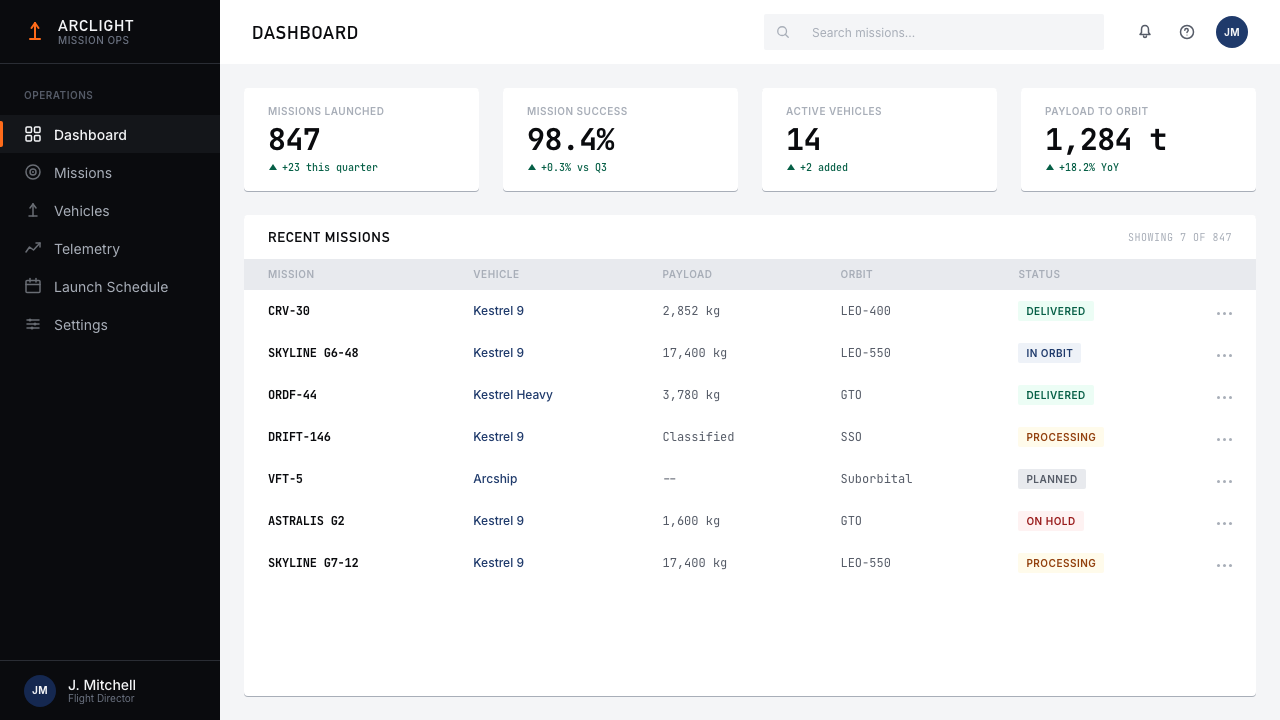
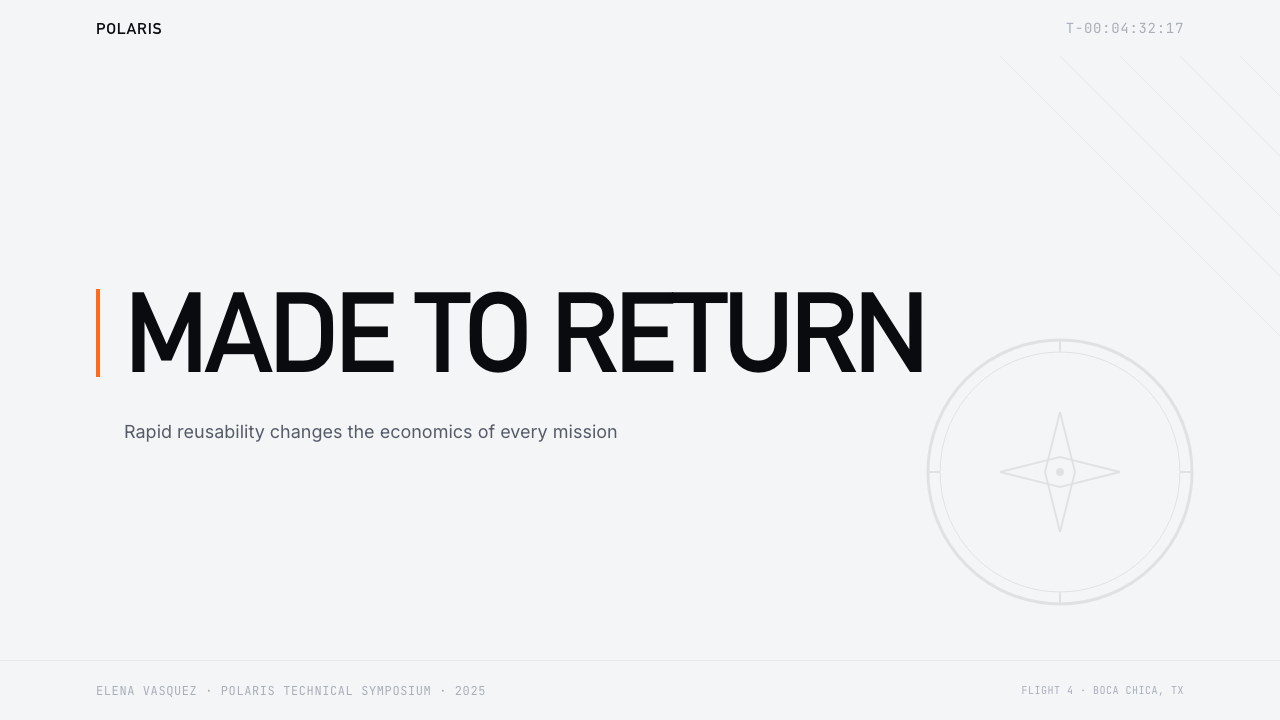
For presentation slides, the style works most powerfully when the content is technical, data-heavy, or stakes-forward. Cover slides should commit to the two-color discipline: a dominant white or near-black field, one accent element in a concentrated orange-adjacent tone, and a single typographic statement in tight compressed letterforms. Data slides work as mission-control dashboards — dense but hierarchically organized, with every metric labeled in the same register as the others. Avoid the temptation to add a second accent color for variety; the system's power comes from the restraint. If information variety is needed, use scale and placement rather than color.
For web interfaces, the style suits products with a technical audience where authority and precision are desired values: developer tools, analytics platforms, infrastructure dashboards, and any context where the user's trust depends on the interface communicating reliability. Apply the surface language literally: white or very dark background, one concentrated accent, tight geometric type, and generous empty space that mirrors the scale of the systems being represented. Avoid soft shadows, rounded corners at large radii, and any surface treatment that implies warmth or approachability — these undercut the system's specific authority. Hard-edged components, precise alignment, and visible structure are the correct choices.
For editorial and marketing work, the aesthetic operates in the poster register — meant to be read at a distance and retained after a single impression. A full-bleed vehicle photograph with a single line of tight stencil type can carry enormous communicative weight. Infographics benefit from the mission-patch logic: complex information (trajectory, timeline, vehicle components) organized within a defined geometric field, with hierarchy managed through scale alone and the accent color appearing exactly once to mark the most critical datum. Marketing pages should resist the urge to visualize the vehicles through illustration; documentary photography is the correct choice, and the design language exists to frame it rather than to replace it.
A common mistake when applying this style is treating the orange accent as a highlight color to be used liberally for calls to action, hover states, and notification badges. In the source material, the orange appears once per composition — it is the plume, the exhaust, the one point of maximum thermal energy. Using it across multiple elements simultaneously destroys the visual logic that gives it meaning. Reserve the accent for the single most important interactive or informational element in any given view. If everything is accented, nothing is.
SpaceX Starship / Falcon — FAQ
Is this a design system or just a visual identity?
It functions as both, but the distinction matters for application. As a visual identity, it governs how the company presents itself — wordmark, vehicle livery, mission patches, broadcast graphics. As a design system for application elsewhere, it offers a set of transferable principles: two-tone palette discipline, typographic compression, material-aware surface treatment, and the hard discipline of using accent color once and only once per composition. The second is more useful for designers, because the principles are extractable without requiring access to the specific hardware that generated them.
How does this relate to other aerospace visual identities like NASA or Boeing?
NASA's identity — the worm logotype, the blue-and-white federal color scheme, the red swoosh of the meatball — carries institutional weight accumulated over decades and communicates through the language of a federal agency: measured, historically aware, conservative by necessity. Boeing's commercial identity is corporate modernism, closer to an airline than a space company. SpaceX sits in a different register: commercial, technically specific, and visually aggressive in the way that startup culture is aggressive — not through decoration, but through the confidence of understatement. The orange accent is doing work that NASA's color scheme distributes across many elements.
Does the style work for non-technical brands or softer subject matter?
Rarely, and usually not well. The SpaceX visual language derives its authority from a very specific set of associations: physical scale, engineering precision, extreme environmental conditions, and operational consequence. Applying it to a consumer product, a food brand, a wellness service, or any context where warmth and approachability are desired values will produce a mismatch between visual tone and product intention. The exception is products that want to borrow the authority of engineering culture — certain fintech platforms, developer tools, high-performance athletic equipment. There, the alignment is real and the style works. The test is whether the product's values genuinely overlap with the style's values, not whether the colors and type look interesting.
What is the most common failure mode when designers apply this style?
Over-decoration of a system that earns its authority through under-decoration. Designers unfamiliar with the source material tend to add complexity — gradient overlays on the white field, a second accent color for variety, soft-shadow card components, illustrated rocket shapes used as decorative elements. Each addition individually seems harmless; together they rebuild the visual noise that the style exists to eliminate. The other common failure is using the orange at high saturation across multiple elements, which converts a structural focal point into a generic highlight system. Study the source material not for what is present but for what is absent.
How should the photographic element of the style be handled in contexts without access to original imagery?
The photographic layer of the SpaceX visual system — dawn light on stainless steel, plume photography, landing burns against a dark sky — is inseparable from the brand because it documents real events. When applying the system in other contexts, the honest approach is to not simulate this layer at all, and instead lean harder into the typographic and structural elements. A design that commits fully to tight stencil type, a white field, one accent, and rigorous geometry will read as coherently within this tradition as one that tries to approximate launch photography and fails. The photographic warmth is earned by actually launching rockets; everything else in the system earns its place through discipline.
Related design styles
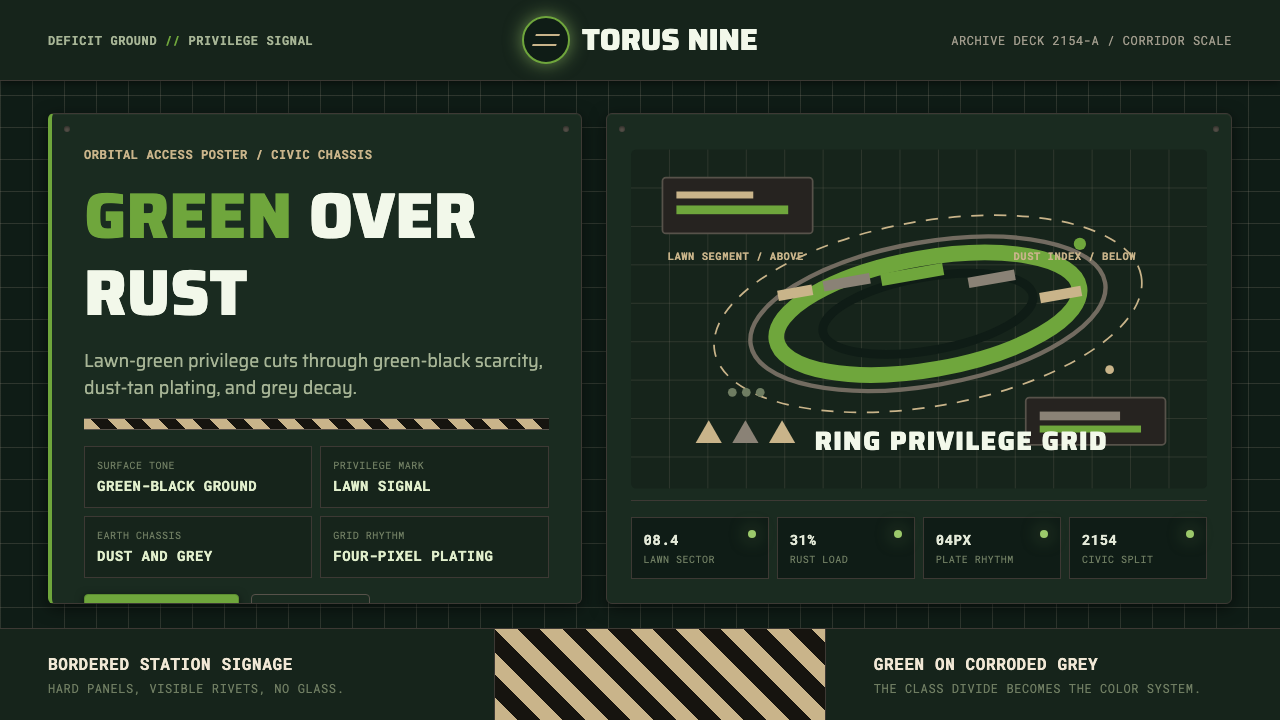 Elysium OrbitalClass divide made visible. Lawn green cuts through green-black plating and du…
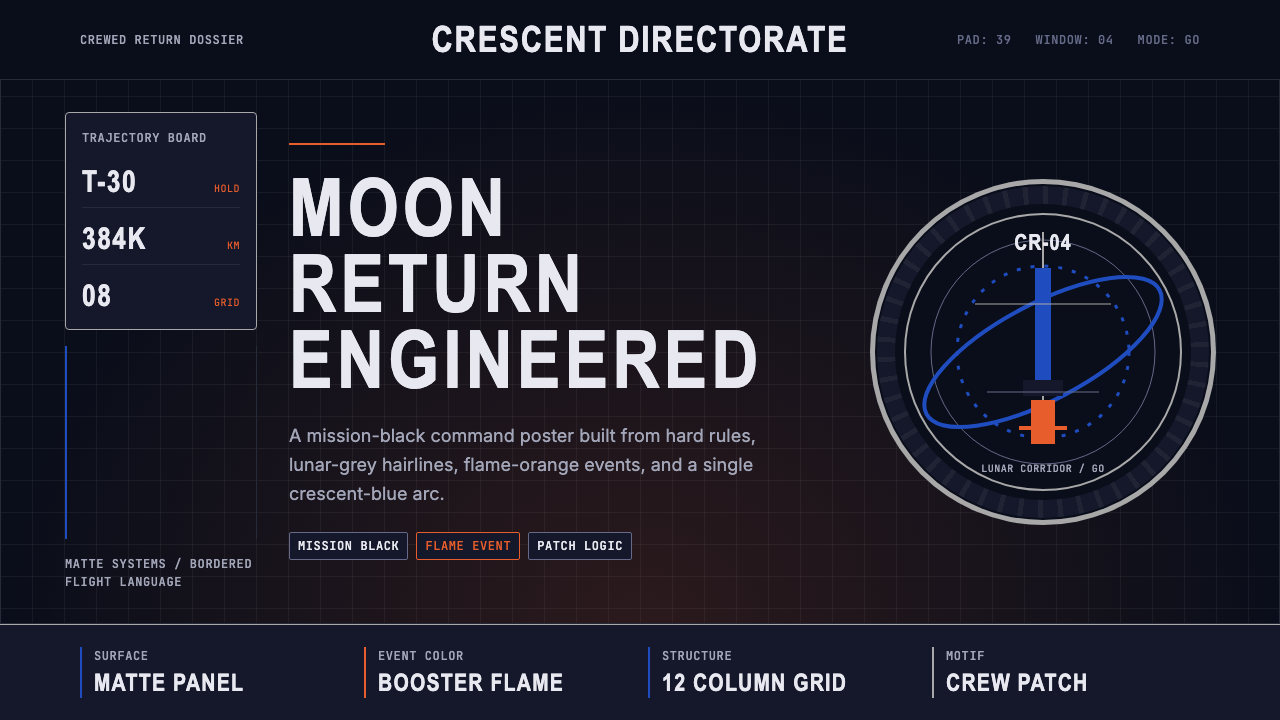 NASA Artemis ProgramCrewed return, engineered. Mission black, crescent-blue arc, flame orange, ri…
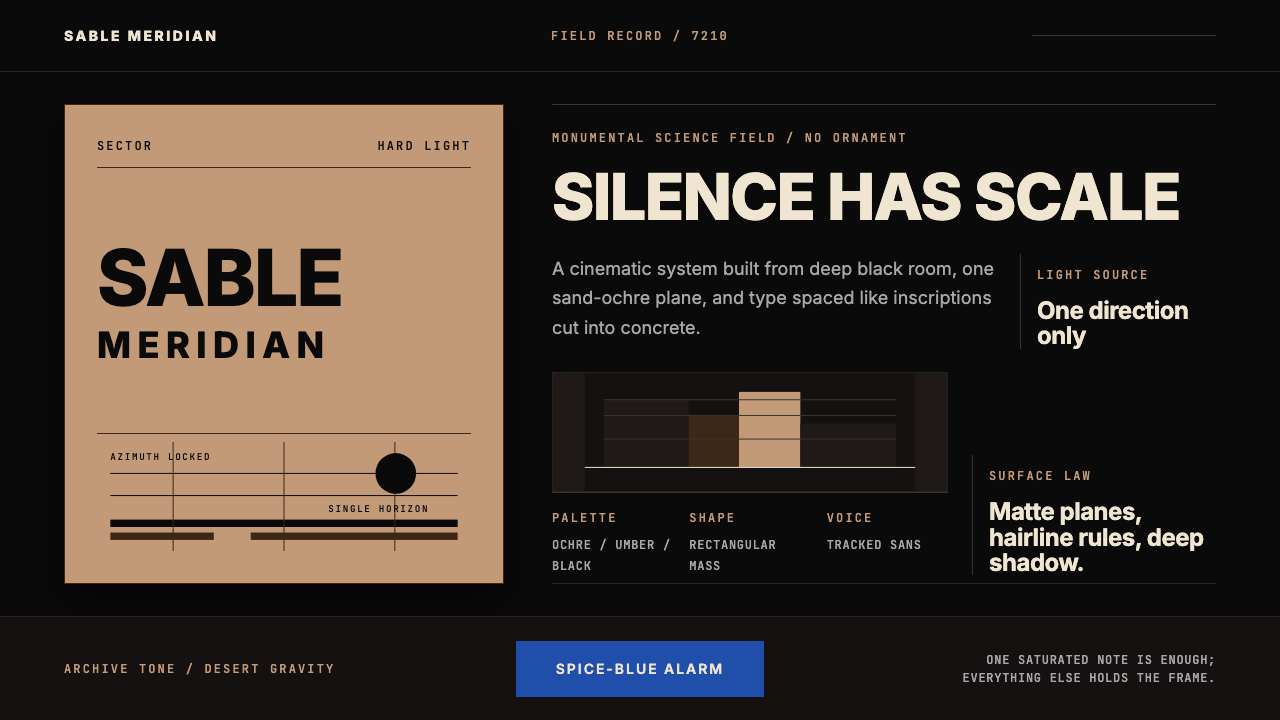 Dune Arrakis (Villeneuve)Silence has scale. Sand-ochre slabs, spice-blue alarm, and tracked Inter on b…
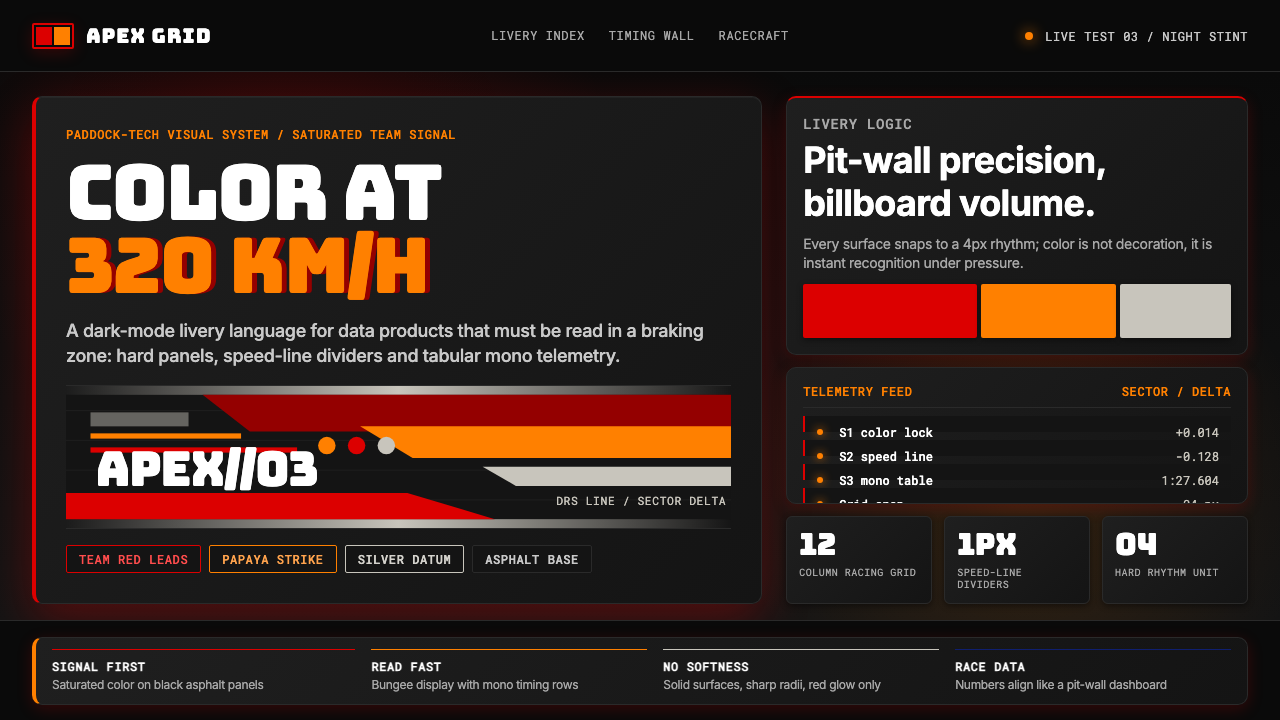 F1 Formula One LiverySpeed is legible. Ferrari red and papaya speed-lines cut through black teleme…
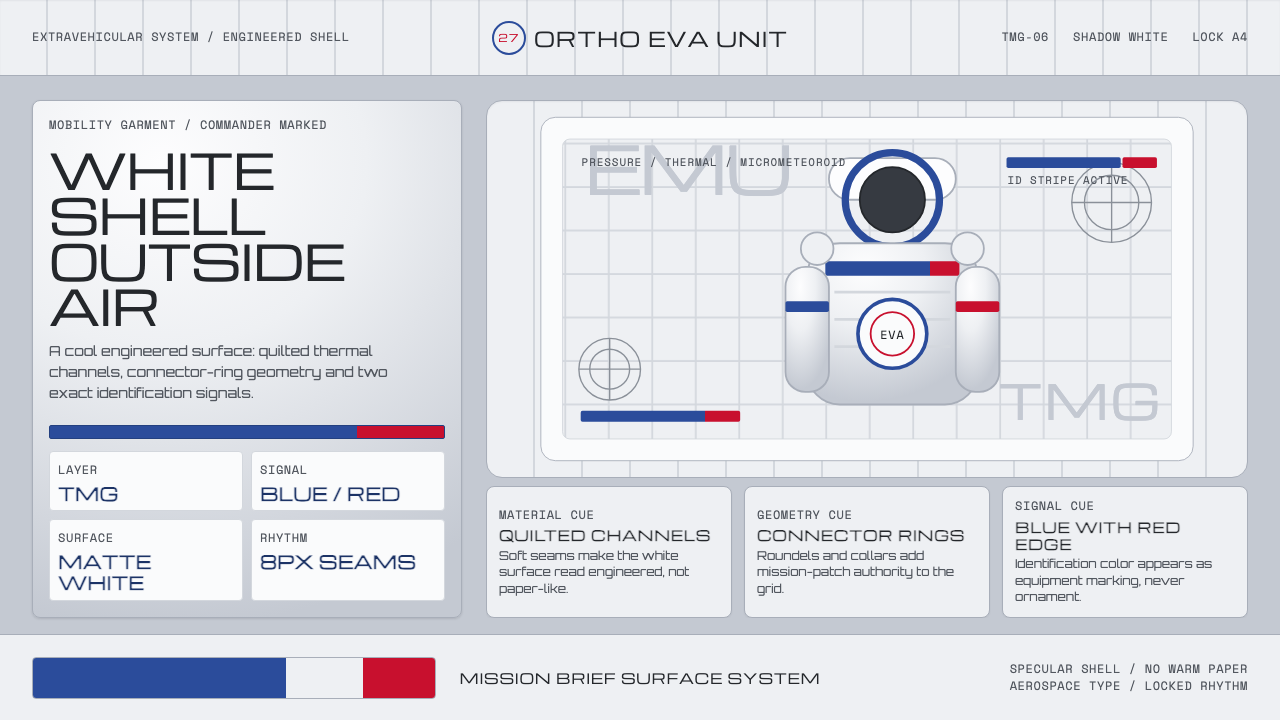 NASA EMU SpacesuitEngineered white, never warm. Quilt seams, blue ID stripes and worm red mark…
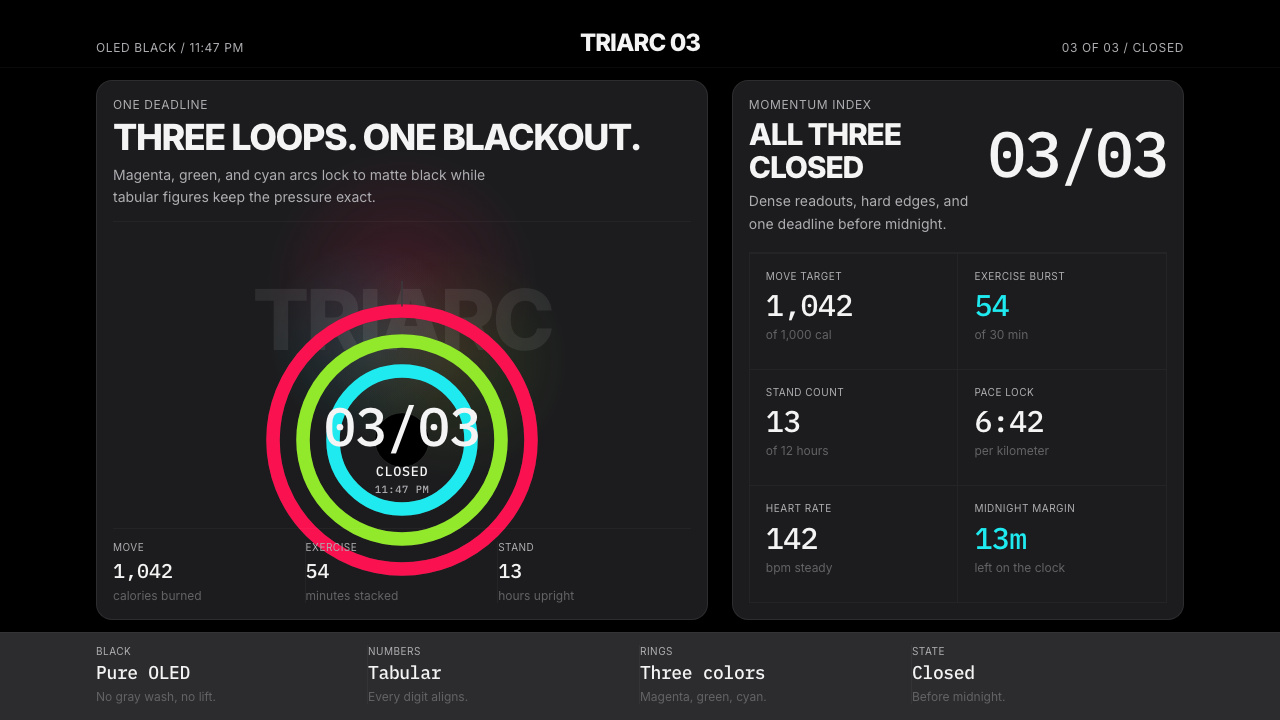 Apple Fitness Rings Closed (2024)Midnight feels exact. Magenta, green, and cyan rings lock onto OLED black.