What is NASA Artemis Program?
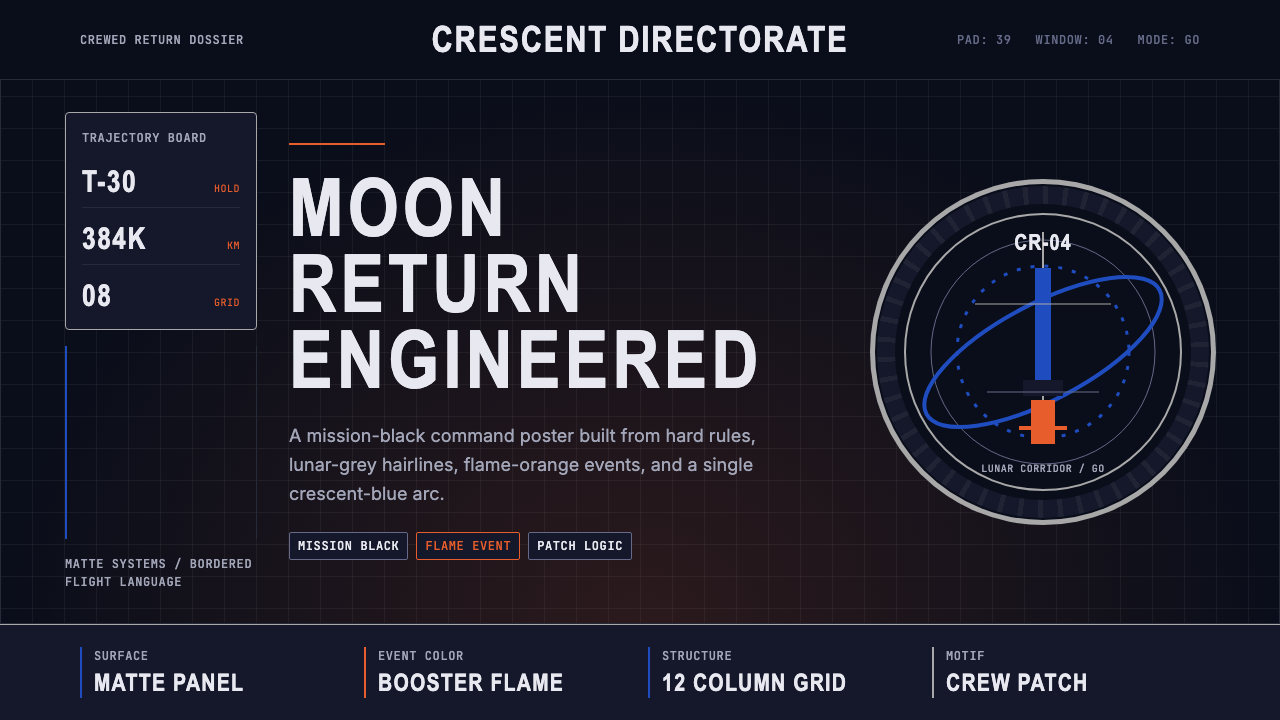
NASA's Artemis program revives the visual confidence of the Apollo era for a new lunar generation — mission black, crescent blue, and flame orange fused with control-room precision.
NASA Artemis Program in brief
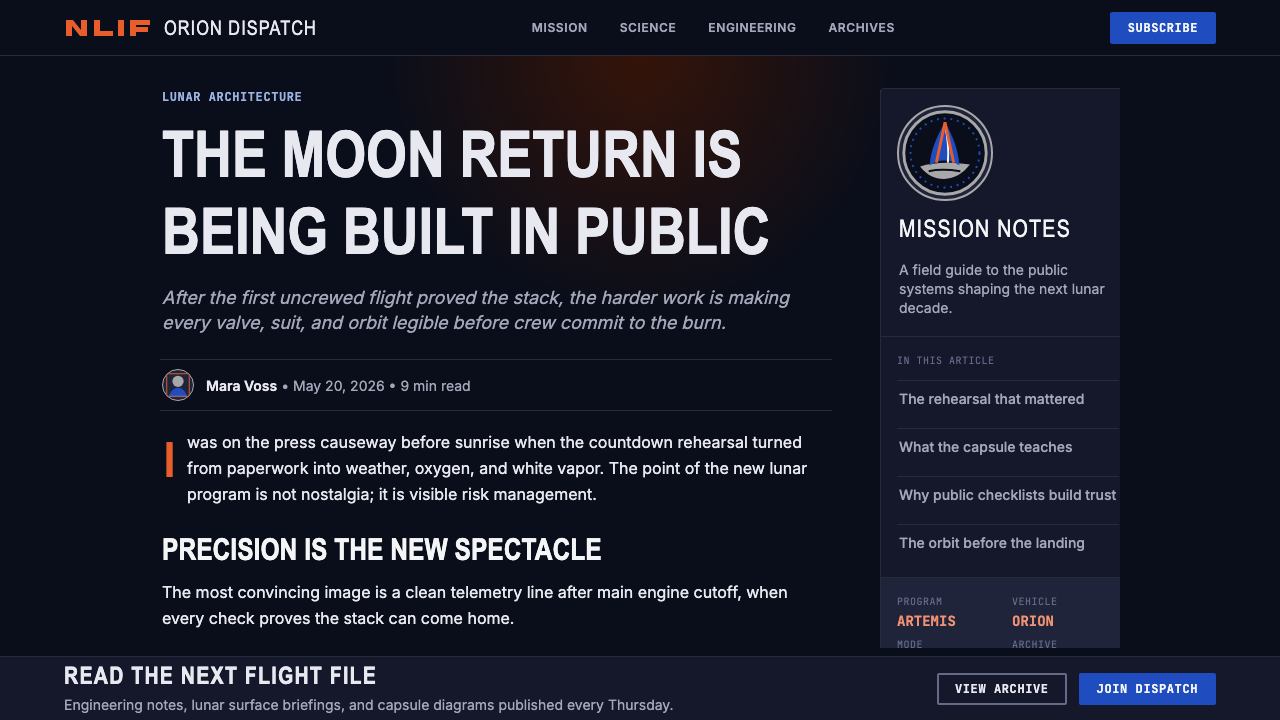
The NASA Artemis design style is the visual identity of the United States' return to crewed lunar exploration, crystallized between 2020 and 2024 alongside the Artemis I, II, and III missions. It extends NASA's institutional graphic tradition — engineered clarity, dense informational grids, and the gravity of human spaceflight — into a contemporary aesthetic that feels simultaneously retro and relentlessly forward-looking.
At its core, the style deploys a palette of deep mission black, a signature crescent arc in a cool space blue, and a warm, fuel-fire orange that echoes the exhaust plume of a Saturn V or the SLS main engines at ignition. These three anchors carry different emotional frequencies: black evokes the void of space and the matte surfaces of spacecraft hulls; blue suggests lunar orbit, atmospheric limb light, and the precision of trajectory data; orange signals power, heat, and the irreversible moment of launch.
The typography is condensed, all-caps, and engineered in register — it reads less like marketing and more like a systems label on a flight panel. Round, embroidered mission patches provide the style's human counterweight: they carry heraldic imagery, crew insignia, and national symbolism in a format that has been standard in crewed spaceflight since Project Mercury. Together, the geometric severity of the grid and the artisanal warmth of the patch create a tension that is central to the style's appeal.
Where does NASA Artemis Program come from?
Artemis as a program was formally announced in 2017, when NASA tasked itself with returning astronauts to the Moon by the mid-2020s — this time to stay, and to establish a sustainable presence that would serve as a proving ground for eventual Mars missions. The program took its name from the Greek goddess of the Moon and twin sister of Apollo, a deliberate mythological symmetry that acknowledged the lineage while signaling something new: Artemis would carry the first woman and the first person of color to the lunar surface.
The visual identity crystallized most visibly between 2020 and 2024, as NASA and its contractors — including Lockheed Martin, Boeing, and SpaceX — produced mission patches, vehicle liveries, press kits, and public communications for the first uncrewed test flight (Artemis I, November 2022) and the planned crewed missions. The design drew explicitly on NASA's own archival identity: the 'worm' logotype, retired in 1992 and revived in 2020, reappeared on the Space Launch System rocket and on Orion spacecraft hardware. This revival was not nostalgia for its own sake but a deliberate assertion that institutional credibility, accumulated through decades of missions, was a design asset worth recovering.
Key figures in the Artemis era shaped the program's public face in different ways. Administrator Bill Nelson, who took office in 2021, oversaw the communications strategy that positioned Artemis as a geopolitical as well as a scientific mission — a response to China's lunar ambitions as much as a continuation of exploration. Astronauts Reid Wiseman, Christina Koch, and Victor Glover, designated for the Artemis II crewed lunar flyby, became the human faces of the program: their mission patch, crew portraits, and public appearances all carried the visual language described here into public consciousness. Koch, set to become the first woman to travel to the Moon's vicinity, represented the program's stated commitment to expanding who spaceflight represents.
The broader movements surrounding Artemis — the commercial crew era, public-private partnerships with SpaceX and Blue Origin, the Lunar Gateway station concept, and the Artemis Accords that established norms for international space cooperation — each left traces in the visual language. Where Apollo's imagery was government-monolithic, Artemis's is ecosystem-aware: it accommodates corporate partner logos, international flags, and the visual vocabularies of collaborating space agencies from Europe, Japan, Canada, and beyond. The mission patch tradition, adapted across these partnerships, became the clearest symbol of this collaborative but iconographically American character.
What defines the NASA Artemis Program look?
Color Palette
The palette is built around three anchors: a near-black that carries the weight of deep space, a cool arc blue that suggests orbital trajectories and lunar distance, and a warm flame orange tied to rocket propulsion and the spectacle of launch. Black dominates as the background field — it is not decorative darkness but structural void. Blue functions as both accent and wayfinding, appearing most often as the crescent arc motif. Orange is used sparingly but decisively, landing on key calls to action, mission designators, or moments of maximum visual emphasis. Secondary neutrals — gray scales and off-whites — carry supporting text and fine-line grid elements without competing with the three primaries.
Typography
All-caps condensed letterforms dominate in headline and identifier roles — they read as systems nomenclature, mission designators, and control-room labels rather than as editorial text. The compression of the letterform is a functional choice: condensed type fits more information into narrow column widths and survives reproduction at small sizes on mission badges, instrument panels, and press materials. Body text, where it appears, is set in a neutral upright face that provides readability without drawing attention to itself. The deliberate contrast between the muscular all-caps headers and the quieter body copy creates a hierarchy that readers parse in stages.
The Mission Patch Motif
The circular embroidered mission patch is the most distinctive compositional element in the Artemis visual lexicon. It carries heraldic conventions — a motto, a symbolic central image, crew names arranged around the perimeter — within a format that has been standard in crewed spaceflight since Project Mercury in the early 1960s. In the Artemis system, patches appear not only as physical embroidered objects on flight suits but as graphic motifs integrated into digital compositions: they anchor layout centers, provide focal weight on dark fields, and carry the human, hand-crafted counterpoint to the machine-grid environment around them. The combination of embroidery-like texture with surrounding geometric precision is a deliberate tension in the style.
Grid and Technical Precision
Layouts are organized around rigid engineering grids that recall the orthographic projections and schematic drawings of aerospace documentation. Spacing is consistent and systematic — components align to an underlying structure that is never visible but always felt. Square-cornered containers, hard ruled lines, and tight column structures communicate control-room discipline. Nothing drifts; every element is locked to its position as deliberately as a component in an assembly diagram. This rigidity is not aesthetic severity for its own sake — it references the actual production discipline of mission-critical documentation, where precision is a safety value.
Matte Surfaces and Hard Edges
The Artemis visual vocabulary avoids gloss, lens flare, and soft atmospheric glow — the tropes of cinematic space spectacle. Surfaces read as matte: the black of the background has the quality of a spacecraft's thermal coating, not a polished void. Edges between elements are hard and decisive, never feathered or blended. This matte, hard-edged approach signals that the aesthetic is rooted in engineering artifacts — heat shields, instrument casings, flight-suit patches — rather than in visual effects design. The contrast with the high-gloss, CGI-saturated imagery of commercial space branding is deliberate.
Emblem and Heraldry Logic
Beyond the circular patch, the broader Artemis visual system incorporates the logic of heraldry: each sub-program, vehicle, and mission carries a distinct mark with consistent compositional rules. The Artemis wordmark, the SLS vehicle identifier, the Orion capsule insignia, and the Gateway station emblem each function as coats of arms within a unified armorial system. Color assignments are meaningful — a departure from decorative branding in which color is applied arbitrarily to distinguish products. The result is a visual ecosystem in which individual elements are legible both in isolation and as part of a family.
Dark-Field Composition
Unlike most design systems that use light backgrounds as the default field, Artemis deploys darkness as the primary compositional ground. Elements are placed on black not for dramatic effect alone but because the void is the literal context of the program's activity. Light elements — white type, blue arcs, orange accent marks — emerge from the dark field as stars emerge from space: with clarity, isolation, and precise positioning. This inversion of the conventional light-on-white layout is the single most powerful signal that the viewer is in an environment governed by different physical and emotional rules than everyday terrestrial design.

Who shaped NASA Artemis Program?
As NASA Administrator from 2021, Nelson shaped the public communications strategy that framed Artemis simultaneously as a scientific mission, a geopolitical statement, and a national aspiration. Under his tenure, the program's visual identity was elevated alongside its policy messaging — the worm logo revival was endorsed, mission patch reveals became media events, and the program's visual language was treated as part of its diplomatic and institutional case. Nelson's positioning of Artemis against international competition, particularly from China's lunar program, gave the style's bold authority a specific geopolitical resonance.
Koch, designated for the Artemis II crewed lunar flyby, became one of the most visible human embodiments of the program's identity. As the astronaut set to become the first woman to travel to the Moon's vicinity, she appeared repeatedly in mission materials, press photography, and public communications, her image consistently embedded in the Artemis visual language. Her presence represents the program's stated mission expansion — Artemis is not only a return to the Moon but a deliberate broadening of who spaceflight represents, and that narrative is inseparable from the visual identity that frames it.
Glover, designated pilot for Artemis II, brought to the program's public imagery a personal and historical dimension. As the first Black astronaut to be on long-duration station crew during the SpaceX Crew-1 mission, and a core crew member for Artemis II, his presence in mission materials reinforced the program's narrative of expansion and inclusion. Mission portraits and patch reveals featuring Glover were widely circulated and became key images in the program's public communications strategy, embedding the crew's human diversity directly into the Artemis visual record.
As Commander of the Artemis II mission and one of its public spokespeople, Wiseman's role in crew communications shaped how the mission's human dimension was presented in the program's visual materials. A veteran of the International Space Station, his experience brought credibility to the Artemis crew portraits and mission briefings. The Artemis II crew, with Wiseman as its public anchor, received some of the most carefully composed photographic and graphic treatment of any crewed spaceflight in decades — each image deliberate in its use of the program's established visual vocabulary.
How do you use NASA Artemis Program today?
The Artemis design language translates into contemporary design contexts that call for authority, precision, and a sense of high stakes — it works best when the product genuinely needs to evoke seriousness of purpose rather than simply borrowing visual credibility from the space program. Applied thoughtfully, the style signals rigor and ambition; applied carelessly, it reads as costume.
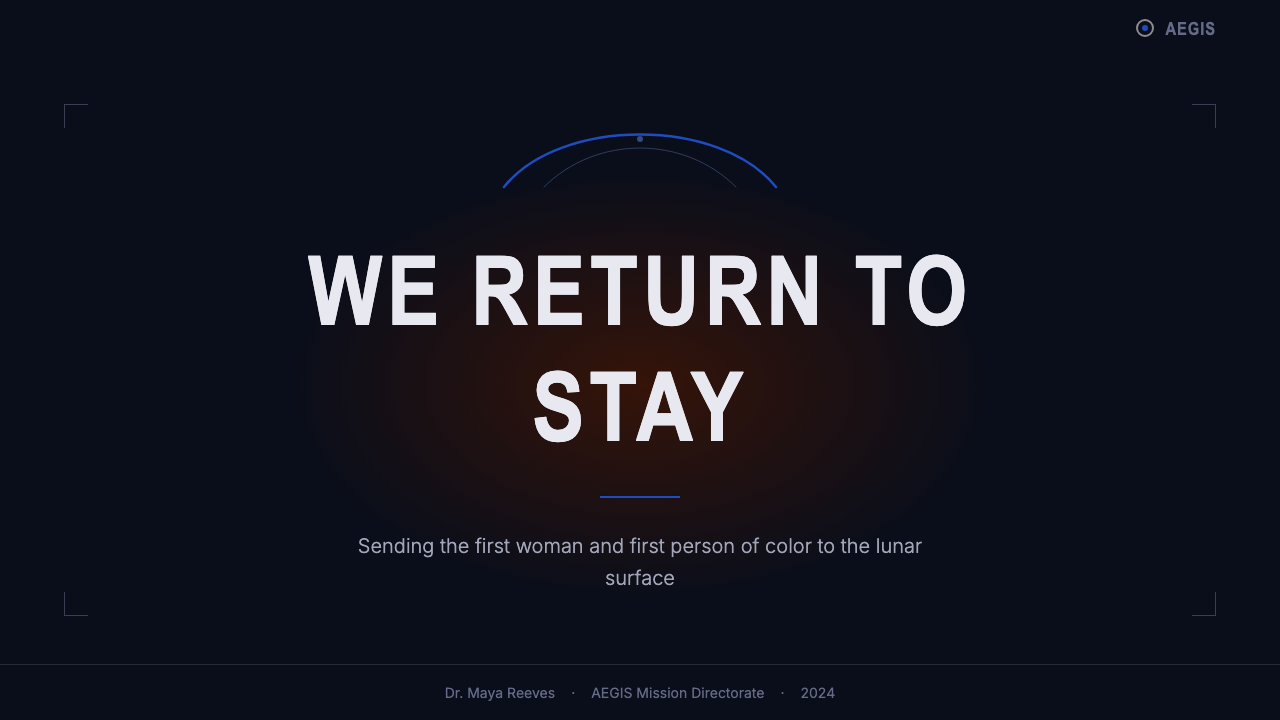
For presentation slides, the style is most effective when applied consistently from cover to close. A cover slide benefits from the dark-field approach: a near-black background, a single large typographic element in all-caps condensed form, and a bold accent — either the blue arc motif or an orange highlight — placed asymmetrically for visual tension. Content slides should treat the grid as non-negotiable: every element aligns, column widths are consistent, and the only decoration is the structural grid itself. Data slides work especially well in this register — charts and diagrams rendered in the style's three-color palette acquire a mission-readout quality that makes technical data feel authoritative rather than merely illustrated.
For web interfaces, the style is best suited to dashboards, launch pages, or product sites where the user needs to feel that they are interacting with something consequential. Apply a dark background as the primary canvas, reserve the accent colors for interactive states and key calls to action, and use condensed all-caps labels for navigation and category identifiers. Component edges should be hard — avoid rounded corners where a squared edge better communicates precision. System status indicators, progress bars, and data readouts all benefit from the mission-critical vocabulary of the style.
For editorial and marketing applications, the Artemis vocabulary works powerfully in headline-driven layouts where a single bold statement anchors a page. Full-width sections alternating between dark and very dark backgrounds — with the blue arc appearing as a dividing or transitional element — create rhythm without resorting to decorative ornament. Marketing materials aimed at announcing something ambitious (a product launch, a significant milestone, a bold institutional claim) benefit from the style's association with moments of high consequence. The mission patch motif, adapted as a circular badge or emblem, can anchor product or event identities within the aesthetic.
A common mistake is treating the dark background as the only Artemis marker and then filling it with generic content — gradients, multiple typeface families, photographic imagery with soft lighting. The style's authority comes not from the darkness alone but from the discipline of what appears within it: condensed type, hard edges, systematic spacing, and a color palette held to three anchors. A second common error is using the orange too liberally, treating it as general fill rather than as a precise emphasis tool. In authentic Artemis-derived work, orange is rare and therefore powerful; when it appears everywhere, the hierarchy collapses and the style reads as mere mood rather than system.
NASA Artemis Program — FAQ
How does the Artemis style differ from generic 'space' aesthetic?
Generic space aesthetics typically rely on photographic nebulae, lens flares, CGI planet renderings, and gradients from deep purple to electric blue — they borrow from science fiction film production design. The Artemis style draws instead from aerospace engineering documentation and the institutional tradition of NASA graphic identity. Its darkness is matte, its edges are hard, its typography is condensed and functional, and its graphic motifs — the crescent arc, the circular mission patch — are specific to the Artemis program rather than generic signifiers of 'space'. The distinction matters practically: the former evokes wonder; the latter evokes authority.
Is this style appropriate for consumer-facing products, or is it primarily institutional?
The Artemis style is primarily an institutional and mission-communications vocabulary, and it carries that register strongly. It works well for consumer-facing products when the brand's positioning genuinely aligns with the style's values: precision, high stakes, capability, and ambition. It has been adopted or referenced in sectors like aerospace technology, fintech platforms signaling trust and gravity, productivity tools targeting professional or technical audiences, and hardware products where engineering credibility is a brand asset. It struggles in consumer contexts that require warmth, approachability, playfulness, or organic texture — the style's severity reads as cold in those environments.
Can the style work on a light background, or is the dark field essential?
The dark field is deeply embedded in the Artemis visual identity — it references the literal context of space and the matte surfaces of spacecraft hardware. A light inversion is possible but requires careful recalibration. On a white or off-white ground, the blue arc retains its function but the flame orange becomes aggressive rather than punctuating; the condensed all-caps type can start to feel like branding pastiche rather than mission documentation. A light-background variant works best when the grid discipline, hard edges, and three-anchor color restriction are maintained strictly — the darkness is removable, but the engineering rigor is not.
How do the mission patches work as a design element in digital contexts?
The circular mission patch translates into digital contexts most naturally as a circular emblem or badge — a contained graphic unit that carries identity, mission name, and symbolic imagery within a round field. In digital applications, it functions as an anchor element: placed at the center of a hero section, used as an avatar or product mark, or deployed as a section divider on dark backgrounds. The key is maintaining the emblem's integrity — treating it as a complete, independent graphic object rather than breaking it apart for decorative elements. A common misapplication is extracting the color palette from a patch while discarding its compositional wholeness, which loses the heraldic authority that gives the motif its weight.
What makes the Artemis style feel contemporary rather than retro, given its strong NASA heritage?
The style walks a deliberate line between heritage and contemporaneity. The worm logo revival, the mission patch tradition, and the condensed all-caps typography all carry explicit historical weight — they are meant to be recognized as institutional continuity. What makes the result feel contemporary rather than merely nostalgic is the selectivity of those references: only the elements that encode authority and precision are revived; the visual habits of the 1970s that would read as dated (certain color combinations, analog gauge aesthetics, particular illustration styles) are absent. The style also accommodates contemporary interface conventions — digital readouts, scrollable layouts, responsive grid structures — without compromising its core vocabulary. Heritage provides gravity; discipline keeps it present.
Related design styles
 Medal Ribbon BarDiscipline worn as color. Crimson, sky-blue and gilt bars lock onto black woo…
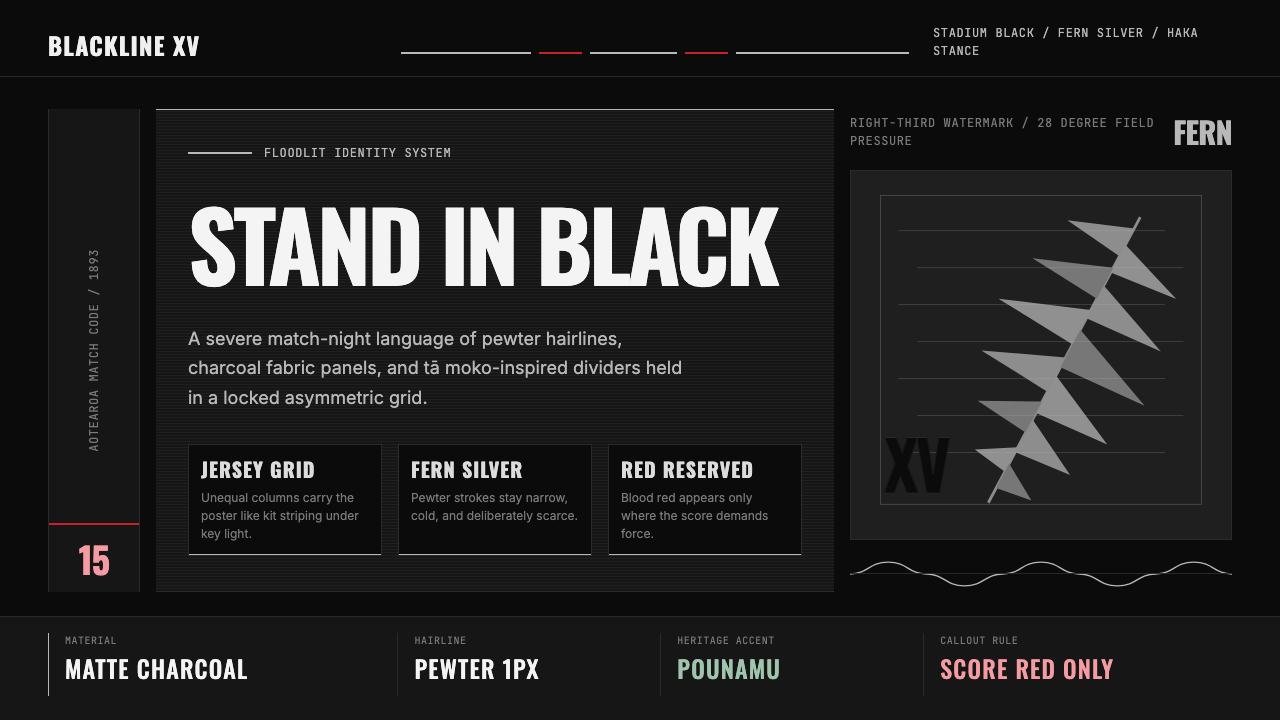 NZ All Blacks Rugby Haka FernBlack owns the field. Pewter Oswald type, jersey-stripe grid, and fern linewo…
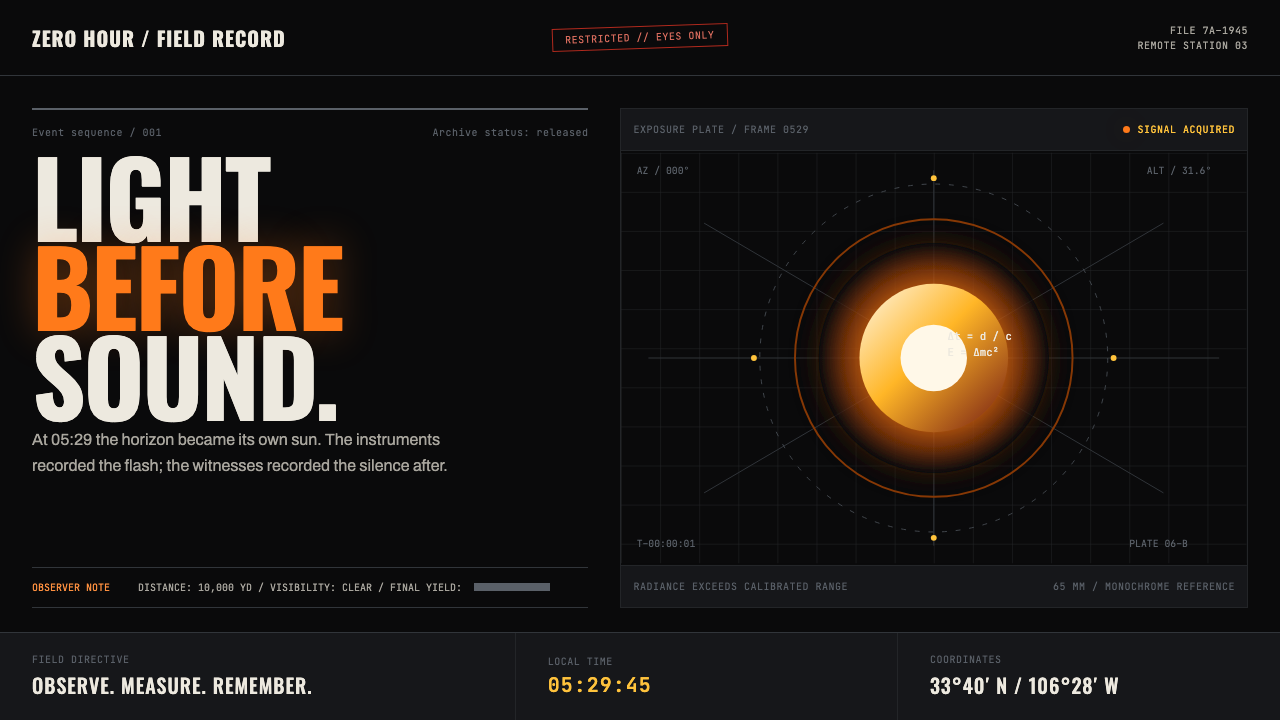 Oppenheimer Trinity (2023)Dread waits in the dark. Incandescent orange ruptures IMAX black and classifi…
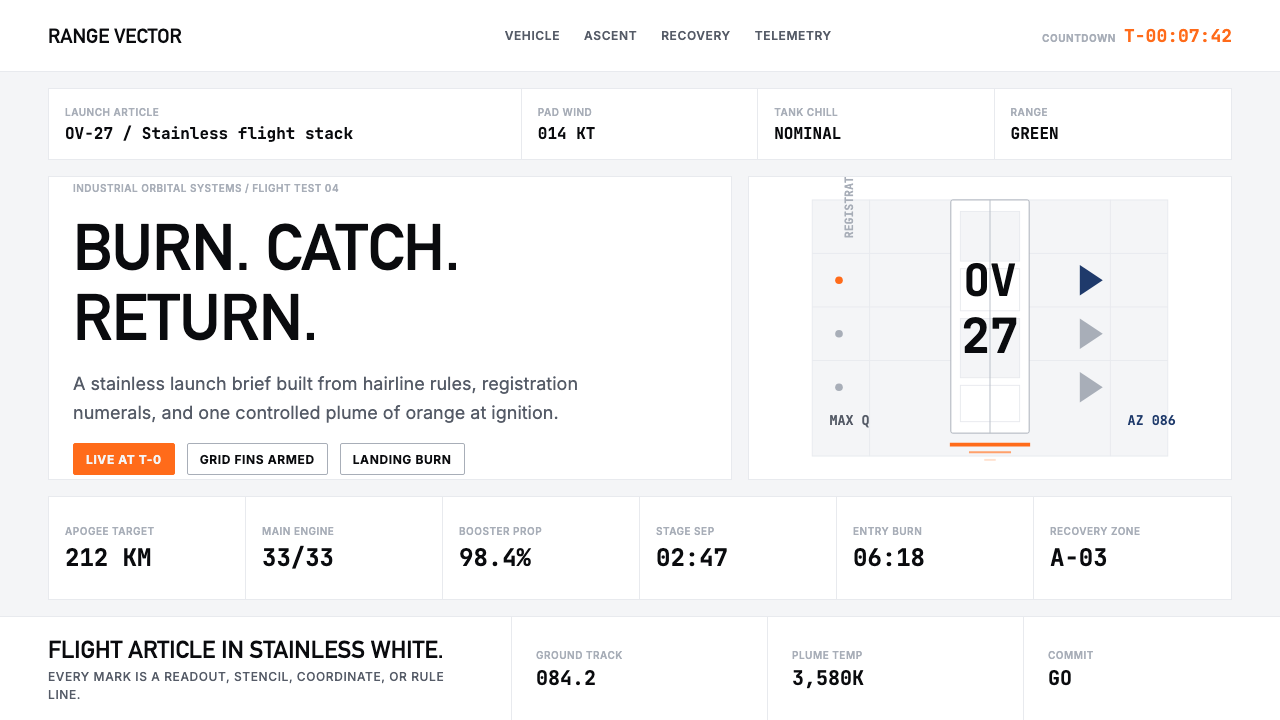 SpaceX Starship / FalconOrbital restraint. Stainless white grids, DIN-like type, and one orange burn…
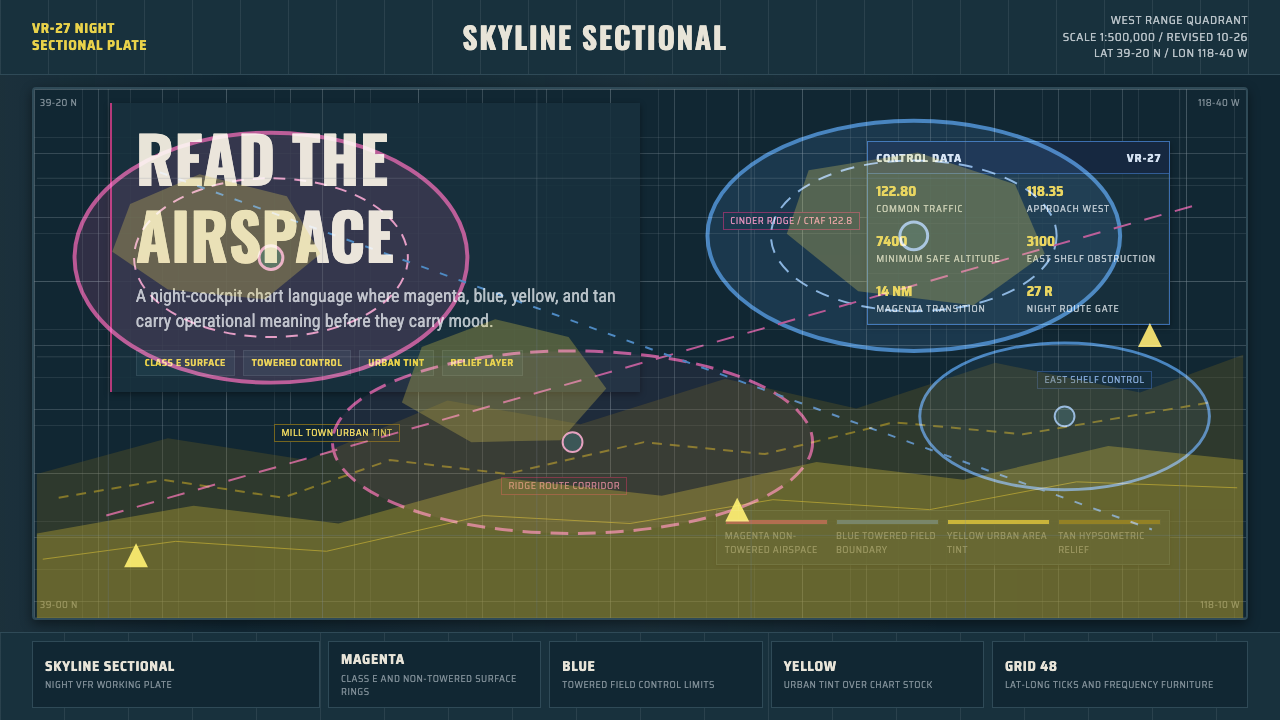 Aeronautical ChartReads like cockpit data. Magenta-blue airspace rings cut through dense dark-c…
 Al Jazeera Arabic NewsAuthority, stripped bare. Gold seal, dense Arabic type, matte charcoal.