What is NASA Saturn V Blueprint?
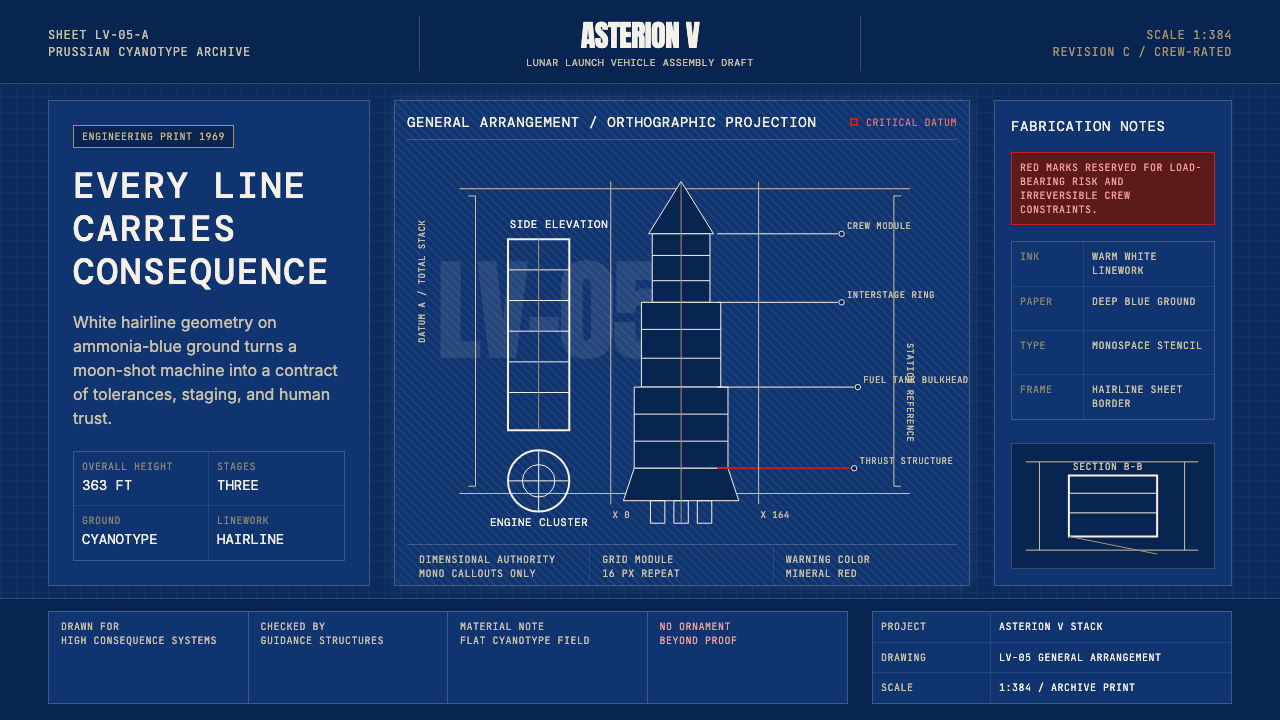
White hairline drawings on saturated blue cyanotype paper — the visual language of the most precisely engineered machine ever launched from Earth.
NASA Saturn V Blueprint in brief
The NASA Saturn V Blueprint aesthetic draws its entire visual authority from a single, utilitarian artifact: the engineering drawing produced at Marshall Space Flight Center between 1962 and 1973 for humanity's most powerful rocket. These were not artistic documents. Every line, every dimension callout, every hatch pattern indicating a section cut, every tolerance specification printed on those ammonia-developed sheets carried the literal weight of human lives. The look that emerged from this life-or-death engineering environment — deep Prussian blue grounds, stark white hairlines, monospace type for numerical callouts, rectilinear geometry with no softening of any corner — is one of the most charged visual vocabularies in twentieth-century technological culture.
As a design system, the Saturn V Blueprint aesthetic translates this austere engineering precision into digital and print contexts. The core ingredients are the inverted blueprint palette (light marks on a dark, saturated blue field), monospace or near-monospace type that reads as dimensional annotation rather than literary text, geometric forms that favor the right angle and the straight edge over any curve, and a rigorous absence of any element that could not be justified by structural or informational necessity. The result is a system that conveys authority, technical mastery, and the kind of seriousness that comes from contexts where error is not tolerable.
What distinguishes the Saturn V Blueprint look from generic dark-mode design is its specific cultural and historical weight. The palette is not simply dark blue on black — it is the particular saturated Prussian blue of a cyanotype print under fluorescent drafting-room light, aged and precise. The typography is not merely geometric; it speaks the vocabulary of dimension callouts, revision clouds, and tolerance blocks. Every compositional choice references the discipline of technical drawing, where nothing is decorative and everything carries an information function.

Where does NASA Saturn V Blueprint come from?
The Saturn V rocket program grew out of the political urgency of the Space Race. In 1961, President Kennedy committed the United States to landing a human on the Moon before the decade's end. The engineering challenge was staggering: the vehicle that would accomplish this mission needed to be taller than a thirty-story building, generate more thrust at liftoff than any machine ever built, and maintain tolerances across all its components that left no margin for fabrication error. Wernher von Braun, director of the Marshall Space Flight Center in Huntsville, Alabama, led the design effort. Arthur Rudolph, as Saturn V project manager, was responsible for the industrial coordination that turned the blueprints into manufactured hardware.
The physical blueprints themselves — cyanotype prints produced by exposing a photosensitive coating to ultraviolet light through a translucent original — were the communication medium of the entire program. Boeing's Michoud Assembly Facility in New Orleans built the S-IC first stage; North American Aviation in Downey, California, built the S-II second stage; Douglas Aircraft in Huntington Beach built the S-IVB third stage; Rocketdyne in Canoga Park designed and manufactured the F-1 and J-2 engines. Thousands of draftsmen at these facilities produced and received cyanotype blueprints that specified every dimension of every part. The visual grammar of those sheets — white lines on blue paper, annotation in condensed block lettering, revision tracking in title blocks — became the shared technical language of the entire Apollo program.
The first Saturn V launched on November 9, 1967 (Apollo 4), carrying no crew, to test the vehicle's systems in a single all-up test that flew all three stages simultaneously — an approach that went against standard incremental testing practice but was forced by the deadline Kennedy had set. The rocket performed almost perfectly. Five months later, Apollo 6 identified some engine issues that were subsequently corrected. Saturn V then carried Apollo 8 around the Moon in December 1968, Apollo 11 to the first lunar landing in July 1969, and continued through Apollo 17 in December 1972. Thirteen Saturn V rockets flew in total; none failed. The program formally concluded in 1973, and the blueprint archive was distributed across NASA facilities and storage — some sheets surviving in remarkably good condition, others deteriorating.
The aesthetic revival of the blueprint look in contemporary design began in earnest in the early 2010s, driven by a combination of nostalgia for the Apollo era, growing appreciation for mid-century American industrial aesthetics, and the technical capability of digital tools to render fine-line precision on dark grounds without the photographic limitations of the original cyanotype process. Space agencies, aerospace companies, and science communicators adopted the style to signal technical seriousness and to distinguish their communications from the glossy consumer-product aesthetic that dominated the same period. By the mid-2010s, the blueprint aesthetic had migrated from aerospace contexts into broader design practice — used for posters, data visualizations, UI themes, and presentation decks that wanted to borrow the connotations of rigorous engineering without necessarily operating in that domain.
What defines the NASA Saturn V Blueprint look?
Palette
The foundational color relationship is light marks on a dark, deeply saturated blue field — the direct inversion of ink on paper, referencing the specific blue of a cyanotype print rather than generic navy or midnight blue. Accent marks appear in a warm off-white or pale yellow, approximating the tone of aged blueprint paper or the amber glow of drafting-room light. A restrained use of orange or amber provides the one warm contrast note, echoing the warning markings found on actual launch vehicle drawings. The palette is not chosen for visual comfort; it is chosen for maximum legibility of fine-line technical information under specific lighting conditions, and that functional origin gives it its authority.
Typography
Monospace or engineering-lettering typefaces are the core typographic choice, directly referencing the hand-lettered block annotations of technical drawings or the Leroy lettering templates that draftsmen used for consistent annotation. Each character occupies equal horizontal space, giving text a diagrammatic rather than literary quality — numbers and letters read as data, not prose. Scale contrast is used aggressively: a label or callout sits at a small, precise size that implies measured accuracy, while section titles or diagram names may appear at a dramatically larger scale to establish document hierarchy. Uppercase or small-caps settings dominate; lowercase type, where it appears, feels like a deliberate stylistic departure from the dominant register.
Line Weight and Precision
The blueprint tradition employed strict hierarchies of line weight — center lines, hidden lines, section lines, border lines, and dimension lines each had a prescribed thickness corresponding to its informational role. The Saturn V Blueprint aesthetic preserves this discipline: hairlines delineate form, slightly heavier lines indicate structure, and the thickest lines mark the primary boundary of an object or region. This hierarchy functions both technically and aesthetically — it creates visual depth on a flat ground without requiring shadow or gradient. Dimension lines with arrowheads, extension lines, and leader lines are legitimate compositional elements in this style, not technical clutter.
Geometry and Form
The visual grammar is overwhelmingly rectilinear. Right angles dominate; curves, where they appear, are mechanical in character — arcs of precise radius, not organic sweeps. Section cuts reveal interior geometry as flat cross-sections. Orthographic projection (top view, front view, side view laid out in standardized relationship to one another) is the underlying spatial logic. Grid lines or registration crosses appear as visual anchors. The style deliberately avoids rounded corners, organic shapes, or any form that could not be produced by a compass, straight edge, and drafting triangle. Everything looks measured because, in the source material, everything was measured.
Annotation as Decoration
In engineering drawings, annotations serve a purely functional role: they communicate specifications that the drawing geometry alone cannot convey. In the Saturn V Blueprint aesthetic applied to design, annotations become a visual texture as much as an informational one. Dimension callouts, part numbers, revision indicators, zone coordinates along border margins, and title block structures are visual elements in their own right — they fill space with the suggestion of technical depth even when their specific content is not being read. This is one of the style's most distinctive features: it transforms the scaffolding of technical communication into surface richness, without ever introducing anything that would be foreign to an actual engineering drawing.
Darkness and Luminosity
Unlike most dark-mode design, which uses darkness primarily for visual comfort or trendy contrast, the Saturn V Blueprint aesthetic treats the dark ground as a luminous field. Light elements appear to glow against the deep blue background, suggesting a backlit drawing table or a technical display screen rather than simply inverted color values. This creates a quality of self-illumination — the white lines seem to emit rather than reflect light, referencing both the phosphor glow of early CRT displays used in mission control and the original cyanotype's distinctive optical properties. The darkness is not atmospheric; it is a medium through which precision is revealed.
Structural Severity
The Saturn V Blueprint style does not attempt to be welcoming, approachable, or warm. Its aesthetic purpose is to communicate that the information it carries has been subjected to a level of rigor that ordinary consumer design does not aspire to. Decorative elements, flourishes, gradient transitions, soft shadows, rounded corners, illustrative imagery, and anything that introduces ambiguity about the designed object's edges or boundaries are all excluded. The result is a style that reads as authoritative precisely because it refuses to court the viewer's comfort — just as an actual engineering specification exists to constrain possibility, not to invite exploration.

Who shaped NASA Saturn V Blueprint?
Von Braun was director of the Marshall Space Flight Center from its founding in 1960 until 1970, and the central technical and administrative figure behind the Saturn V design. His background in German wartime rocket development at Peenemünde gave him an intimate familiarity with the engineering drawing culture that the Saturn V blueprint archive reflects. Von Braun was as much a manager of visual and technical standards as he was a rocket engineer — the rigor of the Saturn V documentation system, which specified everything from engine combustion chamber tolerances to the color coding of hydraulic system lines on schematics, reflected his insistence on complete, unambiguous communication between engineering teams.
As Saturn V project manager from 1963 onward, Rudolph was responsible for coordinating the work of dozens of contractors and subcontractors across multiple states into a single coherent engineering program. The documentation systems that gave the Saturn V blueprint aesthetic its visual coherence — standardized title blocks, revision control procedures, drawing number hierarchies — were maintained under his project management authority. Rudolph's background was in production engineering rather than design, but the discipline he imposed on manufacturing documentation is directly readable in the visual consistency of surviving Saturn V drawings.
The thousands of anonymous draftsmen and technical illustrators who worked at Boeing's Michoud Assembly Facility in New Orleans, as well as at North American Aviation, Douglas Aircraft, and Rocketdyne, are the actual authors of the visual aesthetic now associated with the Saturn V blueprint. Working at large-format drafting tables with Leroy lettering guides, rotring-style technical pens, and mylar or vellum drafting media, they produced the specific combination of line weight hierarchy, annotation style, and compositional discipline that defines the look. Their craft — a blend of technical precision and hand-produced visual consistency — is irreducibly embedded in the aesthetic.
The F-1 engine drawings produced by Rocketdyne engineers in Canoga Park, California, represent some of the most visually complex and aesthetically compelling documents in the Saturn V archive. The F-1, which burned refined kerosene and liquid oxygen to produce more thrust than any single rocket engine before or since, required engineering drawings of exceptional detail — turbopump schematics, combustion chamber cross-sections, and propellant line routing diagrams that pushed the limits of technical illustration at the time. The visual density and informational richness of these drawings is a specific reference point for the Saturn V Blueprint aesthetic at its most technically intense.
The broader NASA visual standards developed during the Apollo era — including the famous 1975 NASA Graphics Standards Manual overseen by the design firm Danne and Blackburn — created the institutional visual context within which the Saturn V blueprints existed. The Manual established typographic standards, color systems, and grid disciplines for NASA's public communications that reflected the same values of precision and technical authority visible in the engineering drawings. Though the blueprint aesthetic and the public identity standards were developed for different audiences, they shared an underlying commitment to visual clarity and technical rigor that made them culturally coherent.
How do you use NASA Saturn V Blueprint today?
The Saturn V Blueprint aesthetic is highly directional: it works powerfully in contexts where technical authority, precision, and the suggestion of engineered complexity are desired values. It does not work in contexts that require warmth, playfulness, consumer-friendliness, or organic visual texture. Applying it requires understanding what the style is actually communicating — not just its visual surface, but the values of rigorous documentation and zero-tolerance engineering that give the visual surface its cultural weight.
For presentation slides, the style excels on both covers and data-heavy content pages. A cover designed in this aesthetic uses the deep blue field as the primary surface, places a technical diagram or schematic element as the central compositional anchor, and sets the title in a monospace or engineering-lettered typeface at a scale that commands the space without crowding it. Subtitle or metadata information appears at a smaller, annotation-level scale, reinforcing the hierarchy between labeling and primary information. Content slides should be treated as technical drawings: organize information in gridded zones separated by hairlines, use numbered or coded callouts rather than decorative bullet points, and treat data charts as geometric objects in their own right — bar charts drawn with blueprint-precision line weights, axis labels in the annotation typeface, and color coding that references the core palette rather than arbitrary hues.
For web UI and dashboard design, the Saturn V Blueprint aesthetic is exceptionally well-suited to interfaces where the user is consuming technical data: scientific instruments, aerospace or engineering software, monitoring systems, developer tools, or financial analytics platforms. The approach: maintain the deep blue field as the background throughout, use near-white or warm off-white for all primary data and text, reserve amber or orange strictly for alert states and critical indicators, and build all card and container components with hard-edged borders rather than rounded corners or soft shadows. Navigation elements should feel like control panel interfaces — compact, precisely labeled, with no decorative icon beyond a geometric indicator. Pricing pages in this aesthetic benefit from the style's natural hierarchy: tier names set at diagram-label scale, feature lists formatted as specification tables, and call-to-action elements using the warm accent color as the sole departure from the blue-and-white ground.
For editorial and marketing applications, the blueprint aesthetic creates strong, distinctive visual presence in contexts that want to signal technological sophistication without appearing corporate or generic. Poster and cover designs work well with the style's inherent drama: a large technical schematic or cross-section of a complex object dominates the composition, with title information set in the annotation register. Data-visualization editorial — long-form articles or reports that make technical information legible to a broad audience — benefits from blueprint-style infographics where dimensional callouts, section cuts, and part-number labels make diagrams feel authoritative. Marketing materials for technology products, scientific instruments, or engineering platforms can use the aesthetic to position the product as a precision tool rather than a consumer convenience.
A common and damaging mistake when applying this style is treating the deep blue palette as a decorative choice rather than a functional one. Designers who borrow the color without understanding the underlying visual logic tend to reintroduce elements that are antithetical to the style — rounded corners that soften the rectilinear severity, gradient fills that undermine the flat, luminous quality of the original cyanotype, soft drop shadows that simulate a different kind of depth than the line-weight hierarchy provides, and typographic choices that mix script or humanist faces with the monospace core, fragmenting the document-register coherence. Another frequent error is over-complexity: the original blueprints were dense because they had to communicate complete engineering specifications in a single sheet. Applied design does not carry that obligation, and attempting to replicate the visual density without the informational justification produces images that feel busy rather than authoritative.

NASA Saturn V Blueprint — FAQ
Is this style only suitable for space or aerospace contexts?
No — but the context needs to share some of the values that the style communicates. The Saturn V Blueprint aesthetic works well wherever precision, technical authority, and the suggestion of engineered complexity are appropriate signals: developer tools, scientific data platforms, financial analytics interfaces, engineering software, industrial monitoring systems, and technology brand communications that want to position a product as a precision instrument. It does not work well in consumer contexts that prioritize warmth, playfulness, or approachability. The key question is whether the audience and purpose can absorb the severity of the style's visual logic without feeling alienated by it.
How is this different from generic dark mode or cyberpunk aesthetics?
The difference is specificity of reference and discipline of execution. Generic dark mode uses dark backgrounds for visual comfort or trend-following, with rounded corners, soft glows, and arbitrary accent colors. Cyberpunk aesthetics use dark grounds for atmospheric effect — neon overlays, glitch textures, diagonal cuts, and a deliberately chaotic energy. The Saturn V Blueprint style uses darkness as a functional medium through which precision is revealed, not as atmosphere or comfort. Its references are specific: cyanotype chemistry, technical drawing conventions, engineering annotation standards. Every element must be justifiable as something that would appear in an actual engineering drawing. The style is severe and disciplined, not expressive or atmospheric.
Can the style work on light backgrounds instead of the dark blue field?
A light-ground version is possible but changes the cultural reference significantly. The historical blueprint was specifically an inverted image — white on blue — so a light-ground version loses the direct cyanotype reference and reads more as generic technical drawing or drafting-table aesthetic. If you go light-ground, the cues that maintain the identity are the monospace annotation typeface, the strict avoidance of rounded forms, the use of dimension lines and callout structures as compositional elements, and the disciplined restraint from any decorative element. A pale warm cream or aged-paper tone as the ground, rather than pure white, preserves some of the warm-aged quality of the original cyanotype and helps the version feel intentional rather than merely desaturated.
How should photography or imagery be handled within this style?
Photography is problematic in the Saturn V Blueprint style because naturalistic images of the physical world conflict with the flat, annotated quality of engineering drawing. Where imagery is necessary, the appropriate approach is to treat photographs as technical documents: high-contrast duotone treatment in the core palette (reducing the image to blue and off-white tones), aggressive cropping to isolate the subject as an object of study rather than a scene, or conversion to technical illustration through a high-contrast threshold effect. Actual technical photographs — close-up detail shots of mechanical components, cutaway views of engine assemblies — are more at home in this style than any lifestyle or ambient photography. When in doubt, replace photography with a diagram or schematic entirely.
What makes a Saturn V Blueprint design feel authentic versus merely thematic?
Authenticity in this style comes from understanding that every visual decision in the original blueprints was made under constraint — not aesthetic constraint, but engineering necessity. Authentic work asks, for each element: could this element appear in an actual technical drawing, and does it serve an informational purpose analogous to what it would serve there? Annotation-style type is authentic because annotation is a core engineering drawing element. A rounded button is not authentic because no engineering drawing contains rounded UI elements. A hard-edged grid line is authentic; a decorative border with corner flourishes is not. The discipline is not about surface-level imitation of the visual style — it is about internalizing the underlying logic of technical communication and allowing that logic to govern every compositional decision.
Related design styles
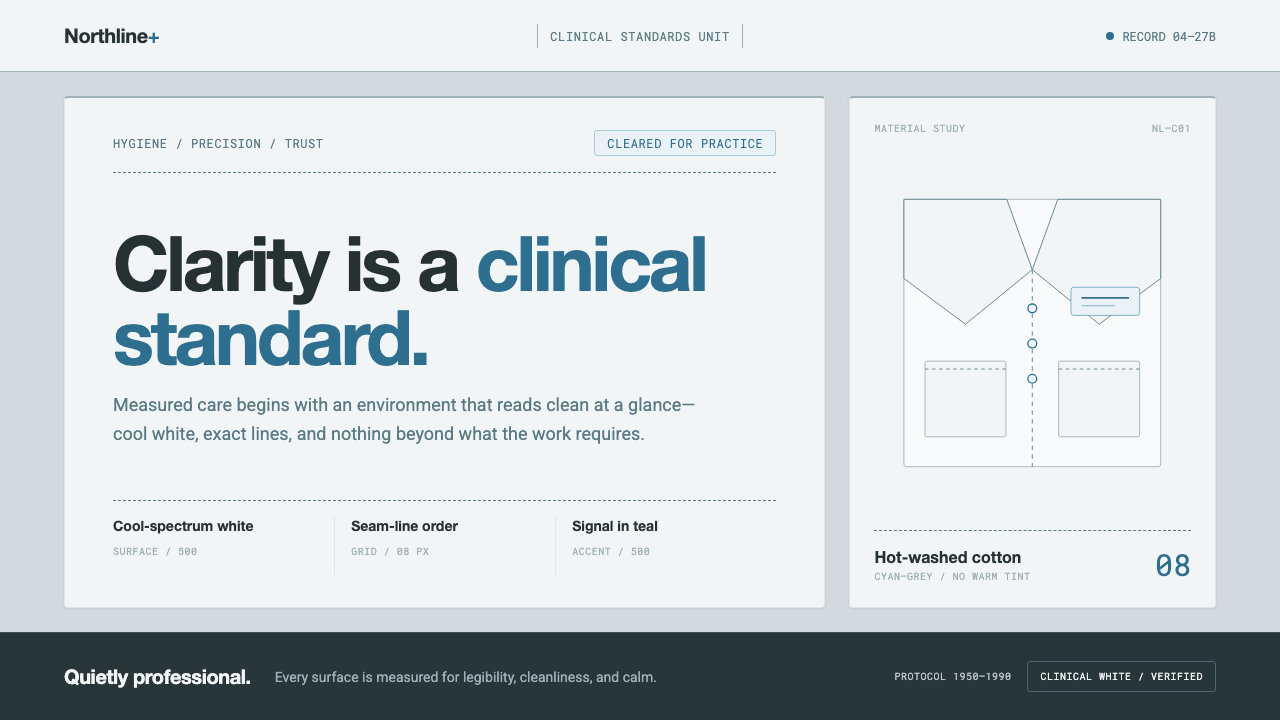 Doctor's Clinical Lab CoatSterile by design. Cool clinical white, teal signals, and seam-line grids enf…
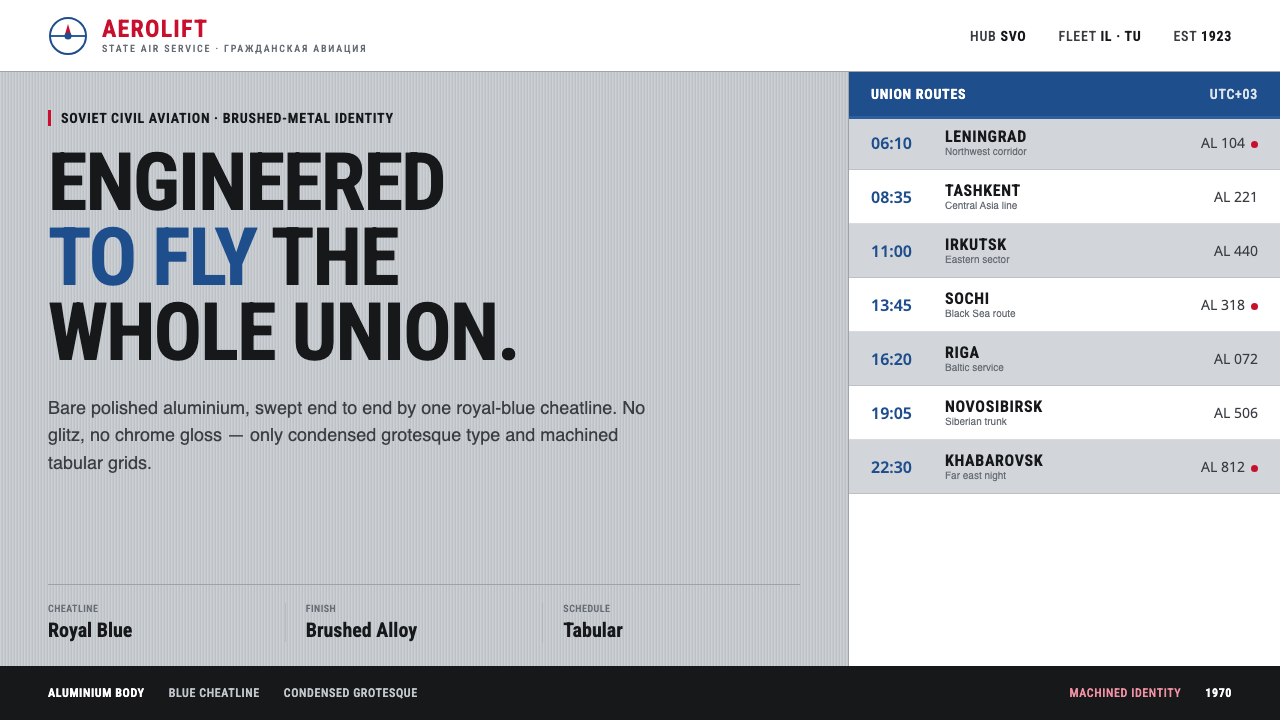 Aeroflot Soviet AirlineEngineered restraint rules. Silver ground, royal-blue cheatlines, and flat gr…
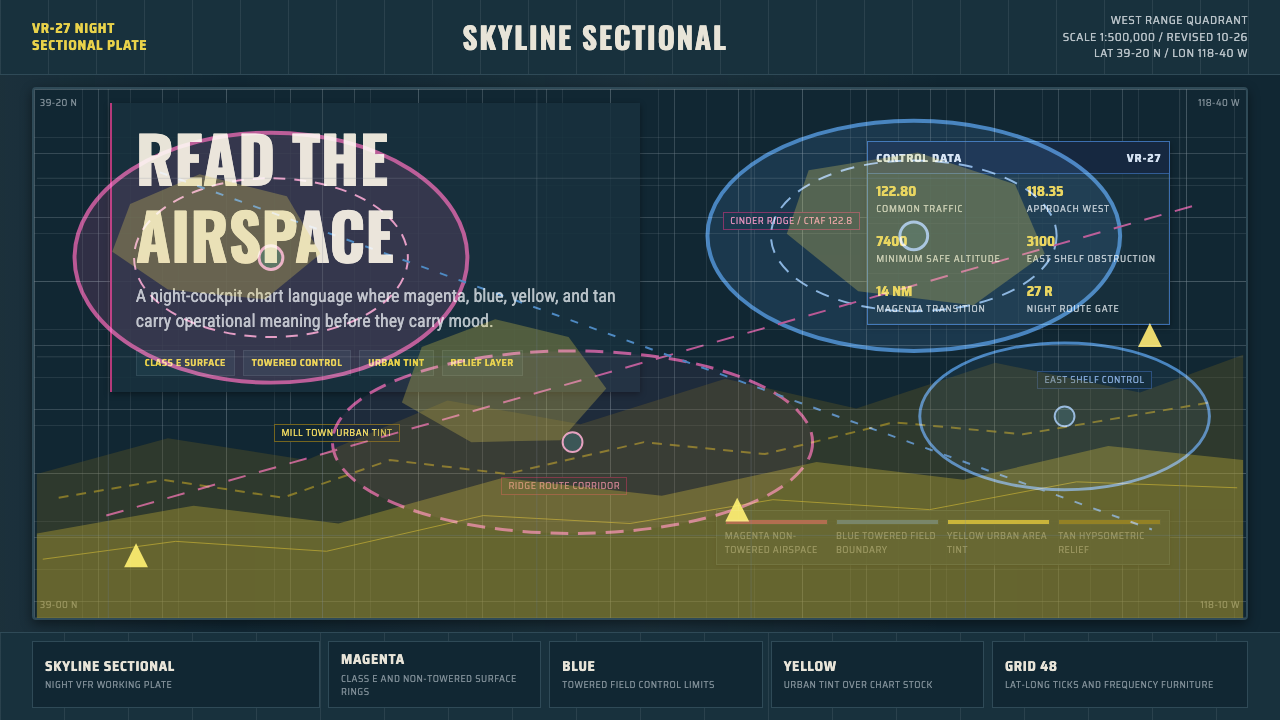 Aeronautical ChartReads like cockpit data. Magenta-blue airspace rings cut through dense dark-c…
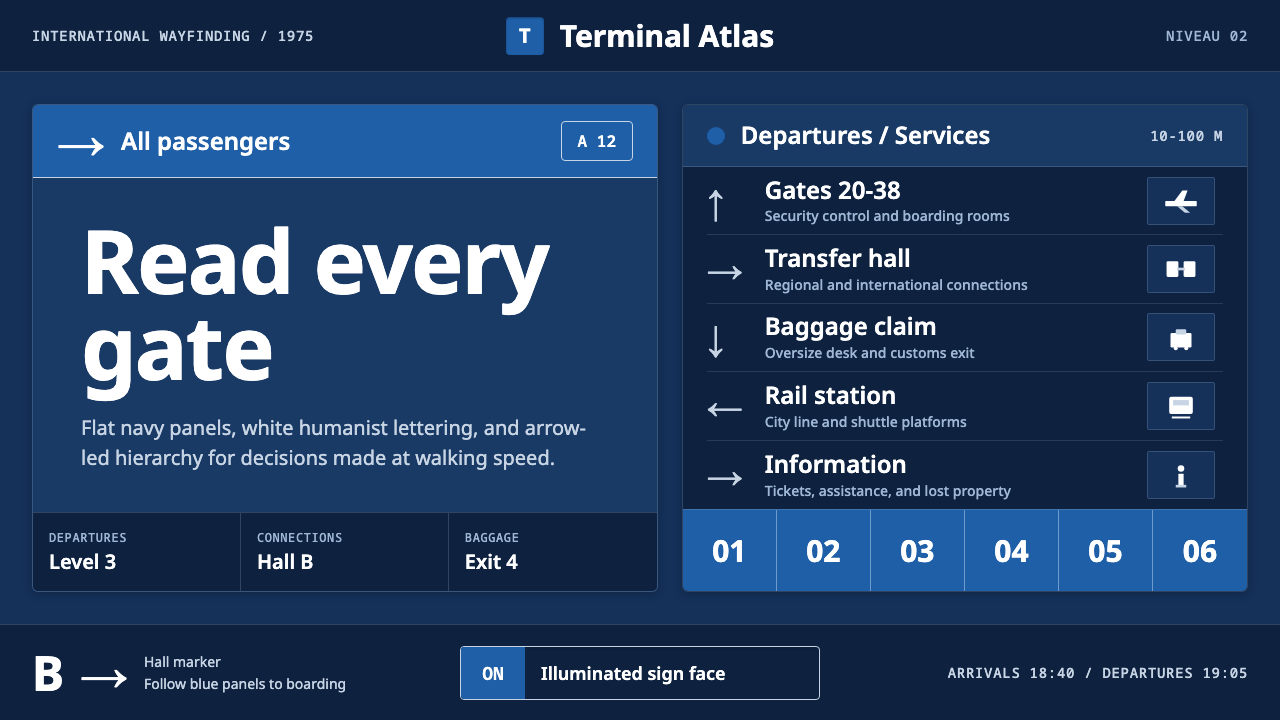 Frutiger CDG AirportLegibility at runway scale. Navy panels, white humanist sans, arrow-led grids.
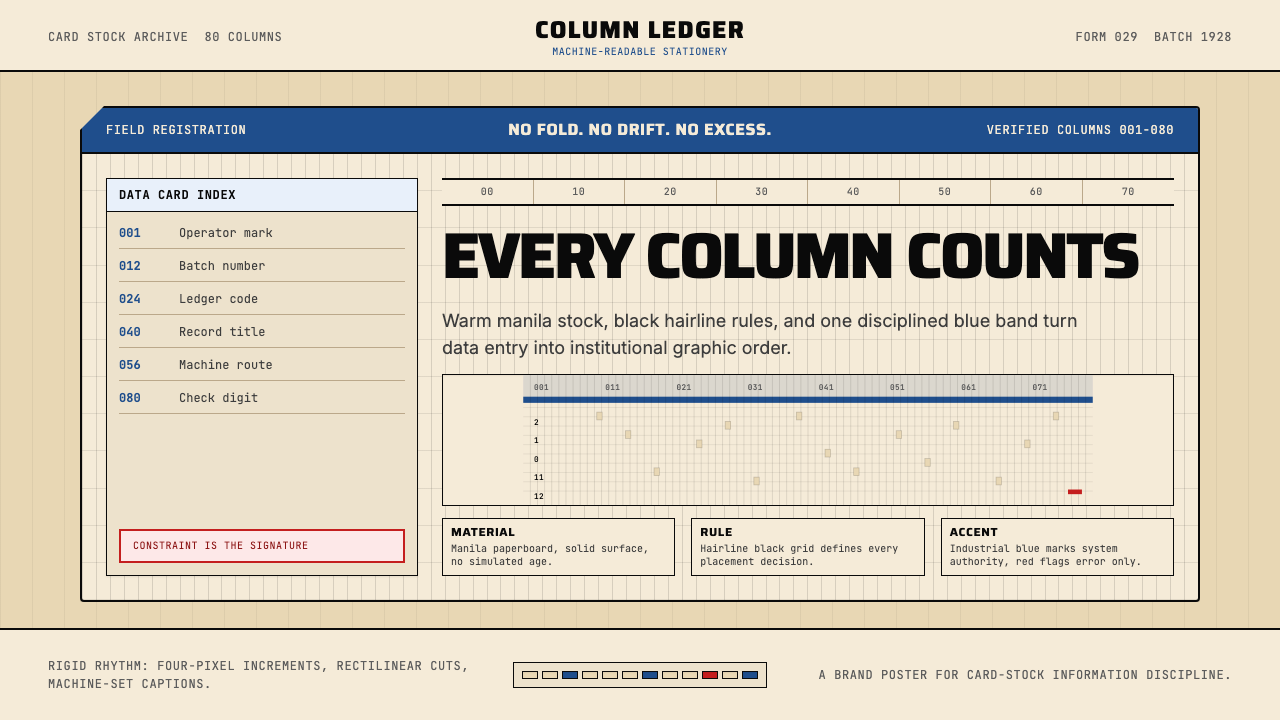 IBM Punchcard 029 (1928)Constraint becomes authority. Manila stock, hairline grid, industrial blue.
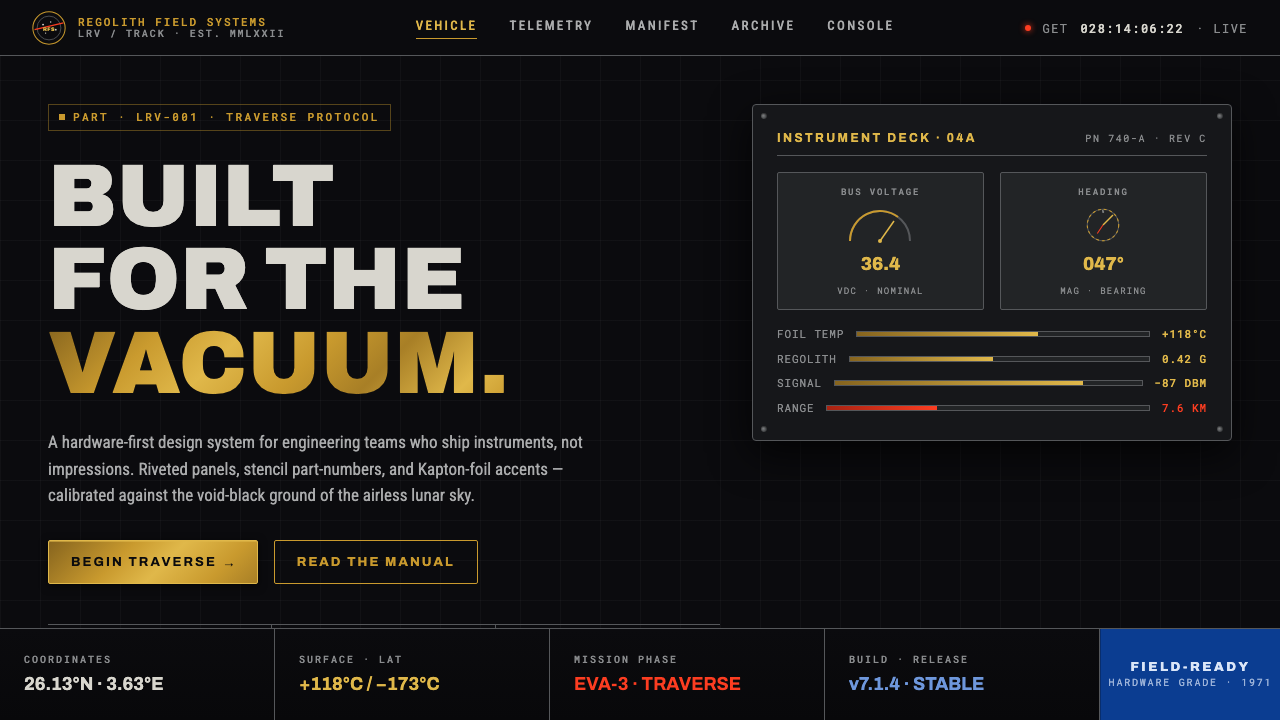 Lunar RoverBuilt for the vacuum. Kapton-gold foil and stencil part-numbers against void-…