What is NZ All Blacks Rugby Haka Fern?
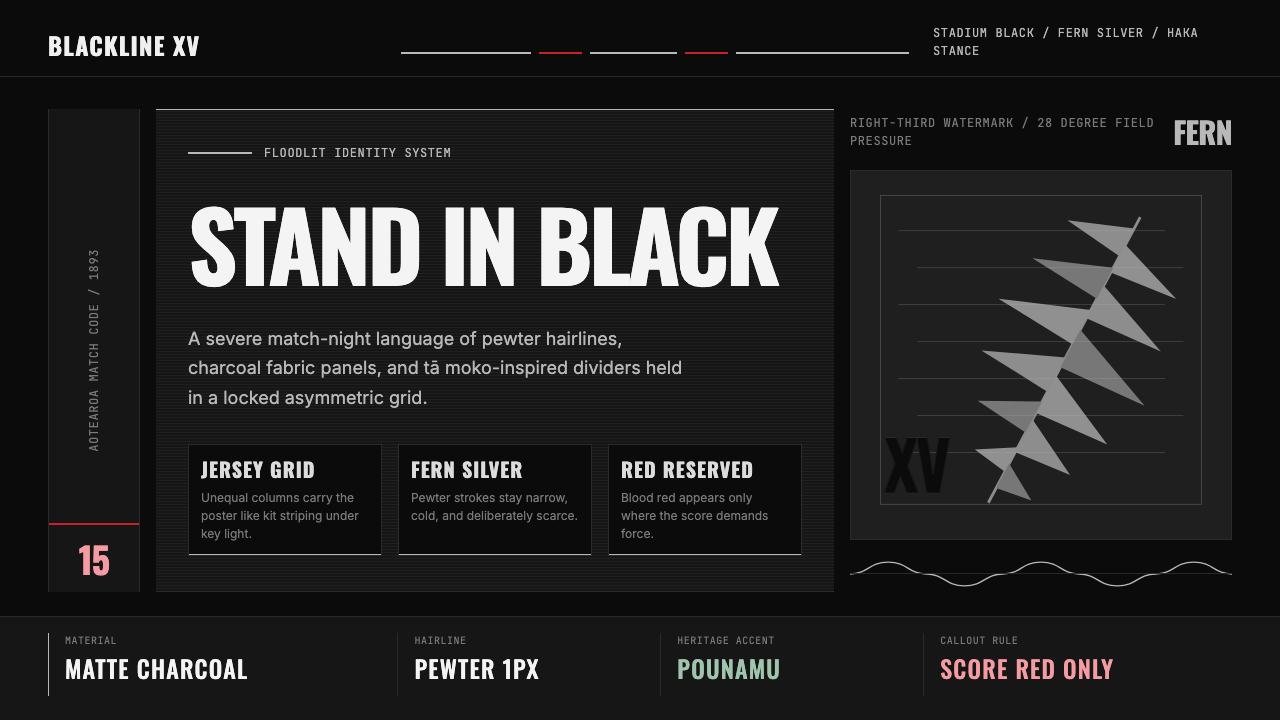
The All Blacks' visual identity is built on a single, unyielding conviction: that black is not merely a color but a declaration of purpose — and every line, stripe, and silver fern that crosses it carries the full weight of that conviction.
NZ All Blacks Rugby Haka Fern in brief
The NZ All Blacks Rugby Haka Fern design system translates the visual language of New Zealand's national rugby team into an interface aesthetic. At its core are the elements that have defined the All Blacks brand since the late nineteenth century: a deep, saturated black field, silver fern linework drawn from Māori botanical iconography, jersey-stripe grids that echo the vertical architecture of the playing kit, and typographic choices that convey solidity and controlled force.
This is a dark system — decisively so. The black ground is not background; it is the dominant statement. Every other element — the silver hairlines of fern fronds, the pewter weight of display type, the occasional flash of white — is cut into or layered over that darkness. The result is an atmosphere closer to a floodlit stadium at night than to a polished corporate identity, and that atmosphere is the point.
What distinguishes this system from generic dark-mode design is its cultural specificity. The fern motif, the tā moko-inspired dividers, and the haka-derived sense of confrontational stance are not decorative choices — they are referential ones. The system asks the viewer to recognize a lineage: from the fields of Aotearoa to Eden Park to the interfaces we build today.
Where does NZ All Blacks Rugby Haka Fern come from?
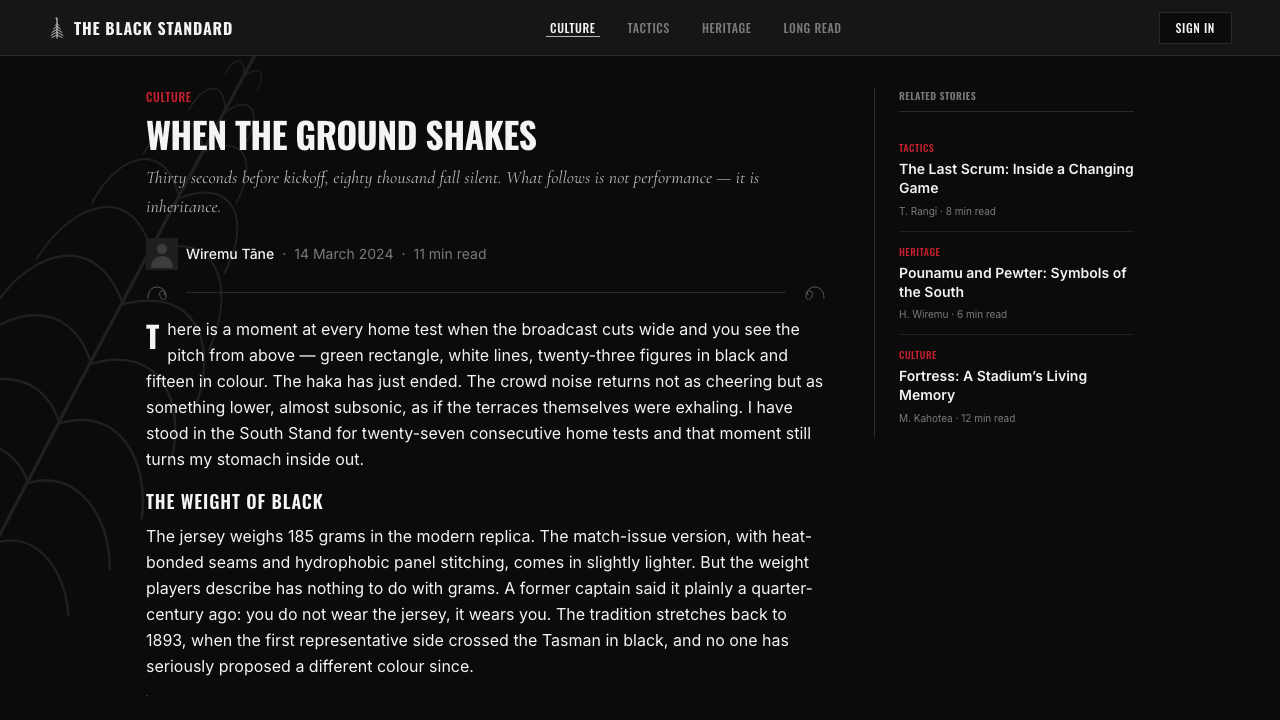
The All Blacks trace their identity to 1893, when New Zealand's provincial unions first organized a national touring side. The black jersey was adopted not as a deliberate branding exercise but as a practical choice — dark fabric masked the mud and wear of hard play. Tom Ellison, one of the founding selectors and a Ngāti Mutunga man, was instrumental in establishing both the uniform and early playing standards. From the beginning, the team's identity was inseparable from its Māori membership and influence.
The silver fern appeared on All Blacks kits from the earliest years as a national emblem. In Māori culture, the silver fern — koru in its unfurling form — carries meanings of new life, growth, and strength. The silver underside of its fronds, visible when the leaf is caught in light, became a visual shorthand for New Zealand on the world stage. By the time the All Blacks were being broadcast to global audiences in the 1970s and 1980s, the fern on black had become one of sport's most immediately recognizable marks.
The haka — specifically 'Ka Mate,' composed by the Ngāti Toa rangatira Te Rauparaha in the early nineteenth century, and later 'Kapa O Pango,' composed in 2005 by Derek Lardelli for the All Blacks — transformed the pre-match ritual into a global cultural moment. Buck Shelford, who captained the team in the late 1980s, is credited with restoring the full power and discipline of the haka's performance after a period of diminished practice, establishing the standard that became the brand. The haka's visual dimension — collective force expressed through synchronized stance, rhythm, and gaze — informs the design system's emphasis on confrontational directness.
The modern brand consolidation came with the professional era and especially the Adidas partnership that began in 1999. Adidas-era kit design introduced the jersey-stripe architecture — vertical ribbed panels that create a sense of compressed energy and forward momentum — and the typographic discipline that carried the brand into digital contexts. Steve Gibbs and his collaborators in Māori visual arts informed the tā moko-inspired linework that appears in official All Blacks graphics, grounding the commercial identity in cultural authenticity. The 2011 Rugby World Cup, which New Zealand hosted and won, marked the point at which the All Blacks brand reached full global recognition — and the design language that supports it reached its current form.
What defines the NZ All Blacks Rugby Haka Fern look?
Color Field
The palette is anchored by a single dominant ground: a deep, near-absolute black that functions as the primary canvas for all other elements. Against this darkness, silver and pewter tones — cool, metallic, and slightly muted — carry the role that white might play in a lighter system. A selective use of pure white appears for moments of maximum contrast, such as critical text at the highest hierarchy level. Anything that reads as warm, earthy, or bright is absent; the palette is cold and deliberate.
Fern Linework
The silver fern motif appears as fine linework rather than filled silhouette — hairline strokes tracing the frond's structure give the impression of light caught on the underside of a leaf at dusk. This linework functions as both decoration and divider, appearing in headers, section breaks, and corner details. The frond curves are never mechanical; they carry the organic irregularity of botanical illustration, which prevents the system from reading as purely industrial.
Jersey-Stripe Grid
The layout system is derived from the vertical ribbed panels of the All Blacks playing kit. Columns are narrow and numerous, creating a compressed, high-density grid that implies forward momentum rather than open breathing room. Content is placed with deliberate asymmetry — a wide primary zone balanced against a narrow secondary zone, much as a jersey's central panel is flanked by tighter side panels. This grid makes the system feel athletic rather than editorial.
Tā Moko Dividers
Section dividers and structural lines reference tā moko — the traditional Māori art of tattooing, which encodes genealogy, identity, and status through interlocking curvilinear patterns. In the design system, these references appear as geometric but organically curved separators between content blocks, not as literal tattoo copies but as abstractions that carry the structural logic of interlocking line-forms. Their presence signals cultural rootedness rather than generic modernism.
Typographic Weight
Display type is set in broad, condensed sans-serif forms — the visual equivalent of a haka stance: planted, wide, and immovable. The weight sits at the heavy end of the spectrum, and it is used for hierarchy rather than decoration; a headline is large because it is the most important element in the hierarchy, not because large type is aesthetically pleasurable. Body text remains lean and tightly tracked, creating strong contrast between the mass of headline and the precision of detail.
Directional Intensity
Compositional flow in this system is unambiguously directional — elements orient toward a focal point or a direction of motion, never radiating outward from a center in the manner of symmetrical design. This reflects the haka's choreographic principle: every movement is purposeful and aimed. Diagonal accents, angled crop lines on images, and asymmetric type placement all reinforce the sense that the composition is in motion, not at rest.
Surface and Texture
Despite the system's intensity, surface treatment is restrained. There are no gradient fills, no lens flares, no chromatic aberration effects that might read as contemporary digital decoration. Where texture appears — a subtle woven grain that references the jersey fabric, a matte quality to background surfaces — it is applied lightly and without becoming a dominant visual event. The restraint honors the jersey itself: the All Blacks kit is famously unornamented, its power derived from the absence of distraction.

Who shaped NZ All Blacks Rugby Haka Fern?
A Ngāti Mutunga man and one of the founding selectors of the All Blacks in 1893, Ellison helped establish both the black uniform and the early playing culture that would define the team's identity. His role represents the foundational presence of Māori individuals in the team's origins — a presence that has shaped the cultural dimension of the brand's visual language from the beginning.
As captain in the late 1980s, Shelford restored the haka 'Ka Mate' to its full intensity after a period of diminished performance, insisting on complete commitment from every player. His intervention defined the haka not as a formality but as a declaration — establishing the standard of confrontational presence that has characterized the All Blacks' pre-match ritual ever since and that informs the design system's directional intensity.
As All Blacks captain across much of the 2000s and 2010s, McCaw presided over the team's most commercially significant era, including the 2011 and 2015 Rugby World Cup victories. His tenure coincided with the full global expansion of the All Blacks brand and the digital codification of its visual identity. McCaw's persona — quiet authority, relentless precision — mirrors the design values the system embodies.
A Māori visual artist whose work informed the tā moko-derived linework that appears in official All Blacks graphics. Gibbs and his predecessors in the tradition of Māori visual art gave the brand's commercial identity its cultural grounding, ensuring that the fern and moko elements in the design system are referential rather than appropriative — they carry a genealogy of meaning that extends far beyond sport.
Lardelli composed 'Kapa O Pango' in 2005, a haka created specifically for the All Blacks that draws on the full tradition of Māori performing arts. Its composition added a second, explicitly team-specific ritual to the All Blacks' pre-match identity and deepened the cultural seriousness with which the brand engages its Māori heritage. The haka's visual choreography — collective, directed, and building in intensity — is a direct influence on the design system's compositional rhythm.
How do you use NZ All Blacks Rugby Haka Fern today?
Applying the All Blacks Haka Fern system correctly requires internalizing a single principle: the darkness is not a mood choice, it is the primary statement. Reversing the system to a light background destroys its logic. Every decision — type color, line weight, spacing between elements — should be made in reference to how it reads against deep black, not how it might adapt to a lighter context.
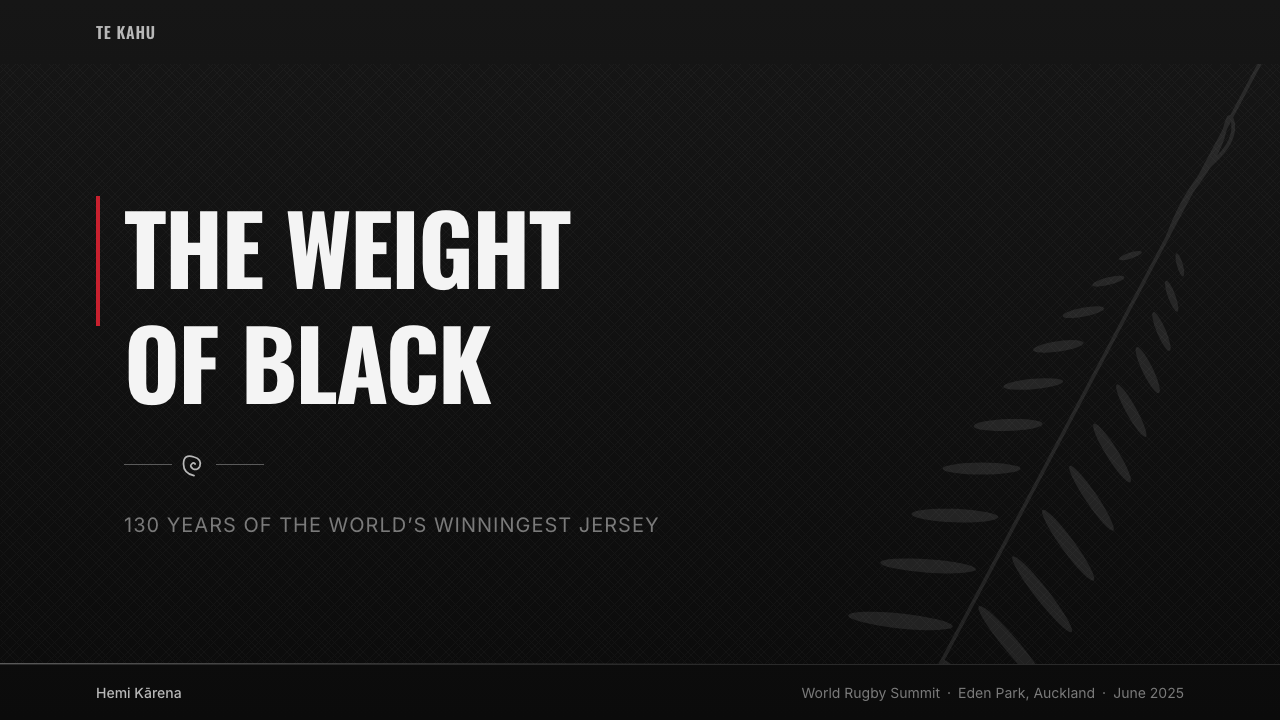
For presentation slides, this system is most powerful on full-bleed dark covers where the contrast between deep black, pewter type, and silver fern linework creates immediate visual authority. Cover slides benefit from asymmetric placement of a single large headline anchored low and left, with fern-derived linework occupying the upper right as a counterweight. Content slides should use a narrow, high-density column structure — the jersey-stripe principle — with generous vertical spacing between concept units rather than between elements within a unit. Data slides suit a diagrammatic, high-contrast treatment: figures and labels rendered in silver against black, with directional emphasis built into the chart orientation itself.
For web interfaces and dashboards, the system suits contexts where authority and precision are the desired values: analytics platforms, sports performance tools, financial dashboards, or any product where the user is processing information under pressure. The approach is to commit fully to the dark ground, use silver and near-white sparingly for primary interactive elements, and reserve any lighter panel only for the most critical status indicators. Navigation should be typographic and minimal — the brand is in the letterforms, not in icon arrays.
For editorial and marketing use, the system's poster-like directional force makes it ideal for high-impact promotional materials, event announcements, or brand campaigns where a sense of collective strength and cultural depth is the message. Full-width feature blocks alternating between absolute black and deep charcoal create rhythm without breaking the tonal envelope. Fern linework in headers and pull quotes signals the cultural register without requiring explanation — the motif carries its meaning to audiences who recognize it, and reads as refined detail to those who do not.
The most common mistake when applying this system is treating the silver and pewter tones as license for generosity — adding too many highlighted elements, softening the black with overlays, or introducing warm neutrals that break the cold precision of the palette. Authentic execution is ruthlessly spare: the black field should occupy the vast majority of any composition, and every lighter element should be earned by its functional necessity rather than placed for visual enrichment. A second common error is importing organic or rounded forms that feel warm or friendly — the system's organic elements (fern curves, moko-derived lines) are specifically cultural and structural, not warm. Adding unrelated rounded shapes or soft gradients breaks the system's logic completely.
NZ All Blacks Rugby Haka Fern — FAQ
Is this system appropriate for brands with no connection to New Zealand or rugby?
It depends on which elements you draw from and how deliberately you do so. The general dark-field, high-contrast, directionally intense aesthetic can be applied broadly — it is a legitimate design register for any brand that wants to project authority, precision, and collective strength. The specifically cultural elements — fern motifs and tā moko-derived linework — require more care. Using them without acknowledgment of their origin risks cultural superficiality; using them with explicit reference to Māori visual culture, or in contexts that have a genuine connection to Aotearoa or Pacific identity, is more defensible. Many brands use the tonal range and grid logic of this system while developing their own structural motifs instead of borrowing the fern.
How does this system differ from other dark sports-brand aesthetics?
Most dark sports aesthetics use darkness as a backdrop for energy — bright neon accents, dynamic motion blur, explosive gradients. The All Blacks Haka Fern system inverts that logic: the darkness is not backdrop, it is foreground. The visual force comes from restraint and precision rather than spectacle. Where other dark sports designs shout, this one commands — through controlled weight, cultural reference, and the deliberate absence of visual noise. The fern and moko elements also give it a specificity that distinguishes it immediately from generic dark-premium aesthetics, which typically use no cultural motifs at all.
Can this system work for digital products outside of sports or performance contexts?
Yes, provided the product's values align with the system's register. The system communicates authority, cultural depth, collective precision, and the absence of distraction — values that translate well to professional tools, high-stakes analytical platforms, premium content products, and any context where the user is expected to perform under pressure. It sits poorly with consumer products centered on warmth, play, or accessibility, and it is not well-suited to contexts that call for lightness or approachability. The test is not whether the category is sports-adjacent, but whether the brand genuinely wants to project the qualities the system embodies.
What is the role of the haka in shaping the design system's visual logic?
The haka functions as a choreographic model for compositional thinking. The haka is not decorative performance — it is structured, purposeful, directed at a specific point of confrontation, and builds in collective intensity from an established base posture. Translated into design, these qualities map onto directional composition (everything aimed rather than radiating), asymmetric but balanced placement (weight achieved through stance rather than symmetry), and typographic gravity (the heaviest elements planted low and forward). The haka also models the principle of earned intensity: the performance begins from stillness and builds — the design equivalent is compositions that have clear visual resting points before the eye reaches the focal element.
How should the fern motif be used — as a primary element or as supporting detail?
In most applications, the fern works best as structural detail rather than as a hero element. Used as a hero — large, centered, dominant — it becomes iconographic rather than systemic, and the composition reads as branding exercise rather than design system. As hairline linework in section dividers, corner treatments, and header details, the fern anchors the cultural register of the composition without overwhelming the content it frames. The exception is dedicated brand moments — cover slides, splash screens, printed covers — where the fern can occupy significant visual real estate precisely because the entire composition exists to establish identity rather than to communicate information.
Related design styles
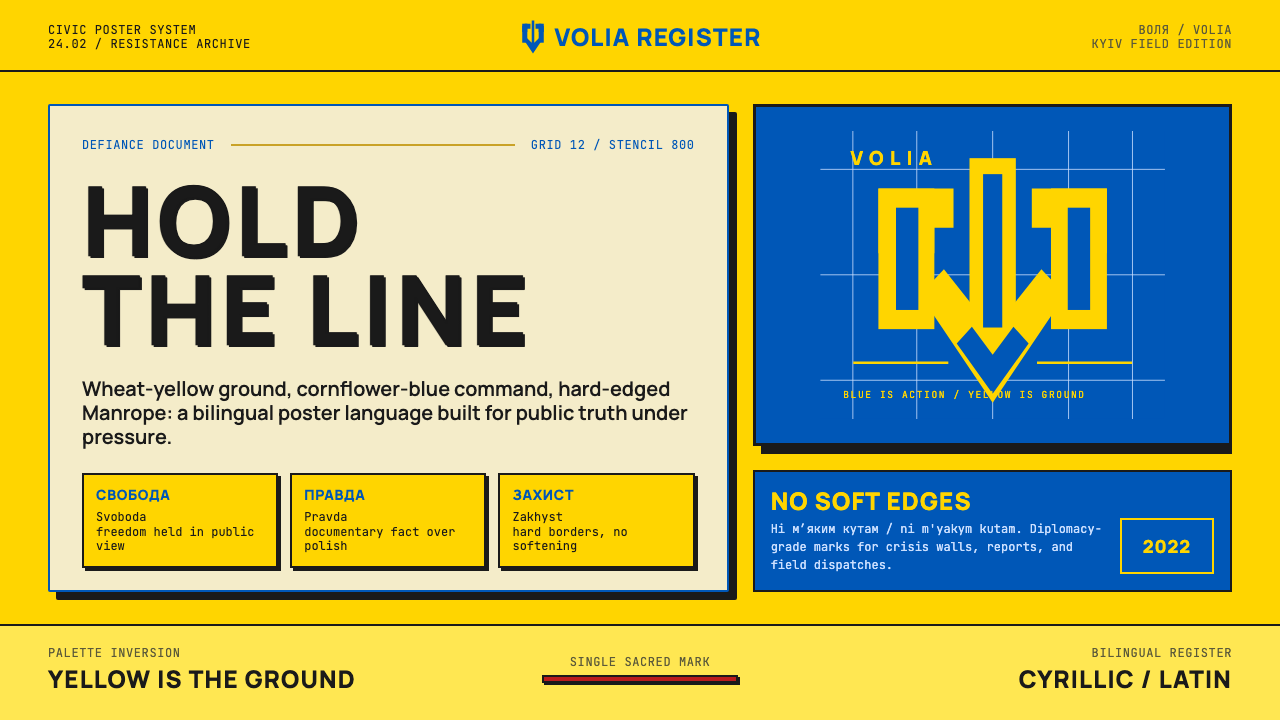 Ukrainian Trident Blue/Yellow (2022)Defiance becomes statecraft. Wheat yellow, cornflower blue, trident mark, ste…
 NASA Artemis ProgramCrewed return, engineered. Mission black, crescent-blue arc, flame orange, ri…
 Al Jazeera Arabic NewsAuthority, stripped bare. Gold seal, dense Arabic type, matte charcoal.
 Wednesday — Nevermore AcademyCold symmetry cuts deepest. Bone-white capitals and hard stripes yield to one…
 Bayern Munich (Rot)Heritage, not hype. Saturated rot fields, gold rules, and blue lozenges enfor…
 FC Barcelona (Blaugrana)Stadium heritage, not nostalgia. Blue-garnet stripes, Bungee type, gold heral…