What is Ukrainian Trident Blue/Yellow (2022)?
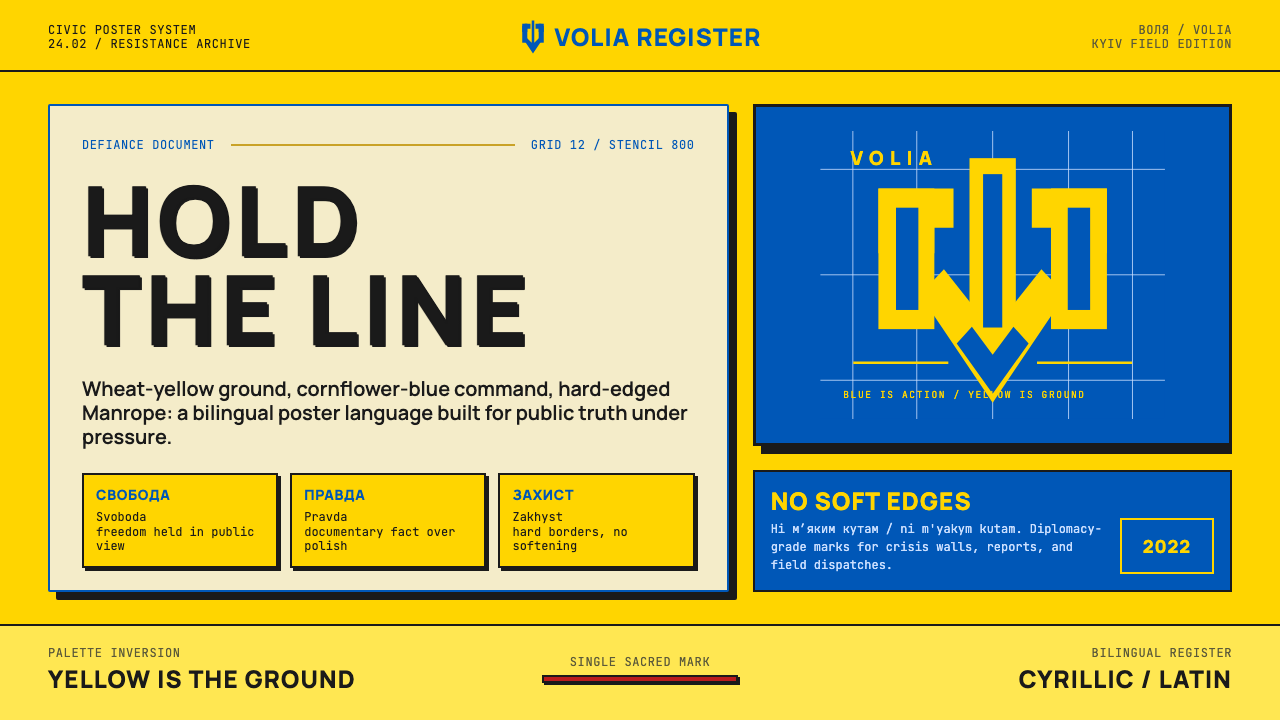
Ukraine's wartime visual identity — crystallized within weeks of the February 2022 invasion — transformed a nation's oldest heraldic symbol into the most recognizable resistance mark of the twenty-first century.
Ukrainian Trident Blue/Yellow (2022) in brief
The Ukrainian Trident Blue/Yellow system is a wartime graphic identity forged under extreme pressure and with extraordinary speed. In the weeks following the full-scale Russian invasion of February 24, 2022, Ukrainian government agencies, Banda Agency, and a dispersed network of volunteer designers converged on a visual language that was immediately legible, diplomatically authoritative, and emotionally galvanizing. What emerged was not a rebrand but a crystallization: the flag colors became a strict two-tone palette, the ancient tryzub trident was elevated from a secondary heraldic mark to the singular identity anchor, and a stencil-cut typographic approach evoked both street protest and wartime infrastructure.
The system operates at the intersection of diplomacy and resistance. It borrows the visual grammar of state communication — letterheads, government seals, institutional weight — but deploys it with wartime urgency: hard corners, high contrast, zero decoration. Documentary photography replaces optimistic stock imagery; Cyrillic and Latin alphabets appear side by side, declaring Ukraine's simultaneous rootedness in its own heritage and its orientation toward the European community. The result works equally on an official communiqué, a Telegram post, a warzone billboard, and a donation campaign.
At its core, this is a system built for legibility under adversity. Two colors, one emblem, a constrained typographic register — not aesthetic restraint but an engineering decision. Fewer variables means more consistent reproduction across every surface, from camo gear and steel signage to social media tiles and embassy facades. The identity holds whether produced in Kyiv or Washington, by professional studios or citizen volunteers.
Where does Ukrainian Trident Blue/Yellow (2022) come from?
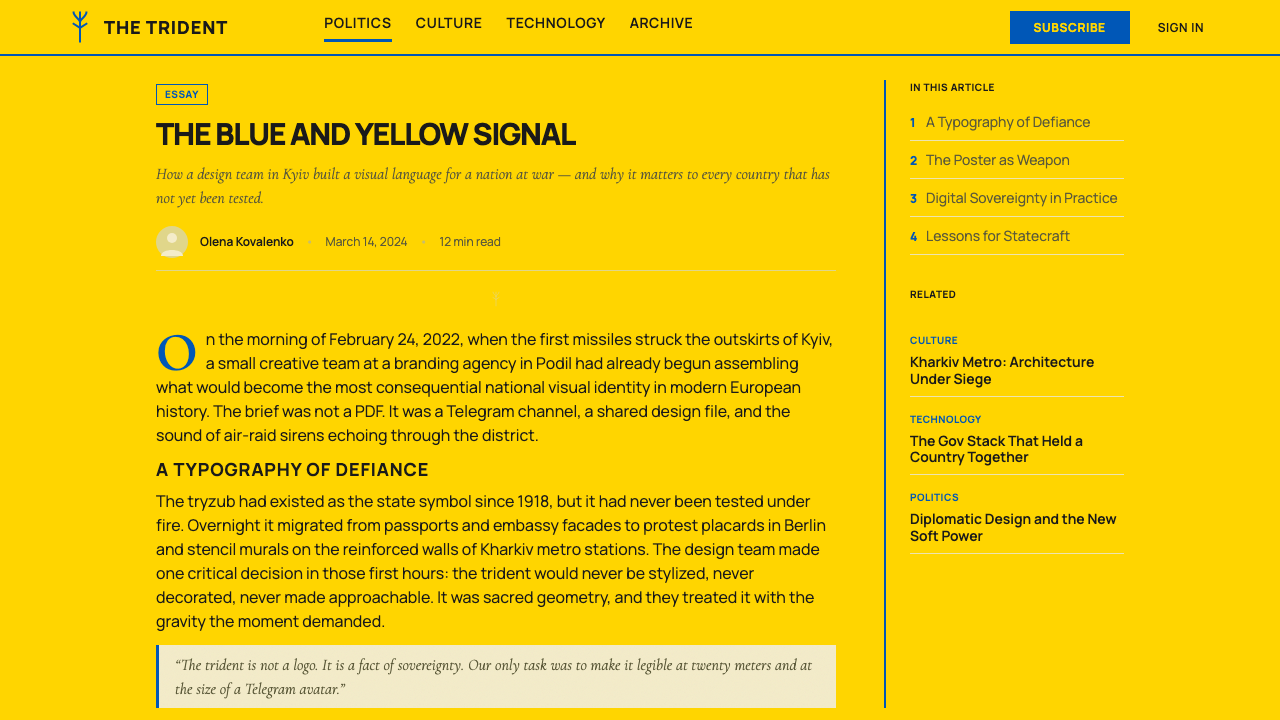
The tryzub — the Ukrainian word for trident — has roots stretching back over a thousand years. It appears as the dynastic seal of Volodymyr the Great, who brought Orthodox Christianity to Kyivan Rus in 988 AD. Its precise origin remains contested: scholars have read it as a stylized falcon in dive, a plow, an anchor, or a bident transforming over centuries into three prongs. The Ukrainian People's Republic adopted it as a state symbol in 1918 during its brief pre-Soviet independence; the independent Ukrainian state formally re-adopted it in 1992. By 2022, it was deeply encoded in Ukrainian civic memory.
The national flag — cornflower blue above and wheat yellow below — provides the chromatic foundation of the resistance identity. Blue evokes the vast sky of the Ukrainian steppe; yellow the wheat fields that defined the country's agricultural heartland. The pairing was formalized in the 1848 revolutionary movements in western Ukraine and re-established as the national flag in 1991. Its emotional resonance in Ukrainian culture pre-dates its political codification by centuries.
The design response coordinated with remarkable speed. Banda Agency became a central creative force; the Ministry of Foreign Affairs' digital team produced a stream of multilingual, high-contrast graphics that circulated globally within days. Volunteer collectives like Brave UA extended the system into street-level applications — murals, stenciled surfaces, the visual language of the territorial defense forces. What distinguished this from previous Ukrainian graphic communication was deliberate discipline: one version of the trident, a fixed two-color relationship, a single typographic register — allowing organizations worldwide to produce recognizably Ukrainian content without centralized resources.
What defines the Ukrainian Trident Blue/Yellow (2022) look?
Two-Color Absolutism
The system operates on exactly two chromatic values: a saturated cornflower blue and a warm, sun-drenched yellow — no neutral third tone, no gray. The two colors are the system. Blue structures headers, borders, and dominant typographic elements; yellow carries the weight of ground and field, evoking Ukraine's agricultural landscape. This absolutism is not a limitation but a strategic asset: every piece of communication becomes instantly, globally recognizable as Ukrainian, regardless of language.
The Tryzub as Singular Mark
The ancient trident seal is the system's one and only graphic emblem. Unlike most modern identity systems that build families of icons and sub-elements, this visual language commits entirely to a single mark, reproduced at every scale — monumental on facades, miniature as a social media avatar, stenciled onto military equipment. This singularity concentrates meaning: nothing dilutes the symbolic weight of the mark. Its thousand-year history collapses into a single, immediately legible form.
Stencil-Weight Typography
Headlines are set in a heavy, geometric sans-serif echoing stenciled lettering from military signage and Kyiv metro graphics. The weight is deliberate: lighter type reads as peacetime; this weight reads as emergency and authority. Headlines appear in high contrast — blue on yellow, yellow on blue, white on blue — with no gradation. Body text plays a subsidiary role, often bilingual. The typographic system communicates before the words are read: official, urgent, a state speaking.
Hard Geometry and Zero Ornament
Corners are ninety degrees. Dividing lines are structural, not decorative. No curves soften zones; no gradients ease the transition between blue and yellow. Each element is placed, not flowed. Ornamental borders, drop shadows, and decorative patterns are entirely absent. This harshness is intentional: warmth and comfort are not values the system communicates. Clarity, authority, and defiance are. The formal vocabulary makes those values legible before any verbal content is read.
Documentary Photography over Stock Optimism
When photography appears in the system, it comes from documentary sources rather than staged stock imagery — real people, real landscapes, real destruction, real resistance. Documentary photography lends credibility that stock imagery cannot manufacture. Photographs are reproduced at high contrast with strong cropping, treated as flat surface elements rather than windows into scenes, coexisting with the two-color palette rather than competing with it.
Bilingual Cyrillic-Latin Architecture
Most official communications appear in both Ukrainian Cyrillic and a Latin-script language — commonly English, but also French, German, or Polish. This bilingual architecture was structural from the start: the identity addressed two audiences simultaneously — its own citizens and the international community it sought to persuade. Both scripts receive equal visual weight, neither subordinating Ukrainian to its translation nor treating foreign-language text as a caption. This dual address is a political statement about Ukraine's place in the European order.
Reproducibility as Core Value
The system was built to be reproduced with minimal resources. The two-color palette works in single-color printing and on monochrome screens; the tryzub is simple enough to render by hand or stencil. This reproducibility let the identity spread globally without centralized distribution: diaspora communities, international supporters, and media organizations worldwide produced visually consistent content. The design system became open-source by necessity, and its coherence held.
Who shaped Ukrainian Trident Blue/Yellow (2022)?
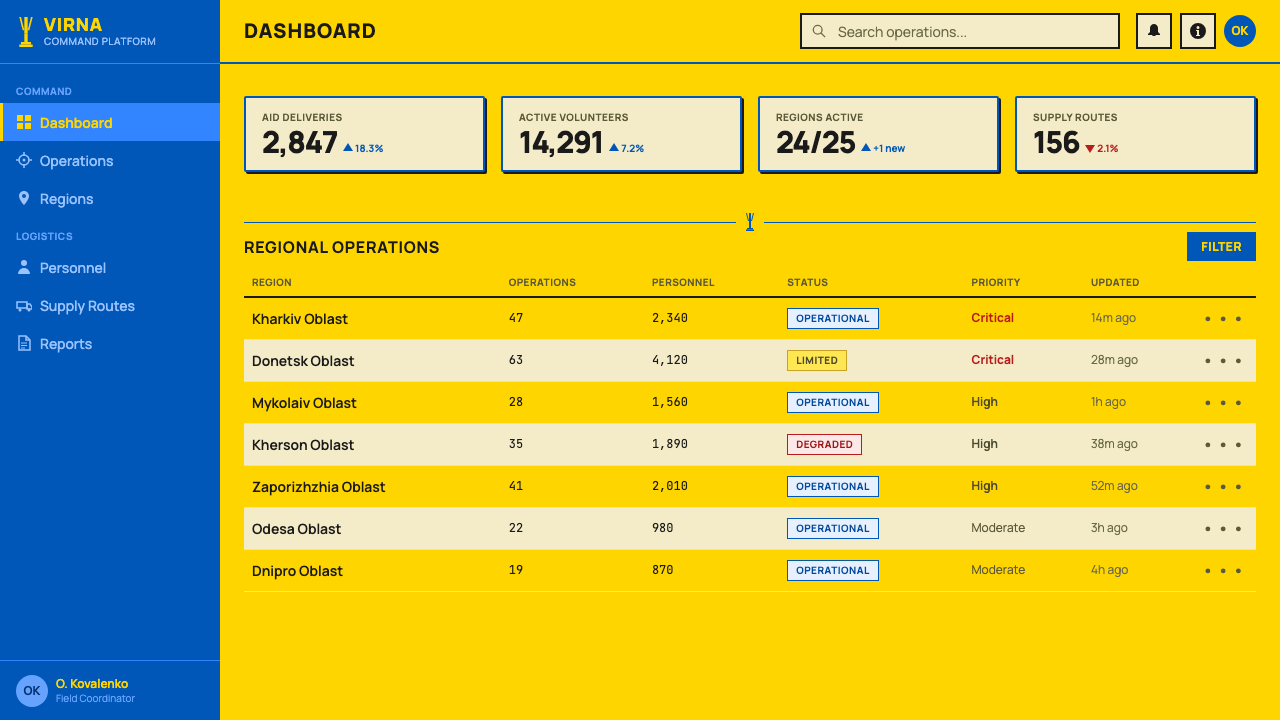
Banda Agency had established a reputation for sophisticated Ukrainian brand work before 2022. When the invasion began, the studio oriented its practice toward the resistance effort, producing graphic systems, campaigns, and templates for Ukrainian government agencies and international partners. Banda's contribution was systemic: they provided the structural logic that made the visual identity consistent across contexts and production environments, from professional studios to improvised wartime print operations.
As Ukraine's Foreign Minister from 2020 to 2024, Kuleba presided over the communications infrastructure that deployed the resistance visual identity at the diplomatic level. Under his direction, the Ministry of Foreign Affairs became one of the most visually consistent government communications operations globally during wartime. His recognition that design quality was inseparable from diplomatic effectiveness meant it received ministerial-level resources — with significant impact on international opinion.
Brave UA was among the most prominent volunteer collectives extending the resistance identity beyond official channels into civil society and international solidarity networks. The collective produced and freely distributed templates, poster files, and digital assets, allowing individuals and organizations worldwide to produce resistance-aligned content without centralized approval. Their work demonstrated that the wartime identity was not a top-down government project alone but a distributed creative effort with broad participation from civil society and the global diaspora.
As president and the most visible face of Ukrainian resistance communication, Zelensky's adoption of the visual system — consistently appearing in military-green garments that complemented the blue-yellow palette — was itself a design decision. His wartime communication style, combining formal state authority with accessible personal directness, mirrored the design system's combination of institutional weight and urgent simplicity.
How do you use Ukrainian Trident Blue/Yellow (2022) today?
The Ukrainian Trident Blue/Yellow system is among the most instructive examples of a design vocabulary applied at maximum pressure with maximum effectiveness. For designers working on projects requiring authority, urgency, and cross-cultural legibility — government communications, advocacy campaigns, emergency response branding — this system offers a structural model rather than a superficial aesthetic to borrow.
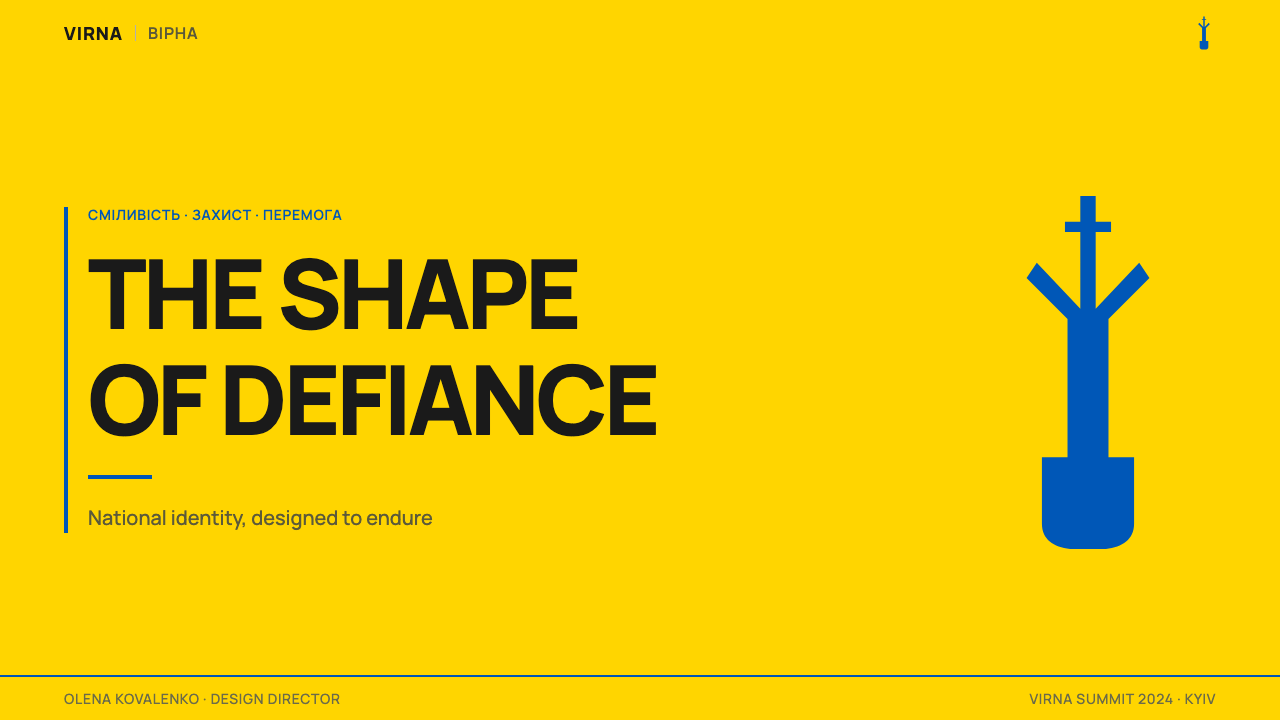
For presentation slides, the two-color logic is directly transferable. Cover slides work best on a full-bleed yellow or blue field, with the key symbol or title in the contrasting tone at maximum weight. The absence of decoration is the point: the bolder and more uncluttered the composition, the more the emblem and message carry their weight. Content slides should maintain high-contrast typographic hierarchy without softening elements — no gradients, no shadows, no decorative rules. Data presentations achieve poster-like clarity when chart elements are restricted to the two primary tones with black for labels.
For web and digital interfaces — advocacy sites, donation campaigns, government portals — the principles translate into a strict design language: pure color fields as section backgrounds, hard borders rather than soft card shadows, body text against a near-white or yellow-tinted ground, and the symbolic mark reserved for primary navigation or hero moments. Interactive states should use the contrasting color to maintain two-color discipline even in motion. A third accent color dilutes the system the moment it appears.
For editorial and documentary contexts — journalism, reports, memorial publications, solidarity campaigns — full-bleed photography overlaid with spare two-color typographic headers produces a visual language that reads as both journalistic and monumental. Pull quotes function best as full-color blocks in the primary palette, white text at headline weight — the graphic equivalent of a raised voice.
A common mistake is treating this system as a flag-themed color palette rather than a communications architecture. Applying blue and yellow as decorative accents within a conventional layout — colored borders, tinted headings on white, flags as illustrations — misses the point. The system's power comes from its absolutism: the colors are the layout, not decoration within it. Rounded corners, soft shadows, or gradient fills do not modernize the system; they undermine it. The hard geometry is load-bearing: round it and you lose the defiant clarity that makes the system legible as resistance.
Ukrainian Trident Blue/Yellow (2022) — FAQ
Is this visual system the official Ukrainian government design standard?
It emerged as a de facto standard through convergence rather than formal mandated adoption. The Ministry of Foreign Affairs, Banda Agency, and multiple ministries developed consistent visual principles from early 2022 that propagated globally through official social media, diplomatic communications, and international campaigns. There is no single published standards document, but the consistency achieved in practice is comparable to what formal standards produce. The absence of bureaucratic formalization was a strength: it allowed rapid adaptation without the delays a formal approval process would have imposed.
How does this wartime system differ from Ukraine's pre-2022 national branding?
Pre-2022 Ukrainian national communications were less visually unified — broader palettes, more varied typographic approaches. The flag colors appeared but were not deployed with the rigorous exclusivity they hold in the wartime system. The tryzub appeared on official documents but was not mobilized as the dominant element across all contexts. Peacetime institutional communications rarely require the absolute visual consistency that crisis conditions demand. The 2022 system stripped Ukrainian visual communication to its structural essentials, removing everything that might dilute the primary message.
Can this visual language be applied to commercial or non-governmental contexts?
The structural principles — two-color absolutism, a single dominant mark, stencil-weight typography, hard geometry — are fully transferable and have been adopted by organizations beyond the Ukrainian government. The difficulty in commercial application is register: the system carries extremely strong associations with a specific historical moment and political cause, and applying it commercially risks trivializing those associations. A more productive approach is to study the structural logic — the two-color discipline, the singularity of the mark, the legibility-first hierarchy — and apply those principles within a different visual vocabulary.
What makes the tryzub so effective as a graphic mark, compared to other national symbols?
Several qualities converge. Its geometric simplicity allows scaling from monumental to miniature and reproduction by stencil or hand without precision tooling. Its symmetry provides visual stability — authoritative rather than provisional. Its historical depth — over a thousand years as a Ukrainian emblem, predating the nation-state — lends legitimacy no designed-from-scratch symbol can claim. And its abstraction keeps interpretation open: it functions as dynastic seal, coat of arms, resistance emblem, and shorthand for Ukrainian identity across languages. Few national symbols combine these properties so completely.
How did social media shape the development of this visual identity?
Social media was not merely a distribution channel — it was the environment in which the identity was developed, tested, and refined. Telegram, Instagram, and Twitter determined compositional constraints: square and vertical crops, legibility across phone and desktop screens. The system's high contrast, simple geometry, and typographic weight perform well within these constraints. Templates shared instantly allowed the identity to propagate without centralized gatekeeping — volunteer designers could produce on-system content within hours of any development, maintaining visual consistency in real time.
Related design styles
 NZ All Blacks Rugby Haka FernBlack owns the field. Pewter Oswald type, jersey-stripe grid, and fern linewo…
 Al Jazeera Arabic NewsAuthority, stripped bare. Gold seal, dense Arabic type, matte charcoal.
 Bayern Munich (Rot)Heritage, not hype. Saturated rot fields, gold rules, and blue lozenges enfor…
 Estonian Song FestivalCivic monumentality sings. Blue-black-white bands meet a concrete arch.
 FC Barcelona (Blaugrana)Stadium heritage, not nostalgia. Blue-garnet stripes, Bungee type, gold heral…
 NASA Artemis ProgramCrewed return, engineered. Mission black, crescent-blue arc, flame orange, ri…