What is Blade Runner 2049?
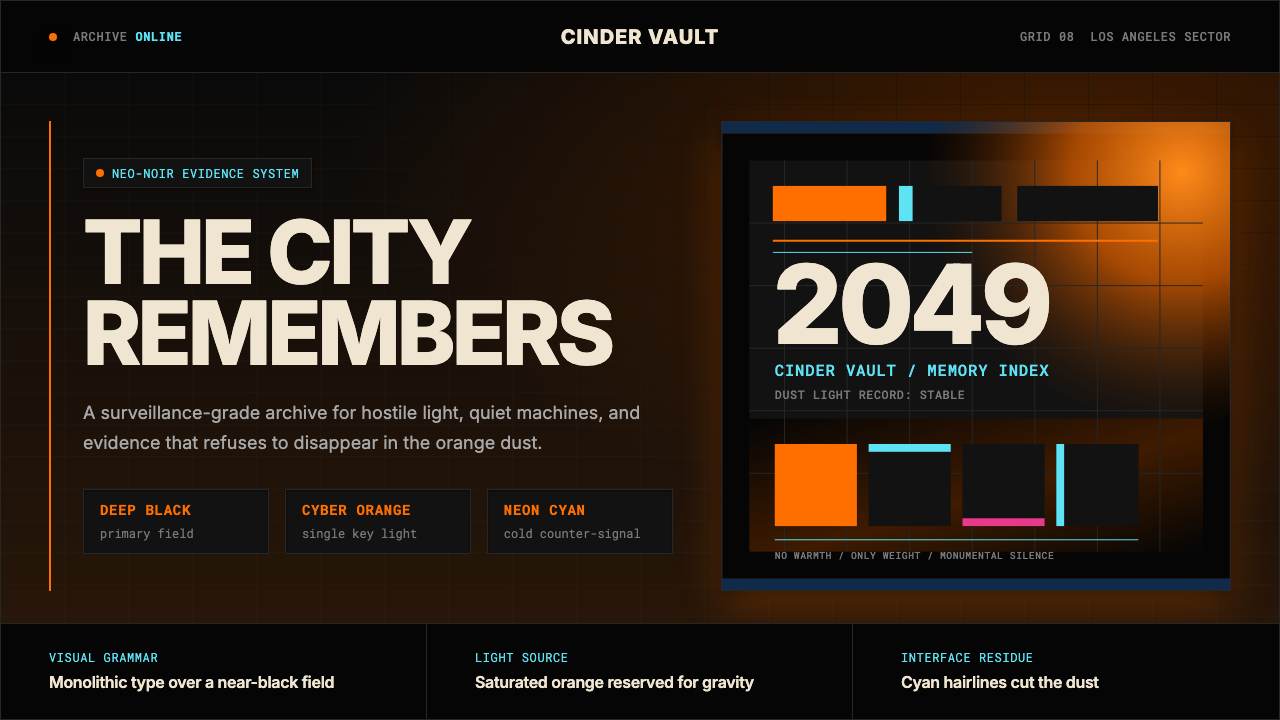
Blade Runner 2049 turned a dying world into a design language — monumental black fields, glowing orange dust, and hairline-thin cyan signals that feel like civilization's last transmissions.
Blade Runner 2049 in brief
Blade Runner 2049 (2017) is a neo-noir science-fiction film directed by Denis Villeneuve and shot by cinematographer Roger Deakins. Its visual language — deep black grounds, vast saturated orange dust atmospheres, hairline-thin cyan interface lights, and sporadic bursts of hot pink neon — has become one of the most influential design aesthetics of the 2010s, finding its way into product interfaces, presentation decks, editorial design, and brand identity far beyond the film industry.
The aesthetic is built around extreme tonal contrast and chromatic restraint. Most of any frame is darkness or warm dust; moments of cyan or magenta arrive as precise, isolated signals against that darkness. Scale is monumental: brutalist concrete towers dwarf human figures; typographic elements in UI designs following this style are similarly oversized, treating letterforms as architectural masses rather than readable marks.
What distinguishes Blade Runner 2049 from generic cyberpunk or dark-UI trends is its emotional temperature. The palette is not aggressive or chaotic — it is exhausted, melancholy, and enormously composed. Every glowing element feels rare, earned, and fragile against the surrounding dark. Designers who apply this aesthetic are not chasing excitement; they are building weight.

Where does Blade Runner 2049 come from?
The visual world of Blade Runner 2049 is inseparable from the 1982 original directed by Ridley Scott. Scott's film — based on Philip K. Dick's 1968 novel Do Androids Dream of Electric Sheep? — established the visual grammar of neo-noir science fiction: perpetual acid rain, vertical neon signage, smoke-filled interiors, and a color palette that blended Los Angeles smog with Shanghai night markets. That film introduced the idea that a future city could look simultaneously high-tech and decayed, simultaneously overwhelming and intimate.
When Denis Villeneuve took on the sequel three and a half decades later, he and production designer Dennis Gassner made a decisive formal choice: to move the dominant color temperature from the cold blues and greens of the original into deep ochre and orange — the warmth of dust, of vast arid territories, of a world whose biosphere has collapsed. Where Scott's Los Angeles was perpetually wet, Villeneuve's is perpetually dry. This shift was not merely atmospheric; it transformed the aesthetic from frenetic and claustrophobic to monumental and desolate.
Cinematographer Roger Deakins — who won his long-overdue Academy Award for his work on this film — brought a discipline rooted in classical painting and landscape photography. He studied the way strong directional light from a single source carves form out of darkness, and he applied this understanding to enormous architectural sets and exterior wastelands alike. The result is that every frame of Blade Runner 2049 has the compositional rigor of a Hopper painting or a Caspar David Friedrich landscape: lone figures dwarfed by inhuman scale, light arriving from precisely one direction, and a profound sense of stillness.
The film's influence on design practice emerged gradually through the late 2010s, as dark-mode interfaces became standard, as digital products began competing on emotional depth rather than feature lists, and as a generation of designers who had grown up with the original Blade Runner found themselves in positions of visual authority. The 2049 palette — specifically the combination of near-black grounds, saturated warm amber or orange accents, and cold hairline cyan — became a recognizable shorthand for a particular kind of ambitious, cinematic digital product: one that wanted to feel inevitable rather than cheerful.
What defines the Blade Runner 2049 look?
Ground and Atmosphere
The dominant visual field is near-total darkness — not the grey-tinged dark of a generic dark theme, but a black so dense it feels physical. Into this darkness, atmosphere is introduced as a secondary ground: a warm amber or orange haze that sits between the viewer and distant objects, giving every composition a sense of vast depth. The relationship between the dark foreground and the atmospheric middle distance is the engine of the aesthetic's emotional power.
Saturated Orange and Amber Accent
Orange and deep amber function as the primary warm accent: they appear as dust atmospheres filling entire mid-ground zones, as glowing call-to-action buttons in interface applications, as horizontal bands separating sections. The saturation is high — this orange never fades to a neutral brown — but it is never combined with other warm saturated hues. It stands alone against darkness, which is precisely what makes it legible and striking.
Hairline Cyan and Cold Precision
Against the warm atmospheric ground, cold cyan appears as the color of precision and technology: interface readouts, structural diagram lines, edge-lit architectural forms. These elements are characteristically fine and exact — hairlines rather than thick rules — suggesting technical systems running below the surface warmth. The coolness of cyan creates a temperature dialogue with the orange that is fundamental to the aesthetic's sense of tension and complexity.
Monumental Typography
Type in this aesthetic is treated as architecture. Headlines are set in oversized, optically extreme sans-serif forms — ultralight weights that feel almost skeletal, or ultrabold weights that feel like slabs of concrete — with generous spacing between characters that emphasizes each letterform's individual mass. Body text is sparse and exact, often placed with deliberate asymmetry relative to the dominant headline mass. There is no decorative typography; letterforms are either structural anchors or information, never ornamentation.
Brutalist Scale and Emptiness
The sense of scale in Blade Runner 2049 is relentlessly inhuman. Architectural elements and landscape forms are enormous relative to any human reference point. In design applications, this translates to abundant empty space used not as minimalist breathing room but as an expression of vast distance — empty zones that feel like wastelands rather than careful whitespace. The composition is never crowded; it is spacious in the way that ruins are spacious.
Hot Pink and Neon as Rare Signal
Moments of hot pink or saturated magenta function as the aesthetic's most unexpected element: a flash of advertising holography, a single neon sign, an edge-lit surface in an interior. These colors appear infrequently and in small quantities, which makes them visually electric when they arrive. In interface terms, hot pink or magenta is reserved for the highest-priority alert or the most unexpected interactive element — a disruption, not a system.
Surface Without Decoration
Surfaces in this aesthetic are either pure black or carry the texture of the environment — concrete grain, atmospheric haze, weathered material — but they are never decorated. There are no ornamental borders, no pattern fills, no gradient washes applied for visual interest. The only visual events are the color accents and typographic elements described above. Restraint is total: if an element is not structural or informational, it does not exist.

Who shaped Blade Runner 2049?
Villeneuve, the Quebec-born director known for Arrival, Dune, and Incendies, brought a meditative, almost geological patience to Blade Runner 2049. Where other science-fiction directors accelerate to urgency, Villeneuve slows down — his frames hold longer than conventional cinema, allowing the weight of architectural space and atmospheric color to accumulate. His directorial instinct to treat silence and duration as formal materials is what gives the aesthetic its quality of stillness, and what makes it so transferable to static design applications where time is replaced by considered space.
Deakins is one of the most technically rigorous cinematographers working in studio filmmaking. His approach to Blade Runner 2049 was to solve every lighting problem with a single, large, motivated light source — meaning the light in each scene appears to come from somewhere logical within the world of the film. This discipline produces the aesthetic's characteristic quality: every element in a frame is either in direct, saturated light or in almost total shadow, with very little middle ground. The high-contrast tonal structure that defines the visual style in design applications is a direct inheritance from Deakins' lighting philosophy.
Production designer Dennis Gassner built the world of 2049 as a series of distinct environmental zones, each with its own atmospheric color signature: the amber dust of the Los Angeles wasteland, the monochrome grey of the protein farms, the cold white of the Las Vegas ruins, the blue-green of the offshore sea headquarters. This zoning system — where color signals location and emotional register simultaneously — is directly applicable to design systems thinking, where color zones in a product communicate context and state rather than mere decoration.
Composer Hans Zimmer and frequent collaborator Benjamin Wallfisch produced a score for Blade Runner 2049 that treated silence as compositional material. Long stretches of ambient drone, metallic resonance, and sub-bass vibration are interrupted by moments of sharp melodic precision — a structural pattern that directly mirrors the visual aesthetic's relationship between vast emptiness and precise signal. Zimmer's approach demonstrates that the 2049 aesthetic is fundamentally a system of contrast management, and that understanding this carries over into how silence and whitespace are used in design work.
Though Syd Mead passed away in 2019 before completing significant work on 2049, his visual conceptualization work on the original 1982 Blade Runner established the foundational vocabulary that Villeneuve's film both inherited and reacted against. Mead's future was dense, layered, and industrial; Villeneuve's response was to hollow it out, replacing density with desolation. Understanding Mead's original vision is essential for understanding what Blade Runner 2049 is doing when it empties a space that the original would have filled.
How do you use Blade Runner 2049 today?
Blade Runner 2049's aesthetic is one of the most transferable cinematic design languages available to contemporary practitioners, precisely because its core logic — extreme tonal contrast, atmospheric warm ground, cold precise signal, monumental scale — translates from screen to surface with minimal translation loss. The rules are few, but they must be applied with genuine commitment. Half-measures produce mediocrity rather than tension.
For presentation slides, this aesthetic excels at cover pages and section transitions. A cover slide works best as a near-full-black composition with a single atmospheric warm element — an abstract dust band, a horizontally-placed wide image with strong amber color grading — and an oversized, optically-extreme headline in cold white or hairline weight. Section transition slides can use a pure color-field approach: deep amber on black, functioning like a scene cut in cinema. Content slides should restrain themselves to the color system's logic: dark ground, white for body text, orange or amber used only for a single call-out or highlighted data point per slide. Stacked warm colors or multi-color data charts in this system immediately read as system violations.
For web interfaces and dashboards, this palette is exceptionally powerful for tools that need to communicate authority, technical depth, and calm expertise — financial analytics platforms, developer dashboards, systems monitoring tools, and luxury or prestige digital products. The approach: commit to a near-black base throughout, use the warm amber-orange tone for primary interactive elements and key metrics, use hairline-weight dividers and labels in cold cyan or grey-white, and reserve hot pink or magenta as a single high-alert signal color used nowhere else. Pricing pages in this system work well when tier differentiation is signaled through luminance and warmth rather than color switching.
For editorial layouts and marketing materials, the style produces strong poster-like compositions that age well. A feature article header in this aesthetic uses a full-bleed dark image with strong warm color grading, an oversized display headline at the top or bottom edge, and almost no additional visual elements — no decorative borders, no gradient overlays, no secondary typographic ornament. Marketing pages work best with a sectional alternation rhythm: full-width black-with-amber zones for feature statements, near-white or concrete-grey zones for supporting copy, and one absolute-black zone with cold precise typographic content for technical specification or pricing.
A common and damaging mistake when applying this aesthetic is lighting up too many elements. The aesthetic's power comes entirely from contrast and scarcity: orange glows because everything around it is dark; cyan hairlines read because everything beside them is either black or warm. As soon as a second orange element, a second cyan accent, or a warming gradient appears behind body text, the system collapses into generic dark-UI. The discipline required is to identify the single most important element in each screen or page — and make only that element warm and bright. Everything else serves as its darkness.

Blade Runner 2049 — FAQ
How is Blade Runner 2049 different from generic dark-UI or cyberpunk design?
Generic dark UI tends to use multiple bright colors, high overall saturation, and decorative neon elements distributed evenly across a dark ground — the result feels energetic and chaotic. Generic cyberpunk multiplies visual noise: overlapping glitch effects, heavy scan lines, crowded information density. Blade Runner 2049 does the opposite: it uses extreme restraint, almost no color except in deliberate, isolated moments, and vast amounts of empty dark space. The emotional register is melancholy and monumental, not exciting or aggressive. If your dark composition has more than two accent colors active at once, or any decorative effects, it is not 2049 — it is cyberpunk.
Can this aesthetic work for a warm or consumer-facing product?
The 2049 aesthetic is poorly suited to contexts requiring warmth, accessibility, or emotional invitation. Products for children, food and beverage brands, wellness applications, social platforms, and any product where the first emotional task is to make the user feel welcome will struggle with this aesthetic — its darkness, scale, and melancholy read as exclusion rather than inclusion. The style is most effective when the product wants to signal that it is serious, technically sophisticated, and not for everyone. Trying to make it warm by adding organic textures or softer typography undermines the system's logic entirely.
How many accent colors should a 2049-inspired design use at once?
The functional maximum is two: one warm (orange or amber) and one cold (cyan or grey-white). In most applications, one is sufficient. The hot pink or magenta third accent, if used at all, should appear in a single location per entire screen or page, never repeated. The entire aesthetic depends on each chromatic event feeling rare and deliberate. A composition where orange appears in a button, a chart highlight, a section background, and a progress indicator simultaneously has diluted the system to the point of incoherence. One anchor, one accent — and then darkness.
Does this style work in light-mode or white-background contexts?
The 2049 aesthetic is fundamentally a dark-ground system, and a light inversion substantially changes its character. On a white or near-white ground, the warmth and atmospheric depth of the amber-orange tones shifts from glowing to simply warm, losing their quality of illumination-from-within. The cold cyan accents, against white, read as decorative rather than precise. A partial application — very dark charcoal or warm dark grey as ground rather than pure black — preserves more of the aesthetic's gravitas than a full light inversion. If a light version is required, treating it as an independent system (high-contrast light surface, single warm-amber accent, no atmospheric grounding) is more honest than calling it 2049.
What is the single most important rule for maintaining the integrity of this style?
Protect the darkness. Every design decision that adds a second warm element, lightens the ground, introduces a gradient, or populates an empty zone with supplementary decoration is a decision to reduce contrast — and reduced contrast is a reduced aesthetic. The darkness is not the absence of design; it is the material the glowing elements are made of. Blade Runner 2049's power, in film and in design, comes entirely from how much is withheld. A designer applying this aesthetic is not adding things to a dark template; they are deciding, over and over, what does not need to exist.
Related design styles
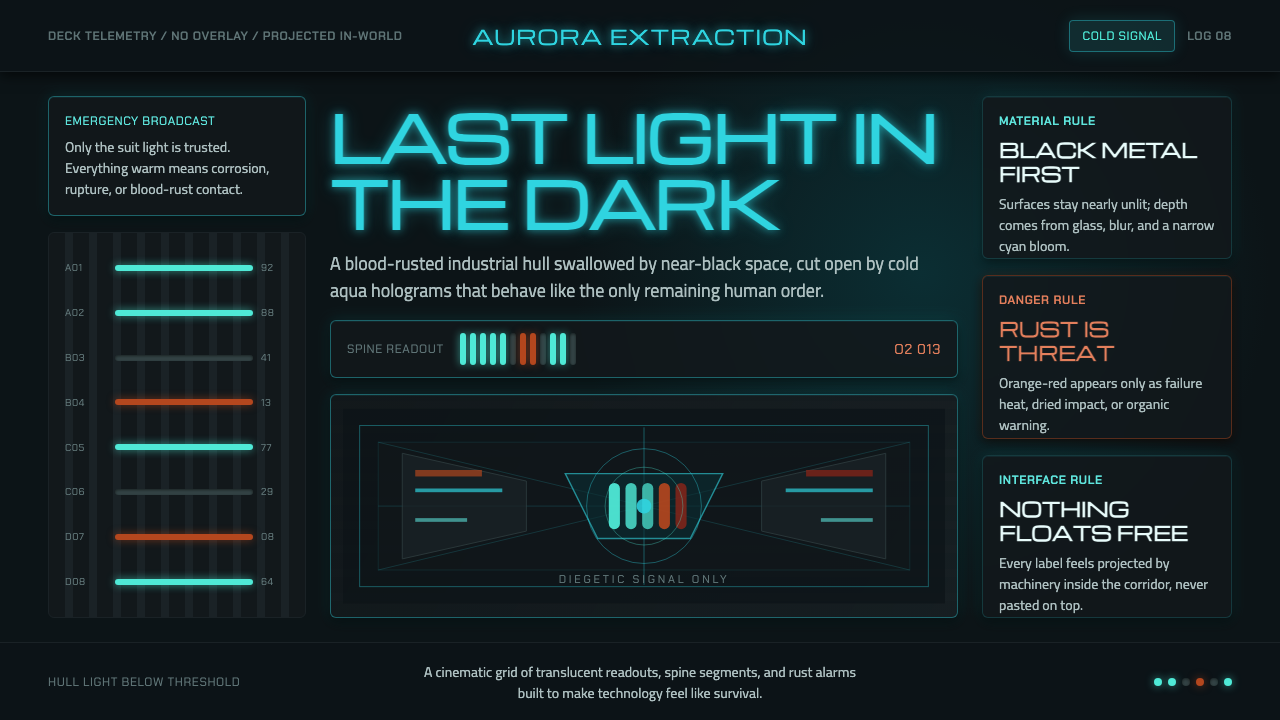 Dead Space IshimuraLast light in the dark. Near-black rust cut by aqua holographic panels.
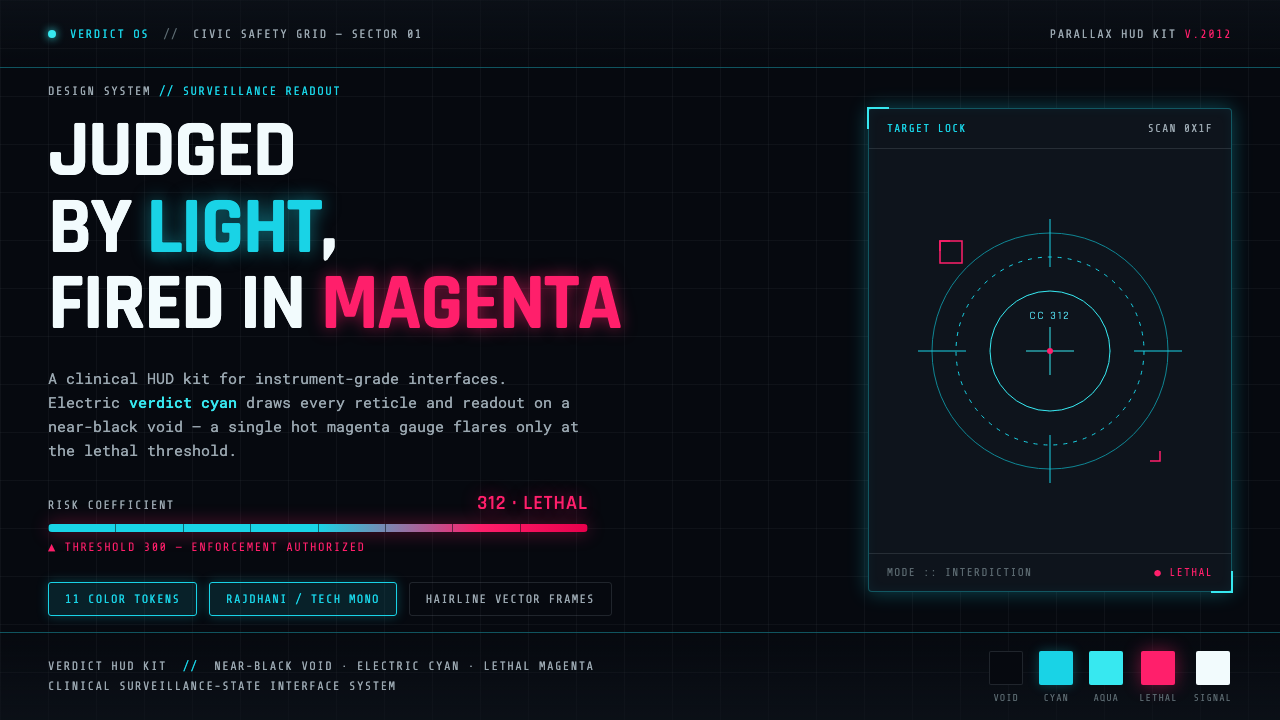 Psycho-PassA surveillance HUD. Cyan reticles on a near-black void; magenta flares only a…
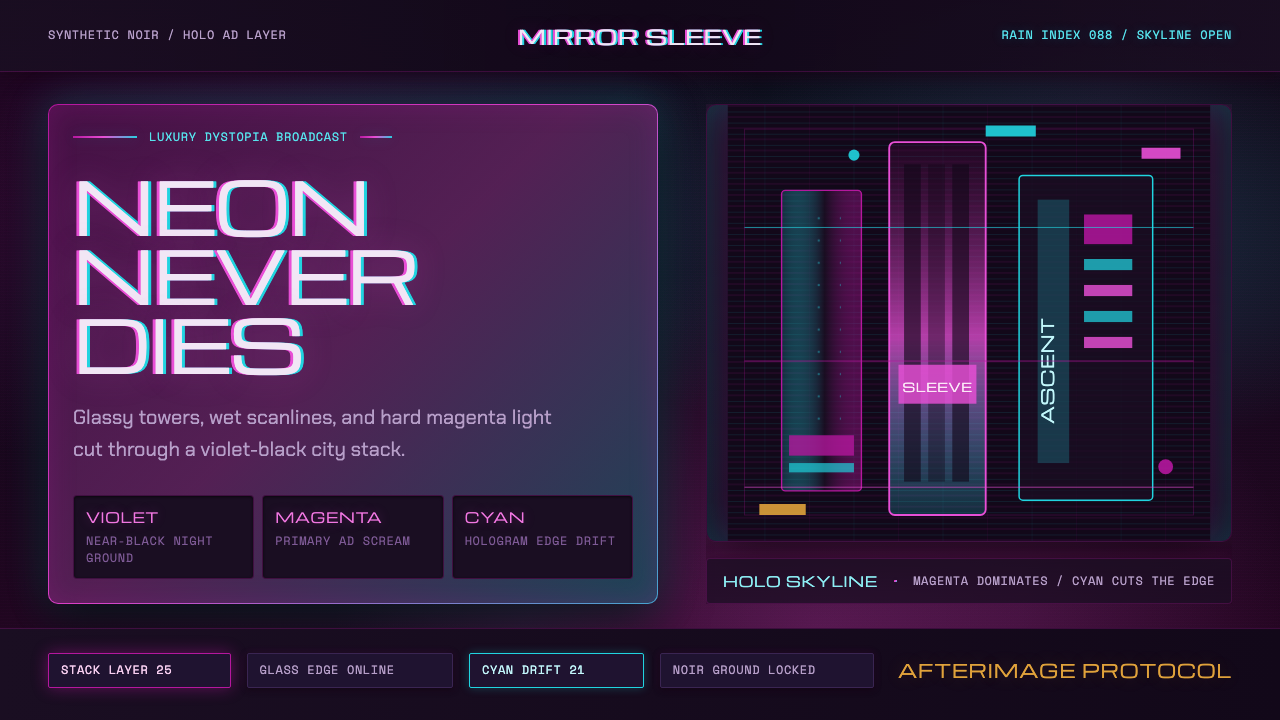 Altered CarbonNeon screams off noir. Magenta glass, cyan scanlines, and stacked vertical si…
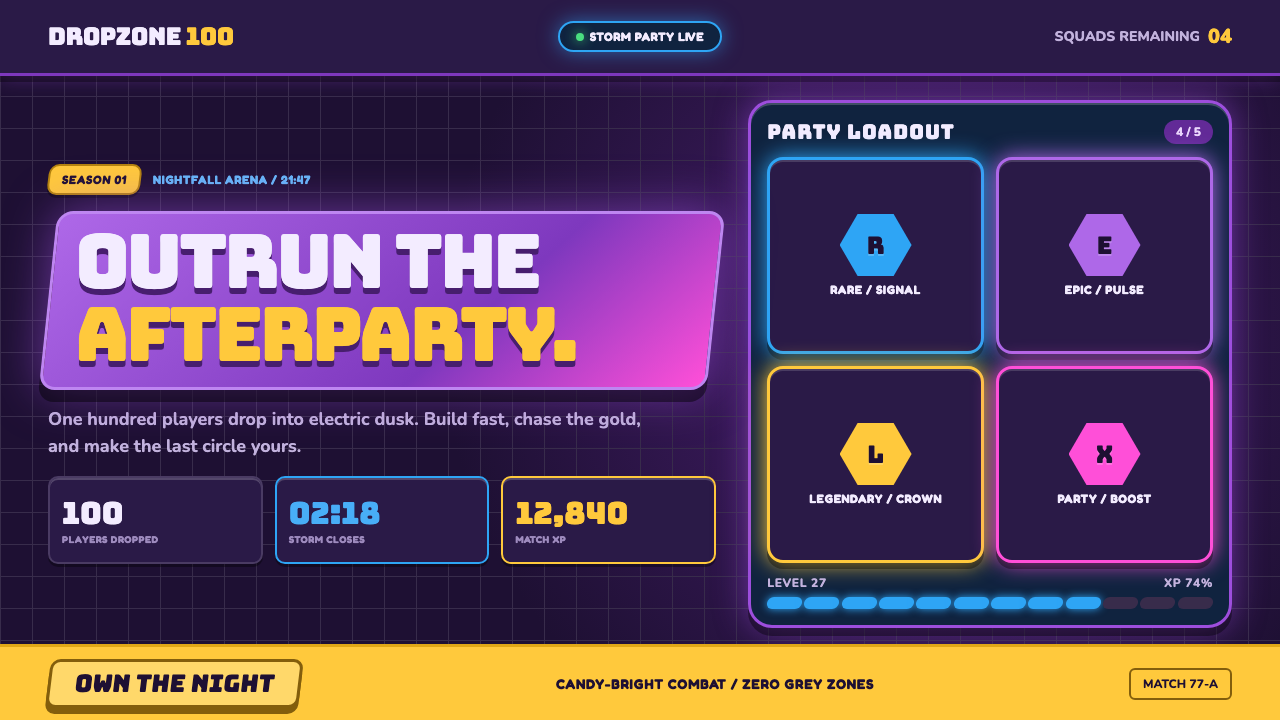 Fortnite (2017 Battle Royale)Battle royale becomes a neon party. Chunky caps and rarity glows electrify st…
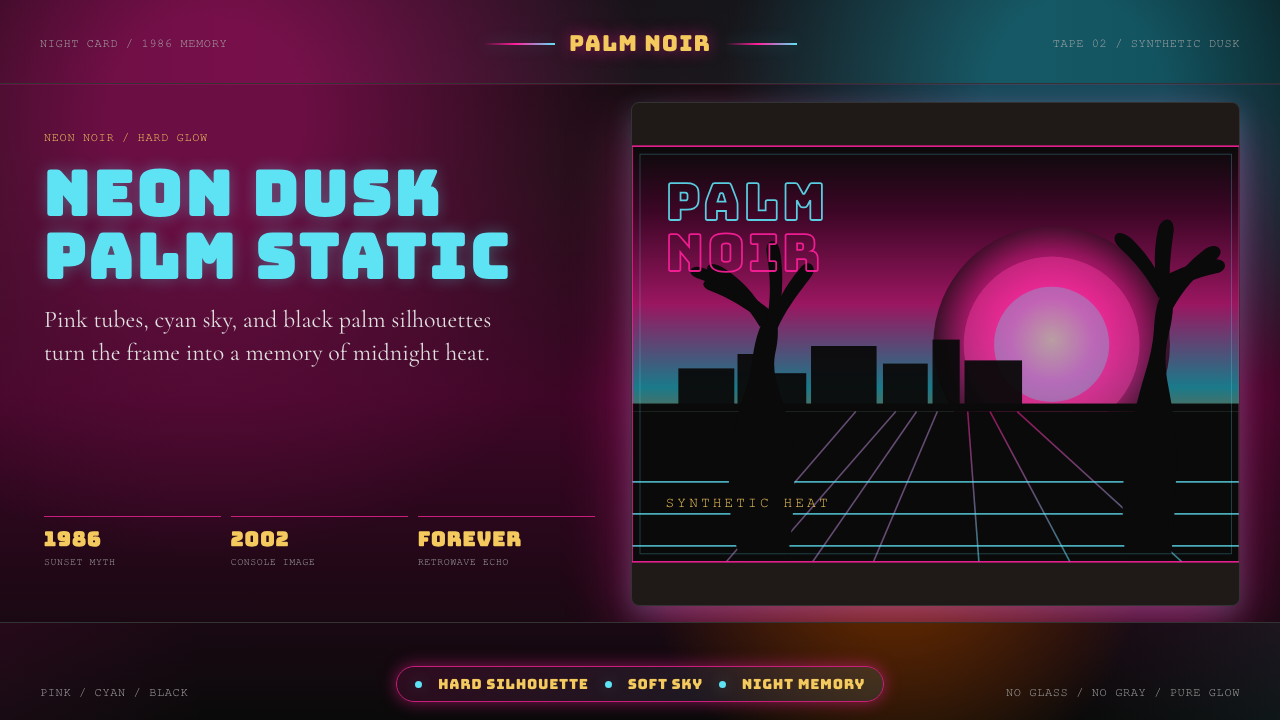 GTA Vice City (2002)Neon-noir nostalgia. Pink-cyan dusk, chunky type, and palm silhouettes.
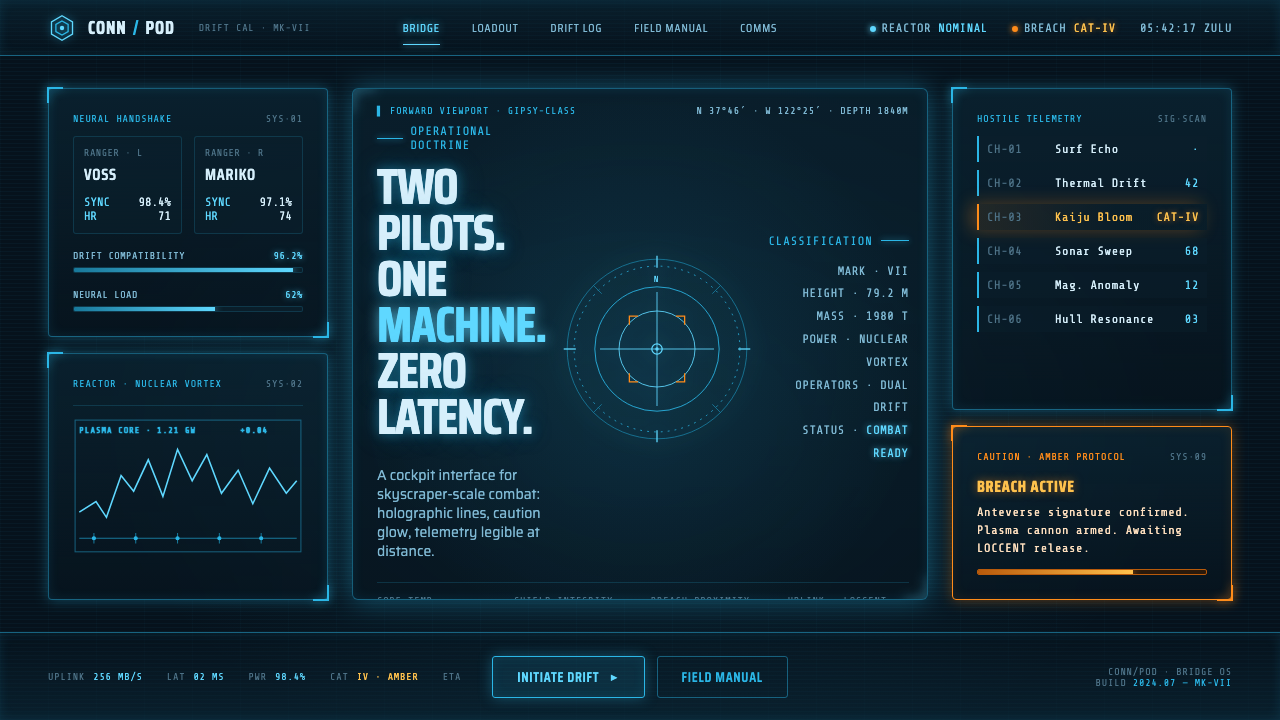 Pacific Rim Jaeger HUDTwo pilots, one machine. Faded Corsair-cyan holograms on near-black steel, am…