What is Pakistani Truck Art?
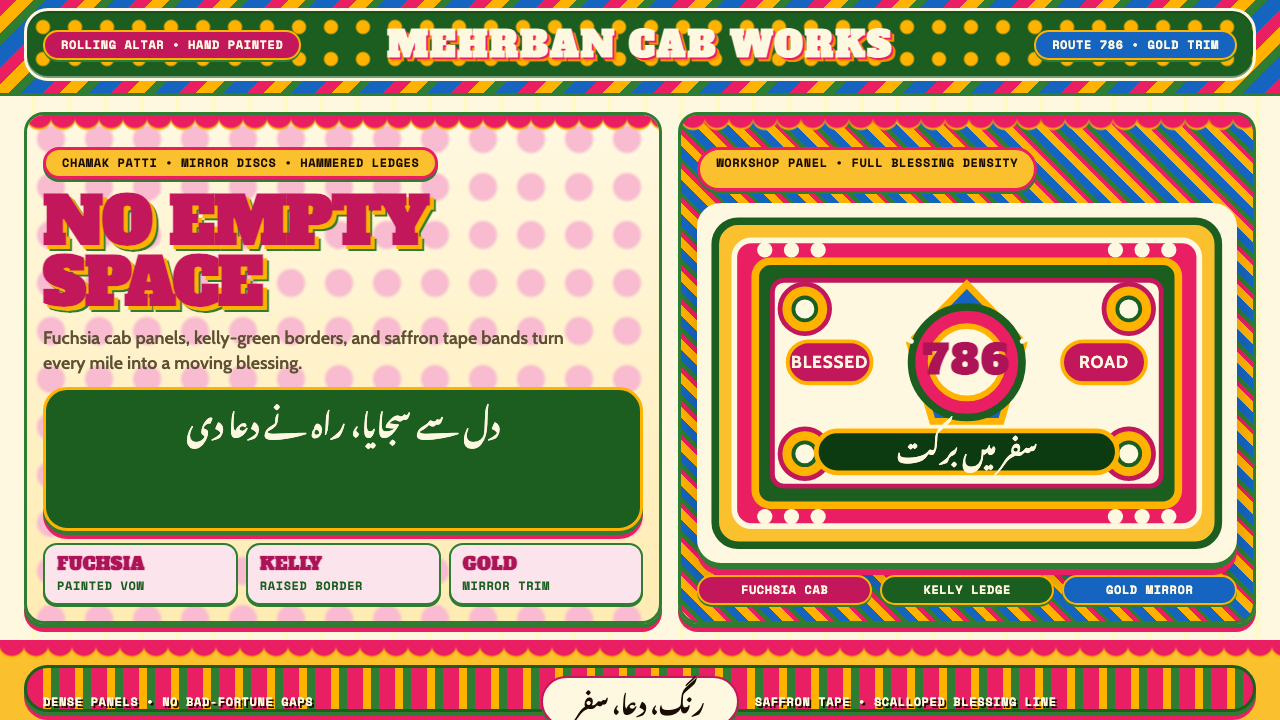
Pakistani truck art is rolling folk maximalism — every inch of metal buried under peacocks, calligraphy, and mirror-work, because empty space is an invitation for bad luck.
Pakistani Truck Art in brief
Pakistani truck art is one of the most exuberant folk visual traditions still practiced at full intensity anywhere in the world. Since the 1950s, the Bedford lorries and Hino trucks rolling out of workshops in Karachi, Rawalpindi, Peshawar, and Quetta have been transformed into moving altars — their cabs, bonnets, bumpers, and rear panels entirely hand-painted, inlaid with chamak-patti reflective-tape mosaics, studded with mirror-work, and hung with hammered metal chains and tassels. The aesthetic principle is absolute: there is no empty space where blessing could fit instead.
The visual vocabulary is deliberately dense and heterogeneous. Peacocks — symbols of beauty and divine grace — appear alongside tigers representing strength, Bollywood actresses representing glamour, and Quranic calligraphy representing devotion. Romantic Urdu couplets share panel space with mountain landscapes, portraits of political leaders, and folk heroes. These images coexist without hierarchy, layered into a chromatic field dominated by fuchsia, kelly green, and gold — colors chosen for their festive intensity rather than any harmonizing logic. The result is a visual argument that abundance is itself a spiritual value.
Unlike many folk art traditions that have migrated primarily into galleries and gift shops, Pakistani truck art remains a living commercial practice. Workshop masters — often inheriting their trade across generations — are commissioned directly by drivers who see the decoration as both personal expression and practical protection. A well-decorated truck is believed to draw the attention of God and saints, ward off the evil eye, and signal the driver's prosperity and taste to other road users. The truck is simultaneously vehicle, advertisement, shrine, and autobiography.

Where does Pakistani Truck Art come from?
The roots of Pakistani truck art lie in the post-Partition urban craft economies of the 1950s. After the creation of Pakistan in 1947, a new national road network and the import of British Bedford trucks created a class of independent long-haul drivers — men who spent weeks away from home on routes connecting Karachi to Lahore to Peshawar to the Afghan border. The decoration of vehicles as a way of personalizing them and asserting identity was not new; South Asian folk traditions of decorating bullock carts, horse-drawn tongas, and river boats stretched back centuries. But the motorized truck offered a larger, more durable surface, and the competitive culture of the road incentivized ever more elaborate display.
The earliest truck decorations were relatively modest — painted borders, a name or verse on the tailgate, perhaps a floral motif. The emergence of chamak-patti, the reflective plastic tape that forms geometric mosaics on bonnet and bumper, transformed the aesthetic from painted illustration toward a dazzling optical effect. By the 1970s — the peak decade of truck registration and long-distance haulage in Pakistan — workshops in the major cities had developed highly specialized divisions of labor. A single truck's decoration might involve a master painter for figural work, a calligrapher for Quranic verses and Urdu poetry, a metal-worker for hammered panels and chains, and a chamak-patti specialist for the reflective tape inlay. Each contributed to a unified whole that no single craftsperson could produce alone.
The tradition drew on multiple cultural streams. Sufi devotional visual culture — with its tradition of elaborate shrine decoration, votive offerings, and the belief that beauty is a form of prayer — gave the practice its spiritual legitimacy. The Mughal miniature tradition supplied certain compositional conventions and the taste for dense pictorial fields. Bazaar calendar art, which had since the early twentieth century printed chromolithographed images of gods, saints, film stars, and nature scenes for popular consumption, provided much of the figurative iconography. Pakistani truck art synthesized these influences into something entirely its own — a vernacular modernism that was simultaneously deeply traditional and rapidly evolving.
International recognition came gradually. Haider Ali, a Karachi-based master who learned the craft from his father Ustad Hussain, became the tradition's most internationally visible practitioner after his work was exhibited at the Smithsonian Folklife Festival in Washington, D.C., in 2002. Subsequent exhibitions in Europe and North America introduced a global design audience to the tradition, spurring collaborations with fashion brands, furniture designers, and digital artists. Yet even as the tradition attracted outside attention, it continued to function primarily as a living craft — trucks decorated in traditional style remain a common sight on Pakistani highways today, competing for visual attention with undecorated container lorries in a kind of rolling aesthetic argument about what a vehicle should be.
What defines the Pakistani Truck Art look?
Horror Vacui Color
The palette of Pakistani truck art is built on saturated, clashing intensity rather than harmonious coordination. Fuchsia, kelly green, cadmium yellow, and vermilion red appear simultaneously at full saturation, creating a visual field that refuses the eye any resting point. Gold — applied as painted highlights, gilded lettering, and metallic tape — functions as a unifying agent that ties disparate hues together through shared luminosity rather than tonal similarity. The underlying principle is that more color signals more blessing; restraint would be a spiritual failure.
Figural Layering
Truck panels are organized not by white space and hierarchy but by layering — figures overlap, frames nest within frames, borders contain secondary illustrations that contain tertiary ones. Peacocks may be depicted against mountain landscapes that are bordered by floral chains that are themselves edged with calligraphic text. This multi-level composition creates a reading experience that rewards slow, exploratory attention rather than quick scanning, inverting the conventional design assumption that important content should be isolated to be seen.
Chamak-Patti Optical Effect
Chamak-patti — strips of reflective plastic tape cut into geometric shapes and applied in interlocking patterns — is the technique most distinctively associated with Pakistani truck art and least replicated in other folk traditions. Arranged in fan shapes, chevrons, and radiating star forms, the tape catches and fragments light as the truck moves, creating an effect closer to kinetic mosaic than static surface. At night, headlight beams transform the truck into a moving source of colored light. The optical intensity is inseparable from the spiritual intention: to make the truck visible, memorable, and undeniable.
Calligraphic Integration
Quranic verses, prayers, and romantic Urdu poetry are not relegated to decorative bands at the margins but woven into the figural composition as fully equivalent pictorial elements. A calligraphic Bismillah may arch across the cab roof in letterforms as large and visually weighted as any figurative painting below it. The script itself — whether in Nastaliq, the flowing cursive script of Urdu, or in bolder display styles — is treated as image as much as text, its curves and ascenders contributing to the overall compositional rhythm in the same way that a painted feather or a floral tendril would.
Hammered Metal Texture
Many truck panels incorporate hammered and embossed metal — steel or aluminum sheets worked into relief patterns of flowers, geometric stars, and arabesque curves. These three-dimensional surfaces interact with painted decoration and flat chamak-patti tape to create a layered material richness that changes appearance with viewing angle and lighting condition. The metalwork also has a sonic dimension: hanging chains and metal pendants produce rhythmic sound as the truck moves, extending the sensory experience of the decorated vehicle beyond the purely visual.
Regional Workshop Lineage
Pakistani truck art is not a unified national style but a family of related regional traditions with distinct visual dialects. Karachi workshops tend toward figurative richness and Bollywood-influenced portraiture. Rawalpindi and Peshawar workshops emphasize geometric complexity in chamak-patti work and bolder Nastaliq calligraphy. Quetta trucks often feature mountain landscapes reflecting the Balochistan terrain. These regional differences reflect different workshop lineages, different patron communities, and different cultural influences — Pashtun in the north, Sindhi in the south, Punjabi in the east — all operating within the shared maximalist aesthetic framework.
Iconographic Eclecticism
One of the defining features of Pakistani truck art is its unapologetic mixing of sacred and secular imagery. A single truck panel may juxtapose Quranic verse with a painted tiger, a film star portrait with a mountain saint's shrine, a national flag with a romantic couplet. This eclecticism is not experienced as contradiction but as abundance — the more diverse the intercessors and sources of beauty and blessing, the more protected and celebrated the driver and his vehicle. The tradition refuses the modernist impulse to purify visual language by restricting it to a single register or meaning system.

Who shaped Pakistani Truck Art?
Haider Ali is the most internationally recognized living master of Pakistani truck art, continuing a family tradition begun by his father Ustad Hussain in the Karachi workshops. His work came to global attention when the Smithsonian Institution invited him to demonstrate his craft at the 2002 Smithsonian Folklife Festival in Washington, D.C. — a pivotal moment that introduced the tradition to a Western design audience. Ali's painting style is notable for its fluid brushwork, its layering of figural and calligraphic elements, and its characteristic use of brilliant fuchsia and gold against deep jewel-toned grounds. He has since collaborated with international fashion and design brands and conducted workshops in Europe and North America while continuing to accept commissions for working trucks in Pakistan.
Ustad Hussain — the title Ustad, meaning master craftsman, indicates his status within the workshop tradition — was a founding figure of the Karachi school of truck painting in the mid-twentieth century. As Haider Ali's father and teacher, he established the compositional principles and color relationships that define the Karachi style: dense figural layering, integration of calligraphy at monumental scale, and the bold use of fuchsia as a ground color. His legacy is preserved both through his son's continued practice and through the many painters who passed through his workshop and dispersed the Karachi aesthetic across Pakistan's transport networks.
Ali Salman Anchan is a contemporary Karachi-based truck artist who has become one of the most prominent voices in the tradition's contemporary evolution, navigating the tension between heritage practice and commercial adaptation. He has been instrumental in translating truck art aesthetics to new surfaces — rickshaws, mobile vans, wall murals, and consumer products — while arguing publicly for the preservation of the traditional workshop system against pressures of industrialization and imported digital printing. His work demonstrates how the maximalist visual logic of truck art can be applied beyond the truck itself without losing its essential character.
Jamal J. Elias is an American scholar of Islamic studies whose 2011 book On Wings of Diesel: Trucks, Identity, and Culture in Pakistan provided the first comprehensive academic study of Pakistani truck art in the English language. His research documented the workshop traditions, the iconographic programs, and the devotional and social functions of truck decoration across Pakistan's regions, establishing the field's scholarly foundation. By analyzing truck art through the lenses of Islamic visual culture, Sufi devotional practice, and post-Partition national identity, Elias situated the tradition within broader histories of art and religion rather than treating it as mere folk curiosity. His work has shaped how international audiences understand and contextualize the practice.
How do you use Pakistani Truck Art today?
Applying Pakistani truck art to contemporary design requires understanding what makes the tradition visually coherent despite its apparent chaos. The underlying organizing principles — radial symmetry within individual panels, the use of borders as both frames and compositional elements, and the consistent application of gold as a unifying chromatic thread — provide the structural logic that allows the style's density to read as richness rather than noise. A designer working in this aesthetic must internalize these hidden structures before attempting to deploy the style's surface features.
For presentation slides, the truck art aesthetic translates most effectively into bold, high-impact cover and title slides rather than data-heavy content pages. A cover slide in this style takes a dark jewel-toned background — deep teal, midnight blue, or rich burgundy — and layers painted-style floral borders, a central figurative element (a peacock, a geometric star, an arched calligraphic form), and the title text in a bold, display-weight typeface. The key is treating the title as a calligraphic object rather than a pure information carrier — its letterforms should feel weighted and ceremonial. Content slides should pull back significantly, using the border vocabulary of the style — decorative frames around key points, small chamak-patti-inspired geometric ornaments as bullet markers — rather than attempting to reproduce the full density of a truck panel.
For web interfaces, the truck art palette and ornamental sensibility work best in contexts where cultural richness and craft heritage are part of the brand proposition — artisanal food and beverage, South Asian fashion and lifestyle, cultural institutions, and travel platforms. Dashboard and utility applications are generally a poor fit. When adapting the aesthetic for interface use, select one or two dominant hues from the palette — fuchsia and gold, or kelly green and gold — and use the others sparingly as accent. Borders and frames drawn from the tradition's ornamental vocabulary can define cards and sections without requiring the full figural complexity. Navigation and body text should be kept legible against the decorative backgrounds, which means ensuring sufficient contrast and restraining ornament in zones where text density is high.
For editorial and marketing applications, the style produces particularly strong results in print and social media contexts where the full visual richness can be appreciated at the appropriate size. A truck-art-inspired poster uses the entire surface as a compositional field, with the headline text integrated into a decorative arch or medallion rather than sitting as isolated typography above an image. Magazine spreads and editorial features can use the tradition's border vocabulary to frame photography — treating photographs as portrait-medallion inserts within an ornamental surround rather than as full-bleed background images. Brand packaging applications benefit from the style's ability to make modest products feel ceremonially elevated: even a simple label becomes a small altar when treated with the full decorative language.
The most common mistake when applying Pakistani truck art is selecting the saturated colors without the structural framework, producing work that reads as garish rather than festive. The tradition's density works because every element is purposeful — borders contain, calligraphy anchors, gold unifies, symmetry organizes. Removing the structure while keeping the color saturation produces visual noise. A second common error is treating the style as primarily decorative — as a surface pattern to be applied to an otherwise conventional layout — rather than as an organizing system in which decoration and structure are inseparable. The truck's entire surface is the composition; there is no neutral zone beneath the ornament.

Pakistani Truck Art — FAQ
How does Pakistani truck art differ from other South Asian decorated vehicle traditions?
Pakistani truck art shares its origins in South Asian folk vehicle decoration with related traditions — Bengali rickshaw art in Kolkata and Dhaka, Filipino jeepney painting, and Indian lorry decoration in Tamil Nadu and Kerala. But it is distinguished by its sheer scale (a full truck offers vastly more surface area than a rickshaw), its integration of chamak-patti reflective tape as a distinct medium, and the depth of its Islamic devotional content — Quranic calligraphy and Sufi iconography are central rather than incidental. Bengali rickshaw art tends toward flat, graphic narrative scenes. Filipino jeepney art is more chromatic-pattern-driven and Catholic in its sacred imagery. Pakistani truck art is the most architecturally complex and the most overtly devotional of these related traditions.
Can the truck art aesthetic be applied to digital interfaces without looking out of place?
Yes, but the adaptation requires discipline. The full density of a truck panel would overwhelm most digital interfaces, which depend on hierarchy and legibility. The successful approach is to use the tradition's structural vocabulary — its border frames, its medallion forms, its calligraphic text treatment — rather than its maximum density. A cultural platform, a luxury food brand, or a heritage travel service can deploy the palette and ornamental logic in headers, splash screens, and brand moments while keeping content areas legible. The key is treating the truck art aesthetic as a mode of emphasis rather than a ground state — deploying its intensity for high-value brand touchpoints while maintaining functional clarity in the spaces that carry user tasks.
Is Pakistani truck art a declining tradition or an evolving one?
Both pressures exist simultaneously. On one hand, digital vinyl printing has made it possible to produce photorealistic truck decoration at a fraction of the cost and time of hand-painting, and many truck owners have shifted to printed stickers. Some workshops have closed, and the number of master painters who can execute the full traditional repertoire has declined. On the other hand, the tradition has found new audiences and surfaces through international exhibition, design collaboration, and the global spread of images on social media. Artists like Haider Ali and Ali Salman Anchan have expanded into new commissions — murals, fashion, product design — that sustain workshop economies even as the traditional trucking commissions evolve. The tradition is not frozen but adapting, which is precisely what living folk traditions do.
What is the role of spirituality and religion in the visual program of truck art?
Religion is not one element among many in Pakistani truck art — it is the underlying justification for the entire practice. The decoration is understood as an act of devotion and a request for divine protection on the hazardous long roads of Pakistan. Quranic verses on the tailgate serve as prayers. Portraits of Sufi saints and their shrines invoke intercession. Even ostensibly secular elements — the peacock, the tiger, floral abundance — carry devotional connotations within the Sufi visual tradition, where natural beauty is understood as a manifestation of divine generosity. The driver who commissions an elaborately decorated truck is not simply personalizing a vehicle; he is building a mobile shrine, investing in protection, and expressing gratitude through beauty. Understanding this devotional logic helps explain why restraint would be aesthetically and spiritually inappropriate within the tradition's own terms.
How should a designer approach referencing truck art without reducing it to superficial cultural appropriation?
The distinction between engaged reference and superficial extraction lies in depth of understanding. A design that borrows the fuchsia-and-gold palette while ignoring the structural logic of borders, the devotional significance of calligraphy, and the workshop tradition that produced the aesthetic is taking the surface without the substance. A more genuine engagement involves studying the compositional principles — how panels are divided, how borders function as both frames and content, how gold operates as a unifying chromatic device — and applying them consistently rather than decoratively. It also means acknowledging the tradition's origins honestly in design contexts, and, where possible, working directly with Pakistani artists and craftspeople rather than synthesizing the aesthetic from photographs alone. The tradition is rich enough to inspire original work that honors its visual logic without mimicking its specific iconography.
Related design styles
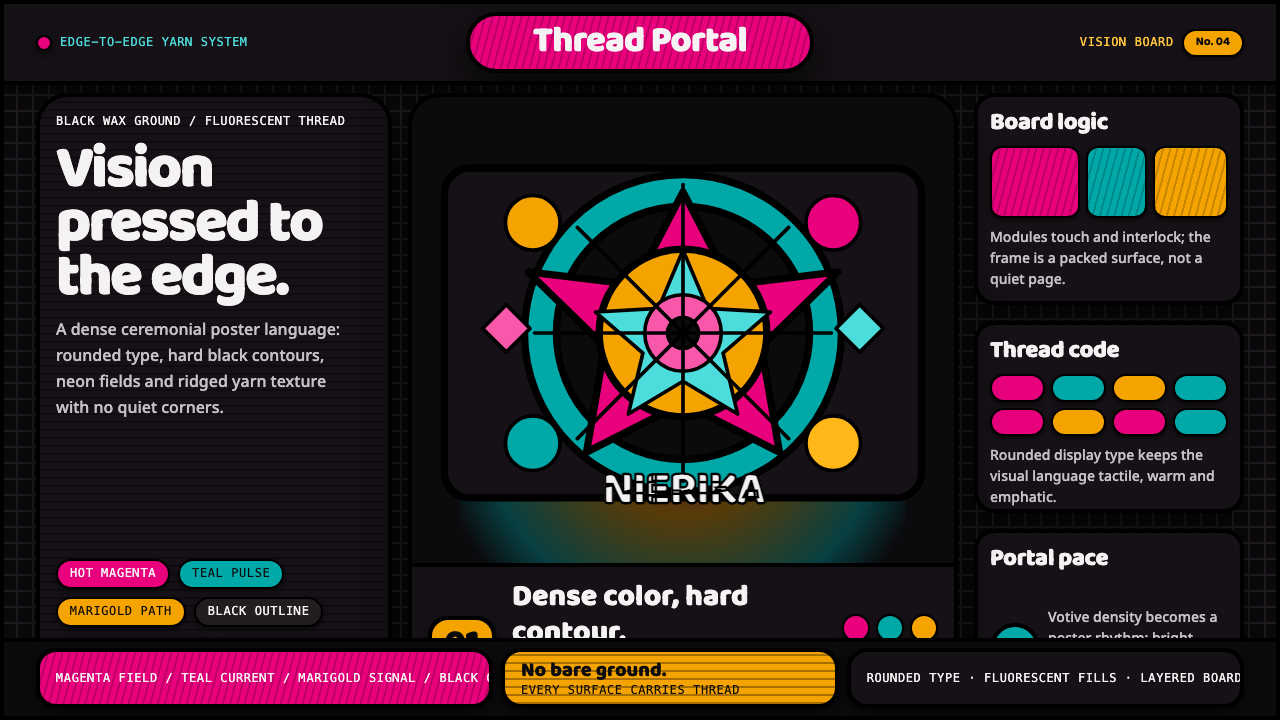 Huichol Yarn NierikaCeremonial density glows. Neon yarn colors lock into black-contoured, edge-to…
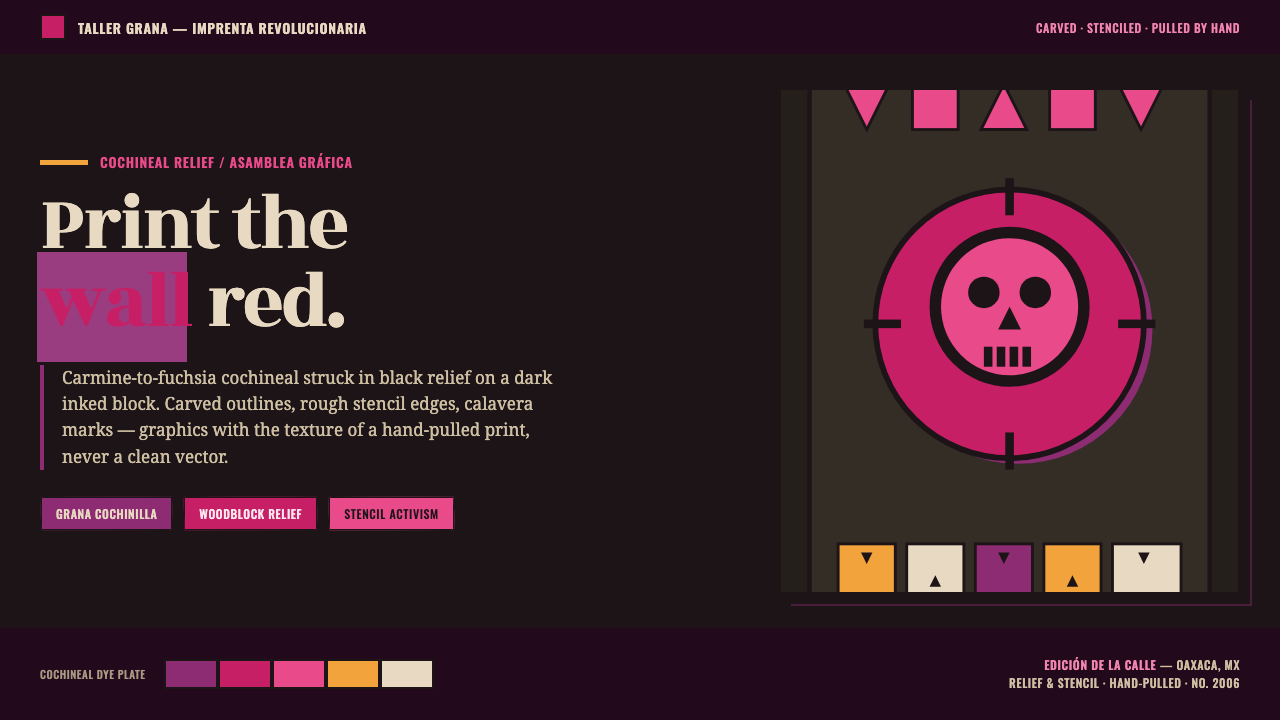 Oaxaca Indigenous-ModernActivist woodblock graphics. Cochineal carmine-fuchsia struck in black relief…
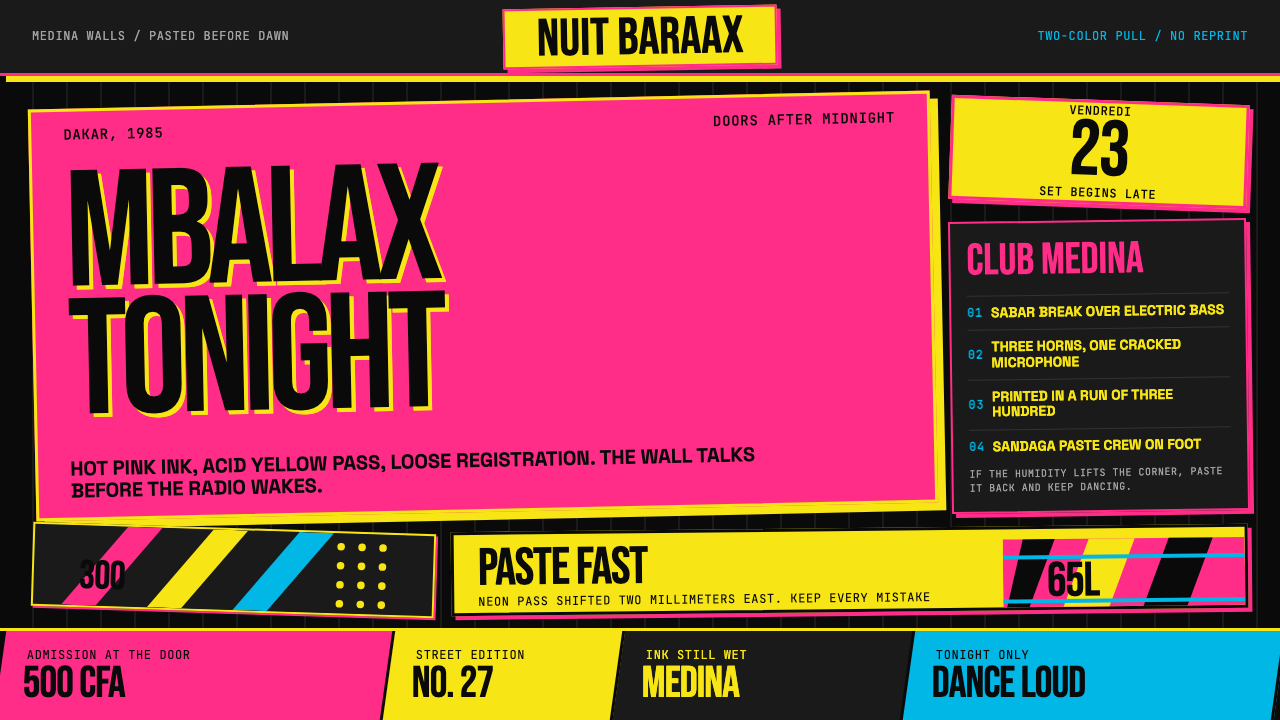 Senegalese Mbalax Poster (Dakar 1985)Street urgency, screen-printed loud. Hot pink and acid yellow drift over blac…
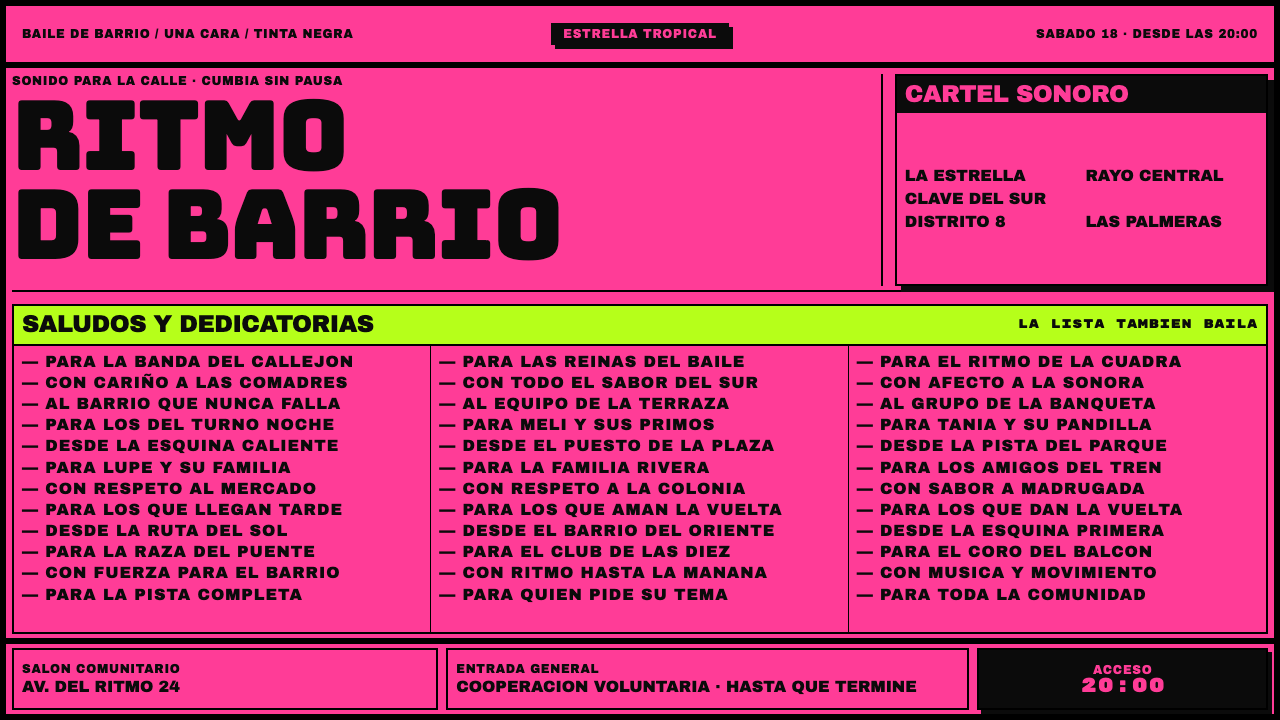 Sonidero FlyerNo quiet size survives here. Black Bungee type and ruled shout-out columns cr…
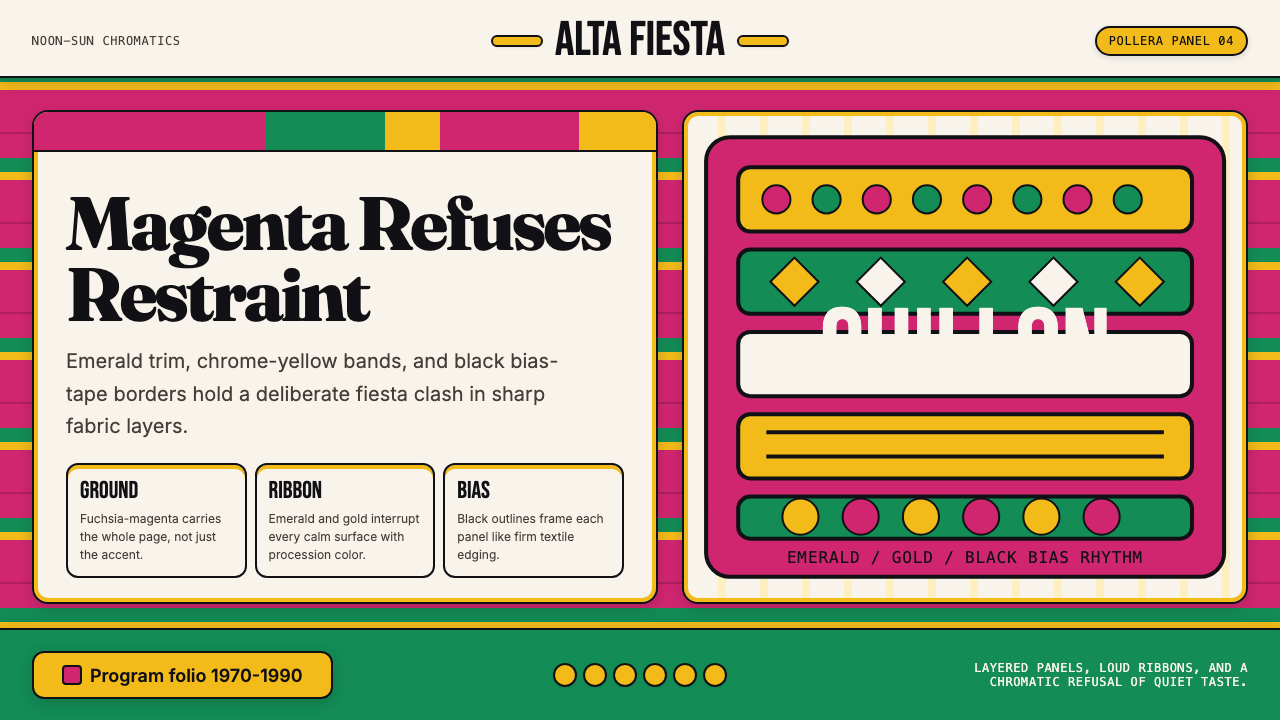 Bolivian Pollera Fiesta MagentaChromatic defiance. Magenta ground, emerald bands and black outlines clash li…
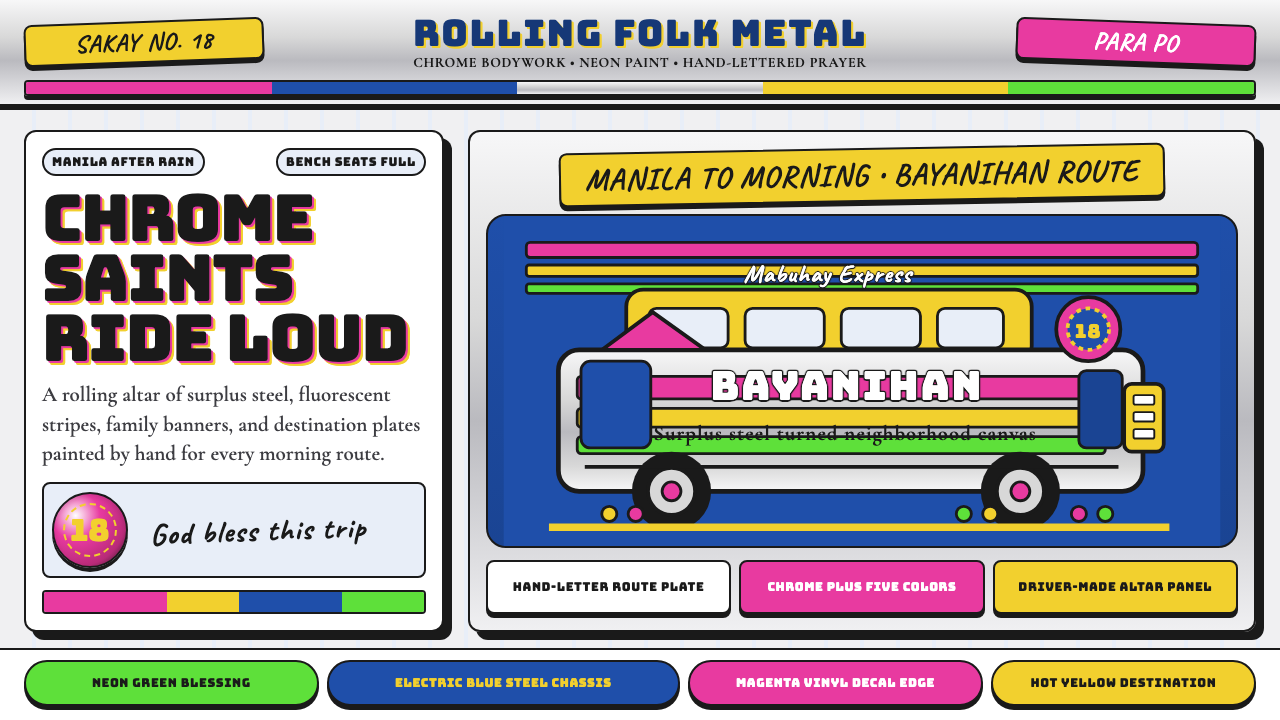 Filipino JeepneyLoud steel, made personal. Chrome gradients carry neon stripes and hand-lette…