What is Filipino Jeepney?
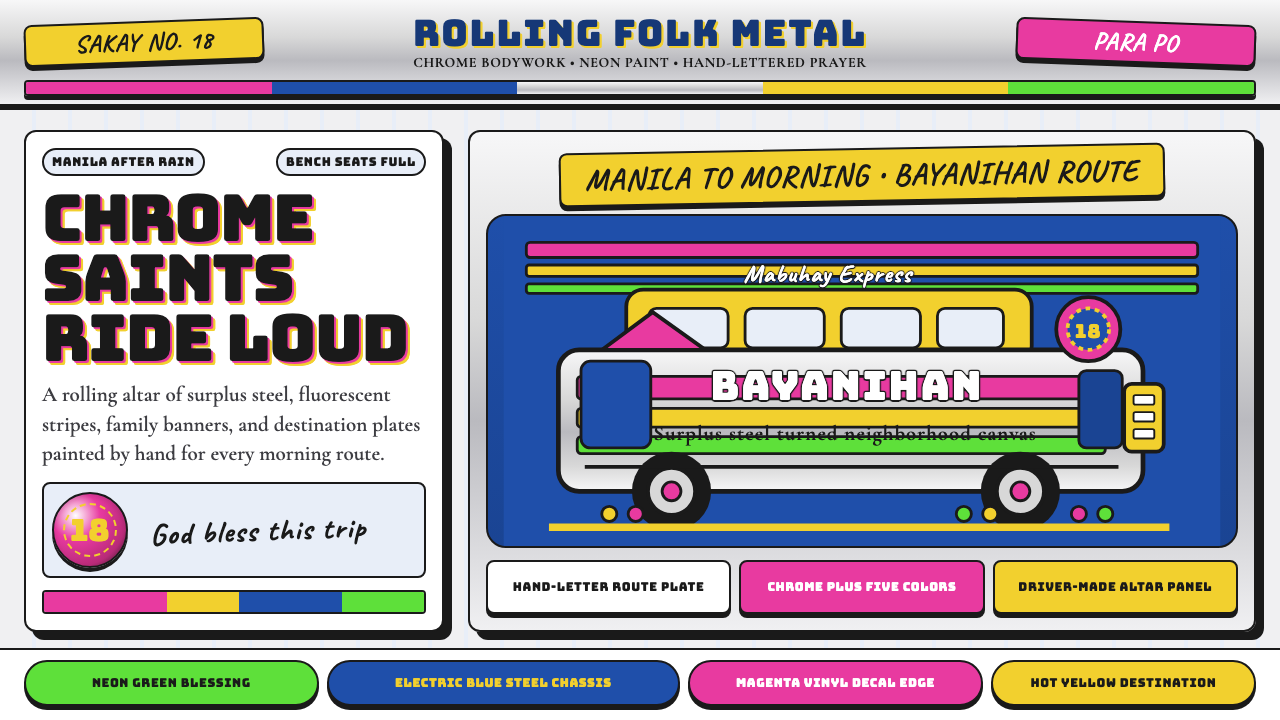
The Filipino jeepney turns a surplus army vehicle into a rolling altar of chrome, neon, saints, and hand-lettered slogans — the loudest folk-art tradition on four wheels.
Filipino Jeepney in brief
The Filipino jeepney is a style of vernacular folk art, public transit vehicle, and living design tradition originating in the Philippines after the Second World War. Rooted in the conversion of surplus US Army jeeps into elongated passenger vehicles, the jeepney aesthetic is defined by unrestrained visual maximalism: chrome-plated bodywork, hand-painted neon stripes, religious iconography, family name banners, pop-culture decals, dangling fringe, and brass bells all compete for attention on a single chassis. Where most design traditions seek coherence through reduction, the jeepney achieves coherence through total accumulation.
As a design system, the jeepney operates on a simple but radical premise: every surface is a canvas, and every centimeter of that canvas must be filled. Chrome silver functions as the metallic base coat that anchors all other color — it catches light, signals craftsmanship, and gives the vehicle a festive shimmer even before any paint is applied. Over that base, drivers and customizers layer three to five vivid brand colors per surface, typically in bold horizontal or diagonal stripes. Hand-lettered destination signs use chunky display lettering for legibility at distance, while painter-script slogans and dedications appear in a looser, more personal hand across bumpers, hoods, and side panels.
Unlike designed systems that emerge from institutions, manifestos, or school movements, the jeepney aesthetic evolved organically from the individual choices of thousands of owner-drivers who were simultaneously operators, commissioners, and curators of their own rolling artworks. No two jeepneys are identical. Each is a personal statement, a micro-biography of its owner's devotions, affiliations, and humor — a practice that places the jeepney squarely within the global tradition of transit-vehicle-as-canvas alongside Mexican lowriders, Indian decorated trucks, and Pakistani jingle trucks.

Where does Filipino Jeepney come from?
The jeepney story begins in 1945, when the United States military withdrew from the Philippines at the end of World War II and left behind thousands of Willys MB and Ford GPW jeeps — the rugged four-wheel-drive vehicles that had served the Allied campaign across the Pacific. Rather than scrap the surplus, Filipino entrepreneurs acquired them cheaply, stripped out the military hardware, lengthened the rear body with welded steel extensions, added two parallel bench seats facing each other, and put them into service as informal shared taxis on Manila's war-ravaged streets. The name jeepney is a portmanteau of jeep and jitney — the American word for a low-cost shared ride.
The visual transformation from military gray to folk-art spectacle happened gradually over the late 1940s and through the 1950s, driven by fierce competition among owner-drivers who needed to distinguish their vehicles and attract passengers. Chrome accessory shops and body fabricators proliferated around Manila's commercial districts, offering increasingly elaborate hood ornaments, side mirrors, and decorative panels. Custom painters developed individual vocabularies of saints, landscapes, animals, and lettering styles. By the 1960s, dedicated jeepney coachbuilders had emerged — most importantly Sarao Motors, founded by Leonardo Sarao in the 1950s in Las Piñas, and Francisco Motors — who began manufacturing purpose-built jeepney bodies rather than converting original military vehicles. These manufacturers established many of the silhouette conventions still recognized today: the long hood, the slatted rear entry, the row of chrome horses or eagles along the roofline.
The golden age of jeepney art is generally placed between the 1960s and the 1990s, when the vehicles were at peak ubiquity and customization reached its most elaborate expressions. Religious iconography dominated the visual program: the Virgin Mary, Santo Niño, and patron saints appeared alongside basketball stars, action heroes, and family portraits. This syncretic mix — Catholic devotion layered over pop culture layered over family pride — reflects the broader character of Filipino visual culture, which absorbed Spanish colonial influence, American mass media, and indigenous craft traditions into a style that is neither purely Western nor purely local but distinctly its own.
The jeepney's cultural prominence has been complicated by practical pressures in the twenty-first century. Manila's notoriously congested traffic, rising fuel costs, and air quality concerns led the Philippine government to launch the Public Utility Vehicle Modernization Program (PUVMP) in 2017, which mandated the phaseout of older, unconverted jeepney models in favor of Euro-4-compliant, more fuel-efficient vehicles. Many of the new replacement vehicles are manufactured modern minibuses and electric jeepneys that lack the hand-fabricated, individually customized character of traditional units. The program sparked significant protests from the transport sector and sparked renewed cultural debate about the jeepney as a national icon — raising questions about whether the design tradition can survive its vehicle's modernization.
What defines the Filipino Jeepney look?
Chrome as Foundation
Chrome plating is the material signature of the jeepney and the layer upon which all other visual decisions rest. Applied to the bumpers, grille, hood ornaments, side mirror housings, roof railings, and decorative horses or eagles running along the roofline, chrome functions simultaneously as preservation coating, prestige signal, and light-catching spectacle. On a bright Manila day, a well-maintained jeepney sends reflections in every direction, announcing itself from a block away. The chrome is not just finish — it is the structural grammar of the form.
Neon Stripe Composition
Jeepney color is organized through bold horizontal, diagonal, or wave-form stripes that divide the vehicle's side panels into distinct chromatic bands. Each stripe band typically carries one saturated color — electric blues, hot pinks, vivid yellows, bright reds, and greens appear with equal frequency and equal intensity. There is no restrained accent palette: all colors are foreground colors. The stripe logic is rooted in practical sign-painting tradition — stripes travel fast and read clearly even on a moving vehicle viewed from the side — but over decades they evolved into an expressive compositional form in their own right.
Hand-Lettered Typography
All text on a traditional jeepney is hand-painted rather than printed or applied as vinyl. Two distinct lettering modes coexist. The first is a bold, upright display hand used for route names and destination labels — these characters are chunky, high-contrast, and sized for legibility at speed. The second is a looser painter-script used for personal slogans, dedications, nicknames, and devotional phrases that appear on bumpers, hoods, and side panels. Phrases like 'God's Gift,' 'Mama's Pride,' or a driver's nickname in elaborate brushwork are common. The coexistence of display and script creates a typographic richness impossible to achieve with any standardized type system.
Syncretic Iconography
The painted imagery that covers jeepney hoods, rear panels, and interior ceilings is a visual archive of Filipino popular devotion and popular culture simultaneously. Catholic saints — particularly the Virgin Mary, the Santo Niño (Holy Child), and regional patron saints — appear alongside basketball stars, comic-book superheroes, local politicians, beauty queens, and beloved actors. The mixing is not considered incongruous by jeepney culture; rather, it reflects a pragmatic and deeply personal view of spiritual and communal life in which all meaningful figures inhabit the same visual field. Each driver selects and arranges this iconographic program personally, making every jeepney a unique devotional and biographical document.
Three-Dimensional Ornament
Beyond paint and chrome, jeepney decoration extends into three dimensions through attached objects: dangling fringe along the interior ceiling edge, plastic rosaries hung from the rearview mirror, miniature altars on the dashboard holding a figurine of a saint flanked by artificial flowers, hood ornaments in the form of chrome horses, eagles, or antlered deer, and brass bells mounted on the front bumper that ring as the vehicle moves. These physical additions transform the jeepney from a painted surface into a sensory environment — one that engages touch and hearing as well as sight. The three-dimensional ornament is inseparable from the aesthetic; a jeepney without fringe and bells is considered visually incomplete.
Saturated Maximalism
The governing aesthetic principle of the jeepney is maximalism: the deliberate refusal of empty space, visual hierarchy, or restraint. Unlike design traditions that treat negative space as a compositional tool, jeepney aesthetics treat unpainted or undecorated surfaces as aesthetic failures — evidence of incompleteness rather than discipline. Colors at full saturation, forms at maximum density, iconographic programs at greatest possible variety: these are the aspirations. The result is a visual texture more akin to a mosaic or a decorated altarpiece than to anything produced by the formal design disciplines of the twentieth century. This maximalism is not carelessness; it is a coherent and intentional philosophy of abundance.
Unique Identity as Norm
In most vehicle design traditions, standardization is the goal — identical units that roll off a production line. The jeepney tradition inverts this logic entirely. Standardization is failure; individuality is the measure of quality. A jeepney that looks like another jeepney has not been properly cared for. The owner-driver's obligation is to commission a vehicle that reflects their specific identity — regional origin, family name, religious devotion, favorite athlete, lucky color — and to maintain and update that visual program over the vehicle's life. This norm of obligatory individuality gives the Philippine streetscape its characteristic visual density, where no two vehicles in a line share the same visual character.

Who shaped Filipino Jeepney?
Sarao Motors, founded by Leonardo Sarao in Las Piñas in the 1950s, became the most iconic jeepney manufacturer in Philippine history. Sarao did not merely convert military vehicles — he developed a purpose-built jeepney body with a distinctive long hood, rear entry with steps, and a standardized chrome ornament rail along the roofline. His factory-made bodies were then handed to individual painters and fabricators for their unique visual programs, making Sarao the structural chassis beneath thousands of individually distinct artworks. The Sarao jeepney silhouette became so familiar that it served as a visual shorthand for the Philippines internationally, appearing on tourist materials and national identity imagery throughout the latter half of the twentieth century.
Francisco Motors emerged alongside Sarao as one of the two dominant coachbuilders of the classic jeepney era. Where Sarao's aesthetic leaned toward rounded, organic forms with heavy chrome ornamentation, Francisco vehicles were notable for slightly more angular bodywork that offered different compositional possibilities for painters and decorators. The rivalry and variety between these two major manufacturers helped establish the range of jeepney body types that painters, chrome workers, and accessory fabricators learned to work with, creating a ecosystem of related craft trades that sustained the jeepney art form throughout its golden age.
Sonny Yabao represents the generation of master jeepney painters who elevated the vehicle's decoration from simple sign-painting into a recognized folk-art practice. Painters of Yabao's generation developed the full iconographic vocabulary of the classic jeepney: the layered landscape backgrounds, the saint portraits rendered with devotional care, the lettering systems that could accommodate both formal destination text and personal dedications within a unified visual field. Their work was not executed from drawings or templates but improvised directly on the vehicle surface, making each completed jeepney a site-specific and unrepeatable artwork.
Wig Tysmans is a Belgian-Filipino artist and documentarian who spent decades photographically archiving the jeepney art tradition at a time when it was already beginning to face pressure from modernization. Tysmans's sustained attention to the vehicles as art objects — rather than merely as transportation — helped establish the critical and scholarly framework through which the jeepney came to be discussed as a serious vernacular art form rather than simply a colorful curiosity. His archival work has become a crucial resource as many of the vehicles he photographed have since been retired or destroyed.
The National Commission for Culture and the Arts in the Philippines has played a significant institutional role in framing the jeepney as a national cultural heritage object rather than merely a transport vehicle. Through exhibitions, documentation projects, and advocacy in the context of the PUV Modernization Program debates, the NCCA helped articulate a public argument for preserving not just individual vehicles but the entire artisanal ecosystem — the painters, chrome fabricators, and accessory makers — whose collective practice sustains the tradition. This institutional recognition placed the jeepney alongside more formally acknowledged Philippine folk arts in the national cultural inventory.
How do you use Filipino Jeepney today?
Applying the jeepney aesthetic to contemporary design work requires understanding its core operating principle: saturation is not a mistake to be corrected but the intended state. Where most design traditions ask you to subtract until only what is necessary remains, jeepney-inspired work asks you to add until every zone of the composition carries visual energy. This is a legitimate and coherent design philosophy, but it demands discipline of a different kind — the discipline of curation within abundance rather than curation through reduction.
For presentation slides, the jeepney style works most powerfully on cover and section-divider pages, where maximalist visual impact is appropriate and the requirement for sustained legibility is low. A jeepney-inspired cover might layer a bold stripe composition in three or four saturated colors behind a title set in a chunky, high-contrast display hand, with a metallic or chrome-toned accent element anchoring one edge. Content slides require more restraint: adopt the stripe logic for color coding — one vivid color per data series or content category — while keeping body text on a clean light ground. Data slides can treat bars, segments, and indicators as bold chromatic forms in their own right, using the jeepney palette's electric blues, pinks, and yellows to differentiate categories at a glance.
For web interfaces, the jeepney aesthetic is most coherent on pages designed for celebration, cultural storytelling, or brand identity rather than transactional utility. A landing page or campaign microsite can carry full stripe backgrounds, hand-lettered-style display headings, and richly decorated section breaks without sacrificing usability. For dashboards or product interfaces where cognitive load matters, translate the jeepney visual language more selectively: use saturated color accents for status indicators and calls to action, reserve the stripe motif for header zones or navigation bars, and keep data-dense areas on neutral grounds. The goal is evocative warmth and visual energy, not overwhelming the user's ability to process information.
For editorial and marketing work, the jeepney style lends itself to event promotion, cultural campaigns, festival programs, and any context where exuberance is appropriate. A jeepney-inspired poster or event flyer uses the full chromatic range without apology, pairing bold display lettering with layered stripe backgrounds and decorative motifs drawn from the folk-art vocabulary — fringe, rosette, pennant, sun-burst. Print applications benefit from the style's inherently high-contrast nature, which ensures legibility even on inexpensive paper stock. For marketing materials aimed at broad audiences, the style signals authenticity, community, and hand-made warmth — positioning values distinct from the polished anonymity of corporate minimalism.
A common mistake when applying the jeepney aesthetic is confusing maximalism with randomness. The visual program of a real jeepney is not chaotic — it is densely ordered, with clear compositional bands, consistent stripe logic, and a unified color family per vehicle even if that family is large. The error to avoid is throwing disparate visual elements together without a governing logic and calling it jeepney-inspired. The authentic tradition has strong compositional bones beneath its exuberant surface: stripes run parallel and purposeful, lettering styles cohere within each register, and iconographic elements are sized and placed with deliberate care. When adapting this style, identify your visual hierarchy first, then fill it with intensity rather than abandoning hierarchy altogether.

Filipino Jeepney — FAQ
Is the jeepney aesthetic the same as maximalism?
Maximalism is the broader category; the jeepney is a specific and culturally rooted instance of it. Not all maximalism looks like a jeepney. What distinguishes the jeepney tradition is not just the density of visual elements but the particular combination of materials and motifs: chrome as structural base, bold stripe composition, hand-lettered typography, Catholic and popular iconography, and three-dimensional physical attachments. Contemporary maximalism in branding or editorial design may share the density principle without sharing any of these specific visual vocabularies. When applying the style, it is worth being clear about which level you are working at — the general principle of abundance, or the specific Filipino visual tradition.
Can the jeepney style work for a professional or corporate brand?
It can, but it requires careful translation. The full jeepney vocabulary — every surface packed with iconography, physical ornament, multiple typefaces, and six saturated colors — is not appropriate for most corporate applications where authority, clarity, and trust are primary signals. However, specific elements of the tradition translate well: the bold stripe motif as a structural device, the chromatic energy of the palette applied selectively to calls to action or brand moments, and the hand-lettered warmth as a counterpoint to corporate anonymity. Cultural institutions, food brands, festival organizers, and lifestyle companies can draw more directly from the tradition. Finance, healthcare, and legal brands should treat it as a tone reference — energetic, warm, communal — rather than a direct visual vocabulary.
How does the jeepney tradition differ from other decorated vehicle traditions like Indian trucks or Pakistani jingle trucks?
All three traditions share the transit-vehicle-as-canvas premise and a commitment to individual expression through decoration, but they diverge significantly in visual vocabulary and cultural logic. Indian decorated trucks tend toward symmetrical compositions, floral and geometric patterns derived from textile traditions, and hand-painted pictorial scenes of religious or heroic narrative. Pakistani jingle trucks share the name with the jeepney bell tradition but feature heavily carved wooden panels, mirror-work, and elaborate calligraphic lettering drawn from the Islamic decorative tradition. The jeepney is distinctive in its chrome-dominant material base, its bold diagonal stripe logic, its syncretic Catholic-pop iconography, and its particular hand-lettering register. Knowing these distinctions matters when applying the style — borrowing from one tradition while labeling it another produces culturally imprecise work.
Does using the jeepney aesthetic require cultural sensitivity?
Yes, and for reasons that go beyond general good practice. The jeepney is not just a visual style — it is tied to the livelihoods and cultural identity of a specific community of Filipino owner-drivers and artisans whose tradition is currently under pressure from modernization policies. Using the aesthetic in ways that reduce it to a decorative surface — ignoring its meaning as a living practice of personal devotion, communal identity, and economic survival — risks the kind of cultural flattening that often accompanies the adoption of folk traditions by mainstream design. The most respectful approach acknowledges the source, understands something of the tradition's history and present challenges, and applies the vocabulary with genuine rather than superficial understanding. Crediting the Philippine folk tradition explicitly in design documentation is a minimum standard.
What happens to the jeepney tradition as modernization replaces the vehicles?
This is an open and actively debated question in the Philippines. The PUV Modernization Program has accelerated the retirement of the hand-fabricated jeepney body in favor of factory-produced electric and Euro-compliant models. Some manufacturers and customizers have attempted to adapt — applying paint and chrome decoration to the new vehicle forms — but the new chassis and body shapes resist the decorative logic developed for the original jeepney silhouette. The artisanal ecosystem that supported the tradition — the body fabricators, chrome shops, and sign painters who trained specifically to work on jeepney surfaces — is itself at risk of dissolution. Cultural institutions, researchers, and diaspora communities outside the Philippines have taken on archival roles. Whether the aesthetic survives as a living practice or migrates into museum collections, graphic design reference, and diaspora cultural identity remains to be determined by choices being made now.
Related design styles
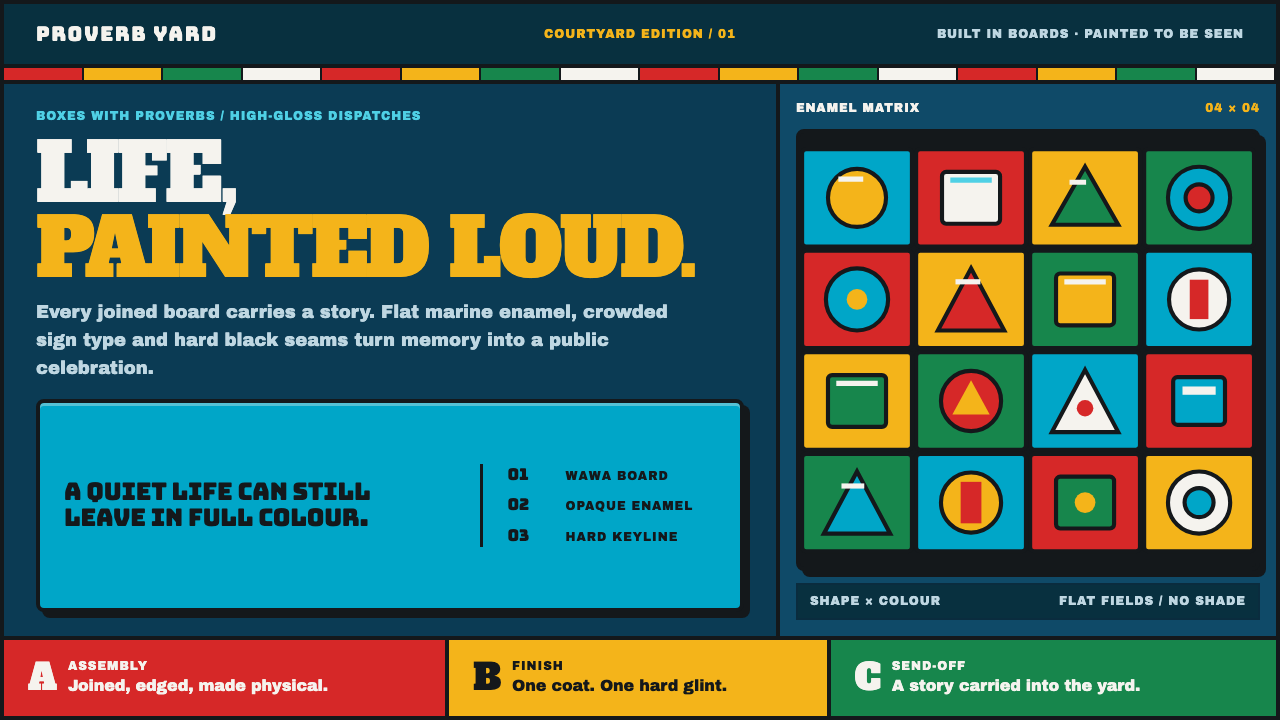 Ga Fantasy CoffinMemory refuses to whisper. Marine enamel, fat sign type and hard black seams…
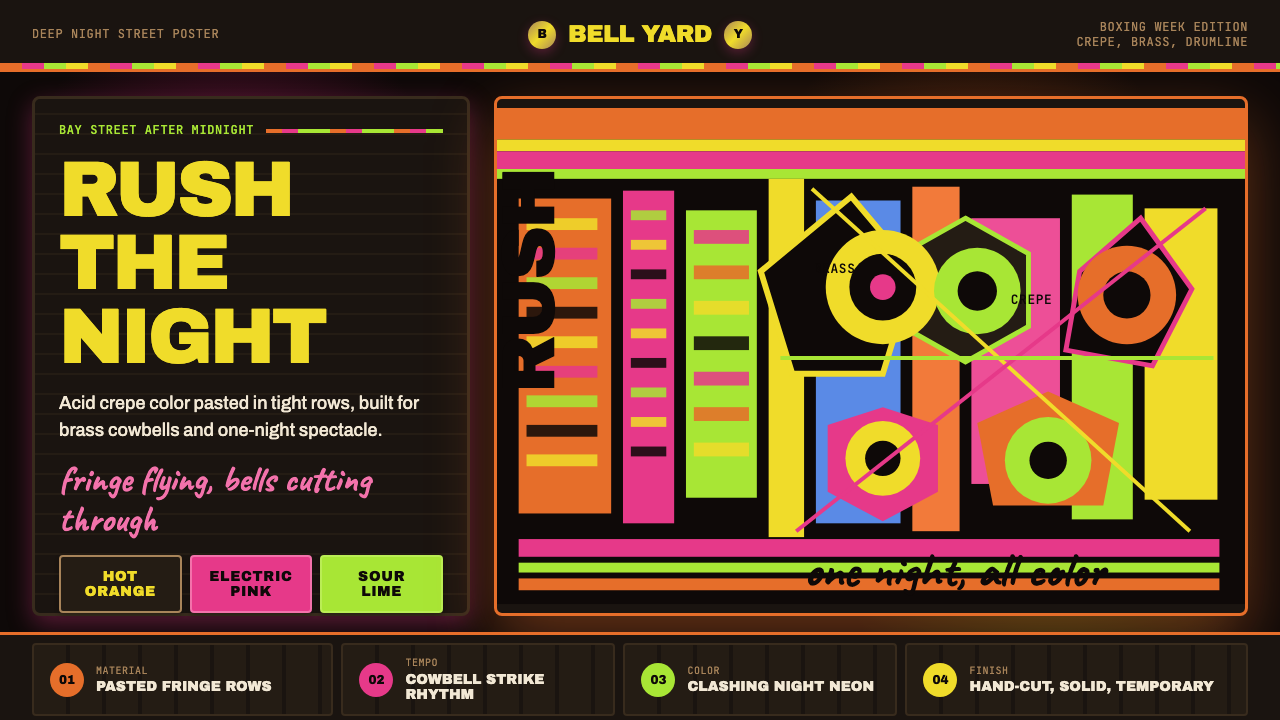 Bahamian Junkanoo CowbellNight refuses silence. Acid crepe stripes and block type collide like cowbell…
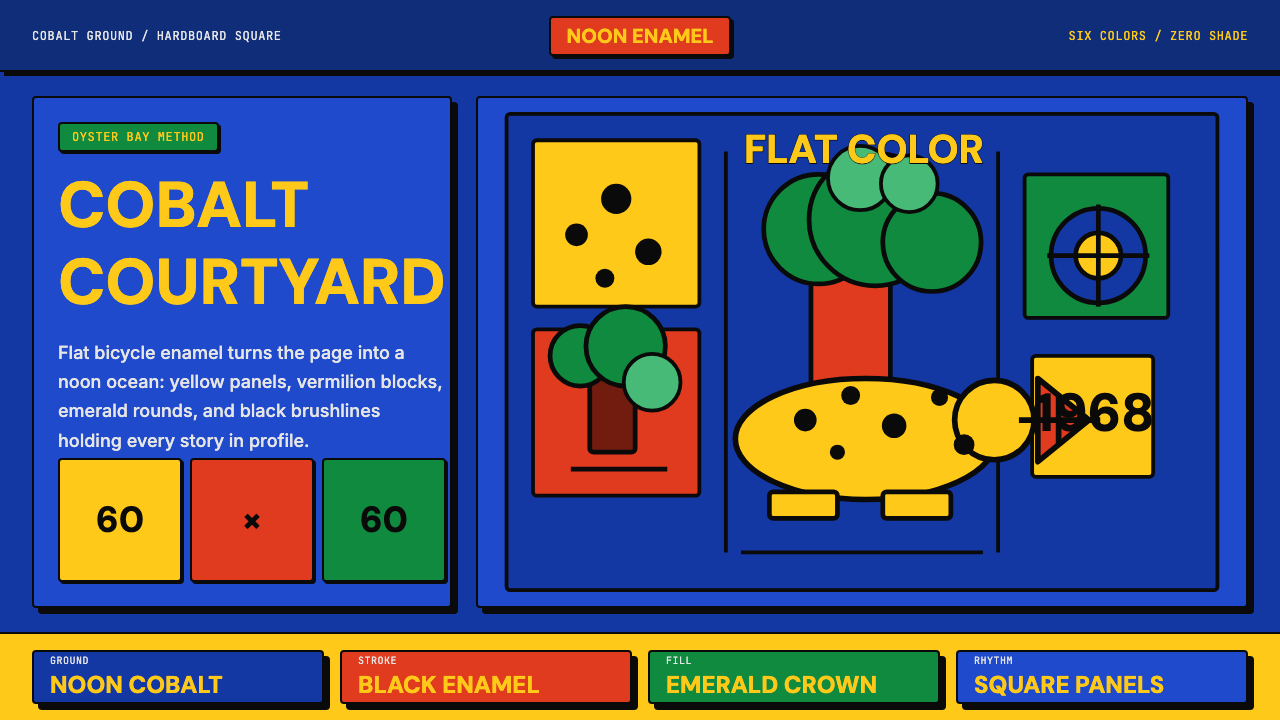 Tanzanian Tingatinga on Cobalt Canvas (1968)Cobalt sings flat. Yellow, vermilion and emerald panels snap under black enam…
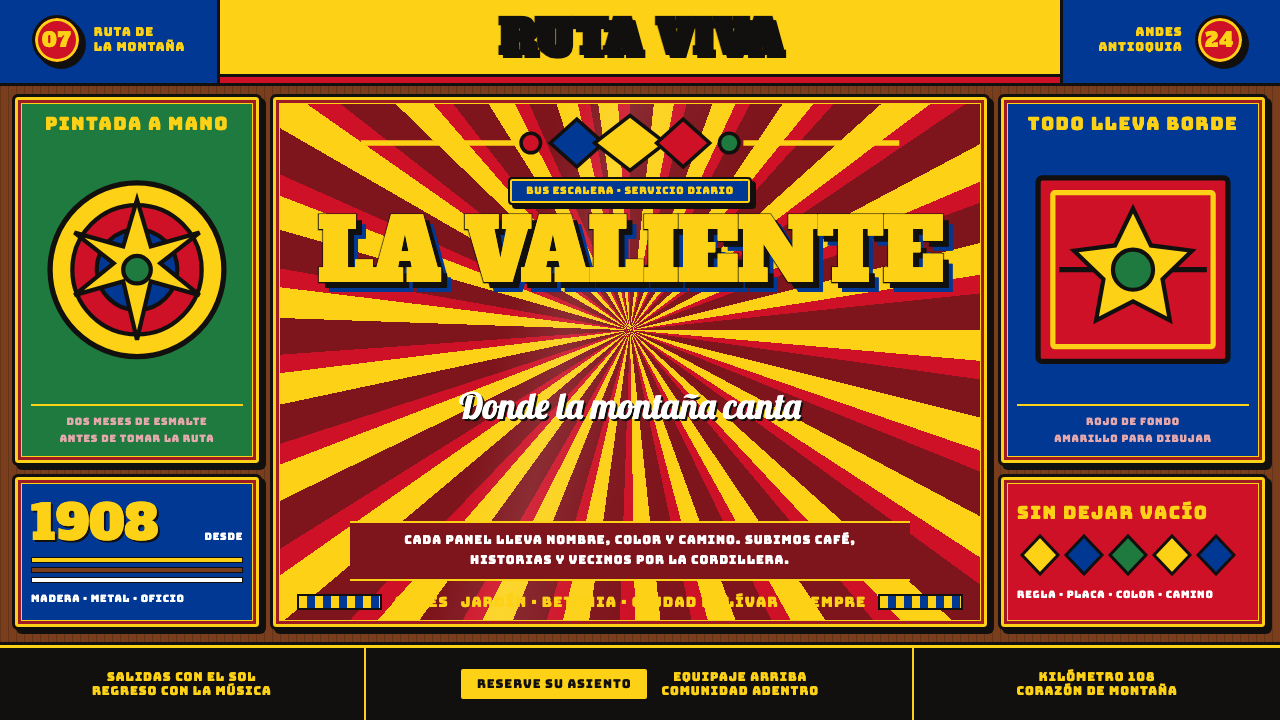 Colombian Chiva BusNothing is left unpainted. Flag-yellow rules, slab lettering and black keylin…
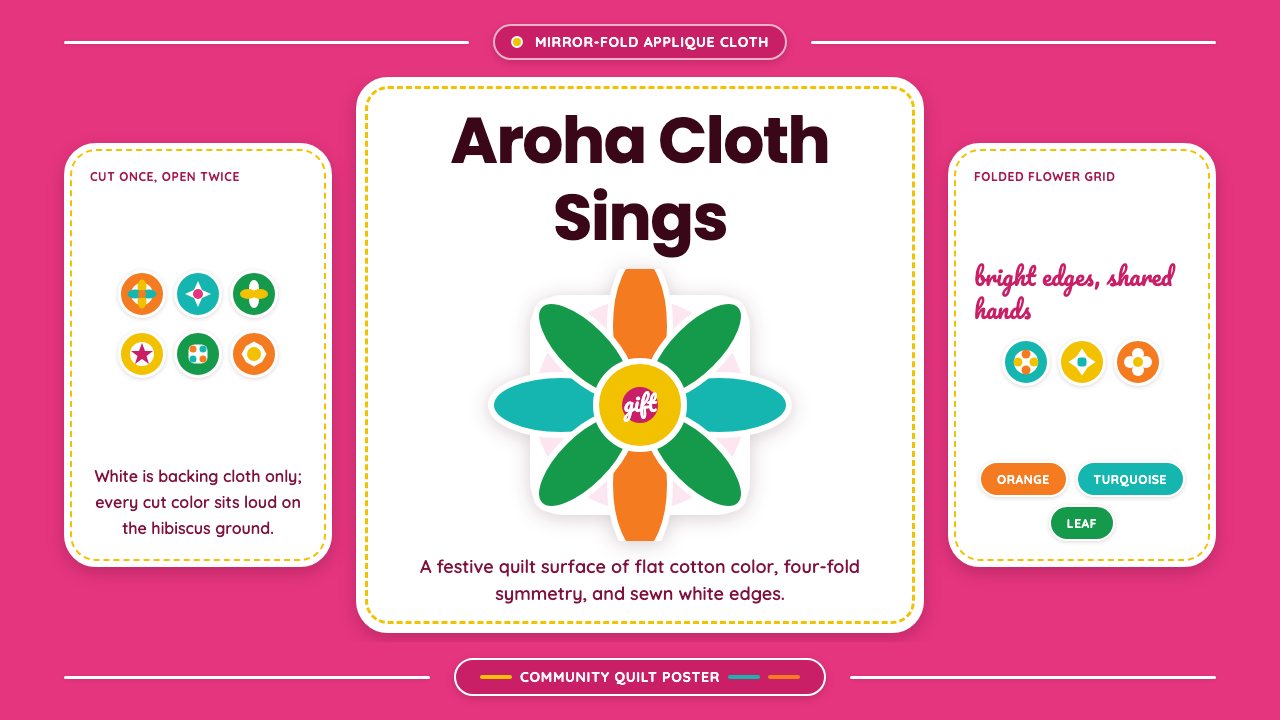 Cook Islands TivaevaeSaturated craft sings. Hibiscus pink carries mirror-fold florals in flat appl…
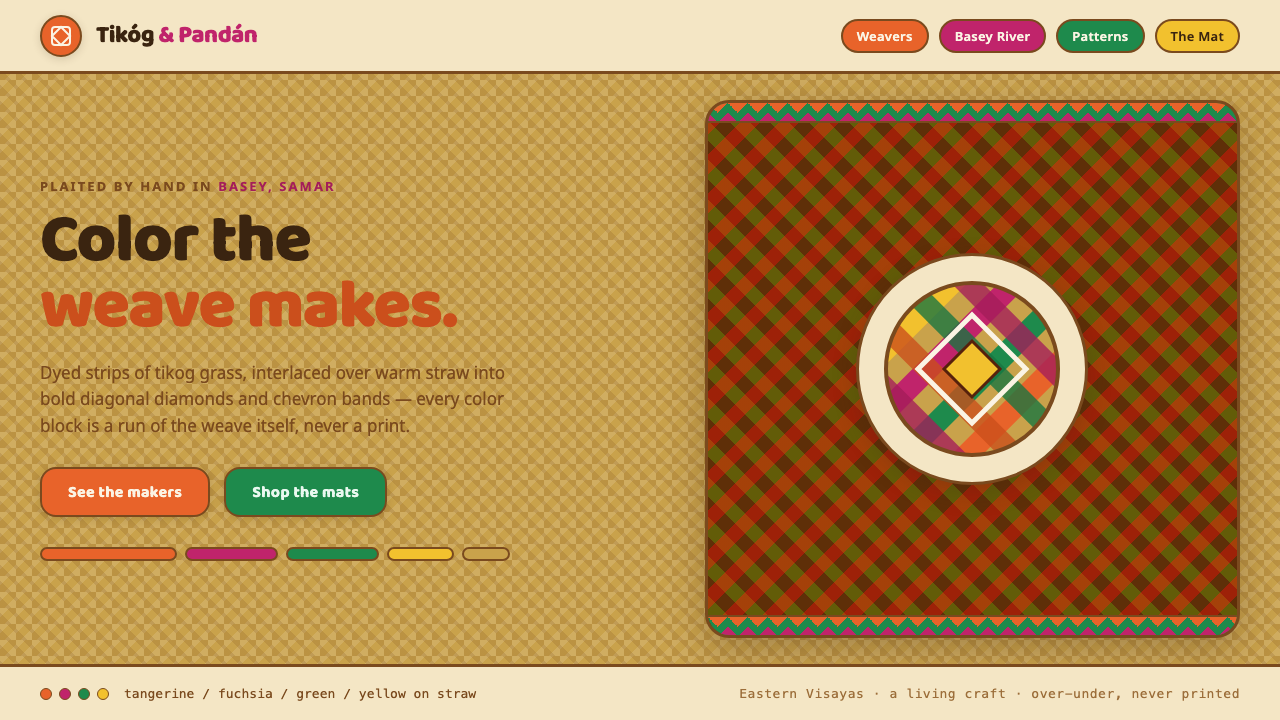 Banig Pandan MatHandwoven Filipino joy. Tangerine, fuchsia and green strips plaited into diag…