What is Bahamian Junkanoo Cowbell?
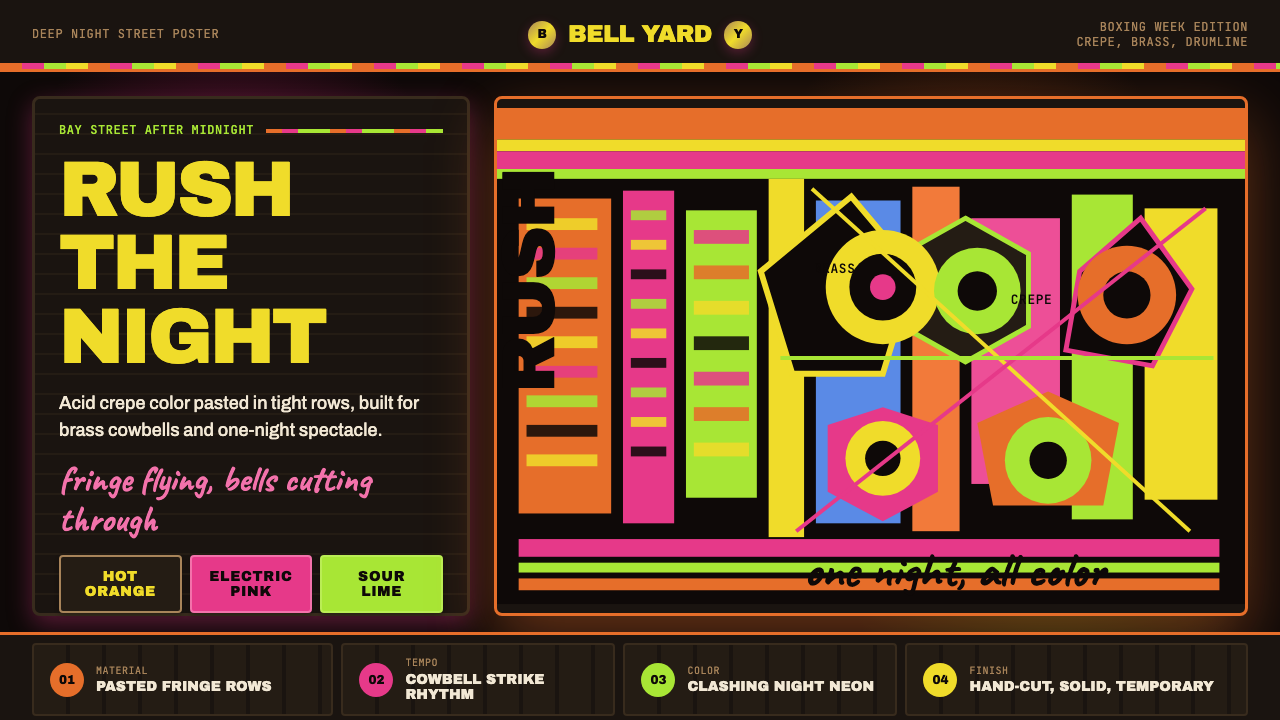
Junkanoo burns through the Bahamian night in acid-bright crepe and goatskin thunder — a street parade that became one of the Caribbean's most electrifying visual languages.
Bahamian Junkanoo Cowbell in brief
Bahamian Junkanoo Cowbell is a design system rooted in the visual spectacle of the Junkanoo parade — the Bahamas' defining cultural event, held annually on Boxing Day and New Year's Day on Bay Street in Nassau. The aesthetic is built from the materials and energy of the parade itself: towering costumes assembled from thousands of hand-cut crepe paper strips, illuminated against a deep night sky, pulsing to the rhythms of goatskin drums, brass horns, and the inimitable clang of the cowbell. The design system channels this kinetic energy into a graphic language that is simultaneously celebratory, bold, and unmistakably Bahamian.
At its core, the Junkanoo Cowbell visual system is organized around an explosive palette of acid-bright colors — hot orange, electric pink, sour lime green, and screaming yellow — layered heavily against a near-absolute black ground. This is not the restrained use of accent color; it is saturation used as a statement of cultural pride and communal joy. The darkness of the base field is essential: it mirrors the parade's nighttime context and makes the chromatic fireworks of each hue all the more blazing. Where other festive design traditions reach for warmth and daylight, Junkanoo insists on the electric charge of color against darkness.
The texture vocabulary of the system is equally distinctive. Dense, fringed, layered surfaces — referencing the crepe paper pasted strip by strip onto parade costumes over weeks of labor — create an impression of material richness and handmade intensity. Geometry in the Junkanoo system is bold and hand-cut in character: angular chevrons, stylized masks, repeated diamond forms, and radiating fan shapes drawn from the silhouettes of costume headdresses. This is folk geometry, exuberant and slightly imprecise, never the cold exactitude of modernist systems.
Where does Bahamian Junkanoo Cowbell come from?
The roots of Junkanoo reach back to the plantation era of the Bahamas, with the earliest documented references dating to the early eighteenth century. Enslaved Africans in the Bahamas were permitted brief periods of freedom around Christmas, during which they took to the streets in masked procession, drumming, dancing, and celebrating in ways that drew on West African cultural memory — masquerade traditions, rhythmic percussion, communal movement. The name itself is contested; some scholars trace it to 'John Canoe,' a West African trader and folk hero whose spirit of defiance and celebration persisted across the Atlantic passage.
After emancipation in 1834, Junkanoo continued as a free celebration, gradually becoming more elaborate and more openly competitive. The goatskin drum — the foundational Junkanoo percussion instrument — provides the parade's driving heartbeat, while the brass cowbell, played with a stick against the bell's body, creates the piercing, syncopated clang that defines the soundscape. By the late nineteenth century, Junkanoo had become embedded in Bahamian popular culture, despite periodic attempts by colonial authorities to suppress it as a public nuisance.
The modern competitive format of Junkanoo was formally organized in 1947, when the parade was restructured around competing groups — 'rushes' — judged on music, costume, and choreography. This competitive framework transformed Junkanoo from a spontaneous street celebration into an organized art form requiring months of preparation. Costume-making became a specialized craft practiced by large groups in secret 'shacks' throughout the year, with the final compositions — sometimes reaching four meters in height and weighing over thirty kilograms — unveiled only at parade time. The secrecy intensified community bonds and the drama of the reveal.
The visual language of Junkanoo has been formalized and celebrated by a generation of Bahamian artists and designers. Jackson Burnside, one of the most influential Bahamian designers and architects of the twentieth century, drew deeply on Junkanoo's color relationships and geometric sensibility in his work, arguing that the parade represented a uniquely Bahamian contribution to world visual culture. E. Clement Bethel, a scholar and composer, documented and theorized the musical structures of Junkanoo, helping elevate it from folk entertainment to recognized cultural heritage. Today Junkanoo is listed among the UNESCO Intangible Cultural Heritage of Humanity candidates and is recognized as the defining expression of Bahamian national identity.
What defines the Bahamian Junkanoo Cowbell look?
Color
The palette is organized around extreme chromatic intensity: acid orange, electric pink, sour lime, and screaming yellow are the primary actors, all deployed against a deep night black that functions as the composition's absolute ground. The relationship between hue and ground is confrontational by design — there is no tonal softening, no gradient fade, no neutral buffer zone. Colors are given full presence and expected to vibrate against one another. This is saturation as cultural declaration, not decoration.
Texture and Layering
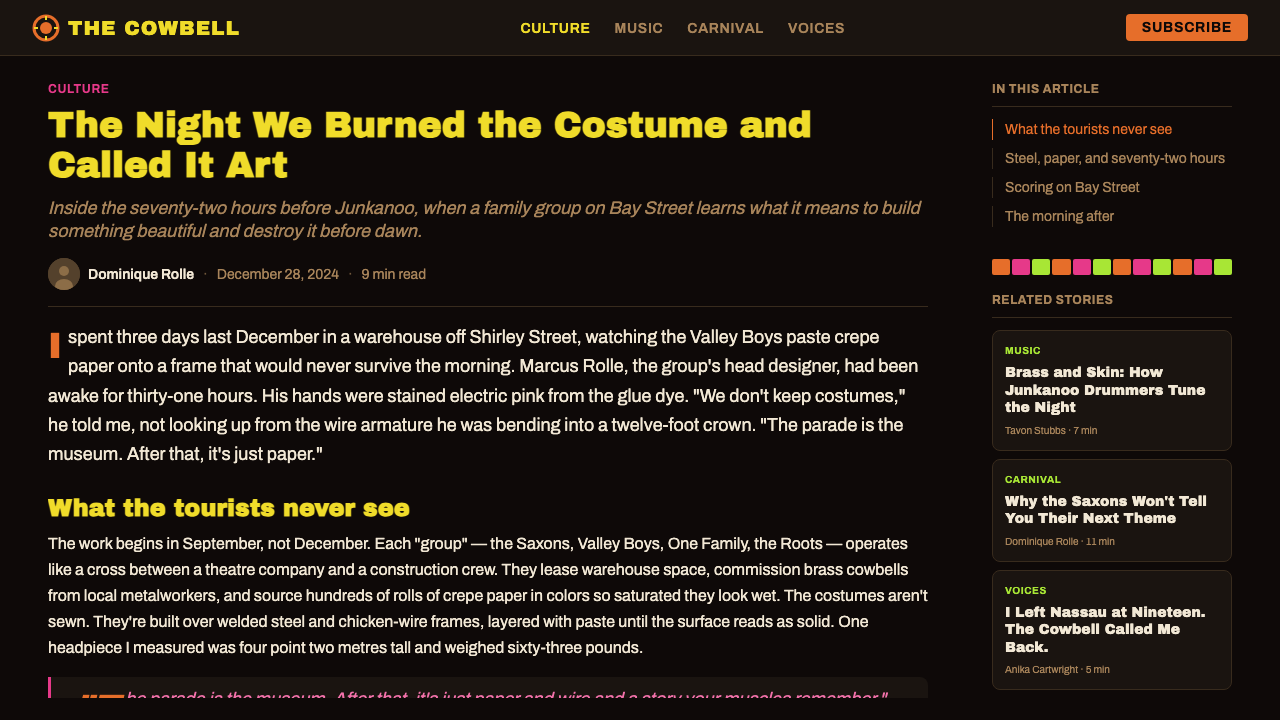
Dense, fringed, and layered surface treatments are central to the system's identity, directly referencing the crepe paper construction technique of Junkanoo costumes. Strips of material — real or implied — overlap in tight, rhythmic patterns that create visual density and a sense of accumulated labor. This layered quality distinguishes the system from other bold, high-contrast aesthetics: the surface always reads as something built by hand, over time, by many people working together.
Geometry
The geometric vocabulary draws from the silhouettes of Junkanoo headdresses and costume components: radiating fan forms, chevrons, diamond arrays, stylized mask shapes, and starburst patterns that suggest movement and percussion. These are not the pure, mathematically defined forms of modernist geometry — they carry the slight irregularity of hand-cut craft, a quality that keeps the system warm and alive rather than mechanical and cold.
Typography
Type in the Junkanoo system is heavy, condensed, and block-like — letterforms that can stand against the visual noise of a densely textured background without collapsing. The weight of the type matches the weight of the palette: there is no place for delicate serifs or airy letterforms when the surrounding composition is this saturated. All-caps settings are common, reinforcing the proclamatory, banner-like quality of street parade signage.
Darkness as Ground
Unlike most festive or tropical design aesthetics that use light or white grounds, the Junkanoo system places deep black at the foundation of every composition. This is not a dark mode adaptation — it is the defining condition. The night is the parade's stage, and all color relationships in the system are calibrated to perform against absolute darkness. Removing the dark ground and placing the palette on white fundamentally changes the character of the aesthetic, draining it of its electric intensity.
Rhythm and Repetition
The system's compositional logic is rhythmic rather than hierarchical. Repeated motifs — strips of color, geometric units, fringe elements — march across surfaces in patterns that evoke the parade's processional movement and the insistent beat of the cowbell. This repetition creates visual momentum: compositions do not resolve into a single focal point but sustain energy across the entire field, demanding the eye move rather than rest.
Folk Craft Heritage
The system carries a deliberate acknowledgment of its handmade origins. Edges are not always perfectly sharp; patterns have the organic variation of cut paper rather than the mechanical precision of vector perfection. This folk-craft quality is not a deficiency — it is the system's primary claim to authenticity and cultural specificity. Overly slick or digitally perfect applications of the aesthetic risk losing the communal warmth that is the style's deepest characteristic.
Who shaped Bahamian Junkanoo Cowbell?
Jackson Burnside (1952–2010) was the most internationally recognized Bahamian architect and visual artist of the late twentieth century. Trained in the United States and deeply influenced by the color relationships he observed in Junkanoo from childhood, Burnside made the parade's aesthetic principles — explosive color contrast, geometric boldness, the pride of Bahamian craft traditions — central to both his architectural practice and his graphic work. He designed the official Bahamian Independence celebration imagery and argued publicly that Junkanoo was not folk entertainment but high visual art, a position that helped legitimize the parade's cultural standing internationally.
E. Clement Bethel (1938–1986) was a Bahamian composer, educator, and cultural scholar whose systematic documentation of Junkanoo music transformed the way the parade was understood. His research into the rhythmic structures of the goatskin drum and cowbell patterns — and his argument that these structures constituted a sophisticated, internally consistent musical system — provided the intellectual foundation for Junkanoo's recognition as serious art. Bethel's work influenced both official Bahamian cultural policy and the design community's respect for the parade's visual discipline.
Eric Gibson is one of the most celebrated contemporary Junkanoo costume designers, having led major Nassau rush groups to repeated championship victories. His approach to costume construction elevated Junkanoo's visual complexity to a new level: multi-story architectural structures covered in precisely cut and layered crepe paper, with chromatic progressions across the surface that reward close examination. Gibson's work demonstrates that Junkanoo costume design is a serious discipline of spatial composition and material mastery, directly analogous to high-stakes craft in other visual art forms.
Cathleen Casebier-Saunders is a Bahamian artist and cultural advocate who has worked to bring Junkanoo's visual vocabulary into fine art and institutional contexts, exhibiting work that explores the relationship between the parade's geometric forms and the broader history of Caribbean visual culture. Her practice raises questions about how folk and festive aesthetics are categorized, displayed, and valued by international art institutions, and argues for Junkanoo's place in conversation with other globally recognized forms of community-based visual art.
How do you use Bahamian Junkanoo Cowbell today?
Junkanoo Cowbell is one of the most directionally specific design systems in the library — it has a strong point of view that should be applied with commitment rather than used as a general tropical or festive flavor. The system works best when the subject matter genuinely calls for exuberance, cultural pride, communal celebration, or nighttime energy. Brands and products that have a legitimate connection to Caribbean culture, Afro-diasporic heritage, street festival aesthetics, or bold nightlife contexts will find the most natural fit.
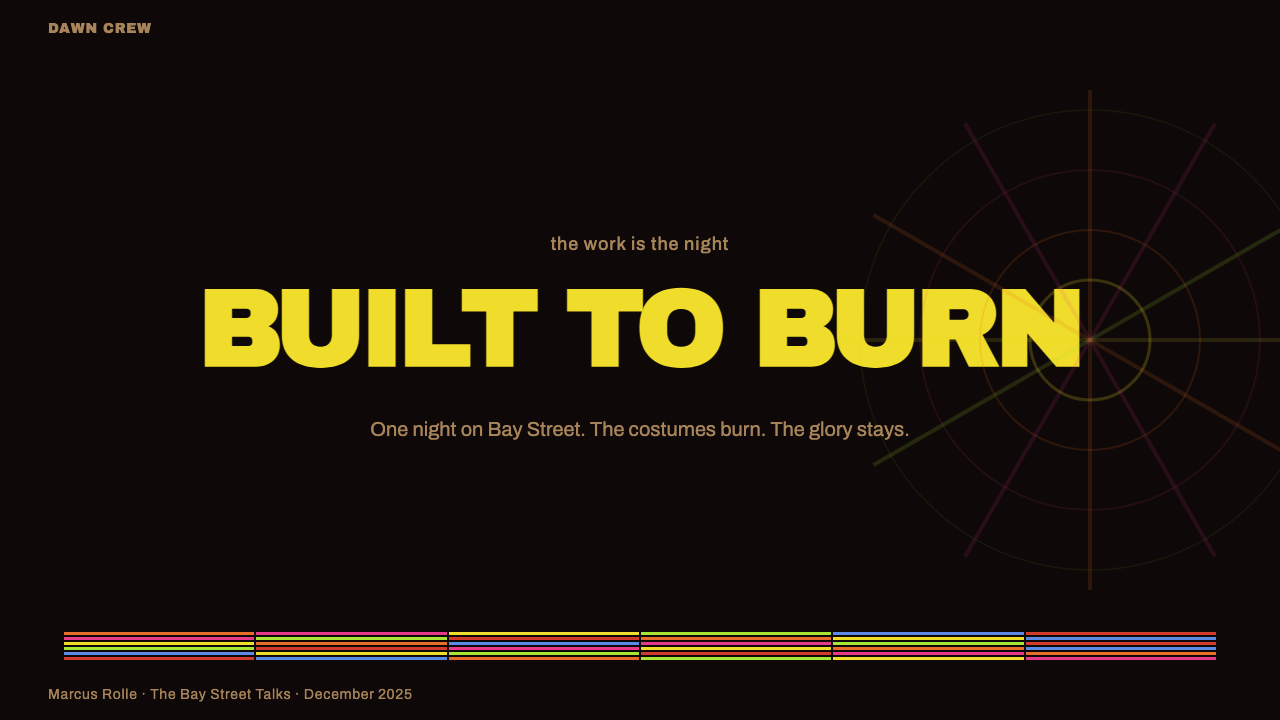
For presentation slides, the system excels on cover pages and section dividers where visual impact is the primary goal. A cover composition works by placing a large geometric headdress form or fringe pattern in one or two of the acid bright hues against the deep black ground, with the title in heavy block type at maximum contrast. Content slides require more restraint: use the black ground consistently, limit each slide to one or two accent colors, and let the dark field carry the weight rather than filling every surface with competing hues. Data slides can use the palette's yellow or orange for the primary data series, with the remaining color reserved for callouts or alerts — the high contrast against black makes charts exceptionally readable at distance.
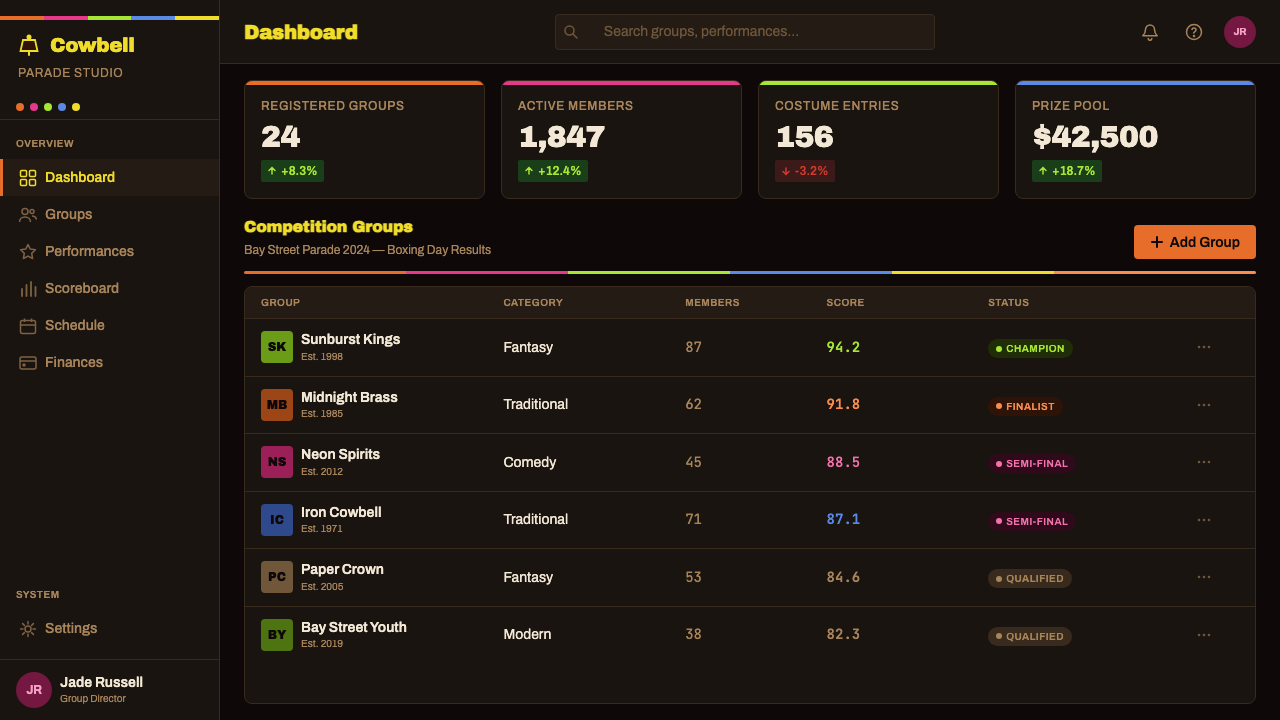
For web interfaces and digital products, the system is particularly powerful for landing pages, event microsites, festival portals, and brand identity pages where a single powerful impression is more valuable than sustained usability across complex workflows. Dashboard applications in this aesthetic require careful restraint: the palette needs to be rationed to avoid visual fatigue, with the deep black serving as the predominant field and the acid hues used only for status indicators, active states, and primary calls to action. Navigation and dense information zones should rely on the black ground with minimal color intrusion.
For editorial and marketing work, Junkanoo Cowbell creates poster-level impact in advertising, event promotion, and cultural journalism. Full-bleed applications — where the black ground extends to every edge and the composition fills the format — are more effective than contained treatments on white or light backgrounds. The system also translates well to physical print and merchandise contexts, where the intensity of the palette reads as vibrancy rather than aggression. Band and musician promotional materials, event posters, cultural festival programs, and brand identity work for food, music, or nightlife businesses are natural homes for this aesthetic.
A common mistake when applying this system is treating it as a generically tropical or Caribbean palette, reaching for turquoise, sand, and coral instead of committing to the specific acid hues and near-absolute black that define Junkanoo's visual logic. Another error is using the system at low intensity — soft versions of the palette on light grounds — which drains the aesthetic of its essential character. The system requires commitment: the dark ground is not optional, the saturation is not negotiable, and the layered texture is what distinguishes an authentic application from a surface impression. Halfhearted applications read as generic tropical kitsch; full commitment reads as a confident, culturally grounded statement.
Bahamian Junkanoo Cowbell — FAQ
Is this style only appropriate for Bahamian or Caribbean brands?
Not exclusively, but cultural context matters. The system's design principles — deep black ground, acid-bright saturation, layered texture, folk geometric forms — are transferable to any context that calls for high-energy celebration, nighttime spectacle, or bold cultural confidence. However, using the style without acknowledgment of its Junkanoo origins risks aesthetic appropriation, and applications that erase the cultural specificity while borrowing only the surface excitement tend to feel hollow. The most successful applications are either genuinely rooted in Caribbean cultural contexts, or are applied with explicit awareness and respect for what the visual language carries.
How does the dark ground affect readability, especially for text-heavy layouts?
The deep black ground, used in combination with the acid hues, creates extremely high contrast for display type and short copy — readability in those contexts is excellent. The challenge arises with extended body text, where long reading on a dark ground increases eye strain for many readers. The practical solution is to use the system's bold aesthetic for the visual framework — the ground, the geometry, the accent colors — while placing extended text blocks in a contained lighter field, such as a near-white or cream inset panel, rather than white type on black across long passages. The Junkanoo system is inherently a display aesthetic, not a long-form reading aesthetic.
Can the system be applied in a lighter, daytime version without losing its identity?
A light version is technically possible but strategically risky. The deep black ground is not incidental — it is the condition that makes the acid palette blazing rather than merely bright. On a white or light ground, the same hues read differently: they are still vivid, but the electric charge that comes from the nighttime contrast is absent. The result tends toward generic tropical or street-art aesthetics rather than the specific Junkanoo character. If a light application is required by context, retaining at least one significant dark element — a full-width black band, heavy black typography, a black geometric anchor — helps preserve the system's identity rather than fully inverting it.
How does Junkanoo Cowbell relate to other Caribbean visual traditions?
The Caribbean encompasses enormous visual diversity, and Junkanoo sits within a larger family of Afro-Caribbean festive traditions — Trinidad Carnival, Jamaica's Jonkonnu, Barbados Crop Over — each with its own distinct visual logic. Junkanoo's particular signature is its commitment to crepe paper as the primary material, its midnight timing, and the resulting chromatic intensity against deep darkness. Trinidad Carnival, by contrast, tends toward feathered and rhinestoned spectacle in daylight, producing a different color relationship. Knowing these distinctions prevents the error of treating 'Caribbean festive' as a single undifferentiated aesthetic — the specificity of Junkanoo is its design strength.
What makes an application look authentically Junkanoo rather than generically loud?
Three qualities separate authentic applications from generic loudness. First, the dark ground: the system reads correctly only when the near-absolute black is the compositional foundation, not an accent. Second, the specific acid hue selection — the palette is not simply 'bright'; it has particular, specific chromatic relationships among orange, pink, lime, and yellow that are calibrated to work together at full saturation against deep darkness. Third, the layered, fringed texture vocabulary: generic loud design uses flat, isolated color shapes; Junkanoo uses dense accumulated strips and overlapping geometric forms that communicate handmade craft and processional rhythm. When all three are present together, the identity is legible and specific.
Related design styles
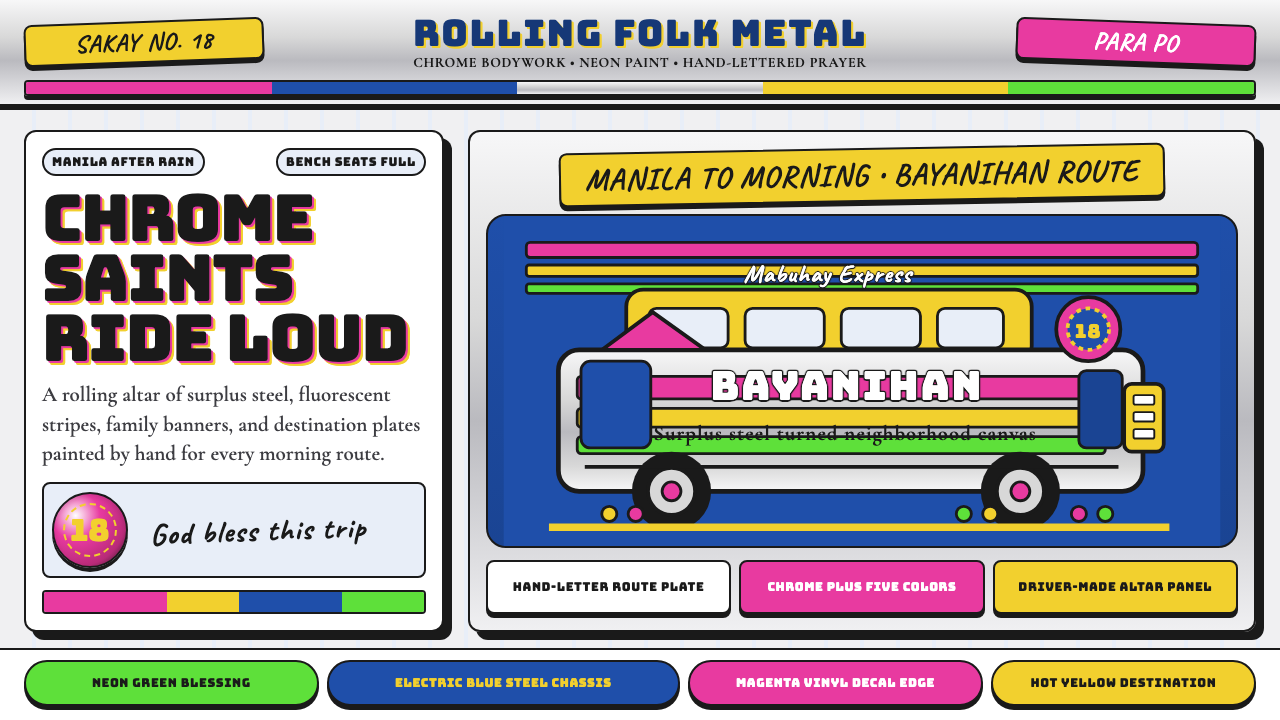 Filipino JeepneyLoud steel, made personal. Chrome gradients carry neon stripes and hand-lette…
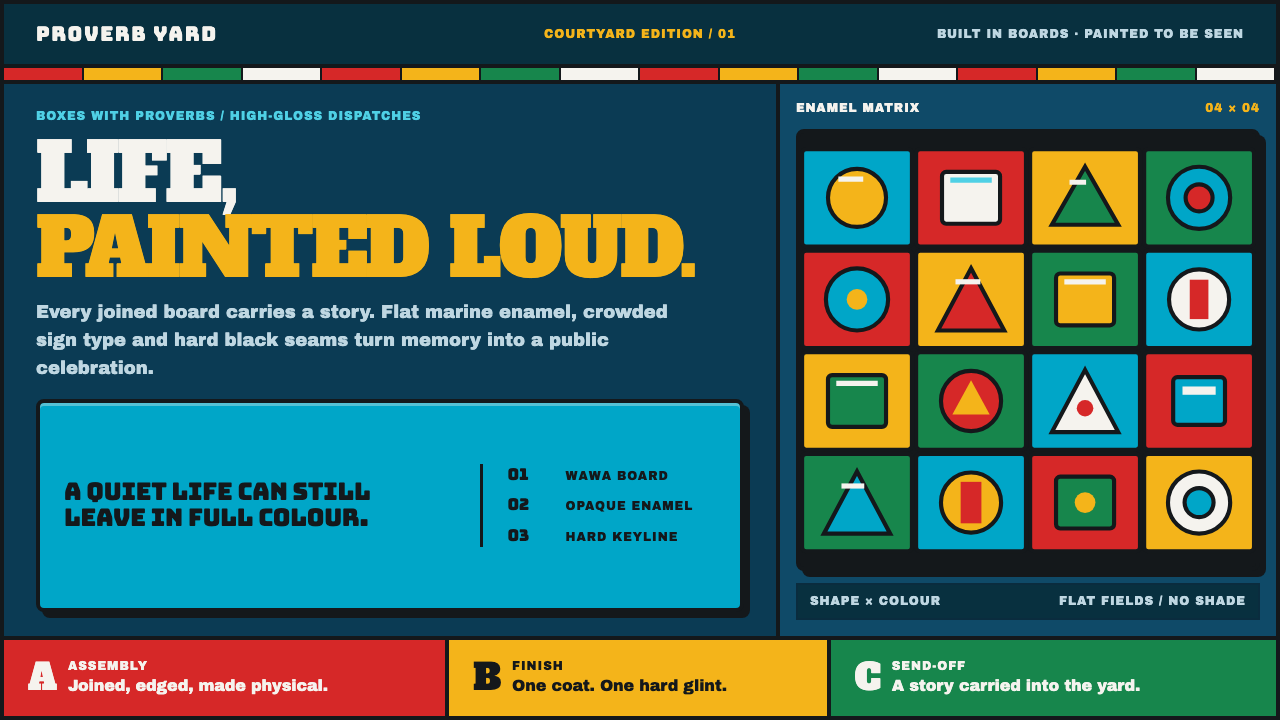 Ga Fantasy CoffinMemory refuses to whisper. Marine enamel, fat sign type and hard black seams…
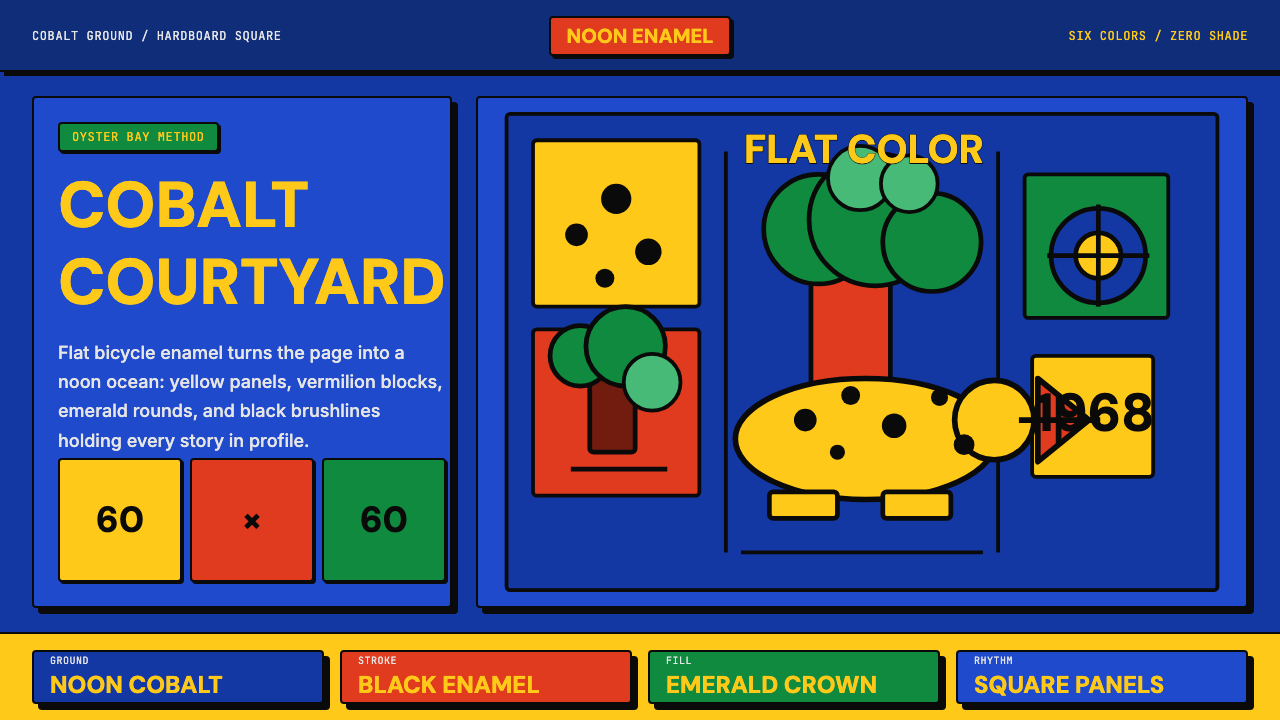 Tanzanian Tingatinga on Cobalt Canvas (1968)Cobalt sings flat. Yellow, vermilion and emerald panels snap under black enam…
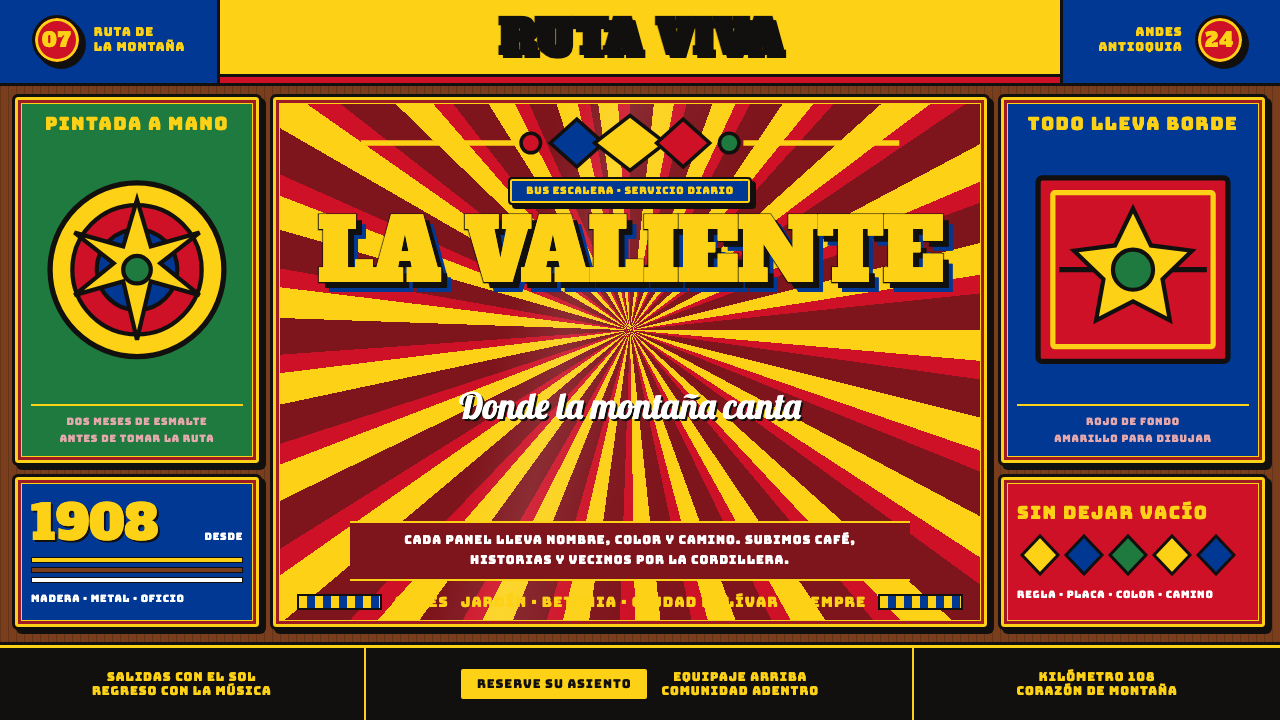 Colombian Chiva BusNothing is left unpainted. Flag-yellow rules, slab lettering and black keylin…
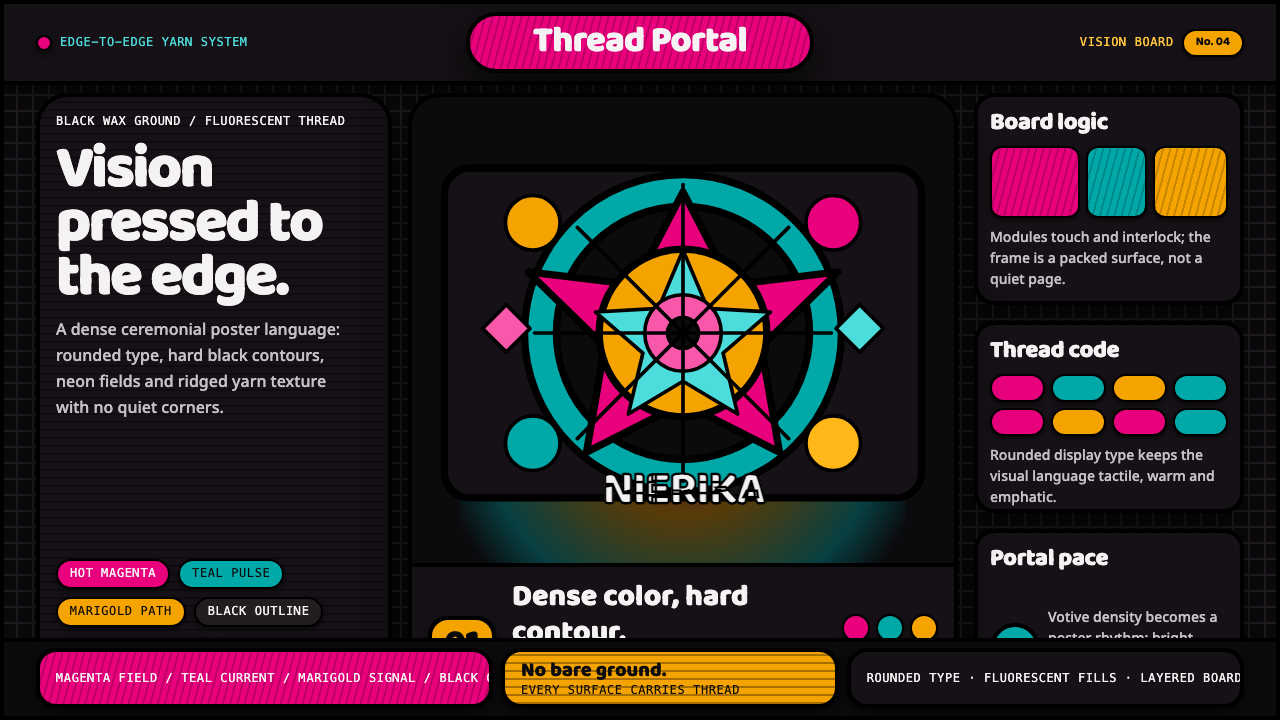 Huichol Yarn NierikaCeremonial density glows. Neon yarn colors lock into black-contoured, edge-to…
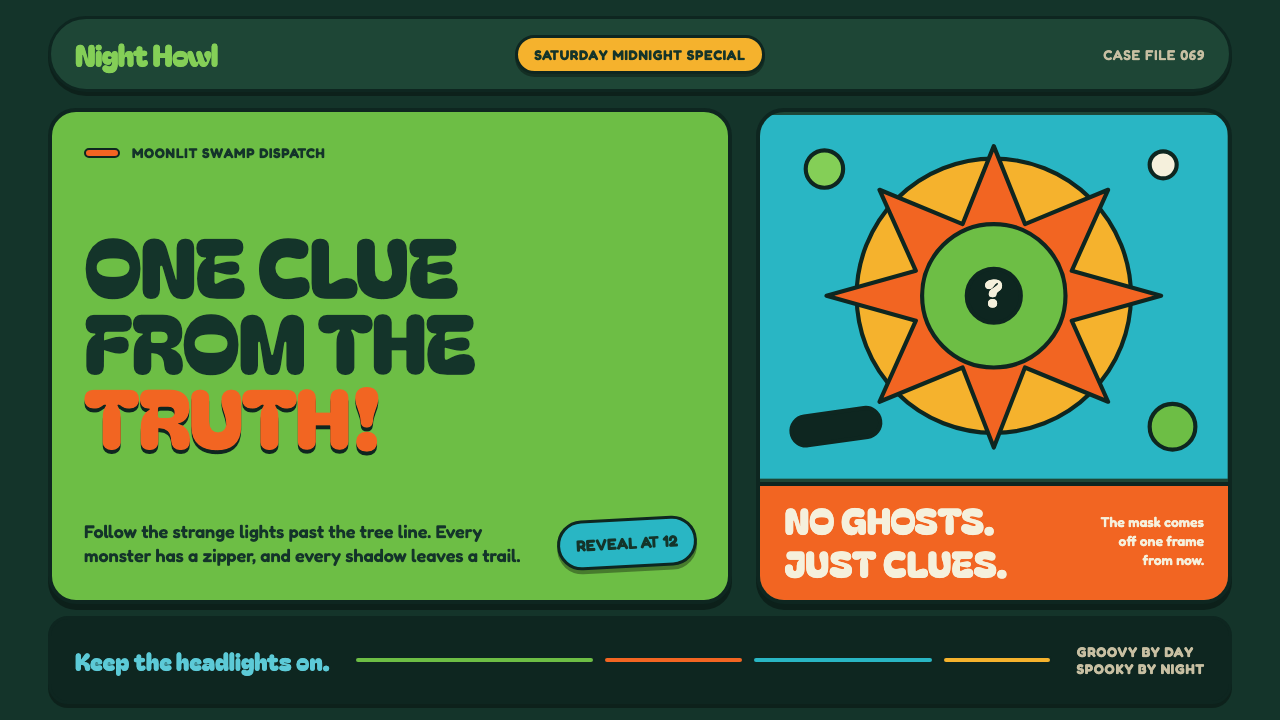 Mystery Machine (Scooby-Doo 1969)Groovy by day, spooky by night. Balloon type and acid-green panels hide the n…