What is Mexican Otomi Tenango?
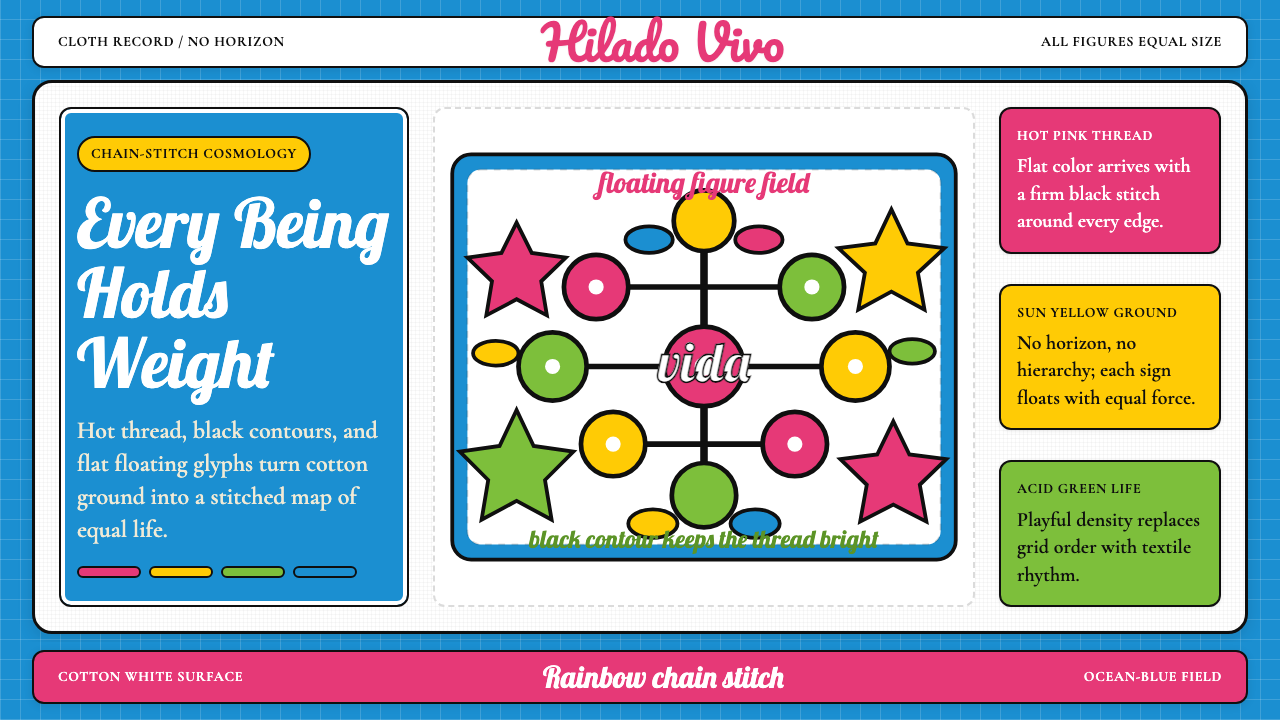
Otomi tenango embroidery turns every living thing into an equal — deer, jaguar, hummingbird, and flower all float side by side on a field of saturated color, stitched in chain stitch by the Hñähñu people of Hidalgo, Mexico.
Mexican Otomi Tenango in brief
Mexican Otomi tenango is the distinctive chain-stitch embroidery tradition of the Hñähñu (Otomi) people of the Sierra Otomí highlands in Hidalgo, Mexico. Its visual signature is immediately arresting: densely populated fields of animals, birds, plants, and geometric shapes rendered in bold, maximally saturated colors — hot pink, acid green, sun yellow, electric blue — with each motif outlined in black chain stitch and filled with flat color. Every creature appears at roughly the same scale, hovering without gravity or perspective on white cotton ground.
The cosmological logic behind the composition is as significant as its visual impact. There is no horizon line, no landscape, no foreground or background — only an infinite field where a deer stands as large as a jaguar, a butterfly holds the same visual weight as a snake. This deliberate flattening and equalization is not a stylistic accident; it reflects an Indigenous worldview in which all living things participate equally in the fabric of existence. The embroidery is a cosmology made visible.
The style is distinguished from other Mexican embroidery traditions by its extreme color saturation, its reliance on the chain stitch as the primary mark-making tool, and its characteristic horror vacui — a dense filling of every available surface with interlocking life forms. The black chain-stitch outline is non-negotiable: it defines the edges of each motif, creates separation between colors, and gives the overall composition its graphic clarity despite the visual complexity.
Where does Mexican Otomi Tenango come from?
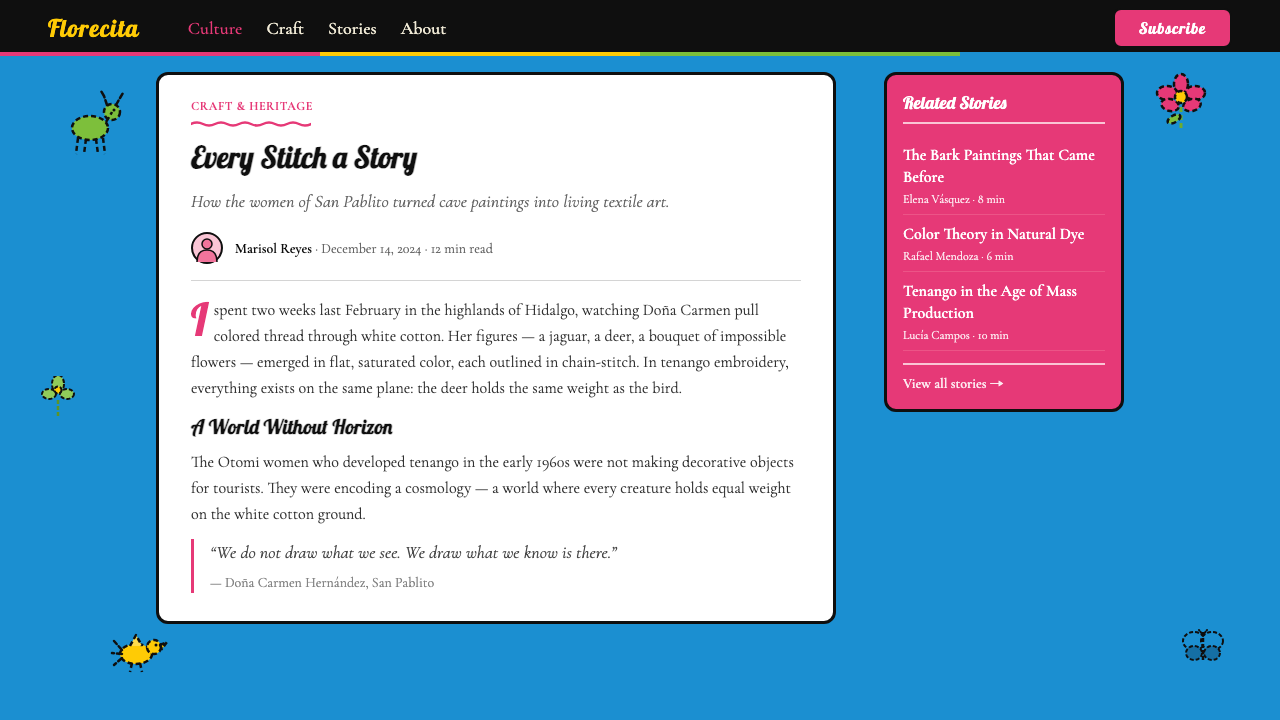
The visual roots of tenango embroidery reach back to pre-Columbian times. The Hñähñu people of the Sierra Otomí have a long tradition of painting on amate — a bark paper made from the beaten inner bark of the fig tree — which served ritual and administrative functions long before Spanish colonization. The animals, plants, and composite creatures that appear in contemporary tenango cloth are direct descendants of the figures painted in amate manuscripts and scratched into cave walls across the region. When scholars like Bodil Christensen documented Otomi bark-paper painting in the mid-twentieth century, they were recording a visual vocabulary that had been maintained continuously for centuries.
The transformation from bark-paper image to embroidered cloth happened in the 1960s, in the town of Tenango de Doria and the neighboring village of San Pablito in Hidalgo's Sierra Otomí. The region had long suffered economic marginalization, and when traditional farming and other livelihoods became increasingly precarious, Otomi women began producing embroidered textiles for sale to urban and tourist markets. Anthropologists and cultural researchers — among them Catharine Good Eshelman, who documented the tradition and its economic dimensions — helped connect the artisans to buyers in Mexico City and beyond. The embroidery was not invented from scratch; it drew on existing needle-arts knowledge and adapted the pre-Columbian visual lexicon into a new, commercially viable form.
The name 'tenango' derives from Tenango de Doria, the municipal center where the practice consolidated and from which the cloths became widely known. The cloths themselves are called bordados tenango or simply tenangos, and they have become one of the most recognized symbols of contemporary Mexican folk art internationally. The style spread to neighboring communities and was adopted by women across the Sierra Otomí region, each locality developing its own slight variations in motif vocabulary and color emphasis while maintaining the essential compositional logic of the flat, horizon-free field.
In the decades since the 1960s revival, tenango has navigated the complex relationship between artisanal authenticity and commercial reproduction. Machine-printed fabric imitating the tenango aesthetic has flooded global markets, raising persistent concerns about cultural appropriation and economic harm to the original makers. The Hñähñu communities of Hidalgo have sought geographical indication protections to distinguish authentic hand-embroidered tenango from industrial copies — a struggle that mirrors the broader tension between living craft traditions and their global legibility as marketable imagery.
What defines the Mexican Otomi Tenango look?
Color Saturation
The defining characteristic of tenango is its unapologetic maximalism in color. Every hue is pushed to its most vivid register: pinks become electric, greens become acid, yellows become solar, blues become oceanic. Colors do not blend, shade, or gradient — they sit as flat, fully saturated fields. The traditional ground is bold blue or white cotton, and the entire palette is organized around the principle that every color should hold its full presence without yielding to any other.
Chain-Stitch Outline
The black chain-stitch outline is the structural armature of every tenango motif. It is applied as a closed contour around every animal, plant, and geometric element, giving each figure a bold graphic edge. This outline is not merely decorative — it performs the crucial visual work of separating adjacently saturated colors that would otherwise bleed into optical chaos. The stitch itself creates a slightly raised, textured line that catches light differently from the flat fill, adding a subtle tactile dimensionality to what is otherwise a resolutely flat image.
Flat Compositional Space
Tenango refuses perspective in every sense. There is no horizon, no shadow, no diminution in scale as elements recede. All motifs exist on a single shared plane, arranged by rhythm and pattern rather than by spatial logic. A large bird and a small flower are the same distance from the viewer. This compositional flatness is rooted in pre-Columbian visual traditions that predate Western perspectival conventions, and it gives tenango its distinctive quality of being simultaneously dense and legible — no element recedes into depth, so every element is equally present.
Horror Vacui — Filled Surface
Every square inch of a tenango cloth is occupied. Animals nestle against plants, plants spiral into geometric borders, geometric borders frame zoomorphic figures who are themselves filled with smaller decorative elements. This principle of filling — known in art historical terms as horror vacui, the fear of empty space — is not haphazard; it follows a rhythmic logic that prevents the surface from becoming chaotic. Background and figure are in constant dialogue: the white or blue ground reads as both empty space and as a color in its own right.
Zoomorphic Motif Vocabulary
The subjects of tenango embroidery are drawn from the natural world of the Sierra Otomí: deer, jaguars, eagles, hummingbirds, rabbits, fish, serpents, butterflies, and a range of flowering plants and trees. Composite or mythological creatures — part animal, part bird, part plant — also appear, reflecting a pre-Columbian tradition of zoomorphic hybridization. Each community in the region maintains its own repertoire of favored motifs, and individual embroiderers develop personal signatures within the shared vocabulary. The specific combination of creatures in any given cloth encodes local knowledge about ecology, cosmology, and seasonal cycles.
Radial and Bilateral Symmetry
While individual tenango cloths may appear entirely freeform at first glance, most are organized by underlying symmetrical armatures — bilateral mirror arrangements along a vertical axis, or radial compositions expanding outward from a central tree-of-life or sunburst motif. This hidden structural logic gives the busy surface a sense of resolution and completeness. The tree-of-life motif — a central trunk with branches hosting animals and birds — is one of the most common organizing devices, connecting the composition to both pre-Columbian cosmological imagery and pan-Mexican folk art traditions.
Material and Mark
Authentic tenango is worked on plain-weave cotton — historically undyed white or cream, though colored ground cloths have become more common in commercial production. The thread is typically acrylic or wool yarn, chosen for its color-fastness and the way it holds the chain-stitch loop tightly. The scale of the stitch is consistent and relatively small, which allows for clean curves in animal forms and sharp corners in geometric elements. The consistency of the stitch size is itself a marker of craft skill; irregular stitch size betrays haste or inexperience.
Who shaped Mexican Otomi Tenango?
Danish ethnobotanist and researcher Bodil Christensen spent decades in Mexico documenting Indigenous craft traditions, with particular attention to Otomi bark-paper painting (amate) in the Sierra Otomí region. Her fieldwork in San Pablito and surrounding communities in the mid-twentieth century produced some of the earliest systematic documentation of the visual vocabulary that would later migrate into tenango embroidery. By connecting the living tradition of amate painting to its pre-Columbian roots, Christensen helped establish the historical continuity of the imagery that tenango embroiderers draw upon.
American anthropologist Catharine Good Eshelman conducted extensive fieldwork with Nahua and Otomi communities in Mexico, with particular focus on the economic and social dimensions of Indigenous craft production. Her research documented how the tenango embroidery tradition functioned not merely as cultural expression but as an economic survival strategy for Hñähñu women navigating a marginalized regional economy. Eshelman's work brought scholarly attention to the labor conditions behind the textiles and to the complex negotiations between artisans, intermediaries, and urban buyers.
The collective authorship of the tenango tradition rests with the embroiderers themselves — the Hñähñu women of Tenango de Doria, San Pablito, and the surrounding Sierra Otomí communities who developed and sustained the practice from the 1960s onward. These women adapted pre-Columbian visual motifs to embroidered cloth, established the compositional conventions that define the style, and passed the knowledge across generations within family and community networks. No single named founder exists; the tradition is a collective achievement of hundreds of artisans working across six decades.
Mexico's national craft fund FONART (Fondo Nacional para el Fomento de las Artesanías) has played a significant role in formalizing, documenting, and marketing tenango embroidery since the later decades of the twentieth century. Through its network of artisan support programs, FONART connected Otomi embroiderers to national and international exhibition circuits and helped establish quality standards that distinguished hand-embroidered originals from machine-produced imitations. Individual master embroiderers — recognized within FONART programs — became the public faces of the tradition in craft fairs and museum collections.
How do you use Mexican Otomi Tenango today?
Tenango is one of the most visually bold design references available — a system built on maximum color saturation, horror vacui composition, and the absolute visual equity of every element on the surface. Applying it well requires embracing its abundance rather than moderating it into something safer. The temptation to thin the palette or add breathing room often produces work that feels neither tenango nor anything else. Commit fully or not at all.
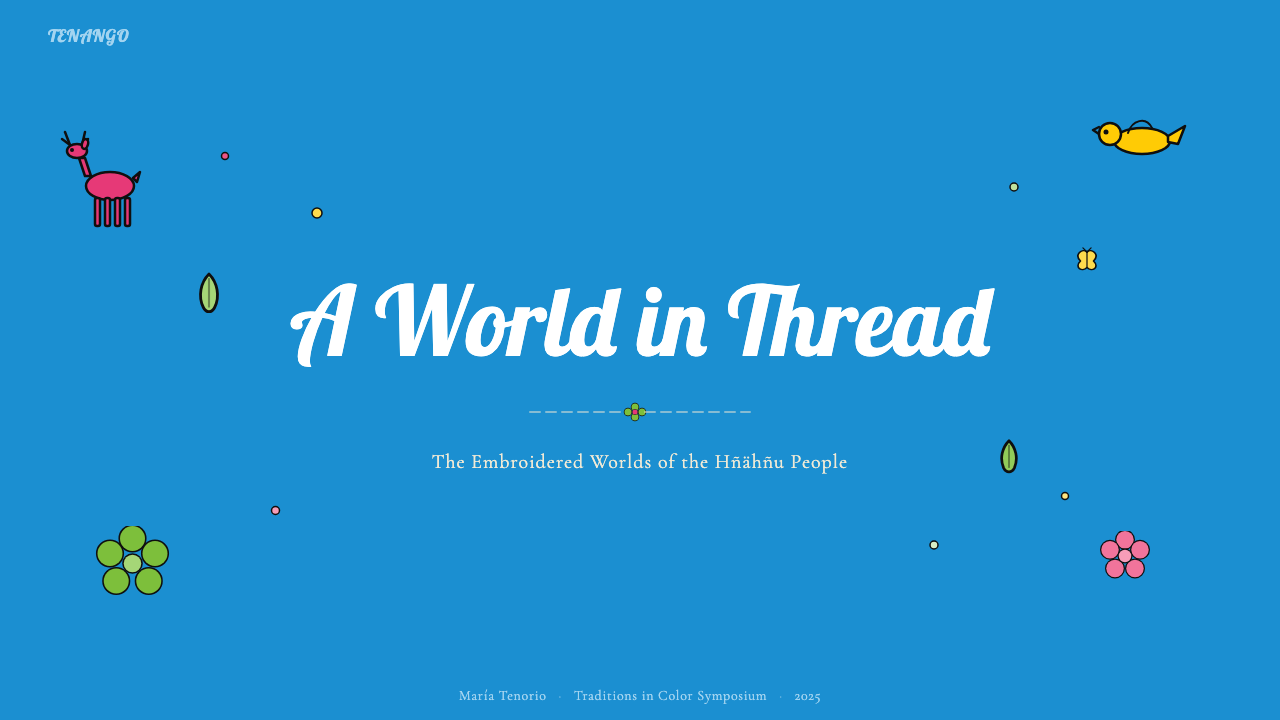
For presentation slides, the tenango aesthetic translates most powerfully to cover pages and full-bleed section dividers. A cover built on this reference might use a saturated ground color — a deep oceanic blue or an intense warm white — with a dense composition of illustrated motifs organized symmetrically around a central focal image. Type should be minimal and strong: a single title line in a bold, clean face, allowed to breathe within the density of the illustration rather than competing with it. Content slides should strip back to near-plain: carry only the color ground and perhaps a single small motif as a consistent decorative marker; the density of the cover establishes the visual identity, and the content slides need not replicate it.
For web interfaces and digital products, tenango references are best suited to contexts celebrating cultural richness, craft, or ecological themes — tourism and hospitality brands, artisan marketplaces, food and beverage products with regional or heritage positioning, and cultural institutions. The approach is not literal replication but translation: take the color logic (high saturation, flat fill, black outline), the compositional logic (filled surface, bilateral symmetry, equal visual weight), and the motif spirit (zoomorphic, plant-based, pattern-driven), and express them through whatever visual elements the interface requires. A pricing page does not need embroidered deer — it needs the courage of the color and the confidence of the flat fill.
For editorial and marketing work, tenango vocabulary supports immersive, culturally grounded layouts. A magazine spread or campaign landing page that draws on this reference might use a full-bleed illustrated border — dense patterned bands at the top and bottom of the page — framing a more legible content area. The key is contrast: the illustrated zones can be maximally dense, provided the text zones are protected and clean. Marketing for craft products, food brands, or heritage tourism can use tenango motifs as framing devices without colonizing the content area.
The most common mistake when applying tenango references is desaturating or softening the palette to make it feel more contemporary or neutral. Doing so destroys the core logic of the style: every color in the tenango system is at full strength because the style's cosmological premise is that every element is equally present and equally important. A muted tenango is a contradiction. A second common mistake is using the motifs without the structural logic — placing isolated animals on white space as decorations rather than as participants in a composed, filled field. Tenango motifs derive their meaning from density and relationship, not from isolation.
Mexican Otomi Tenango — FAQ
Is tenango embroidery the same as Otomi embroidery?
Tenango is a specific regional style of Otomi embroidery, not a synonym for all Otomi textile work. The Otomi people inhabit a broad area of central Mexico and produce diverse textile traditions. Tenango refers specifically to the chain-stitch embroidery style developed in Tenango de Doria and neighboring communities in Hidalgo's Sierra Otomí from the 1960s onward, characterized by its saturated colors, horror vacui composition, and flat, horizon-free animal and plant motifs. Other Otomi communities produce quite different textiles — including the bark-paper amate paintings of San Pablito, which share the same visual vocabulary but are made by an entirely different process.
How does the tree-of-life motif function within the tenango composition?
The tree-of-life motif — a central trunk with radiating branches hosting birds, animals, and flowers — functions as a compositional armature rather than a standalone symbol. It gives the horror vacui surface an organizing axis, anchoring the surrounding field of figures to a structural center. Cosmologically, the tree image connects above and below, earth and sky, rooted world and aerial world — a vertical axis that maps the relationships between different orders of being. In practice, a tenango cloth organized around a tree-of-life motif is easier for the eye to read and feels more resolved than a purely all-over pattern without such a structural anchor.
Can the tenango aesthetic work in digital design without literal embroidery illustration?
Yes, and often the most successful translations are the ones that extract the system's logic rather than copying its surface. The core transferable principles are: maximum color saturation with no gradients, flat fills bounded by strong black outlines, equal visual weight distributed across the composition, and dense patterning that fills rather than punctuates the surface. These principles can be applied to typographic compositions, icon systems, data visualizations, or UI component styling without any literal animal or plant imagery. The spirit of tenango is egalitarian abundance — every element gets its full presence. A design that achieves that feeling without a single bird or flower is more authentically tenango than one that pastes embroidery textures onto a conventionally minimal layout.
How do I distinguish hand-embroidered tenango from machine-printed imitations?
Authentic hand-embroidered tenango shows the raised texture of the chain stitch, which is visible to the eye and palpable to the touch. The back of the cloth carries the stitch work clearly. Colors are applied with the slight inconsistency of handwork — a hot pink field in two adjacent sections may be minutely different in shade due to thread variation. Machine-printed imitations are flat to the touch, perfectly consistent in color, and have no discernible texture variation. The composition of a hand-embroidered piece is also typically unique or semi-unique — no two hand-embroidered cloths are identical — while printed imitations are exact repeating reproductions. For design reference purposes, the distinction matters because the aesthetic qualities of tenango — including its slight irregularity — are part of what makes it visually compelling.
What contexts are a poor fit for the tenango aesthetic?
Tenango struggles wherever restraint, minimalism, or institutional authority is the primary visual goal. Corporate dashboards that depend on quiet hierarchy for data legibility, medical or legal interfaces where calm and neutrality signal trust, or luxury goods where sophisticated understatement is the brand premise — these are not good fits. The style's intrinsic maximalism and chromatic intensity also makes it technically difficult to apply to information-dense products: when the composition itself is already saturated with visual events, adding charts, tables, and navigation to the same surface creates genuine cognitive overload. Tenango works best when the visual experience is the point — when immersion, celebration, and cultural storytelling are what the design is for.
Related design styles
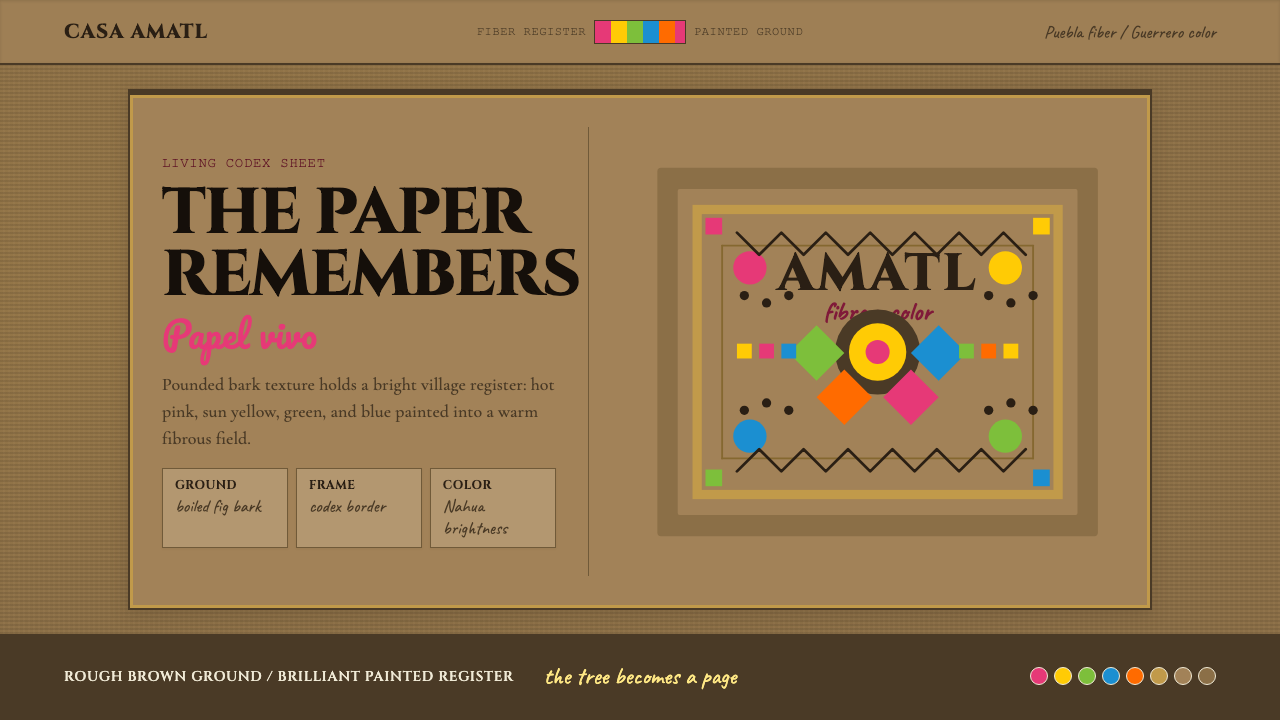 Mexican Amate Bark PaperLiving craft, not nostalgia. Bark-brown fiber carries hot pink and sun-yellow…
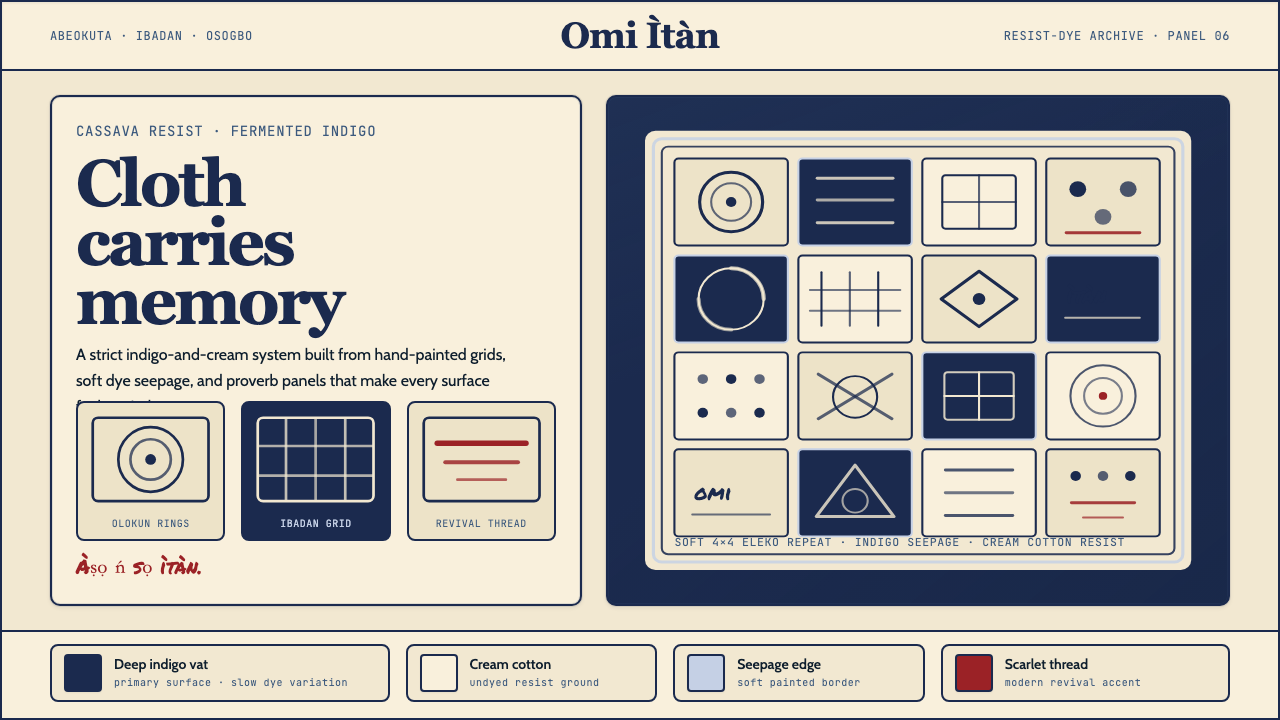 Yoruba Adire IndigoMemory lives in cloth. Deep indigo grids on cream cotton carry hand-painted p…
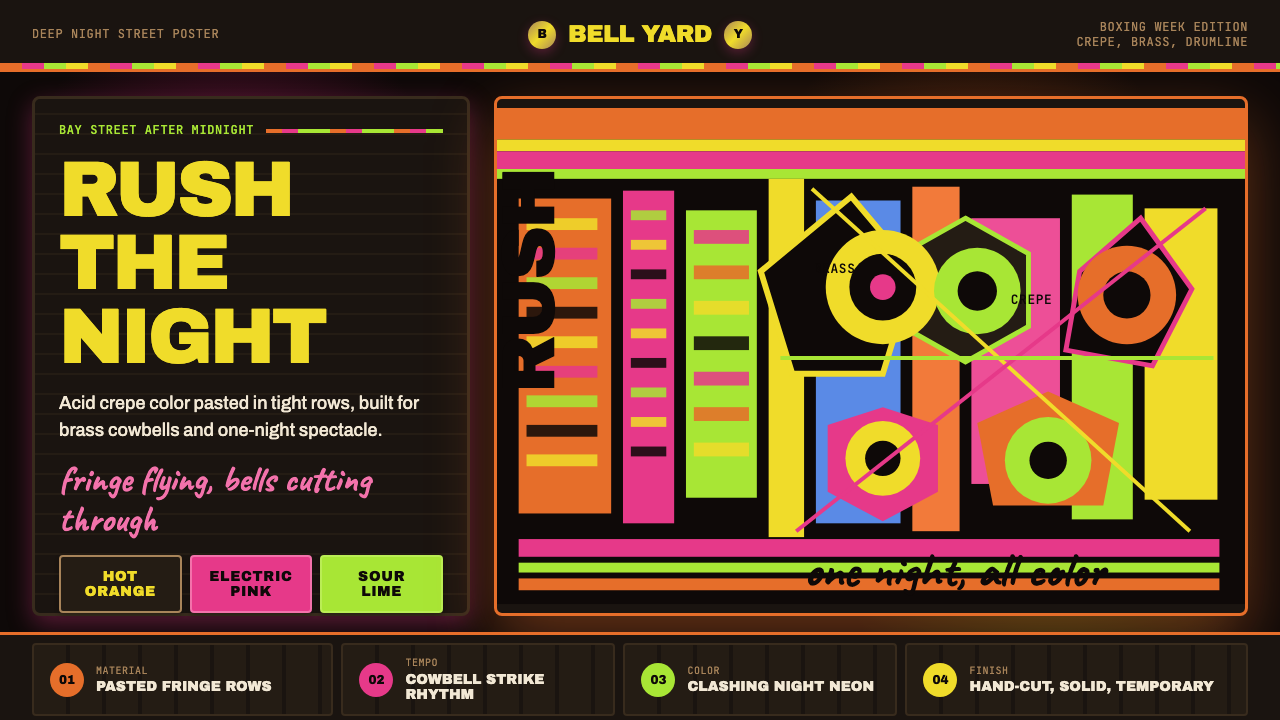 Bahamian Junkanoo CowbellNight refuses silence. Acid crepe stripes and block type collide like cowbell…
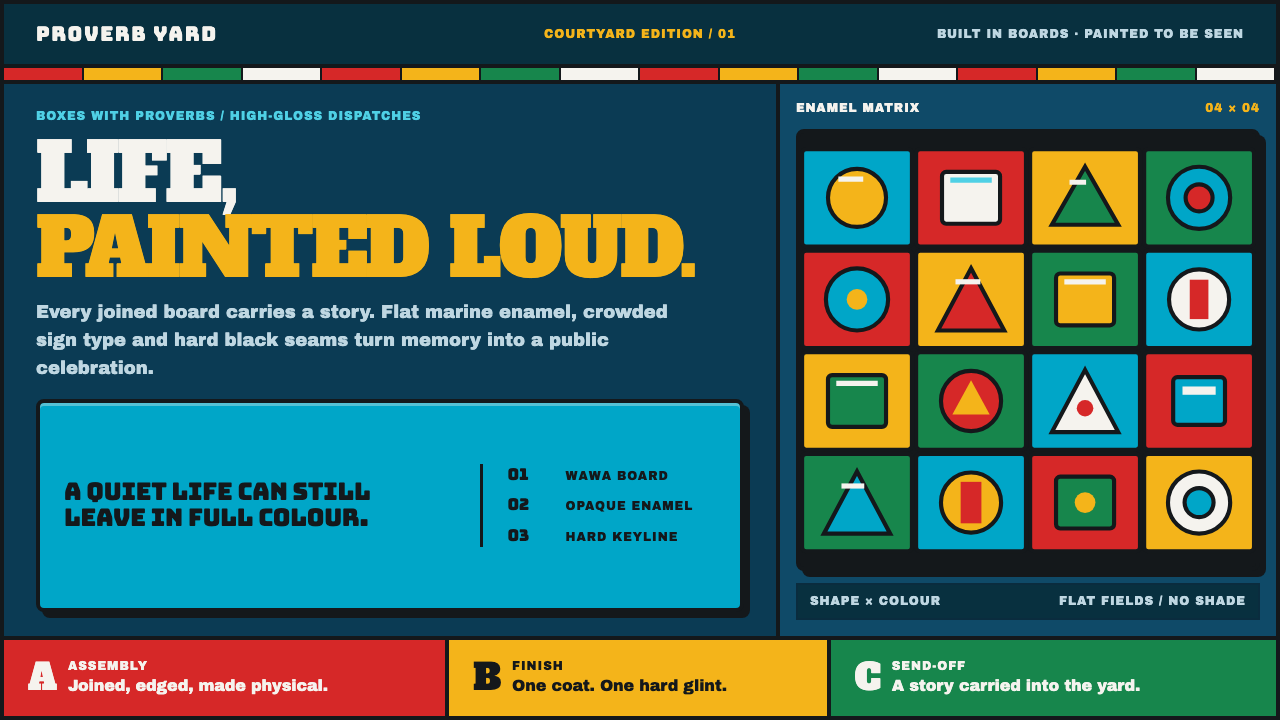 Ga Fantasy CoffinMemory refuses to whisper. Marine enamel, fat sign type and hard black seams…
 Lao Orchid Mauve TextileHandwoven sinh silk made digital. Orchid-mangosteen ground banded with naga b…
 Sri Lankan BatikCloth that remembers its making. Indigo grounds, saffron motifs, veined with…