What is Tanzanian Tingatinga on Cobalt Canvas (1968)?
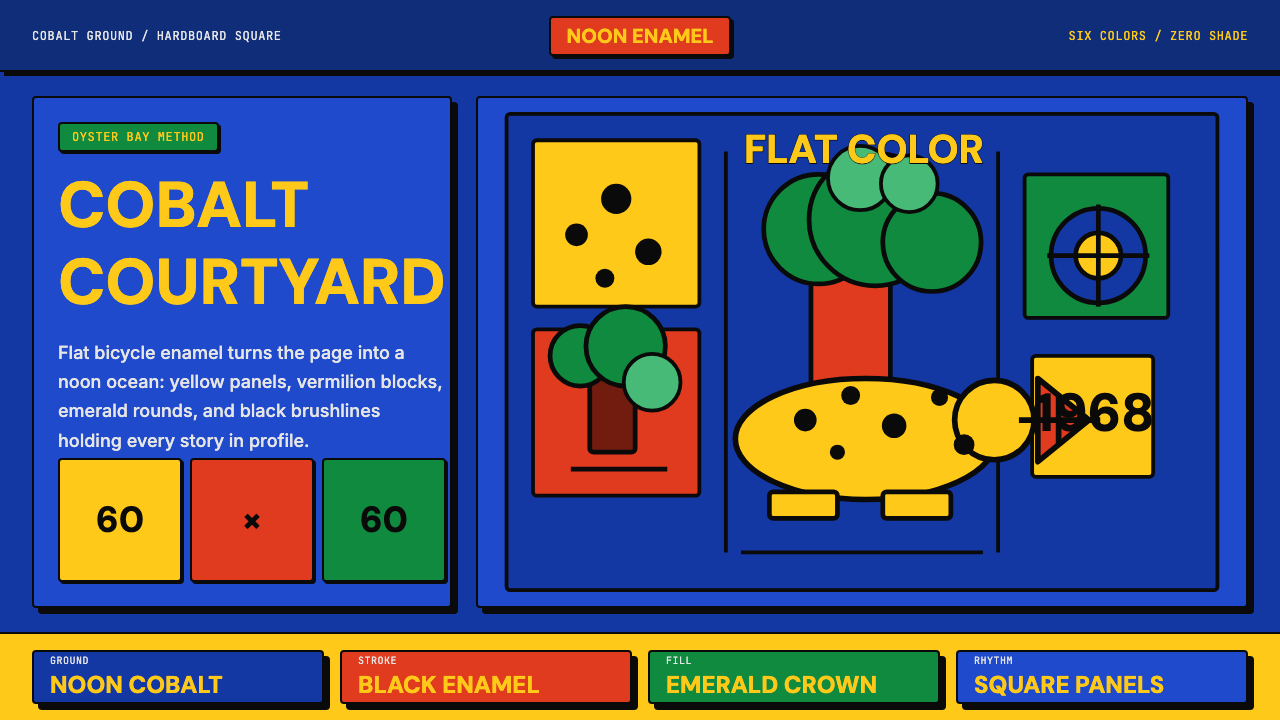
Edward Saidi Tingatinga picked up leftover bicycle enamel and a square of hardboard in 1968 and invented one of Africa's most joyful and widely recognized painting traditions — a flat, color-saturated world where every creature glows against a cobalt ground.
Tanzanian Tingatinga on Cobalt Canvas (1968) in brief
Tingatinga is a Tanzanian painting style founded in Dar es Salaam in 1968, distinguished by its flat, unshaded fields of color, bold black outlines, and exuberant menagerie of wildlife rendered in full profile. The cobalt-canvas variant — named for its deep blue ground — is the style's most iconic expression: animals, birds, and flowering trees float against an ocean-blue field as though cut from bright enamel and pressed onto glass.
What separates Tingatinga from other folk or outsider art traditions is its material honesty. The style was never trying to simulate oil painting or academic naturalism — it was exploring what a few saturated bicycle paints could do when handled with complete confidence. Every choice follows from the materials: no shading because enamel laid flat is more vivid than enamel blended; bold outlines because the black paint drawn in a single brushstroke is what holds the composition together; repeated decorative patterns in the background because this is what fills a flat ground most beautifully.
The visual effect is immediately legible across cultures and scales. A Tingatinga composition reads as joyful pattern at a distance and as meticulous wildlife observation up close — the hornbill's beak, the leopard's rosettes, the acacia's branching silhouette are all rendered with a specificity that rewards scrutiny even though no traditional illusionistic technique is used.
See the Tanzanian Tingatinga on Cobalt Canvas (1968) design system
Where does Tanzanian Tingatinga on Cobalt Canvas (1968) come from?
Edward Saidi Tingatinga was born around 1932 in the Nakapanya area of what is now Tanzania. He came to Dar es Salaam as a young man and worked in various domestic jobs before discovering that the bicycle repair shops nearby discarded small quantities of enamel paint. In 1968, in his courtyard in the Oyster Bay district of Msasani, he began painting on hardboard squares approximately sixty centimeters on a side — a size dictated by the standard sheet he could afford to buy and cut. He used only six colors: cobalt blue, vermilion, yellow, green, white, and black. No primer, no preparation, no mixed tones.
The choice of material was a constraint that became a creative philosophy. Bicycle enamel dries quickly, holds its color with a glossy intensity, and resists blending — it wants to be used flat, in one pass, with confident brushwork. Tingatinga adapted to this rather than fighting it, developing a vocabulary of bold profile views, concentric dot patterns for feathers and fur, and landscape elements — baobabs, acacia, grass — reduced to their most essential silhouettes. The result was a style that looked nothing like any regional precedent: not academic, not missionary-influenced, not tribal-traditional, but something entirely new born from specific materials in a specific place.
Tingatinga's early paintings attracted the attention of tourists and diplomats visiting Oyster Bay, and by the early 1970s a small cooperative of painters had formed around him. Key among these were Simon Mpata, Hassan Mandu, and January Linda, all of whom learned the technique directly from the founder and would later spread it throughout East Africa. The cooperative's formation was partly economic — sharing materials and a selling location — and partly curatorial: the group collectively defined what counted as Tingatinga painting and excluded work that deviated too far from the founder's approach.
Edward Saidi Tingatinga died in 1972, killed accidentally by police who mistook him for a criminal during a street incident — he was just forty years old. The paintings he had produced in four years were few, and authenticated originals are now held by collectors and institutions across Europe and Africa. His death, however, did not end the style he had created. The cooperative he had seeded became the Tingatinga Arts Cooperative Society, which continues to operate in Dar es Salaam to this day, training new artists and maintaining the tradition's visual standards. By the 1980s and 1990s, Tingatinga painting had spread throughout the East African coast, reaching Kenya, Uganda, and Zanzibar, and had become one of the region's most recognizable export arts.
The cobalt-ground variant specifically emerged as the dominant expression of the style because the deep blue background — evoking the Indian Ocean that Dar es Salaam faces — provided the highest contrast for the warm vermilion, yellow, and green animal forms that populated the compositions. Later painters in the tradition experimented with other background colors, including ochre grounds and white grounds, but the cobalt canvas remained the form most associated with the original Tingatinga vision and the one that best captured the luminous, almost UV-bright quality of the enamel medium.
What defines the Tanzanian Tingatinga on Cobalt Canvas (1968) look?
Flat Saturated Ground
The cobalt-blue background is the defining field of the style — a single, unmodulated expanse of deep blue that reads simultaneously as sky, water, and pure chromatic space. There is no horizon, no gradient, no vignette. The ground is not a suggestion of environment; it is a declaration of color. Every other element in the composition is defined by how it contrasts against this field, which means the ground actively participates in the design rather than serving as passive backdrop.
Bold Black Outline
Every figure — animal, tree, or decorative motif — is bounded by a confident black contour drawn in a single, uninterrupted pass. The line is not thin and tentative; it is wide enough to read clearly at the scale of a sixty-centimeter square and strong enough to hold the composition together when multiple bright colors compete within a single frame. The outline serves as both structural skeleton and visual equalizer: it gives every element the same visual weight regardless of how light or dark its interior color is.
Warm-Cool Chromatic Drama
The Tingatinga palette is built on a deliberate tension between the cool depth of the cobalt ground and the warm intensity of the figures placed upon it. Vermilion, yellow, and orange forms advance assertively from the blue field; emerald green, being neither fully warm nor cool, acts as a mediating accent. This warm-against-cool dynamic is what gives the cobalt variant its particular luminosity — the figures seem to be lit from within rather than illuminated by an external source.
Decorative Surface Patterning
Tingatinga paintings are never empty. Where academic naturalism would leave negative space, Tingatinga fills it with rows of dots, concentric rings, radiating lines, or repeated floral motifs. These patterns serve multiple functions: they fill the flat ground with visual energy, they describe texture on animal surfaces (the dot-clusters that render a leopard's spots, the radial patterns that suggest feather structure), and they create an overall rhythm that ties the entire composition into a cohesive decorative whole. The patterns are systematic but hand-drawn, so they carry a slight irregularity that prevents the work from feeling mechanical.
Wildlife as Protagonist
East African animals — lions, leopards, elephants, zebras, hornbills, fish eagles, chameleons — are the primary subject matter, always rendered in strict profile or three-quarter view that shows their most characteristic silhouette. This is not a Western naturalist's documentary approach; it is closer to heraldry, where the animal form is chosen to be immediately recognizable and symbolically powerful. Each creature occupies its own territory within the composition, separated by decorative pattern rather than spatial recession, so the overall effect is more like an illuminated catalog than a landscape.
Enamel Gloss and Tactility
Bicycle enamel dries to a surface with more sheen than matte gouache but less mirror-like than modern gloss varnish. In the original paintings, this characteristic sheen catches light across the surface, creating micro-variations in tone that add life to an otherwise flat field. In design systems inspired by Tingatinga, this quality is translated into a visual character that avoids both flat opacity and glossy photorealism — surfaces suggest lacquer or glazed ceramic rather than digital flatness or photographic texture.
Symmetry and Repetition as Structure
Unlike Western academic composition, which typically organizes a scene around a single focal point and a hierarchy of secondary elements, Tingatinga compositions often distribute multiple subjects across the picture plane with near-equal visual weight, held together by the symmetry of the decorative field rather than by linear perspective or narrative hierarchy. This creates a sense of abundance and completeness — the painting is not a moment captured but a world declared.

See the Tanzanian Tingatinga on Cobalt Canvas (1968) design system
Who shaped Tanzanian Tingatinga on Cobalt Canvas (1968)?
The founder of the style, Tingatinga worked in Dar es Salaam's Oyster Bay district from 1968 until his death in 1972. In only four years of active painting, he established a visual language complete enough that it could be learned, replicated, and extended by dozens of painters after him. His work is now held in private and institutional collections in Europe and East Africa. The combination of extreme chromatic confidence and material modesty — the most vivid colors applied with the simplest tools on the cheapest available support — defined not just the style's look but its ethics.
One of the earliest members of the cooperative that formed around Tingatinga in the early 1970s, Mpata was instrumental in preserving and systematizing the style after the founder's death. He helped define the visual standards that the cooperative enforced — the particular weight of the black outline, the preferred background colors, the treatment of animal subjects — and trained a generation of artists who became the tradition's second wave. His work is considered among the most faithful to the original spirit of the style.
Mandu trained under the founder and became known for his particularly elaborate use of decorative patterning in backgrounds — his paintings often feature multiple layers of interlocking dot-and-ring motifs that create a dense, tapestry-like quality while still maintaining the fundamental Tingatinga vocabulary. He represents the tradition's tendency to move from simplicity toward richness without abandoning the core formal constraints.
One of the original cooperative members, Linda was particularly influential in the tradition's geographic spread beyond Dar es Salaam. His work helped establish Tingatinga painting in the tourist markets of Kenya and Zanzibar, and his training of artists outside the original Tanzanian context contributed to the style becoming a genuinely regional rather than purely local phenomenon. He also experimented with larger formats than the classic square, demonstrating that the visual grammar could scale beyond its original constraints.
How do you use Tanzanian Tingatinga on Cobalt Canvas (1968) today?
Tingatinga on cobalt canvas is one of the few historical styles that can be applied to contemporary design contexts without adaptation anxiety — its formal properties are already so resolved and self-consistent that the designer's job is principally one of selection and restraint rather than translation. The deep cobalt ground, warm accent colors, bold outlines, and pattern-filled surfaces are a complete system that can be dropped into digital and print environments with remarkable fidelity to the original spirit.
For presentation slides, the style works with particular force on cover and chapter divider pages. A full-bleed cobalt background with a single wildlife motif rendered in the Tingatinga manner — flat color, black outline, decorative dot patterning — creates an immediately memorable opening image that signals both cultural specificity and visual confidence. Content slides are better served by pulling the palette rather than the illustration style: a cobalt accent bar against a white or very light ground, with warm vermilion or yellow used sparingly for emphasis, maintains the chromatic drama without competing with data or body text. The key constraint is discipline with the warm palette — use one warm color as primary accent and hold the others in reserve.
For web interfaces, the style suits contexts where warmth, cultural expression, and visual richness are desired alongside clear hierarchy. Dashboard components can use the cobalt ground for hero sections or key metrics, with card surfaces remaining light to preserve readability. The bold-outline aesthetic translates naturally to illustrated icon systems and spot illustrations — the outlines ensure that pictographic elements remain legible even at small sizes on varied backgrounds. Navigation and pricing pages can use the cobalt field as a full-width section background for premium or highlighted content, with the warm accent palette marking calls to action.
In editorial and marketing applications, Tingatinga gives a project a visual identity that is simultaneously global and specific — recognizably African in origin but entirely contemporary in execution. Magazine feature spreads and event posters benefit from the style's poster-like scale: full-page cobalt fields with a large central motif and headline in contrasting warm color. Marketing campaigns for travel, culture, food, and lifestyle brands find in the style an alternative to the generic flatness of much contemporary illustration — the Tingatinga vocabulary signals handcraft and specificity without requiring literal geographic content.
The most common mistake when applying this style is treating the decorative background patterning as optional. In genuine Tingatinga work, the dots, rings, and repeated motifs are not decoration applied to a finished composition — they are what transforms a flat color field into a living surface. Removing them and applying only the cobalt ground with wildlife silhouettes produces something closer to generic flat illustration than to the Tingatinga tradition. A second common error is softening the outlines — using a tapered, calligraphic stroke instead of the consistent, confident black contour. The style's integrity depends on that line remaining bold and unwavering throughout the composition.

See the Tanzanian Tingatinga on Cobalt Canvas (1968) design system
Tanzanian Tingatinga on Cobalt Canvas (1968) — FAQ
Is Tingatinga considered fine art or folk art?
This classification has been debated since the style became internationally known in the 1970s. In Tanzania and across East Africa, Tingatinga is understood as a living artistic tradition with named masters, a defined vocabulary, and a community of practitioners who have inherited and developed the style across generations — closer in conception to a fine art school than to anonymous folk craft. In Western markets, it has often been marketed as decorative or folk art, partly because of its origin story (bicycle paint, hardboard, courtyard studio) and partly because the cooperative model produces work in large quantities. The more accurate framing is probably craft-based fine art: individual works are signed and attributed, quality varies significantly across practitioners, and the best examples command serious collector attention.
How does Tingatinga relate to other African art traditions?
Tingatinga is unusual among African visual traditions in being entirely urban, entirely modern, and entirely the invention of a single identified individual rather than an inherited community practice. It does not derive from any pre-colonial visual tradition, does not use any traditional materials or iconography, and was not associated with religious or ceremonial function. In this sense it is more analogous to a twentieth-century urban art movement — comparable in its mode of origin to American street art or Brazilian naïf painting — than to the carved masks, textile patterns, or body decoration that typically represent African art in global cultural contexts. Its connection to the broader East African context is primarily geographic and social rather than formal.
Can the cobalt-canvas variant be used in dark-mode digital interfaces?
The cobalt-canvas Tingatinga is itself already a dark-ground design — the deep blue background functions as the dark field against which warm colors advance. This means the style is inherently well-suited to dark-mode interfaces, where a very dark blue serves as the surface color and warm vermilion, yellow, and green are used as accent and interactive-state colors. The main adjustment required is ensuring sufficient luminance contrast between text elements and the cobalt ground — the style's original vocabulary does not include small-scale text, so typographic hierarchy needs to be established separately, typically by using white or very light cream for body text and the warm accent palette for headlines and labels.
Why are animals always shown in profile in Tingatinga paintings?
The profile view serves several simultaneous purposes in the Tingatinga system. Practically, it produces the most recognizable silhouette for each animal — you can identify a hornbill from its profile in a way that a three-quarter view would complicate. Formally, it eliminates the problem of foreshortening, which requires representational depth cues that the flat enamel style cannot accommodate. Aesthetically, the profile is the heraldic pose — it is the pose of coins, stamps, and emblems, and it gives each animal a dignity and clarity that a more casual viewpoint would undermine. The consistent use of profile across all subjects also creates visual unity: however varied the animals, their uniform presentation angle makes the composition feel like a coherent collection rather than a random assembly.
Is it appropriate to use Tingatinga aesthetics outside of East African contexts?
The question of cultural appropriation versus appreciation is live in discussions of Tingatinga, and the answer depends significantly on context and intent. The style is well documented, attributable to a named founder and a named cooperative tradition, and continues to be actively practiced and commercially sustained by Tanzanian and East African artists — it is not a fragile or dying tradition being extracted by outsiders. Using the aesthetic vocabulary respectfully — acknowledging its origin, not misrepresenting it as generic 'African art,' and where possible directing audiences to the tradition's actual practitioners — is the approach most consistent with both ethical practice and design integrity. Where the style is used purely decoratively, without any acknowledgment of its cultural context, it risks reducing a precise and historically grounded visual system to surface pattern.
Related design styles
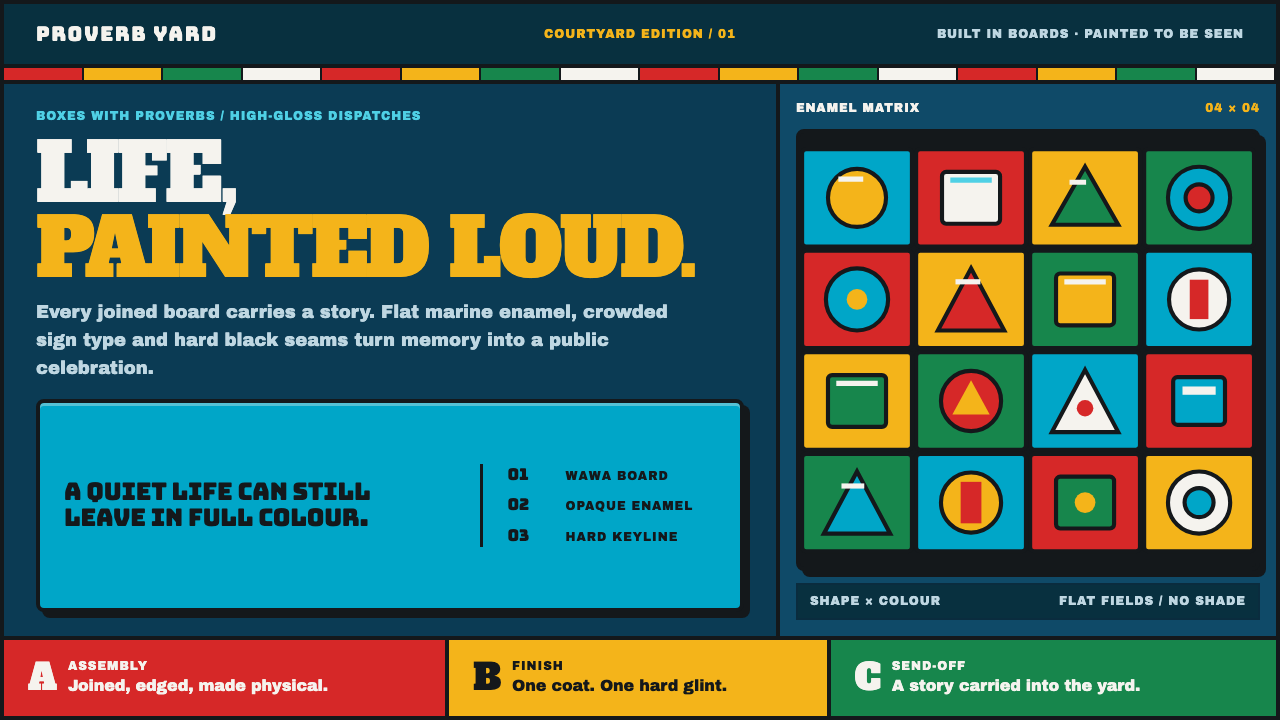 Ga Fantasy CoffinMemory refuses to whisper. Marine enamel, fat sign type and hard black seams…
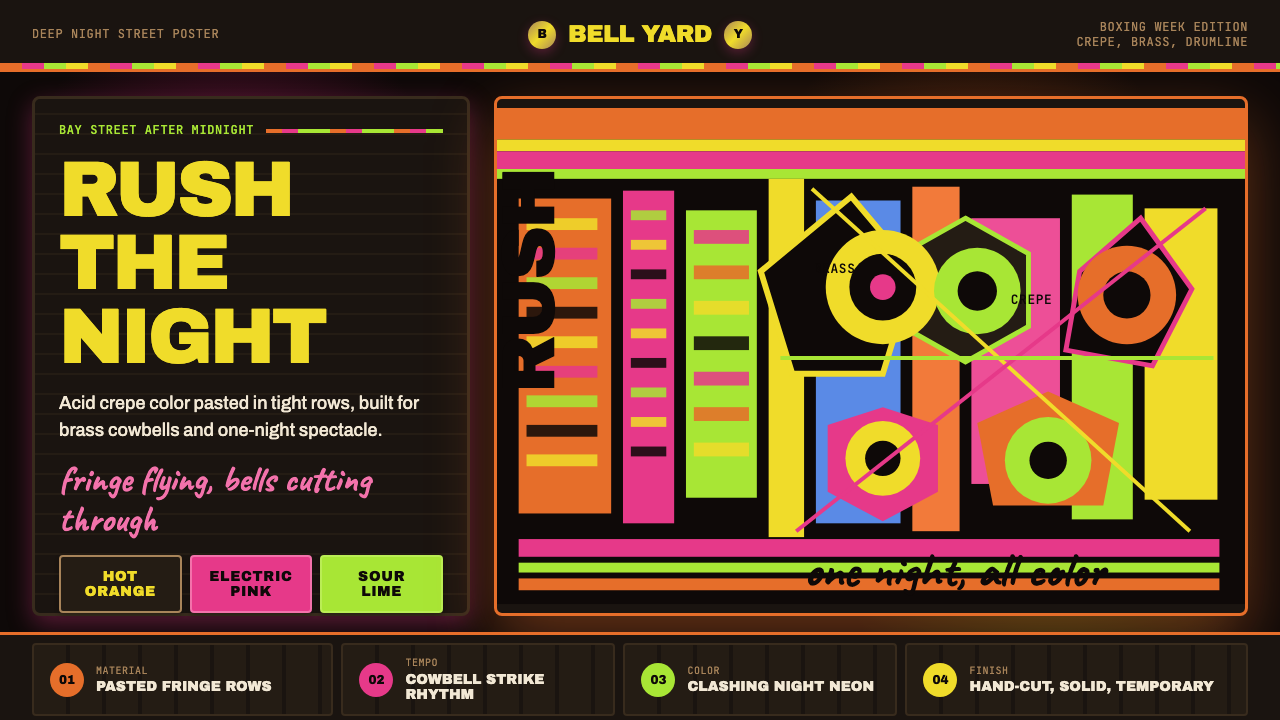 Bahamian Junkanoo CowbellNight refuses silence. Acid crepe stripes and block type collide like cowbell…
 Filipino JeepneyLoud steel, made personal. Chrome gradients carry neon stripes and hand-lette…
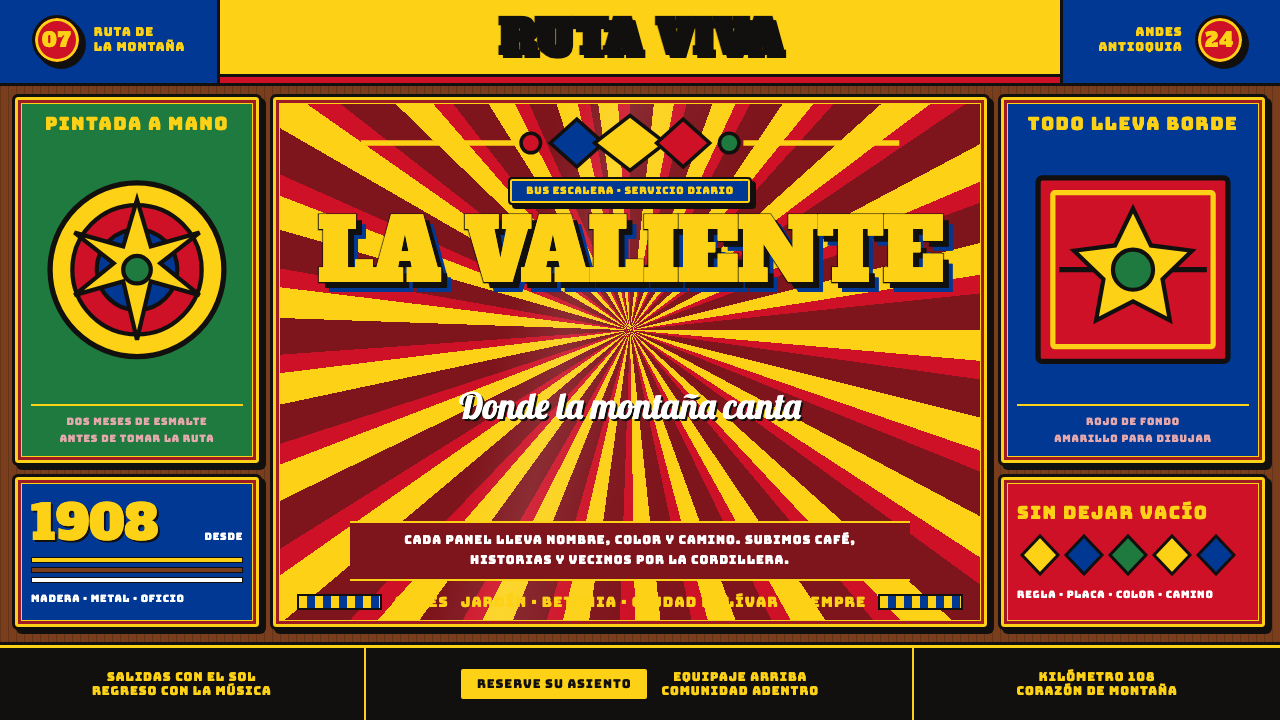 Colombian Chiva BusNothing is left unpainted. Flag-yellow rules, slab lettering and black keylin…
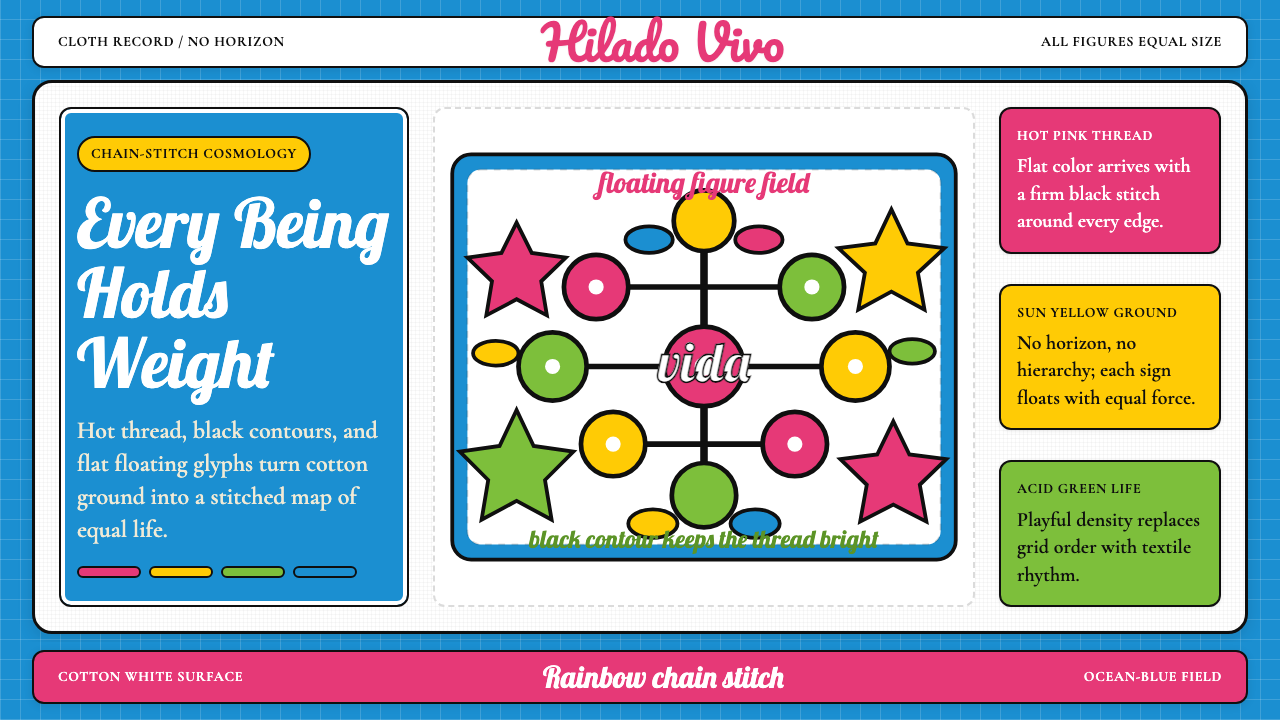 Mexican Otomi TenangoAll life floats equally. Ocean blue, hot pink, sun yellow, acid green, black…
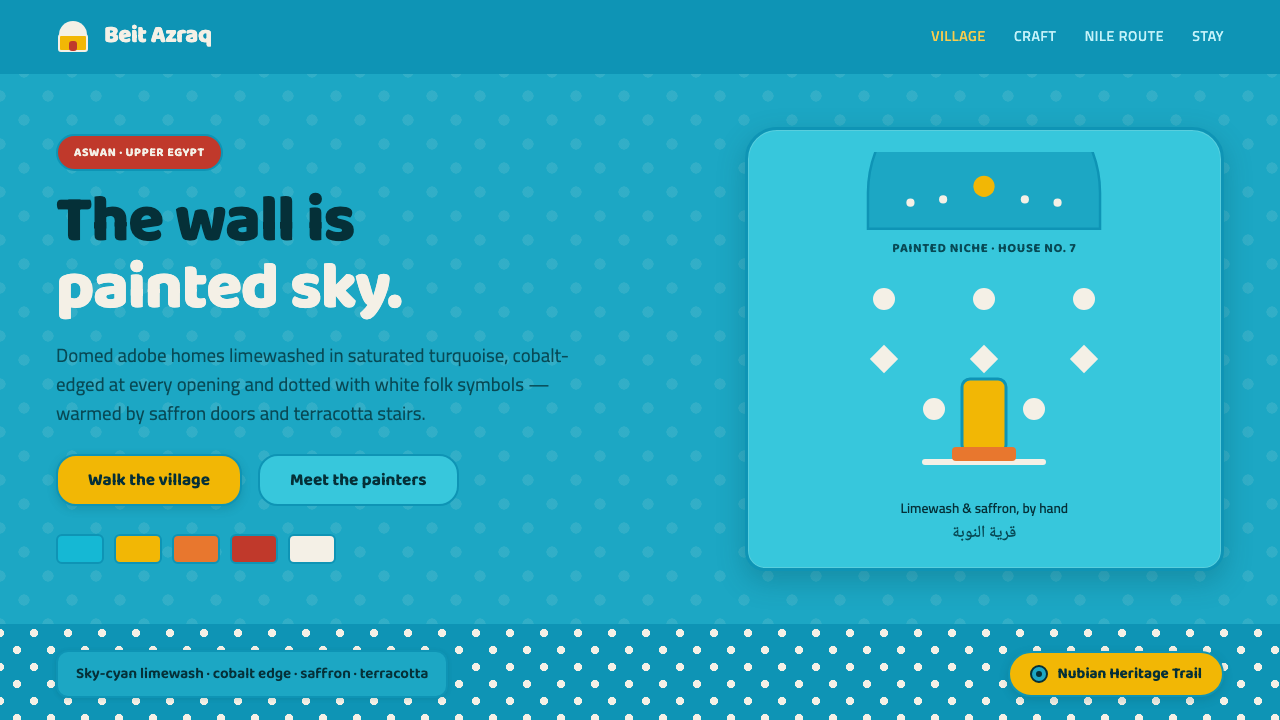 Nubian House BlueThe wall is the page. Sky-cyan limewash, cobalt-edged niches, white folk dots…