What is Tahitian Tifaifai (Appliqué Quilt)?
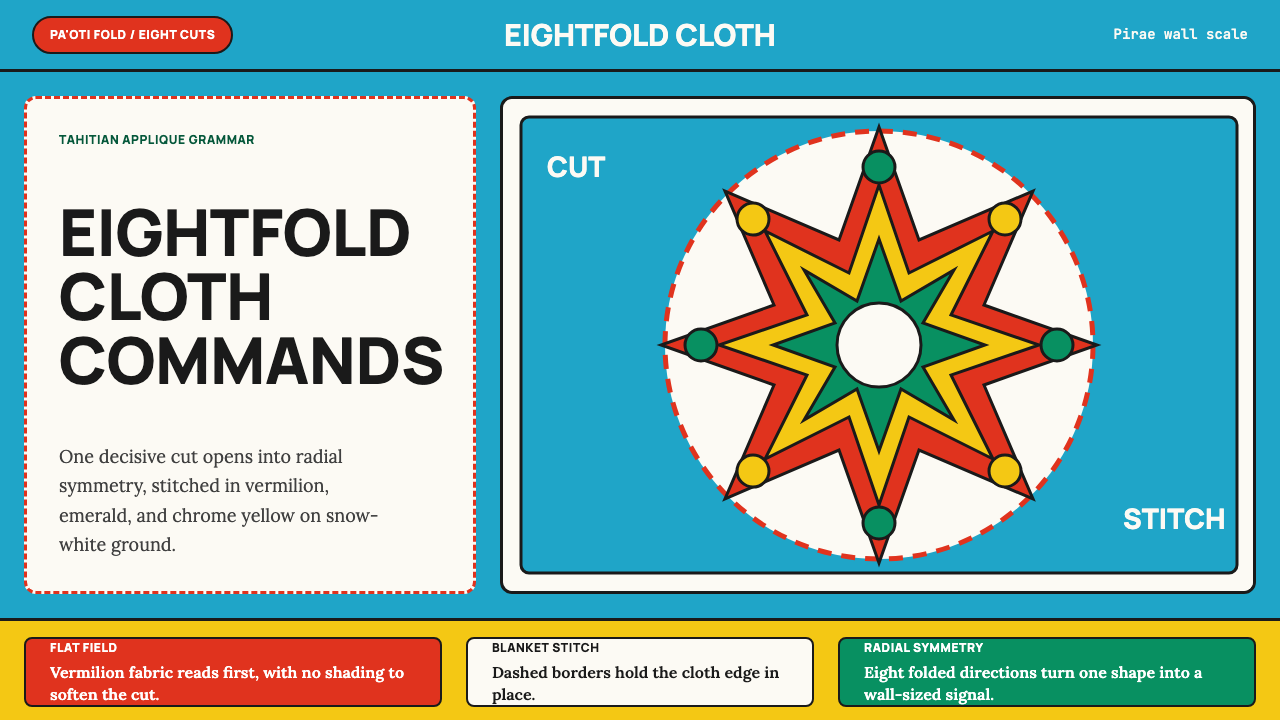
Tifaifai cuts the world into bold, symmetrical flora and stitches it onto a contrasting ground — the graphic logic of a Pacific island living wall, encoded as a design system.
Tahitian Tifaifai (Appliqué Quilt) in brief
Tifaifai is the traditional Tahitian appliqué quilt — a large textile form in which fabric is folded eight times, cut into radially symmetrical botanical shapes such as breadfruit leaves, hibiscus blossoms, or mango branches, then hand-stitched onto a ground cloth in a contrasting color. The result is a single powerful motif that commands the entire surface, with no filler pattern, no gradation, and no hierarchical background. The shape and the ground are equals locked in chromatic tension.
As a visual design system, Tifaifai translates this textile logic directly into interface and composition principles. Flat color fields replace gradients and texture. Shapes are decisive, large-scale, and botanically specific — not abstract. Contrast is the primary tool: every composition pairs a warm assertive foreground with a cool or neutral ground, or vice versa, such that each element reads instantly from a distance. Nothing blurs; nothing fades. The eye lands on the motif and stops.
The style sits at an unusual intersection: it is simultaneously traditional craft, Pacific cultural identity, and a graphic sensibility that anticipates contemporary bold-color flat design by over a century. A tifaifai hung in a Pirae home in 1970 and a contemporary poster with a single large botanical silhouette share the same core decision — give one shape the whole wall, and trust the contrast to do the rest.
Where does Tahitian Tifaifai (Appliqué Quilt) come from?
The tifaifai tradition emerged in the Society Islands — principally Tahiti, Mo'orea, and Raiatea — following the arrival of Christian missionaries in the 1820s and 1830s. Protestant missionaries from England and America introduced Western quilting techniques as part of a broader program to replace pre-Christian dress and textile practices with forms they considered appropriate. Tahitian women, already skilled in the art of tapa cloth production — beating bark into fine sheets and dyeing them with botanical pigments — encountered European appliqué and patchwork and immediately began transforming these imported techniques according to their own aesthetic sensibilities.
What emerged was not a copy of European quilting but a genuinely new form. Tahitian makers largely rejected the block-based patchwork structure common in American and British quilting, preferring instead a single large appliqué motif cut from folded fabric — a technique that produces the eight-fold radial symmetry characteristic of the form. The botanical imagery drawn upon — breadfruit, hibiscus, tiare gardenia, banana leaves — was already central to Polynesian visual culture and carried deep associative meaning. The tifaifai thus fused a newly introduced craft technology with indigenous botanical iconography and a pre-existing aesthetic preference for bold, high-contrast visual statements.
Through the nineteenth and early twentieth centuries, tifaifai became embedded in the ceremonial and social fabric of Tahitian life. Large tifaifai were — and continue to be — made for births, marriages, and deaths; they are presented as gifts that mark the most significant passages of a person's life. The scale of a tifaifai is itself significant: these are not decorative accents but commanding textiles designed to occupy entire walls or serve as ceremonial wrappings. Their making is a communal activity, with women gathering to cut, stitch, and complete pieces over extended periods. This collective dimension means the tifaifai carries not just visual but social meaning.
Scholarship on tifaifai developed significantly in the late twentieth century, with researchers including Joyce D. Hammond and Anne D'Alleva examining the form's cultural negotiation between missionary influence and Polynesian agency. Institutions including the Musée de Tahiti et des Îles and exhibitions organized through the Heiva i Tahiti festival have ensured ongoing visibility for the tradition. The Tahitian Quilters Association and contemporary Polynesian craft revival movements have continued to develop the form, with makers like Hinatea Colombani and Lisa Schiller bringing tifaifai into dialogue with contemporary fiber art while maintaining the core visual logic of bold symmetry and high contrast.
What defines the Tahitian Tifaifai (Appliqué Quilt) look?
Radial Symmetry
Every tifaifai motif is built on eight-fold radial symmetry — the natural consequence of cutting folded fabric. This produces compositions where a single botanical form radiates from the center in all directions simultaneously, creating a visual weight that is perfectly balanced without being static. Unlike bilateral symmetry, which implies a spine and two sides, radial symmetry implies a center of gravity and an outward expansion. The result reads as both contained and expansive, like a window onto a larger pattern that extends beyond the frame.
Flat Color Fields
The tifaifai palette is built from pure, unmixed color fields with no gradients, no shading, and no texture simulation. Foreground and background are each a single, unmodulated hue. The chromatic relationship between them does all the expressive work: a vermilion motif on a snow-white ground reads as festive and bold; the same motif reversed reads as more contained and ceremonial. This flatness is not a limitation of the textile medium — it is a deliberate aesthetic choice that predates digital flat design by more than a century.
Botanical Specificity
Unlike abstract geometric design systems, tifaifai motifs are always recognizable as specific plants — breadfruit with its lobed leaves, hibiscus with its trumpet form, tiare with its pinwheel petals. This botanical specificity is not decorative sentimentality; it connects each piece to the material ecology of French Polynesia and gives the motif cultural grounding that abstract shapes cannot carry. In design application, this translates to a preference for large, legible, and iconically specific shapes over abstraction — silhouettes that name something rather than merely suggest.
Scale and Dominance
A tifaifai is made to dominate its environment. Traditional examples occupy entire walls or wrap large ceremonial objects; the scale is non-negotiable. This principle of scale-as-statement translates directly into design practice: a tifaifai-derived composition commits to one primary visual element at a size that commands the entire surface, rather than distributing interest across multiple competing elements. Secondary elements — borders, text labels, supporting graphics — are kept narrow and subordinate. The primary motif and its ground is the composition.
High Chromatic Contrast
The contrast between motif and ground is never subtle in tifaifai — these textiles were made to be read across a room. The color pairs chosen are typically complementary or near-complementary: warm against cool, vivid against neutral, deep against pale. Intermediate tones that would soften the transition are absent by convention. This high contrast is both visual and symbolic: it declares the distinction between figure and ground, between the made object and the space around it, as something worth marking emphatically.
Ceremonial Weight
Tifaifai are not everyday objects — they are made for, and carry the weight of, life's most significant moments: birth, marriage, death. This ceremonial purpose inflects the aesthetic: there is nothing casual or provisional about the visual decisions. Forms are complete, not sketched. Colors are resolved, not exploratory. The composition arrives at its final state and holds it without apology. In design terms, this translates to a visual register that feels definitive rather than tentative — surfaces that project confidence and intentionality rather than iteration.
No Negative Space as Emptiness
In tifaifai, the ground cloth is not background in the neutral sense — it is the second element of a two-element composition, as active and as considered as the applied motif. The spaces between the botanical cutouts are not gaps; they are the ground color expressing itself through the silhouette of the motif. This mutual activation of figure and ground is one of the style's most sophisticated visual qualities, and it distinguishes tifaifai-derived design from compositions where background is merely fill.

Who shaped Tahitian Tifaifai (Appliqué Quilt)?
A contemporary Tahitian quilt maker whose work has been central to bringing tifaifai into dialogue with international fiber art communities while maintaining the formal precision and cultural specificity of the traditional form. Her pieces have been exhibited in contexts that position tifaifai not as folk craft but as a sophisticated graphic tradition with its own internal logic and historical depth.
An American scholar whose research on tifaifai — particularly her work on the symbolic content of botanical motifs and the social context of communal quilt-making — produced some of the first serious academic treatment of the form in English. Her writings helped establish tifaifai as a subject for material culture studies and positioned its visual conventions within a broader analysis of Polynesian aesthetic agency.
An art historian whose work on Polynesian visual culture examined tifaifai in the context of the larger negotiation between missionary influence and indigenous aesthetic practice in the Society Islands. Her analysis drew attention to the ways in which Tahitian women actively transformed imported techniques rather than passively receiving them — a reading that repositioned tifaifai from 'influenced craft' to 'creative synthesis.'
A quilt artist and educator who has worked to document and teach tifaifai technique to new generations of practitioners both within French Polynesia and internationally. Her work occupies the intersection of preservation and pedagogy, ensuring that the technical knowledge embedded in the tradition — how to fold, cut, and stitch to achieve the characteristic radial symmetry — remains transmissible beyond its original geographic and cultural context.
How do you use Tahitian Tifaifai (Appliqué Quilt) today?
Tifaifai is a high-commitment visual style. It does not layer well with other aesthetics, and it resists the kind of incremental, element-by-element application that more modular design systems invite. To use it well, you commit to its core logic: one dominant botanical shape, two high-contrast color fields, no gradients, no intermediate tones, and the confidence to let that arrangement fill the entire surface without supplementation. Partial application — borrowing the color palette while keeping a busy layout, or using the symmetry principle while softening the color contrast — typically produces results that feel neither tifaifai nor anything else.
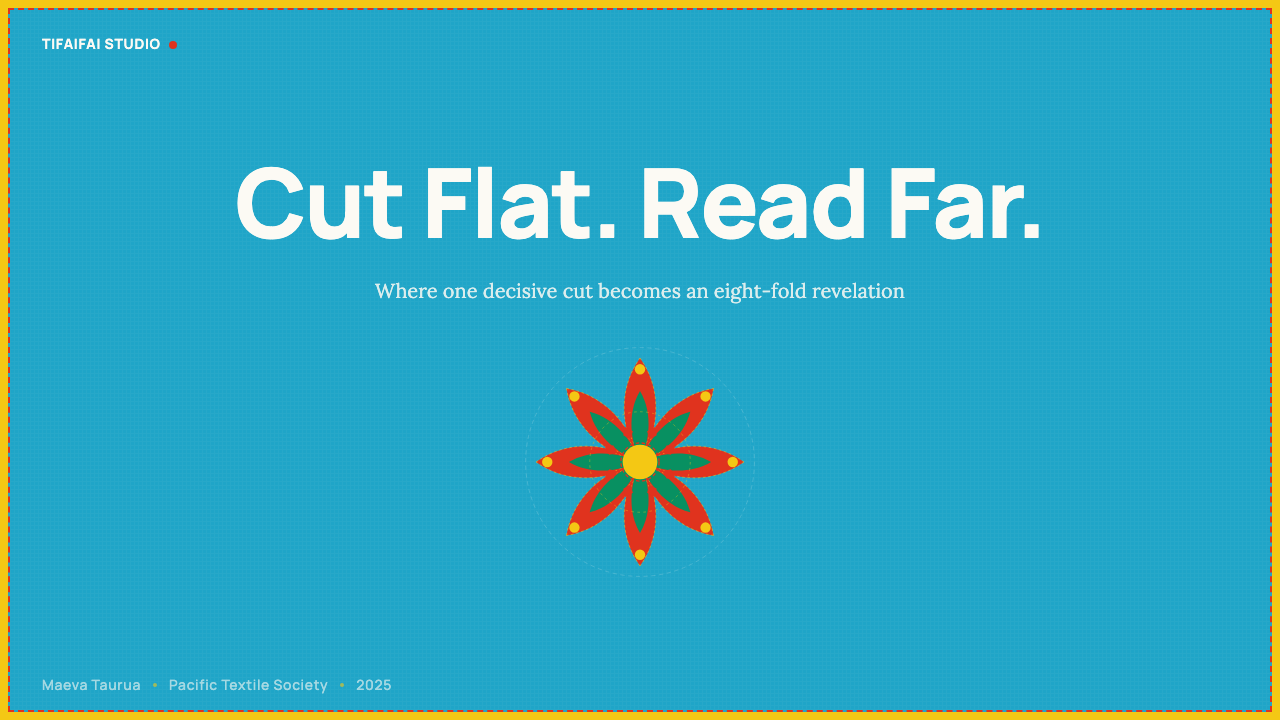
For presentation slides, tifaifai logic works most powerfully on covers and section dividers. A cover built around a single large botanical silhouette in a vivid foreground color against a stark contrasting ground immediately signals that the work inside has been made with intention. The motif should be allowed to extend to the edges of the frame rather than being centered with generous margins — tifaifai fills its format. Content slides demand a different translation: the botanical silhouette becomes a background element at reduced scale, the two-color logic governs accent and background, and type is set with the same decisiveness — large, clear, no decorative secondary typefaces.
For web interfaces, tifaifai is most effective in full-page hero sections and splash screens, where its scale-as-statement logic can be honored. A hero section built around a large central botanical illustration in high-contrast flat color, with a call-to-action in the contrasting ground color, is direct and memorable. Dashboard and data interfaces are more challenging: the style's commitment to a single dominant element sits in tension with data density. The resolution is to apply tifaifai logic to navigation, headers, and state indicators, while treating data areas as neutral ground — letting the structure frame the data rather than compete with it.
For editorial and marketing work, tifaifai-derived layouts work well in print and large-format digital contexts where bold visual claims are appropriate. A poster or marketing page that gives a single botanical form the majority of the surface, keeps body text narrow and subordinate, and uses a two-color palette throughout will land with the same directness as its textile source. The style also carries cultural specificity — its botanical imagery and Pacific provenance are not neutral signifiers. Using it in work that has genuine resonance with Polynesian themes reads as referential; using it as purely aesthetic selection without cultural context risks appearing superficial. The more specific and committed the application, the more the style rewards.
The most common mistake is treating tifaifai as a decorative motif rather than a compositional logic. Adding a tifaifai-inspired botanical border to an otherwise standard layout, or using the symmetrical motif as a small repeating tile, misses the point entirely — the style's power comes from the motif's dominance of the total surface, not from its decorative presence within a surface organized by other principles. Similarly, softening the color contrast to make the design feel more versatile undermines the defining quality. Tifaifai is a style that asks for total commitment; a half-hearted version produces half-hearted results.
Tahitian Tifaifai (Appliqué Quilt) — FAQ
Is tifaifai related to Hawaiian quilting?
Yes — Hawaiian quilting and tifaifai share a common origin in the same wave of missionary contact with Polynesia in the early nineteenth century, and both traditions developed the characteristic folded-and-cut single-motif appliqué form rather than the block-based patchwork more common in American mainland quilting. The visual results are closely related: both use large central botanical motifs, high contrast between motif and ground, and radial symmetry. However, tifaifai and Hawaiian quilts developed independently across their respective island groups, and there are meaningful differences in motif repertoire, color palette traditions, and ceremonial context. Neither form is derived from the other; both represent independent creative responses to similar missionary influence.
How should the botanical motif be chosen when applying this style to a non-Tahitian context?
Tifaifai's botanical specificity is central to its cultural meaning — breadfruit and hibiscus are not arbitrary shapes but plants with deep significance in Polynesian life. When applying the visual logic of the style in other contexts, you face a genuine choice: use the traditional Tahitian botanical vocabulary and acknowledge the cultural reference explicitly, or substitute botanicals that have meaning in the specific cultural or product context you are working in. The latter approach can produce work that honors the compositional logic of tifaifai while rooting it in local material culture. What to avoid is treating the botanical motif as purely decorative shape-filling — the specificity of the plant is not incidental to the tradition.
Can tifaifai work with more than two colors?
Traditional tifaifai is built on a two-color relationship — one color for the appliqué motif, one for the ground cloth. This constraint is not incidental; it is the source of the form's visual power. The moment a third color is introduced, the composition begins to subdivide, and the absolute figure-ground tension that makes tifaifai so arresting begins to diffuse. In contemporary and experimental work, multi-color tifaifai do exist — typically using a bordered or graduated motif — but these are departures from the core convention. For design applications, the two-color discipline is worth maintaining: use accent color for text, borders, or call-to-actions within one of the two primary fields, rather than introducing a full third hue.
Does tifaifai lend itself to dark-mode or dark-ground layouts?
Yes — and some of the most striking traditional tifaifai use dark grounds. A deep emerald ground with a white or ivory motif, or a midnight blue ground with a golden motif, reads with the same high-contrast logic as the more common light-ground examples. The key principle is that the contrast between motif and ground must remain absolute: both must be pure, unmodulated fields with no softening intermediate tones. Dark-ground tifaifai-derived design works particularly well in contexts that call for gravitas and formality — invitations, ceremonial communications, high-end product packaging — where the dark ground amplifies the weight of the occasion rather than reading as trendy.
How does tifaifai relate to the broader category of Pacific Island textile arts?
Pacific Island textile traditions are enormously varied — from the geometric warp-ikat weaving of some Micronesian groups to the plaited pandanus fiber mats of Samoa and Tonga to the bark cloth (tapa) traditions widespread across Polynesia. Tifaifai occupies a specific position within this diversity: it is the form that emerged most directly from contact with Western quilting technology, and its graphic language of high-contrast botanical silhouettes on flat color grounds is distinct from both the geometric precision of Pacific weaving traditions and the texture-based aesthetics of tapa. It is not representative of Pacific textile art as a whole — it is a specifically Tahitian and Society Islands form with its own history, its own ceremonial context, and its own visual logic.
Related design styles
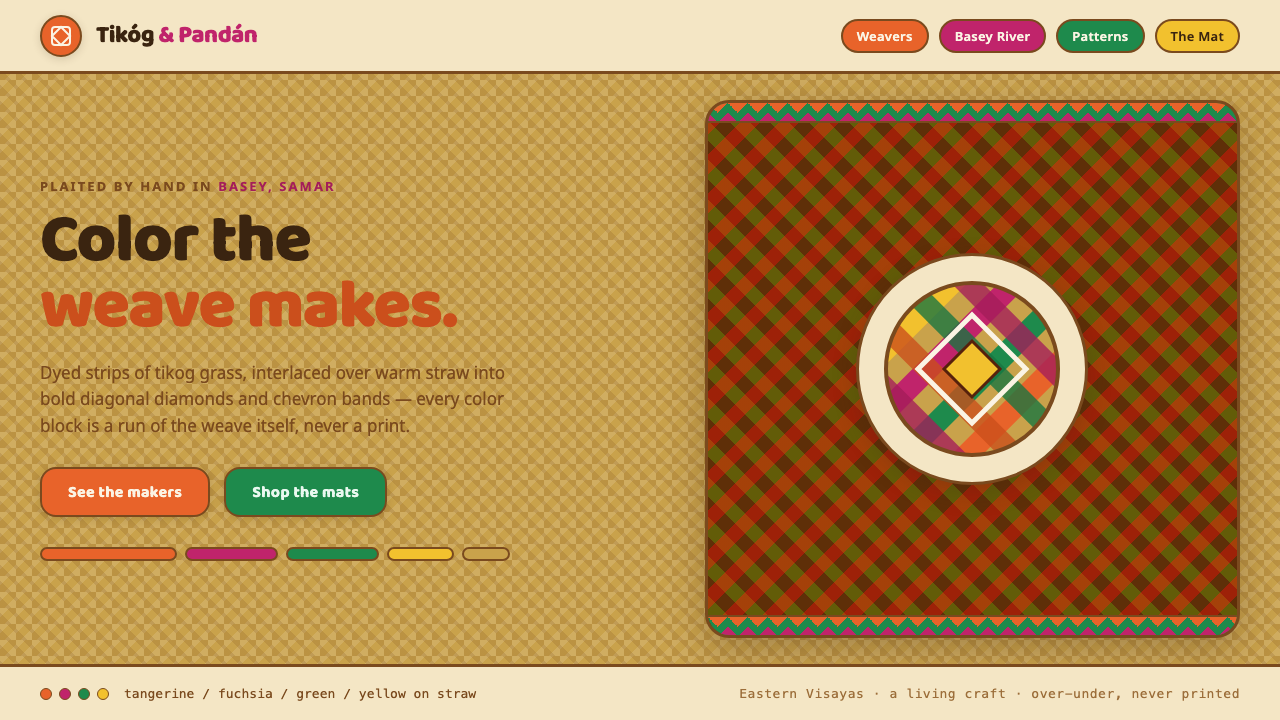 Banig Pandan MatHandwoven Filipino joy. Tangerine, fuchsia and green strips plaited into diag…
 Channapatna Lacquered ToysGloss feels handmade. Lac-red ground and turmeric-indigo bands turn pixels in…
 Cook Islands TivaevaeSaturated craft sings. Hibiscus pink carries mirror-fold florals in flat appl…
 Ethiopian Injera Mesob SpreadHospitality is woven in. Berbere red, flag bands, and an injera field hold th…
 Fiji Bula Floral ShirtLoud cloth, zero quiet corners. Teal ground carries orange blooms and magenta…
 KFC Colonel (1952)Roadside appetite, turned up loud. Enamel red stripes and slab-serif shouts f…