What is Barbie Dreamhouse?
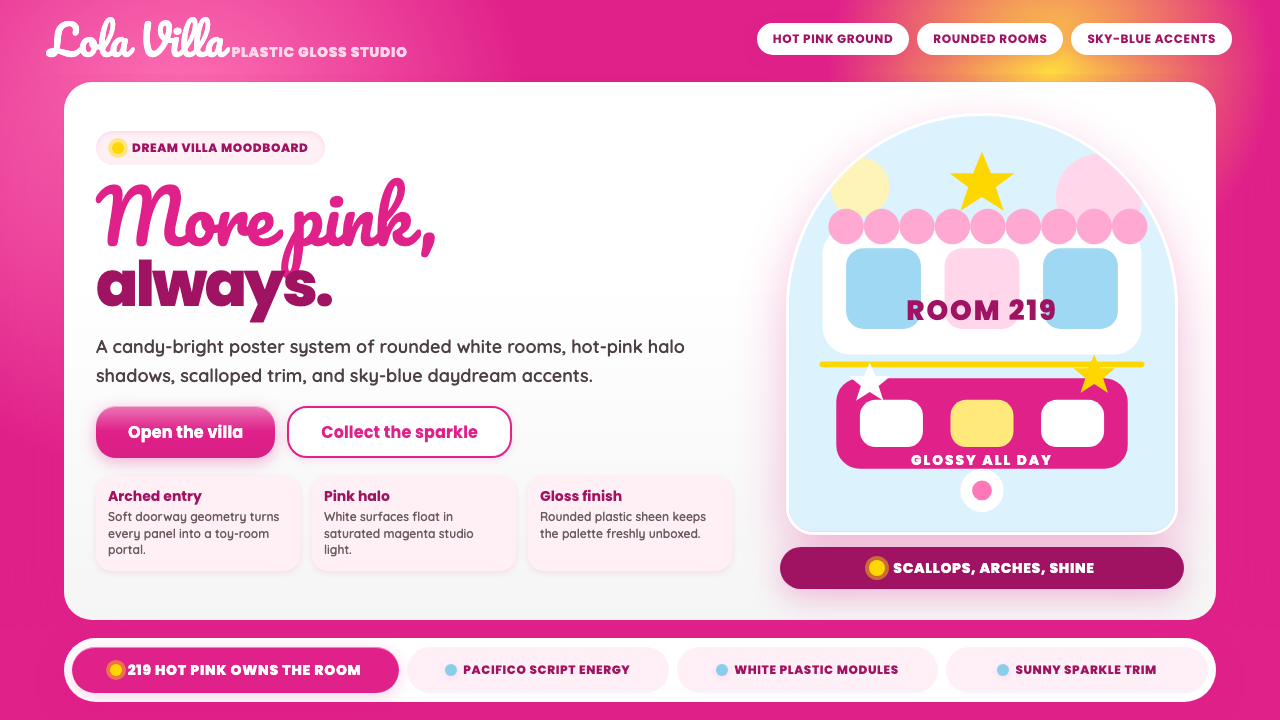
Barbie Dreamhouse turns pink into a complete worldview — glossy arches, scalloped edges, and script lettering declare that more is always more.
Barbie Dreamhouse in brief
Barbie Dreamhouse is a design system rooted in aspirational femininity, built around an all-encompassing hot pink ground, rounded forms, glossy surfaces, and a playful combination of script and rounded sans-serif lettering. Every element in the system — from doorway silhouettes to shadow treatment to typographic pairing — reinforces a single emotional register: confident, joyful, and unapologetically maximalist.
Unlike design movements grounded in restraint, Barbie Dreamhouse embraces saturation and repetition as virtues. The signature color is not used as an accent or a highlight but as the atmosphere itself. Walls, floors, furnishings, vehicles, and backgrounds share the same warm, luminous pink field, creating a unified visual world where the environment and the objects within it feel inseparable. This total-immersion strategy is the system's defining characteristic and its primary emotional tool.
The system's vocabulary is deliberately soft: arched doorways instead of rectangular frames, scalloped hems instead of straight edges, bubble letterforms instead of angular type, gentle gloss instead of matte flatness. Depth is suggested through soft, diffuse highlights and warm-toned shadows that read as glamorous rather than structural. The overall effect is one of theatrical warmth — a stage set for fantasy that invites participation rather than observation.

Where does Barbie Dreamhouse come from?
The Barbie doll was created by Ruth Handler and launched by Mattel at the American International Toy Fair in March 1959. Handler was inspired by watching her daughter Barbara imagine adult scenarios for paper dolls, and she conceived of a three-dimensional adult fashion doll that could embody aspiration and possibility rather than domesticity. The doll's full name — Barbara Millicent Roberts — was rarely used; she was simply Barbie, and from the beginning her visual identity was anchored in a particular shade of warm, saturated pink that Mattel would eventually formalize in partnership with Pantone.
The first Barbie Dreamhouse arrived in 1962, just three years after the doll's debut, and established the architectural vocabulary that would define the franchise for decades. The dollhouse format gave Mattel's designers a literal stage on which to develop a complete interior world: arched openings, pastel furnishings, and an abundance of pink as both structure and decoration. Over the following decades the Dreamhouse was reimagined repeatedly — gaining swimming pools, elevator shafts, spiral staircases, and increasingly elaborate facades — but the core visual grammar remained stable: everything curved, everything pink, everything glamorous.
The Barbiecore cultural moment of 2022 and 2023 marked the style's most significant expansion beyond the toy aisle. Sparked initially by fashion circles rediscovering and celebrating hyper-feminine aesthetics, Barbiecore was then crystallized into a fully realized design language by director Greta Gerwig's 2023 live-action film. Production designer Sarah Greenwood and set decorator Katie Spencer constructed a physical Barbieland in which the architecture, props, and landscape were all rendered in the system's signature vocabulary — arched facades, scalloped trim, and an overwhelming chromatic saturation — establishing a definitive visual reference that has since influenced fashion, interiors, digital design, and marketing worldwide.
The cultural resonance of Barbie Dreamhouse draws on several decades of contested meaning around pink as a gendered color. Pink's association with femininity in Western consumer culture is largely a twentieth-century construction — in earlier centuries, pink was considered a warm, energetic color more appropriate for boys, while blue was seen as delicate and suitable for girls. The reversal hardened during the mid-twentieth century, coinciding almost exactly with Barbie's launch. The Dreamhouse aesthetic participates in and ultimately reclaims this history, deploying pink not as a passive or diminutive signal but as a loud, assertive, world-filling declaration. Feminist reclamation of the style — the recognition that embracing pink maximalism can be a form of defiance rather than conformity — is central to why Barbiecore resonated so strongly with adult audiences.
What defines the Barbie Dreamhouse look?
Color Field
The dominant tone is a warm, intense hot pink — not a pastel blush, not a dusty rose, but a fully saturated, almost luminous magenta-pink that reads as both cheerful and authoritative. This color functions as the ground for nearly everything else: it appears in backgrounds, shadows, architectural elements, and surface textures simultaneously, creating a monochromatic envelope rather than a color accent. Secondary tones — soft lilac, warm cream, bright white, occasional coral — appear as relief against the primary field without ever challenging its dominance.
Form and Silhouette
Every structural element favors curvature over angularity. Doorways are arched, windows are rounded, furniture legs curve outward, and rooflines describe gentle arcs. Scalloped edges — the repeating half-circle pattern derived from decorative trim — appear consistently on awnings, skirt hems, table edges, and architectural borders. The absence of hard right angles is not incidental: it is the system's primary way of signaling comfort, approachability, and femininity as traditionally coded softness.
Surface and Gloss
Surfaces are rendered with a high-gloss finish that recalls lacquered plastic, patent leather, and polished resin. Highlights are soft and diffuse rather than sharp and specular, suggesting a warm, ambient glow rather than a point-source reflection. This glossiness is crucial to the system's emotional meaning: it reads as aspirational luxury, the visual equivalent of something beautiful and untouchable. Matte or textured surfaces rarely appear; when they do, they function as contrast elements rather than as the dominant surface quality.
Typography
The typographic system pairs a flowing, informal script face — recalling the cursive signature of the Barbie logo itself — with a rounded, friendly sans-serif for display and body use. Script letterforms carry the system's sense of personal warmth and signature authority; they appear in titles, taglines, and moments of emotional emphasis. The rounded sans-serif provides legibility and structure without introducing the geometric austerity of classical grotesque faces. Together, the pairing produces a register that feels both polished and handmade, aspirational and intimate.
Shadow and Dimension
Depth is achieved through warm-toned, soft shadows that suggest gentle three-dimensionality without breaking the system's fantasy logic. Shadows are typically pink-adjacent — slightly deeper or more saturated versions of the background tone rather than neutral grays or cool blacks — which maintains the monochromatic envelope even in darker areas. This approach differs fundamentally from either the flat, shadow-free surfaces of contemporary digital minimalism or the hard, offset shadows of graphic design traditions: the shadows here are atmospheric, meant to feel like stage lighting rather than simulated physics.
Ornament and Decoration
Unlike design systems that treat ornament as waste, Barbie Dreamhouse treats decoration as structural. Scallops, bows, floral motifs, star accents, and repeating geometric borders are not applied to an otherwise complete design but are woven into the system's fundamental grammar. The guiding principle is not 'does this element earn its place' but rather 'does this element add to the sense of joyful abundance.' More is understood as more, and the restraint exercised is one of color temperature and tonal range rather than decorative quantity.
Spatial Logic
The Barbie Dreamhouse spatial vocabulary is theatrical rather than architectural. Spaces are organized around display and visibility — rooms are often open-fronted, furniture is arranged facing outward, and sightlines are carefully managed to maximize the sense of abundance within the frame. In two-dimensional applications, this translates to centered, symmetrical compositions where objects are displayed rather than arranged, and generous scaling ensures that key elements — the logo, the product, the headline — feel larger than life. The stage-set logic prioritizes emotional impact over spatial efficiency.

Who shaped Barbie Dreamhouse?
Ruth Handler co-founded Mattel with her husband Elliot in 1945 and created the Barbie doll in 1959, naming it after her daughter Barbara. Handler's core insight — that girls wanted to imagine themselves as adults rather than play at being mothers — produced a doll whose entire design ecosystem was organized around aspiration, fashion, and self-projection. She also created Ken in 1961, named after her son. Handler's original vision established the foundational values of the Barbie design system: femininity as empowerment, play as a rehearsal for limitless possibility, and pink as the visual language of a world entirely the doll's own.
Jill Barad joined Mattel in 1981 and rose to become its CEO in 1997, the first woman to lead a major toy company. During her tenure she was the primary architect of Barbie's global expansion, overseeing the doll's transformation into a fully realized lifestyle brand with hundreds of career iterations, globally diverse versions, and a cohesive visual identity that extended the Dreamhouse aesthetic into packaging, marketing, and retail environments. Her aggressive brand-building strategy established Barbie as a cultural institution rather than simply a toy, and the visual consistency she enforced across categories laid the groundwork for the style's later recognition as a coherent design system.
As director of the 2023 live-action Barbie film, Greta Gerwig transformed a toy franchise's visual vocabulary into a fully articulated cinematic design language. Working with production designer Sarah Greenwood, Gerwig oversaw the construction of physical sets — arched facades, scalloped trim, overscaled furniture, and saturated pink throughout — that gave the Barbie Dreamhouse aesthetic its most rigorous and widely seen realization to date. The film's visual approach was deliberately maximalist and self-aware, treating the style's excesses as expressive tools rather than limitations. The resulting images circulated globally and defined the visual benchmarks for Barbiecore as a design movement.
Production designer Sarah Greenwood, working alongside set decorator Katie Spencer, was responsible for the physical realization of Barbieland in the 2023 film. Greenwood's approach involved meticulous research into the history of Mattel's Dreamhouse designs across decades, synthesizing their recurring visual motifs — the scalloped edges, the arched openings, the glossy finishes, the overscaled props — into a coherent built environment that could support both comedy and emotional weight. Her sets demonstrated that the Barbie Dreamhouse vocabulary is not merely decorative whimsy but a spatially coherent system with its own internal logic, capable of sustaining the full complexity of a designed world.
How do you use Barbie Dreamhouse today?
Barbie Dreamhouse is among the most emotionally immediate styles available for presentation and marketing work, precisely because its associations are so deeply embedded in popular culture. Applying it correctly requires understanding its emotional logic — the system is built around abundance, confidence, and theatrical warmth — rather than simply applying pink to an existing layout. The question to ask before deploying the style is whether the product or message genuinely benefits from that emotional register, and whether the audience will read the reference as intentional celebration rather than unironic kitsch.
For presentation slides, the style works most powerfully on cover slides and section dividers, where its theatrical boldness can operate at full scale. A Barbie Dreamhouse cover slide centers the title in a rounded, script-accented typeface against a saturated pink ground, with scalloped or arched framing elements that echo the dollhouse architecture. Content slides require more restraint: a warm cream or very light pink ground with the primary hot pink reserved for headings, callout boxes, and visual accents keeps the system readable across a full deck. Data slides benefit from the style's cheerful palette — bar charts in tonal variations of the primary pink, with white labels — which makes quantitative information feel approachable rather than clinical.
For web interfaces, Barbie Dreamhouse is well-suited to landing pages, marketing homepages, consumer-facing product pages, and event microsites where emotional impact and brand distinctiveness are the primary goals. The approach: use the saturated pink as a full-bleed background for hero sections, pair it with white or cream for text-heavy areas, and deploy the script typeface for headlines while reserving the rounded sans-serif for body copy and navigation. Buttons should feel rounded and tactile — slightly elevated, soft-shadowed, with color fills that suggest the lacquered plastic of the original toy. Dashboard or data-heavy interfaces are rarely suited to the style; its maximalism competes with information density rather than supporting it.
For editorial and marketing work, the style excels in contexts where the brand message is explicitly playful, celebratory, or reclaiming a traditionally feminine aesthetic. Campaign posters and social graphics benefit from the system's full visual force: centered composition, overscaled lettering, layered decorative elements, and that defining hot pink at maximum saturation. Print materials — packaging, invitations, promotional items — translate the system's gloss through paper stock and finish choices: coated stocks with soft-touch or gloss laminate, foil accents in warm metallic tones, and die-cut edges that echo the scalloped and arched silhouettes of the Dreamhouse itself.
A common mistake when applying Barbie Dreamhouse is confusing saturation with maximalism. Adding more decorative elements without coordinating them to the system's specific curvature-and-gloss logic produces visual noise rather than joyful abundance. The style's maximalism is disciplined: every element curves, every surface gleams, and the color envelope stays tight within the warm-pink-to-white range. Introducing cool tones, hard-edged geometric shapes, or high-contrast dark backgrounds immediately breaks the fantasy register. Similarly, pairing the style with serious or austere messaging creates a tonal mismatch that reads as either ironic or confused — the system works with confidence only when the communication it carries is as unambiguous in its warmth as the design itself.

Barbie Dreamhouse — FAQ
Is Barbie Dreamhouse the same as Barbiecore?
Barbiecore is the broader cultural and fashion trend that peaked in 2022 and 2023, characterized by the enthusiastic adoption of pink maximalism across clothing, interiors, and popular culture. Barbie Dreamhouse is more specific: it refers to the particular design vocabulary developed across decades of Mattel's Dreamhouse products and crystallized in the 2023 film — arched architecture, scalloped edges, glossy surfaces, script-and-rounded-sans typography, and the signature hot pink as an all-encompassing field. Barbiecore is the cultural moment; Barbie Dreamhouse is the specific visual system that most fully expressed it.
Can the style work without the signature pink?
The style can be partially translated to other warm, saturated color families — a coral-and-cream version, or a lilac-dominant variant — and retain much of its emotional character, because the structural vocabulary of arches, scallops, gloss, and rounded type carries substantial meaning on its own. However, removing the specific hot pink while keeping everything else produces a result that reads as Dreamhouse-adjacent rather than Barbie Dreamhouse proper. The color is not merely an attribute of the system — it is its primary identity signal, the first thing audiences recognize, and the element most directly tied to its cultural meaning. Translations that preserve the warmth and saturation direction while shifting hue can work in specific contexts, but they should be understood as variations on the theme rather than full expressions of the system.
How is Barbie Dreamhouse different from other feminine or pastel design styles?
Pastel design styles — think of the soft, desaturated pinks of contemporary wellness or beauty branding — typically use reduced saturation and quiet tonal ranges to convey gentleness, calm, and approachability. Barbie Dreamhouse does the opposite: it uses maximum saturation, high contrast between hot pink and white, layered decoration, and theatrical scale to convey confidence, exuberance, and aspiration. Where pastel aesthetics whisper, Barbie Dreamhouse shouts. The system is also more architecturally specific than generic feminine palettes — its scalloped edges, arched forms, and glossy surfaces are not interchangeable with other pink-adjacent styles but constitute a coherent spatial and material vocabulary with a particular cultural lineage.
Does the style suit serious or professional contexts?
Rarely in a direct application, but productively when the professional context is itself questioning or subverting expectations around seriousness. The Barbie Dreamhouse aesthetic has been used effectively in feminist discourse, in marketing for products that deliberately challenge conventions of what professionalism looks like, and in entertainment and events contexts where boldness and memorability are valued over authority. Applying it to genuinely serious contexts — financial services, healthcare, legal, enterprise software — typically produces tonal mismatch because the system's values are celebratory rather than authoritative. However, borrowing individual elements — the rounded typeface, a restrained use of warm pink as an accent — from the system without adopting its full maximalism can introduce warmth into professional contexts without the tonal collision.
What is the most common error when designers first apply this style?
The most common error is treating Barbie Dreamhouse as a color palette rather than a spatial and material system. Designers who apply only the pink — without adopting the rounded forms, the scalloped detailing, the glossy surface logic, and the script-plus-rounded-sans typographic pairing — produce work that looks pink without feeling like the Dreamhouse. The color alone does not carry the meaning; it is the complete combination of chromatic saturation, curvature, surface quality, and typographic warmth that produces the system's distinctive emotional effect. A second common error is undercommitting: the style does not work at half intensity. Muted pinks, minimal decoration, and restrained composition all pull against the system's fundamental logic. Barbie Dreamhouse requires full confidence in its own excess.
Related design styles
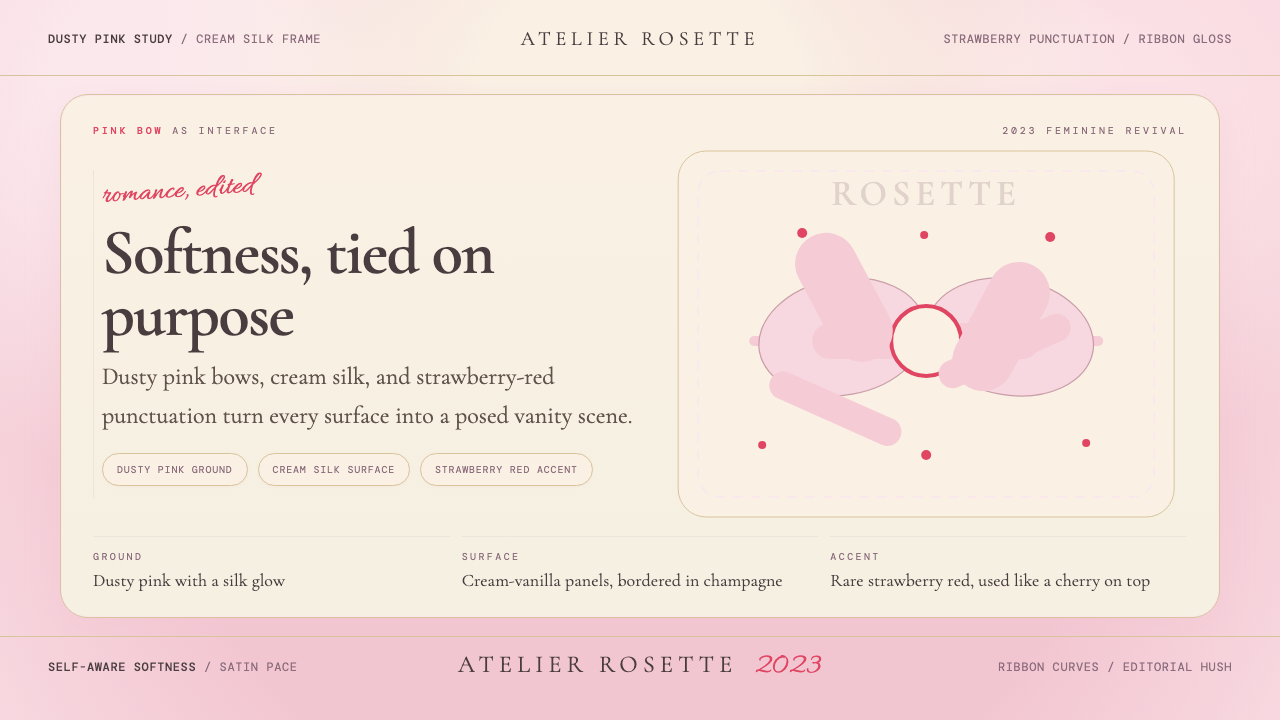 Coquette Aesthetic Pink Bow (2023)Softness is deliberate. Dusty pink, cream silk, and strawberry red frame ever…
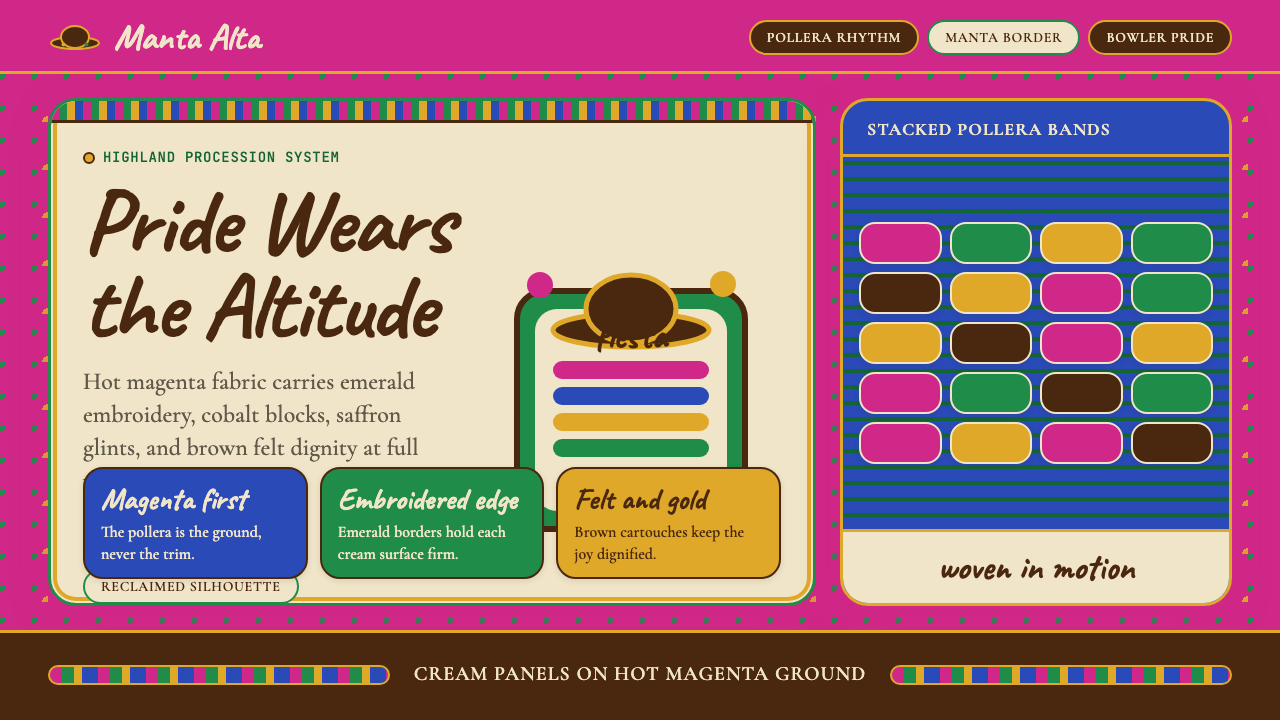 Bolivian Cholita (Bowler-Hat Fiesta)Loud pride, fully reclaimed. Magenta pollera bands, emerald borders, bowler c…
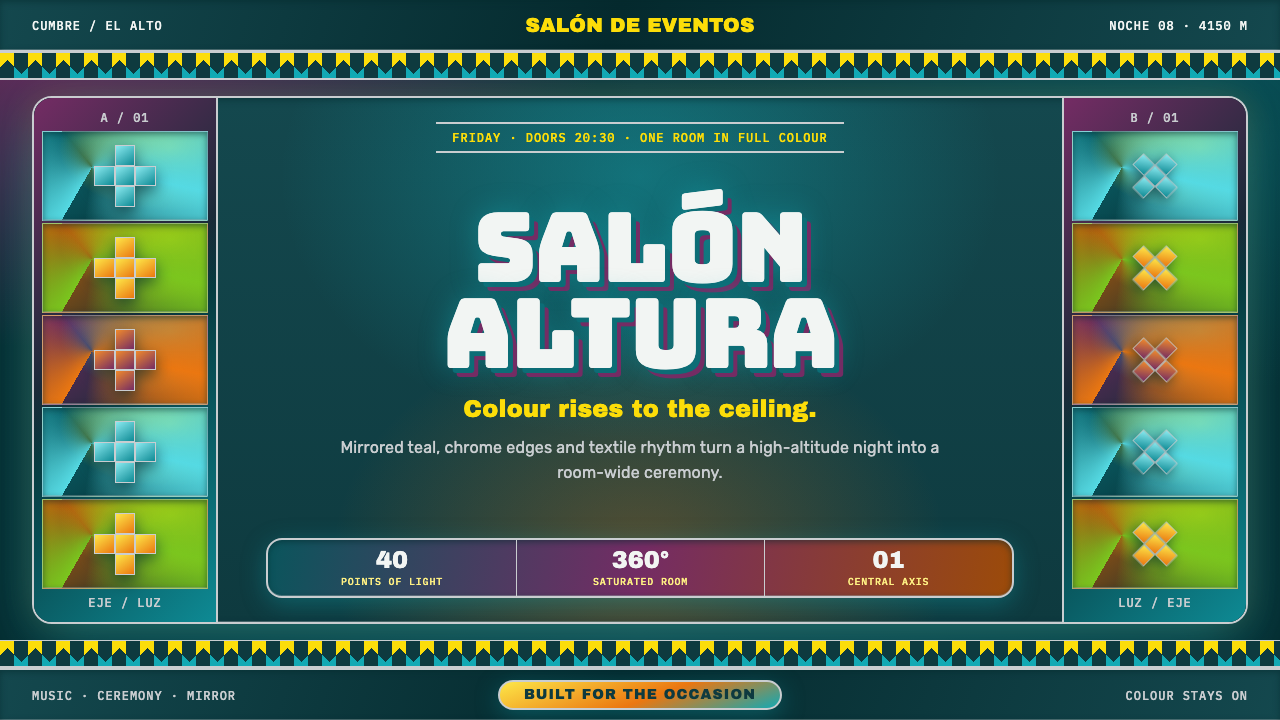 Cholet — Freddy MamaniSaturation is the architecture. Mirrored teal, chrome trim and textile geomet…
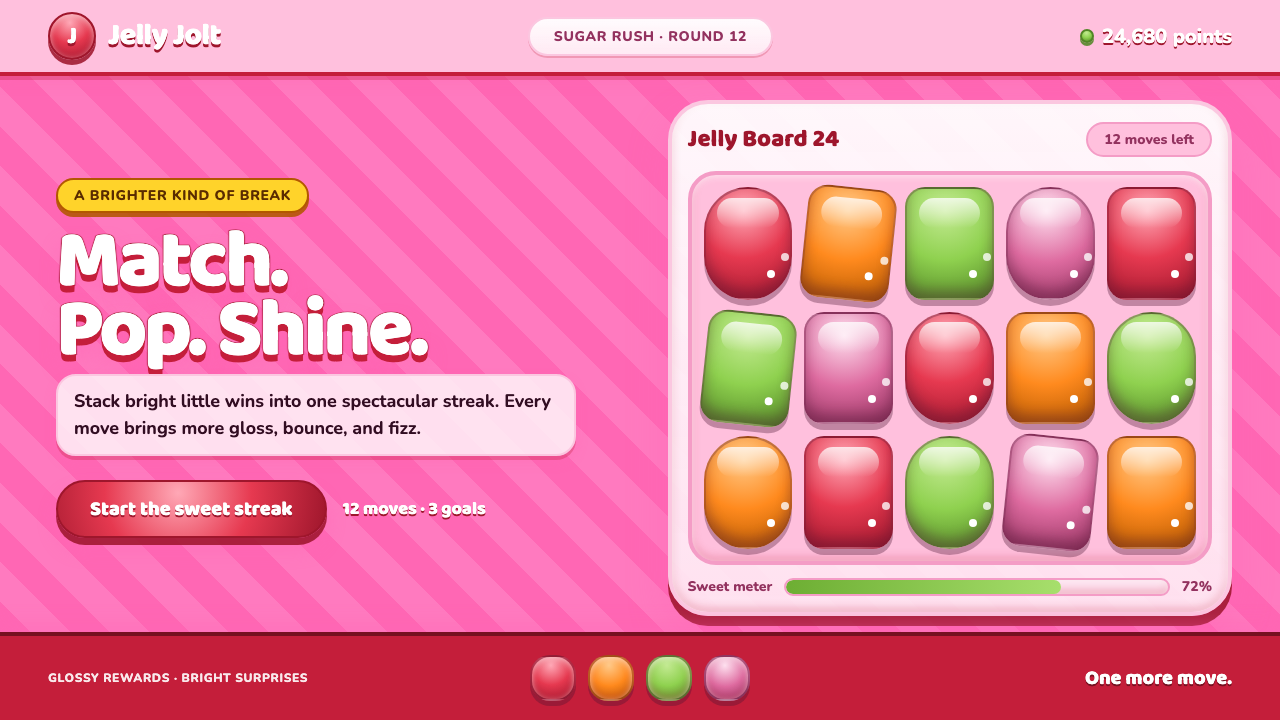 Candy Crush (2012)Sugar rush without restraint. Glossy candy tiles pulse across a striped bubbl…
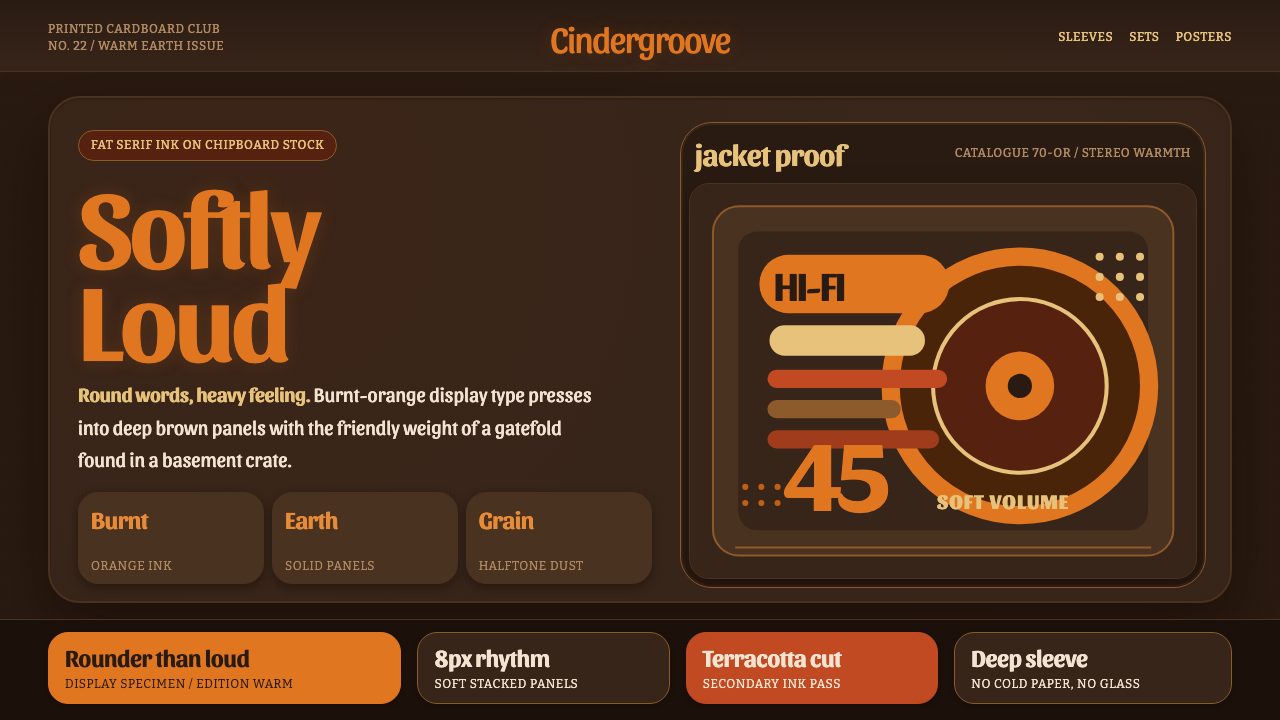 Cooper Black DisplayShouts softly. Burnt-orange Cooper type sinks into deep chipboard brown with…
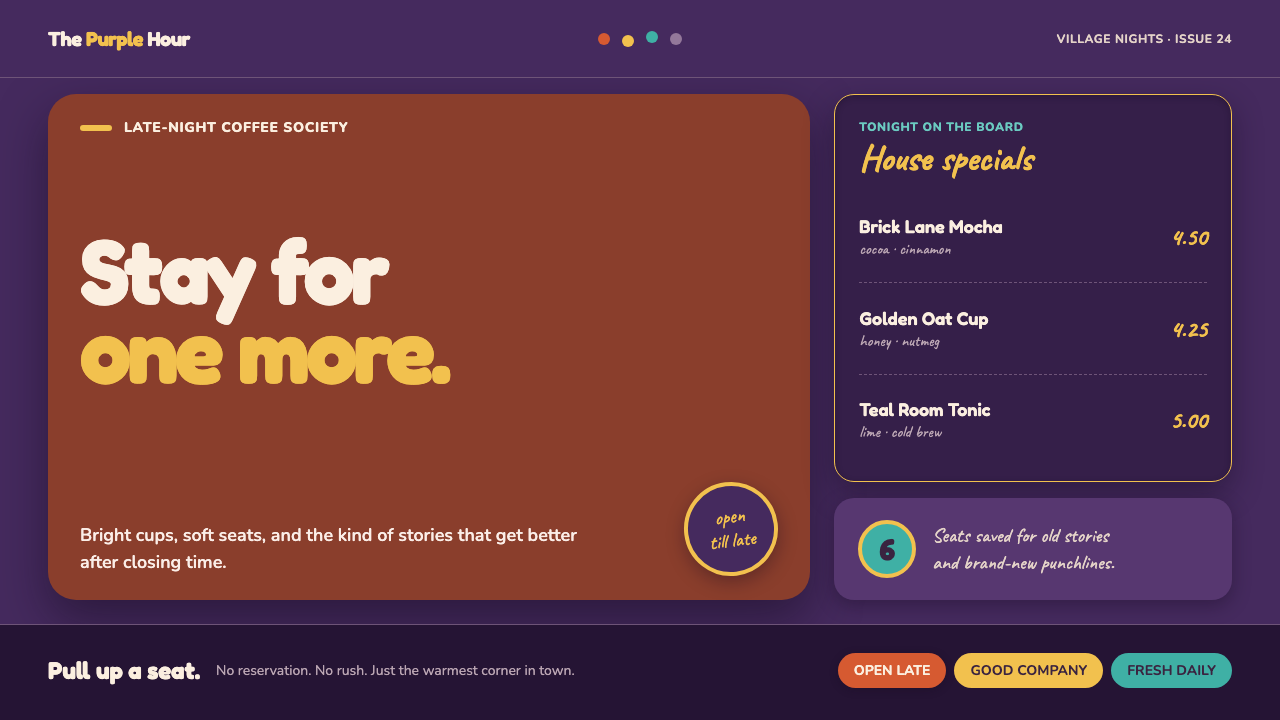 Friends Central Perk (1994)Sitcom warmth, turned TV-bright. Grape walls, couch orange, and bouncing colo…