What is Zomato India Delivery?
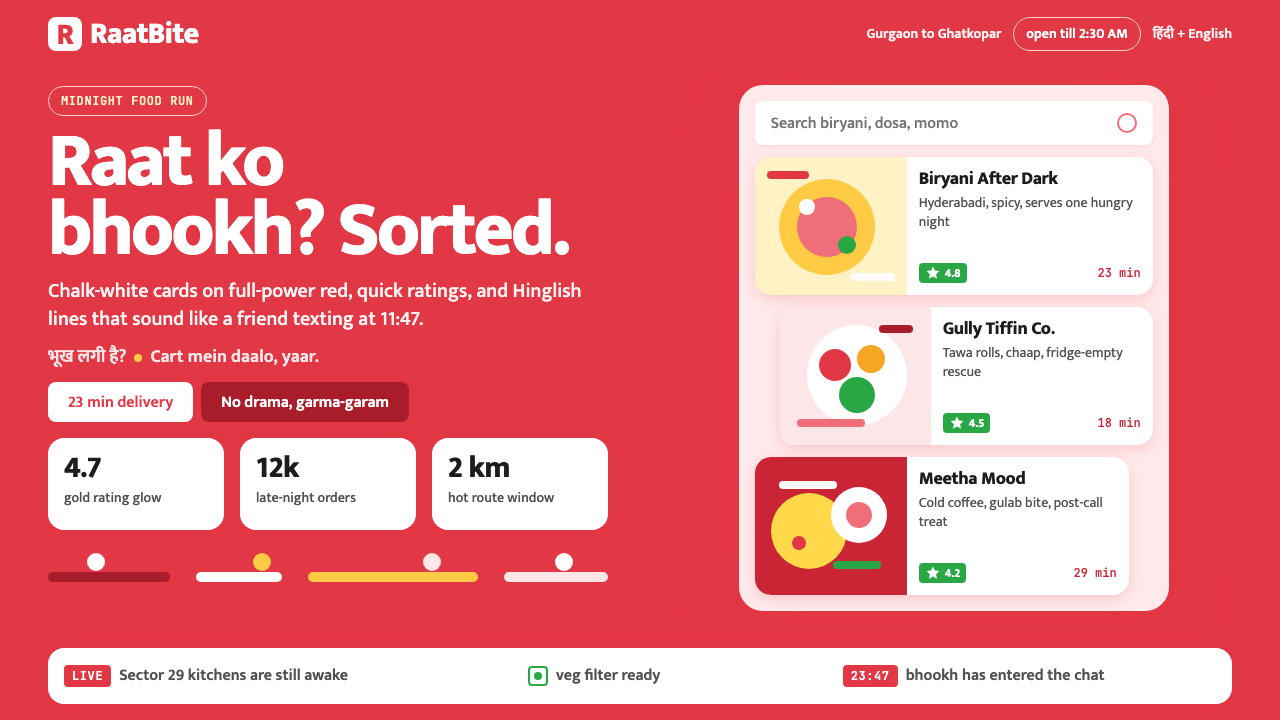
One saturated red and a voice that texts like your funniest friend at midnight — Zomato's post-2020 visual system turned Indian food delivery into a design landmark.
Zomato India Delivery in brief
Zomato India Delivery is the visual and verbal identity system that the Gurgaon-based food-technology company refined and locked in around 2020, a year before its landmark IPO on the National Stock Exchange. It is not a static logo-and-color guideline — it is a living interface language built for mobile-first card-scroll behavior, shaped by bilingual typography, saturated hero color, and a copywriting voice that is at once informal, urgent, and distinctly Indian.
The system is organized around a single dominant color — a fierce, warm red that floods the page background — against which chalk-white card surfaces float. Each card carries bold food photography, star ratings rendered in gold, and delivery countdown timers. The visual hierarchy is almost brutally simple: background color signals the brand, white cards surface the content, gold marks quality, and every word is written in a Hinglish register that mixes Hindi idiom with English syntax to create something neither purely one nor the other.
What distinguishes this system from generic delivery-app design is its coherence across all touchpoints: the same warmth in the notification copy as in the empty-state illustration, the same typographic weight in a restaurant name as in a promotional banner. The system was designed to work for a young, mobile-native Indian urban audience who are simultaneously fluent in multiple languages, accustomed to dense visual information, and deeply responsive to humor and personality in brand communication.

Where does Zomato India Delivery come from?
Zomato began in 2008 as Foodiebay, a restaurant discovery website built by Deepinder Goyal and Pankaj Chaddah, two engineers at Bain and Company in New Delhi. The original product was a simple digitization of paper menus — functional, informational, almost entirely without visual personality. The company renamed itself Zomato in 2010 and expanded aggressively through the following decade, entering markets across South and Southeast Asia, the Middle East, and briefly operating in several European and American cities before refocusing on India.
The visual identity that most people associate with Zomato today is the product of the 2020 refresh, shaped significantly by the demands of the Indian food-delivery market during and after the COVID-19 pandemic. As restaurant dining collapsed and delivery surged, Zomato's app became the primary interface millions of Indians used to access food. The design team — led internally with contributions from brand strategist Gulshan Bajwa and finance executive Akshant Goyal overseeing the broader brand health in the IPO run-up — recognized that the product needed to feel as warm, trustworthy, and immediate as the best neighborhood restaurant. The saturated red was not chosen arbitrarily: red carries deep cultural resonance in India, associated with celebration, auspiciousness, and energy, from festival textiles to the tikka worn at religious occasions.
The bilingual typography was a direct response to the linguistic reality of Zomato's market. India has no single written vernacular that reaches every user; the app serves users in Delhi, Mumbai, Chennai, Kolkata, Bengaluru, and hundreds of smaller cities, each with distinct language preferences. Rather than defaulting to English only — which would have felt alienating to large segments of the user base — or fragmenting the design into dozens of localized versions, the team adopted Mukta, a typeface engineered to render Devanagari script and the Latin alphabet at harmonious visual weight. This allowed a single layout system to carry Hindi, English, and Hinglish text without breaking visual rhythm.
The Hinglish copywriting voice emerged from a deliberate brand decision to sound like a friend rather than a service. Earlier app copy in the Indian consumer-tech space tended toward formal English, which created a social distance between brand and user. Zomato's writers pushed in the opposite direction: micro-interactions were written with the cadence and humor of an informal chat — delivery confirmation messages that crack jokes about hunger, empty search states that commiserate with the user, promotional notifications that adopt the exaggerated enthusiasm of a friend recommending a restaurant. This voice became so strongly associated with the brand that it influenced an entire generation of Indian consumer app copywriting. The 2021 IPO — which valued the company at approximately twenty billion dollars — cemented the system as not just a design outcome but a commercial proof point: warmth, speed, and cultural specificity at scale.
What defines the Zomato India Delivery look?
Dominant Brand Color
A single saturated warm red functions as the total background environment — it floods the screen rather than appearing as an accent or a logo element. This approach is unusual in app design, where muted or neutral backgrounds are typical; Zomato's choice makes the brand color inescapable and immediately recognizable even in peripheral vision. The red is warm rather than cool, suggesting energy, appetite, and cultural celebration rather than urgency or danger.
White Card Architecture
Against the saturated background, chalk-white card components create a layered spatial system. Cards carry all functional content — restaurant identity, food photography, ratings, pricing, and delivery metadata — while the colored ground acts as connective tissue between cards. The white is clean and slightly cool, creating strong contrast with the warm background and making food photography appear vivid and appetizing. Subtle elevation through shadow gives cards a sense of physical presence without simulating complex depth.
Gold as Quality Signal
Star ratings are rendered in gold — not as decoration but as a precise semantic choice. In the context of the red-and-white system, gold stands out as the only warm metallic note, carrying cultural associations with value, reward, and prestige that are broadly recognized across Indian visual culture. The use of gold for ratings creates an immediate and universally understood hierarchy between restaurants: a five-star gold cluster reads as premium at a glance without requiring any text explanation.
Bilingual Typography at Equal Weight
The typeface selected for the system handles both Devanagari script and the Latin alphabet, with both scripts rendered at visually equivalent stroke weight. This means a restaurant name in Hindi and its English transliteration sit at the same apparent size and boldness on a card, neither subordinating the other. The resulting layout feels native to India's multilingual reality rather than like a foreign-language overlay on an English-first design. The type scale moves through clear large-to-small hierarchy, with restaurant names large, cuisine tags smaller, and metadata at a compact but legible size.
Hinglish Copywriting Voice
Every piece of interface copy — from button labels to push notifications to empty-state messages — is written in a conversational register that blends Hindi cultural reference with English syntactic structure. The tone is late-night, informal, and comedic: it assumes the user is a young urban Indian who appreciates irony, understands food culture as social ritual, and responds better to humor than to transactional language. This voice is carried consistently across the entire system, including states that other apps treat as purely utilitarian, such as loading screens and error messages.
Hero Food Photography
Food photographs occupy the dominant visual real estate within each card, shot and processed to appear warm, immediate, and slightly larger than life. The photography style favors overhead and close-up angles that emphasize texture, color, and portion — the visual language of appetite rather than of culinary aspiration. Images are treated with enough warmth and saturation to remain vivid against the already-saturated brand background, a deliberate calibration that distinguishes Zomato's visual system from more neutrally styled competitors.
Delivery Countdown as Design Element
Estimated delivery time is given prominent typographic placement within cards, treated not as metadata but as a primary selling point. The countdown — typically expressed as a range in minutes — sits in large, bold numerals that create a sense of immediacy and service confidence. This design choice reflects a key insight of the Indian food-delivery market: speed is both a practical requirement and an emotional promise. Making the number prominent and readable at a glance turns a functional data point into a brand statement about reliability.

Who shaped Zomato India Delivery?
Goyal co-founded the company in 2008 as Foodiebay and led it through its transformation from a restaurant discovery platform to a full-stack food-delivery operation. His product philosophy — that technology should feel warm and personal rather than efficient and transactional — shaped the design direction that became explicit in the 2020 refresh. Under his leadership, Zomato resisted the impulse to homogenize its visual language for international markets and instead doubled down on Indian cultural specificity, a decision that proved commercially decisive in the IPO period.
Chaddah co-founded Zomato alongside Goyal and was instrumental in the company's early expansion across Indian cities. His understanding of how Indian consumers discover and choose restaurants — through social trust networks, peer recommendation, and local culinary knowledge — informed the rating and review architecture that became central to the card design language. The gold star rating system reflects his founding insight that social proof, made visually prominent, is the strongest purchase signal in the Indian food market.
Bajwa contributed to Zomato's brand strategy during the period when the visual system was being consolidated. The Hinglish voice that the brand became famous for — informal, witty, and culturally embedded — required deliberate brand governance to ensure consistency across a large team producing copy at high volume and velocity. Bajwa's work on brand standards helped codify what was initially an instinctive cultural tone into a repeatable system that could be applied by writers, designers, and product managers across the entire app surface.
As a key executive overseeing financial and strategic functions during the IPO preparation, Akshant Goyal's role involved ensuring that the visual and brand investments being made translated into measurable business outcomes. The 2020 identity refresh was not purely a creative exercise — it was timed to build brand equity ahead of the public listing. His involvement underscores the degree to which the Zomato visual system was understood internally as a commercial asset: the design language, the photography style, and the Hinglish voice were all treated as compounding investments in brand recognition that would support the valuation narrative.
How do you use Zomato India Delivery today?
The Zomato India Delivery visual system is highly transferable to presentation and slide design whenever the goal is to communicate energy, warmth, and approachability at speed. For a cover slide, the approach works best with a full-bleed brand color background — a rich, saturated warm red — and a single white or cream card element centered or offset to carry the title. The contrast between the intense background and the bright card creates instant visual impact without requiring any additional decoration. Headline type should be bold, generous in size, and set with enough negative space within the card that the text breathes rather than crowds. A secondary detail — a subtitle, a tagline, a date — can be set smaller in the same card, creating clear hierarchy through scale alone.
For content slides, the card-on-color system translates directly into a modular grid of information panels. Each card carries one concept: a data point, a quote, a metric, an image with caption. The saturated background unifies the slide even when multiple cards are present, and the white surfaces direct the eye to the content. Data visualization on this system works best when charts are treated as bold graphic objects — bars and circles at full color saturation against the card's white ground — rather than as fine-line analytical diagrams. Labels should be large and direct, written in the friendly, confident voice the system is built on, avoiding the formal passive constructions typical of corporate reporting.
For web interfaces, dashboards, and pricing pages, the system offers a strong model for hierarchy through color environment. A pricing page built on this visual logic uses the brand color as a dominant section background for the most important tier, with white or neutral backgrounds for secondary tiers — the color itself signals primacy without requiring extra visual devices like badges or callout boxes. Dashboard panels function as cards: white surfaces on a lightly colored ground, each panel carrying one metric or widget. The key discipline is restraint in color: the warm red works as a full environment or as a strong accent, but never as a light tint or a mid-saturation wash — the system depends on the color being committed to, not hedged.
For editorial and marketing applications, the Zomato system's most powerful tool is its combination of large photography and strong typographic voice. A marketing page or social card built on this language leads with a full-bleed food or product photograph that is warm, close, and tactile. Type is placed on a white card overlaid on the photograph or on a separate colored band below it. The copy should carry the brand's characteristic informal energy — contractions, direct address, humor — which creates the sense that the content is being spoken by a person rather than published by an institution. This voice makes even promotional content feel like a recommendation from a trusted source.
A common mistake when applying this system is diluting the brand color. The Zomato visual logic depends on the red being used at full, uncompromised saturation — as a background environment, not as a tint over white or a mid-tone accent. Designers who are uncertain about so much color often reduce it to a pastel or a partial overlay, which destroys the system's primary mechanism: the contrast between the intense ground and the bright card. Similarly, the Hinglish copywriting voice should not be translated into formal language when applying the system to non-Indian contexts — instead, find the locally equivalent register of friendly informality, because the system's emotional effect depends on the copy and the visual language reinforcing each other. A bold visual paired with stiff copy produces dissonance, not warmth.

Zomato India Delivery — FAQ
Is the Zomato visual system appropriate for products outside food and delivery?
The system's core mechanisms — saturated color environment, white card architecture, prominent photography, and informal copywriting voice — are transferable to any consumer product that values warmth, speed, and cultural relatability. It works especially well for marketplace products, event ticketing, travel booking, and lifestyle apps where the goal is to make browsing feel enjoyable rather than utilitarian. It is less suitable for professional services, financial products, or B2B tools where the dominant values are precision, authority, and formal trust — contexts where an intense brand-color background can feel overwhelming or unprofessional.
How does the Hinglish voice translate when designing for audiences outside India?
The Hinglish voice is not a linguistic formula but a tonal stance: friendly, direct, informal, and culturally embedded. When applying the visual system to other markets, the key is to find the equivalent register in the local language — the way a trusted friend speaks about food, a place, or an experience — rather than to translate Hinglish literally. In practice, this means contractions over formal grammar, second-person direct address, humor that references shared cultural knowledge, and a willingness to be playful in states that traditional interface copy treats as purely functional. The voice works because it signals social equality between brand and user; that signal can be reproduced in any language that has an informal register.
Can this system work in a light or dark mode, or is it tied to its specific background color?
The system's saturated background is structural rather than decorative — it is the primary mechanism that makes the white card surfaces pop and gives the interface its characteristic energy. A fully light mode version (white or cream background with colored accents) loses the system's most distinctive quality and begins to resemble generic app design. A dark mode version is possible, but it requires replacing the warm red with a deep, rich dark tone — not pure black — and using warm cream or white for card surfaces. The gold ratings, prominent photography, and bold typography translate well to dark mode; the informal copywriting voice remains unchanged. However, the emotional temperature of dark mode is lower — it reads as more premium and less immediately warm, which shifts the brand perception meaningfully.
What makes this system specifically Indian rather than just a bold consumer app design?
Three elements are specifically culturally rooted. First, the red is warm and celebratory rather than urgent or cautionary — it references the chromatic range of Indian textiles, festivals, and ritual markers, a palette that carries different connotations in Indian visual culture than in Western design contexts where red often signals warning or energy alone. Second, the bilingual typography — rendering Devanagari and Latin at equal visual weight — is not a localization afterthought but an architectural decision that treats India's linguistic plurality as a design strength rather than a problem to be managed. Third, the Hinglish copywriting voice is impossible to produce authentically without cultural fluency in both Hindi and English as they are actually spoken and mixed by urban Indians — it is not translatable, only natively writable. Remove these three elements and you have a competent bold consumer app; keep them and you have something that could only have come from a specific place.
How should the card hierarchy be structured when there are many items competing for attention?
The Zomato system handles information density through physical card size rather than through additional color or badge layering. Primary items — featured restaurants, top-rated options, sponsored placements — receive larger cards with dominant photography. Secondary items receive smaller cards with more compact typography and less image prominence. The hierarchy reads spatially: the eye travels by card size first, then by image appeal, then by rating, then by delivery time. The key discipline is to resist adding color variation within the card system to signal priority — the background color is already doing that work by creating a unified ground that the cards emerge from. Adding tinted cards, colored borders, or priority badges introduces noise that competes with the photography, which is the system's most powerful attention mechanism.
Related design styles
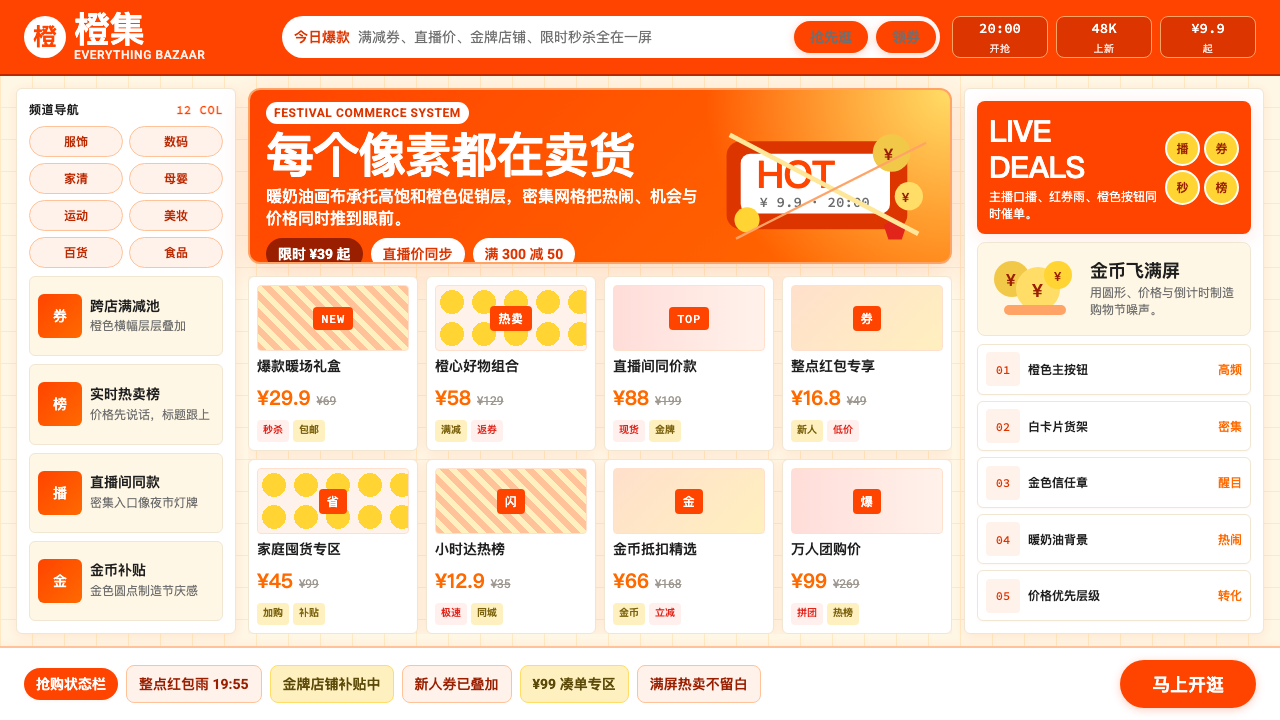 Taobao (淘宝)Every pixel sells. Orange on cream, dense price grids and gold coins shout ab…
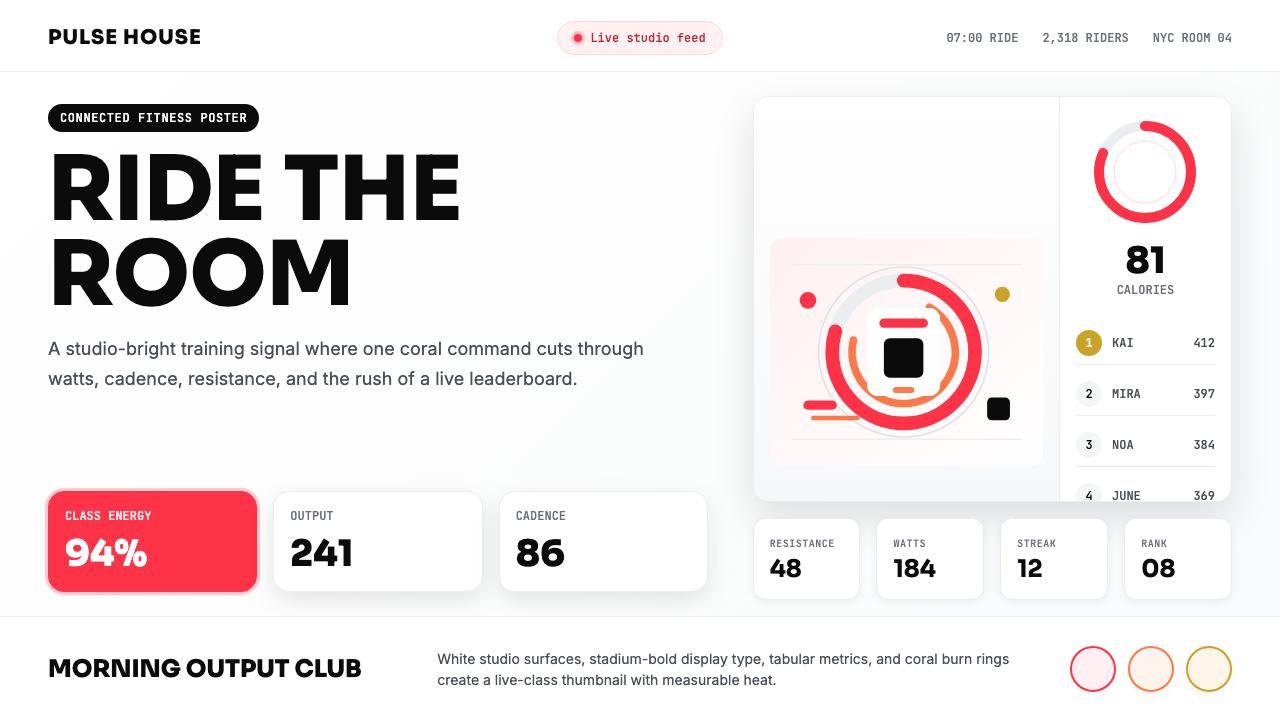 Peloton Fitness Coral (2020)Studio-bright urgency. Coral rings, Sora caps, and leaderboard grids drive th…
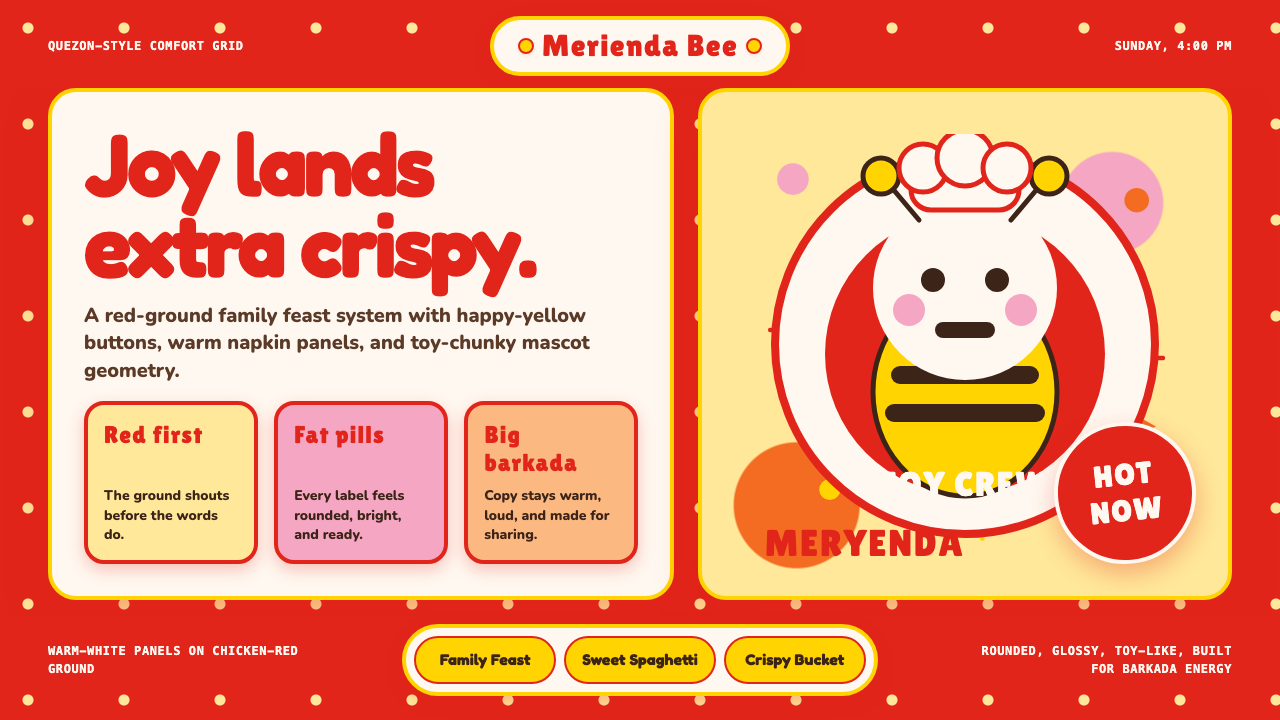 Philippines Jollibee Bee MascotJoy shouts first. Red ground, Fredoka curves, yellow pills, chunky grid.
 Replit 2024Coding feels warm. Coral buttons, cream panels, rounded code tiles make build…
 Shein Fast FashionDopamine density wins. Hot pink grids, starbursts, and candy pills pack every…
 Svelte Compiler OrangeCompiler warmth goes loud. Orange flood, Fraunces italics, and code cards do…