What is Philippines Jollibee Bee Mascot?
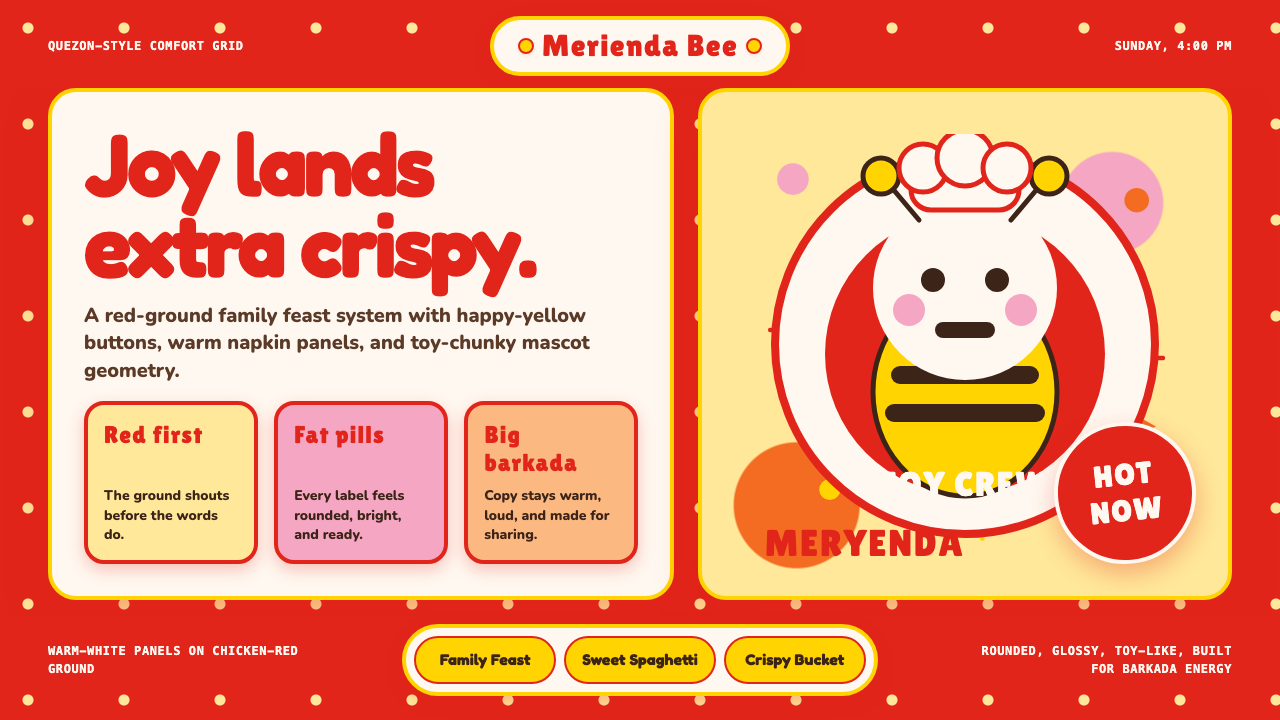
Jollibee turned a smiling red bee into a symbol of Filipino pride — and built a design language loud enough to outlast every global competitor that ever tried to muscle into its home market.
Philippines Jollibee Bee Mascot in brief
Philippines Jollibee Bee Mascot is a design system rooted in one of Southeast Asia's most beloved fast-food brands. Its visual identity is defined by a charged emotional warmth rather than coolness or restraint: deep red surfaces, sunshine-yellow accents, chunky rounded forms, and a mascot-forward visual culture that places the smiling bee at the center of nearly every communication. The system radiates joy loudly and without apology.
Where many global fast-food brands rely on efficiency and appetite cues alone, Jollibee's design system layers in a distinctly Filipino sense of togetherness — the bayanihan spirit of communal celebration — expressed through generous proportions, glossy food photography that glorifies abundance, and a typographic personality that feels friendly and approachable rather than corporate or slick.
The system is not subtle. It does not whisper. Its palette is saturated and unapologetically warm, its shapes are fat and soft rather than sharp or geometric, and its mascot persona carries an emotional register that ranges from celebratory to sentimental — matching the full arc of Filipino family life that the brand explicitly evokes in its advertising.
Where does Philippines Jollibee Bee Mascot come from?
Jollibee's story begins not as a fast-food chain but as an ice cream parlor. Tony Tan Caktiong and his family opened two Magnolia Ice Cream parlors in Cubao, Quezon City, in 1975. When customers started requesting hot meals, the family pivoted, and in 1978 Jollibee Foods Corporation was officially incorporated. The timing placed the brand in an extraordinary competitive moment: McDonald's was preparing its Philippine entry, which arrived in 1981. Rather than retreat, Jollibee competed — and won. By the mid-1980s, Jollibee had more stores in the Philippines than the American giant, a feat that no local competitor in any major market had managed at that scale.
The bee mascot was introduced around 1980 and was crucial to this victory. In a country where American brands arrived carrying the prestige of the global, Jollibee responded with local warmth. The mascot — a cheerful, round-bodied red bee in a chef's toque and bow tie — drew on a visual vocabulary of abundance and hospitality rather than speed or modernity. It looked like something a Filipino grandmother might have embroidered on a kitchen towel. That domesticity was strategic: it signaled that Jollibee understood Filipino families in ways that a foreign company never could.
The brand's design language consolidated around the values the mascot embodied. Red, already associated in Filipino culture with good fortune and festivity, became the dominant ground. Yellow, the color of sunshine and ripe tropical fruit, functioned as the celebratory accent. The forms that surrounded the bee — signage, packaging, uniforms, interiors — leaned toward roundness and generosity of proportion, avoiding the aggressive linearity of competitors. Chunky lettering, pill-shaped buttons, and playful graphic borders all contributed to a visual identity that felt genuinely approachable and culturally legible.
The global expansion that began in 1998, bringing Jollibee stores to the United States, the Middle East, and eventually the United Kingdom and Vietnam, imposed a new challenge on the design system: to carry Filipino cultural identity into diaspora markets without feeling parochial. The mascot's emotional legibility — its uncomplicated happiness — proved to be the system's most portable asset. Overseas Filipinos (OFWs) recognized the bee as a piece of home, and non-Filipino customers in diverse communities encountered it as an emblem of genuine joy rather than a corporate construction. The system's warmth traveled because it had never been manufactured; it had been grown from real cultural roots.
Throughout subsequent decades, the visual system has been refreshed but never fundamentally broken. Art direction on packaging grew more polished, food photography became more aspirational, and digital touchpoints introduced the system's vocabulary into interfaces and social media. Yet the foundational decisions — the red ground, the yellow accent, the round forms, the central mascot — have remained stable, giving the brand an unusual degree of visual continuity across nearly five decades and dozens of markets.
What defines the Philippines Jollibee Bee Mascot look?
Color: Warm and Saturated Ground
The system's dominant color is a deep, festive red that functions less as a warning signal and more as a ground of celebration — the red of Chinese New Year lanterns, of birthday tablecloths, of a family gathering in full swing. Against this, a bright sunshine yellow operates as the primary accent, producing a chromatic relationship that feels energetic and abundant rather than aggressive. White appears generously in typography and secondary surfaces, creating moments of breathing space that prevent the composition from overwhelming the viewer. The palette as a whole reads as a feast prepared for guests.
Mascot Centrality
Unlike design systems that treat mascots as optional decorative additions, Jollibee's system positions its bee as a structural element — almost an anchor that every other visual decision orbits. The mascot's round body, toque, and exuberant expression set the emotional register for the entire system. When the mascot appears at scale, it establishes a warmth that the typography and color alone could not sustain. When it is absent, its personality still shapes the choices made in its place. The system is, in a meaningful sense, a mascot-first visual culture.
Form: Rounded and Generous
Across every touchpoint — buttons, packaging shapes, signage outlines, icon styles — the Jollibee design language favors softly rounded corners and full, pillowy silhouettes over hard edges or geometric precision. This roundness is not accidental: it mirrors the mascot's form and carries the same emotional coding, signaling approachability, comfort, and a sense that there is always a little more room at the table. Pill shapes and oval containers recur throughout, giving the system a tactile warmth that feels more handcrafted than engineered.
Food Photography: Glossy and Abundant
Food photography in the Jollibee visual system is not understated or artisan-styled — it is unabashedly indulgent. The hero product shots prioritize glossy surfaces, steam, and overflowing portions in ways that signal celebration rather than restraint. Chickenjoy pieces glisten. Rice is domed and plentiful. Spaghetti sauce is deep and richly colored. The photography functions as a visual feast that amplifies the brand's message of abundance and joy. This approach requires restraint in composition — the food itself is always the primary actor, with backgrounds kept simple enough not to compete.
Typography: Friendly and Bold
The typographic personality of the system leans toward rounded, thick letterforms that feel approachable and confident at the same time — never delicate or refined, but also never aggressive or mechanical. Headlines are set at generous weights that read clearly at distance, matching the bold visual environment they inhabit. The overall typographic register is one of cheerful directness: it announces rather than whispers, but it announces warmth rather than authority.
Cultural Specificity: Filipino Warmth
Perhaps the most important characteristic of the system is that it encodes a specific cultural emotional register — the Filipino concept of kapwa (shared identity), the warmth of extended family meals, the communal joy of merienda. These values are not illustrated literally but are expressed structurally through the system's generosity of form, its saturated warmth of color, and its mascot's unconditional happiness. The system works because it is not universal-by-design; it is Filipino-first, and the universality it achieves is a byproduct of that specificity being genuinely felt.
Emotional Range: Celebration to Sentiment
Jollibee's visual identity is unusually capable of spanning a wide emotional register — from birthday party exuberance to quiet, sentimental longing — without losing coherence. This range is achieved primarily through the mascot's expression and scale, and secondarily through photography direction that can shift from brightly lit group celebrations to more intimate, warmly lit single-figure moments. The system has the structural flexibility to be festive in one campaign and tender in the next, which is rare among fast-food brand identities and explains much of the brand's unusual emotional hold on its audience.
Who shaped Philippines Jollibee Bee Mascot?
The founder of Jollibee, Tan Caktiong made the foundational brand decisions that shaped the visual system's values: the choice to compete against McDonald's on warmth rather than efficiency, the embrace of local cultural identity over imported prestige, and the early investment in the mascot as a brand cornerstone. His instinct that Filipino families would respond to a visual language of celebration and belonging rather than speed and convenience guided every subsequent design decision. He later expanded the company through strategic acquisitions — including Chowking, Greenwich, and Mang Inasal in the Philippines, and Smashburger and The Coffee Bean internationally — making Jollibee Foods Corporation one of Asia's largest restaurant groups while keeping the flagship brand's emotional core intact.
As CEO and long-serving executive of Jollibee Foods Corporation, Tanmantiong has been the principal architect of the brand's global expansion strategy and its visual identity consistency across markets. His leadership during the international growth phase — navigating the challenge of bringing a deeply Filipino visual language to diaspora communities in the United States, the Middle East, and Southeast Asia — required maintaining the system's emotional authenticity while adapting it to diverse retail environments. Under his watch, the brand refined its ability to communicate Filipino warmth to non-Filipino audiences without sanitizing the cultural specificity that makes it distinctive.
The design team credited as 'Creative Heads' that developed and refined the bee mascot in the early 1980s made a pivotal visual decision: making the mascot round, chef-hatted, and unconditionally cheerful at a time when most fast-food brand characters were either abstract shapes or human analogues. By choosing a bee — an insect associated with industriousness and community — and rendering it in an almost cartoonishly warm register, the team created a visual personality that was legible across age groups and culturally specific without being exclusionary. The mascot's design choices established the soft, rounded, saturated visual grammar that the entire Jollibee system now expresses.
While not designers, the millions of Overseas Filipino Workers who became Jollibee's most emotionally invested ambassadors worldwide function as a key design figure in this system's story. Their relationship with the brand shaped its global design decisions: the visual system had to carry not just appetite cues but homeland cues, functioning as a proxy for Philippine culture itself in cities from Dubai to Daly City to London. This community's emotional response to the brand forced the design system to maintain its cultural authenticity through international expansion, rather than diluting it into a generic fast-food register.
The founding family's background as entrepreneurs from the Fujian Chinese-Filipino community brought a specific cultural lens to the brand's earliest design decisions. The emphasis on red as a ground color, on abundance as a visual value, and on communal celebration as the primary emotional register all reflect the intersection of Filipino and Chinese-Filipino cultural sensibilities. The family business model — in which extended family involvement was normalized — also shaped the brand's commitment to depicting food as a vehicle for family togetherness rather than individual consumption, a commitment that remains visible in Jollibee advertising and in-store visual communication today.
How do you use Philippines Jollibee Bee Mascot today?
The Jollibee design system is one of the richest references available for anyone building a brand that needs to communicate warmth, cultural specificity, and communal joy at scale. Applying it correctly requires understanding that its energy comes from emotional sincerity — it works because Jollibee really does embody the values it depicts — and that surface imitation without underlying cultural coherence produces work that reads as hollow rather than joyful.
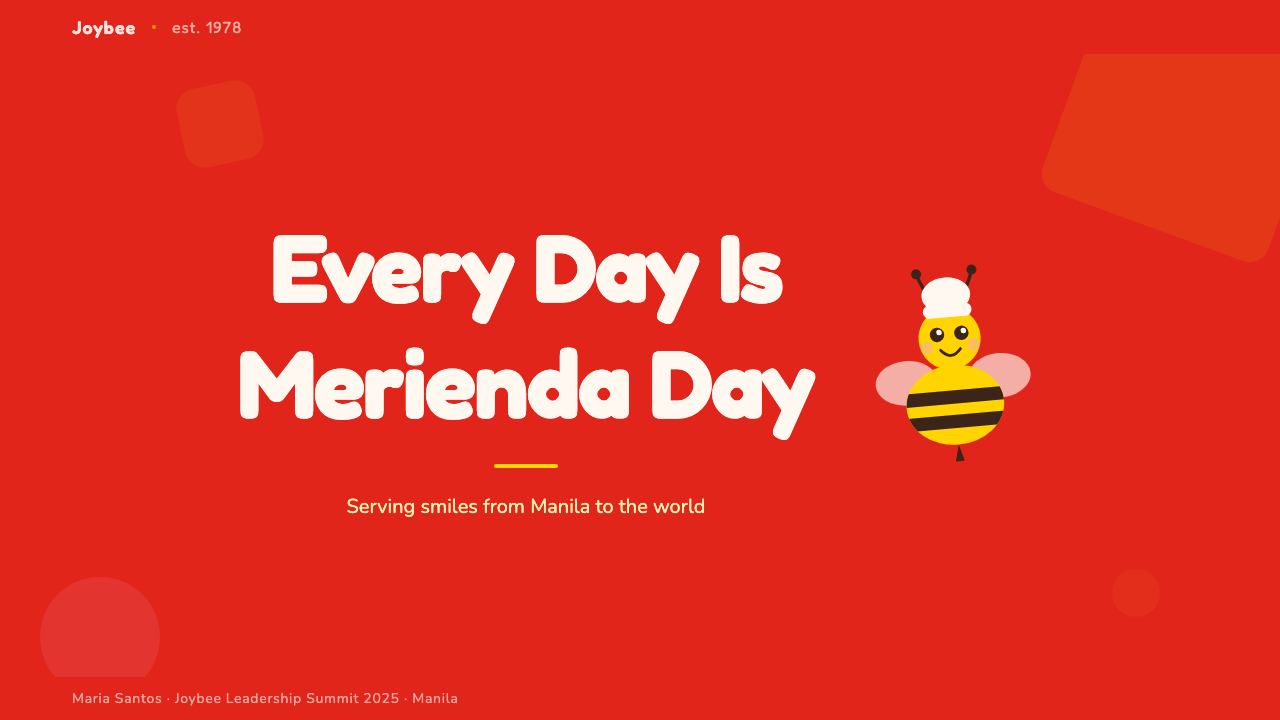
For presentation slides, the system's most transferable lessons are in cover design and section dividers. A cover built in this register should lead with a warm, saturated dominant color field — red or deep orange — overlaid with bold, rounded type at generous scale, with a focal element (a logo, a mascot-like illustration, or a central hero image) positioned off-center but weighted toward balance. Section divider slides benefit from the system's palette logic: alternating between the dominant warm ground and a bright accent ground breaks the visual monotony of long decks while maintaining tonal coherence. Data slides should use the accent color sparingly to highlight the single most important data point — not to color every bar in a chart.
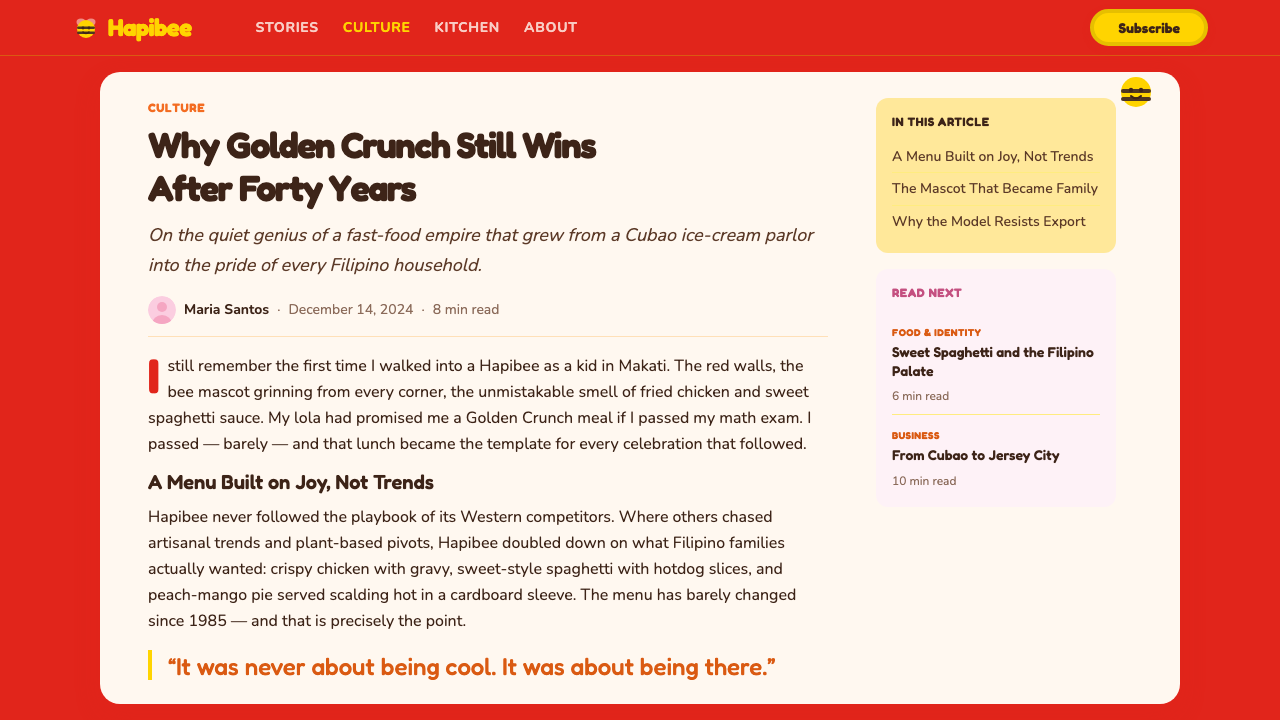
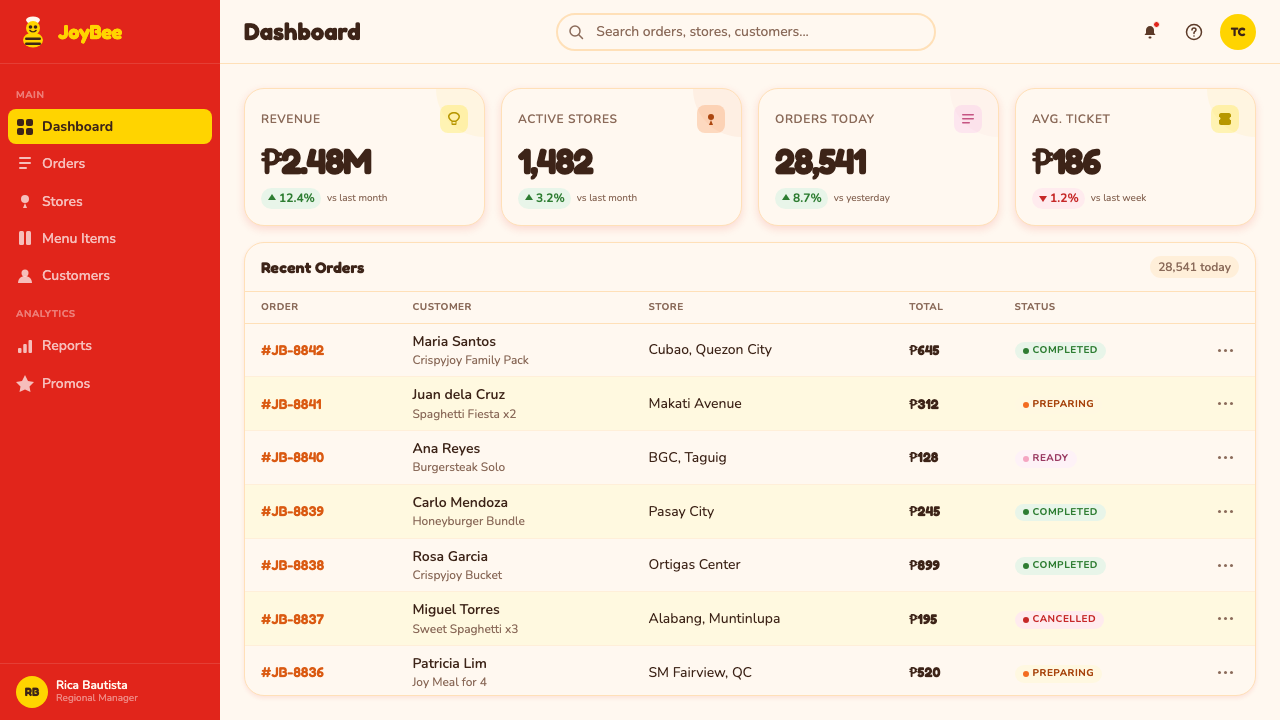
For web interfaces, the system offers strong guidance for consumer-facing products where warmth and approachability are primary values: food delivery apps, family-oriented services, community platforms, and festive e-commerce experiences. The key principle to carry over is that white space should feel generous rather than sparse — the Jollibee visual environment is never cramped — and interactive elements like buttons should be rounded and substantial rather than thin or hairline. Navigation should be typographically bold enough to read at a glance, with hover states that feel genuinely responsive rather than minimal.
For editorial and marketing work, the system's most useful lesson is the power of mascot-forward communication. Any brand that has a character — human, animal, or illustrated — can learn from how completely Jollibee commits to centering that character in every piece of communication. Marketing layouts benefit from the system's generosity: hero images should be large and food-forward, copy should be direct and warm rather than clever or ironic, and calls to action should feel like an invitation rather than a demand. The system's emotional range — from celebration to quiet sentiment — is also worth studying: the same visual grammar can support a joyful launch campaign and a tender brand story if the photography direction and copy register are shifted carefully.
The most common mistake when applying the Jollibee visual reference is treating its energy as license to simply pile on color, character, and warmth without structural discipline. The system's apparent exuberance actually rests on consistent restraint in composition: the red ground is usually uninterrupted by competing textures, the food photography maintains a clear subject-to-background hierarchy, and the mascot appears at considered scale rather than everywhere at once. Borrowing the emotional temperature without the compositional discipline produces work that reads as chaotic rather than celebratory. The second common mistake is desaturating the palette in an attempt to make it feel more 'sophisticated' — the warmth of the system lives in its full saturation, and pulling it back undermines the fundamental emotional register.
Philippines Jollibee Bee Mascot — FAQ
Why did Jollibee beat McDonald's in the Philippines when no other local chain managed to?
The design system answer is that Jollibee's visual language was doing cultural work that McDonald's global standardization could not replicate. McDonald's arrived in the Philippines in 1981 with a visual identity optimized for global legibility — clean, efficient, and deliberately culture-neutral. Jollibee responded not by competing on the same terms but by doubling down on everything that made it Filipino: the mascot's warmth, the red-and-yellow palette coded to local festivity rather than international branding, the menu items tuned to Filipino palates (the signature sweet-style spaghetti, the garlic rice). The visual system and the product were consistent expressions of the same cultural value proposition, and together they were more legible to Filipino consumers than a foreign brand optimized for everywhere at once.
Can the Jollibee visual style work for non-food brands?
The system's specific elements — the mascot, the glossy food photography, the branded red — are inseparable from its food-brand context. But the underlying design principles it demonstrates — mascot-first visual culture, warm saturated palettes for community-oriented brands, rounded generous forms for approachability, emotional range that spans celebration to sentiment — are fully transferable. A children's education platform, a community-focused fintech product, or a family-services brand could legitimately borrow from these principles without adopting the bee or the red. What cannot be transferred is the emotional authenticity: the Jollibee system works because it genuinely expresses Filipino cultural values, not because it deployed particular colors and shapes. Any application that borrows the form without the underlying cultural coherence will feel hollow.
How does the Jollibee visual system handle the difference between celebratory and sentimental campaigns?
The system's flexibility is primarily achieved through photography direction and mascot expression rather than changes to the core palette or forms. In celebratory campaigns — birthdays, graduations, holiday gatherings — the photography is brightly lit, shot from above or at table level, filled with multiple figures, and accompanied by the mascot at full exuberance. In sentimental campaigns — the brand's long-running OFW homesickness advertisements are the clearest example — the photography shifts to warmer, lower-key lighting, tighter framing around individuals or small groups, and the mascot either recedes or appears in a quieter register. The red and yellow remain, but they breathe differently in the lower-key environment. The structural consistency of the visual system is what makes this range work: because the palette and forms are stable, the emotional shift can be achieved through relatively small adjustments to lighting and composition without the brand becoming unrecognizable.
What makes the Jollibee mascot design particularly effective compared to other fast-food mascots?
Several design decisions distinguish the bee from competitors. First, the choice of species: a bee carries connotations of industriousness, community, and sweetness that a clown (McDonald's Ronald), a king figure (Burger King), or an abstract shape cannot. It arrives with positive cultural coding already attached. Second, the form is unconditionally warm — the round body, the toque, the broad smile signal hospitality and abundance without any hint of the unsettling uncanny valley quality that some mascot designs produce. Third, the mascot is scaled generously in applications — it appears large, at eye level, as the primary visual actor rather than as a small supporting element. Fourth, and perhaps most importantly, the mascot's emotional register matches the brand's actual cultural claim: Jollibee does not just use happiness as a marketing tool; the brand genuinely sells communal joy, and the bee's design embodies that promise at a visual level that customers recognize as authentic.
How should designers adapt the Jollibee visual register for digital-first contexts without losing its warmth?
The system's warmth in digital contexts lives primarily in three places: the color temperature of backgrounds and surfaces (warm whites and soft creams retain warmth where pure cold whites do not), the roundness of interactive elements (pill-shaped buttons and rounded card corners communicate approachability at the micro level), and the generosity of imagery (large, high-resolution food or community photography maintains the system's abundancelogic even when the mascot is not present). The traps to avoid are the cooling effects of flat gray backgrounds, hairline borders on interactive elements, and compressed image sizes that strip the photography of its glossy warmth. Animation in digital contexts should feel playful and slightly bouncy rather than precise and mechanical — motion that matches the mascot's personality carries the system's warmth into interactive states in ways that static design alone cannot.
Related design styles
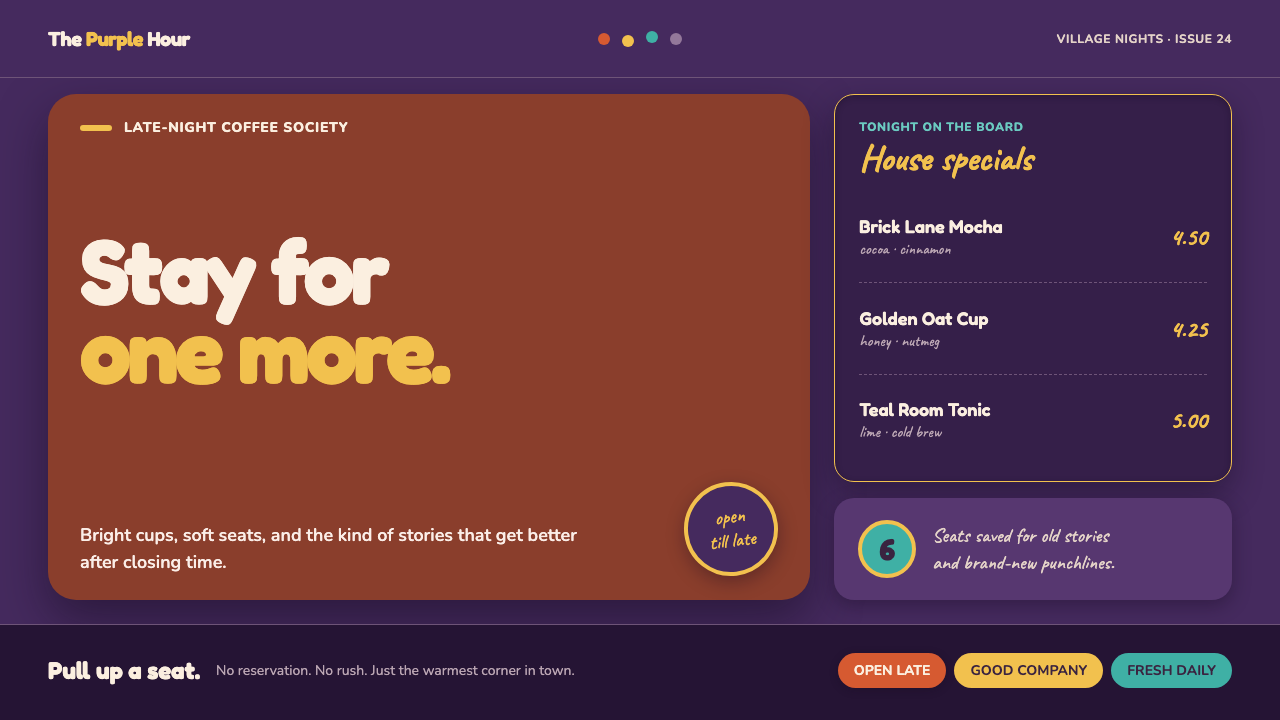 Friends Central Perk (1994)Sitcom warmth, turned TV-bright. Grape walls, couch orange, and bouncing colo…
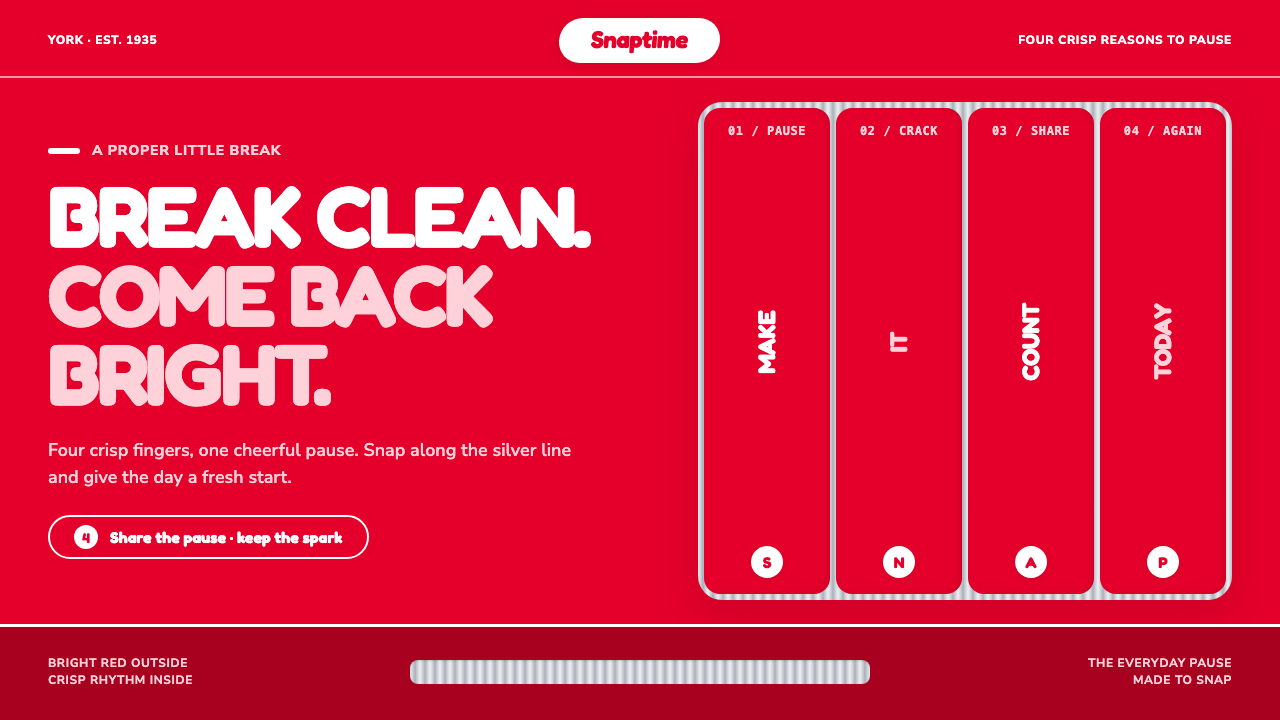 KitKat (1935)A break you can hear. Pillar-box red, plump white type, and silver grooves se…
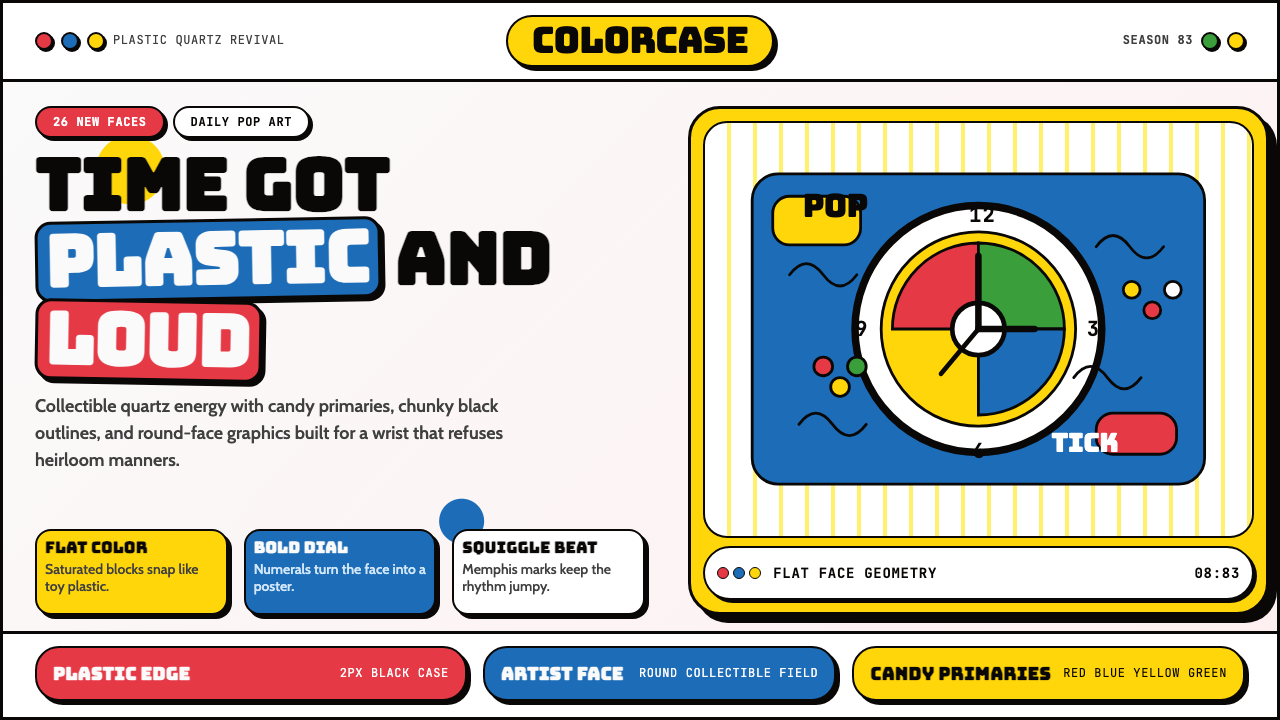 Swatch Watch (1983)Pop plastic optimism. Bungee type, candy primaries, round dials and squiggles…
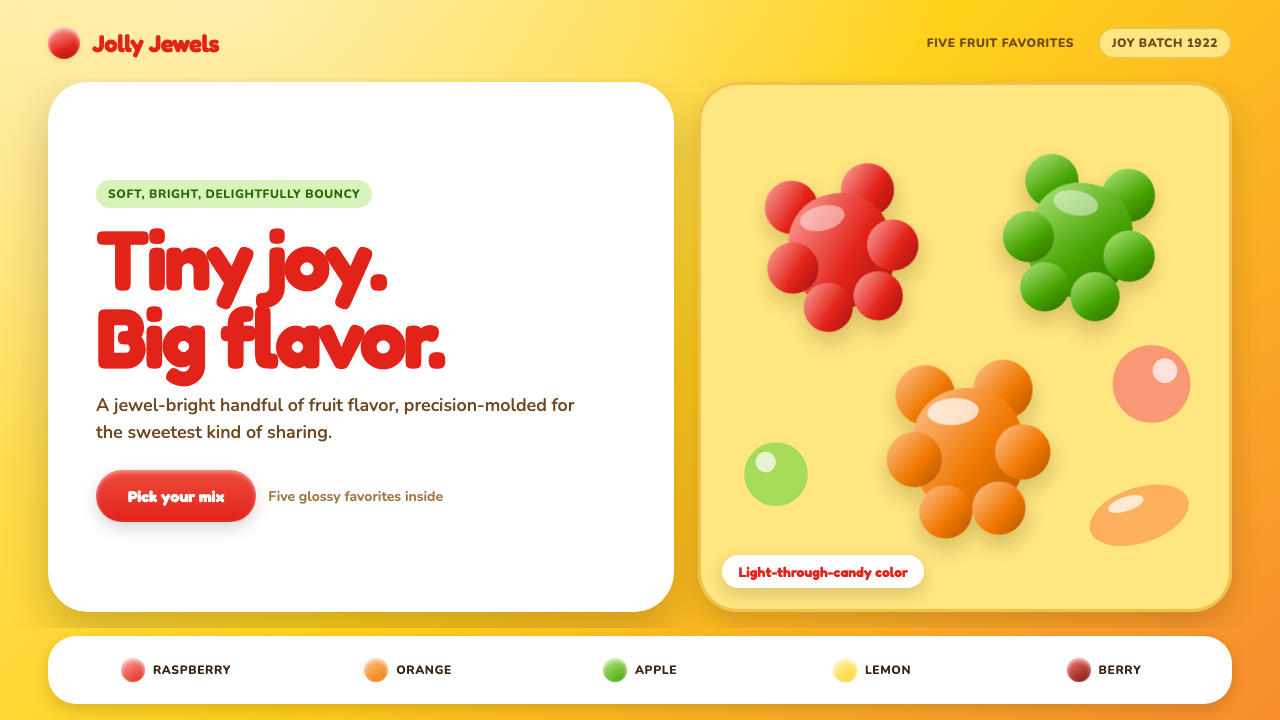 Haribo Goldbears (1922)Childhood joy, precision-molded. Glossy fruit colors tumble across a foil-gol…
 Nickelodeon Orange Splat (1984)Kids own the screen. Orange fields, slime-green pops, and wobble borders do t…
 Nutella (1964)Breakfast feels brighter. Cherry script and roasted-hazelnut brown warm a cri…