What is Sonic the Hedgehog (1991)?
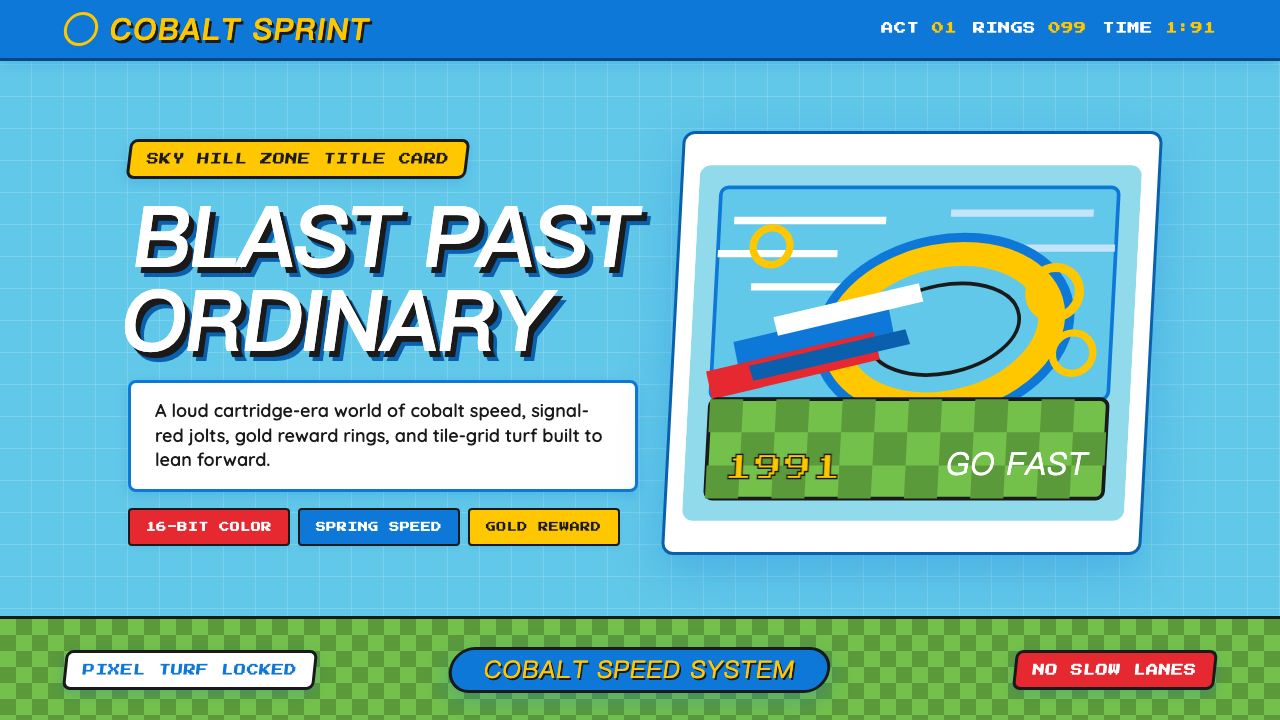
Velocity made visible: Sonic the Hedgehog's 1991 visual identity turned speed into an aesthetic — cobalt spikes, CRT-vivid color, italic everything, and attitude that dared an entire generation to keep up.
Sonic the Hedgehog (1991) in brief
Sonic the Hedgehog's 1991 visual identity is one of the most recognizable design systems to emerge from the era of 16-bit console gaming. Created in Japan and then amplified through Sega of America's aggressive marketing, it fused elements of Japanese character design, American attitude branding, and the technical constraints of Mega Drive hardware into a single coherent aesthetic that communicated speed, rebellion, and confidence before a player touched a controller.
The system's visual core is built on saturated, high-contrast color relationships. A sky-cyan background against cobalt-blue character design, gold collectible rings against emerald green terrain, and a checkerboard ground pattern that creates an unmistakable sense of velocity and forward motion. Every color choice was made to pop against the low-resolution constraints of CRT televisions — colors needed to read clearly on a cathode-ray tube display with bleeding phosphors and limited luminance precision, which pushed the palette toward bold, unambiguous separation.
Typography and wordmark design followed the same logic: the Sonic logotype leaned into aggressive italic angles, giving static letterforms the visual suggestion of motion. This italic-as-speed convention became central to the early-90s gaming aesthetic and influenced how an entire generation of entertainment properties communicated energy through type. The result is an aesthetic that does not merely depict a fast character — it is itself a designed object that feels fast.

Where does Sonic the Hedgehog (1991) come from?
In 1990, Sega of Japan launched an internal competition to find a new company mascot that could compete with Nintendo's Mario. The winning design came from character artist Naoto Ohshima, who created a spiky cobalt-blue hedgehog inspired partly by Felix the Cat's boldness and partly by Bill Clinton's can-do attitude — both figures Ohshima had collected as visual references. The hedgehog's blue color was chosen to match Sega's own corporate blue, establishing an immediate brand alignment between character and company identity.
Programmer Yuji Naka and game designer Hirokazu Yasuhara joined Ohshima to form the core team. Naka's technical breakthroughs allowed Sonic to move at screen-clearing speeds that had no precedent in console gaming, which meant the visual design had to function at blur-velocity — landscapes had to read as landscapes, obstacles had to read as obstacles, in fractions of a second. This constraint shaped everything: simplified, chunky character proportions that stayed legible at speed; large landmark shapes like loop-de-loops that registered instantly; color contrasts robust enough to survive fast scrolling.
Sega of America, led by Tom Kalinske, saw Sonic not just as a game character but as a brand weapon in the console wars. The American marketing apparatus translated the Japanese visual system into an aggressive street-level attitude campaign, encapsulated by the famous tagline positioning Sega against Nintendo. North American packaging and advertising pushed the palette toward even higher contrast, sharpened the italic angles, and adopted the blue spikes as a symbol of corporate rebellion against the status quo. The character design remained consistent; the attitude surrounding it intensified.
The classic visual canon — often dated 1991 to 1998, encompassing the original Mega Drive trilogy and the Sonic CD spin-off — represents the purest expression of this system before the character entered three-dimensional game space. The transition to 3D in 1998's Sonic Adventure required a significant redesign, elongating proportions and introducing more detailed rendering, which diluted many of the design qualities that made the original character so visually forceful. The 1991 identity is therefore understood as a closed and complete aesthetic chapter — chunky, two-dimensional, CRT-native, and unrepeatable.
What defines the Sonic the Hedgehog (1991) look?
Color Palette
The palette is built around a small number of high-saturation hues selected for maximum contrast on a CRT display. Sky cyan dominates the background register; cobalt blue defines the character; gold-yellow marks collectibles; emerald green and earthy brick-red define the terrain. These colors were not chosen for subtlety — they were chosen to be unmistakable at motion blur. Black outlines around every element reinforce separation where color alone might bleed. The total effect is a palette that reads as cheerful and energetic even at a glance.
Character Proportion
Sonic's original sprite design uses chunky, compressed proportions — a large head relative to body, short limbs, and a silhouette dominated by the distinctive spiky quills. These proportions were partly dictated by the resolution limits of Mega Drive hardware, which constrained how many pixels could define a character without visual noise. The compression created a figure that is immediately readable at small sizes and remains legible when the screen scrolls at high speed. Every major anatomical feature — the eyes, the shoes, the spines — is oversized relative to realistic proportion, ensuring the character telegraphs intent and emotion across frames.
Speed Signifiers
The visual language of speed permeates every design layer. Italic-slanted wordmarks and logotypes imply forward lean and momentum before any animation plays. Motion blur lines — simple parallel streaks — extend from the character during fast movement, translating a gameplay state into a recurring graphic motif. Loop-de-loop track elements provide a visual metaphor for unbroken circular velocity. Even the checkerboard ground tiles reinforce speed by creating a strong receding-plane perspective that draws the eye forward. These conventions became shorthand for speed itself across late-80s and early-90s entertainment design.
Outline and Pixel Clarity
Every sprite and background element is bounded by a consistent black outline — a technique that traces directly back to the limitations of composite video output on CRT televisions, where adjacent saturated colors without separation would bleed into one another. The outline functions simultaneously as a technical workaround and a stylistic signature, giving the entire visual world a bold, almost comic-book quality. Objects look drawn rather than rendered, deliberate rather than simulated. This outlined, flat aesthetic became one of the defining visual signatures of the classic Sonic era and distinguishes it sharply from the smooth-shaded 3D aesthetic that followed.
Attitude and Expression
Sonic's character design encoded attitude as a design value, not merely a personality trait. The character's resting expression features a slight smirk and confident, slightly narrowed eyes — a visual posture of cool detachment that was deliberately modeled to contrast with the rounder, friendlier faces of Nintendo's characters. This attitude was systematically extended into all promotional materials: advertising, packaging typography, the aggressive forward lean of the logotype, and the slogan-based marketing campaigns. The visual system was designed not just to look exciting but to project an identity — young, rebellious, faster than anything the competition could offer.
Environmental Iconography
The Green Hill Zone — the first stage of the original game — established an environmental visual vocabulary that has persisted across the franchise. Checkerboard cliff faces, tropical palm trees against a bright blue sky, and rotating spike balls on chains provided a compact set of iconic shapes that instantly signal the Sonic world. Each of these environmental elements was designed to be readable at a single glance at any scroll speed, which meant strong silhouette shapes, high color contrast, and avoidance of visual ambiguity. The checkered-earth pattern became especially iconic — a graphic device rather than a realistic surface, a visual rhythm that makes the ground itself feel designed rather than represented.
Wordmark and Logotype
The Sonic logotype — rendered in bold, heavily italicized letterforms with a forward-slanting axis — is one of the clearest examples of typography deployed as pure attitude communication. The extreme angle of the slant goes beyond conventional italic usage; it approaches the visual territory of a speed blur, as though the letters themselves are still accelerating. Letterforms are thickened and slightly rounded at terminals, referencing the same chunky, legibility-at-speed logic as the character design. The wordmark was designed to work on North American packaging where aggressive contrast with competitor branding was a primary brief, and it succeeds by being visually louder than almost anything else in its retail environment.

Who shaped Sonic the Hedgehog (1991)?
Ohshima was the character designer who created Sonic's original visual design, winning the internal Sega competition to find a mascot. His design decisions — the cobalt-blue color chosen to match Sega's brand, the compressed proportions optimized for sprite legibility, the attitude-forward smirk that defined the character's personality — established the complete visual DNA that the entire franchise rested on. Ohshima also designed Dr. Eggman (Robotnik), the primary antagonist, and contributed to the environmental design of early Sonic titles. His approach demonstrated how hardware constraint and character design could be treated as complementary creative forces rather than opposing pressures.
As the lead programmer, Naka's technical innovations were inseparable from the visual design: the game could only look the way it looked because his code allowed the character to move the way it moved. Naka developed the physics engine that produced Sonic's characteristic momentum-based movement — the way velocity builds, curves, and carries through loops — and this physics system directly determined which visual environments, character proportions, and speed-signifier conventions would be readable and which would collapse into chaos at high scroll speeds. The visual system and the game system were co-designed, and Naka's half of that collaboration is as responsible for the final aesthetic as any purely visual decision.
Kalinske led Sega of America during the period when the Sonic visual identity was translated from a Japanese game aesthetic into a North American brand weapon. His aggressive marketing strategy — positioning Sega as the rebellious, cool alternative to a family-friendly Nintendo — required that the visual system carry attitudinal freight beyond what its original Japanese context demanded. Under his direction, advertising and packaging pushed the palette's contrast further, sharpened the logotype's angles, and developed the cultural messaging that surrounded the visual identity. The result was that the Sonic aesthetic became inseparable from a specific brand attitude, which is why the design reads not just as a game character but as a cultural position.
As game designer, Yasuhara was responsible for the level architecture — the structural environments that defined the visual contexts in which the character appeared. His stage designs balanced speed-oriented open corridors with obstacle-dense sections, and this structural rhythm required the visual environment to shift registers quickly and legibly. Yasuhara's design of Green Hill Zone established the template for Sonic environmental iconography: high-contrast landforms, distinct landmark shapes, and a strong foreground-midground-background layer system that remained readable at speed. His contribution is often discussed in gameplay terms, but its visual consequences were foundational.
How do you use Sonic the Hedgehog (1991) today?
The Sonic 1991 aesthetic translates most naturally into design contexts where high energy, bold hierarchy, and immediate visual impact are the primary goals. It is not a system for quiet refinement — it is a system for making things impossible to ignore. Applying it correctly means committing to its core logic: saturated color for meaning, strong outlines for separation, italic angles for momentum, and a refusal to let any element apologize for existing.
For presentation slides, the style works extremely well on cover and title pages where impact matters most. A cover built on this aesthetic uses a dominant sky-cyan or cobalt field, a heavily slanted wordmark or title in bold letterforms, and a single gold or red accent element — a geometric shape, a ring motif, a speed-line block — to anchor the composition. Content slides should simplify: a strong horizontal color bar defines the header register, body text sits in high contrast against a light ground, and data elements like bar charts take on the bold, flat geometry that the style demands. Keep the palette to two colors per slide; the full palette is for the system, not each individual frame.
For web interfaces, the style performs well on landing pages and product announcement pages where the goal is to generate excitement and convey momentum. Full-width hero sections with a high-contrast color field and an oversized typographic statement establish the register. Pricing tiers or feature lists benefit from the style's natural hierarchy: use the boldest, most saturated color for the primary tier, a secondary hue for supporting options, and outline treatment for the least prominent. Button states should be clean and decisive — a solid fill shifts to a fully saturated variant on hover, with no soft transitions. Dashboard contexts can use the checkerboard motif as a subtle background texture in section headers to signal the style without overwhelming data content.
For editorial and marketing work, the aesthetic supports poster-style compositions where the message needs to hit at a glance. A Sonic-derived editorial layout uses a dominant image or color block in the upper register, a heavy italic headline that leans forward across the composition, and a tight lower section for body text with maximum contrast against the background. Marketing materials for entertainment products, sports events, gaming-adjacent brands, and youth-culture campaigns are natural applications. The style also has strong retro-nostalgia appeal, making it effective for anniversary campaigns, throwback product launches, or any context where early-90s cultural energy is the message.
A common mistake when applying this aesthetic is confusing high energy with visual chaos. The original system works precisely because it is disciplined within its excess: every color has a consistent role, every italic angle is consistent, every outline weight is consistent. Importing the visual loudness without the underlying consistency produces work that reads as busy rather than bold. A second common error is over-indexing on the character imagery at the expense of the broader design system — the checkerboard, the speed lines, the saturated color architecture — which means the result looks like merchandise rather than a designed communication. The style's power comes from its systematic application, not from dropping a familiar mascot onto an otherwise generic layout.

Sonic the Hedgehog (1991) — FAQ
Is this style just nostalgia, or does it work as a contemporary design system?
It functions as a fully viable contemporary design system, not merely as a nostalgia trigger. The visual principles — high contrast, bold outline, italic momentum, saturated palette with clear role assignments — are structurally sound and solve real communication problems. Where it excels is in contexts requiring immediate impact: launch campaigns, event materials, entertainment products, and interfaces where energy is a brand value. The nostalgia layer is a bonus that activates recognition in audiences who grew up with the original, but the system's legibility and hierarchy work independently of that cultural reference.
How does the Sonic 1991 aesthetic differ from other early-90s gaming visual styles?
The distinguishing features are the specific combination of attitude-forward character expression, cobalt-dominant palette with the sky-cyan pairing, and the systematic use of italic as a speed signal in the wordmark and marketing materials. Many contemporaries used high-saturation palettes and chunky proportions — these were general 16-bit era conventions. What makes the Sonic system distinct is that the design is not merely shaped by the hardware constraints but actively weaponizes them: the chunky proportions become boldness, the CRT-vivid colors become brand identity, and the speed-lines become a recurring graphic motif rather than just an animation effect. The design has a coherent attitude that goes beyond gameplay illustration.
Can this aesthetic work for non-entertainment brands?
Yes, with deliberate recontextualization. The core visual tools — saturated palette, strong outline, italic momentum, checkerboard geometry — are transferable to any brand context that wants to communicate speed, energy, and confidence. Technology startups positioning around performance, sports and fitness brands, rapid-delivery services, and youth-facing consumer brands are all natural recipients. The key is to abstract the visual principles away from the specific character imagery and gaming context: use the palette architecture and the typographic energy without the mascot, and the system functions as bold contemporary branding rather than gaming pastiche.
What is the right way to use the checkerboard motif without it feeling like a costume?
Use it structurally, not decoratively. In the original game, the checkerboard ground serves a visual-design function: it creates a receding-plane perspective that communicates ground level and forward direction at high scroll speeds. Applied in contemporary work, the motif is most effective when it performs a similar structural role — as a section divider, a background texture that establishes spatial depth, or a grid-module pattern in a data-heavy layout. Applying it as a wallpaper fill or a purely ornamental surface pattern removes the structural logic and produces something that looks costumed. Size and scale matter: large-scale check blocks read as bold geometry; fine-grain checks read as decorative texture. The bold geometry is Sonic; the fine-grain texture is something else.
How should color proportion be managed when the full Sonic palette is too much for a single composition?
The original game managed this by assigning each color a consistent layer: sky cyan lives in the background, cobalt blue on the character, green and earthy tones on the terrain, gold on collectibles. This layer assignment meant the full palette was always present but never fighting itself — each color occupied its own spatial register. In contemporary work, the same principle applies: assign each palette color to a consistent compositional role before designing. Background, primary typographic element, accent, data element — one color per role. When the palette needs to be further reduced, sky cyan and cobalt are the most brand-essential pair; gold as accent; the terrain colors can be dropped entirely without losing the core identity.
Related design styles
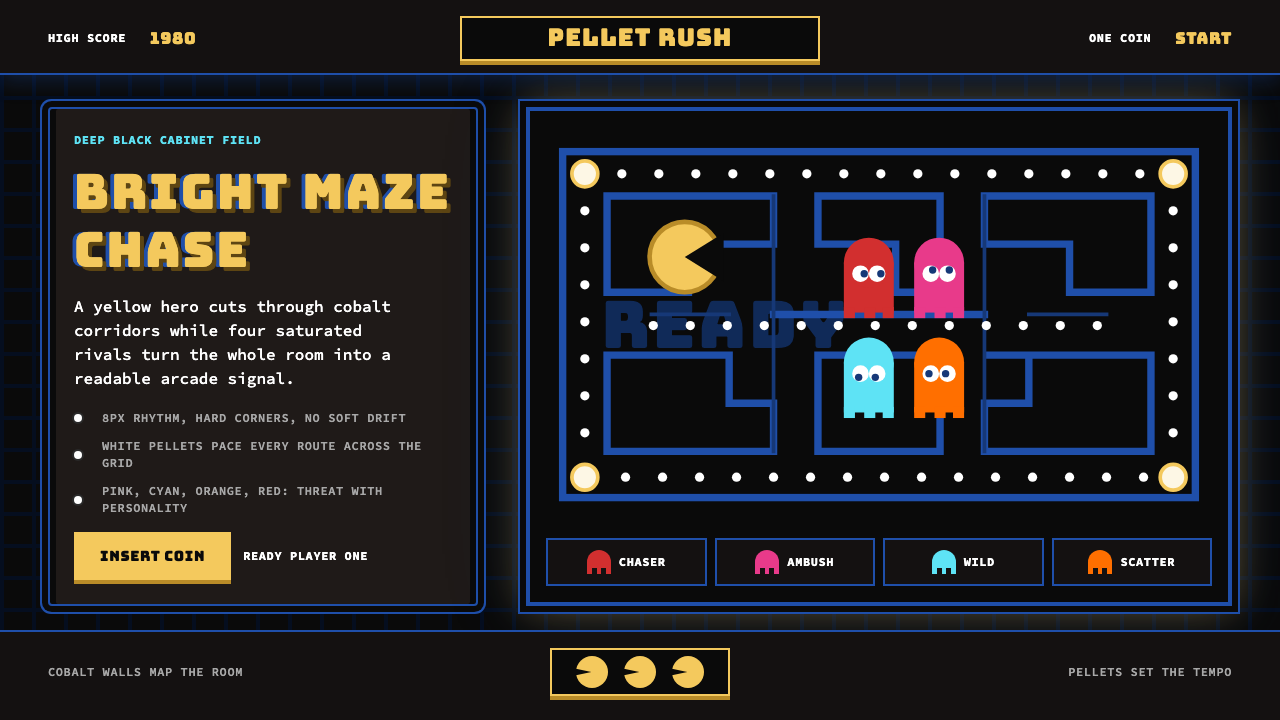 Pac-Man (Namco 1980)Arcade joy burns bright. Yellow disc, cobalt maze, and four ghost hues snap o…
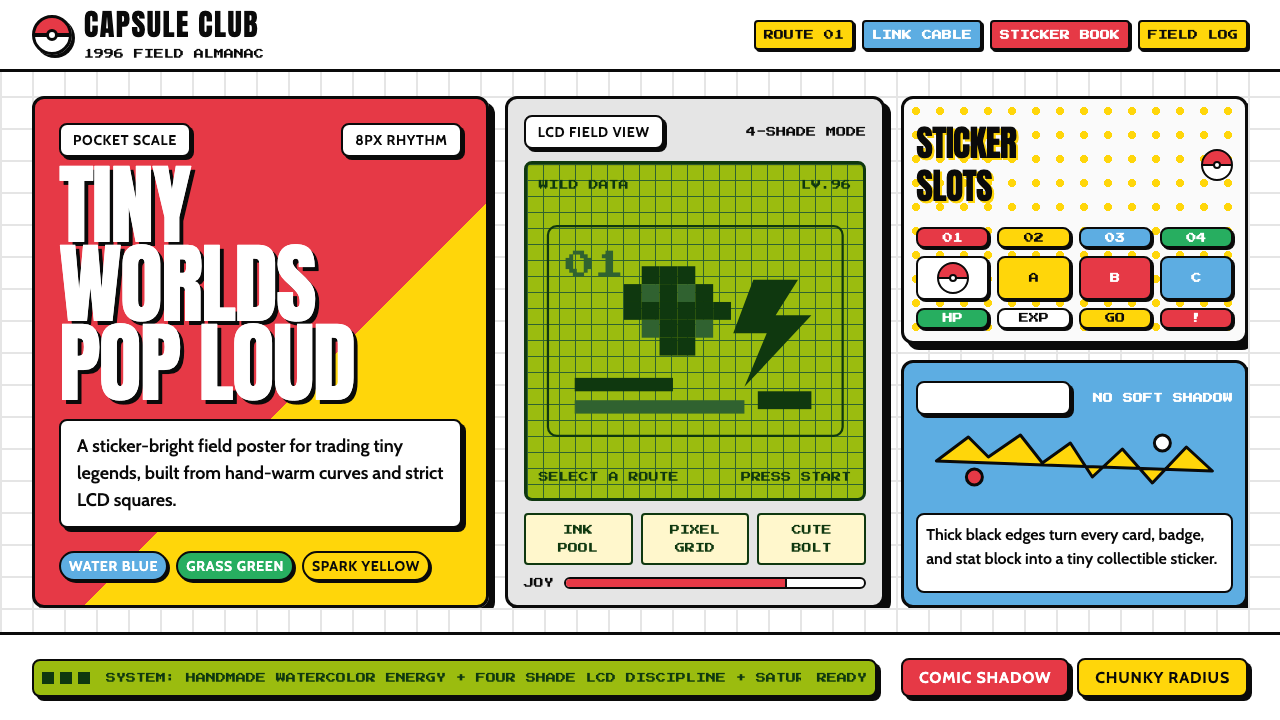 Pokémon Game BoyKawaii meets cartridge logic. Capsule red, LCD green, Anton heft, and 8px gri…
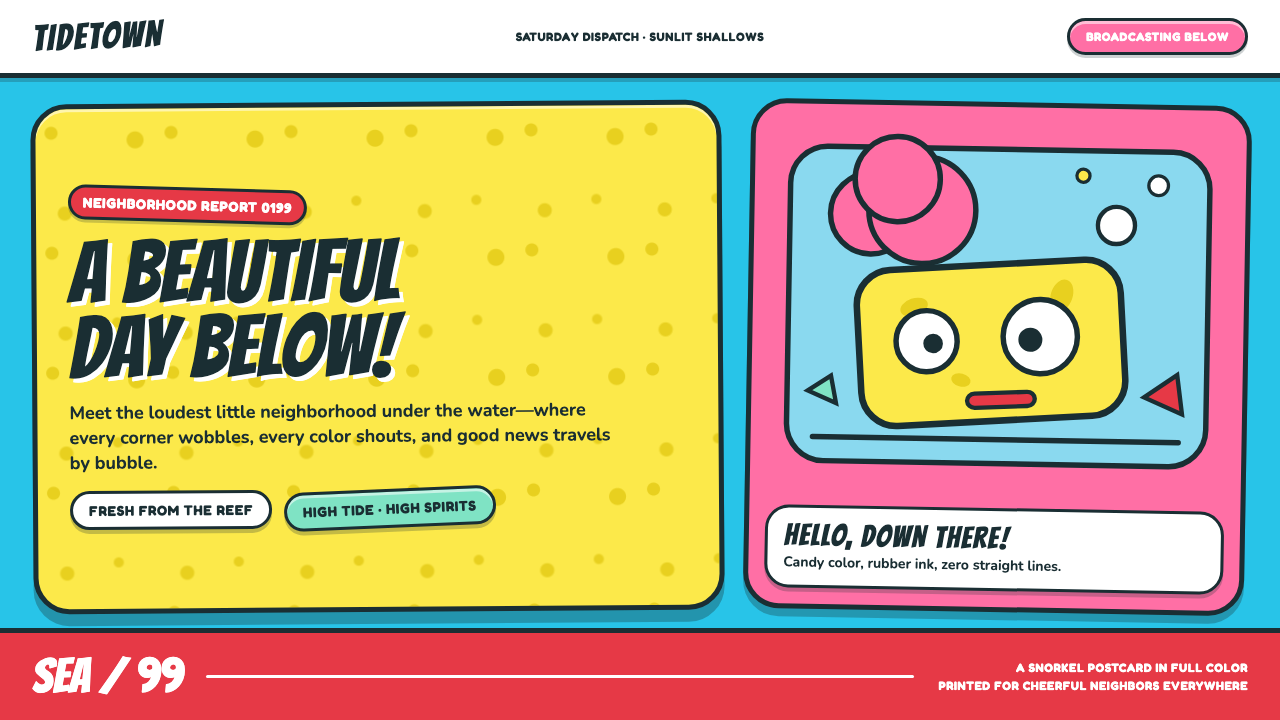 SpongeBob Bikini Bottom (1999)Undersea suburbia shouts with joy. Banana yellow and cyan bounce inside fat,…
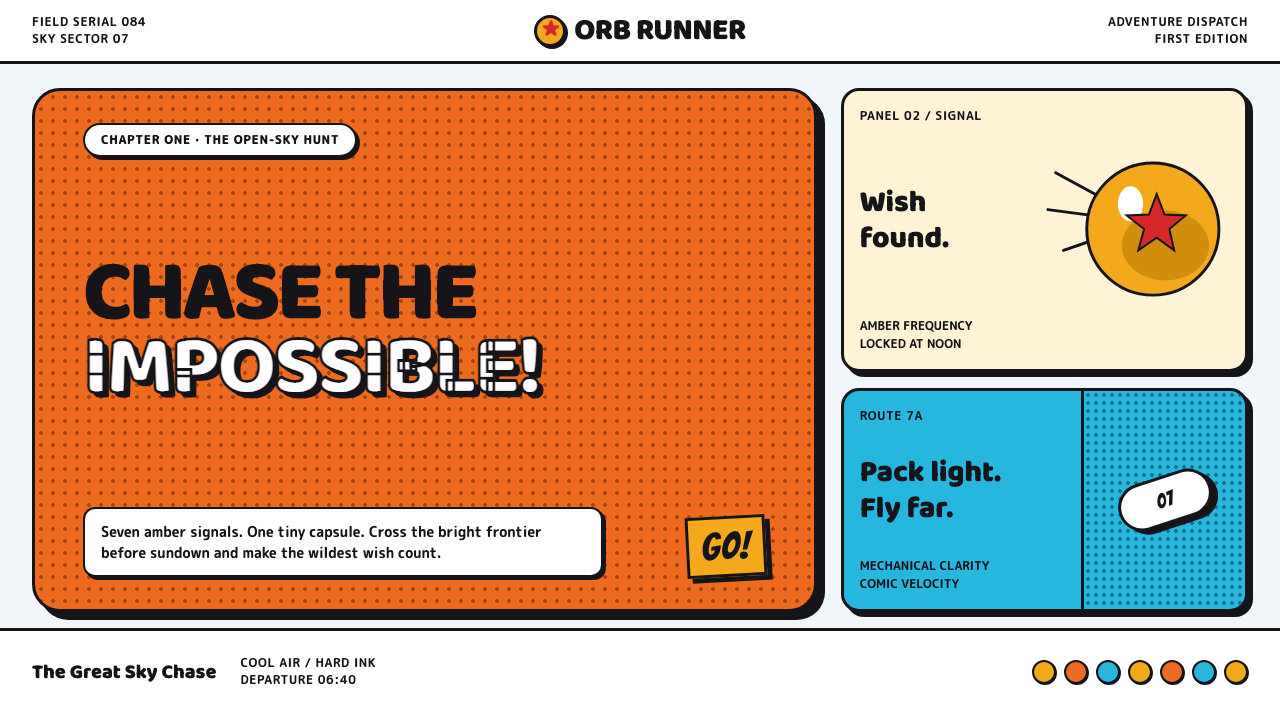 Dragon Ball (1984)Adventure lands with comic force. Gi-orange panels, amber spheres and crisp h…
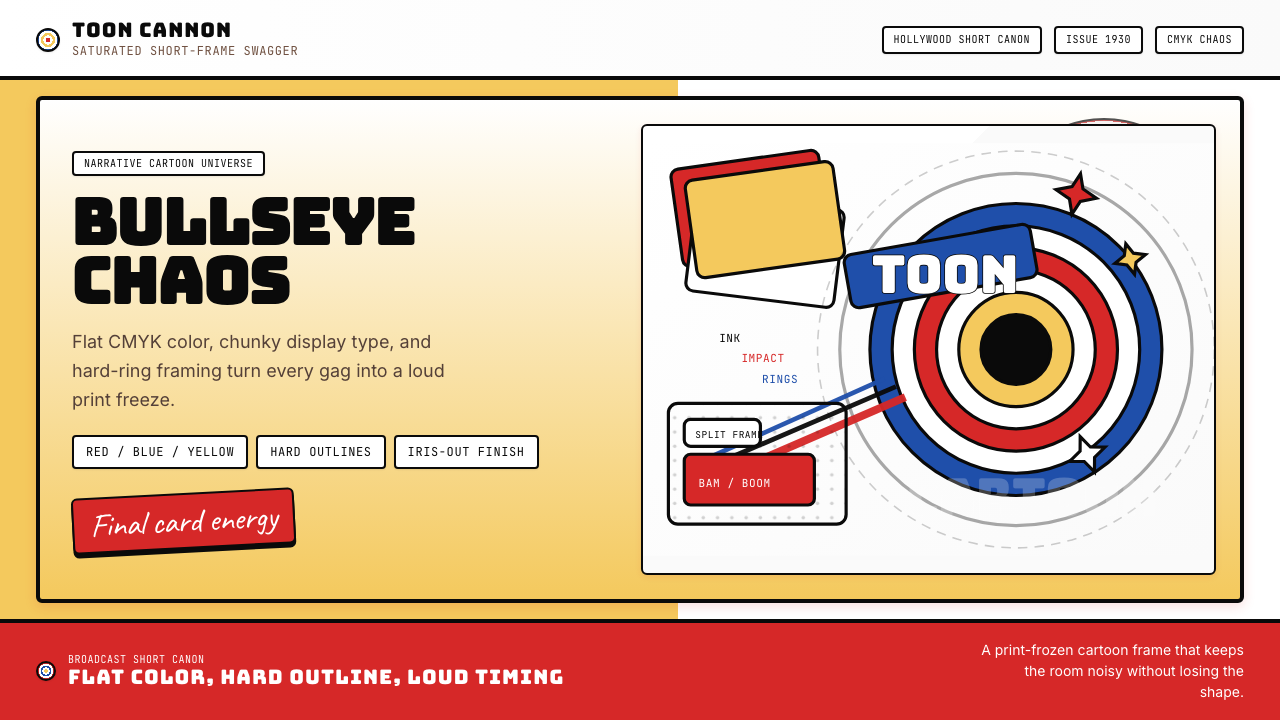 Looney Tunes (Warner Bros.)Pure cartoon chaos. Bull's-eye rings, Bungee type, and red-blue-yellow blocks.
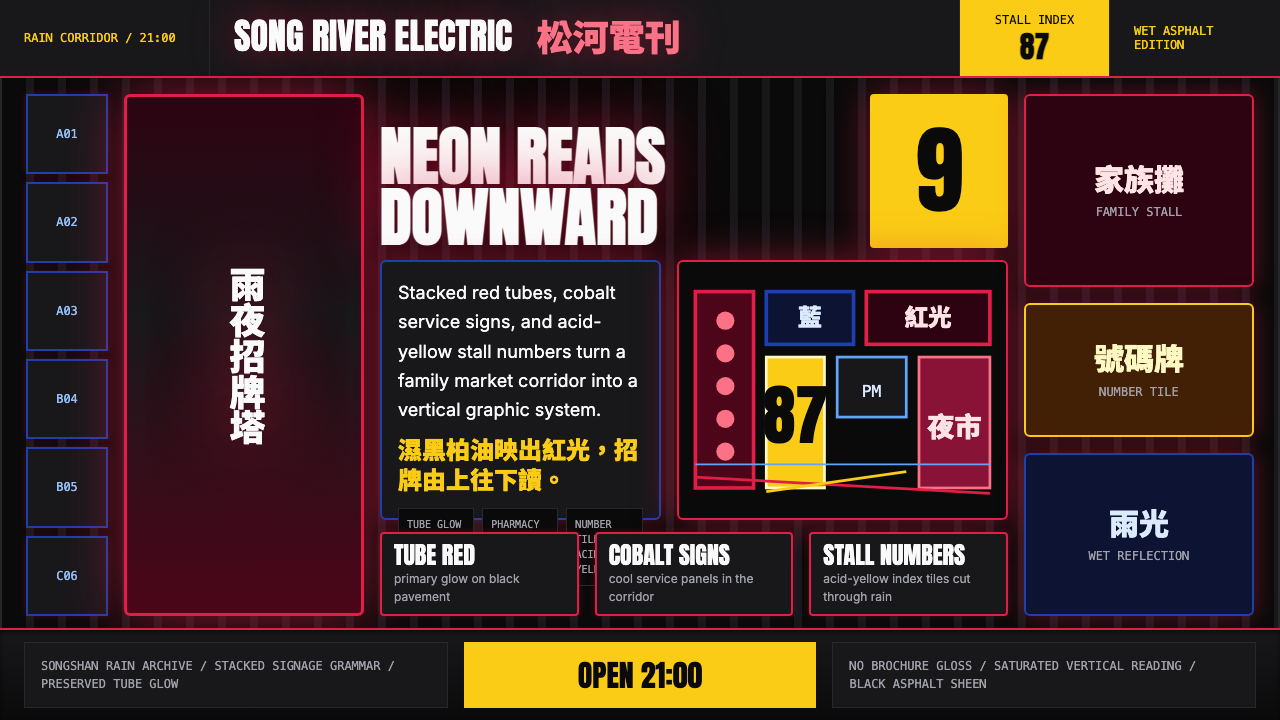 Taiwanese Raohe Night Market NeonTaipei night reads vertically. Neon red, cobalt panels, and acid-yellow numbe…