What is Pokémon Game Boy?
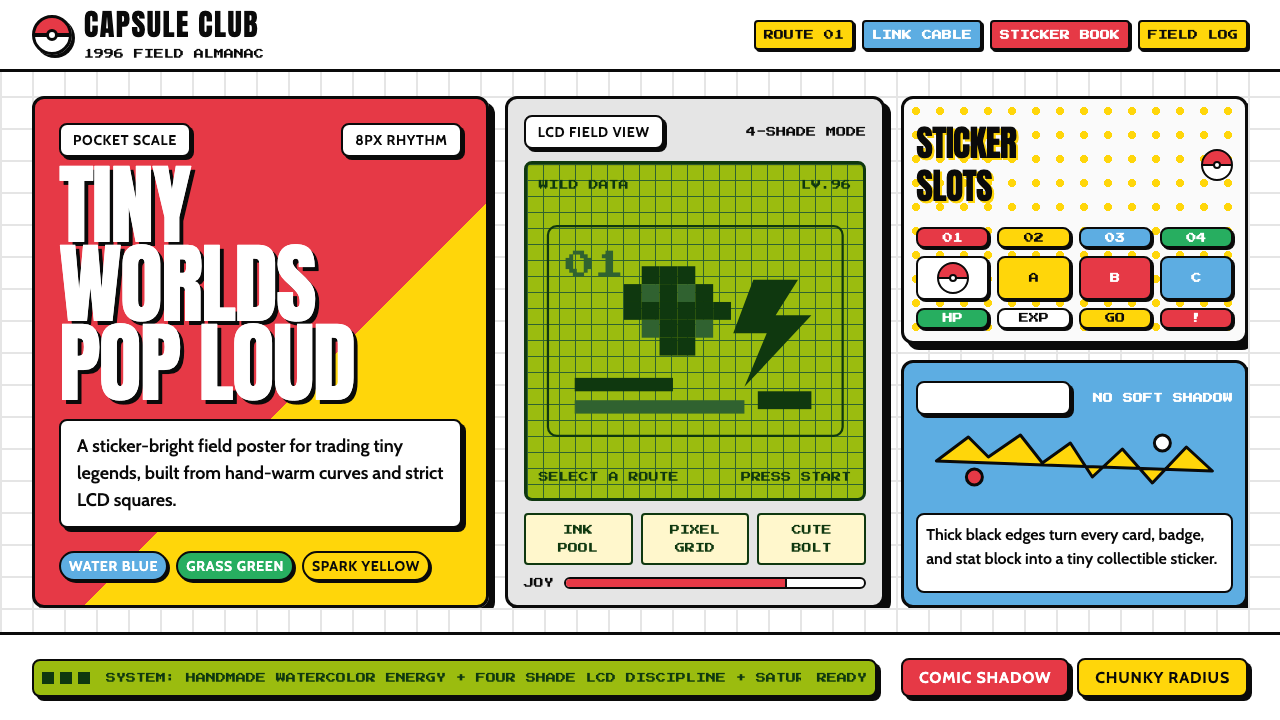
Pixel sprites and hand-painted watercolors collided in 1996 to create one of the most joyful and instantly recognizable visual languages in the history of interactive media.
Pokémon Game Boy in brief
The Pokémon Game Boy aesthetic is a design language born from the collision of two seemingly opposed visual traditions: the rigorous, grid-bound pixel art of the original Game Boy hardware and the delicate, organic hand-watercolored creature illustrations that artist Ken Sugimori created for the franchise. The resulting system is simultaneously handmade and systematic — warm and playful at surface level, yet governed underneath by strict technical constraints that gave it coherence and memorability.
At its core, the style is defined by saturated kawaii confidence. A palette anchored by Pokéball red, Pikachu yellow, and the distinctive phosphor-green of the Game Boy LCD screen forms the chromatic foundation, set against the kind of pure whites and heavy blacks that manga line art demands. Thick contour lines borrowed from Japanese comic illustration give every element a sense of weight and presence. Rounded, capsule-shaped forms — chunky buttons, bubbly letterforms, softly squared badges — communicate approachability without sacrificing visual punch.
What makes the aesthetic durable across three decades is its successful resolution of a genuine design tension: it is both a product of severe hardware limitation and an expression of boundless creative ambition. The four-shade monochrome constraint of the original Game Boy forced pixel artists to develop an economy of form that, paradoxically, produces characters and interfaces of extraordinary clarity. Layered on top of that austere pixel logic, the kawaii illustration tradition — exaggerated proportions, expressive eyes, round silhouettes — fills the system with personality and warmth.

Where does Pokémon Game Boy come from?
The story begins with Satoshi Tajiri, a game developer from Machida, Tokyo, whose childhood passion for collecting insects became the conceptual seed of Pokémon. Through the late 1980s and early 1990s, Tajiri and his company Game Freak labored over a concept they called Pocket Monsters — a role-playing game that would use the Game Boy Link Cable to let players trade and battle creatures between handheld consoles. Nintendo was skeptical, and the project languished for six years in development. When Pocket Monsters Red and Green finally launched in Japan in February 1996, they sold quietly at first, word spreading slowly through the elementary school networks that Tajiri had always imagined as his audience.
The visual identity of the franchise was inseparable from Ken Sugimori's illustration work. Sugimori, a co-founder of Game Freak and Tajiri's closest creative collaborator, developed the original creature designs using watercolor and ink — a deliberately handmade technique that gave each creature warmth, organic texture, and a sense of individual character. His palette leaned toward saturated primaries and clean secondaries, with thick black outlines that would translate legibly at the Game Boy's small screen resolution and in the printed media — manga adaptations, trading cards, strategy guides — that were always envisioned as part of the franchise ecosystem. The 151 original creatures he designed established visual conventions — round silhouettes, large eyes, readable color differentiation — that persist in the franchise to this day.
The Game Boy hardware itself was a decisive constraint and, in retrospect, a creative gift. The original Game Boy, released by Nintendo in 1989, displayed graphics on a reflective liquid crystal screen capable of rendering four shades of green-gray. Pixel artists at Game Freak, working within a strict tile-based grid, had to communicate creature personality, attack animations, and interface hierarchy using only this severely limited vocabulary. The discipline forced a kind of radical simplification that — like the best constraint-driven design — produced results with exceptional clarity and memorability. The chunky, high-contrast sprite aesthetic that emerged from these constraints would later be referenced deliberately by designers long after hardware had made such limitations obsolete.
The franchise's international expansion from 1998 onward — the Western release of Pokémon Red and Blue, the animated television series, the trading card game licensed to Wizards of the Coast, and the Pokémon Yellow version that added Pikachu as the player's companion — transformed the visual language from a Japanese niche product into a globally legible aesthetic. Each extension of the franchise reinforced the core visual vocabulary: Pokéball red-and-white, Pikachu's saturated yellow, the rounded typefaces and heavy outlines of the logo and merchandise. By the time the franchise reached its thirtieth year, that 1996 visual grammar had become one of the most commercially reproduced design systems in history, spanning games, animation, physical merchandise, theme park installations, and digital collectibles.
What defines the Pokémon Game Boy look?
Color
The palette is anchored by three hero colors: a saturated capsule red associated with the Pokéball, a warm and luminous yellow drawn from Pikachu's design, and the distinctive phosphor-green of the original Game Boy LCD screen. These sit against pure white backgrounds — the paper-white of manga pages — with black deployed for outlines and structural hierarchy. Each color carries narrative weight: red signals energy, danger, and action; yellow communicates warmth, electricity, and joy; the LCD green evokes the specific nostalgia of handheld gaming. Pastel secondary colors appear in creature and badge design, but the three primary anchors dominate every composition.
Outline and Contour
Heavy black outlines are the structural signature of the style, inherited directly from Ken Sugimori's ink-and-watercolor illustration method and from the pixel art tradition where clear silhouettes were a technical necessity at small display sizes. Every element — creatures, buttons, badges, text containers — is bordered by a consistent black stroke that reads as a confident declaration of form rather than a design accident. This outline logic extends to comic-book offset shadows: a shape's shadow is rendered as the same shape displaced at a diagonal, solid black or a deep color, rather than a soft diffuse blur.
Pixel Grid and Tile Logic
Beneath the kawaii surface, every spatial decision in the system is governed by a strict tile-based grid inherited from Game Boy hardware architecture. Buttons, cards, and content blocks align to a coarse modular grid — the visual equivalent of the hardware tile map — so that compositions feel both playful and rigorously organized. Rounded corners are generous and uniform, echoing the physical form of the Game Boy console itself and the capsule-shaped design of the Pokéball. This combination of grid discipline and rounded softness is the system's defining spatial characteristic.
Typography
Typefaces in the Pokémon Game Boy aesthetic are chunky, rounded, and unabashedly bold — letterforms that prioritize legibility at small sizes and emotional warmth over refined elegance. The style draws on the pixel bitmap font tradition of early game hardware, where every character was constructed from a small matrix of dots and required maximum contrast to be read on a green-gray screen. Display type is treated with the same weight and confidence as the illustrated elements — often outlined, frequently accompanied by a comic-book shadow — so that words function as visual objects rather than neutral carriers of information.
Kawaii Proportion and Form
The creature design tradition of the franchise introduced a set of proportion conventions that permeate the entire aesthetic: oversized heads relative to bodies, large circular eyes that occupy much of the face, simplified limb forms, and overall silhouettes that read as round and soft rather than angular and threatening. These kawaii conventions — rooted in the Japanese aesthetic concept of cuteness as a value in itself — translate into interface elements that are generous in size, rounded in form, and warm in color temperature. Hardness and aggression are reserved for deliberate emphasis, such as type-weakness indicators or status effect alerts.
Badge and Emblem Logic
The franchise's Gym Badge system — eight collectible emblems representing regional champions, each with a distinct shape and color — introduced an emblem design vocabulary that is central to the aesthetic. Badges function as compact, high-contrast icons: a single dominant shape, one or two colors, a strong outline, and a design that reads instantly at small sizes and memorably at large ones. This badge logic extends naturally to interface design, where category chips, achievement indicators, type tags, and status pills inherit the same design DNA — each a self-contained visual object with immediate recognizability.
Noise, Dither, and Screen Texture
The four-shade constraint of the Game Boy display produced a characteristic visual texture: areas of mid-tone were achieved through checkerboard dithering patterns — alternating light and dark pixels that, at reading distance, blend into apparent gray values. This dither texture, along with the slight luminous haze of the original LCD backlight, gives the aesthetic a material specificity that distinguishes it from generic pixel art. Contemporary applications of the style often introduce subtle grain or scanline overlays to invoke this hardware memory without replicating it literally — gesturing toward the physical experience of playing a Game Boy under different lighting conditions.

Who shaped Pokémon Game Boy?
Tajiri is the creator and original director of Pokémon, whose childhood habit of collecting insects in rural Tokyo evolved into the franchise's central mechanic of catching, training, and trading creatures. His insistence on using the Game Boy Link Cable — a peripheral that Nintendo had largely abandoned — as the social backbone of the game forced a cooperative dimension into what could have been a solitary experience, and established the visual and mechanical vocabulary of creature exchange that defined the franchise's design logic. His six-year battle to bring Pokémon to market despite Nintendo's skepticism is a foundational story in the history of game design.
Sugimori is the lead creature designer and art director of the Pokémon franchise, responsible for the visual identity of all 151 original Pokémon and for establishing the illustration conventions — thick ink outlines, watercolor fills, exaggerated kawaii proportions — that define the franchise's look to this day. His transition from hand-painted originals to digital illustration tools as the franchise scaled is a case study in preserving aesthetic consistency across technological change. As art director, he oversaw the visual language of Pokémon through its expansion into trading cards, animation, and eventually three-dimensional game environments, maintaining the core character design DNA across all media.
Masuda joined Game Freak as a programmer and composer for the original Pokémon games, later becoming director, producer, and eventually chief operating officer of Game Freak. His compositional work — creating the instantly recognizable eight-bit musical themes using the Game Boy sound chip — established an audio identity that reinforced the visual aesthetic: both were products of radical constraint producing memorable output. As director of subsequent mainline titles, Masuda was responsible for translating the franchise's core visual and mechanical language into new hardware generations while preserving the qualities that made the original design system durable.
Nishida is a designer at Game Freak credited with creating the original designs for Pikachu and several other iconic first-generation Pokémon, including Eevee. Her creature designs are notable for their particular balance of the kawaii tradition — roundness, large eyes, approachable scale — with visual distinctiveness and instant silhouette recognizability. Pikachu's design in particular, with its lightning-bolt tail, circular cheek markings, and fully saturated yellow body, became the visual ambassador of the entire franchise and one of the most reproduced character designs in commercial history. Nishida's work demonstrates how constraint-driven simplicity in character design produces icons rather than illustrations.
The logo, packaging, and merchandise graphic design of the original Pokémon franchise was developed by a team of graphic designers working under the direction of Nintendo's product design division and the licensors at Creatures Inc. Their work established the franchise's typographic identity — the bold, rounded, outlined wordmark that appears on every game cartridge, box, and official piece of merchandise — and the packaging design conventions that would be maintained across decades and hardware generations. The original Red and Blue cartridge packaging, with its bold color blocking, creature portrait placement, and logo hierarchy, became a visual template referenced by game packaging design globally.
How do you use Pokémon Game Boy today?
The Pokémon Game Boy aesthetic is one of the few historical design systems that successfully combines systematic grid discipline with emotional warmth and playful exuberance. Applying it well requires understanding that the style works through contrast — the contrast between strict pixel-grid organization and organic kawaii illustration, between heavy black outlines and saturated warm color, between technical constraint and creative abundance. Simply applying a retro green color or adding pixel textures produces a nostalgia costume, not a coherent design system.
For presentation slides, the style excels at creating covers and section dividers with immediate visual impact. A cover page benefits from the franchise's poster-like composition logic: a large creature silhouette or badge-shaped emblem anchors the center, with the title treated as a display element with its own outline and offset shadow. The background should commit to one hero color — the saturated red, the bright yellow, or the LCD green — used at full saturation. Content slides should shift to a near-white ground with the hero color reserved for interactive elements, data callouts, and section headers. Data visualizations work naturally in this system: bar charts become stacked type bars with the franchise's color hierarchy, pie charts become badge-shaped emblems, and progress indicators become Pokéball-styled completion rings.
For web interfaces, the style is particularly well-suited to products targeting younger audiences, gaming communities, creative tools, and any platform where visual energy and personality are as important as functional clarity. Dashboard layouts benefit from the badge-and-grid logic: category chips, status indicators, and achievement tiles adopt the rounded, outlined, high-contrast form of Gym Badges, arranged on a coarse modular grid. Pricing pages work well with this aesthetic's tier-differentiation vocabulary — each tier presented as a distinct badge or card with its own hero color, heavy outline, and offset shadow, immediately communicating visual hierarchy without relying on subtle gradient or typographic weight alone.
For editorial and marketing applications, the style brings strong visual authority to covers, campaign headers, and social media graphics where stopping power matters. A Pokémon Game Boy-derived editorial layout uses full-saturation color blocks for section dividers, bold outlined type for headlines, and a layout logic that echoes the franchise's trading card grid — information organized into compact, self-contained panels. Marketing pages can deploy the style's badge vocabulary for product feature callouts: each feature presented in a rounded, outlined container with its own color assignment and supporting iconography drawn from pixel-art conventions. The style also translates naturally to email design, where its high-contrast, flat construction ensures reliable rendering across email clients that routinely strip or reinterpret CSS.
A common mistake when applying this style is overloading the layout with all three hero colors simultaneously at full saturation. Authentic Pokémon Game Boy compositions typically lead with one hero color per scene or section, using the others as structural accents — the same principle that governs the franchise's own game UI, where a single type-color dominates each encounter screen. Another frequent error is treating the pixel aesthetic as purely retro: adding scanlines, resolution reduction, or dithering effects without the underlying grid discipline and outline logic produces a costume effect rather than a coherent design system. The pixel texture should feel structural — a consequence of the compositional rules — not decorative.

Pokémon Game Boy — FAQ
Is this style purely nostalgic, or does it work for contemporary professional contexts?
The style has genuine contemporary applicability when the product context supports it. The emotional warmth, badge-based hierarchy, and pixel-grid organization are genuinely useful design tools — not just retro decorations. Gaming products, creative tools, education platforms, youth-facing consumer apps, and event branding for entertainment properties all benefit from the system's combination of visual energy and structural clarity. The risk is misapplication: deploying the style for products where formal authority, calm, or clinical precision is the desired emotional register — financial services, medical tools, enterprise software — will produce a mismatch between aesthetic and context that users will sense even if they cannot articulate it.
How does this style differ from generic pixel art or chiptune aesthetics?
Generic pixel art or chiptune aesthetics typically lean into monochrome or limited palettes, stark geometric blocks, and a kind of digital austerity that references arcade and early home console culture broadly. The Pokémon Game Boy system is distinctive in layering a warm, kawaii-inflected illustration sensibility on top of the pixel constraint — the franchise's visual identity was always defined by Ken Sugimori's organic, hand-painted creature designs as much as by the hardware's pixel grid. The result is a system that feels both technical and handmade, both nostalgic and emotionally immediate. The heavy black outline and the saturated, named-color palette — rather than the arbitrary palette of any specific hardware — are the style's identifying marks.
Can the style work in a dark-background or night-mode layout?
A dark-background variant is possible and has precedent in the franchise itself — later Game Boy Color and Game Boy Advance titles used deep navy and charcoal grounds for night scenes and cave environments. The key challenge is that the style's outline logic depends on high contrast between the outline and both the element color and the background. On a dark ground, the black outline may need to be replaced with a light outline or a thick drop shadow to preserve the defining characteristic. The three hero colors respond differently to dark grounds: the LCD green reads with appropriate eeriness, the saturated red holds its presence, but the bright yellow can overwhelm a dark composition if used at full saturation for large areas. A dark variant works best when the yellow is reserved for small accent elements and a single hero color dominates each screen.
How do you handle photography or realistic imagery within this style?
Realistic photography sits uncomfortably within the Pokémon Game Boy aesthetic, whose visual logic is fundamentally illustrative and graphic rather than photographic. The franchise's own media never used photography for creature representation — watercolor illustration, pixel sprites, and later three-dimensional models were always the vehicles. When photography must be used in a contemporary application, the recommended approach is aggressive graphic treatment: high-contrast duotone conversion using the hero color palette, silhouette cropping against flat color backgrounds, or posterization that reduces tonal range to a small number of flat shades. The goal is to make the photograph function as a graphic element within the system's flat, high-contrast visual logic, rather than as a naturalistic window.
What makes this style durable across thirty years when most game aesthetics date quickly?
Most game aesthetics date because they are expressions of what was technically possible at a given moment — early three-dimensional polygon graphics, mid-period bloom and lens flare, or the post-processing effects of a particular hardware generation. The Pokémon Game Boy aesthetic is durable for the opposite reason: it was defined by constraint and illustration, not by technical capability. The watercolor creature designs do not age because they were never meant to look photorealistic. The pixel grid logic became nostalgic rather than obsolete because it was always a design choice, not a hardware limitation. And the kawaii proportional conventions draw on a tradition — Japanese cute aesthetics — that predates and will outlast any particular technology. The style's durability is an argument for designing around strong illustrative and proportional principles rather than technical effects.
Related design styles
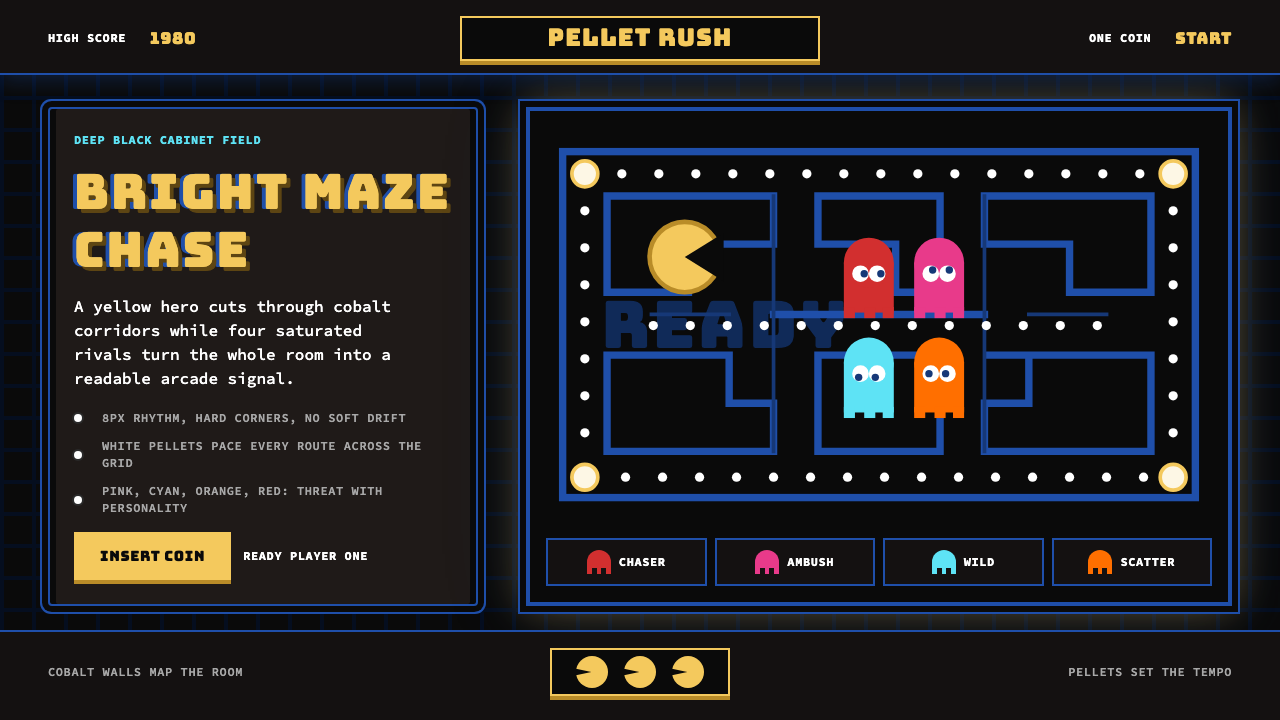 Pac-Man (Namco 1980)Arcade joy burns bright. Yellow disc, cobalt maze, and four ghost hues snap o…
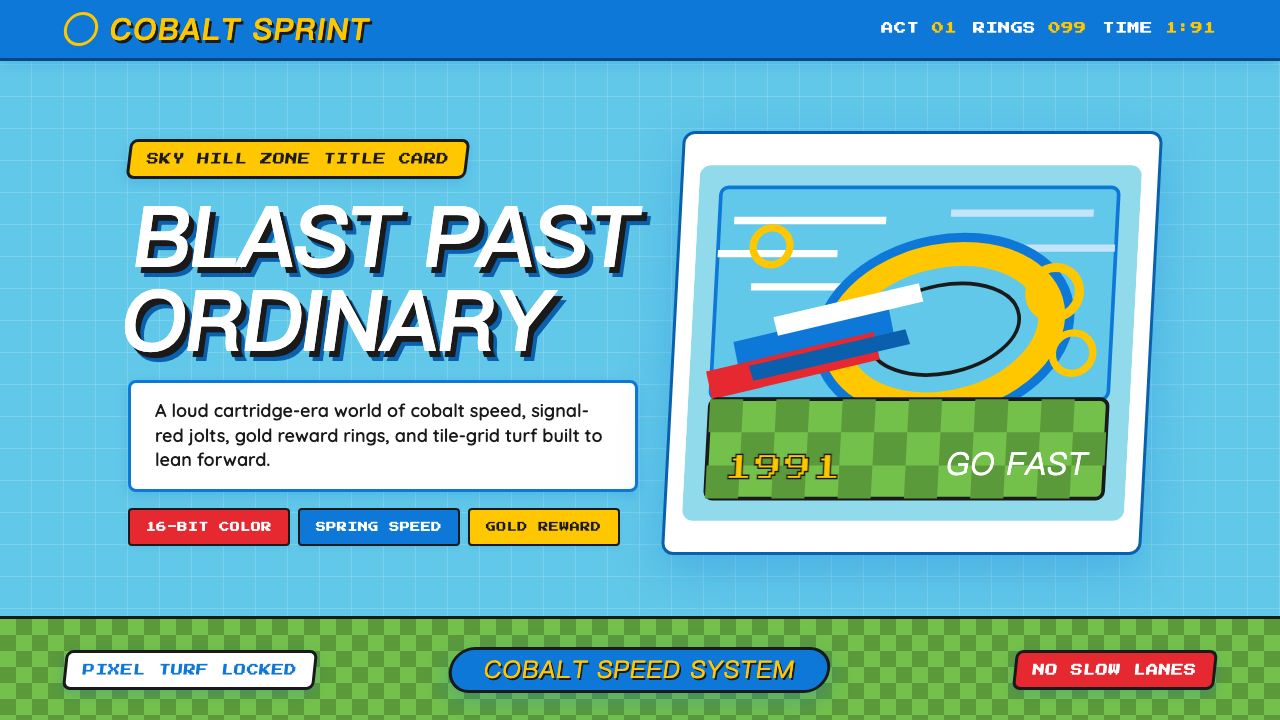 Sonic the Hedgehog (1991)Velocity has teeth. Sky-cyan, cobalt slant type, gold rings, checkerboard tur…
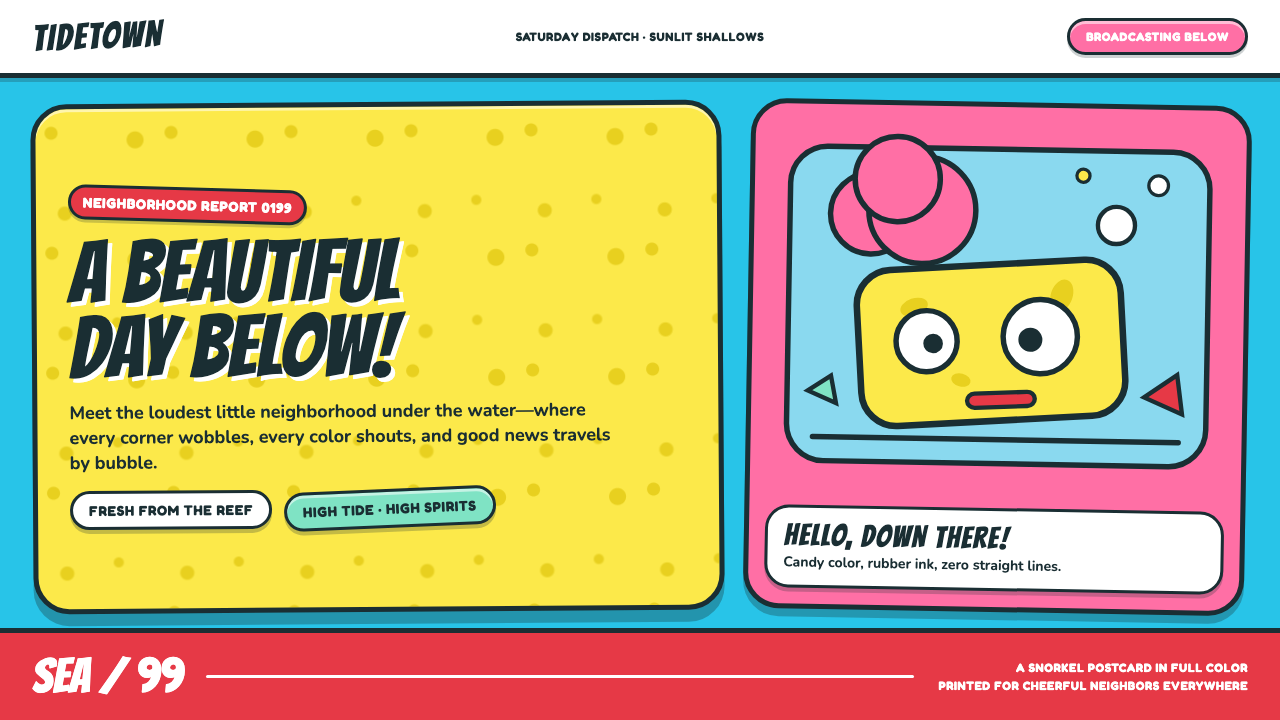 SpongeBob Bikini Bottom (1999)Undersea suburbia shouts with joy. Banana yellow and cyan bounce inside fat,…
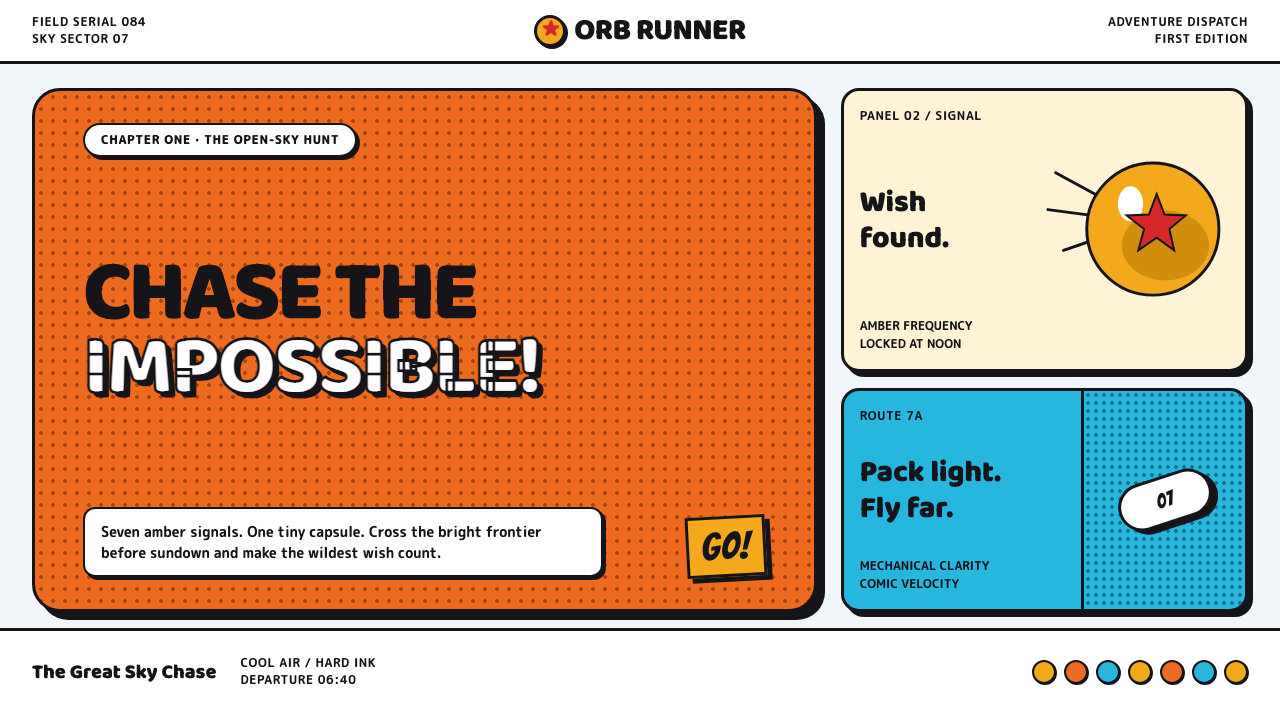 Dragon Ball (1984)Adventure lands with comic force. Gi-orange panels, amber spheres and crisp h…
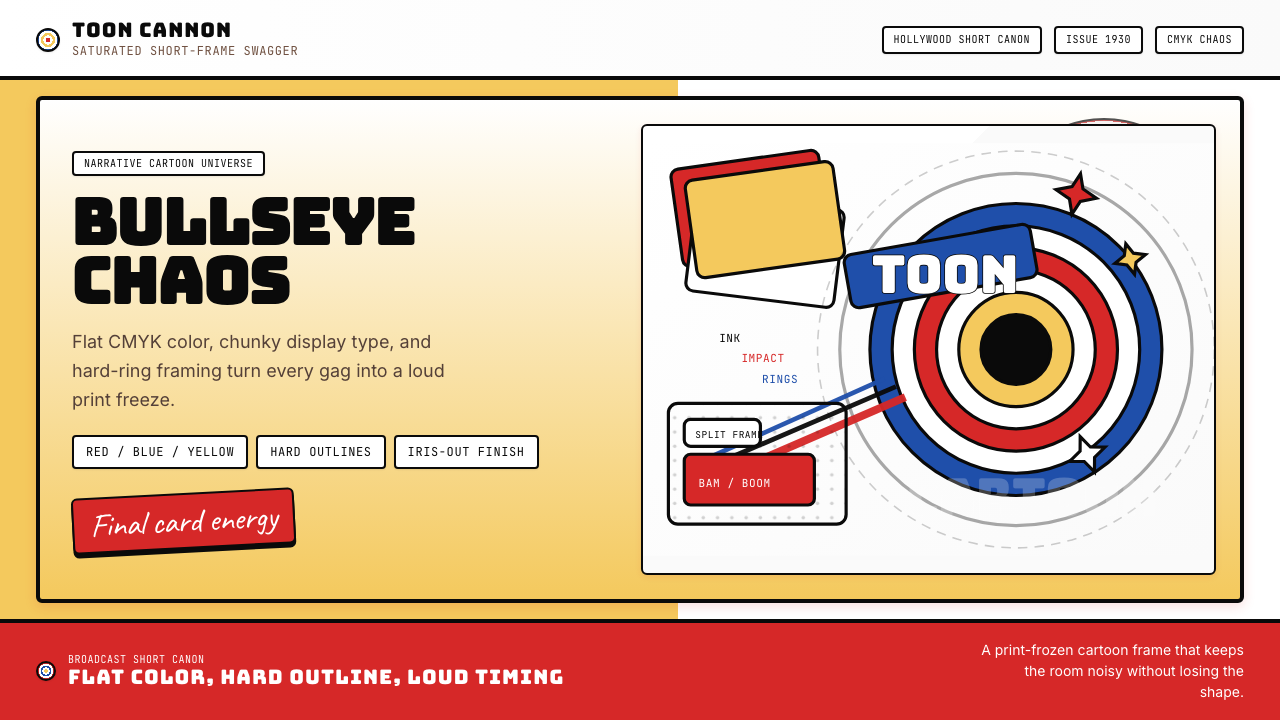 Looney Tunes (Warner Bros.)Pure cartoon chaos. Bull's-eye rings, Bungee type, and red-blue-yellow blocks.
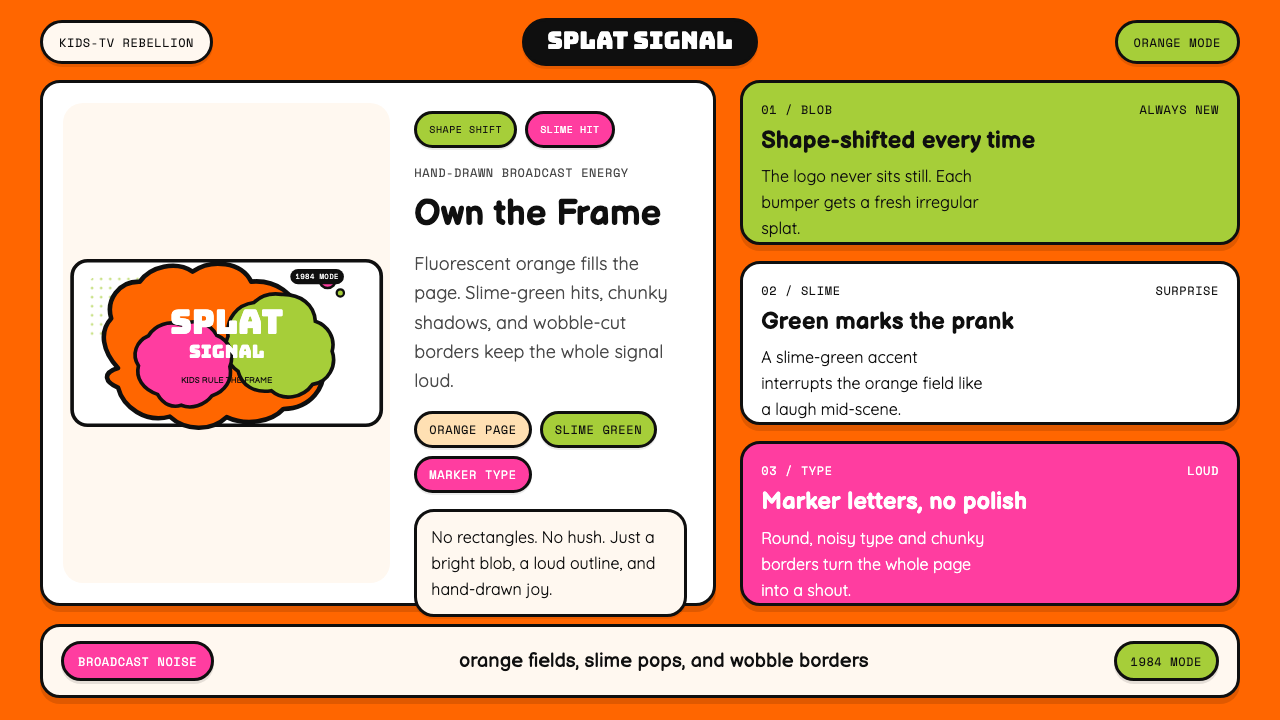 Nickelodeon Orange Splat (1984)Kids own the screen. Orange fields, slime-green pops, and wobble borders do t…