What is Aardman Claymation?
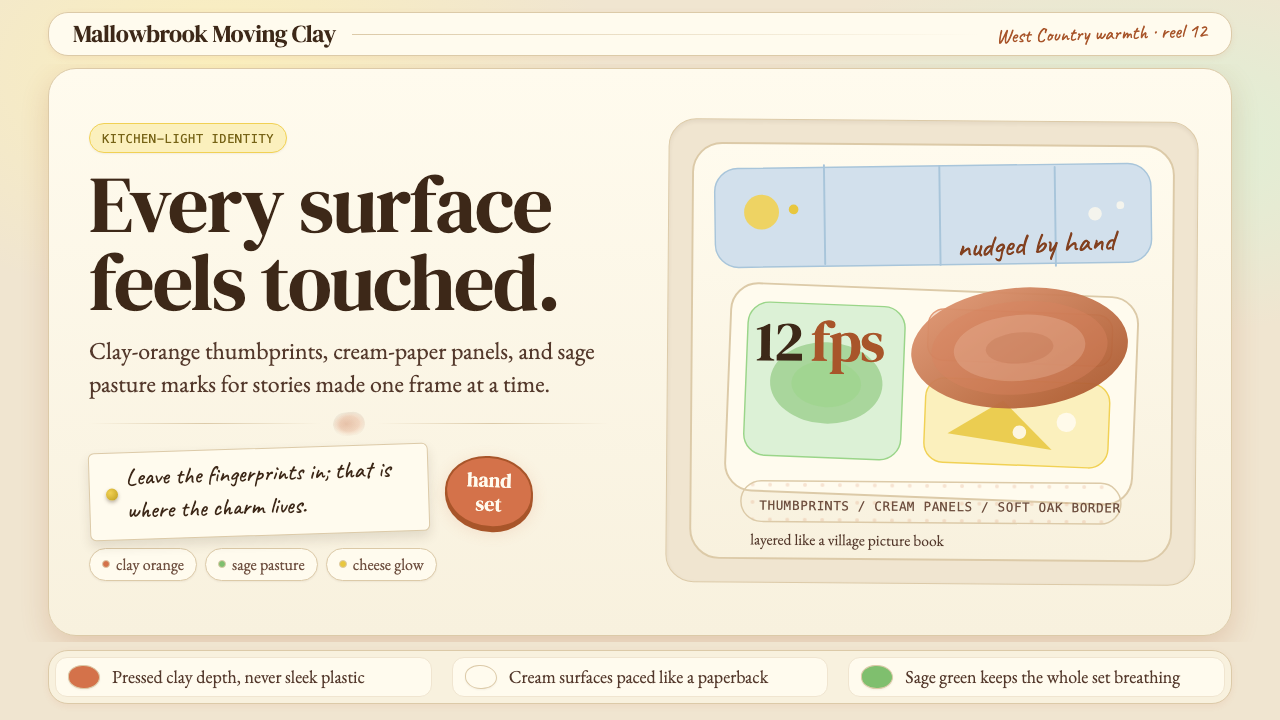
Aardman Claymation translates the tactile warmth of British stop-motion — thumbprints, clay-orange, and cottage-kitchen light — into a design language where every surface feels handmade.
Aardman Claymation in brief
Aardman Claymation is a design aesthetic derived from the visual identity of Aardman Animations, the Bristol stop-motion studio founded in 1972. The studio's most celebrated works — A Grand Day Out (1989), Wallace and Gromit, Chicken Run, and Shaun the Sheep — established a visual vocabulary so specific and internally consistent that it translates naturally into interface, editorial, and presentation design. The defining quality is tactility: the sense that every surface has been touched, pinched, or smoothed by a human hand.
The palette reads like the interior of a West Country cottage kitchen — warm clay-orange, cream and aged-cheese yellows, soft sage-green, and the chalky off-white of a plaster wall — all lit by gentle, diffuse window light rather than dramatic studio illumination. Shapes are rounded, never razor-sharp. Edges carry the slight imprecision of something pressed from soft material. This is not sloppiness; it is deliberate warmth, the visual equivalent of a firm handshake from someone with flour on their apron.
Translated into two-dimensional design, the system favors generous serif headlines that feel hand-set, hand-lettered annotations in the margins, cards with softly rounded corners that suggest clay modeling, and shadows that are warm-tinted and diffuse rather than cold and geometric. Illustration, when present, leans toward the rounded, slightly exaggerated character-drawing style of classic British animation — no sharp angles, no hard silhouettes. The overall register is approachable, witty, and human without being cloying or naive.

Where does Aardman Claymation come from?
Aardman Animations was co-founded by Peter Lord and David Sproxton in Bristol in 1972, initially producing animated segments for BBC children's programming. For more than a decade the studio refined its claymation technique in relative obscurity, developing the material handling, lighting, and character-modeling practices that would define the later signature look. The breakthrough came with Nick Park, who joined Aardman in the early 1980s as a student and completed A Grand Day Out — featuring the first appearance of Wallace and Gromit — in 1989. The film had been in production, on and off, for six years.
A Grand Day Out and its immediate successors, The Wrong Trousers (1993) and A Close Shave (1995), won multiple Academy Awards and introduced the Aardman visual language to a global audience. The aesthetic those films codified was not accidental. Claymation at Aardman's scale is painstaking: each character is built by hand, lit by hand, and moved in increments of a single frame at a time. The slight imperfections that result — fingertip impressions in clay surfaces, the almost-imperceptible warp of a figure between frames — are not errors to be concealed but qualities to be preserved. The studio consistently chose warmth and character over technical slickness.
The British cultural context mattered enormously. Aardman's humor is rooted in a distinctly English tradition of village eccentricity, deadpan understatement, and the comedy of the mundane elevated to heroic scale. Wallace is a Lancastrian cheese enthusiast. Gromit is a silent, long-suffering dog of obvious intellectual superiority. Their adventures take place in terraced houses, on village greens, and on a homemade rocket to the moon — settings that are simultaneously cozy and absurd. This cultural specificity shaped every visual choice: the warm domesticity of the palette, the cottage-scaled proportions of the environments, the hand-lettered labels on jam jars and cheese wheels that populate the frame.
Chicken Run (2000), the studio's first feature film made with DreamWorks Animation, brought the aesthetic to a still larger audience while preserving its handmade integrity. Shaun the Sheep, introduced as a supporting character in A Close Shave and spun off into his own series from 2007, extended the franchise further while stripping the character design to its most geometric and graphic minimum — demonstrating that the Aardman visual identity is robust enough to accommodate both highly detailed clay modeling and clean simplified silhouettes. By the time Shaun the Sheep Movie appeared in 2015, the Aardman aesthetic had become recognizable worldwide as a coherent and transferable visual system.
What defines the Aardman Claymation look?
Color Palette
The Aardman palette is built from warm, slightly desaturated earth tones that evoke fired clay, aged dairy products, and English pastoral landscapes. Clay-orange is the anchor hue — present in walls, surfaces, and accent touches throughout. Cream and pale yellow-white read like aged paper or the interior of a farmhouse. Sage-green appears as the natural counterpoint, referencing grass, garden leaves, and painted cottage woodwork. All hues are softened as if slightly dusty or sun-bleached, never saturated to the point of harshness. The overall palette effect is of warmth without aggression, color that invites rather than demands attention.
Surface Texture
The most distinctive quality of Aardman-derived design is the suggestion of physical texture on every surface. Backgrounds carry a faint grain — the visual equivalent of a clay surface that has been smoothed but not sanded flat. Cards and panels feel as if they could be picked up and bent slightly. This is achieved not through applied texture filters but through the soft, warm shadows and slightly uneven color fields that mimic the behavior of clay under diffuse lighting. The effect is anti-digital: surfaces appear to exist in three dimensions even when rendered flat.
Rounded Forms
Nothing in Aardman's visual world is sharp. Characters have rounded heads, stumpy fingers, and eyes that bulge gently outward. Environments feature arched doorways, oval windows, and furniture with swollen, almost pneumatic proportions. In design application, this translates to generously radiused corners on all containers and buttons, type choices that lean toward rounded, friendly letterforms rather than geometric precision, and compositional arrangements that favor curved paths and oval groupings over rectilinear grids. The rounding is not a style detail but a philosophy: the world is handmade and imperfect, and hard edges belong to machines, not to people.
Warmth of Light
Aardman sets are lit with the quality of English afternoon light coming through a small window — warm in temperature, directional but soft, casting diffuse shadows that pool gently at the base of objects rather than slicing across surfaces. In design terms, this translates to shadows that are warm-tinted rather than cool-gray, applied with generous blur and modest offset. Elevation is communicated through warmth and softness rather than through hard contrast. Bright highlights are rare; the palette lives in the middle values, the way a clay model does when lit from a north-facing studio window.
Hand-Lettered Typography
Labels, signs, and annotations in Aardman films are always hand-lettered in a characterful, slightly wobbly script that communicates authenticity and craft. Cheese labels, rocket blueprints, garden signs — each carries the personality of having been written by the character who made it. In design translation, this appears as a preference for display typefaces with calligraphic warmth and visible stroke variation over geometric neutral letterforms. Body text may remain in a workhorse serif, but headline and accent text reaches toward the handmade. When actual handwriting or lettering is used as a design element, it functions as a signature of the human origin of the work.
Domestic Scale
Aardman stories are cottage-scale epics. The settings are kitchens, gardens, garages, village halls — intimate spaces in which the characters' ordinary belongings (a wedge of Wensleydale, a pair of knitting needles, a garden gnome) become central props. This sense of domestic scale informs design work drawn from the aesthetic: layouts feel like arrangements on a kitchen table rather than compositions in a gallery. White space is warm and inhabited, not cool and empty. Information is presented at a human, conversational scale rather than broadcast scale.
Wit and Eccentricity
Aardman's humor is a function of its visual sensibility, not separate from it. Characters have slightly too-large eyes and slightly too-small mouths. Machinery is recognizable but absurdly modified — a motorcycle with a sidecar that becomes an aircraft, a rocket built from household plumbing. This eccentric wit translates into design as a permission to be playful within a coherent system: an unexpected illustration in the corner of an otherwise earnest data slide, a label with a small visual joke, a mascot character who appears at unexpected moments. The wit should feel discovered rather than telegraphed.

Who shaped Aardman Claymation?
Nick Park joined Aardman Animations as a student in the early 1980s and completed A Grand Day Out in 1989 after six years of intermittent work, introducing Wallace and Gromit to the world. He subsequently directed The Wrong Trousers (1993) and A Close Shave (1995), both Academy Award winners. Park is the primary author of the Aardman visual language as it is recognized today: the warm palette, the rounded character proportions, the blend of British village eccentricity with genuine emotional warmth. His work established that stop-motion claymation could achieve the same level of character depth and narrative sophistication as any other animation medium.
Peter Lord co-founded Aardman Animations with David Sproxton in 1972 and served as its co-director and chief creative officer for decades. His early work establishing the studio's claymation technique — particularly the material practices for building, painting, and rigging clay characters — laid the physical and procedural foundations that Nick Park and subsequent directors would inherit. Lord directed Chicken Run (2000), the studio's first feature film and its commercial breakthrough on an international scale. As studio co-head, he shaped Aardman's commitment to handmade quality over digital convenience, a decision that has defined the studio's identity.
David Sproxton co-founded Aardman Animations alongside Peter Lord and served as the studio's chief executive officer through its period of greatest international growth. Where Lord focused on the creative and directorial side, Sproxton managed the business and production infrastructure that allowed Aardman's handmade aesthetic to scale to feature films and international co-productions without sacrificing its defining qualities. His partnership with Lord over more than four decades represents one of the longest-running and most productive creative-business collaborations in British animation history.
Wallace, the cheese-loving, gadget-obsessed Lancastrian inventor created by Nick Park, is the primary visual and tonal ambassador of the Aardman aesthetic. His design — domed bald head, wide grin, small hands, fondness for tank-top jumpers — encapsulates everything the studio stands for: warmth, gentle absurdity, and the conviction that ordinary people with extraordinary enthusiasm are worth celebrating. The character's home, 62 West Wallaby Street, is a compendium of the Aardman interior design vocabulary: tiled kitchens, wooden furniture, hand-lettered labels on household goods.
Shaun the Sheep, introduced as a supporting character in A Close Shave (1995) and expanded into his own series from 2007, represents the most graphically reduced expression of the Aardman aesthetic. Shaun's design strips the clay-character vocabulary to its geometric minimum — a black oval body, white oval face, stick-like legs — while retaining the warmth and expressiveness of the studio's more detailed work. His television series and feature films are entirely silent, relying on visual storytelling and the expressive potential of simple rounded forms. Shaun demonstrates that the Aardman aesthetic is not dependent on material complexity but on tonal and proportional warmth.
How do you use Aardman Claymation today?
Aardman Claymation is among the most approachable historical animation aesthetics for contemporary design application, because its emotional register — warm, witty, handmade — transfers well across media without requiring close technical mimicry of stop-motion photography. The key to applying it correctly is understanding that the system's warmth is structural, not cosmetic: it lives in the palette choices, the radius of corners, the quality of shadows, and the tonal register of typography, not in the addition of clay-texture overlays or cartoon illustrations on top of an otherwise generic layout.
For presentation slides, the Aardman aesthetic works particularly well on cover pages and section dividers. A cover built in this system uses a warm cream or clay-toned background, a generous serif headline that reads as slightly hand-set, and a simple rounded illustration or character as the visual anchor. Avoid sharp geometric compositions; instead, allow elements to sit at slightly informal angles, as if arranged on a table rather than placed on a grid. Content slides should maintain the warm palette but restrain the illustration — use warm-tinted data visualization with rounded bar corners and generous white space around each element. Data slides benefit from the approachability of the palette: warm-toned charts feel less clinical than their cool-gray counterparts, making complex information easier to receive.
For web interfaces and dashboards, the Aardman aesthetic suits any context where approachability and trust are the primary emotional goals — consumer-facing tools, community platforms, children's educational products, food and lifestyle brands. The interface vocabulary draws from the characteristic rounded-corner card with a warm, softly shadowed elevation; muted clay-toned backgrounds with cream-white content areas; and typographic choices that lean serif for headings and warm-feeling sans for body text. Navigation should feel conversational rather than clinical. Pricing pages benefit from the style's inherent trustworthiness: a warmer, hand-crafted-feeling layout reduces the anxiety that precision-engineered pricing tables can produce.
For editorial and marketing work, the Aardman aesthetic supports long-form storytelling well. An article layout in this system uses a warm off-white paper ground, a comfortable wide measure for body text set in a workhorse serif, and generous margins that can hold hand-lettered pull-quotes or small illustrated marginalia. Marketing pages can use the style's poster potential more boldly: full-width illustrated headers with clay-tone color fields, headline type with a hand-set quality, and calls to action that feel like friendly invitations rather than commercial imperatives. The aesthetic is particularly well-suited to brand storytelling, about-us pages, and any content where the goal is to communicate genuine character rather than institutional authority.
A common mistake when applying this aesthetic is mistaking warmth for casualness and allowing the system to become visually undisciplined. Aardman's films are not sloppily made — they are meticulously crafted works that merely appear effortless. Design work in this aesthetic must maintain clear hierarchy, consistent use of the palette, and deliberate compositional choices, even as it embraces rounded forms and hand-lettered details. Adding a clay texture overlay to a poorly structured layout will not produce Aardman-style warmth; it will produce visual noise. The warmth must come from the underlying structural choices — palette, proportion, shadow quality — not from decorative application on top of a generic foundation.

Aardman Claymation — FAQ
Is Aardman Claymation style the same as general cartoon or illustration styles?
No. Aardman Claymation is a specific aesthetic derived from the stop-motion practices and British cultural context of a particular studio. General cartoon or illustration styles are enormously varied and do not carry the Aardman system's characteristic palette, material warmth, domestic scale, or eccentric-village humor. The most important distinction is material: Aardman's warmth comes from the behavior of clay as a medium — its rounded forms, soft shadows, and surface imperfections — not from cartoon conventions like ink outlines or flat cel-animation fills. Applying cartoon conventions to this aesthetic will produce something that looks neither like Aardman nor like thoughtful illustration.
Can this style work in dark-mode interfaces?
With significant adaptation. The Aardman aesthetic is fundamentally a light-mode system — its warmth depends on the behavior of warm clay tones against cream or pale backgrounds, lit from above by diffuse warm light. Inverting to a dark background removes the foundational conditions for that warmth. A dark-mode variant is possible if the background is not cold black but a deep warm brown or very dark clay-toned neutral, with the cream and orange palette retained for content and accent. The result will read more as a dramatic, evening-lit version of the aesthetic rather than its natural daytime expression. Soft shadows will need to be replaced by subtle inner glows or warm highlights to preserve the three-dimensional quality of the surfaces.
How does Aardman Claymation style handle data visualization?
Data visualization in the Aardman aesthetic should feel approachable and legible without becoming cartoonish or imprecise. The practical approach: use the warm clay and cream palette for chart backgrounds and gridlines, apply the characteristic rounded forms to bar ends and data points, and use warm accent colors drawn from the system for category differentiation rather than a generic rainbow palette. Labels and annotations can adopt a slightly more handwritten character than would appear in a neutral system. What to avoid: making charts so decorative that the data becomes secondary, or adding clay-texture effects that reduce readability. The data must remain primary; the aesthetic is a warmth applied to a rigorous information structure, not a substitute for it.
Does the Aardman aesthetic suit premium or luxury products?
Not in the conventional sense of luxury. Aardman's values are artisanal warmth, accessibility, gentle wit, and the celebration of the ordinary — not exclusivity, scarcity, or aspirational distance. A premium product positioned in this aesthetic would need to frame its premium-ness through craft and character rather than through refinement and restraint. Think of an artisan cheese producer, a handmade toy company, or a heritage biscuit brand: these are contexts where premium is communicated through the quality of making rather than the severity of design reduction. For products whose luxury positioning depends on coldness, space, and material precision, the Aardman aesthetic is the wrong system — it will undermine rather than reinforce the premium signal.
How does the Aardman aesthetic differ from other warm or retro illustration styles?
The most useful comparisons are with mid-century editorial illustration and with folk-art-inspired warmth. Mid-century illustration shares the warm palette and rounded forms but tends toward flatter, more graphically precise compositions and a more sophisticated, ironic wit. Folk-art-inspired warmth shares the handmade quality and the earth-tone palette but is typically more symmetrical, more pattern-driven, and culturally rooted in specific national traditions. Aardman's distinctiveness lies in its specific combination: British village-eccentricity humor, the material memory of clay as a sculptural medium, the domestic English cultural context, and the influence of stop-motion filmmaking's technical constraints. These are not generic retro-warmth qualities — they are precise cultural and material inheritances that give the aesthetic its particular character.
Related design styles
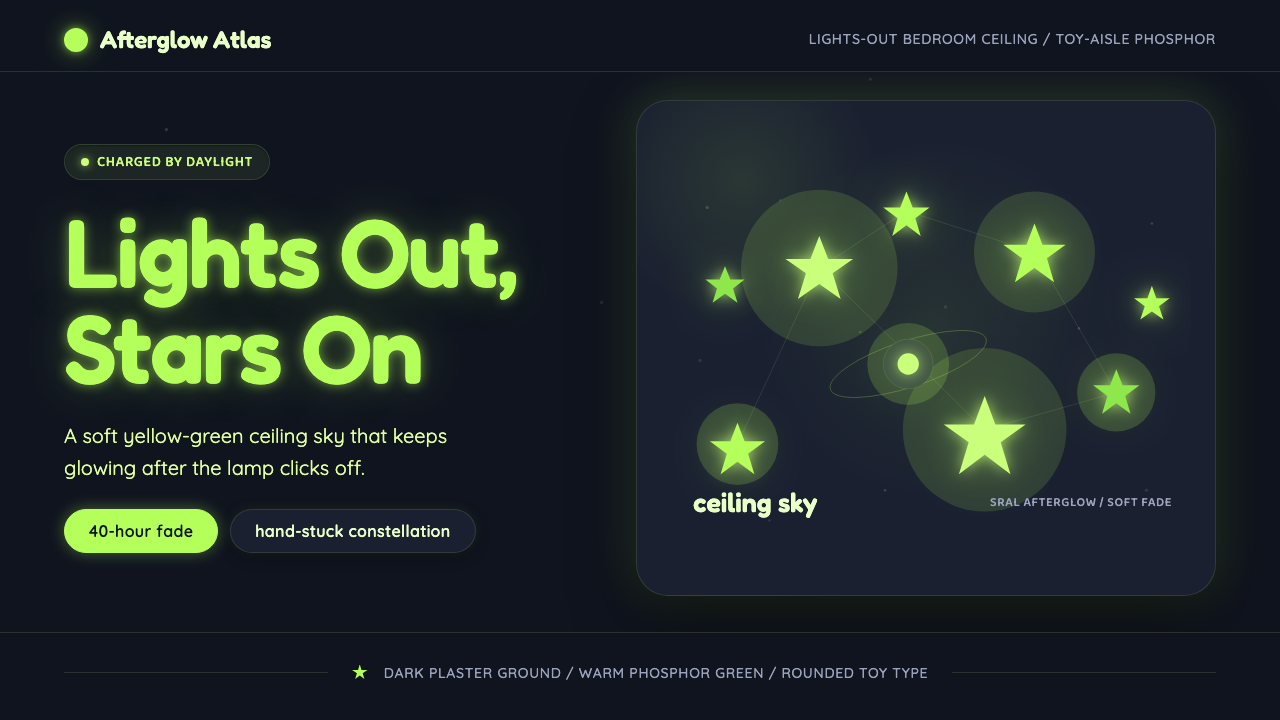 Glow-in-Dark Ceiling StarsTurns lights-out into wonder. Yellow-green stars glow across a dark blue-gray…
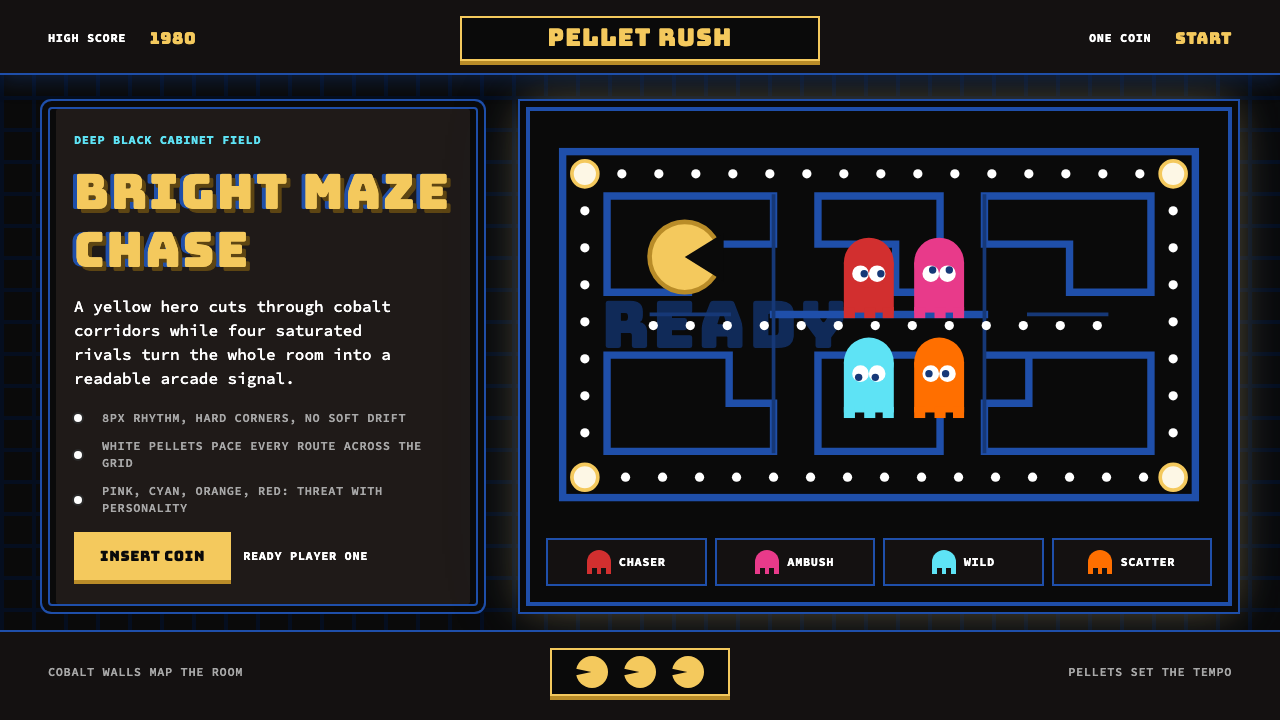 Pac-Man (Namco 1980)Arcade joy burns bright. Yellow disc, cobalt maze, and four ghost hues snap o…
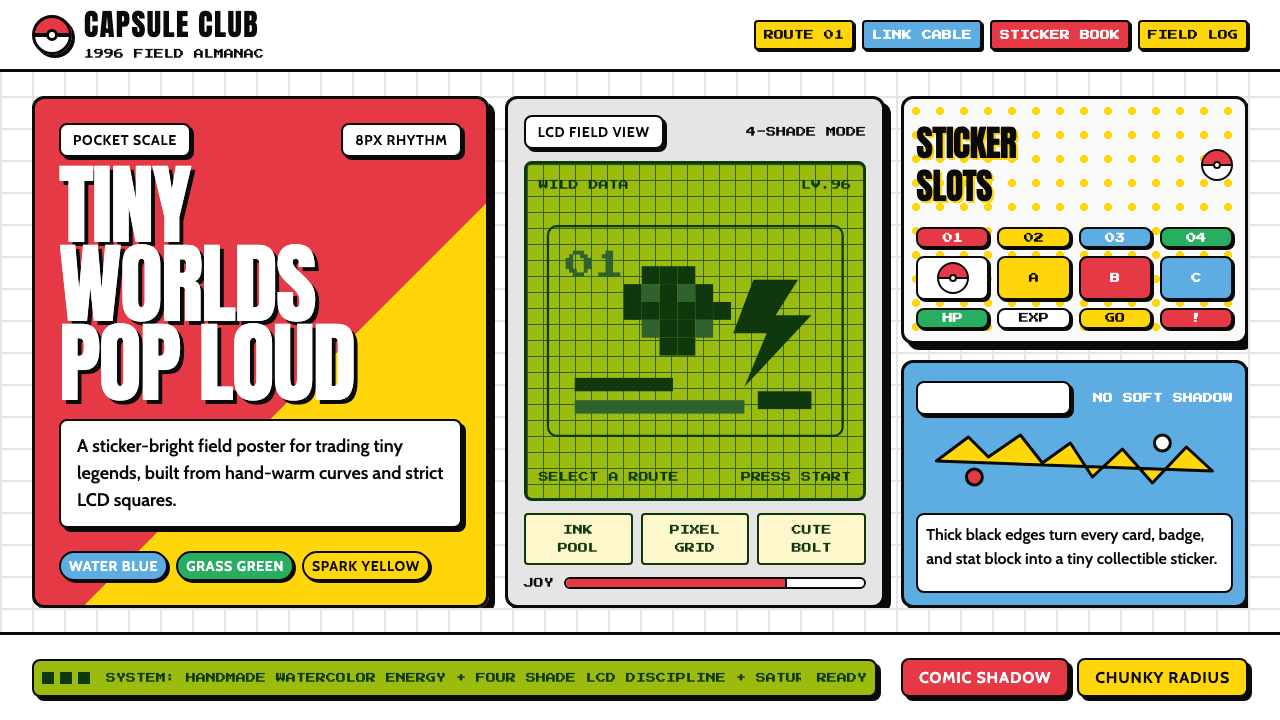 Pokémon Game BoyKawaii meets cartridge logic. Capsule red, LCD green, Anton heft, and 8px gri…
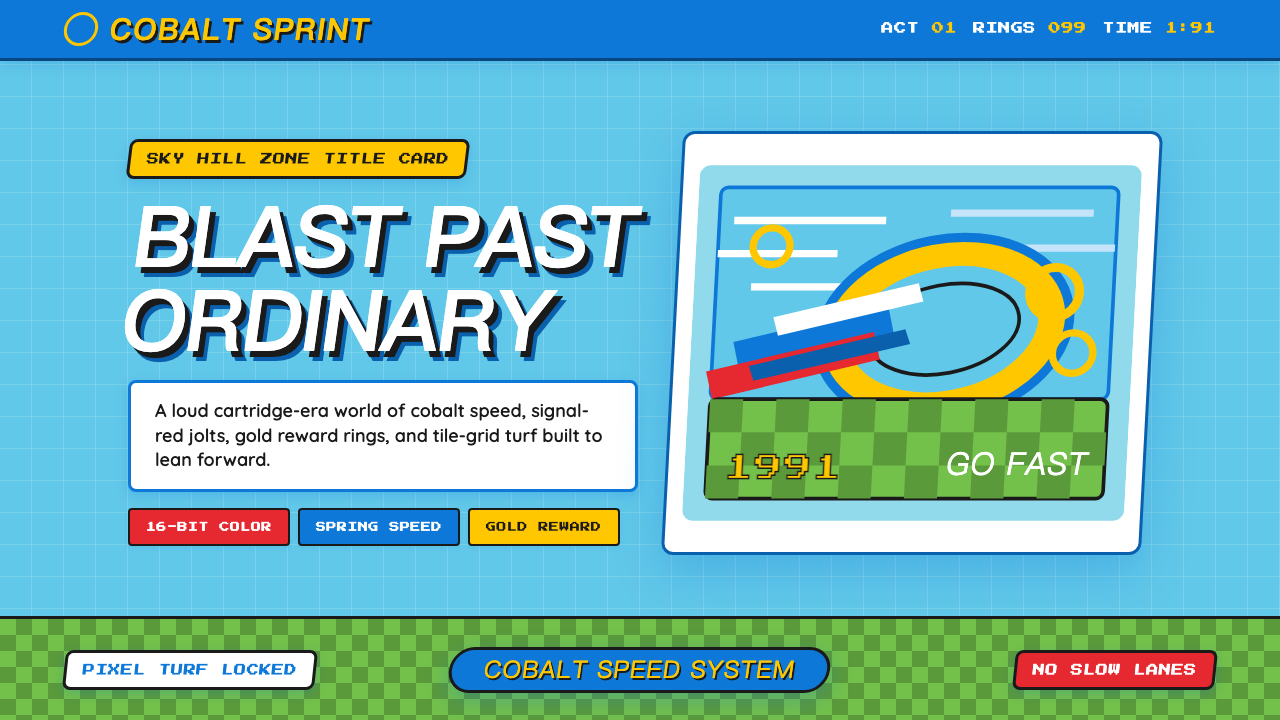 Sonic the Hedgehog (1991)Velocity has teeth. Sky-cyan, cobalt slant type, gold rings, checkerboard tur…
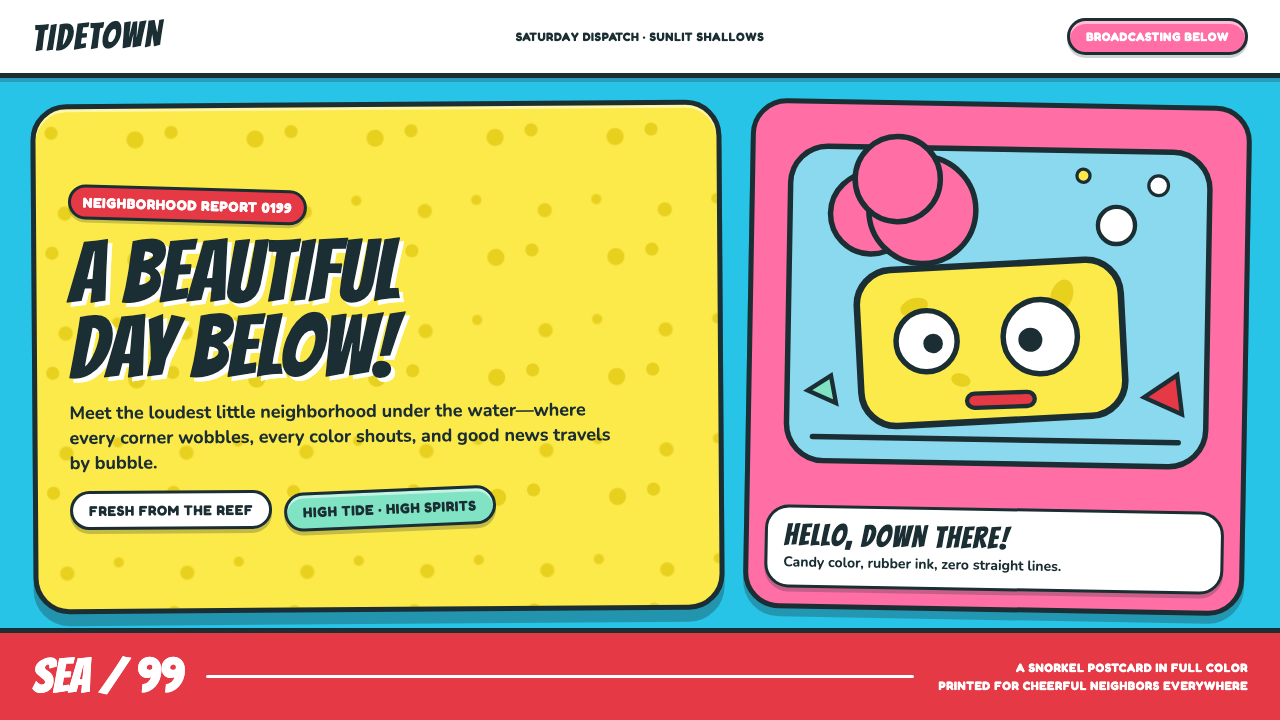 SpongeBob Bikini Bottom (1999)Undersea suburbia shouts with joy. Banana yellow and cyan bounce inside fat,…
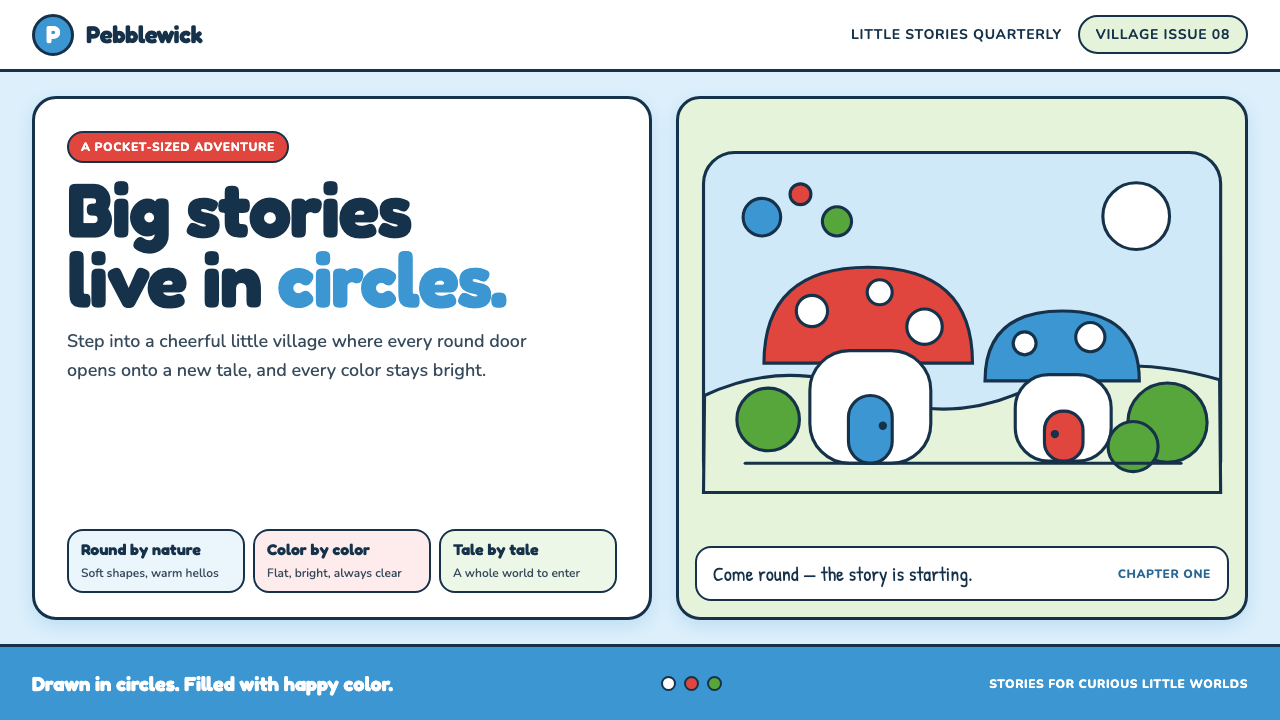 The Smurfs (Peyo, 1958)Joy comes full circle. Sky blue, candy red and soft ink outlines build a flat…