What is Doraemon?
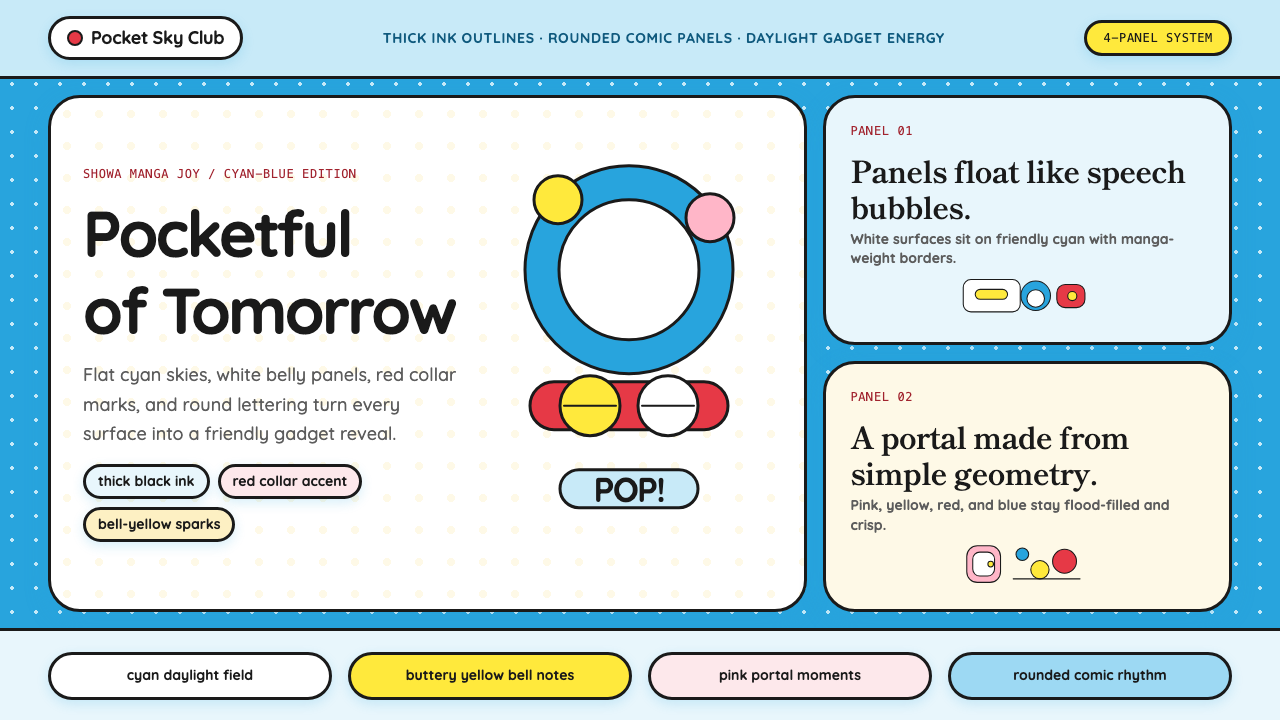
Half a century of manga joy distilled into bold outlines, flood-fill cyan, and the irresistible roundness of a robot cat from the future.
Doraemon in brief
Doraemon is a visual design language drawn directly from one of the most beloved manga and anime franchises in history. Its aesthetic vocabulary is rooted in Showa-era Japanese children's comics: thick black outlines that hold every shape firmly in place, broad flat fields of primary color with no shading or gradation, and an obsessive commitment to rounded, circular geometry that mirrors the character's own circle-constructed body. The style radiates kindergarten warmth — it is the visual grammar of childhood comfort and wonder.
The palette begins with the signature cyan-blue of Doraemon's body, a vivid mid-tone that reads as optimistic and immediately legible across all ages. It is offset by pure white for surfaces and backgrounds, warm red for collar and bell accents, soft pink for the Anywhere Door portal, and yellow for highlights. No hue in this system is dark, muted, or ambiguous — every color earns its place by being as clear and joyful as possible.
Applied to interfaces and graphic design, the Doraemon style translates these manga craft conventions into a recognizable modern system: extreme corner rounding on every container, bold stroke outlines on interactive components, a bright daylight palette that never approaches darkness, and typography that carries the chubby hand-drawn quality of comic lettering. The result is a design language that communicates safety, friendliness, and playful intelligence.

Where does Doraemon come from?
Doraemon was created by the duo Fujiko F. Fujio — the pen name of Hiroshi Fujimoto and Motoo Abiko — and first appeared in January 1970 in multiple children's manga magazines simultaneously, a launch strategy engineered to reach the broadest possible audience of primary-school readers in Japan. The character is a robotic cat sent back from the twenty-second century to help a hapless boy named Nobita Nobi, and his visual design was established almost immediately: a spherical blue-white body, a broad round face with a red nose and whiskers, and the iconic red bell collar that became one of the most recognized accessories in Asian popular culture.
The visual style of the Doraemon manga is firmly rooted in the conventions of mid-century Showa-era children's comics. Fujiko F. Fujio drew in a clear-line tradition that prioritized readability and emotional accessibility over artistic complexity — thick, consistent outlines, flat color fills, simple expressive faces that could convey the full range of childhood emotions in a single panel. The character's circular construction is no accident: circles carry universal connotations of softness, safety, and completeness across cultures, and Doraemon's design makes those associations inescapable.
The anime adaptation launched in 1973 on Nippon Television and has continued in various forms ever since, with the long-running Shin-Ei Animation production — beginning in 1979 — establishing the definitive modern look of the franchise. Animated by Shin-Ei and voiced for decades by a rotating cast of voice actors (with Wasabi Mizuta taking over the title role in 2005 and remaining through the present day), the series brought Doraemon's visual language to television screens across Japan and, eventually, across most of Asia. By the time the franchise's visual identity was fully standardized around 2005, it had evolved into one of the most systematically consistent character design systems in entertainment history.
Doraemon's cultural reach extends far beyond entertainment. The character has served as Japan's official anime ambassador in diplomatic contexts, appeared on government tourism campaigns, and been adopted by educational programs throughout Southeast Asia. This soft-power role has made the franchise's visual language — the cyan blue, the round forms, the bold outlines — into something approaching a regional cultural symbol. The aesthetic carries connotations of Japanese quality, childhood nostalgia, and cross-generational warmth that give it unusual emotional weight for a design language derived from commercial entertainment.
What defines the Doraemon look?
Signature Blue
The defining color of the system is the vivid cyan-blue of Doraemon's body — a bright, fully saturated mid-tone that sits confidently between turquoise and sky blue. It is not a corporate blue or a navy; it reads as cheerful, open, and unmistakably warm despite being a cool hue. This blue functions as the primary field color for backgrounds, large containers, and hero areas, and its emotional register — optimistic, childlike, immediately recognizable — defines the entire palette's mood.
Bold Black Outlines
Every component in this design language is bounded by a visible, weighty outline. These strokes are consistent in thickness across the hierarchy, functioning less as borders and more as the structural skeleton that holds each shape in place — exactly as ink outlines hold panels in a manga page. The outlines create immediate legibility at any size, unify disparate elements into a coherent visual system, and give the interface a graphic, illustrated quality that distinguishes it from flat design conventions.
Rounded Geometry
Rounded corners are applied at an extreme degree — not a subtle softening but a deliberate push toward circularity. Buttons, cards, badges, and containers all approach pill or oval shapes. The rounding is so pervasive and consistent that it reads not as a stylistic choice applied to individual elements but as a fundamental property of the design system itself, directly echoing Doraemon's spherical body and the rounded panel shapes common in children's manga.
Flat Color Fields
Colors are applied as solid, unmodulated fills — no gradients, no texture overlays, no inner shadows suggesting three-dimensionality. Each color block is uniform from edge to edge, in the tradition of manga color printing where flat fills were both an aesthetic choice and a production necessity. This flatness makes the palette feel bold and immediate rather than polished or rendered, giving the overall design an energetic print-comic quality.
Accent Colors as Storytelling
Beyond the signature blue and white, each accent color in the system carries a direct referential meaning borrowed from the franchise: warm red echoes the bell collar — used for primary calls-to-action and the most important interactive elements; soft pink recalls the Anywhere Door — used for secondary highlights and transition states; yellow references the four-dimensional pocket — used for warnings, featured items, or energy-rich states. Designers using this system are working with a pre-loaded set of cultural associations that users who grew up with the franchise will recognize intuitively.
Comic-Inflected Typography
Type choices in this system favor rounded, slightly condensed letterforms that echo the chubby quality of hand-lettered comic text. Headlines feel friendly and approachable rather than authoritative or sharp. The character weight skews toward the heavier end to complement the bold outline language of the surrounding components; thin or lightweight type looks out of place. Both Japanese and Latin letterforms should prioritize stroke warmth and visual roundness over geometric precision.
Joyful Brightness
The entire system operates in a bright, high-key register — there are no dark themes, no shadowed moods, no color choices that read as serious or somber. Even interactive states like hover, focus, and error are handled with brighter or warmer variants of existing palette colors rather than with darkening or desaturation. This consistent brightness is not accidental; it is a structural commitment that keeps the experience feeling safe, welcoming, and emotionally accessible to the widest possible audience.

Who shaped Doraemon?
The pen name of Hiroshi Fujimoto, who was the primary artistic and narrative driver of the Doraemon franchise. Fujimoto developed the clear-line drawing style and circular character construction that became the visual foundation of the franchise. His approach to visual storytelling — prioritizing emotional clarity and readability over rendering complexity — established the aesthetic principles that still govern the franchise's design language decades after his death in 1996. Fujimoto's commitment to round, simple, universally readable forms was not naivety but a sophisticated understanding of how visual communication reaches across age, education, and cultural difference.
The other half of the Fujiko F. Fujio pen name partnership. While Abiko was less involved in Doraemon specifically after the duo split their creative partnership in 1987, his collaborative work during the franchise's formative years shaped the storytelling rhythm and episodic structure that gave the visual language its context. The combination of Abiko's narrative instincts and Fujimoto's visual sensibility produced a franchise whose design vocabulary was always in service of emotional storytelling rather than aesthetic display.
The production studio that has animated the definitive modern version of Doraemon since 1979. Shin-Ei's work on the series standardized the franchise's color relationships, defined the precise visual weight of the black outlines, and established the brightness levels that have remained consistent across decades of television broadcast. The studio's meticulous maintenance of visual consistency — across thousands of episodes and multiple theatrical films — is what transformed the franchise's aesthetic from a single artist's drawing style into a reproducible, systematic design language.
The voice actress who has provided the voice of Doraemon in the Shin-Ei production since 2005. Mizuta's casting marked the beginning of the franchise's fully contemporary era, coinciding with a comprehensive visual refresh of the character design and merchandise standards. Her tenure spans the period during which the franchise's visual identity became globally standardized and began to influence design outside Japan — in children's media, educational contexts, and eventually in digital product design across Asia.
How do you use Doraemon today?
The Doraemon design language is one of the most emotionally immediate styles available in contemporary interface design. Applying it well requires understanding its core promise: this system should feel safe, joyful, and effortlessly welcoming before it communicates anything else. Every application decision — corner radius, outline weight, color assignment — should serve that promise. If a design choice makes the interface feel more formal or severe, it is working against the style.
For presentation slides, this style works best when it commits fully to its visual vocabulary. A cover slide benefits from the bold contrast of the signature blue as a full-field background with white display type and a strong accent element in red or yellow. Content slides should use white or near-white backgrounds to maximize legibility, with the blue reserved for headers, callout boxes, or data-category labels. Data slides should treat charts as graphic objects — round-capped bar charts, full-color-fill segments — with every data series assigned a distinct palette color. The system is particularly effective for educational presentations and children's content platforms where warmth and legibility must coexist.
For web interfaces, the Doraemon style suits products where friendliness and approachability are genuine user needs: onboarding flows, children's education platforms, family-oriented dashboards, and consumer apps targeting broad age ranges. The approach on a pricing or feature page is to use card components with heavy corner rounding and visible outlines, section backgrounds that alternate between white and the signature blue, and buttons that are rounded, boldly colored, and large enough to communicate confidence. Navigation elements should be clearly labeled in rounded type; icon systems should favor filled, outlined icons over thin-line systems.
For editorial and marketing materials, this style's graphic boldness makes it well-suited to social media cards, event posters, and brand campaign materials targeting younger audiences or families. A marketing layout in this style should use the full-color system confidently: blue as the dominant field, white for readable text areas, and red and yellow sparingly as accent anchors. Illustration-style decorative elements — simple circle-based characters or rounded shape motifs — integrate naturally with the design language and can add narrative warmth to otherwise information-heavy layouts.
The most common mistake when applying this style is restraint in the wrong places. Designers sometimes soften the outlines, reduce the corner rounding, or introduce intermediate neutral tones in an attempt to make the result feel more 'professional.' These adjustments undermine the system's fundamental logic. A half-committed Doraemon application looks neither playful nor polished — it looks unfinished. The style requires conviction: the outlines should be weighty, the corners should be dramatically round, and the colors should be saturated. A second common mistake is using the palette's warmth as license for visual clutter — the system is bold, not busy, and generous whitespace is as important here as in any minimal design language.

Doraemon — FAQ
Is this style only appropriate for children's products?
Not exclusively, but it requires a genuine alignment between the style's emotional register and the product's purpose. The Doraemon design language communicates warmth, safety, and playful joy — values that resonate beyond children's products in contexts like family apps, educational platforms for all ages, community-driven social tools, and consumer brands that want to project friendliness without irony. Where it struggles is in contexts demanding authority, seriousness, or premium positioning: financial tools projecting stability, enterprise software requiring cognitive neutrality, or luxury products where restraint is a signal of quality. The question to ask is whether the product benefits from the associations the style carries — not whether the audience is young.
How does this style handle dark mode?
The Doraemon design language is fundamentally a light-ground system and does not adapt naturally to dark backgrounds. The signature blue at full saturation on a dark background can become overpowering and loses its characteristic cheerful warmth. If a dark variant is required, the approach should shift significantly: use the blue sparingly as an accent and rely on near-black backgrounds with bold white typography and the red collar accent as the primary call-to-action signal. The black outlines that define the system in light mode may need to be replaced with white or light-colored outlines on dark fields. However, a forced dark mode Doraemon application will always feel like a compromise — the system's core values are most fully expressed in a bright, open, light-ground environment.
Can this style work alongside photography?
Photography is the most difficult element to integrate with the Doraemon aesthetic. The flat, outline-defined, fully saturated character of the system sits in visual tension with the naturalistic tonal range of photographic images. When photography is necessary, the most effective approaches are aggressive cropping to isolate the subject, duotone or flat-color treatment to reduce tonal complexity, or placing photography inside outline-bordered containers that frame it as a designed element rather than a naturalistic window. Alternatively, treating photographs as texture backgrounds that are substantially covered by flat-color overlays can work. The worst approach is placing naturalistic full-color photography directly adjacent to the bold flat elements of the design system — the contrast reads as a category error.
How does this style differ from other Japanese character-design aesthetics like Sanrio or Pokémon?
All three aesthetics draw from Japanese children's character design traditions, but they operate differently as design systems. Sanrio's style — most visible in Hello Kitty — is softer, pastelier, and more reliant on secondary and tertiary colors; it emphasizes cuteness (kawaii) over boldness and tends toward a more delicate visual weight. Pokémon's design language is more diverse and inventory-driven, organized around type-coding a large number of distinct characters rather than a single character's consistent palette; it uses bolder contrasts and more saturated accent colors but lacks Doraemon's outline consistency. The Doraemon system is uniquely characterized by its commitment to high saturation at full key, heavy outline weight, and a tightly constrained referential palette — it is the most systematically consistent of the three as a design language.
What types of content benefit most from this design language?
Content where emotional accessibility and instant comprehension are more important than authoritative sophistication. Educational materials — especially those aimed at breaking down complex topics for non-specialist audiences — benefit from the style's combination of bold visual hierarchy and warm approachability. Onboarding experiences, where first impressions determine whether users continue, can use the style's welcoming energy to lower the perceived cost of engagement. Gamified interfaces and reward systems gain from the style's natural affinity with animation and expressive state changes. Community platforms and social products where the goal is to make users feel they belong to something joyful rather than something efficient are strong candidates. The style is also effective for any product that wants to signal cultural proximity to Japanese or broader Asian popular culture.
Related design styles
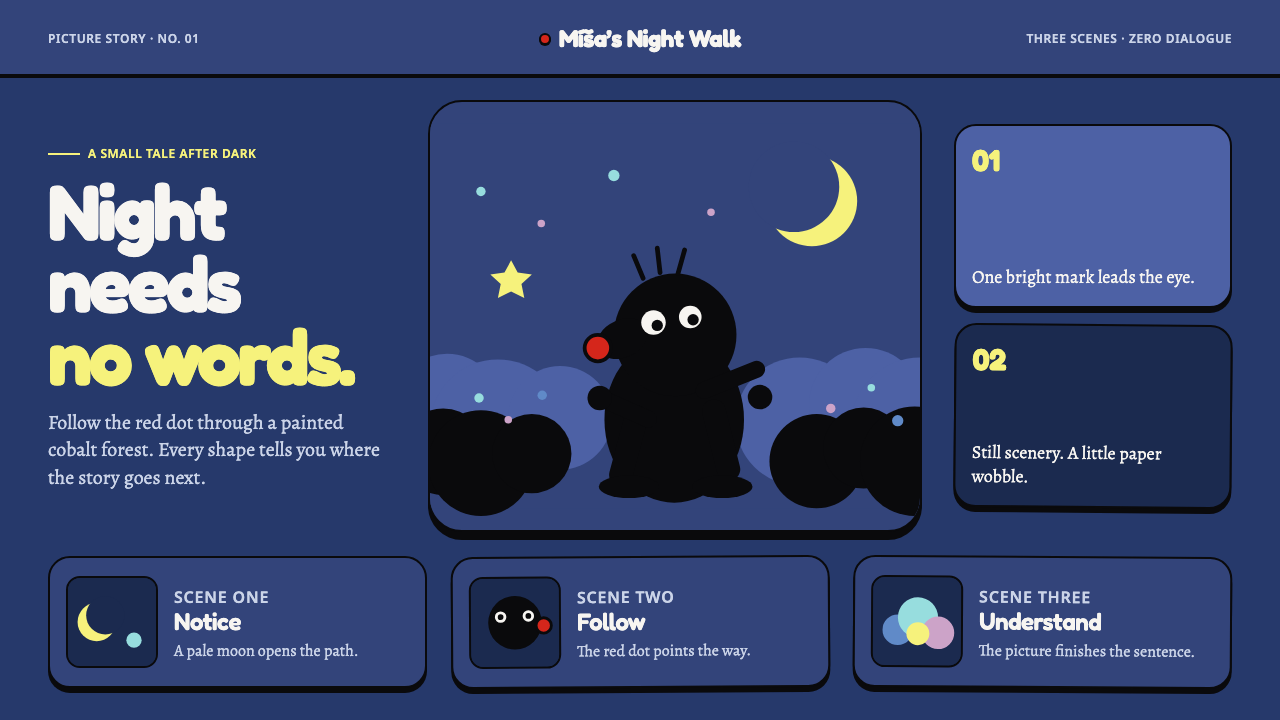 Krtek AnimationWordless wonder. Cobalt gouache stages black paper forms, guided by one red d…
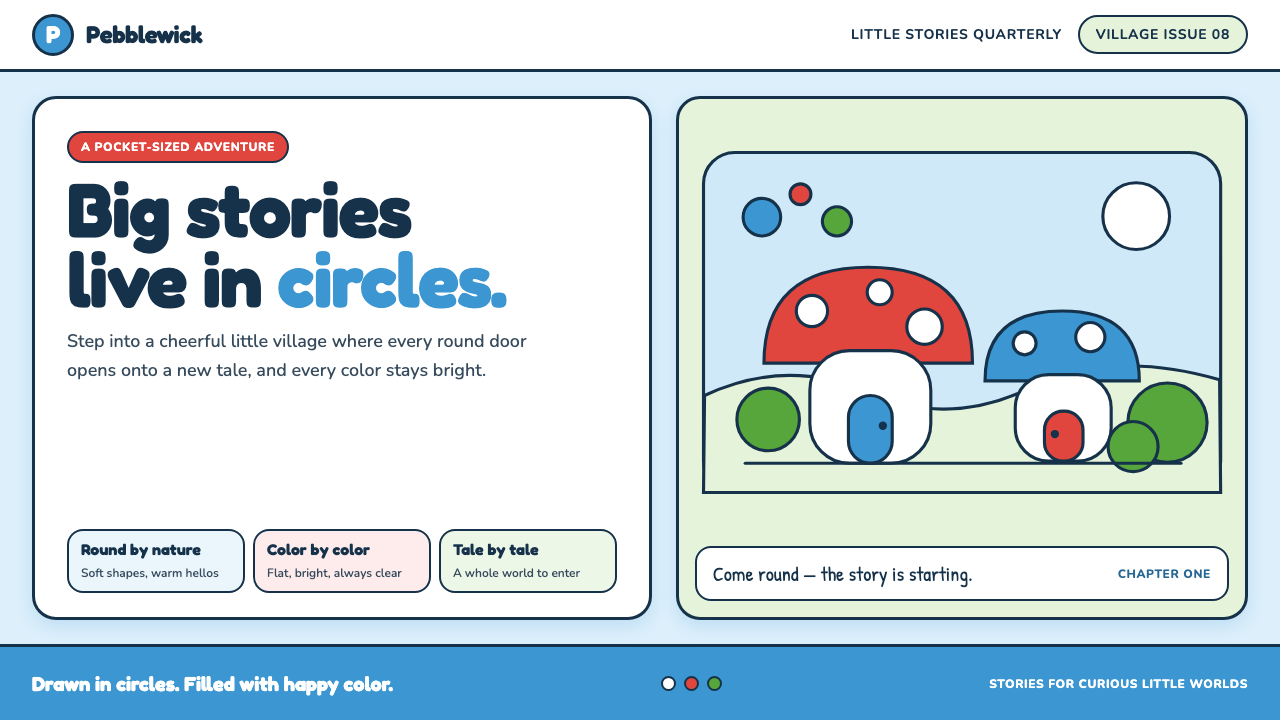 The Smurfs (Peyo, 1958)Joy comes full circle. Sky blue, candy red and soft ink outlines build a flat…
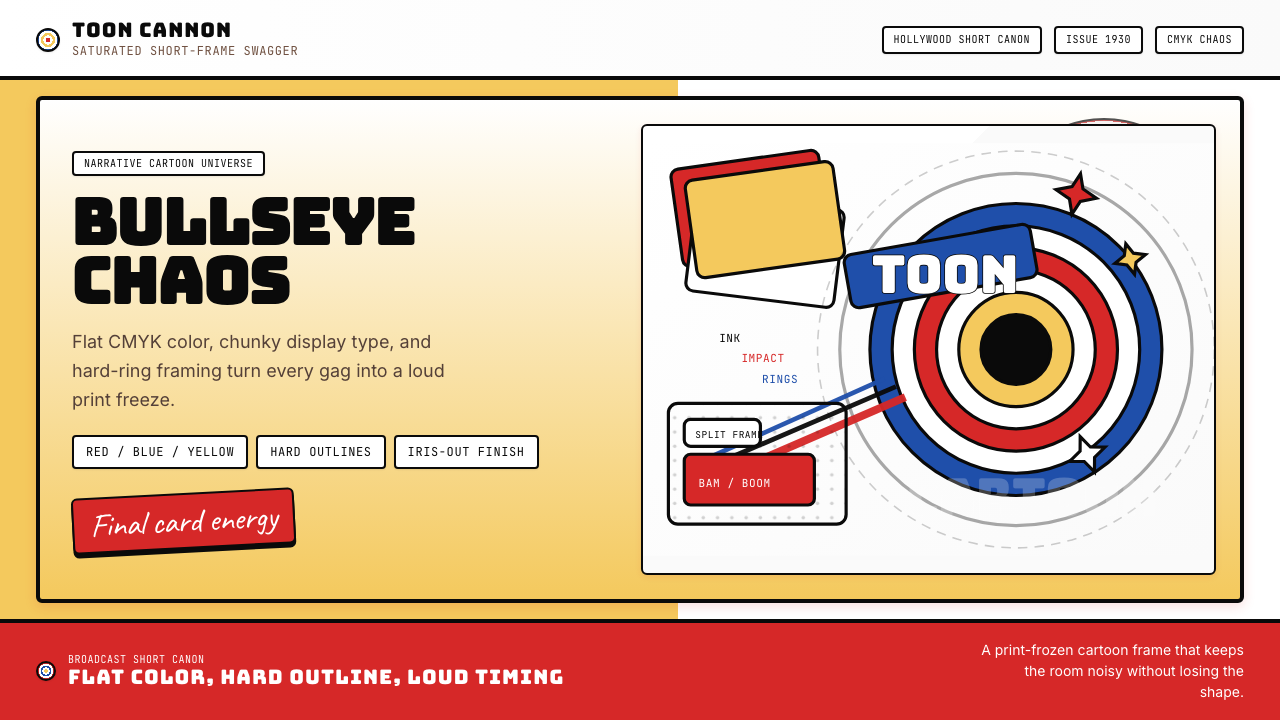 Looney Tunes (Warner Bros.)Pure cartoon chaos. Bull's-eye rings, Bungee type, and red-blue-yellow blocks.
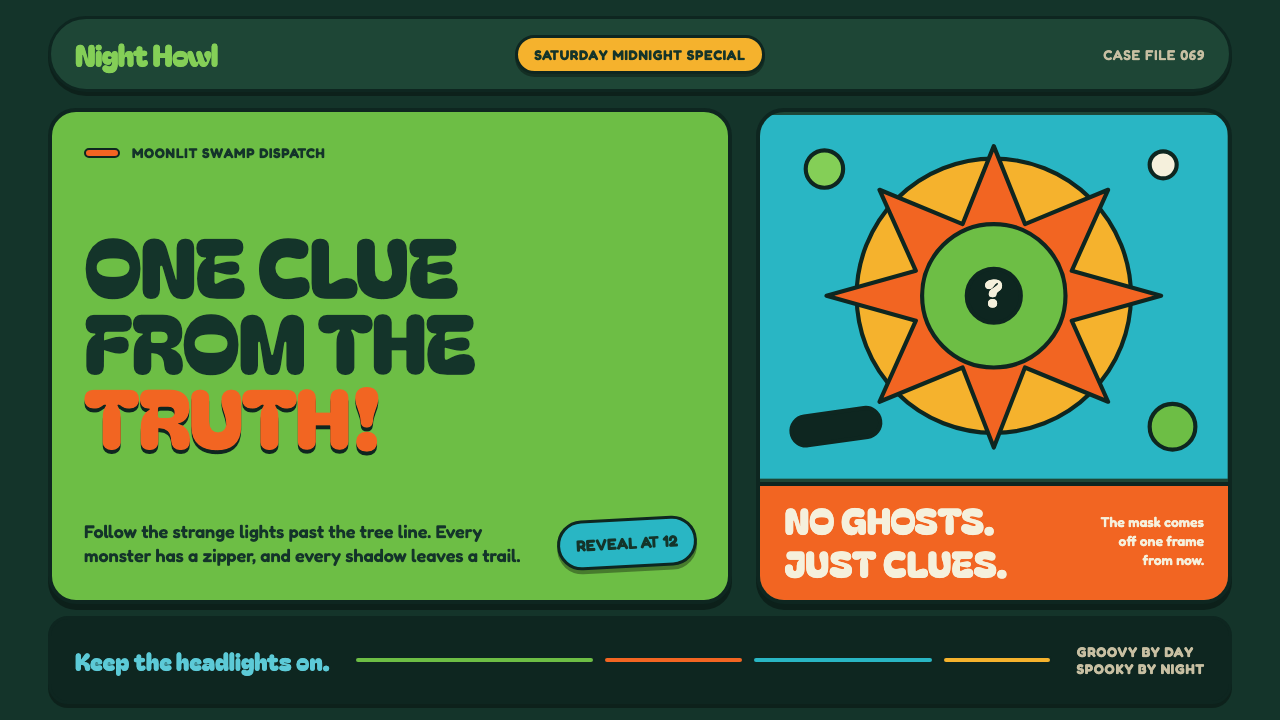 Mystery Machine (Scooby-Doo 1969)Groovy by day, spooky by night. Balloon type and acid-green panels hide the n…
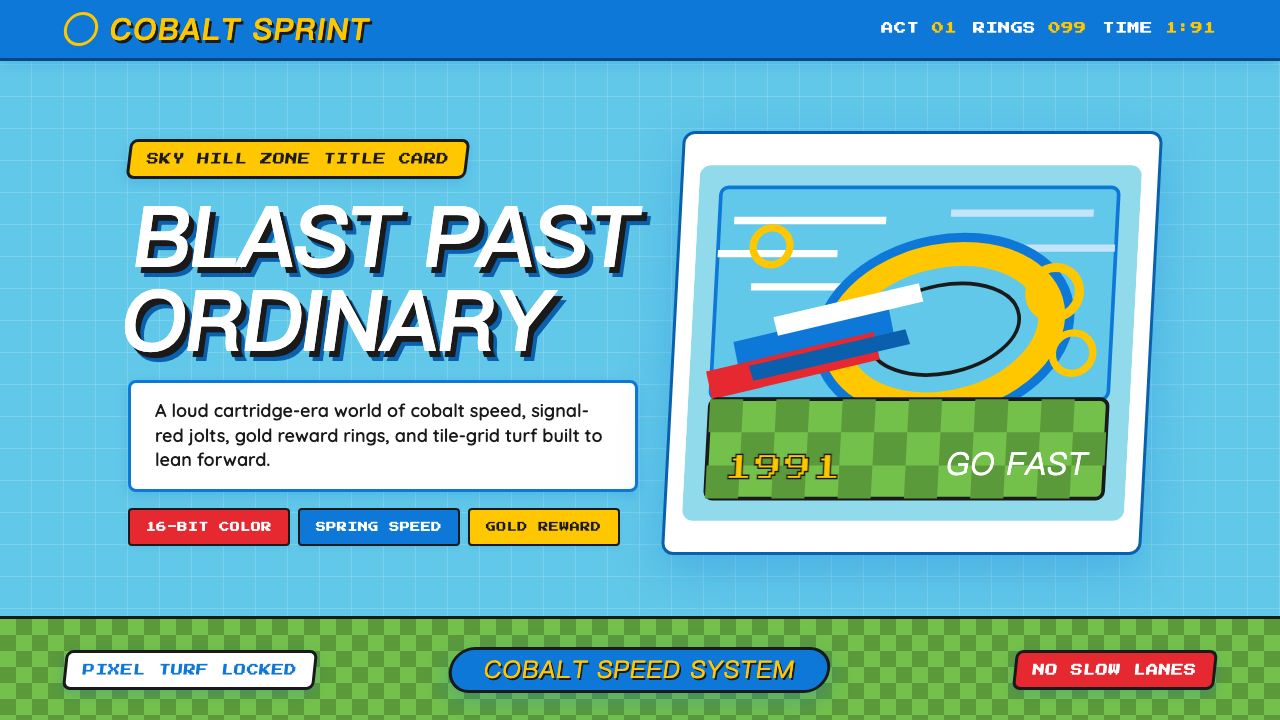 Sonic the Hedgehog (1991)Velocity has teeth. Sky-cyan, cobalt slant type, gold rings, checkerboard tur…
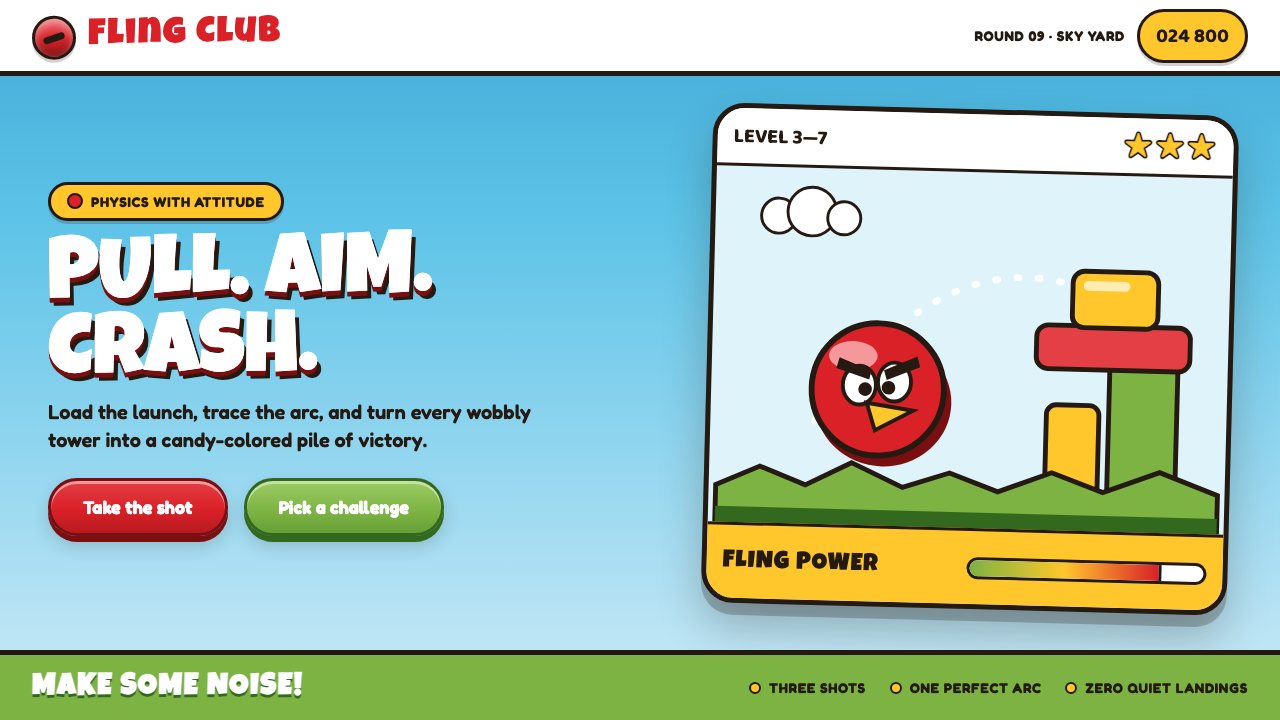 Angry Birds (2009)Adorable aggression takes flight. Candy primaries, chunky outlines, and a dot…