What is Orange Crush Soda (1906)?
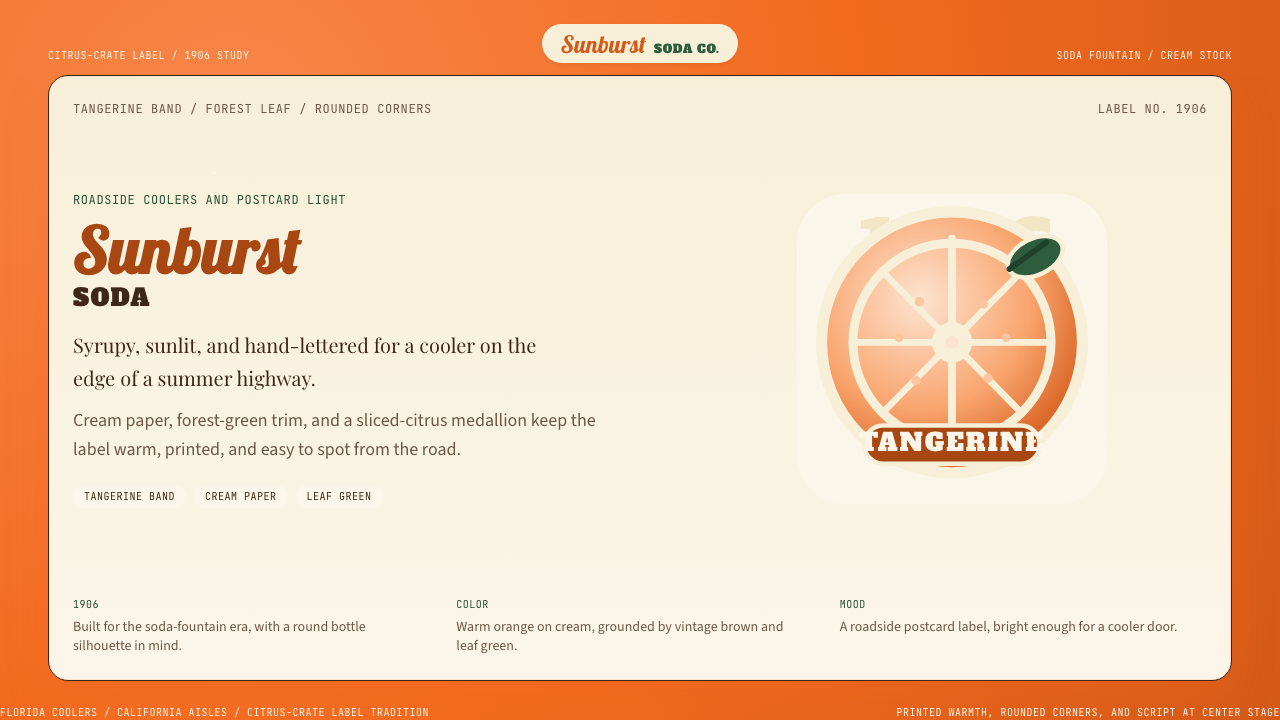
Orange Crush turned a Florida citrus label into a complete visual language — warm tangerine, hand-lettered script, and cream paper that make every surface feel like a postcard from 1947.
Orange Crush Soda (1906) in brief
Orange Crush Soda (1906) is an American illustrated-label design system rooted in the visual heritage of the early twentieth-century soda fountain era. Its defining marks are a saturated tangerine ground, a flowing cursive wordmark, hand-drawn citrus slice illustrations, and cream-toned paper textures that evoke the lithographed bottle labels of the 1920s through 1950s. Together these elements create an aesthetic of warm, sun-drenched nostalgia — the feeling of a sweating glass bottle in a roadside gas station cooler.
The system belongs to a broader tradition of American citrus-marketing design, a genre that flourished when Florida and California growers competed fiercely for consumer attention. Labels had to communicate freshness, sweetness, and regional identity in an instant, working across everything from glass bottles to tin trays to advertising cards. The visual vocabulary that emerged — vivid fruit illustration, rich warm color, readable hand-lettered type — proved extraordinarily durable, surviving the transition from lithography to offset printing to digital reproduction.
What distinguishes the Crush aesthetic from generic vintage pastiche is the specificity of its warmth. The palette is not simply orange: it layers the deep tangerine of the soda itself against forest-green leaf accents and the gentle cream of aged paper. Rounded corners echo the silhouette of the classic fluted glass bottle. The overall effect is less 'retro' than genuinely historical — a design language with traceable origins, consistent visual logic, and a relationship to real material culture.

Where does Orange Crush Soda (1906) come from?
Orange Crush was founded in 1906 by Clayton J. Howel and Neil C. Ward, who developed a formula for a carbonated orange beverage in Chicago, Illinois. At the time, flavored sodas were a booming category: soda fountains were social anchors of American small-town life, and citrus flavors — positioned as healthful and refreshing — commanded premium status. The name 'Crush' likely referenced the cold-pressed juice extraction method, implying genuine fruit content in an era when most competitors used artificial flavorings. From the beginning, the brand's identity leaned heavily on the suggestion of real citrus — a visual promise made through illustration rather than ingredient lists.
The visual language that would define Crush emerged through the 1910s and 1920s, as the brand expanded distribution and invested in bottle-label design. J. M. 'Cap' Thompson was an early figure associated with the brand's commercial development. The iconic labels of the era were lithographed masterworks of the applied graphic arts: sliced orange cross-sections rendered with botanical accuracy, script lettering designed to flow like a pen stroke across curved glass, and a color palette anchored in the warm citrus spectrum. These labels did not merely name the product — they performed its flavor through visual sensation.
The brand's aesthetic reached its visual peak during the American mid-century soda fountain culture of the 1930s through 1950s. This was the Norman Rockwell era of illustrated packaging — a moment when American commercial art was deeply invested in idealized, hand-crafted imagery as an antidote to industrial impersonality. Crush's tangerine-and-cream palette, its hand-lettered warmth, and its citrus-slice illustrations positioned it squarely within this tradition. The roadside gas station, the lunch counter, the summer afternoon — Crush's visual world was inseparable from these American settings.
The brand passed through multiple ownership changes across the twentieth century, eventually reaching its current home under Keurig Dr Pepper. Through these transitions, the core visual identity proved remarkably stable. The tangerine color, the script wordmark, the citrus illustration — these elements survived reformulations, repackagings, and decades of evolving consumer tastes. This persistence itself became part of the brand's meaning: Orange Crush is legible as a historical artifact as much as a contemporary beverage. The Curio design system distills this accumulated visual logic into a transferable set of aesthetic principles — capturing the warmth and material richness of the illustrated-label heritage without being constrained to its specific commercial context.
What defines the Orange Crush Soda (1906) look?
Color Palette
The dominant hue is a rich, deeply saturated tangerine — warmer than a traffic orange, richer than a pastel apricot, sitting in the zone that evokes ripe navel oranges in direct sunlight. This anchoring color is balanced by two secondaries: a cream or off-white derived from aged paper stock, which softens the overall warmth, and a deep forest green drawn from citrus foliage, which provides cool contrast and grounds the composition. The interplay of warm tangerine, cool green, and neutral cream is the system's most distinctive signal.
Typography
Script and cursive letterforms carry the emotional weight of the system. The wordmark tradition leans on flowing, connected letterforms that suggest a confident pen stroke — informal enough to feel hand-made, consistent enough to feel authoritative. This script register contrasts with a secondary display typeface in a rounded, sturdy style reminiscent of early twentieth-century American commercial lettering: slightly condensed, warm, and unpretentious. Body text, where it appears, calls for a legible serif or rounded sans that maintains the system's warmth rather than importing modernist neutrality.
Illustration Language
The citrus slice cross-section is the system's most iconic illustrative element — a halved or quartered orange rendered with enough botanical detail to communicate freshness and authenticity, but stylized enough to read clearly at small sizes and on curved surfaces. This illustration tradition draws from the citrus-crate label art of California and Florida, where competition between growers drove an elevation of illustration quality. Other permitted illustrative elements include citrus leaves and stems, bubbles suggesting carbonation, and light glare effects implying cold glass.
Texture and Surface
Paper texture is integral to the aesthetic rather than decorative afterthought. The cream ground of the system carries the subtle grain of uncoated stock — fibrous, slightly rough, the opposite of the slick coated surfaces of contemporary packaging. This texture signals age and handcraft, anchoring the design in a pre-digital material culture. Applied digitally, paper grain works best as a very light overlay, present enough to read at normal viewing distances but not so heavy that it reads as distress or damage.
Shape and Structure
Rounded corners and softened edges pervade the system, echoing the contour of the classic fluted Crush glass bottle. Rectangular containers become pill-shaped; badges use ovoid rather than sharp-cornered frames; compositional zones are bounded by curved rules rather than hard lines. This consistent rounding creates a sense of physical friendliness — forms that feel pleasant to hold — while also functioning as a period marker, since the severe hard corner was itself a later modernist imposition on a tradition that preferred the more forgiving curve.
Depth and Layering
Unlike flat modernist systems, the Crush aesthetic embraces light dimensionality. Subtle drop shadows — soft rather than hard, warm in tone to match the palette — suggest that elements rest on the cream ground rather than being painted on it. Illustration elements overlap type, type overlaps texture, and the whole composition achieves the layered quality of a printed label built up through successive lithographic passes. This is not the severe geometric shadow of Bauhaus or the deep shadow of contemporary neumorphism — it is the gentle depth of an old label.
Warmth as a System Value
Every element in the system — color, type, illustration, texture, shape — is selected for its contribution to a unified warmth. This is not warmth in a generic or vague sense but a specifically American, specifically mid-century warmth: the kind associated with summer leisure, handmade things, and the confident optimism of the postwar consumer era. The system therefore has an inherent personality. It is unsuited to contexts demanding neutrality, severity, or technological sophistication, and it excels in contexts where approachability, pleasure, and sensory appeal are the desired brand values.

Who shaped Orange Crush Soda (1906)?
Howel co-founded the Orange Crush brand in Chicago in 1906, developing the original carbonated orange beverage formula alongside Neil C. Ward. His contribution was not merely commercial: by insisting on a product identity tied to real citrus — expressed through the brand name, the illustration language, and the sourcing narrative — Howel established the visual and conceptual foundation that would persist for over a century. The decision to compete on perceived authenticity rather than price or novelty shaped everything that followed in the brand's visual history.
Ward partnered with Howel in the founding of Orange Crush, bringing the commercial and distribution expertise that allowed the formula to move from local Chicago novelty to nationally distributed brand. The early scaling decisions — standardizing bottle shape, investing in label printing quality, establishing the tangerine-and-cream color identity across regional bottlers — were the kind of operational choices that embed a visual language into mass culture. Ward's role represents the infrastructure side of a design system: without consistent reproduction and distribution, even the best-conceived aesthetic fails to achieve cultural resonance.
Thompson was an early figure in the commercial development of Orange Crush, associated with the brand's expansion during its formative years. His involvement coincided with the period in which the visual identity — the script wordmark, the citrus illustration system, the characteristic bottle shape — was being consolidated into the recognizable form that would persist across decades. Thompson represents a generation of American brand builders who understood that a soda was not merely a formula but an experience, and that visual design was the primary vehicle for delivering that experience to consumers at the point of sale.
The visual richness of the Orange Crush aesthetic owes a significant debt to the anonymous and semi-anonymous illustrators who elevated citrus-crate label art in California and Florida between roughly 1880 and 1950. Working for printing houses that supplied growers and bottlers, these illustrators developed a specialized vocabulary for depicting citrus: the light-refracting translucency of orange flesh, the textured skin of the rind, the glossy surface of leaves. Their work was commercial art in the most rigorous sense — designed to survive printing on uncoated stock, to read from a distance, and to communicate quality instantly — and it achieved a level of craft that has influenced packaging design ever since.
The peak visual decade for Orange Crush's aesthetic — the 1940s and early 1950s — coincided precisely with the height of Norman Rockwell's cultural influence and the broader American investment in illustrated, hand-crafted commercial imagery. This was not coincidence: Rockwell and the Saturday Evening Post cover tradition represented the same cultural values that Crush's visual language embodied — idealized Americana, warmth, accessibility, the comfort of the familiar. Understanding the Crush aesthetic requires understanding this mid-century moment, when American commercial design was the most confident, craft-intensive, and culturally resonant it has ever been.
How do you use Orange Crush Soda (1906) today?
The Orange Crush (1906) style is a high-warmth, high-specificity system that rewards thoughtful application and punishes careless deployment. It is not a neutral historical overlay — it carries strong personality associations with American summer leisure, handcrafted authenticity, and mid-century optimism. Before applying it, confirm that these associations align with your product's intended emotional register. When they do, the system delivers an immediately recognizable warmth that few other historical palettes can match.
For presentation slides, the style transforms both cover and content pages. A cover works best as a compositional evocation of the label itself: the tangerine ground filling a generous band across the top or bottom, cream space for the title set in a rounded or script-influenced display typeface, and a citrus-derived illustrative motif — even a simplified one — as the compositional anchor. Content slides should use the cream as a warm near-white background, the tangerine for section headers or data highlights, and green sparingly for secondary accents. Data visualizations — bar charts, progress indicators — take on an almost illustrated quality when bars are rendered in the tangerine-to-cream spectrum with softly rounded ends. The paper-texture overlay, kept very subtle, gives slides the feeling of printed material rather than screen output.
For web interfaces, the style is best suited to contexts where warmth and approachability are strategic priorities: food and beverage brands, artisan marketplaces, heritage product lines, tourism and hospitality, seasonal promotional landing pages. Dashboard or pricing applications in these sectors benefit from the system's clear hierarchy: tangerine for primary calls to action, cream for card backgrounds, forest green for success states or freshness signals. Navigation elements in a rounded sans-serif maintain period character without sacrificing readability. Avoid using the style for contexts that require perceived technological sophistication, clinical precision, or corporate neutrality — the warmth that is a strength in the right context reads as unsophisticated in the wrong one.
For editorial and marketing applications, the system supports both print-derived layouts and digital equivalents. An editorial layout might use the tangerine as a full-bleed section header block, with cream body-text areas below; pull quotes set in script-influenced type become natural focal points. Marketing pages work with the style's label-poster logic: a feature block might place illustrated citrus art alongside product copy set in rounded display type, the whole thing framed by a forest-green rule that echoes the border tradition of vintage labels. For social media cards, the most effective approach borrows the label format directly — a tangerine ground, a script headline, a simplified citrus motif, and the cream or forest-green secondary — creating a card that reads as designed rather than generated.
The most common mistake when applying this style is conflating vintage warmth with visual clutter. The original bottle labels were actually well-organized compositions: strong focal illustration, clear typographic hierarchy, and decisive negative space. Contemporary applications that pile on multiple textures, several script typefaces, excessive aged-paper distress, and competing decorative borders quickly tip from evocative into illegible. The correct approach is selectivity: one texture, one script element, one or two warm accent colors, and enough negative cream space to let each element breathe. The Crush aesthetic is generous — but it is not chaotic.

Orange Crush Soda (1906) — FAQ
Is this style appropriate for tech products or SaaS interfaces?
Rarely, and only in specific contexts. The Crush aesthetic is optimized for warmth, approachability, and sensory association — values that work against the perceived precision, capability, and modernity that most SaaS products need to communicate. A fintech dashboard, a developer tool, or a B2B analytics platform will typically read as dated or unsophisticated in this style. The exceptions are SaaS products in adjacent spaces: a restaurant management platform serving small independent operators, a food-and-beverage inventory tool, or a consumer-facing recipe subscription service might plausibly use elements of the system. Even then, the most effective approach is selective borrowing — warm color accents, a rounded interface, perhaps a textured background — rather than full system immersion.
How do I avoid making designs look like Halloween rather than citrus?
The orange-versus-Halloween trap is real and comes down to three factors: hue temperature, palette companionship, and illustration character. Halloween orange tends toward a cooler, more aggressive spectrum — it pairs with black for maximum contrast. Crush tangerine is warmer, richer, and more red-adjacent. Keep the hue in the warm-orange zone rather than letting it drift toward a pure or cool orange. Second, pair the tangerine with cream and forest green rather than with black; black-and-orange is a Halloween combination, cream-and-orange is a citrus one. Third, the illustration language matters: clean, naturalistic citrus fruit references summer and fresh produce; spiky or angular graphic treatments read as contemporary without historical warmth.
Can the style work in a dark-background or night-mode variant?
A dark variant is possible but requires significant rethinking of the palette relationships. The warmth of the system depends heavily on the cream ground — remove it and the tangerine loses its grounding context. On a very dark background, tangerine reads correctly (it is bright enough to hold) but the forest green tends to disappear, losing the cool-warm contrast that gives the palette its depth. A workable dark variant replaces the cream ground with a very dark warm brown or a near-black with a slight warm undertone, keeps the tangerine as the primary accent, uses a muted sage or olive instead of forest green, and adds a warm off-white (not cold white) for text. The paper-texture approach still applies, but the texture should be even more subtle on dark grounds to avoid reading as noise.
How does this style differ from generic vintage or retro design?
Generic vintage design borrows surface signals — distressed textures, sepia tones, antiqued typefaces — without grounding them in a specific historical visual logic. The Orange Crush system is rooted in a precise tradition: the American citrus-marketing label as it existed between roughly 1906 and 1955, with specific color relationships, specific illustration conventions, and specific typographic registers derived from that tradition. The difference shows in application: generic vintage feels mood-driven and interchangeable; the Crush system has internal consistency. When you choose this style, you are choosing a specific historical argument about warmth, craft, and American summer culture — not applying a filter. That specificity is what gives the system its authority and also what limits its range of appropriate applications.
What kinds of brands and products are the strongest fits?
The strongest fits share one or more of the following qualities: they are in or adjacent to the food and beverage category; they are positioning on heritage, craft, or authenticity; they are targeting a broad consumer audience rather than a specialized professional one; they operate in contexts where emotional warmth and sensory pleasure are purchase drivers. Specific strong fits include artisan food and drink brands, vintage-styled retail, summer or seasonal event identities, hospitality and tourism brands emphasizing regional character, recipe and food media, and any brand seeking to communicate tradition and trustworthiness in a consumer-friendly visual register. Weak fits include B2B software, medical and clinical applications, financial services, and any product whose value proposition centers on technological advancement or analytical rigor.
Related design styles
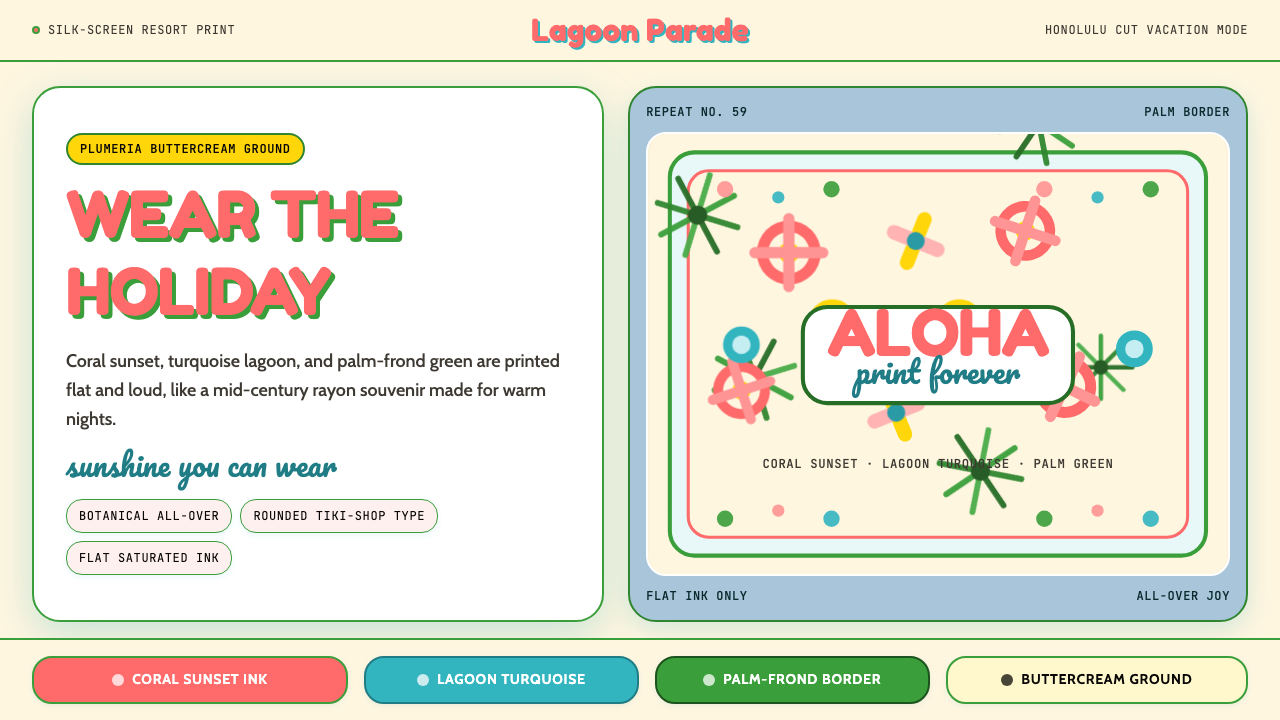 Hawaiian Aloha ShirtThe shirt is the holiday. Buttercream ground, coral Fredoka type, and flat tr…
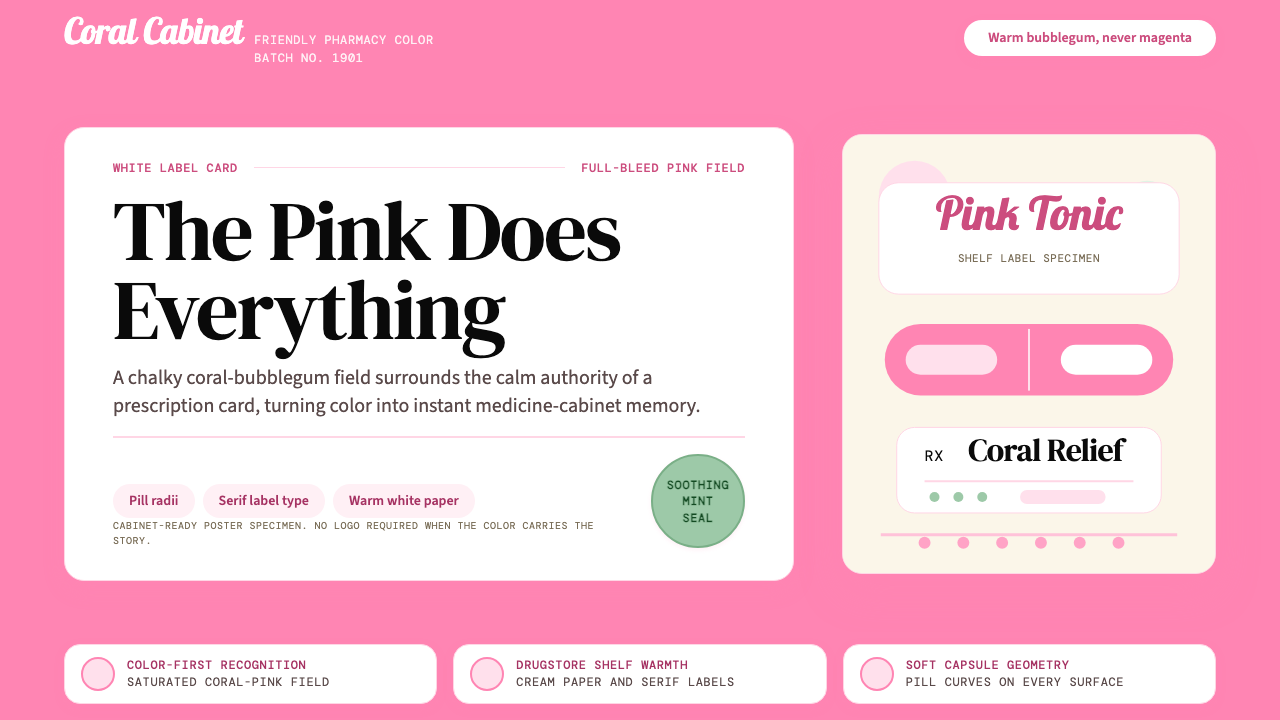 Pepto-Bismol Pink (1901)Color is the cure. Bubblegum pink floods the field; white label cards and pil…
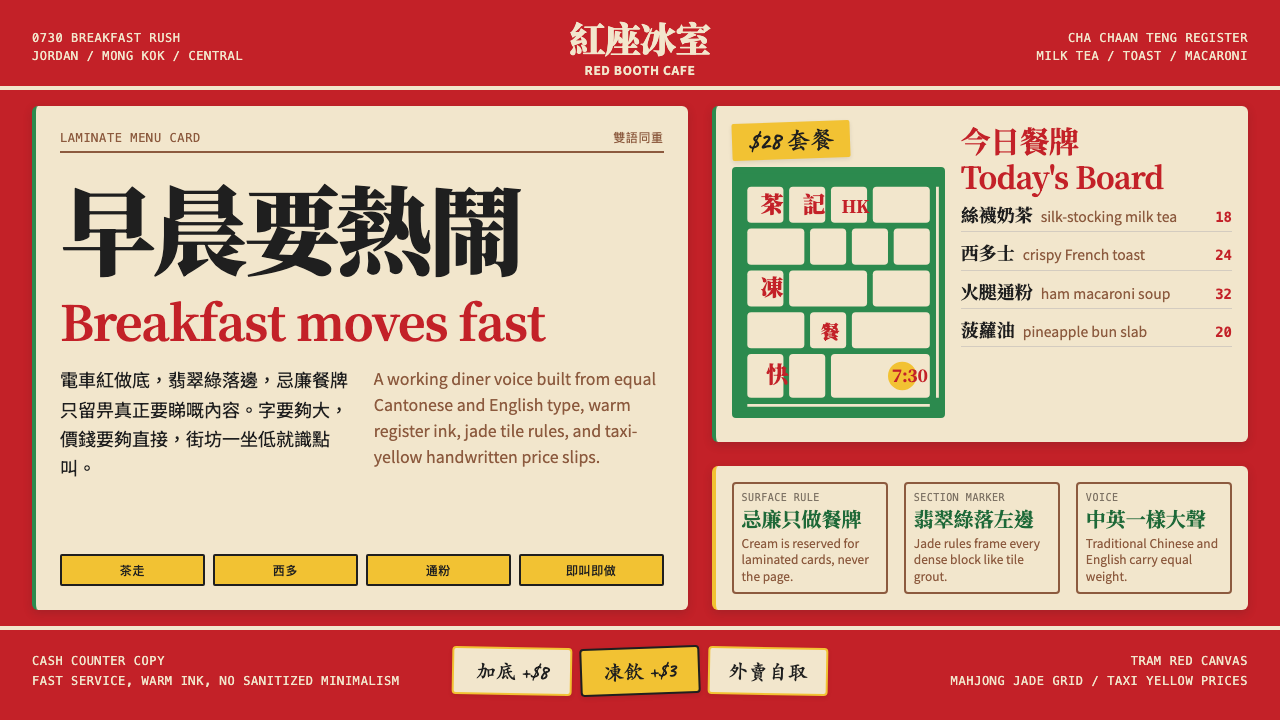 Hong Kong Cha Chaan TengDemocratic diner warmth. Tram red, jade rules, cream menu cards, equal Canton…
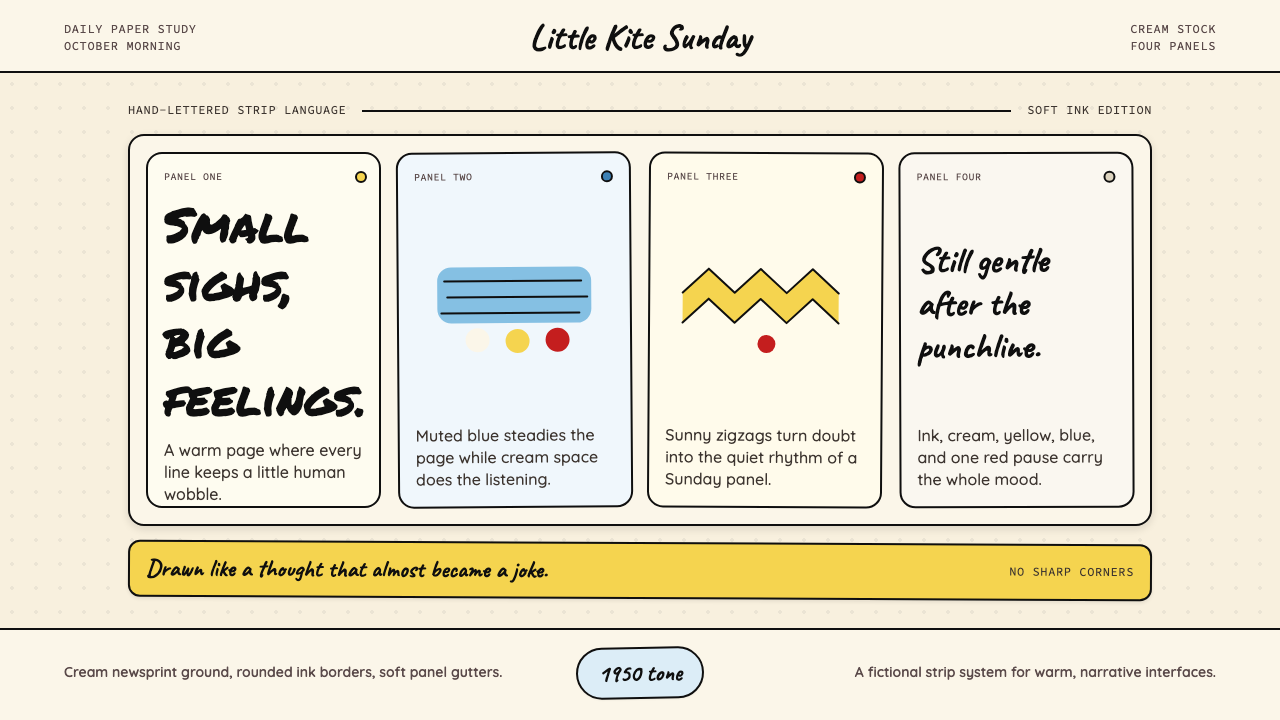 Peanuts Comic Schulz (1950)Gentle melancholy on newsprint. Caveat lettering, cream panels, yellow and bl…
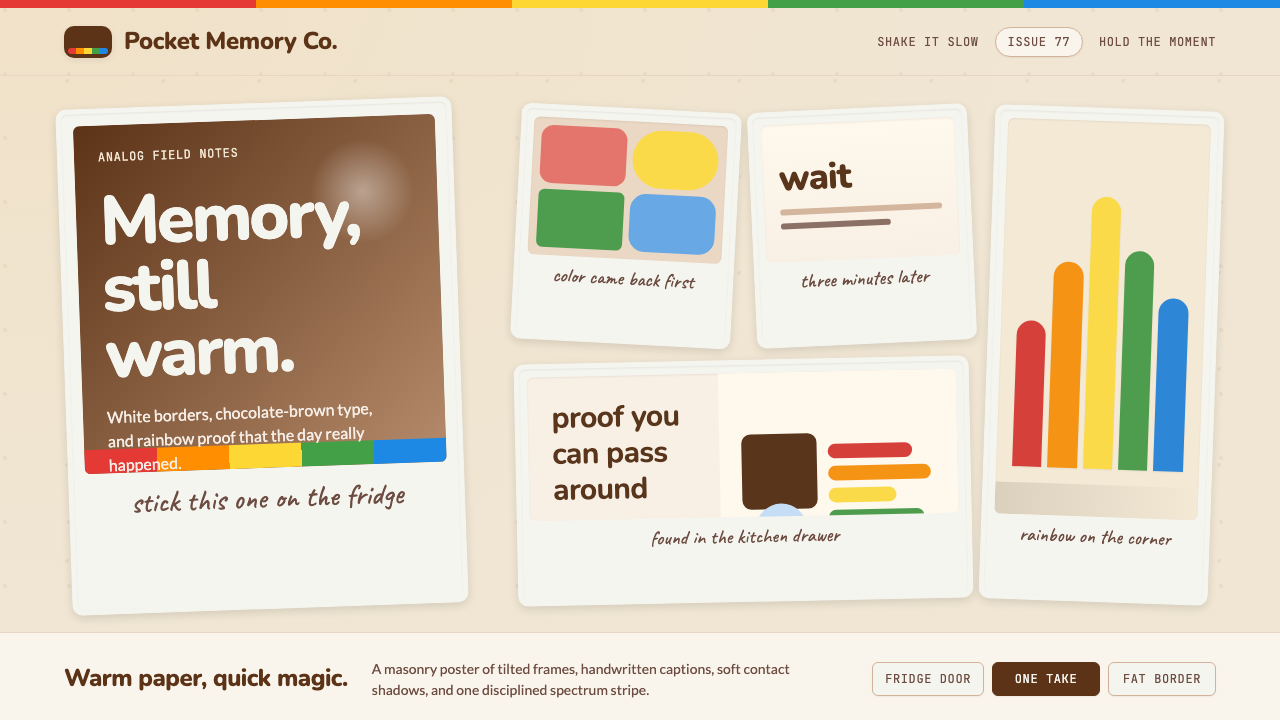 Polaroid InstantMemory made tangible. Photo-white frames tilt on aged paper with a warm rainb…
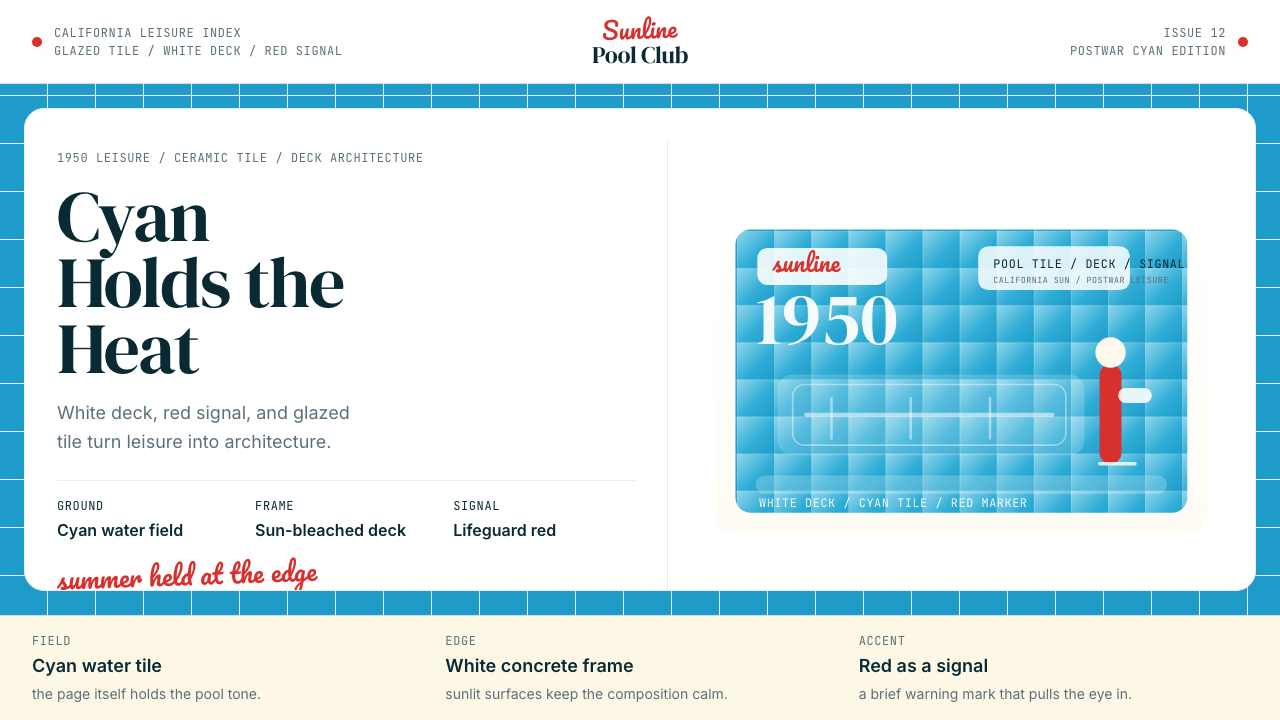 Swimming Pool Vintage Cyan Tile (1950)Leisure turned architectural. Cyan tile, white deck, and red accents set the…