What is Polaroid Instant?
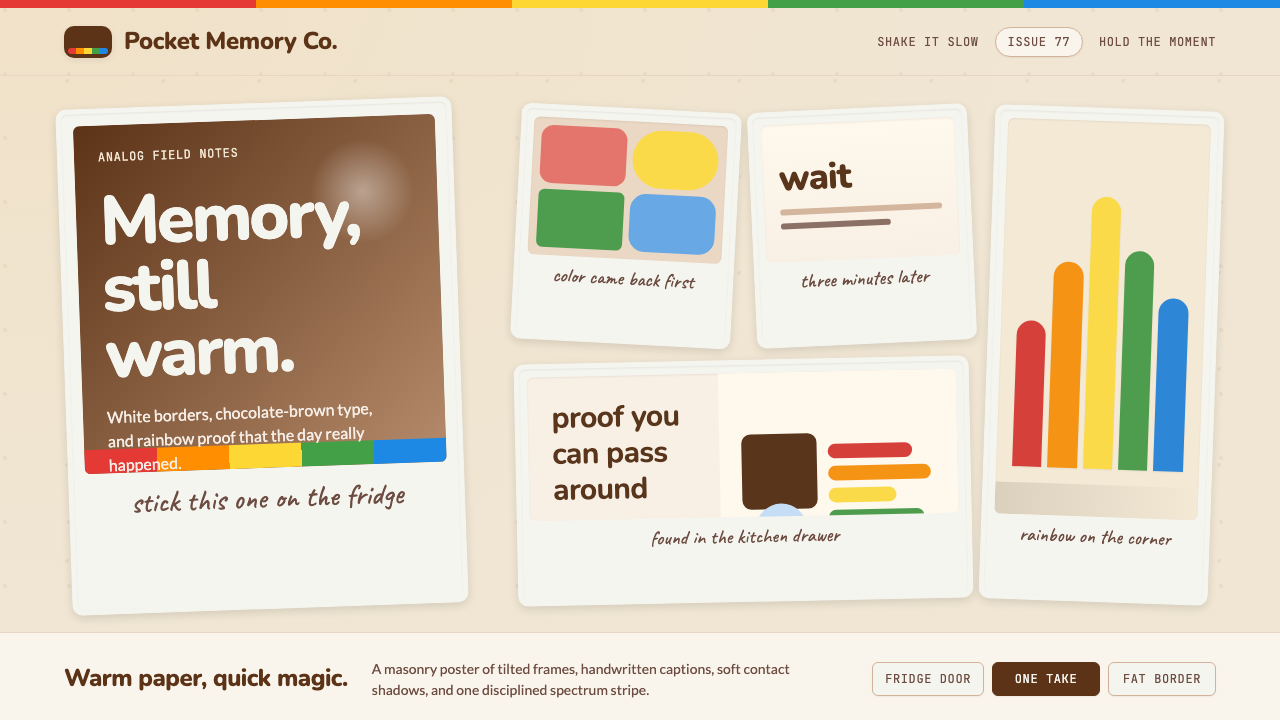
The white-bordered instant print turned memory into something you could shake, watch bloom, and hold in your hand.
Polaroid Instant in brief
Polaroid Instant is a design style derived from the visual language of instant photography — wide cream-white photo borders, warm-toned image surfaces with the soft color-shift of chemical development, a signature rainbow spectrum stripe, and the casual tilt that comes from pinning a print to a corkboard without a level. The aesthetic is inseparable from its physical origin: the instant photograph as object, as artifact, as proof that something happened.
Where many nostalgic styles reach for surface texture alone, Polaroid Instant is grounded in a specific material logic. The white border is structural — it frames the image, provides a writing surface for captions, and signals the hand-held scale of the original object. The rainbow stripe is brand history made visual. The slight rotation is not careless; it is the readable mark of human handling, of a print passed between people. Together, these elements produce warmth without sentimentality, personality without chaos.
Tonally, the style sits in warm browns, aged whites, and the soft faded chromas of a photograph left in sunlight — not pure, brilliant hues but colors that have lived a little. It pairs easily with handwritten annotations, caption-style type, and layered compositions that mimic a wall of pinned prints or the open pages of a scrapbook. The overall feeling is analog authenticity: lived-in, specific, trustworthy in the way that a physical photograph is trustworthy.

Where does Polaroid Instant come from?
The story of Polaroid Instant begins in 1943, on a family vacation in Santa Fe, New Mexico. Edwin Land — physicist, inventor, and founder of the Polaroid Corporation — had just photographed his three-year-old daughter Jennifer. She asked why she couldn't see the picture right away. Land, whose career had already produced the first practical polarizing filter for sunglasses and car headlights, spent the rest of that afternoon walking through the city working out the chemistry of instant development in his head. Within a year he had the core concept; within four years he had a camera. The first Polaroid Model 95, introduced to the public in November 1948 at the Jordan Marsh department store in Boston, sold out its entire stock on the first day.
The early Polaroid cameras produced sepia-toned prints on a peel-apart film that required the user to time the development with a watch, peel the negative from the positive, and coat the surface with a chemical fixative to prevent fading. The process was intimate and faintly alchemical — a private ritual of waiting, peeling, and seeing. Through the 1950s and 1960s, the technology improved steadily, but the defining transformation came in 1972 with the SX-70, the first camera to produce fully automatic, self-developing prints that emerged from the camera face-up and developed in daylight without any user intervention. The photographer simply pointed, pressed, and watched the image slowly bloom from gray to color. This was the Polaroid that became culturally iconic.
The rainbow spectrum stripe — the visual element most associated with the Polaroid brand — debuted on the SX-70 film pack in the early 1970s and migrated to cameras, packaging, and advertising through the decade. It was not purely decorative: the stripe signified the color fidelity of the film at a moment when color instant photography was technically difficult and commercially differentiated. But its visual effect was immediately legible as joyful and accessible, a chromatic shorthand for spontaneity. Andy Warhol shot thousands of Polaroids throughout the 1970s and 1980s, using the camera as a sketching tool and the prints as both source material and finished artwork. Ansel Adams served as a paid consultant to Polaroid for decades, contributing technical expertise and lending the camera a quiet artistic legitimacy.
The decline of the original Polaroid Corporation was slow and painful. Digital cameras eroded the instant-photography market through the 1990s, and in 2001 Polaroid filed for bankruptcy. The company reorganized, struggled, and filed again in 2008, the same year a group of former employees and enthusiasts launched the Impossible Project — acquiring Polaroid's last operating film factory in Enschede, the Netherlands, and beginning the years-long process of reformulating instant film chemistry from scratch. By 2017 the Impossible Project had rebranded as Polaroid Originals, and by the early 2020s a fully revived Polaroid brand was producing both new cameras and new film. The analog revival had found its flagship. In design, the Polaroid aesthetic had meanwhile become a reference point for authenticity, warmth, and the deliberate rejection of digital perfection — qualities that made it newly relevant to brands and designers working in an era of algorithmic imagery.
What defines the Polaroid Instant look?
The White Border
The defining structural element of the Polaroid aesthetic is its wide, cream-white border — heavier at the bottom than on the three other sides, a proportion dictated by the film chemistry and ejection mechanism of the original cameras. In design applications, this border functions as a frame, a signature, and a scale indicator simultaneously. It sets the image apart from its background, creates a writing surface that implies annotation and authorship, and immediately reads as photographic even when the content inside is illustration, type, or data visualization. Using a symmetrical border or omitting the heavier bottom weight loses the essential character.
Warm, Faded Tonality
Polaroid film had a characteristic warmth — slightly pushed toward amber and brown in the shadows, with highlights that leaned cream rather than pure white. Colors in the midtones were full and saturated but carried a softness that distinguished them from the sharp chromas of digital photography. In design terms, this translates to a palette built on warm off-whites, chocolate and caramel browns, and muted versions of primary hues — colors that feel like they have been exposed to a few years of light and touch. Pure, brilliant colors read as out of place; the palette rewards restraint and the sense of gentle aging.
The Rainbow Stripe
The spectrum stripe — a band of continuous color running from red through orange, yellow, green, and into blue — is the Polaroid Corporation's most recognizable brand marking, appearing on camera bodies, film packaging, and promotional materials from the early 1970s onward. In design, it functions as an accent of exuberant color within an otherwise warm, restrained palette: a single horizontal or diagonal stripe that signals the brand's identity without overwhelming the composition. The stripe should appear as a deliberate citation rather than decoration; using it multiple times or at large scale dilutes its effect.
The Casual Tilt
Polaroid prints, when displayed on bulletin boards, refrigerators, or scrapbook pages, almost never sit perfectly level. A slight rotation — typically just a few degrees clockwise or counterclockwise — is the visual grammar of casual keeping. In design, this tilt is not arbitrary; it is a precise signal of informality and human handling. Applied to photo-card components, illustration frames, or image modules, it introduces warmth and personality without requiring decorative illustration. The tilt should be gentle enough to read as natural rather than deliberate, and consistent enough across a composition that it feels like a system rather than a mistake.
Handwritten Annotation
One of the persistent rituals of instant photography is writing directly on the white border — a date, a name, a caption, a running joke. This practice gives Polaroid design its typographic character: a blend of printed or near-handwritten caption type for the formal label, and actual or simulated handwritten script for the personal mark. In digital applications, this does not require real handwriting; the quality to pursue is informality and specificity — type that looks like it belongs to a person and a moment rather than to a brand guideline. Pairing a casual caption with a more structured layout element creates the productive tension between the analog and the organized.
Layered, Scrapbook Composition
Polaroid prints accumulate. On a refrigerator door, a travel journal, a dorm room wall, they overlap and cluster, arranged by impulse rather than grid. Design in this style embraces that layered quality: photo-cards that overlap slightly, compositional arrangements that feel gathered rather than aligned, backgrounds that suggest aged paper or linen rather than a pure digital surface. The layering is controlled — it reads as curated casualness, not disorder — and functions as a counterpoint to the flat, grid-locked cleanliness of most contemporary interface design.
Soft Photographic Texture
The surface quality of a Polaroid print is distinctive: slightly grainy in the shadows, with a matte finish that diffuses specular reflection, and a color depth that comes from the dye layers of the film rather than the pixel grid of a sensor. In design, this translates to imagery and backgrounds that carry a gentle grain or film-like softness, surface treatments that avoid the hard-edged clarity of pure digital rendering, and an overall visual temperature that favors warmth and slight imperfection over technical precision. The texture should feel like evidence of process rather than added decoration.

Who shaped Polaroid Instant?
Edwin Land founded the Polaroid Corporation in 1937 and remained its driving creative and scientific force for four decades. A Harvard dropout who filed more than five hundred patents in his lifetime, Land approached instant photography not as a commercial opportunity but as a problem in applied physics: how to complete the entire photographic process inside the camera, in daylight, within seconds. His SX-70 camera, launched in 1972, was considered by many engineers an impossible device — a folding single-lens reflex camera that produced integral self-developing prints — and remains one of the most technically sophisticated consumer products of the twentieth century. Land's insistence on keeping photography intuitive and emotionally immediate shaped the Polaroid aesthetic as much as any visual decision.
Andy Warhol shot an estimated hundred thousand Polaroid photographs between the early 1970s and his death in 1987. He carried a Big Shot camera as routinely as a notebook, using it to document the faces that passed through The Factory, to make compositional studies for his silk-screen portraits, and — increasingly — as a finished artwork in its own right. Warhol's embrace of the Polaroid was not nostalgic; it was conceptual. The instant print collapsed the distance between experience and record. For a painter whose entire project interrogated the nature of reproduction and celebrity, the camera that could make a portrait in a minute was a philosophical instrument as much as a photographic one. His practice gave instant photography a place in the art world that the medium has never fully relinquished.
Ansel Adams' association with Polaroid began in 1948, the year the first camera went on sale, and continued until his death in 1984. He served as a formal consultant to the company, advising on the optical and tonal qualities of new film stocks and testing prototypes in the field. Adams published a manual specifically on Polaroid photography and used the medium extensively to make exposure tests before committing to large-format film. His involvement gave the brand a credibility in fine-art photography circles that proved commercially valuable and culturally lasting. It also established a precedent: that instant photography could be taken seriously by practitioners who cared deeply about image quality, tonal range, and the dignity of the photographic process.
Florian Kaps was one of the founders of the Impossible Project, the initiative that saved Polaroid's last film-production facility after the corporation's 2008 bankruptcy. An Austrian entrepreneur and Polaroid collector, Kaps had previously launched an online marketplace for vintage instant film. Recognizing that the closure of the Enschede factory would permanently end the supply of integral instant film, he assembled a coalition of investors and former Polaroid engineers to acquire the facility and begin reformulating the chemistry from scratch — a process that took years and produced many technically imperfect but commercially successful film stocks. His work ensured the physical continuity of the medium and provided the material basis for the analog revival that subsequently made the Polaroid aesthetic newly relevant to a generation of designers and brand strategists who had never owned a camera.
How do you use Polaroid Instant today?
Polaroid Instant is a warmth-first style — its fundamental job is to make designed objects feel human, specific, and emotionally present. Applying it correctly means understanding what the visual grammar is actually doing: the border says 'this is a held object'; the tilt says 'a person placed this here'; the warm tonality says 'this has been touched by time.' Each element carries a semantic weight, and using any of them decoratively without that weight produces pastiche rather than design.
For presentation slides, the style works exceptionally well as a cover treatment and for narrative or testimonial sections. A cover built around a single tilted photo-card on an aged-paper background, with a handwritten-style caption beneath, immediately signals the warmth and specificity that the rest of the presentation will deliver. Content slides should be treated with more restraint: one or two photo-card components per slide, arranged in a slightly clustered rather than formally aligned manner, with body text in a clean, legible face that contrasts against the informal decorative elements. Data slides can integrate the aesthetic by framing charts inside a photo-border component and using warm palette variations to differentiate data series — the result reads as approachable and editorially considered rather than purely functional.
For web interfaces, Polaroid Instant suits context where human connection and trust-building are primary goals: testimonial sections, about pages, community features, portfolio galleries, and brand storytelling modules. The photo-card with its white border and slight shadow functions as a component that immediately implies authenticity. Pricing pages and dashboards are more difficult territory — the style's informality can work against the clarity and scannability those pages require — but a selective application of warm tonality in backgrounds, combined with photo-card-style feature highlights, can soften a formal layout without compromising its hierarchy. Navigation and type elements should remain clean and readable, with the nostalgic elements reserved for imagery and decorative modules.
For editorial and marketing work, the style has particular strength in brand contexts that want to signal heritage, craft, or community: food and beverage brands, travel and hospitality, independent retailers, creative studios, and event photography. A marketing page built in this style typically alternates between full-width warm-toned photography with an overlay of photo-card components and a cleaner, more typographic section for factual or functional content. Print editorial benefits from the style's native warmth: feature spreads with overlapping photo-card imagery, caption type set in a casual weight, and section openers that use a single bold photo-card as the primary illustration create a scrapbook feeling that is approachable without sacrificing credibility.
The most common mistake when applying Polaroid Instant is treating it as a texture filter rather than a compositional system. Designers sometimes apply a uniform film grain, a warm color overlay, and a few rounded-corner elements, and assume the result is the style. It is not. The style's character comes from the logic of the print as object — border, tilt, annotation, layering — not from surface warmth alone. A second common error is over-rotating: a tilt beyond about five or six degrees reads as chaotic rather than casual. And a third is overloading with decorative elements simultaneously — border, stripe, tilt, handwriting, and grain all at full intensity cancel each other out and produce visual noise instead of warmth. The discipline is choosing which one or two elements will carry the moment, and letting the others rest.

Polaroid Instant — FAQ
Is Polaroid Instant the same as Lo-Fi or Analog Revival as a design style?
They are related but distinct. Lo-Fi and analog revival are broad categories that include cassette-tape aesthetics, vinyl record design, grainy film photography in general, and various retro-technology references. Polaroid Instant is more specific: it is derived from a single, highly recognizable visual object — the instant print — and its grammar is defined by that object's physical properties: border weight and proportion, development tonality, rainbow stripe, tilt, and annotation. A lo-fi design might use film grain and muted color without any of the Polaroid-specific structural elements; a Polaroid Instant design uses those structural elements even when the grain and color are secondary. The specificity is the style's strength — it is readable and associative in a way that generic lo-fi is not.
Can the style work for a premium or luxury brand context?
With care, yes. The challenge is that Polaroid Instant's warmth and intentional imperfection can read as informal or even low-cost in contexts where precision and exclusivity are the primary signals. However, the style can be elevated by restraint: a single, large, beautifully framed photo-card on a clean warm ground, with minimal annotation and generous spacing, reads as curated and deliberate rather than casual and accumulated. The key is reducing the layering and scrapbook energy while retaining the border, tilt, and tonal warmth. Luxury applications tend to use one strong photo-card element per layout rather than clustered arrangements, and they pair the nostalgic framing device with high-quality imagery that earns the aesthetic rather than leaning on it for warmth the content doesn't otherwise deliver.
How does Polaroid Instant handle dark-mode or dark-background layouts?
The canonical Polaroid aesthetic is light-ground — the cream-white border and aged-paper background are central to the style's identity. A dark background inversion is possible but requires significant adjustment. On a deep ground, the photo-card border shifts from its characteristic cream-white to a luminous, slightly warm white, and the overall palette must compensate by using richer, more saturated warm tones in image content to preserve the sense of warmth. The rainbow stripe reads well on dark grounds and becomes more prominent — which means using it even more sparingly than usual. The risk is that a dark-ground Polaroid design begins to read as generic vintage or lo-fi rather than specifically Polaroid; retaining the exact border proportion and tilt is especially important on dark backgrounds to preserve the style's structural identity.
What makes Polaroid Instant feel authentic versus kitsch?
The line between authentic and kitsch in this style comes down to structural logic versus surface accumulation. An authentic application uses the border, tilt, and annotation because they carry meaning — they reference the physical object and its rituals of use. A kitsch application adds those elements because they look nostalgic, without regard for whether they are doing any semantic work. Practically: authentic applications are selective — one or two Polaroid-specific elements per composition, used at considered scale and proportion. Kitsch applications are cumulative — borders plus tilt plus stripe plus grain plus handwriting plus warm overlay, all at maximum intensity. The second principle is editorial restraint in imagery: authentic Polaroid design uses strong, specific photographs or illustrations that feel like they belong to a moment; kitsch design uses stock photography with a filter applied. The style rewards genuine content more than almost any other nostalgic aesthetic.
Does Polaroid Instant work for data-heavy products like analytics dashboards?
Generally, it is not the right choice for primary analytics interfaces, where precision, density, and scannability are the overriding requirements. The style's warmth and informality work against the cognitive clarity that data-heavy screens need. However, selective application is possible and can be effective in specific contexts: onboarding flows, empty states, achievement moments, and summary cards can all benefit from a Polaroid-inflected warmth that makes the product feel more human and the data feel less clinical. The approach is to use the full Polaroid visual language as an accent layer within an otherwise neutral, functional interface — photo-card-style highlight modules for key metrics, warm-toned background sections for narrative content — rather than applying the style to the entire product. The moment the style competes with data legibility, it should step back.
Related design styles
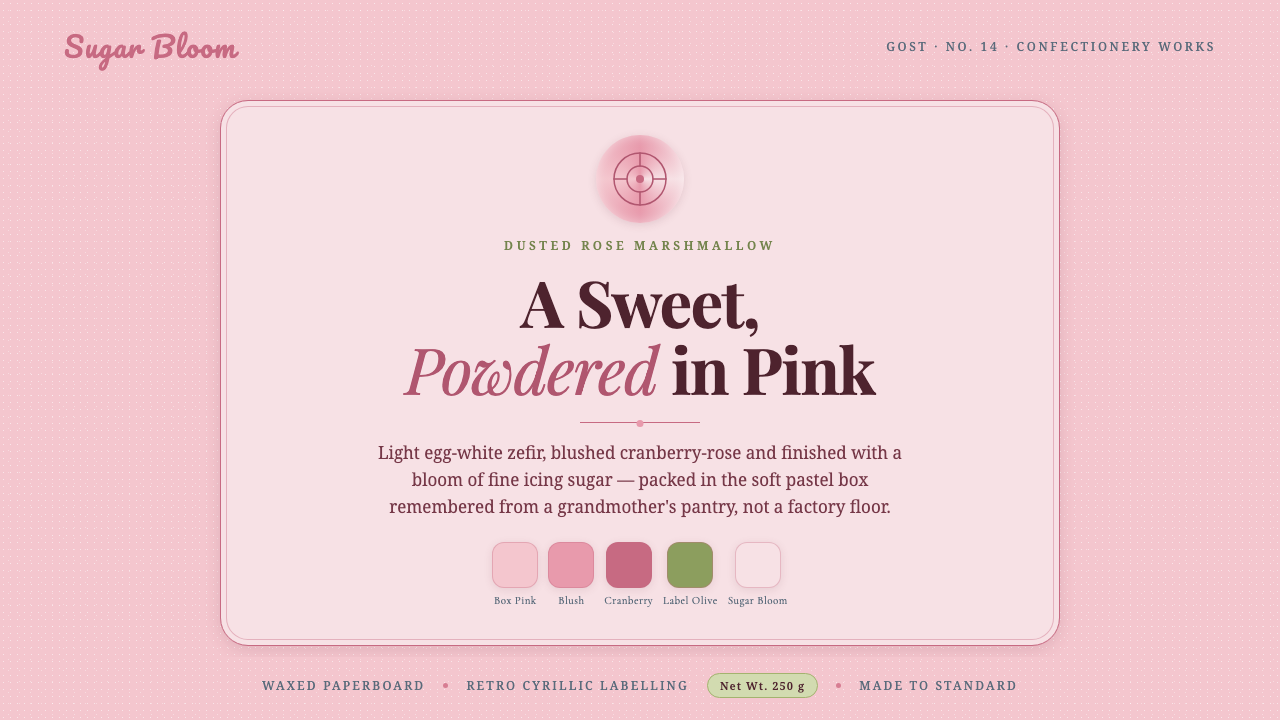 Soviet Zefir ConfectioneryA sweet remembered, not manufactured. Sugar-pink waxed-box ground, berry-rose…
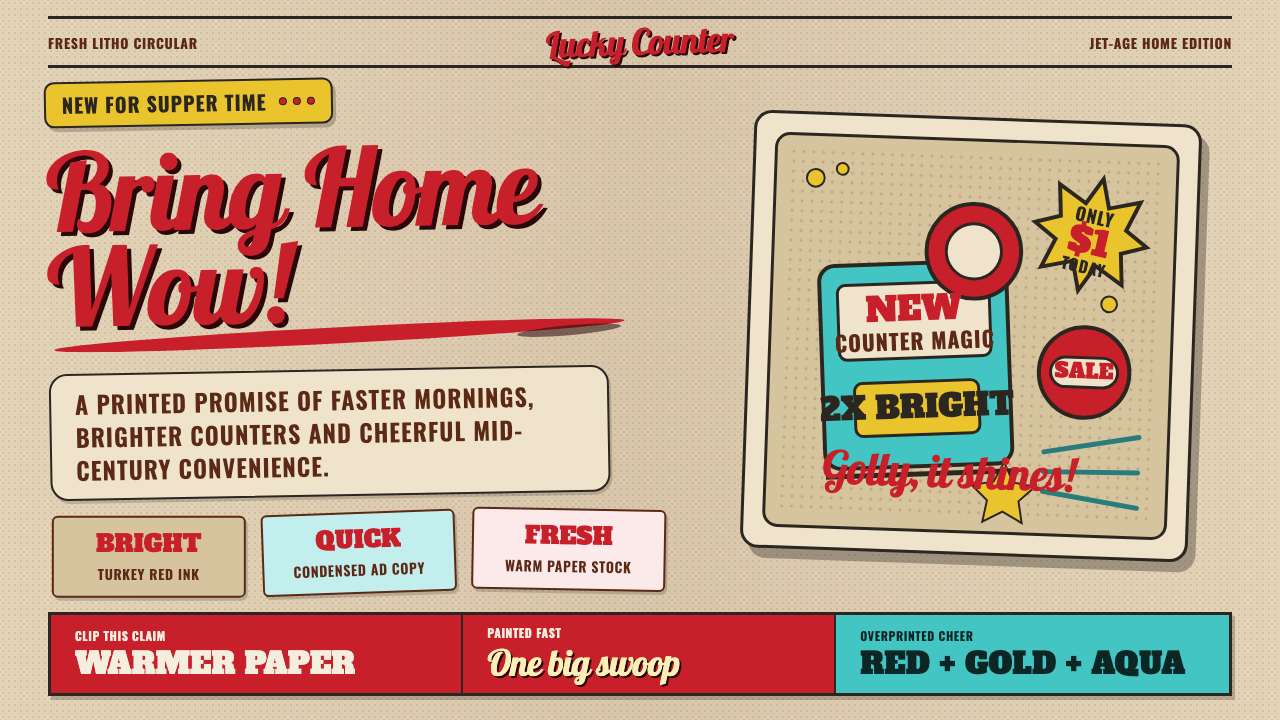 1950s Brush Script AdSells tomorrow in one swoop. Turkey red script, tan paper, starbursts, and ha…
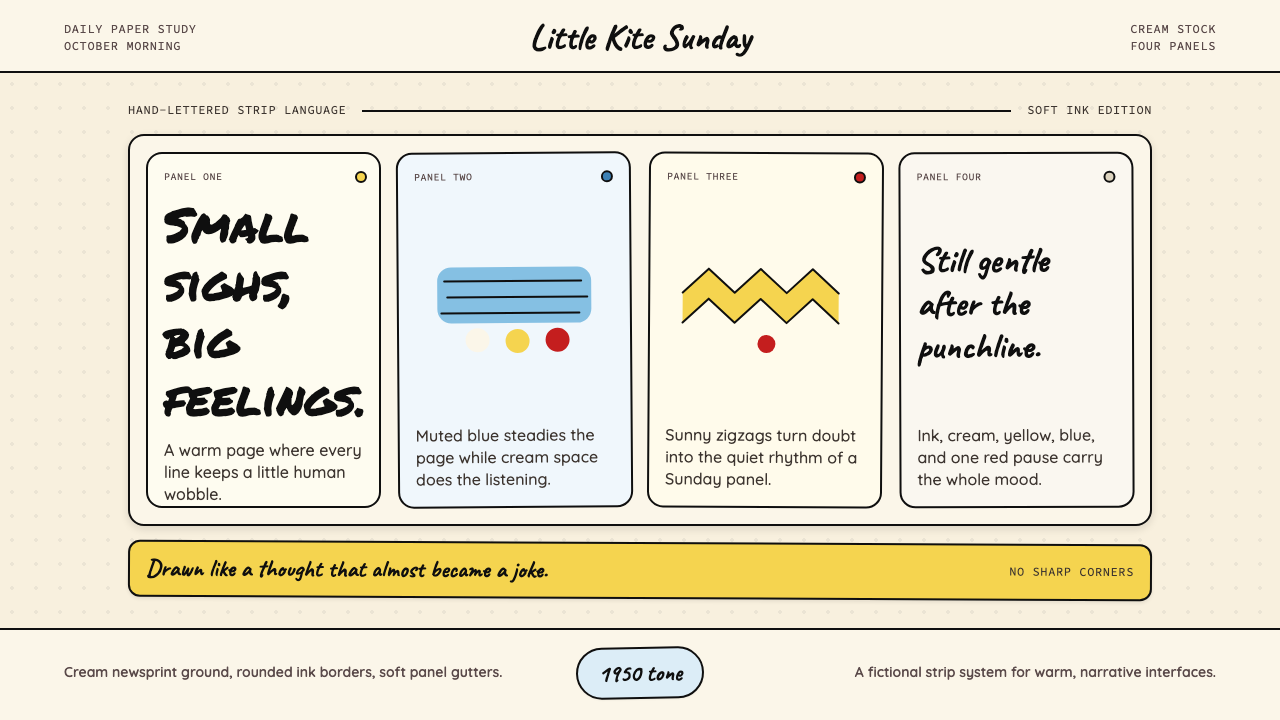 Peanuts Comic Schulz (1950)Gentle melancholy on newsprint. Caveat lettering, cream panels, yellow and bl…
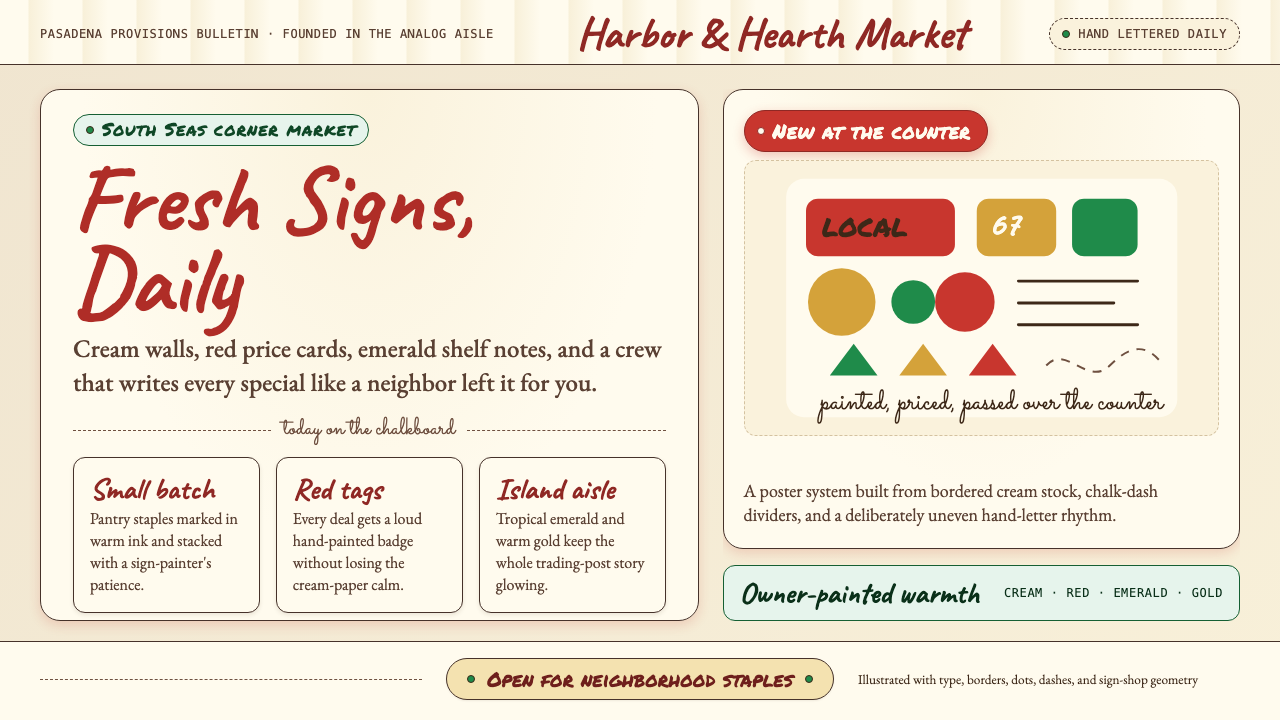 Trader Joe's Hand-LetteredHandmade grocery warmth. Cream chalkboards, red price tags, emerald accents.
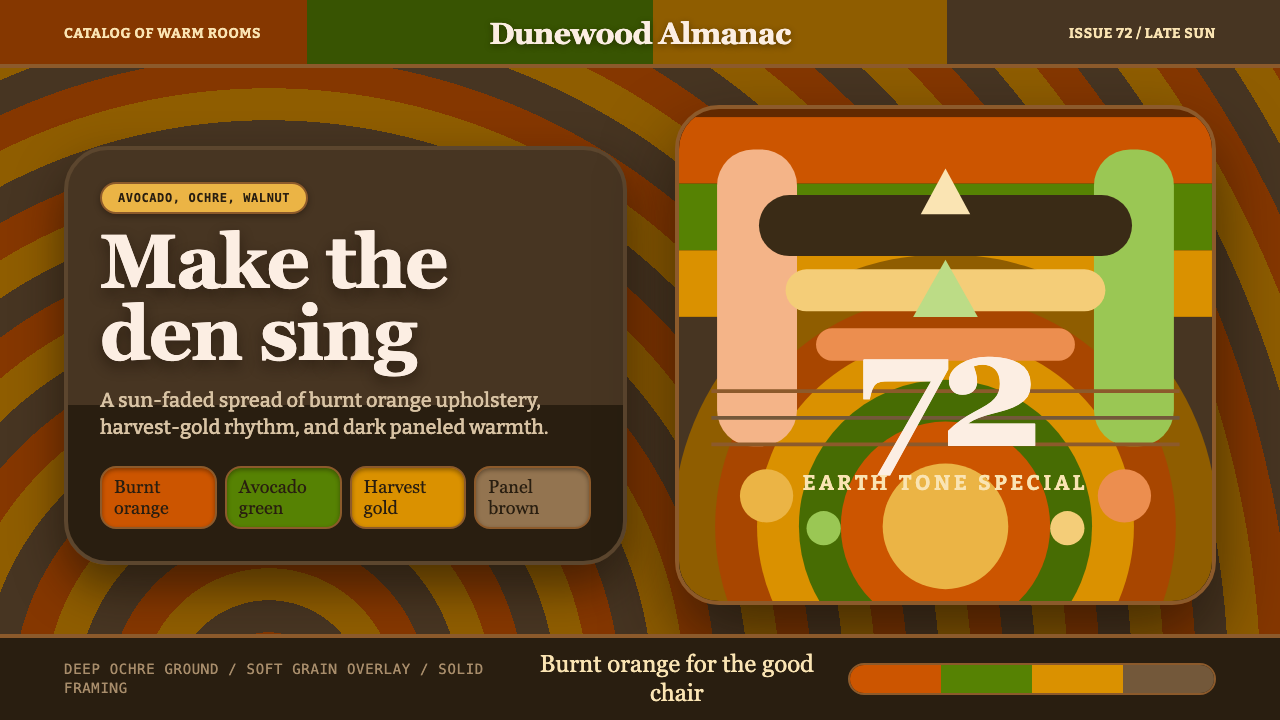 1970s Earth TonesWarm maximalism stays muddy. Bulbous slabs, avocado bands, and harvest-gold r…
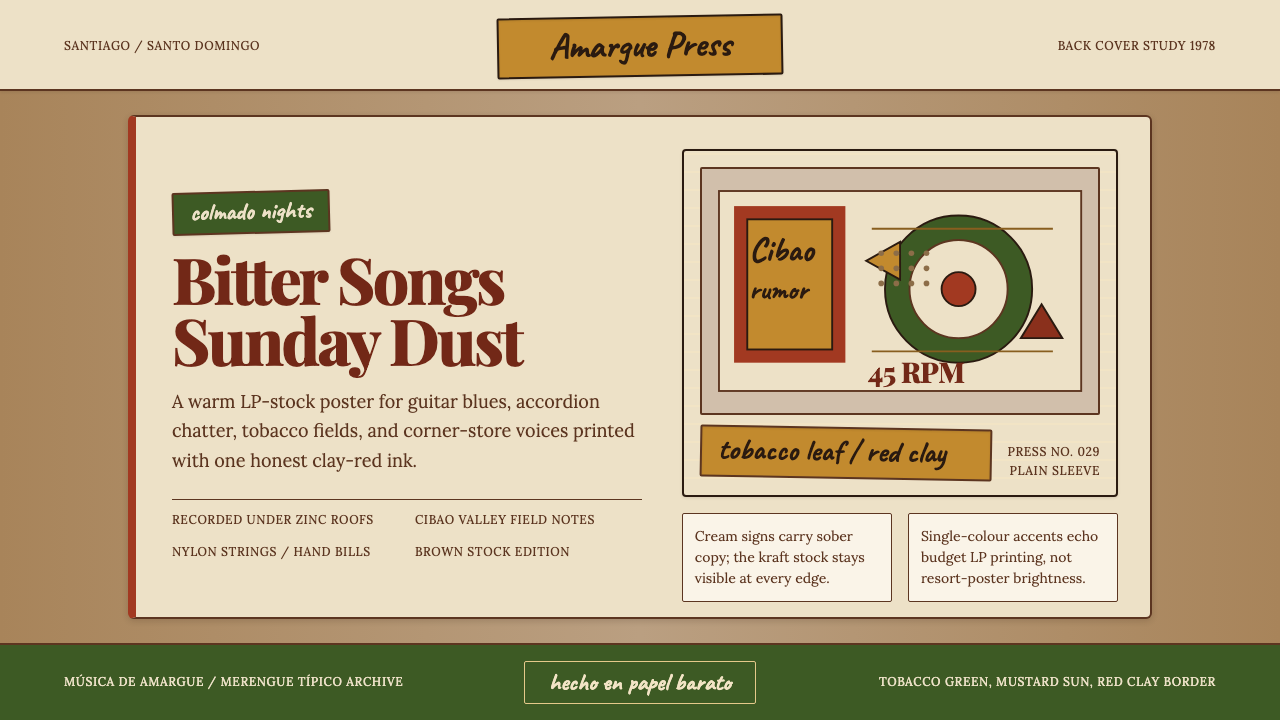 Dominican Bachata & Perico RipiaoPlainspoken warmth. Kraft stock, red clay serif, and typewriter credits carry…