What is Trader Joe's Hand-Lettered?
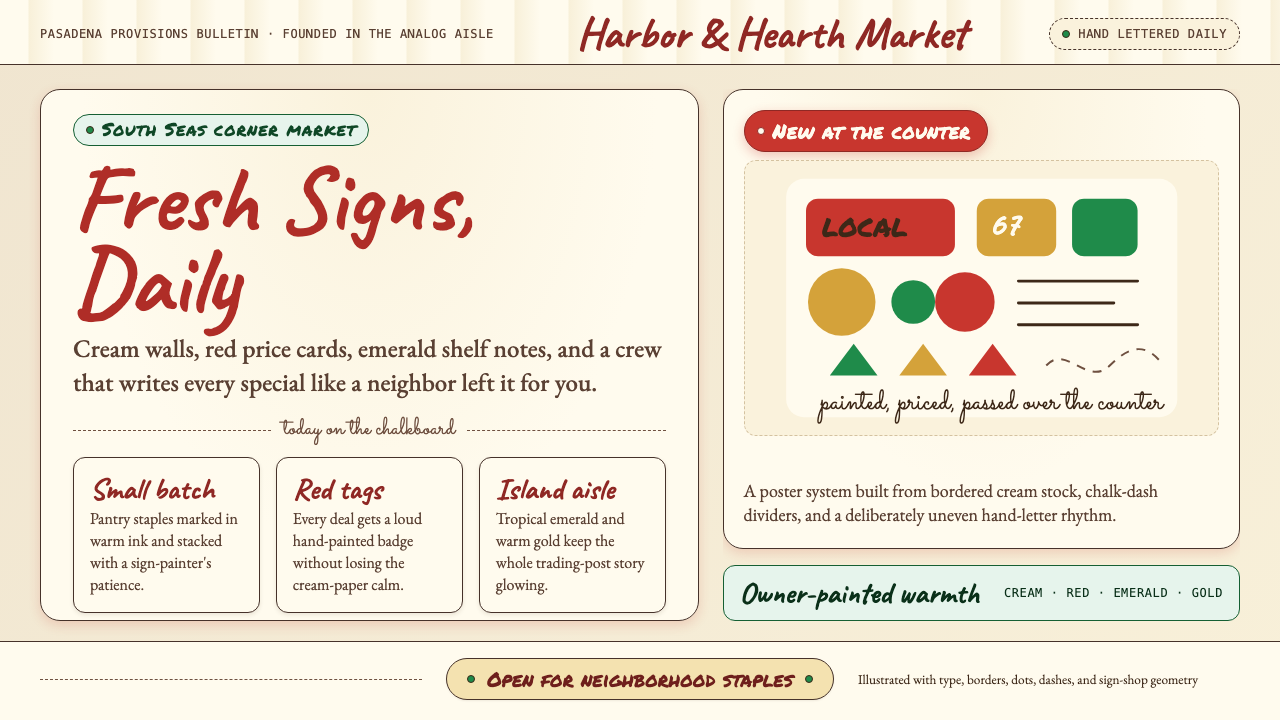
Trader Joe's turned a chalkboard and a piece of chalk into one of the most recognizable retail identities in America — proof that warmth drawn by hand outlasts any polished supermarket brand.
Trader Joe's Hand-Lettered in brief
Trader Joe's Hand-Lettered is the visual language of an American specialty-grocery chain that has, since 1967, refused to look like a supermarket. Every store greets customers with hand-painted chalkboard signs, crew members in Hawaiian shirts, and a warm cream interior that borrows more from a tropical trading post than from a fluorescent-lit food warehouse. The result is a design identity built not on precision and system, but on the cumulative warmth of imperfect, human marks.
The aesthetic rests on a small, deliberate palette — creamy off-white grounds, a signature red used for pricing and emphasis, a tropical emerald that nods to the chain's Polynesian South Seas heritage, and flashes of warm gold. Over these colors sit letterforms that look genuinely hand-drawn: casual, bouncy, slightly uneven, with the natural variation you expect from a felt-tip marker or a piece of chalk. Nothing in the system strives for geometric perfection. The imperfections are the point.
What makes this identity durable is that it solves a genuine emotional problem. Mass-market grocery retail tends toward cold efficiency — bright white light, uniform shelving, sans-serif pricing. Trader Joe's inverts that equation deliberately. Every hand-lettered sign, every illustrated product label, every chalkboard menu reads as evidence that a person was here, paid attention, and wrote this for you. The style communicates neighborly trust rather than corporate scale.

Where does Trader Joe's Hand-Lettered come from?
Joe Coulombe founded the first Trader Joe's in Pasadena, California in 1967, converting a small convenience store chain called Pronto Markets into something altogether different. Coulombe's insight was demographic and cultural: he saw that a growing number of educated, well-traveled Americans — people who had encountered interesting food and drink abroad — had no reliable local source for the things they wanted. He would stock unusual wines, international cheeses, and specialty foods at prices that felt fair, and he would make the store itself feel like an adventure rather than an errand.
The South Seas and Polynesian theming was Coulombe's deliberate invention, inspired in part by the tiki culture popular in mid-century California and in part by his own sense that a 'trading post' metaphor would give the store a coherent, adventurous personality. Hawaiian shirts became the staff uniform. The store name itself — Trader Joe's — evokes the romantic image of a well-traveled merchant who has brought back treasures from distant places. The hand-lettered signage that followed was a natural extension of this ethos: signs that looked like they had been written by hand that very morning felt authentic in a way that printed signage never could.
In 1979, Theo Albrecht, the German billionaire co-founder of the Aldi Nord discount grocery empire, purchased Trader Joe's. This was a remarkable pairing on paper — Aldi's entire identity was built on ruthless price efficiency and functional, logo-light packaging — but in practice, Albrecht understood the value of what Coulombe had built and left the visual language essentially untouched. The hand-lettered style continued without interruption, becoming more refined and intentional over the following decades while retaining its warm, imperfect character.
By the time Trader Joe's had expanded to approximately six hundred stores across the United States, the hand-lettered identity had become one of the most studied examples of retail brand consistency in American design history. Unlike brands that invest heavily in enforced standardization — pixel-perfect logo reproduction, pantone-matched color management across every touchpoint — Trader Joe's achieved consistency through cultural repetition and a shared aesthetic sensibility rather than rigidity. Each store's signage was slightly different, drawn by local staff trained in the style, and that variation was treated not as a flaw to be corrected but as evidence of the brand's genuine humanity.
What defines the Trader Joe's Hand-Lettered look?
Hand-Lettered Imperfection
The defining quality of the style is that letterforms look genuinely written rather than typeset or digitally rendered. Stroke weights vary naturally within a single character. Baselines wander slightly. Letter spacing is optically adjusted by eye rather than mathematically locked. This imperfection is not sloppiness — it is the result of skilled lettering artists working within a loose shared sensibility — but it reads as warmth rather than control, as human rather than mechanical.
Chalkboard as Primary Medium
The chalkboard sign is the visual anchor of the Trader Joe's in-store experience. Cream or off-white chalkboard surfaces — rather than the pure black of a traditional blackboard — provide a softer, warmer ground for lettering in white chalk and colored chalk accents. The medium implies ephemerality: these signs could be erased and rewritten today, which reinforces the sense that they reflect genuine daily attention rather than pre-printed corporate messaging.
The Signature Color Quartet
The palette is tightly controlled around four anchors: warm cream for backgrounds and large surface areas; Trader-Joe red for price callouts, headings, and structural emphasis; tropical emerald for accents that reference the Polynesian South Seas heritage; and warm gold used sparingly for highlights and festive moments. These four colors work together to feel warm rather than primary-school bright, inviting rather than aggressive. They are consistently applied across chalkboards, product labels, bags, and printed materials.
Illustrated Product Storytelling
Trader Joe's private-label product packaging pairs hand-lettered text with hand-drawn illustrations — loose tropical motifs, fruit and vegetable line drawings, nautical details — that reinforce the South Seas trading-post narrative. The illustrations are deliberately unpretentious: they have the quality of good doodles made by someone who can actually draw, rather than the polished output of a professional illustration studio. This registers as authentic and personal even at the scale of a mass-market product line.
Casual Hierarchy Without Grids
Where a modernist design system would establish hierarchy through a strict typographic grid, the Trader Joe's approach achieves it through size contrast and color alone. A large bouncy headline in red sits above smaller descriptive text in cream or white, with price information in a contrasting bold. The arrangement feels discovered rather than engineered — as if the person lettering the sign added the most important thing first, then filled in context around it. This optical rather than mathematical organization is central to the style's handmade warmth.
Tropical and Nautical Motifs
Running through the visual system is a consistent vocabulary of decorative detail drawn from the chain's Polynesian South Seas mythology: palm fronds, waves, sailing ships, tropical birds, island maps, and tiki-adjacent ornamental borders. These motifs appear on product labels, shopping bags, seasonal decorations, and the hand-painted murals that distinguish each individual store. They give the identity cultural specificity and a sense of place that is rare in mass-market retail — you are not just in a grocery store, you are at Trader Joe's.
Warmth Over Efficiency
The overarching design value is warmth, and every specific decision in the style serves this value at the expense of something a conventional retail designer might consider a virtue. Labels are not perfectly aligned. Signs are not identically formatted across stores. Pricing presentation is inconsistent by corporate standards. None of this is accidental. The deliberate rejection of the crisp, efficient, standardized look of mass grocery retail is what makes Trader Joe's feel like a neighborhood store even when it occupies the footprint of a large commercial space.

Who shaped Trader Joe's Hand-Lettered?
Coulombe founded Trader Joe's in 1967 in Pasadena, California, and served as its chief executive until 1988. He invented the South Seas trading-post concept, the Hawaiian-shirt uniform, and the private-label product strategy that would define the chain's identity for decades. Crucially, he established the hand-lettered, chalkboard-heavy visual language as a deliberate counter-positioning against the polished, fluorescent supermarket aesthetic dominant at the time. His instinct that an educated, adventurous consumer segment was underserved in American grocery retail proved prescient: Trader Joe's became a category unto itself.
Albrecht, co-founder of the Aldi retail empire, acquired Trader Joe's in 1979 through Aldi Nord. The acquisition was philosophically surprising — Aldi's aesthetic is the near-opposite of Trader Joe's, built on extreme functional minimalism and absence of brand personality — but Albrecht's stewardship proved decisive in one respect: he did not attempt to rationalize or standardize the Trader Joe's visual language into something more Aldi-compatible. By leaving the hand-lettered, warm, idiosyncratic identity intact, he allowed it to compound in cultural value across subsequent decades.
Trader Joe's does not employ a centralized team of brand designers who produce finished sign artwork for distribution to stores. Instead, each store maintains staff trained in the house lettering style — crew members who can pick up a chalk pen or a paint marker and produce signs consistent with the brand's aesthetic sensibility without requiring a template. These anonymous artists, working across hundreds of locations, are collectively the authors of the visual identity. The style's resilience is partly a testament to how clearly its values — warmth, imperfection, handmade quality — can be transmitted and interpreted by different people in different places.
The mid-century American tiki movement — a romanticized, fictional vision of Polynesian culture that swept through bar and restaurant culture from the 1940s through the 1960s — provided the cultural raw material from which Coulombe constructed the Trader Joe's mythology. Establishments like Trader Vic's and Don the Beachcomber had established the visual vocabulary: tropical wood, woven textures, carved totems, warm amber lighting, and a sense of escapist exoticism. Coulombe translated this cultural appetite into a grocery context, and the hand-lettered, tropical-motif visual language of Trader Joe's carries that lineage forward in a form that has proved considerably more durable than the tiki bars that inspired it.
As the parent company of Trader Joe's since 1979, Aldi Nord occupies a curious position in the brand's story: a company whose own retail aesthetic is nearly the opposite of Trader Joe's has, for over four decades, funded and protected an identity built on handmade warmth and tropical whimsy. This separation of corporate parent from brand identity has been absolute — Aldi and Trader Joe's do not cross-promote, do not share visual identity elements, and operate as entirely distinct brands in the minds of consumers. The arrangement illustrates how a strong, coherent retail identity can persist and compound independently of the entity that owns it.
How do you use Trader Joe's Hand-Lettered today?
Trader Joe's Hand-Lettered translates best when its emotional logic is understood first: the style exists to make designed objects feel human-made and locally attentive rather than corporately produced and globally distributed. Any application that captures that emotional register will succeed in the style; any application that treats it as a surface treatment — hand-lettered fonts on an otherwise rigidly systematic layout — will feel costume-like rather than authentic.
For presentation slides, the style works particularly well for brands in food, hospitality, retail, or consumer goods that want to signal approachability and craft. A cover slide benefits from a chalkboard-textured ground in warm cream, with the title lettered in the signature red and a loose tropical or organic motif tucked into a corner. Content slides should lean into casual hierarchy: oversized category headers in a hand-drawn script, body text in a warm serif, and data or statistics treated as featured callouts with hand-drawn underlines or encircling strokes rather than formal data tables. Data slides work especially well when charts are illustrated rather than plotted — bar elements drawn with slight imperfection, pie segments with hand-inked outlines — giving quantitative information the same warmth as the surrounding narrative.
For web interfaces, the style is most appropriate for product pages, recipe content, store locators, and seasonal campaign landing pages rather than transactional or dashboard-heavy applications. A pricing or product page in this style uses cream or off-white as the dominant background, reserves the signature red for primary calls to action and featured pricing, and uses the emerald and gold sparingly for categorical differentiation. Card components benefit from a slightly rough border treatment rather than a perfectly radius-cornered container. Navigation benefits from a wordmark-forward approach with minimal iconography — the style reads as personal communication, not wayfinding system.
For editorial and marketing work, the style supports rich storytelling layouts where text and illustration are woven together rather than separated into clean zones. A marketing page for a food brand using this aesthetic might feature full-width illustrated banners, hand-lettered pull quotes set against a warm background, and product photography that is slightly informal — shot on a kitchen counter or wooden table rather than in a studio with seamless paper. The style pairs well with printed materials: menus, packaging inserts, event programs, and seasonal mailers all benefit from the warmth of chalkboard-inspired lettering and hand-drawn illustration against cream stock.
A common mistake when applying this style is mistaking hand-lettered fonts for hand-lettered feeling. Digital typefaces that simulate hand-drawing — however technically accomplished — will rarely achieve the warmth of the style unless they are surrounded by other hand-made elements: illustrated borders, rough textures, imperfect layout decisions. A second common mistake is over-saturating the palette; the style's warmth comes from the dusty, chalky quality of its colors, not from their brightness. Colors used at full saturation will read as cheerful rather than warm, festive rather than neighborly. Finally, the style does not suit contexts that require precision trust signals — financial services, medical information, complex technical documentation — where imperfection reads as unreliability rather than humanity.

Trader Joe's Hand-Lettered — FAQ
Can this style work for brands that have nothing to do with food or grocery retail?
Yes, but with important constraints. The hand-lettered chalkboard aesthetic has migrated well into contexts like coffee shops, farm-to-table restaurants, artisan makers, farmers markets, and small-batch consumer goods — essentially any category where the values of craft, local provenance, and human attention are genuine selling points. It works less well for technology products, financial services, or B2B software, where the imprecision that signals warmth in a grocery context reads as amateurism or lack of rigor. The question to ask is whether imperfection is a genuine value in your context or merely a stylistic affectation borrowed from a different category.
How do you balance the style's warmth with the need for clear information hierarchy?
The style achieves hierarchy through size and color contrast rather than through grid rigidity, which means the designer must be more intentional about scale differences — not less. The hierarchy collapses when hand-lettered elements are too close in size or when color is applied inconsistently. In practice, the solution is to be bold: make the primary element substantially larger than the secondary, use the signature red as a clear focal color for the most important information, and let secondary and tertiary content settle into a quieter scale and tone. The casual feel of the style comes from texture and imperfection, not from visual muddiness.
Is it appropriate to use digital hand-lettering tools, or must everything be physically drawn?
Digital tools are entirely appropriate and increasingly dominant in professional production of this style. Pressure-sensitive drawing tablets and brushes in vector applications can produce results that are indistinguishable from physically drawn lettering in reproduction. What matters is not the tool but the sensibility: whether the output has natural variation in stroke weight, whether letterforms show evidence of a drawing hand rather than a drawing algorithm, whether the composition has the optical rather than mathematical feel of the style. The test is not process but outcome — if it reads as warm and handmade, the method is irrelevant.
How does this style age, and will it feel dated?
The hand-lettered chalkboard aesthetic has shown remarkable durability over Trader Joe's nearly six decades of operation, partly because it is rooted in a genuine material practice — chalked chalkboards and hand-painted signs existed before the chain and will exist after — rather than in a digital design trend. Styles that simulate natural processes and material qualities tend to age more gracefully than styles that simulate digital effects or contemporary UI conventions. That said, the specific combination of tropical motifs, Hawaiian-shirt culture, and the Polynesian romance has generational connotations; a fresh application of this aesthetic might update those cultural references while retaining the hand-lettered warmth that is the style's durable core.
What is the most important single thing to get right when applying this style?
Color temperature. The entire emotional register of the style depends on its palette reading as warm and slightly dusty rather than bright and saturated. The cream ground, the Trader-Joe red used at a softer tint rather than at maximum saturation, the chalky emerald — these color decisions create the sense of a worn, beloved, humanly inhabited space rather than a freshly-minted commercial environment. Designers who replicate the hand-lettered typography correctly but apply it over cool white backgrounds or highly saturated colors will find that the warmth evaporates entirely. Get the color temperature right and the rest of the style follows; get it wrong and no amount of hand-drawn lettering will recover it.
Related design styles
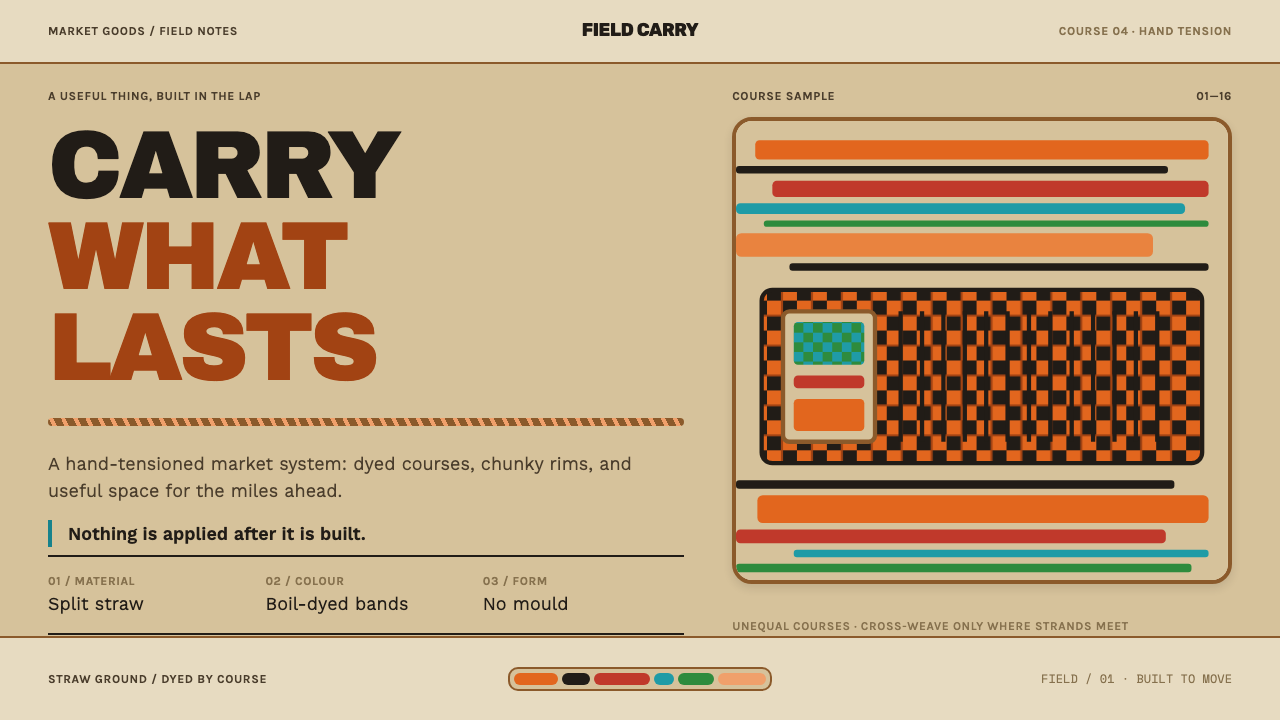 Bolga BasketStructure is the ornament. Unequal orange, red and turquoise bands cross on s…
 Outer WildsCosy cosmic melancholy. Campfire orange glows through typewritten teal field…
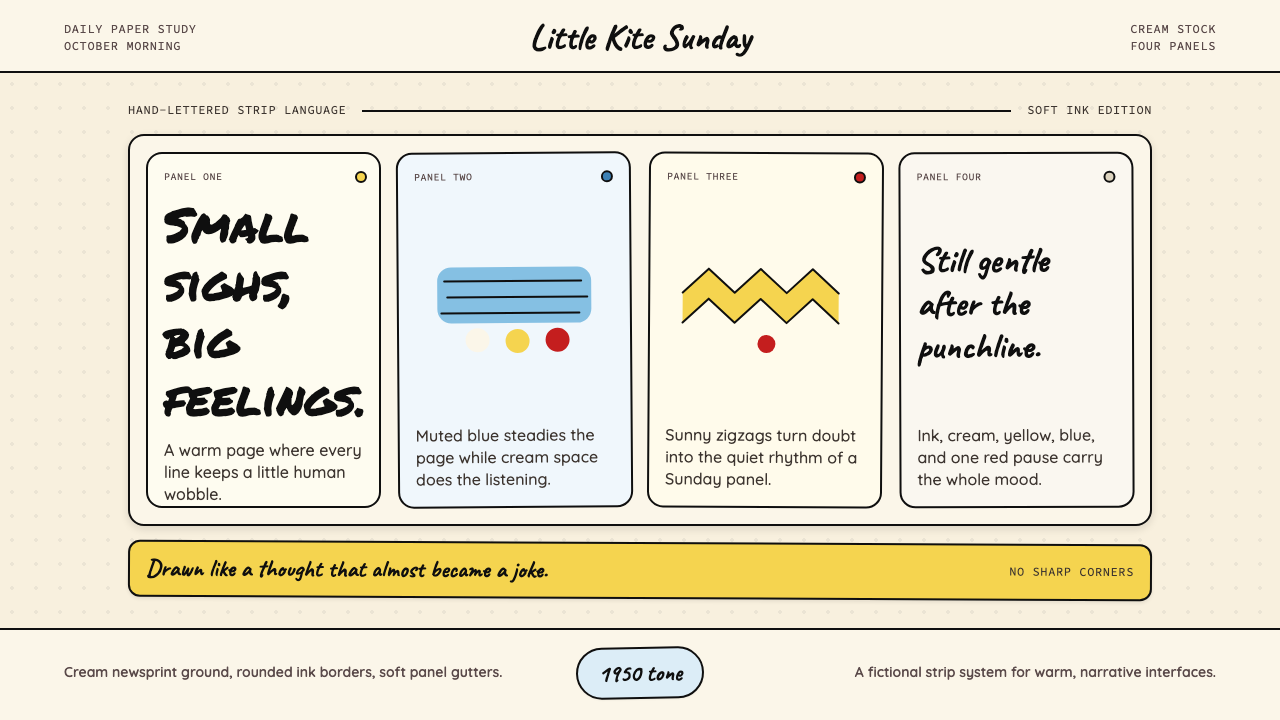 Peanuts Comic Schulz (1950)Gentle melancholy on newsprint. Caveat lettering, cream panels, yellow and bl…
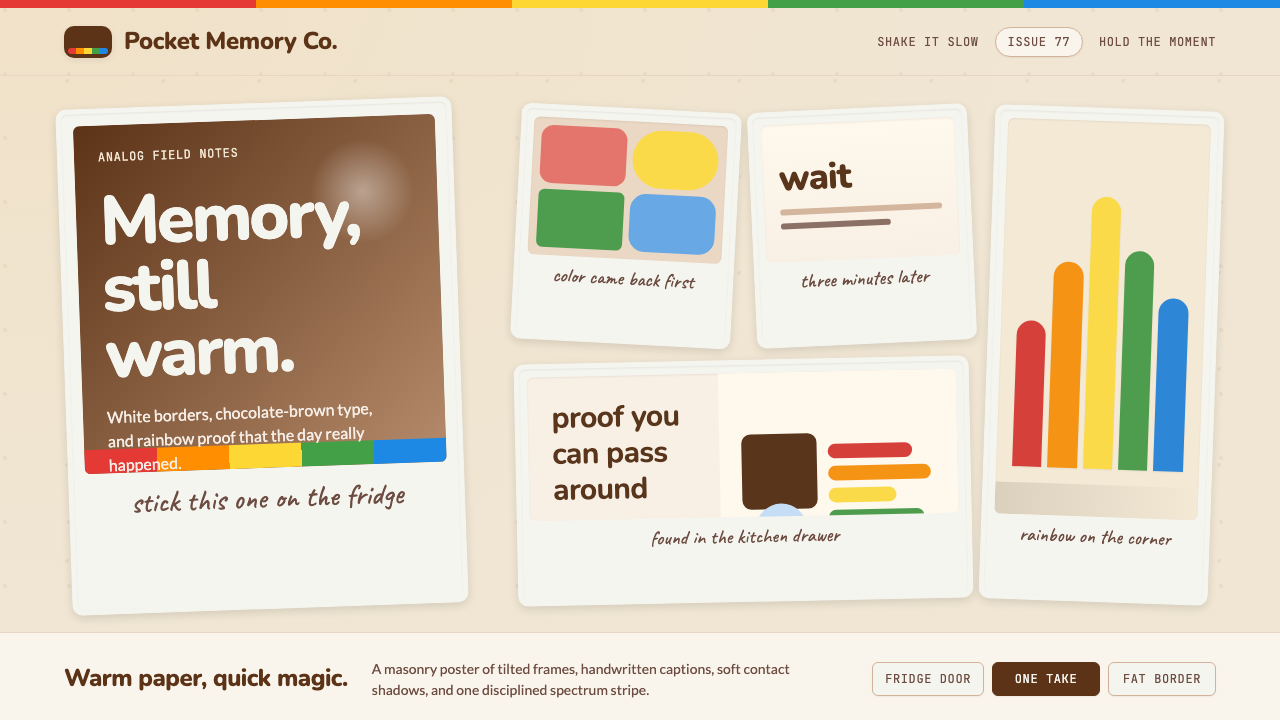 Polaroid InstantMemory made tangible. Photo-white frames tilt on aged paper with a warm rainb…
 Dominican Bachata & Perico RipiaoPlainspoken warmth. Kraft stock, red clay serif, and typewriter credits carry…
 Hershey's Chocolate Brown (1894)Plain, enduring, warm. Cocoa brown meets silver foil on cream paper.