What is Hershey's Chocolate Brown (1894)?
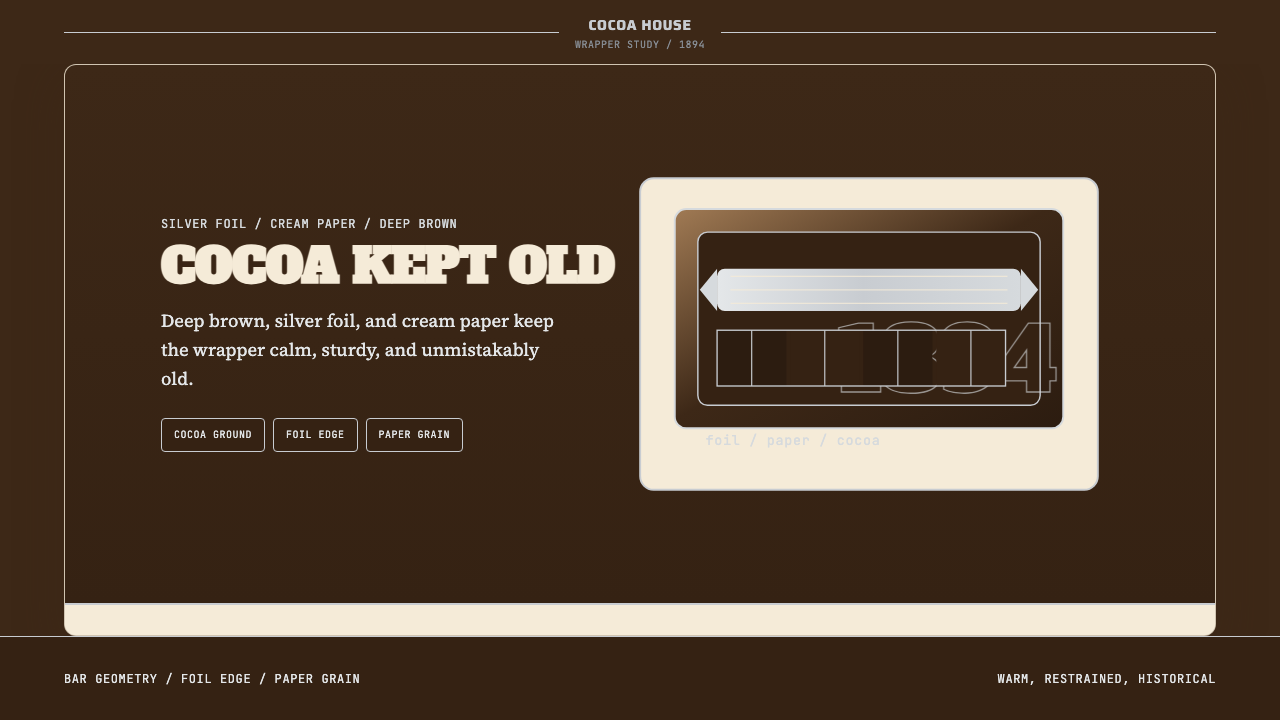
Since 1894, a single warm cocoa brown — paired with silver foil and cream paper — has made Hershey's the most recognizable chocolate brand in American history.
Hershey's Chocolate Brown (1894) in brief
Hershey's Chocolate Brown is the warm, slightly red-shifted cocoa tone that has anchored American milk chocolate packaging for well over a century. The visual identity pairs this deep, matte brown with silver-foil accents and cream-tinted paper surfaces, producing a palette that feels simultaneously rustic and refined — substantive without being luxurious, familiar without being cheap.
The design language is built on rectilinear geometry — the rectangular chocolate bar itself becomes the organizing metaphor — combined with condensed serif wordmarks that convey solidity and permanence. The iconic silver-wrapped Kiss silhouette adds a sculptural, three-dimensional counterpoint to an otherwise flat compositional system. Everything in the system is load-bearing: the brown signals authenticity and the earth, the silver signals care and craft, the cream signals wholesomeness.
What distinguishes this palette from generic 'chocolate brown' branding is its specific warmth and saturation. The tone is rich enough to feel indulgent yet matte enough to feel honest. It does not chase the glossy darkness of premium European chocolate branding, nor does it reach for the light, caramel warmth of artisan confections. It occupies a deliberate middle register — democratic, enduring, and distinctly American.

Where does Hershey's Chocolate Brown (1894) come from?
Milton Snavely Hershey did not begin as a chocolatier. He spent much of his early career failing at candy businesses in Philadelphia, New York, and Chicago before returning to his native Lancaster County, Pennsylvania, where he finally found commercial traction with caramels. In 1893, attending the World's Columbian Exposition in Chicago, Hershey encountered German chocolate-making machinery on display and became convinced that milk chocolate — then an expensive European luxury — could be manufactured at mass scale for ordinary American consumers. He sold his Lancaster Caramel Company in 1900 for one million dollars and turned the proceeds toward building a factory and a town.
The community Hershey built — literally named Hershey, Pennsylvania, incorporated in 1906 — was a company town in the most complete sense: streets named Cocoa Avenue and Chocolate Avenue, a trolley system, housing for workers, schools, a department store, and eventually an amusement park. The branding that emerged from this environment was inseparable from its geography. The visual system was not the product of a design agency or a deliberate brand strategy session; it grew organically from the materials and methods of the factory itself. Brown was the color of the product. Silver was the color of the foil that preserved it. Cream was the color of the paper that wrapped it.
The wordmark — with its condensed, high-contrast serif letterforms — reflected the commercial printing conventions of the late nineteenth century, when bold condensed type was the standard language of American trade cards, labels, and newspaper advertising. Hershey was not making an aesthetic statement so much as speaking the visual vernacular of his era. The durability of that vernacular choice is what became remarkable: most contemporaneous packaging aesthetics have been updated repeatedly, while Hershey's has remained essentially legible across more than a century of media change.
William F. R. Murrie, who served as president of Hershey Chocolate Company from 1908 to 1947, helped stabilize and institutionalize the brand during its critical growth decades. The Hershey Trust, established by Milton Hershey in 1909 to benefit the Milton Hershey School, became the controlling institutional entity whose conservatism reinforced brand continuity. Each generation of custodians faced market pressure to modernize the visual system and, in each generation, made only the minimum necessary adjustments — gradual refinements of proportion and printing technique without rupturing the core palette. The result is one of the longest unbroken runs of brand consistency in American consumer goods history.
What defines the Hershey's Chocolate Brown (1894) look?
Signature Brown
The defining tone is a deep, warm cocoa brown with a perceptible red undertone — neither the cool darkness of unsweetened baking chocolate nor the golden warmth of caramel. It reads as substantive and grounded in all lighting conditions, holding its character whether printed on matte paper, embossed on foil, or rendered on a backlit screen. The warmth is essential: it signals the actual sensory experience of milk chocolate, not an abstracted or aspirational version of it.
Silver Foil Accent
Silver is the system's contrast agent and its link to craft. Originally a functional material — the aluminum foil that kept milk chocolate fresh — the silver accent became an integral visual element that lifts the palette out of pure earthiness into something more considered. Where the brown is warm and opaque, the silver is cool and reflective, creating a complementary tension. In print and packaging, this relationship is physical; in digital or presentation work, a cool neutral or metallic tone carries the same structural role.
Cream Ground
Pure white is conspicuously absent from the authentic Hershey palette. The ground is consistently cream — slightly warm, slightly aged — which softens the contrast between brown and silver and gives the overall system an approachable, handcrafted quality. Cream also links the visual identity to the dairy origin of milk chocolate: the palette literally evokes cacao, foil, and fresh cream. This warmth distinguishes the system from colder, more clinical brand palettes.
Condensed Serif Wordmark
The lettering style is emphatically condensed — tall, narrow, and high-contrast in stroke weight — which gives the wordmark physical presence without requiring large point sizes. The serifs anchor each letter firmly to its baseline, conveying stability and a sense of institutional permanence. This is not the playful rounded lettering of modern snack branding, nor the geometric precision of contemporary wordmarks; it belongs to a tradition of American commercial signage and trade typography that reads as both historical and authoritative.
Rectilinear Block Geometry
The rectangular chocolate bar — segmented into a grid of identical blocks — is both product and compositional logic. Layouts derived from this system favor strong horizontal and vertical axes, clear contained sections, and deliberate use of repetition. There are no organic shapes, flowing curves, or decorative roundels; even the Kiss silhouette, though conical, is a precise geometric form. The geometry communicates consistency, precision, and the reassurance that what you see is exactly what you get.
Restrained Decoration
The system is not undecorated — there are rules, borders, and embellishments that frame the wordmark — but every decorative element is subordinate and modest. Borders are thin and rectilinear; no flourishes escape the discipline of the overall system. This restraint is historically grounded: late nineteenth-century commercial printing conventions demanded that labels be legible at small scale and reproducible on industrial presses with limited colors. The resulting economy became a virtue that the brand has never abandoned.
Cross-Media Stability
One of the system's remarkable properties is how well it migrates across radically different media. The same palette that reads as warm and trustworthy on a foil-wrapped candy bar also functions on a billboard, a television commercial, a digital banner, a glass storefront, and a slide deck. The depth of the brown provides enough contrast on both light and dark backgrounds; the silver accent adapts from physical metallic surfaces to digital highlights without losing its relational logic. This media-agnosticism was not designed in — it was an accidental property of choosing materials honestly.

Who shaped Hershey's Chocolate Brown (1894)?
Milton Hershey (1857–1945) is the origin point of the entire visual system, not because he was a designer but because he made the foundational material decisions — brown foil over cream paper — that became the brand. His instinct was practical rather than aesthetic: he used what the factory produced and what the market supplied. That practicality, applied consistently over decades, created one of the most durable brand identities in American commercial history. His philanthropic vision — the Milton Hershey School, funded by the Hershey Trust — also shaped the institutional conservatism that has kept the visual system intact across ownership changes and market pressures.
Murrie served as president of Hershey Chocolate Company from 1908 to 1947, stewarding the brand through two world wars, the Great Depression, and the company's dramatic expansion. His tenure corresponds precisely to the period in which the visual identity solidified from a provisional commercial label into an institutionalized brand standard. Murrie's son Bruce would later co-found M&M's with Forrest Mars — a fact that underscores how central the Hershey operation was to the entire landscape of American confectionery branding in the mid-twentieth century.
Established by Milton Hershey in 1909 to benefit the Milton Hershey School for orphaned and underprivileged children, the Hershey Trust has controlled a majority stake in the Hershey Company for over a century. As the ultimate governing body, it has consistently prioritized brand stability and long-term institutional integrity over short-term market trends. Each time professional marketers or outside consultants proposed aggressive visual modernization, the Trust's conservatism acted as a counterweight. This institutional structure — unusual in consumer goods — is a principal reason the brand's visual identity has survived essentially intact.
The standardization of Hershey's silver-foil-over-brown-paper wrapping in the early twentieth century involved a generation of anonymous production engineers and packaging suppliers whose decisions — about foil gauge, paper grade, and print color consistency — quietly fixed the palette in its final form. D. L. Miller and contemporaries in Hershey's manufacturing operations represent this often-overlooked dimension: brand identity is not only the product of designers but of material supply chains. The specific quality of Hershey's brown is partly a function of the inks and papers available to Pennsylvania commercial printers in the 1900s and 1910s.
Harry Burnett Reese, a former Hershey employee, founded the H. B. Reese Candy Company in 1923 and began marketing Reese's Peanut Butter Cups — eventually acquired by Hershey in 1963. The Reese's visual identity, while distinct in its use of orange, operates within the same warm-brown gravitational field established by the parent company. The relationship between the two palettes demonstrates how Hershey's core brown functions as a brand ecosystem anchor: sub-brands can introduce new accent colors while remaining tonally coherent with the master palette.
How do you use Hershey's Chocolate Brown (1894) today?
Hershey's Chocolate Brown is one of the most instructive historical palettes for designers working on brands, presentations, or editorial projects that need to communicate warmth, heritage, and democratic accessibility. Applying it correctly requires understanding what the system is actually doing: it uses deep warm brown as a structural anchor, silver as a precision accent, and cream as a breath-giving ground. The mistake most designers make is substituting pure white for cream — which immediately shifts the system from its characteristically warm, approachable register into something colder and more clinical.
For presentation decks, the palette works exceptionally well across cover, section divider, and content slides. A cover built from this system places the title in cream or silver type against a full-bleed brown field — bold, immediate, and visually warm. Section dividers can echo the chocolate-bar metaphor by using a grid of brown rectangles with one highlighted block to signal position. Content slides benefit from a cream or off-white ground with brown used only for headers and structural rules; silver or a desaturated warm tone serves supporting text. Data visualizations should follow the palette's hierarchy: primary series in brown, secondary in silver, tertiary in cream — creating charts that read as designed objects rather than software defaults.
For web dashboards and pricing pages, the Hershey palette maps well onto interfaces where trust, stability, and clarity are design priorities. A dashboard using this system keeps its background in cream or a very light warm neutral, uses deep brown for navigation elements and primary data labels, and reserves silver for metadata, secondary values, and borders. Pricing tiers benefit from the brown-to-silver range as a natural low-to-high or standard-to-premium signal. Interactive states — hover, selected, active — can shift the brown deeper or introduce a warm highlight, staying within the palette's tonal logic. Avoid the temptation to introduce pure white, cool gray, or blue-tinted neutrals, which immediately break the system's warmth.
For editorial and marketing materials, the palette supports a poster-like boldness that reflects its confectionery origins. Feature spreads work well with brown as a full-bleed section background, cream body text, and silver pull-quotes or subheadings. Marketing pages aimed at heritage positioning — anniversary campaigns, product-origin storytelling, institutional credibility — fit naturally within this system because the palette already reads as historical and authentic. The cream ground, in particular, carries connotations of aged paper and handcraft that modern pure-white backgrounds lack. Packaging mockups, editorial features, and brand history timelines are natural applications.
A common mistake when applying this palette is treating the brown as a neutral and building a full-saturation color system on top of it. Brown is not a neutral here — it is a primary actor, carrying emotional weight and brand authority. Introducing competing warm colors (orange, amber, gold at high saturation) fights with the brown rather than supporting it. A second common error is over-relying on silver as a decorative element; silver earns its place in this system through restraint. Use it for one or two elements per composition — a border, a headline, a key data point — and let brown do the majority of the structural work. When both errors are avoided, the palette rewards designers with a system that ages gracefully and reads as trustworthy across nearly every medium.

Hershey's Chocolate Brown (1894) — FAQ
Is Hershey's brown a seasonal or evergreen palette?
Evergreen, by design and by track record. The palette was never tied to a seasonal color trend and has never required a trend-driven refresh because it is anchored in product reality — the color of cacao — rather than fashion. This is precisely what makes it instructive for designers: a palette grounded in material truth tends to outlast palettes grounded in aesthetic fashions. The system does adapt seasonally through accent elements — red and green foil wrapping at Christmas, pastel foil for Easter — but the core brown remains constant and serves as the stable reference against which seasonal variations read.
How does this palette differ from premium chocolate branding like Lindt or Godiva?
Premium European chocolate brands typically use a darker, cooler brown — approaching near-black — combined with gold rather than silver, and pure white rather than cream. The gold-white-dark combination reads as luxurious and exclusive. Hershey's system uses a warmer, lighter brown, silver instead of gold, and cream instead of white — a combination that reads as dependable, familial, and democratic. The distinction is not merely tonal; it reflects genuinely different brand propositions. Applying Hershey's palette to a premium-positioning product will undercut the luxury signal; applying a premium palette to a mass-market product will feel aspirational in a way that alienates the core audience.
Can this palette work for a digital-native brand without any physical product?
Yes, but with deliberate intent. The palette's warmth and heritage associations are assets in digital contexts where most competitors default to cool, minimal, or hyper-saturated aesthetics. A fintech, legal, or institutional platform that reaches for warm brown and cream signals trustworthiness and longevity rather than novelty — which can be a meaningful differentiator. The key constraint is that the palette's heritage connotations need to serve the brand narrative: a startup positioning itself as 'the future of X' will find the historical warmth working against its messaging, while a platform emphasizing reliability, craft, or generational continuity will find it working with the message.
How do you handle dark-mode or inverted layouts with this palette?
The Hershey palette is a light-ground system — cream and warm paper are canonical. A full dark-mode inversion is possible but requires caution. On a very dark, near-black background, the core brown can lose its warmth and read as simply dark, reducing the palette to a near-monochrome. The most effective dark-mode adaptation maintains the cream and silver as foreground type and accent elements against a deep brown background — rather than against black. This keeps the palette's relational logic intact: brown is still the primary ground, cream is still the readable surface, silver is still the precision accent. Introducing true black as the background typically pushes the system out of its tonal register and into something more generic.
Why has the visual identity stayed so stable when most consumer brands refresh every decade?
Three factors account for the exceptional continuity. First, the palette is anchored in material reality rather than aesthetic fashion — brown, silver, and cream are what the product literally looks like, which means no trend cycle threatens their relevance. Second, the Hershey Trust's institutional conservatism has consistently prioritized brand heritage over marketing novelty; the Trust's century-long majority ownership is structurally unusual in consumer goods. Third, the palette achieved such broad cultural penetration — across generations and demographic groups — that the cost of change became effectively prohibitive. Hershey's brown is not just a brand color; it is part of the collective sensory memory of American childhood. That depth of association is almost impossible to rebuild if abandoned.
Related design styles
 Scout Merit BadgesEarned, not polished. Forest-green rings and khaki twill make every badge fee…
 Tobacco Curing BarnSlow heat turns leaf to gold. Amber and sienna glowing on dark timber, label-…
 Hong Kong Cha Chaan TengDemocratic diner warmth. Tram red, jade rules, cream menu cards, equal Canton…
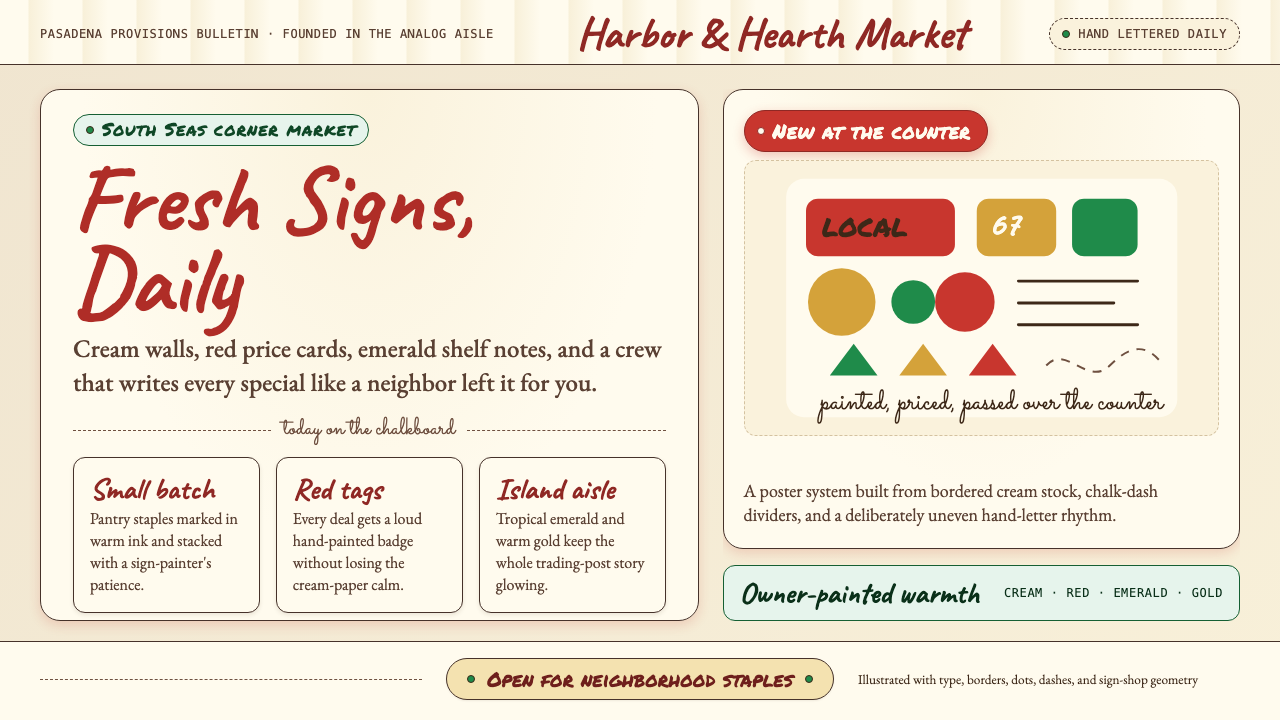 Trader Joe's Hand-LetteredHandmade grocery warmth. Cream chalkboards, red price tags, emerald accents.
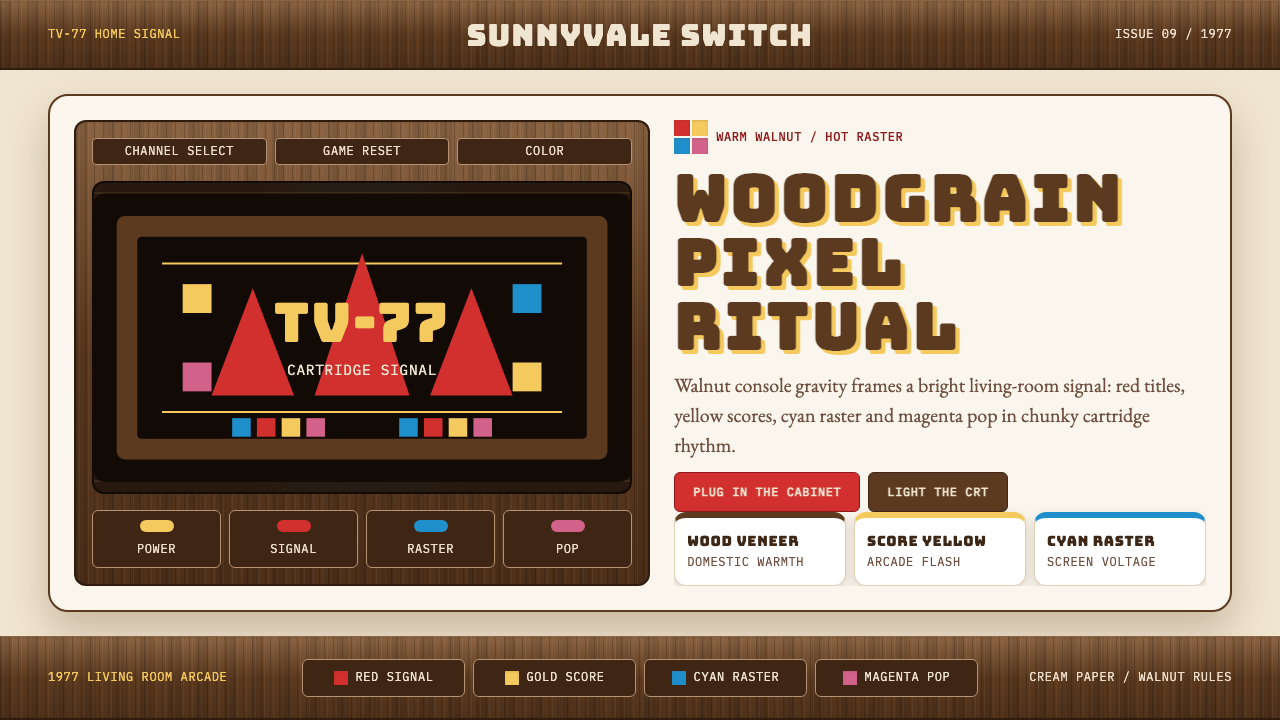 Atari 2600 (Woodgrain)Woodgrain meets raw pixels. Walnut panels frame Bungee type and CMYK raster b…
 Biplane AviationPioneer flight feels hand-built. Dark walnut, brass, stitched edges, and char…