What is Mid-Century Modern (Eames)?
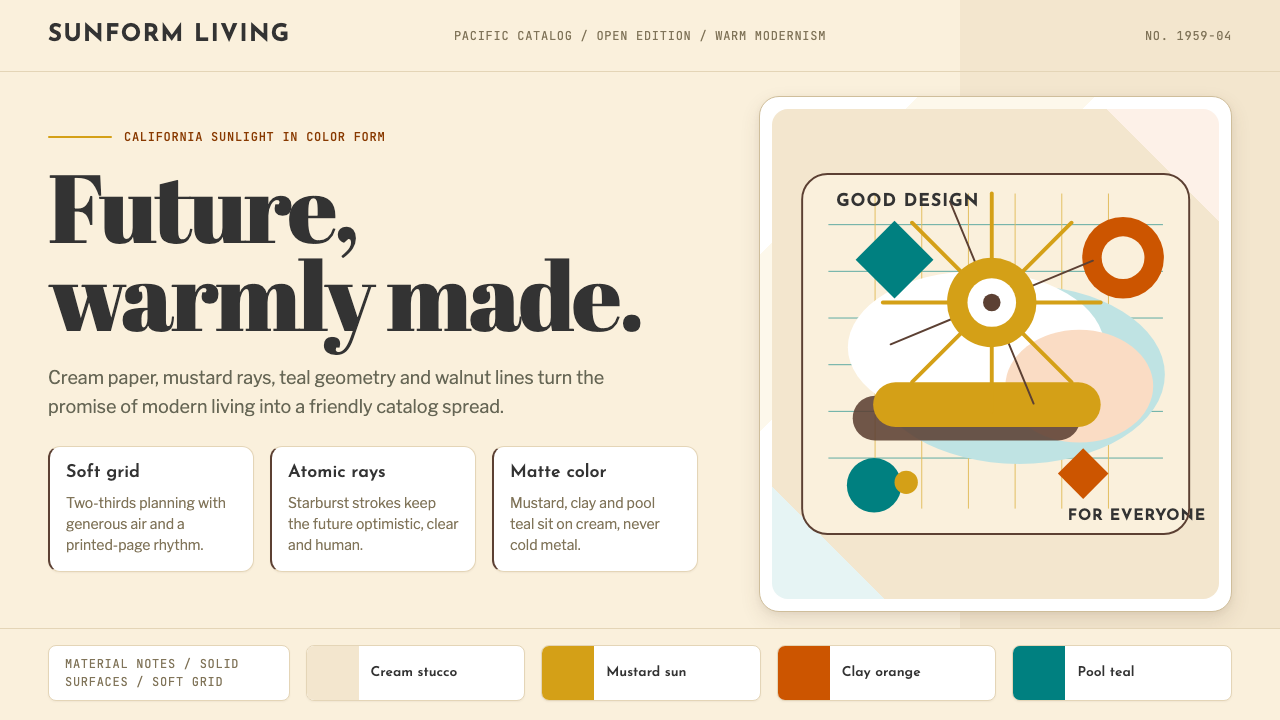
Mid-Century Modern is the conviction that good design belongs to everyone — warm wood, sunlit color, and atomic-age optimism shaped into chairs, posters, and a visual language that still feels like the future done right.
Mid-Century Modern (Eames) in brief
Mid-Century Modern is the American design movement of the 1950s and 1960s that fused European modernist principles with post-war optimism, industrial ingenuity, and a distinctly Californian warmth. Where the Bauhaus had stripped design to its coldest rational skeleton, Mid-Century Modern clothed that skeleton in organic curves, warm earth tones, and the genuine conviction that mass production could make well-designed things accessible to ordinary households.
The movement's visual vocabulary is built from apparent contradictions that somehow resolve. Furniture legs taper to fine points while seat shells billow into generous curves. Color palettes combine warm cream and mustard with cooler teal and olive — sunlight and shadow coexisting. Atomic-age starburst motifs and boomerang shapes reference science and space exploration, yet they are rendered in materials — molded plywood, spun fiberglass, bent aluminum — that feel tactile and approachable rather than industrial and cold.
As a design system, Mid-Century Modern excels at communicating friendliness without sacrificing sophistication. It is the rare historical style that manages to feel both confident and welcoming — neither the severity of Bauhaus nor the excess of Art Deco, but a third way that treats delight as a legitimate design goal alongside function.

Where does Mid-Century Modern (Eames) come from?
The roots of Mid-Century Modern lie in the interwar years, when European modernism — Bauhaus, De Stijl, the International Style — began emigrating to the United States as political conditions in Europe deteriorated. Architects and designers such as Walter Gropius, Mies van der Rohe, and László Moholy-Nagy brought the formal discipline of European modernism to American schools and studios. But the transplant did not reproduce unchanged. American culture, material abundance, and a native craft tradition tempered the European austerity into something warmer and more humanistic.
The decisive catalyst was the Second World War, which transformed American manufacturing. Military contracts drove investment in new materials — fiberglass, molded plywood, lightweight aluminum alloys — and new forming techniques developed for aircraft fuselages and military equipment. Charles and Ray Eames were among the designers who recognized that these wartime technologies could be redirected toward domestic furniture. Their molded plywood splints and stretchers for the Navy became the direct technological ancestors of the Eames molded plywood chairs produced from 1946 onward. The war had funded the tooling; the peace provided the market.
The institutional home of the movement was not a school but a competition. In 1948, the Museum of Modern Art in New York launched its International Competition for Low-Cost Furniture Design, which produced entries that defined the era's ambitions: seating that could be manufactured industrially, priced for middle-class households, and designed with the same formal care as fine art. The Eames Office, Herman Miller, and Knoll — the three organizational pillars of American mid-century design — built their most significant work in this period, each operating from the conviction that industrial production and good design were not in tension but were natural allies.
Geographically, the movement was centered in Los Angeles and New York, with significant production hubs in Grand Rapids, Michigan. The Case Study Houses program in California, sponsored by Arts and Architecture magazine from 1945 through 1966, commissioned modernist residential architecture from the leading designers of the era — including Charles and Ray Eames, whose own Pacific Palisades home became an iconic demonstration that prefabricated steel components could produce a space of extraordinary warmth and livability. This geographic and cultural context — California light, post-war prosperity, space-age optimism — gave the movement its characteristic tone, distinct from the more austere modernisms that had preceded it.
What defines the Mid-Century Modern (Eames) look?
Color Palette
The Mid-Century Modern palette draws from California sunlight and the American landscape: warm cream and off-white grounds, mustard yellow, burnt orange, olive green, teal, and a muted terracotta. These are not primaries deployed symbolically in the Bauhaus manner but naturalistic hues — the colors of sun-dried grass, sage, desert clay, and Pacific water. Black appears sparingly, typically confined to fine structural lines, type, or graphic accents. The overall effect is warmth without sweetness, confidence without coldness.
Organic Curves
Where Bauhaus geometry is angular and mathematically precise, Mid-Century Modern form is biomorphic — curves that mimic kidney shapes, leaf silhouettes, amoeba outlines, and the natural ergonomic contour of the seated human body. These curves are not arbitrary; they follow the logic of materials under stress (a fiberglass shell distributes load most efficiently through a compound curve) and the logic of the human form. In two-dimensional work, this translates to layouts where shapes breathe and edges soften, and where straight horizontal rules coexist with irregular organic blobs.
Atomic-Age Motifs
Starbursts, boomerangs, orbiting ellipses, snowflake crystals, and amoeba forms are the signature decorative vocabulary of the era, all drawing from atomic physics, space exploration, and molecular biology — the sciences that captured the postwar imagination. These motifs appear on wallpaper, textiles, ceramic surfaces, and in graphic work as background ornament or focal decorative elements. They carry optimism and scientific curiosity without technical literalism — a starburst clock is not a diagram of fission but a celebration of energy.
Warm Natural Materials
Walnut and teak wood — dark, fine-grained, with visible natural figuring — provide the movement's characteristic material warmth. In graphic and digital contexts, this translates to wood-grain textures used as background accents, warm brown tones that suggest natural surfaces, and a general preference for matte over glossy finishes. The material vocabulary extends to natural fibers, woven textures, and the slightly imperfect surfaces of hand-craft — all of which signal authenticity and human presence in contrast to the purely industrial.
Restrained Playfulness
Mid-Century Modern permits decorative pleasure in a way Bauhaus strictly forbids, but that pleasure is always disciplined. Pattern and ornament appear as considered graphic decisions — Alexander Girard's textiles are exuberant but formally tight, each motif rendered in clear flat color with precise edges. The style does not chase whimsy for its own sake; it uses pattern, color variety, and organic form to create warmth and human connection while maintaining an overall compositional coherence that keeps the work from tipping into decoration without structure.
Typographic Friendliness
Mid-Century Modern typography leans toward humanist sans-serif and slab-serif letterforms — faces with slightly irregular optical corrections, moderate stroke contrast, and the suggestion of a hand behind the drawing. This is a meaningful distinction from Bauhaus geometric sans-serifs, which are mechanically constructed and deliberately impersonal. The Mid-Century typographic register is legible, confident, and approachable — optimized for the American magazine page, the advertising spread, and the trade show exhibition panel, all of which needed to capture attention while remaining welcoming.
Compositional Balance Through Asymmetry
Like Bauhaus, Mid-Century Modern avoids rigid bilateral symmetry, but its asymmetric balance is softer and more intuitive — achieved through the interplay of organic shapes, color weight, and directional flow rather than through strict mathematical tension. A composition might anchor a bold typographic block in one corner, balance it with a floating starburst motif in the opposite zone, and connect the two through a field of warm ground color. The result feels naturally balanced rather than calculated, which is the style's compositional signature.

Who shaped Mid-Century Modern (Eames)?
Charles Eames (1907–1978) and Ray Kaiser Eames (1912–1988) formed one of the most productive design partnerships of the twentieth century, working from their Venice, California studio from 1941 onward. Their experiments with molded plywood — initially funded by the Navy's need for lightweight splints and stretchers — produced a body of seating that remains in continuous production today. Beyond furniture, the Eames Office produced films, exhibitions, toys, and graphic work that established the visual grammar of American mid-century design. Their 1977 film Powers of Ten, a meditation on scale from the galactic to the subatomic, exemplifies the breadth of a practice that understood design as a way of seeing the world.
George Nelson (1908–1986) served as design director of Herman Miller from 1945 to 1972, and in that role shaped the company's identity as the preeminent American design brand of the era. His own design contributions — the Marshmallow sofa, the Ball clock, the Bubble lamp series — became defining icons of the movement's playful-yet-rigorous character. Nelson was equally significant as a talent recruiter and intellectual catalyst: he was instrumental in bringing Charles Eames and Alexander Girard to Herman Miller, effectively assembling the team that made the company's mid-century output so remarkable.
Alexander Girard (1907–1993) served as director of the Herman Miller Textile Division from 1952 and, in that capacity, designed over three hundred fabric and wallcovering patterns that became the color and surface dimension of Mid-Century Modern interiors. Where furniture designers worked in three dimensions and graphic designers in two, Girard operated in the dimension of pattern and color field, producing bold, flat, folklorically influenced textiles that brought warmth and visual richness to modernist interiors without reintroducing historicist decoration. His 1961 La Fonda del Sol restaurant commission in New York integrated graphic design, interior design, and textile design into a total environment — a vision that anticipates much of what contemporary brand design aspires to.
Eero Saarinen (1910–1961), the Finnish-American architect and designer, pursued the elimination of what he called 'the slum of legs' — the visual clutter created by four-legged furniture on a floor. His response was the Tulip chair and table (1955–1956), produced for Knoll, in which a single pedestal base supports a generous curved shell. The sculptural clarity of the Tulip series — one continuous form, no joint exposed — represents the movement's aspiration to integrate engineering and aesthetics into an inseparable whole. Saarinen's architectural projects, including the TWA Flight Center at JFK and the Gateway Arch in St. Louis, extended the same biomorphic formalism to the scale of public infrastructure.
Florence Knoll (1917–2019) was the architectural backbone of Knoll Associates and the figure most responsible for bringing Mid-Century Modern design into the American corporate office. As head of the Knoll Planning Unit, she developed the concept of total interior design — treating a workplace as a single designed environment in which furniture, surface, lighting, and graphic identity were integrated rather than assembled from separate catalogs. Her own furniture designs are characteristically rectilinear and architecturally rigorous, providing the structural counterpoint to the more sculptural work of Saarinen and others in the Knoll stable. She is also credited with establishing the model of the design firm as a curator-editor, selecting and commissioning work from leading designers rather than producing everything internally.
How do you use Mid-Century Modern (Eames) today?
Mid-Century Modern translates with unusual naturalness into contemporary digital and print design, because its core principles — organic warmth, optimistic color, disciplined composition — remain visually fresh without requiring literal period reproduction. The key is understanding that this is not a nostalgic style but an optimistic one: applying it should make work feel welcoming and confident, never retro for its own sake.
For presentation slides, the style excels at both cover and content work. A cover benefits from the bold compositional approach: position a large organic shape or starburst motif in warm mustard or teal against a cream ground, with the title in a sturdy humanist sans-serif at generous scale. Content slides should use the palette's warmth to differentiate sections — section breaks marked with a color band rather than a thin rule, callout boxes tinted in a muted mid-century hue. Data slides come alive when charts are treated as graphic objects: bars and segments colored in the warm palette, with generous whitespace around them so the data reads as information, not noise.
For web interfaces, Mid-Century Modern suits dashboards, pricing pages, and brand marketing sites where friendliness and confidence are both required. Structure the page on a clean grid with a cream or warm off-white background; use walnut-toned brown or dark olive for typographic hierarchy rather than defaulting to pure black. Reserve the brighter hues — mustard, teal, burnt orange — for interactive states, featured pricing tiers, and calls to action. Card components work well with a slight warm tint and a subtle offset shadow rather than the stark hard-edged shadow of Bauhaus work. Navigation should feel typographic and spacious, with room for each element to be itself.
For editorial and marketing applications, the style supports rich visual storytelling. A Mid-Century editorial spread works with large organic shapes as section dividers, period-appropriate geometric texture patterns as background elements in feature boxes, and pull quotes set in a warm accent color at expressive scale. Marketing pages benefit from the contrast between cream and dark sections — alternating between a warm ground with dark type and a deep teal or charcoal ground with cream type — with starburst or boomerang graphic accents appearing at key transitions to add visual energy without breaking the compositional order.
The most common mistake when applying Mid-Century Modern is mistaking warmth for sweetness and over-saturating the palette. Authentic mid-century color is sophisticated — mustard is never neon yellow, teal is never turquoise, and cream is never white. A second common error is decorating without composing: placing starburst motifs and atomic age ornaments as fill rather than as purposeful compositional anchors. Every decorative element should occupy a specific structural role in the layout. A third mistake is mixing too many hues simultaneously — the palette offers many colors, but successful work typically selects two or three for any single composition and treats the rest as background texture.

Mid-Century Modern (Eames) — FAQ
How does Mid-Century Modern differ from Bauhaus?
Both movements share a commitment to functional design and the elimination of gratuitous ornament, but their emotional registers are opposite. Bauhaus is severe, rational, and rooted in the idea that beauty and function are identical — decoration that serves no structural purpose should not exist. Mid-Century Modern treats delight as a legitimate design goal in its own right. Organic curves, warm color, and playful motifs are not decoration for the sake of decoration but are understood as genuine functional contributions to human comfort and emotional wellbeing. Bauhaus design makes you feel that everything unnecessary has been removed; mid-century design makes you feel welcomed.
Can Mid-Century Modern work in dark-mode or dark-background layouts?
It can, but the inversion requires care. The style's characteristic warmth comes largely from its cream and warm-white grounds, which the palette is calibrated against. On a dark background — deep charcoal, very dark teal, or near-black — the warm hues need to be shifted slightly to maintain their character: mustard can remain, but it should be treated as a single accent rather than a dominant field; teal works well as a mid-tone accent. The key risk in dark inversion is that the organic shapes and starburst motifs, which have a sunny quality on light grounds, can feel ominous on very dark backgrounds. A dark mid-century palette works best when it commits to warmth in the dark — using a dark warm brown or very dark olive as the ground rather than a neutral black.
Is Mid-Century Modern appropriate for data-heavy technical products?
Yes, more than its reputation might suggest. The style's organic warmth and non-threatening color palette make it an effective antidote to the cold, sterile aesthetic that data tools often adopt by default. A dashboard built in mid-century palette — cream ground, warm brown type hierarchy, teal and mustard as data category colors — reads as authoritative without being intimidating. The key is not to fight the data with decoration: keep the chart areas clean and spare, use the decorative vocabulary (starburst, organic shapes) only in empty states, headers, and section breaks, never inside the data visualization itself. The style handles moderate data density well; for extremely dense analytical interfaces, a cleaner, more neutral approach may serve better.
What makes a Mid-Century Modern application look authentic versus kitsch?
The line between authentic and kitsch in mid-century work comes down to compositional discipline versus decorative accumulation. Kitsch mid-century piles up starbursts, atomic motifs, and warm colors until every surface is covered — the equivalent of a restaurant that has used all the props from the era without understanding the underlying formal logic. Authentic mid-century work is selective: one or two signature motifs, deployed at specific structural roles in the composition, against grounds that have room to breathe. The other test is color sophistication: if the mustard reads as yellow, the cream reads as white, and the teal reads as turquoise, the palette has been pushed too far toward modern bright versions of the hues. True mid-century color is muted and sun-aged, not fresh off the color wheel.
Which contemporary industries and product types are best suited to Mid-Century Modern?
The style is particularly well-suited to lifestyle brands, home and furniture retail, boutique hospitality (hotels, cafes, co-working spaces), premium food and beverage products, and creative professional services (architecture firms, interior design studios, editorial agencies). It also works for technology companies that want to project warmth and approachability alongside competence — the style signals that the company values human experience, not just efficiency. It struggles where cold precision is the desired signal: high-frequency trading platforms, medical device interfaces, aerospace and defense documentation. The simplest test is to ask whether the product's core promise is warmth, craftsmanship, or optimism — if yes, mid-century is a natural fit; if the promise is clinical precision or raw power, look elsewhere.
Related design styles
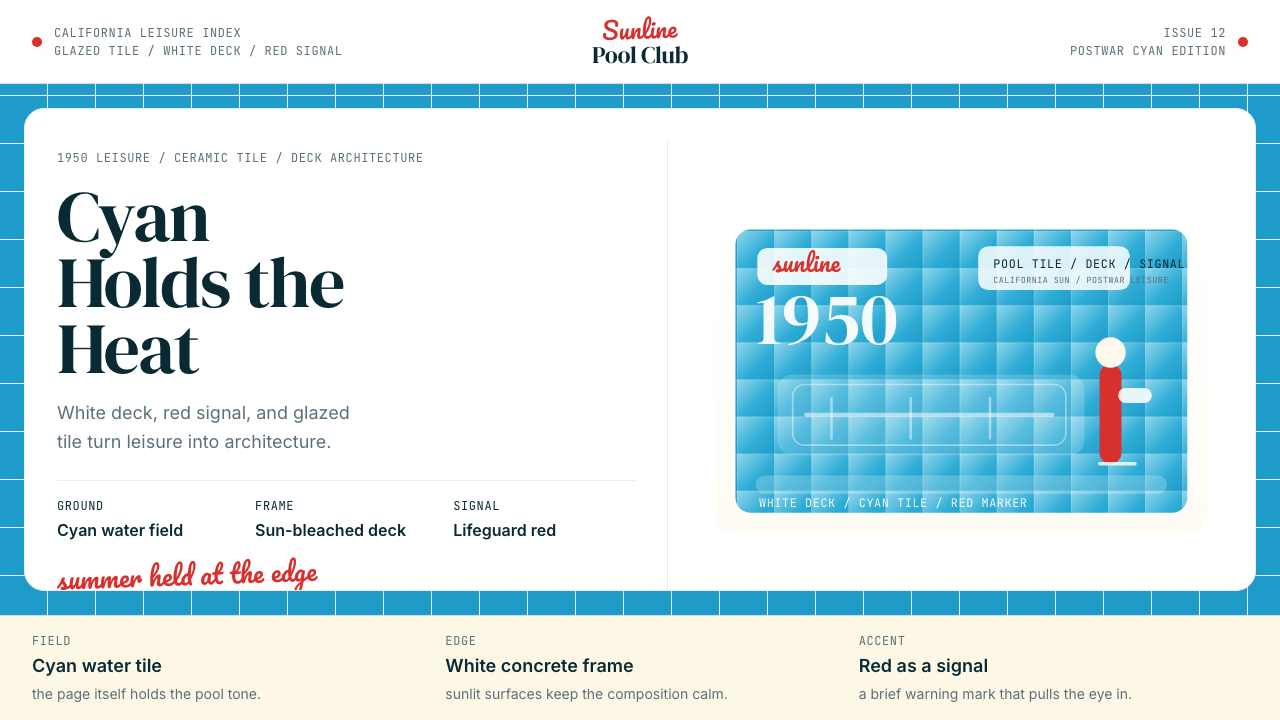 Swimming Pool Vintage Cyan Tile (1950)Leisure turned architectural. Cyan tile, white deck, and red accents set the…
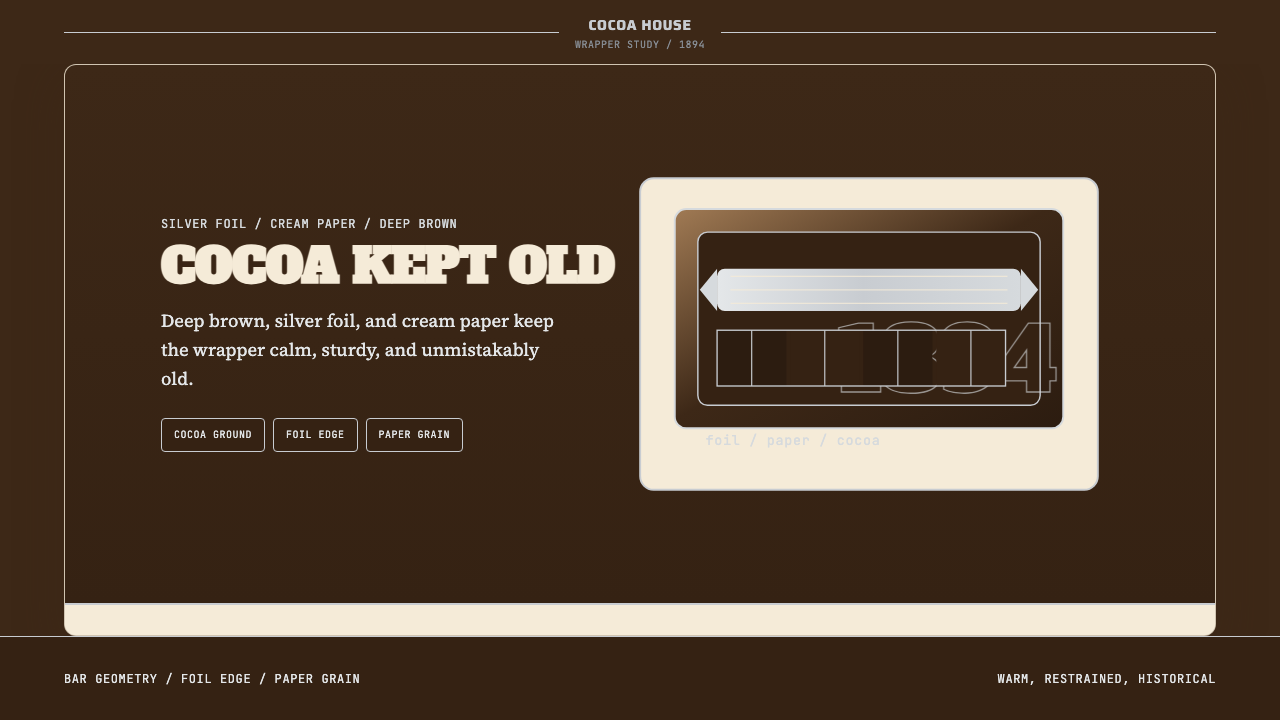 Hershey's Chocolate Brown (1894)Plain, enduring, warm. Cocoa brown meets silver foil on cream paper.
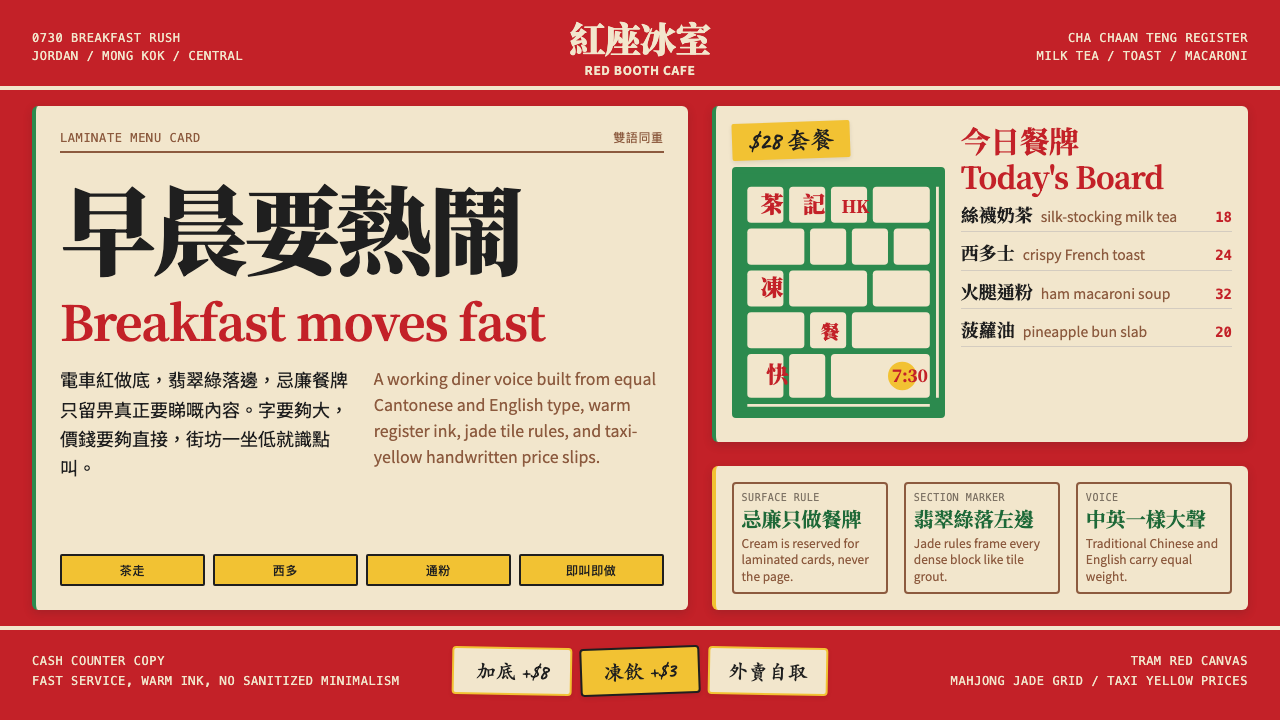 Hong Kong Cha Chaan TengDemocratic diner warmth. Tram red, jade rules, cream menu cards, equal Canton…
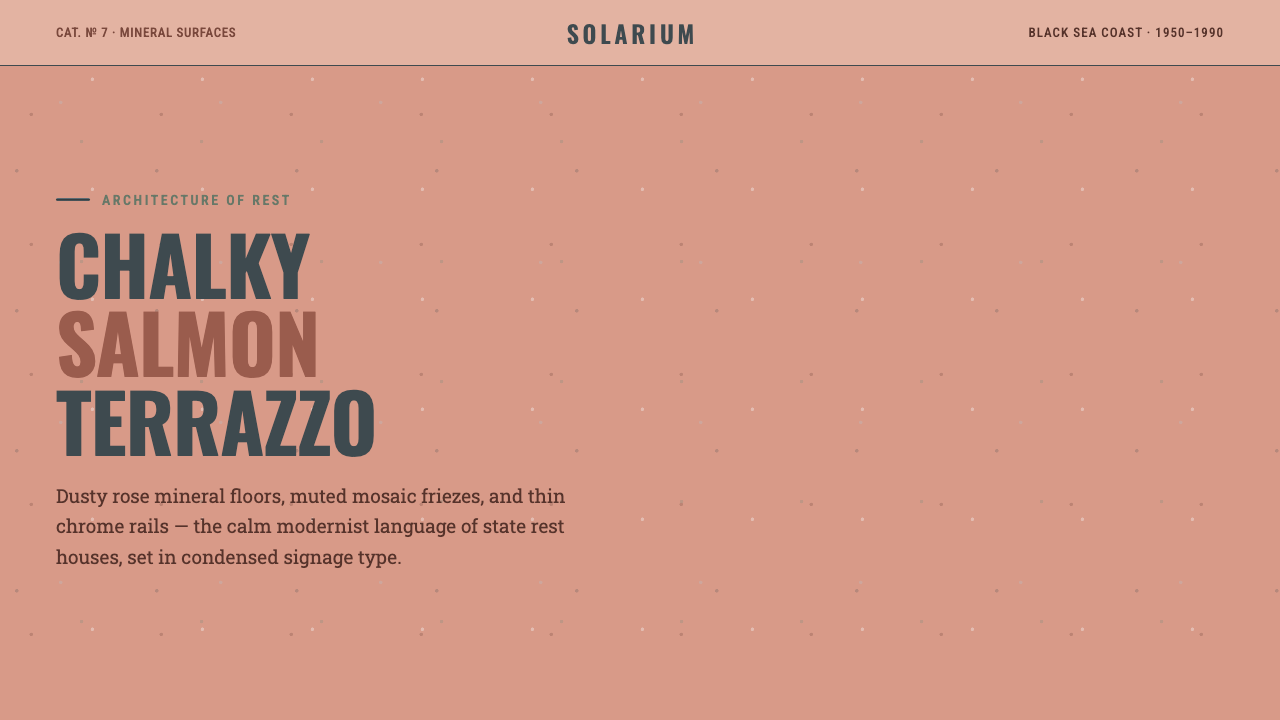 Soviet Sanatorium PinkState calm in stone. Salmon terrazzo, condensed signage, and chrome rails for…
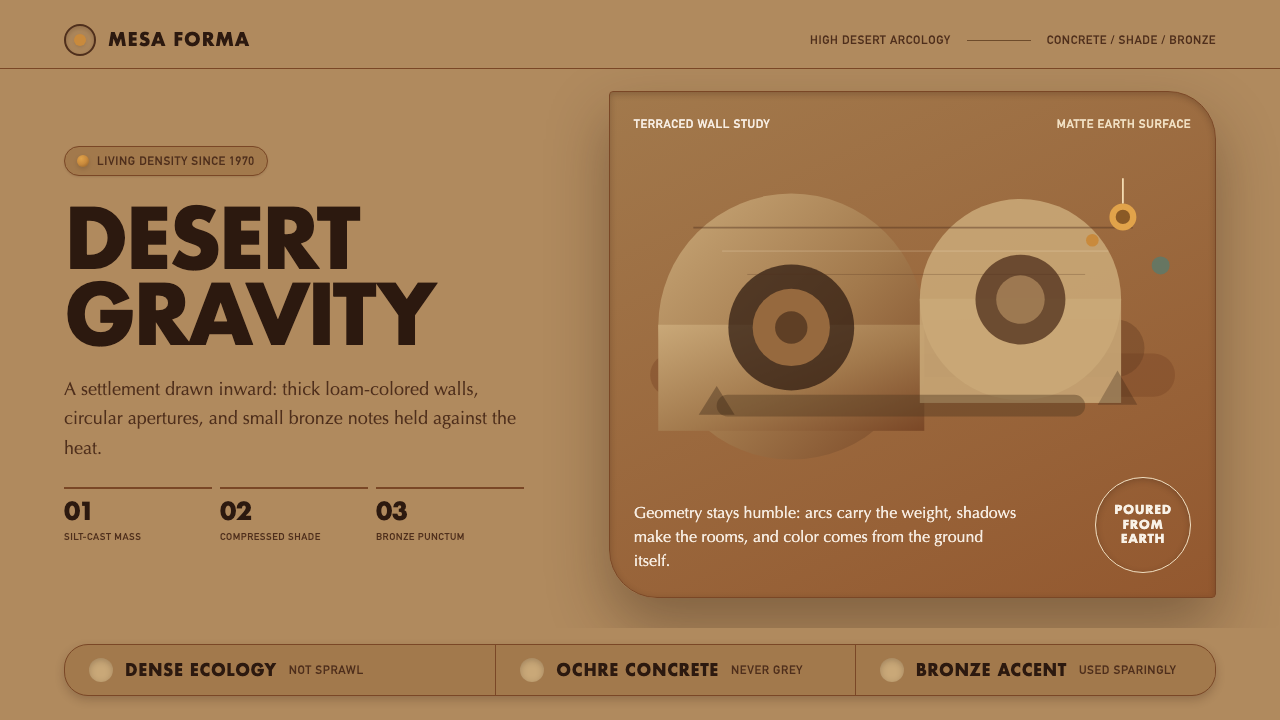 Arcosanti ArcologyArchitecture becomes desert. Ochre concrete, circular apertures, and bronze a…
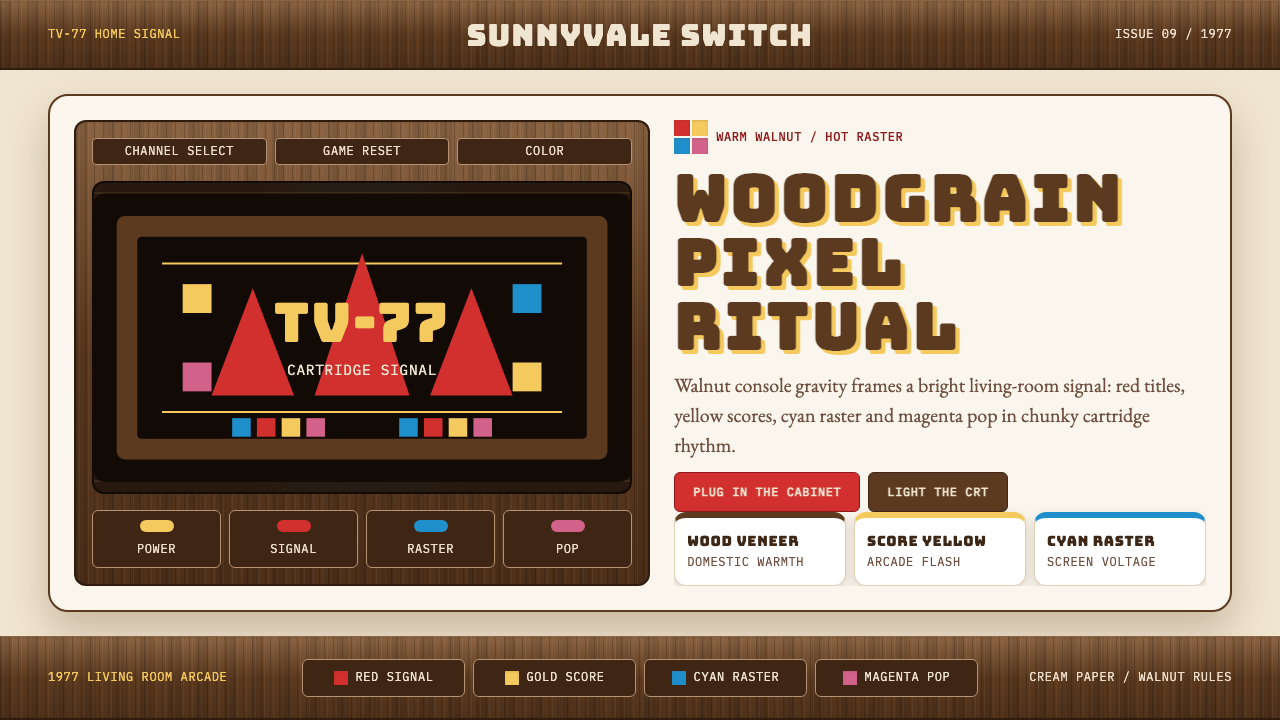 Atari 2600 (Woodgrain)Woodgrain meets raw pixels. Walnut panels frame Bungee type and CMYK raster b…