What is Swimming Pool Vintage Cyan Tile (1950)?
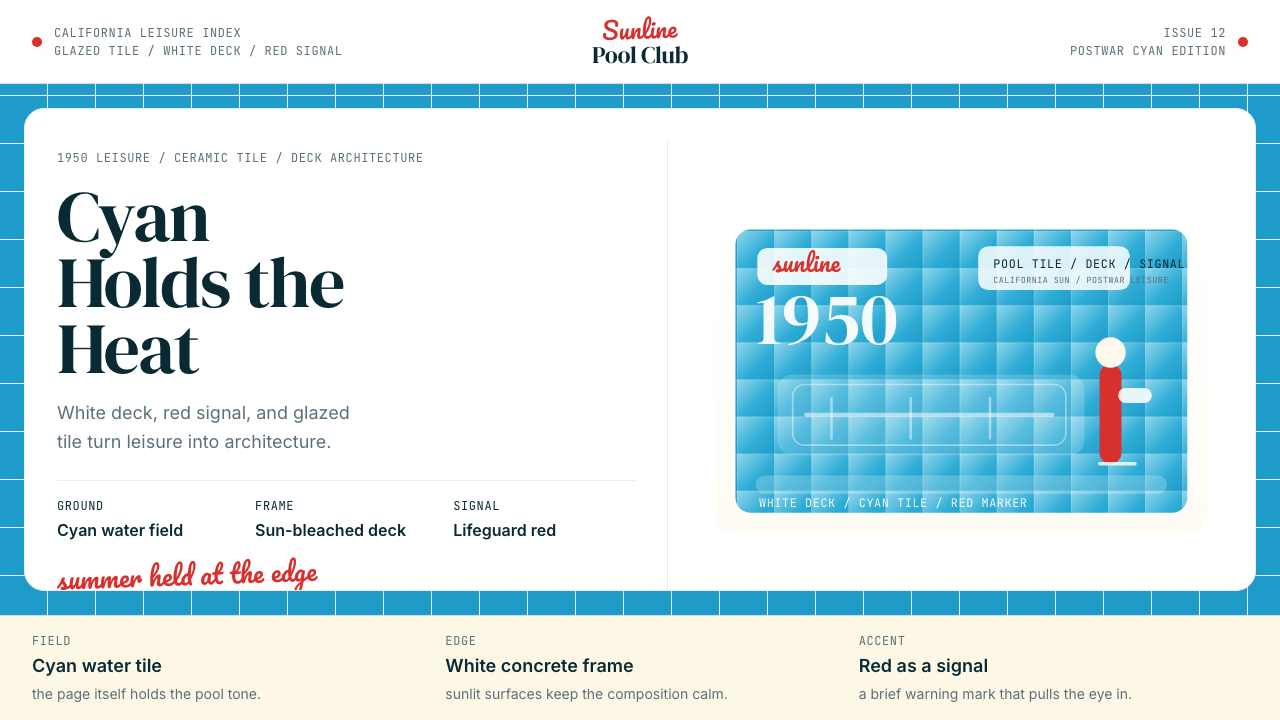
Chlorine and California sun — the postwar American swimming pool turned glazed cyan tile, white concrete, and a splash of lifeguard red into one of the twentieth century's most joyful visual identities.
Swimming Pool Vintage Cyan Tile (1950) in brief
Swimming Pool Vintage Cyan Tile (1950) is a mid-century American aesthetic grounded in the architecture and leisure culture of the postwar swimming pool. Its palette — a specific aqueous turquoise ceramic tile, white sun-bleached concrete, warm cream towel tones, and an attention-commanding lifeguard red — is drawn directly from the physical environment of Southern California resort pools, Miami beach clubs, and MGM Hollywood water-spectacle productions of the 1950s.
The visual system works through environmental association. Every color carries the memory of a surface: cyan is the shimmer of chlorinated water seen through ceramic glaze, white is the poolside deck radiating midday heat, cream is the canvas of stacked sun towels and painted metal furniture, and red is the painted lifeguard chair or the striped canvas umbrella that says 'stop and notice.' Typography in this tradition mixes the clean geometric sans-serif of poolside safety signage with the loose romantic script of cocktail menus and resort marquees.
What distinguishes this style from generic mid-century pastiche is its chromatic specificity. The cyan is not simply turquoise or teal — it is the precise hue of a glazed pool tile under direct sunlight, a tone that reads simultaneously as water, coolness, and architectural material. Combined with the warmth of cream and the high-contrast punch of red, the palette achieves a thermal balance: cool and inviting at its foundation, warm and comfortable in its secondary tones, urgent and directional in its accents.

See the Swimming Pool Vintage Cyan Tile (1950) design system
Where does Swimming Pool Vintage Cyan Tile (1950) come from?
The swimming pool entered American popular culture as a domestic luxury in the 1920s, but it was the postwar economic boom of the late 1940s and 1950s that democratized it — at least among the expanding middle class of California, Florida, and the Sun Belt. By 1950, the backyard pool had become an attainable symbol of suburban success, and the resort pool had become the backdrop for a new leisured self-image that was specifically, insistently American. The construction methods of this era standardized a distinctive material vocabulary: white Portland cement for decks and coping, and the glazed ceramic tile — predominantly in shades of aqua, cyan, and turquoise — that lined pool interiors and waterlines across the country.
The visual archive of this aesthetic was built largely by a small number of photographers and filmmakers. Slim Aarons, who spent decades documenting the leisure class at their Palm Springs estates and Beverly Hills pools, created images so saturated with California light and cyan water that they defined how the postwar pool looked in cultural memory. His work — shot on assignment for publications including Holiday magazine — established Palm Springs Desert Modern architecture, with its flat roofs, glass walls, and kidney-shaped pools, as the spiritual home of the style. The actresses, socialites, and industrialists he photographed at poolside gave the aesthetic its aspirational register.
Esther Williams brought the aesthetic from architecture into mass popular culture through her MGM water-ballet films of the late 1940s and 1950s. Productions such as 'Bathing Beauty' (1944), 'Neptune's Daughter' (1949), and 'Million Dollar Mermaid' (1952) staged elaborate aquatic spectacles in which the pool was not a backdrop but the primary set — its cyan water, white tile edges, and theatrical red-and-cream costumes composing frames that tens of millions of cinema audiences absorbed as images of glamour and leisure. Williams's productions effectively broadcast the pool aesthetic from California to every American city that had a movie theater.
The architects who designed the physical pools during this period gave the style its material foundation. Albert Frey, the Swiss-trained modernist who settled in Palm Springs and became one of the defining voices of Desert Modern, integrated pools into residential architecture in ways that made the cyan tile surface a deliberate compositional element — reflecting sky, extending interior color palettes, and creating a dialogue between the built and the natural desert landscape. Donald Wexler, another Palm Springs architect, brought industrial prefabrication methods to residential construction and designed pools whose clean lines and precise material choices distilled the style to its essentials. Their buildings and pools — widely photographed from the 1950s onward — established the architectural grammar that the style still references.
What defines the Swimming Pool Vintage Cyan Tile (1950) look?
Color Palette
The palette is built around four functionally distinct tones. The dominant aqueous cyan — the color of glazed pool tile seen under direct sunlight — serves as the primary ground and the system's most recognizable signal. White, clean and slightly sun-bleached, provides the content frame and creates the high-contrast legibility that the style depends on. Cream and warm sand tones act as a thermal counterweight, softening the cool intensity of the cyan and adding the sensory warmth of canvas and painted metal. Lifeguard red appears as the accent: saturated, directional, and used sparingly to signal priority or draw the eye to a single focal point.
Typography
The typographic system is a deliberate counterpoint between two period-specific modes. Clean, round-cornered geometric sans-serif type — the kind used for poolside safety notices, lane markers, and institutional signage — handles all hierarchy-critical information. Against this, a loose, slightly bouncy script lettering — evoking hand-painted cocktail menus, resort marquees, and motel signage of the era — provides warmth, nostalgia, and a distinctly mid-century leisure register. The two voices do not compete; the script appears at display scale for names and headlines while the sans handles navigation and body. Letterforms are open and friendly, never compressed or stressed.
Pattern and Texture
Grid-based tile patterns — the most literal reference to the ceramic pool interior — appear as a structural background texture or as a framing device for section breaks and data panels. The tile grid is geometric and regular but not rigid: slight variations in the weight of grout lines or the tonal shimmer between adjacent tiles give it an organic, hand-crafted quality that distinguishes it from pure digital geometry. Water caustic patterns — the rippling light lattices that form on pool floors — appear as secondary decorative overlays, applied at low opacity to suggest depth and movement without obscuring content.
Surface Quality
Materials in this aesthetic read as slightly tactile and period-specific, not digitally smooth. The glazed tile surface implies a very subtle reflective quality — not a high-gloss mirror, but the soft sheen of ceramic under poolside diffused light. Card and panel components carry this same restrained luminosity: surfaces look slightly warmed, as if by afternoon sun, rather than lit from within by a screen. Shadows, where they appear, have a hard architectural edge — the shadow of a concrete overhang rather than a dropped web element — and are warm in tone rather than cool grey.
Imagery and Illustration
Photographic references draw from the Slim Aarons tradition: overhead or oblique aerial views of pools, close crops of tile and water, sun-bright scenes with dense shadows. When photography is used, it is treated with slight tonal warming and an elevated contrast that echoes the quality of Kodachrome film stock — the dominant photographic medium of the era. Illustrative elements are drawn from the mid-century graphic vocabulary: stylized figures derived from poolside safety silhouettes, wave forms simplified to two or three clean curves, and sun motifs reduced to radial line patterns. Realism is never the goal; the reference is always the graphic reduction of the era, not photographic documentation.
Spatial Composition
Layouts lean into the rectangular geometry of the pool itself. Wide horizontal bands — echoing the horizontal datum of water, deck, and building fascia — provide the primary organizing structure. Content is divided into clearly edged zones rather than blended regions, and generous clear space around elements evokes the open concrete deck surrounding the pool. The horizontal emphasis does not preclude verticality; tall typographic moments and portrait-oriented images create the depth and visual rhythm of pool lane markers seen from above. There is no ambiguity about where one zone ends and another begins.
Accent and Hierarchy
Hierarchy in this system is established through a combination of color temperature contrast and scale, rather than through multiple competing accent colors. The warm-cool tension between the cyan ground and cream secondary panels naturally stratifies content into background and foreground. Red appears at most once or twice in any given layout — it is too visually forceful to appear repeatedly without eroding its urgency. Headlines are large enough to be readable from a distance, consistent with the tradition of outdoor poolside signage. Body text sits comfortably at reading size, with line spacing open enough to suggest unhurried resort leisure rather than information density.

See the Swimming Pool Vintage Cyan Tile (1950) design system
Who shaped Swimming Pool Vintage Cyan Tile (1950)?
Philadelphia-born photographer Slim Aarons (1916–2006) spent the postwar decades documenting the leisure class at their most photogenic — Palm Springs estates, Beverly Hills pools, European villas. His signature work captured the specific chromatic world that defines this style: cyan tile water against bleached concrete, bright towels against painted metal, and the particular quality of California light in the late afternoon. Images from his Holiday magazine assignments became the defining visual archive of postwar American poolside culture, and the palette and compositional sensibility of his photographs remain the most direct source material for anyone working in this aesthetic.
Esther Williams (1921–2013) was an MGM star whose synchronized swimming spectacles of the late 1940s and 1950s defined the cinema version of this aesthetic for mass audiences. Productions filmed on the MGM lot in Hollywood — and at location pools across California and Florida — composed elaborate frames in which cyan water, white tile edges, cream costumes, and red accents appeared as deliberate design choices rather than incidental environmental color. Her films broadcast these visual proportions to every American movie audience, cementing the palette in collective cultural memory as the standard register of leisure, glamour, and postwar optimism.
Albert Frey (1903–1998), the Swiss-born modernist architect who settled permanently in Palm Springs in 1939, became the most important architect of Desert Modern residential design. His pools were not afterthoughts attached to buildings but integral compositional elements — the cyan tile water surface extending the color language of his interiors outward into the desert landscape, the pool deck treated as an outdoor room with as much care as any interior space. Frey's integration of pool, architecture, and landscape established the physical grammar that photographers like Slim Aarons then documented, creating the feedback loop through which the style's visual vocabulary was consolidated and broadcast.
Donald Wexler (1926–2015) brought industrial precision and mid-century optimism to Palm Springs residential architecture, designing houses and pools that paired prefabricated steel construction with the characteristic Desert Modern palette. His work for the Alexander Construction Company in the late 1950s produced many of the most photographed domestic pools of the era — clean rectangular pools with precise tile work, surrounded by the white and cream surfaces and aluminum accents that became emblematic of the style. Wexler's approach demonstrated that the aesthetic was not a luxury reserved for high-budget custom commissions but could be achieved through systematic, production-oriented thinking.
Architectural photographer Julius Shulman (1910–2009) created the canonical photographic record of California mid-century modern architecture, and his images of poolside residences in Palm Springs, Los Angeles, and surrounding areas established the standard compositional conventions through which the style is recognized today. Shulman's technique — shooting in the golden hour, using reflections in pool surfaces to double the architecture, composing human figures as scale indicators within the larger geometric order — transformed functional documentation into aspirational imagery. His photographs defined not just how the buildings looked but how the entire lifestyle they represented was to be seen and desired.
How do you use Swimming Pool Vintage Cyan Tile (1950) today?
Swimming Pool Vintage Cyan Tile (1950) is particularly effective in contexts where warmth, leisure, and confident retro sophistication are the target emotional register. Unlike cooler or more severe historical styles, it carries both an optimistic period charge and an immediate sensory appeal — the cyan reads as refreshing and the overall system as welcoming rather than austere. This makes it well-suited to products and presentations that need to feel curated and memorable without feeling cold or corporate.
For presentation slides, the style works differently on covers and content pages. Cover slides benefit from the style's bold chromatic contrast: a full-field cyan or cream background, a display-scale headline in the alternate tone, and a single well-placed red accent element that anchors the eye. Tile-grid texture applied subtly behind the headline adds period depth without competing with content. Content slides should commit to the horizontal banding logic — primary information in a white or cream panel, supporting context in a secondary cyan or cream zone. Data slides become graphic objects in their own right: charts and diagrams rendered in the palette's four tones, with bars, segments, and trend lines colored according to their narrative role rather than conventional chart conventions.
For web interfaces and digital dashboards, the style translates cleanly to both light and warm-toned layout systems. Pricing pages benefit from tier differentiation using the full four-tone range: free or entry tiers in cream and white, premium tiers in cyan, and the highest tier or most critical call-to-action in red. Dashboard components should use the tile-grid motif as a subtle background to data panels, creating visual coherence without competing with the numbers. Navigation and header treatment should stay typographic and restrained — the palette does the work of establishing atmosphere without requiring heavy graphic decoration. Interactive states — hover, active, selected — are natural moments for the red accent, used as a warmth signal against the cooler cyan field.
For editorial and marketing materials, the style carries strong poster-like authority. Magazine-style layouts work well with alternating cream-ground and cyan-ground sections, using white for text legibility and reserving red for pull-quotes or section-initiating headlines. Marketing pages benefit from the style's cinematic aspect: full-width image treatment with the warm-toned photographic processing described above, paired with large display type in the geometric sans. Social cards and event promotions in this style read as collectible objects — the combination of specific cyan, warm cream, and red accent gives them a precision that distinguishes them from generic retro pastiche.
A common mistake when applying this style is treating the cyan as a flexible background that can accommodate any content. The specific emotional tone of this palette — poolside leisure, mid-century optimism, warm-climate confidence — is not neutral, and it reads as incongruent in contexts requiring urgency, clinical precision, or contemporary minimalism. Similarly, using multiple script typefaces or mixing period-inaccurate fonts dilutes the style's coherence rapidly. The script element, in particular, should be used at display scale only; setting body text in a script face is both illegible and stylistically inconsistent with the clean-legibility ethic of poolside signage that underpins the typographic system. A restrained hand — one script, one geometric sans, four palette tones, and tile pattern used at most as background — produces far more convincing results than an accumulation of period references competing for attention.

See the Swimming Pool Vintage Cyan Tile (1950) design system
Swimming Pool Vintage Cyan Tile (1950) — FAQ
How is this style different from a generic mid-century modern aesthetic?
Generic mid-century modern covers a wide range of sub-styles — Atomic Age space-race graphics, Eames-influenced product design, Scandinavian organic modernism — that share a period but not a specific palette or material vocabulary. Swimming Pool Vintage Cyan Tile (1950) is precisely located: its defining color is the ceramic pool tile of 1950s California and Florida, its reference world is resort leisure rather than domestic modernism or corporate design, and its typographic sensibility mixes poolside signage with cocktail-menu script rather than advertising gothic. It is warm, sensory, and site-specific in a way that broader mid-century references are not.
Does this style work in dark-mode or night-themed layouts?
It requires significant adjustment. The style's emotional core is daylight leisure — California afternoon sun, shimmering water, warm concrete — and this energy depends on a light ground. A dark inversion is possible but tends to shift the register entirely: the cyan reads differently against a dark ground (more electric, more neon, more contemporary) and loses the warm-light quality that distinguishes vintage pool aesthetics from generic aquatic color. If a dark variant is needed, the most successful approach is to use a very deep navy or charcoal as the base rather than pure black, keep cream as a warm accent rather than converting to white, and reduce the red so it reads as a warm ember rather than a warning signal.
Can the style work for technology or SaaS products, or is it too lifestyle-specific?
It can work for technology products, but the product's positioning needs to align with what the style communicates. It is well-suited to consumer-facing technology in travel, hospitality, wellness, and leisure — booking platforms, resort apps, lifestyle subscriptions, community tools for recreational activities. It struggles in pure enterprise software, developer tools, or any context where the user expects clinical neutrality and contemporary minimalism. The palette reads as warm and confident rather than rigorous and precise, which is an asset in consumer experience design but a liability in contexts that need to convey analytical authority. SaaS products with a distinct personality and a design-literate audience can use it effectively as a brand differentiator.
What is the correct role of the tile pattern — background only, or can it be used more prominently?
The tile grid is most effective as a structural background element — present enough to evoke the pool environment, recessive enough that it does not compete with content. At full opacity as a primary surface, it quickly reads as wallpaper and overwhelms everything placed on top of it. The appropriate use is at low opacity behind content panels, as a border or frame motif at full opacity around isolated elements, or as a hero section texture that is then 'cleared' by a content overlay. Using it as a large-scale decorative hero — the full tile grid filling a banner or cover without content overlay — works only when no information needs to be read on top of it, such as in a purely decorative social media background.
How should this style handle accessibility and contrast requirements?
The good news is that the style's chromatic architecture is naturally well-suited to accessible contrast. White or near-white text on the saturated cyan ground, and dark text on cream or white grounds, both produce strong legibility. The challenge arises with the cyan itself as a text color: mid-range cyan on white does not meet standard contrast ratios for body text without adjustment. The solution is to use cyan for large-scale display type and graphic elements rather than body copy, and to ensure all essential text is set in near-black or white. Red as an accent should always be paired with a secondary indicator beyond color alone — a shape, a border, or a size distinction — to remain accessible to users with red-green color vision differences.
Related design styles
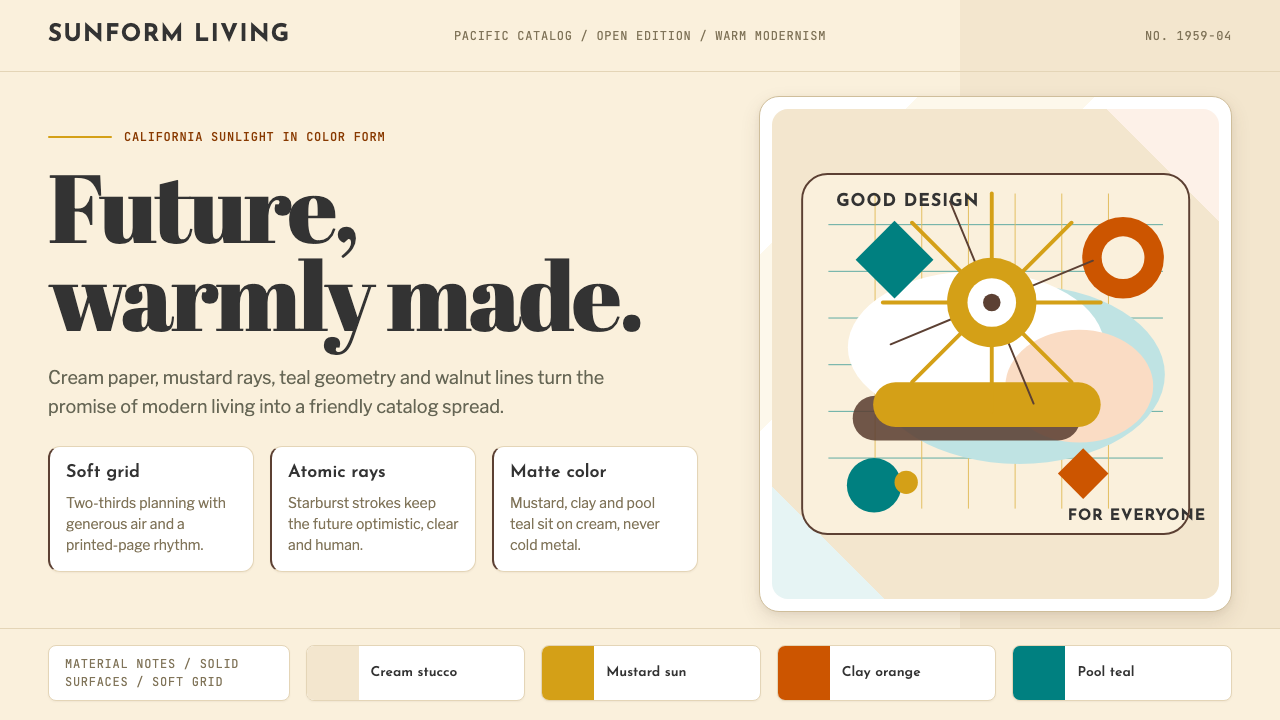 Mid-Century Modern (Eames)Optimistic, not austere. Cream canvas, mustard starburst, teal geometry and w…
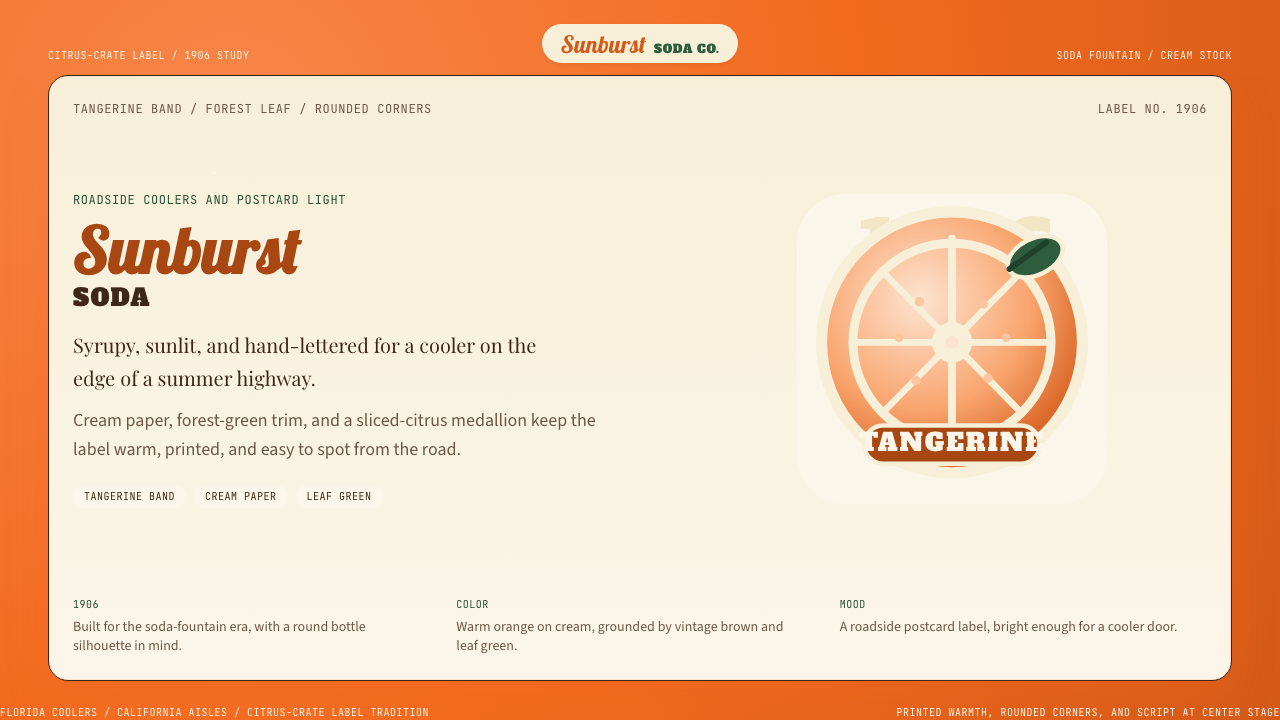 Orange Crush Soda (1906)Syrupy nostalgia. Tangerine, cream, and script make it a postcard label.
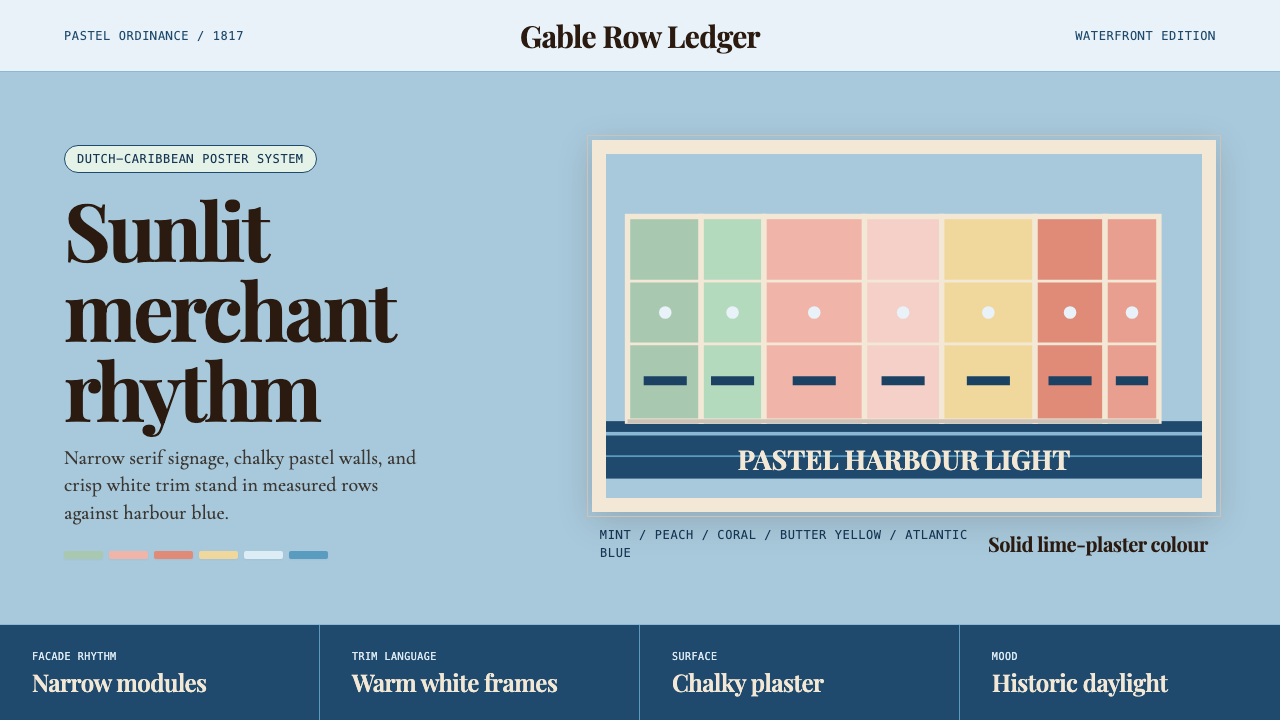 Curaçao Handelskade PastelPastel order feels sunlit. Coral, mint, and serif gables march across sky blu…
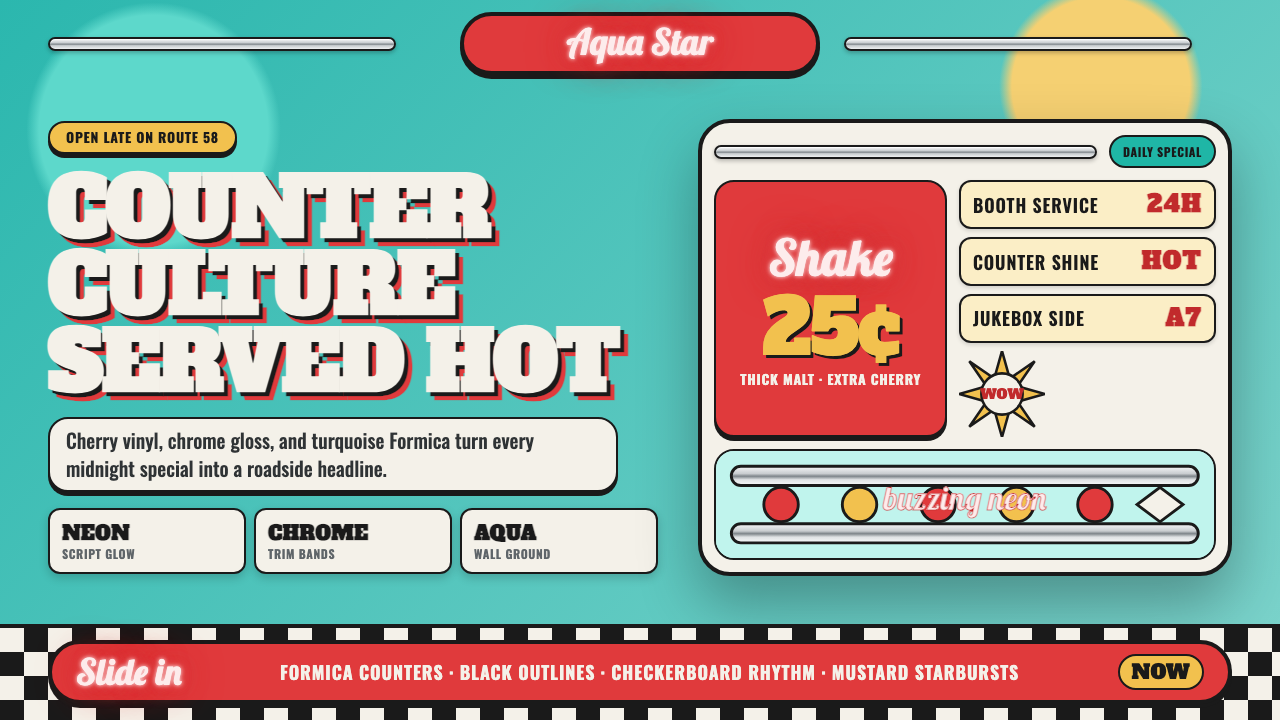 1950s Diner AquaRoadside optimism shouts. Aqua walls, cherry vinyl, chrome bands, and neon sc…
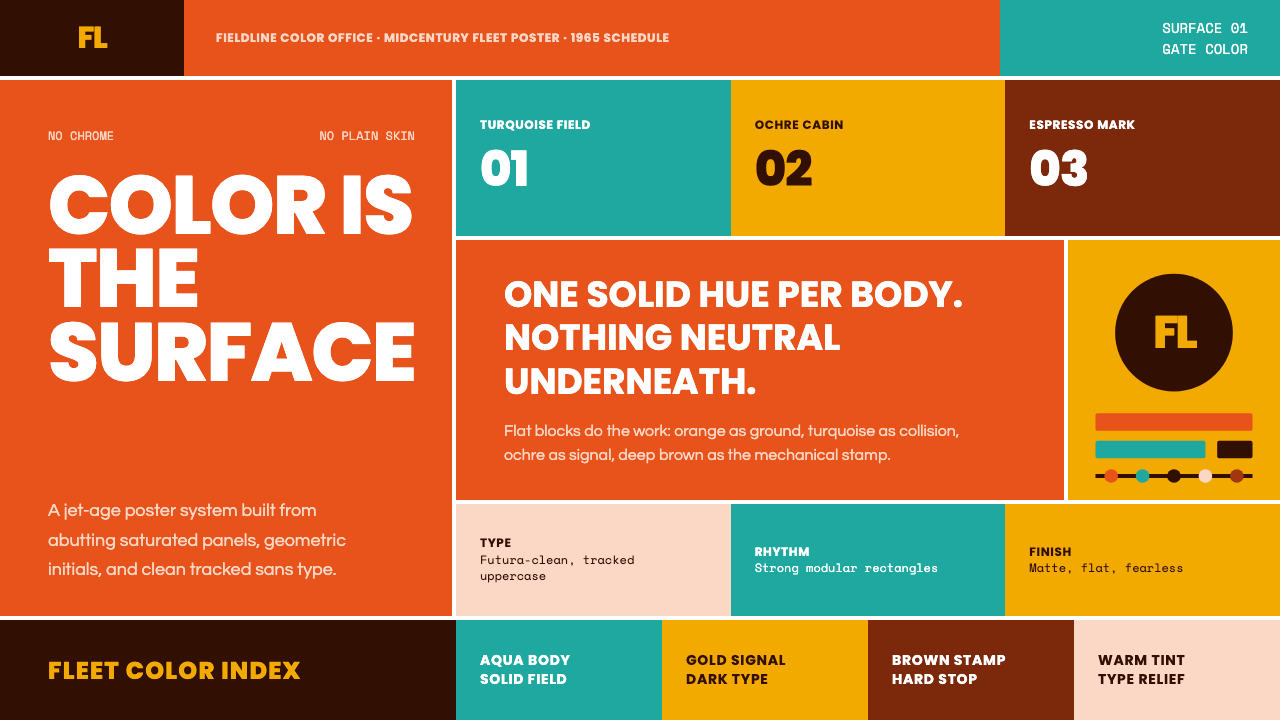 Braniff (Girard)Color becomes fuselage. Jellybean orange, turquoise blocks, and geometric san…
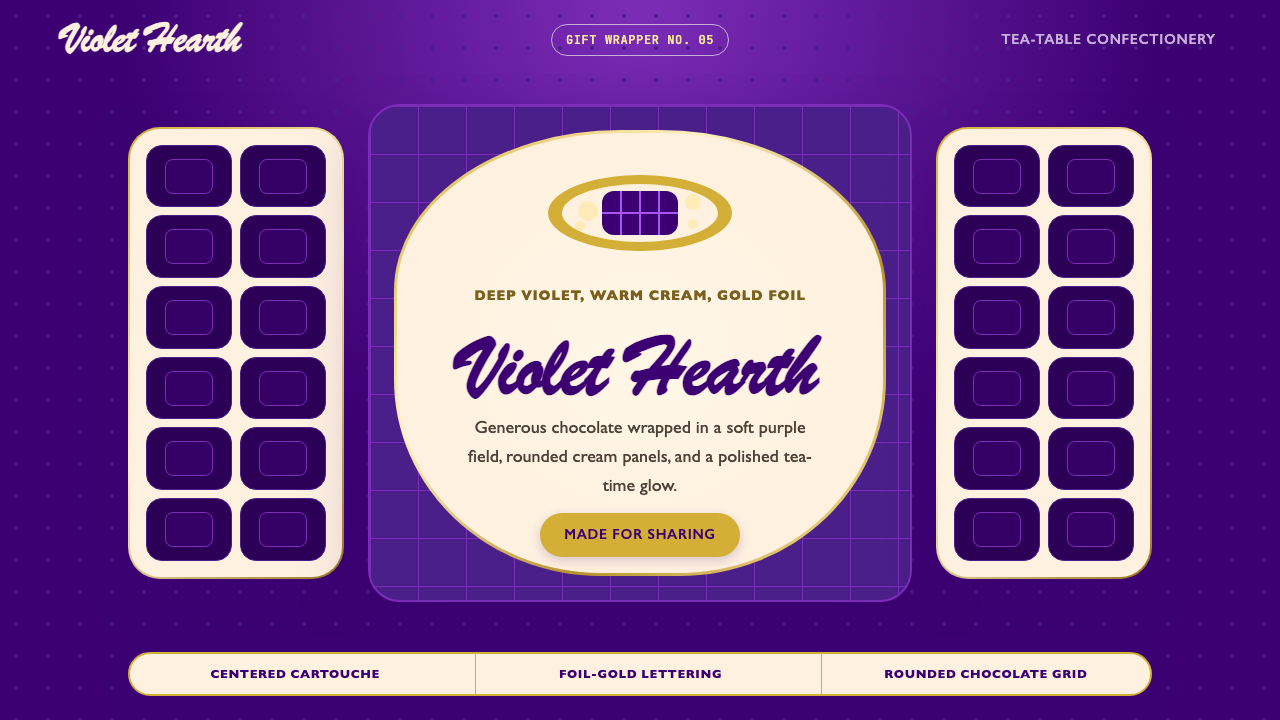 Cadbury Dairy MilkEveryday indulgence feels generous. Deep violet fields cradle cream cartouche…