What is Curaçao Handelskade Pastel?
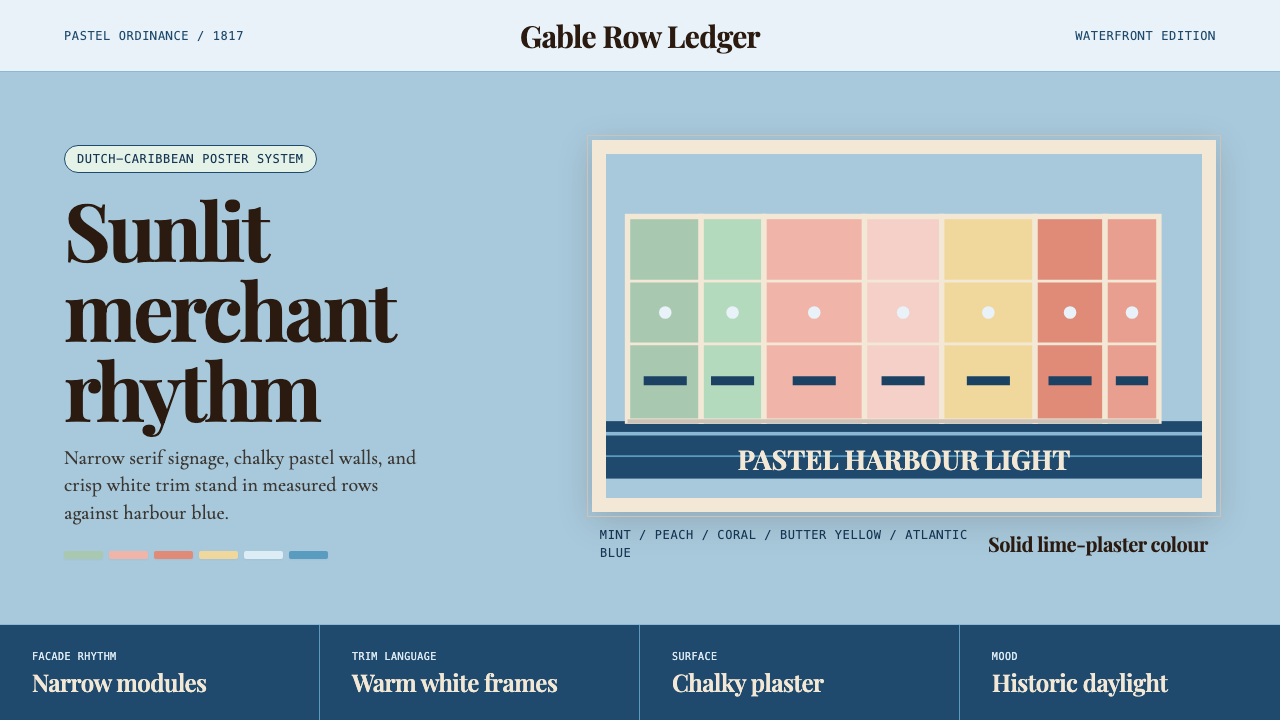
Willemstad's Handelskade proves that a municipal painting ordinance from 1817 can become one of the Caribbean's most distinctive design languages — chalky pastels, stepped gables, and harbour-salt geometry arranged with the precision of a Dutch merchant ledger.
Curaçao Handelskade Pastel in brief
Curaçao Handelskade Pastel is a design system rooted in the waterfront merchant houses of Willemstad, the capital of Curaçao in the Dutch Caribbean. The style draws on the UNESCO World Heritage streetscape of the Handelskade — a continuous row of narrow, stepped-gable façades painted in mandated chalky pastels: mint, peach, coral, butter yellow, and sky blue. The effect is simultaneously regimented and joyful, the product of colonial Dutch mercantile order meeting Caribbean light and colour.
The visual character is shaped by a tension between strict regularity and warm softness. The gabled façades repeat at the same narrow width, creating a rhythm of vertical punctuation across the harbourfront. Yet within that rigid frame, each building wears its own pastel hue, making the row feel like a curated collection rather than a uniform block. This interplay of order and chromatic individuality is the style's defining paradox — and its chief source of visual energy.
As a design system, the style translates the Handelskade's physical grammar into digital and print contexts: chalky, slightly muted pastel palettes deployed against deep harbour blues; stepped and gabled silhouettes as structural ornament; period-influenced serif letterforms that echo the colonial-era signage of the waterfront; and a gentle surface texture suggesting lime plaster weathered by salt air and tropical sun. The overall atmosphere is warm, precise, and faintly theatrical — like a Wes Anderson scene staged on an island.
Where does Curaçao Handelskade Pastel come from?
Willemstad's Handelskade — literally 'merchants' quay' — developed in the seventeenth and eighteenth centuries as the commercial heart of the Dutch West India Company's Caribbean operations. Curaçao's natural deep-water harbour made it the pivot of trade across the region: enslaved Africans, sugar, salt, tropical hardwoods, and European manufactured goods all passed through Willemstad's wharves. The merchant houses lining the harbour were built in a distinctly Dutch style — narrow-fronted, with the characteristic stepped gables that allowed buildings to be identified by silhouette from vessels approaching port.
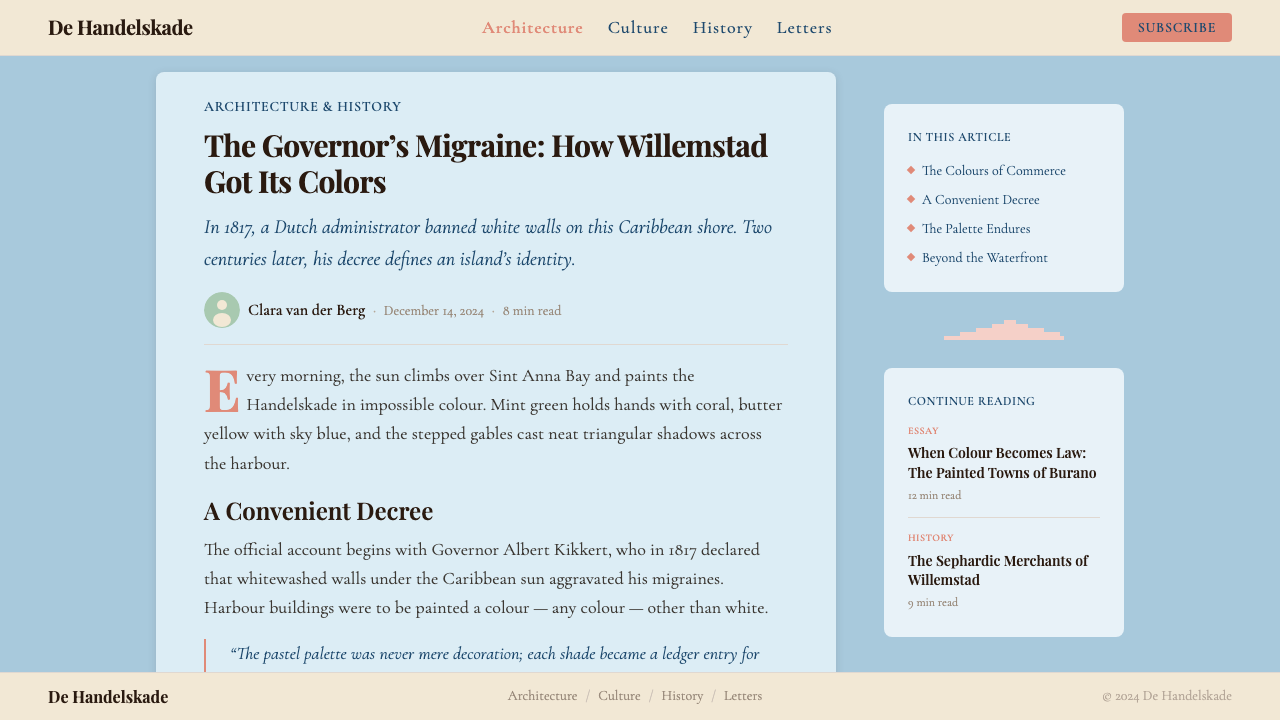
The mandatory pastel palette has an origin story that has become part of the island's mythology. Governor Albert Kikkert, who administered the island in the early nineteenth century, is said to have suffered from debilitating headaches that he attributed to the glare of the whitewashed buildings in the tropical sun. In 1817 he issued a directive requiring that buildings be painted in colours rather than white. Whether the headache story is apocryphal or not, the effect was lasting: the ordinance established a colour culture that persisted through changing political administrations, architectural fashions, and economic cycles. By the twentieth century the pastel palette of the Handelskade had become the island's defining visual identity.
The architectural style itself reflects layers of cultural influence. Dutch colonial building traditions dominated the structural forms — stepped gables, symmetrical façades, and the narrow footprints dictated by the width of original land grants. But the surface treatment absorbed Sephardic Jewish merchant influence: many of the most prominent Handelskade trading houses were built and owned by Sephardic families who had settled in Curaçao after expulsion from Iberia, bringing with them a Mediterranean sensibility for warm colour and ornamental plasterwork. The resulting architecture is genuinely syncretic, neither purely Dutch nor purely Caribbean nor purely Mediterranean, but a fusion unique to this island.
UNESCO inscribed the historic area of Willemstad, including the Handelskade, as a World Heritage Site in 1997, citing its outstanding example of Dutch colonial Caribbean architecture and its role as a cultural crossroads. The inscription triggered a wave of restoration work led by architects in the Pietermaai district and along the waterfront, which in turn introduced the Handelskade streetscape to a global audience of designers, photographers, and filmmakers. The colour-coordinated row of gabled buildings — vivid against the deep Caribbean blue of the Sint Annabaai waterway — became one of the most photographed urban streetscapes in the world and a touchstone for designers working with pastel palettes in contemporary contexts.
What defines the Curaçao Handelskade Pastel look?
Pastel Palette
The defining feature of the style is its chalky, slightly muted pastel range — mint, peach, coral, butter yellow, and sky blue — drawn directly from the mandatory painting ordinance of the Handelskade. These are not candy-bright pastels but sun-bleached, lime-plaster tints: colours that carry the memory of tropical heat and salt air. They are deployed in sequences rather than isolation, always in relationship with a deeper anchor hue — typically a saturated Caribbean or harbour blue — that gives the palette its depth and prevents it from floating into sweetness.
Stepped Gable Geometry
The stepped gable — the characteristic Dutch roofline silhouette — is the style's primary structural ornament. In two-dimensional contexts, the gable form appears as a repeating motif that organizes space: card headers shaped like gabled façades, dividers that trace roofline silhouettes, navigational elements that echo the rhythmic repetition of the harbourfront row. The geometry is simultaneously historical and abstract — recognizable as a building profile but usable as a pure shape language without literal illustration.
Lime-Plaster Surface Texture
The original Handelskade buildings were finished in lime plaster — a material that ages beautifully in tropical climates, developing a gently pitted, slightly granular surface as salt air and sun work on it over decades. The style captures this quality as a subtle textural layer: a faint grain or chalky dust that sits beneath the colour, giving flat fields a tactile quality without competing with the information hierarchy. Applied with restraint, it distinguishes the Handelskade aesthetic from flat digital pastels and grounds it in its physical architectural source.
Colonial Serif Typography
Where Bauhaus reaches for the geometric sans-serif as its typographic instrument, the Handelskade style turns instead to period-influenced serifs — letterforms that recall the painted signage and carved stone inscriptions of the colonial-era waterfront. These are serifs with moderate bracketing and classical proportions, neither aggressively condensed nor excessively decorative: legible, composed, and carrying a quiet sense of historical authority. They pair naturally with the architectural setting, reinforcing the visual logic that this is a system with roots in a specific time and place.
Narrow-Façade Rhythm
The Handelskade's distinctive spatial rhythm comes from the repetition of narrow building widths — each plot was historically allocated a defined frontage, producing a row where no single building dominates but the collective sequence creates a visual density. In layouts and interfaces, this principle translates to tight modular grids and column structures where elements repeat at consistent narrow intervals, creating a harbourfront-like procession of contained units. The rhythm is not rigid uniformity but controlled variation: each unit holds its place, and together they form a coherent whole.
Deep Anchor Blue
Against the chalky lightness of the pastel range, the style anchors its compositions with a deep, saturated blue that references both the Caribbean sea and the harbour waters of Sint Annabaai. This is not a standard navy nor a digital primary blue but something closer to the colour of deep tropical water: rich, slightly warm, and carrying the visual weight that the pastels cannot provide on their own. It serves as the backdrop against which the pale tones read most vividly, and as the primary vehicle for type and structural elements when contrast and authority are required.
Symmetry with Chromatic Variation
The Handelskade's paradox — strict structural symmetry paired with individual chromatic freedom — is the style's most transferable compositional principle. Layouts are organized through symmetric or near-symmetric structural grids, establishing a sense of mercantile order and reliability. Within that ordered structure, colour assignments vary from unit to unit: one card reads in coral, its neighbour in mint, the next in peach. The system does not require colour uniformity; it requires structural consistency. This gives the style unusual flexibility — it can accommodate a wide range of content while maintaining visual coherence.
Who shaped Curaçao Handelskade Pastel?
Kikkert administered Curaçao in the early nineteenth century and is credited — whether historically verified or mythologized — with the 1817 ordinance that required Handelskade buildings to be painted in colours rather than the traditional white. Whatever the precise circumstances, the ordinance he is associated with had consequences that outlasted his administration by two centuries: it set the colour culture of Willemstad on a trajectory that would eventually define the island's visual identity for the world.
Curaçao's Sephardic community — descendants of Jews expelled from the Iberian Peninsula in the late fifteenth century — played a central role in establishing the Handelskade as a commercial and architectural landmark. Families such as the de Leóns, the Henriquezes, and the Maderios built and occupied many of the waterfront trading houses, bringing with them a Mediterranean aesthetic sensibility for warm colour, ornamental plasterwork, and the architectural grandeur appropriate to prosperous mercantile families. Their cultural contribution is embedded in the Handelskade's appearance at a level that the colonial Dutch structural tradition alone does not explain.
Following UNESCO World Heritage designation in 1997, a generation of architects and preservation specialists working in Willemstad's Pietermaai district led the effort to restore and stabilize the Handelskade and surrounding historic buildings. Their work involved not only structural consolidation but the careful research and reapplication of historically appropriate pastel finishes — re-establishing the colour culture of the waterfront after decades of neglect and inappropriate repainting. This restoration effort is largely responsible for the Handelskade's current photogenic clarity and for the contemporary design world's access to the style as a coherent, legible visual system.
The VOC's Atlantic counterpart, the Dutch West India Company (WIC), established Curaçao as its Caribbean headquarters in the seventeenth century. The company's mercantile logic shaped everything about the Handelskade: the narrow building plots (each proportioned to maximize frontage on the valuable waterfront), the stepped gables (imported from Amsterdam and Rotterdam), and the commercial density that made Willemstad one of the most important trading posts in the Caribbean. The WIC's colonial infrastructure is the structural reason the Handelskade exists at all — and the reason its architecture speaks in the specific dialect of Dutch mercantile prosperity.
While not a figure in the style's historical development, the American filmmaker Wes Anderson has become an unexpected touchstone for understanding the Handelskade aesthetic in contemporary design discourse. Anderson's characteristic use of symmetric composition, precisely coordinated pastel palettes, period architectural settings, and a tone that balances melancholy with whimsy maps almost exactly onto the visual qualities of the Handelskade waterfront. Designers and commentators frequently invoke Anderson's work when describing the style's appeal — the sense of a colour-coded world organized with slightly absurd precision — making him a useful bridge between the historical streetscape and contemporary audiences.
How do you use Curaçao Handelskade Pastel today?
Curaçao Handelskade Pastel is a warm, historically grounded style with strong visual identity, and its success in application depends on understanding the logic beneath the palette. The style is not simply about using pastels — it is about the specific relationship between chalky, muted tones and a deep anchor blue, organized through a rhythm of repeating narrow units and given tactile weight by lime-plaster texture. Applied without that structural understanding, the result reads as generic pastel design rather than the genuine Caribbean-Dutch synthesis the source material represents.
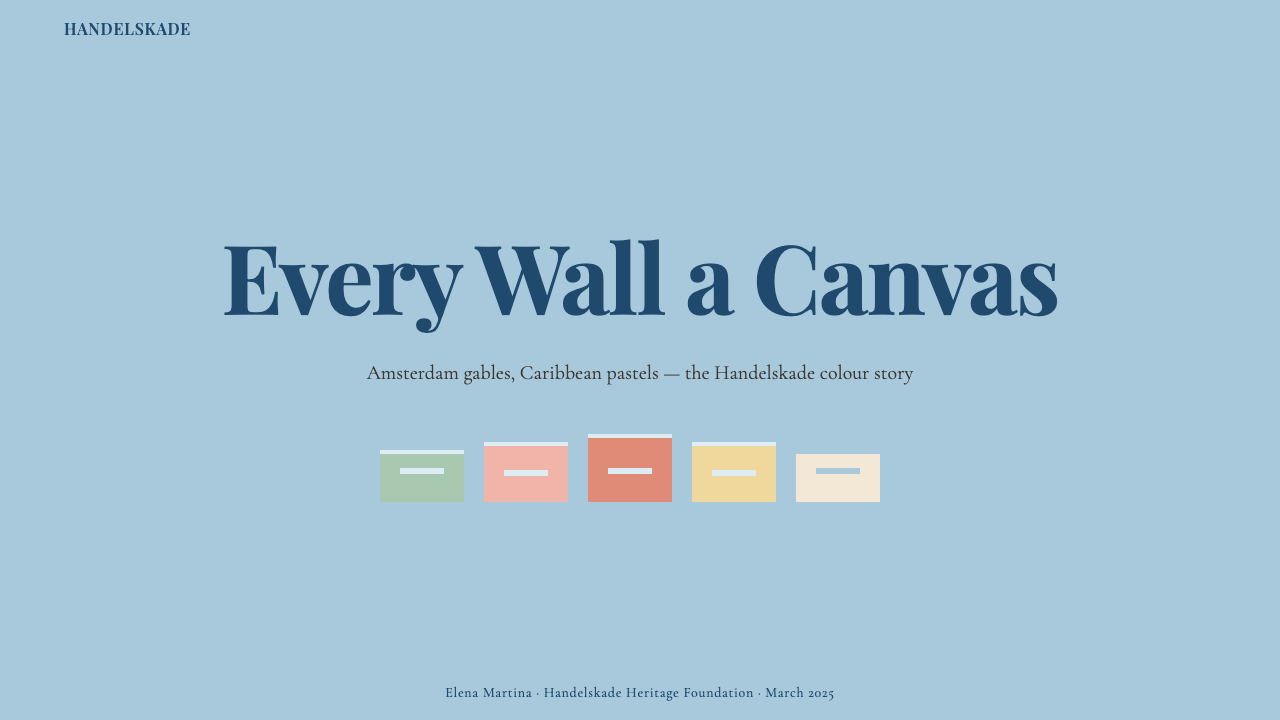
For presentation slides, the style works particularly well on cover pages that need warmth and distinctiveness without sacrificing clarity. A cover organized like a Handelskade façade — a row of colour-differentiated gabled panels, each containing a key point or category — immediately communicates a system with multiple distinct parts. Content slides benefit from the style's inherent modularity: a consistent narrow-column grid with chalky pastel panel backgrounds for supporting information, and a deep blue field for primary text or data. Data visualizations take on a genuine character in this system — bar charts and comparative tables can be colour-coded using the pastel range, with the anchor blue used to highlight the primary subject of attention.
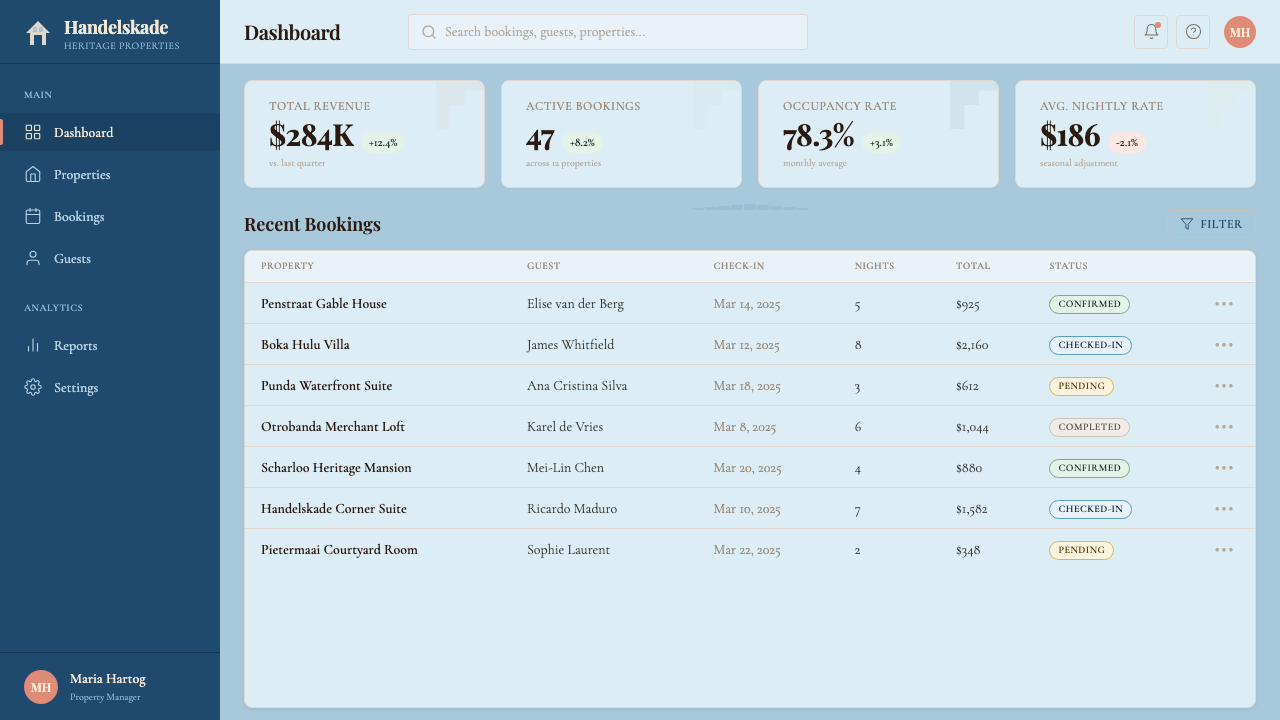
For web interfaces and digital products, the style is best suited to platforms with a strong brand personality that want to differentiate from generic minimal or generic material design. Travel and hospitality platforms, cultural heritage applications, boutique e-commerce, and editorial destinations all offer natural fits. The implementation logic: a near-white or very pale pastel background carries most of the content; structured card components with chalky pastel fills and gable-profile headers organize collections; the deep anchor blue appears in navigation, primary calls to action, and wherever the interface needs to assert authority. Surface texture, applied very lightly to background fields, prevents the pastel palette from feeling sterile or digital.
For editorial and marketing contexts — printed materials, social content, brand identity work — the style offers a strong and underused visual territory. Most contemporary pastel design skews either toward millennial pink softness or Scandinavian minimalism; the Handelskade palette, with its colonial Dutch structure and Caribbean warmth, occupies a different position entirely. A brand identity built on this system reads as historically informed, globally curious, and visually self-confident: appropriate for cultural organizations, design-forward hospitality businesses, heritage tourism, premium food and beverage, and publishers with a strong editorial point of view.
A common mistake when working with this style is treating the pastel palette as the complete system and neglecting the deep anchor blue. Without the harbour blue, the chalky pastels lack visual weight and the compositions tend toward weakness rather than warmth. A related error is over-texturing: the lime-plaster effect should read as a whisper beneath the colour, not as a dominant surface treatment. Finally, the gable motif should be used selectively as a structural accent rather than repeated literally as decoration — when every element wears the gable silhouette, the architectural reference becomes kitsch rather than resonant.
Curaçao Handelskade Pastel — FAQ
Is this style appropriate for dark-mode interfaces?
The Handelskade palette is fundamentally a light-ground system — the chalky pastels read best against white, cream, or very pale backgrounds, just as the original buildings read best against the bright Caribbean sky. A strict dark inversion is possible but requires significant adaptation: the pastels must be deepened and desaturated to avoid reading as garish against a dark ground, the lime-plaster texture becomes less effective and may need to be dropped entirely, and the deep harbour blue loses its anchoring function since it can no longer contrast with lighter tones. A more successful approach for dark contexts is to select one or two pastels from the range, deepen them toward jewel tones, and use the harbour blue as the near-black base rather than as an accent.
How does this style differ from other Caribbean or tropical design aesthetics?
Most tropical design aesthetics rely on high-saturation brights — vivid teals, intense yellows, strong magentas — alongside organic motifs like foliage, florals, and hand-drawn illustration. The Handelskade style is distinctly different: its pastels are muted rather than bright, its geometry is architectural and rectilinear rather than organic, and its cultural reference is Dutch colonial mercantile rather than indigenous or Creole. The result is tropical in climate but European in structure — warm in palette but ordered in composition. This makes it particularly useful for contexts that want warmth and exoticism without the visual noise of conventional tropical design.
Can the gable motif be used without literal architectural illustration?
Yes, and this is often the more sophisticated approach. The stepped gable silhouette is a purely geometric form — a series of horizontal steps ascending to a peak — that can be abstracted into dividers, card headers, icon backgrounds, and decorative rules without reading as literal building illustration. Used this way, it functions like the Bauhaus triangle or the Art Deco chevron: a culturally resonant geometric form that carries the style's identity without demanding pictorial interpretation. The key is consistency of angle and step proportion so that the abstracted form retains its architectural DNA across different applications and scales.
How many colours from the pastel range should be used simultaneously?
The Handelskade source uses the full pastel range simultaneously — this is essential to the style's character, since a single pastel without its neighbours reads simply as a quiet colour rather than as part of a coordinated ensemble. The visual logic works because each hue is similarly muted and chalky, giving the range internal coherence even when five or six tones appear together. In practice, two to four pastels alongside the anchor blue constitutes a workable palette for most applications; the full range of five or six is appropriate for gallery-like or collection contexts where the variety itself is the point. The critical rule is that the pastels must be consistent in character — all chalky and muted, none candy-bright — or the ensemble falls apart.
Is the style suited to serious or functional contexts, or is it primarily decorative?
The style is more functional than it appears. The Handelskade's colour-coordination originated as a regulatory system — each building is individually coloured but the range is controlled, producing order from variety. This makes it a genuinely useful model for information design contexts where multiple categories or entities need to be visually distinguished while maintaining overall coherence: product catalogues, multi-stream data presentations, portfolio or collection platforms, and multi-brand environments. The architectural order beneath the cheerful palette — the strict narrow-façade rhythm, the consistent gable geometry, the regulated colour range — is what separates the style from casual pastels and gives it the structural backbone to carry serious content.
Related design styles
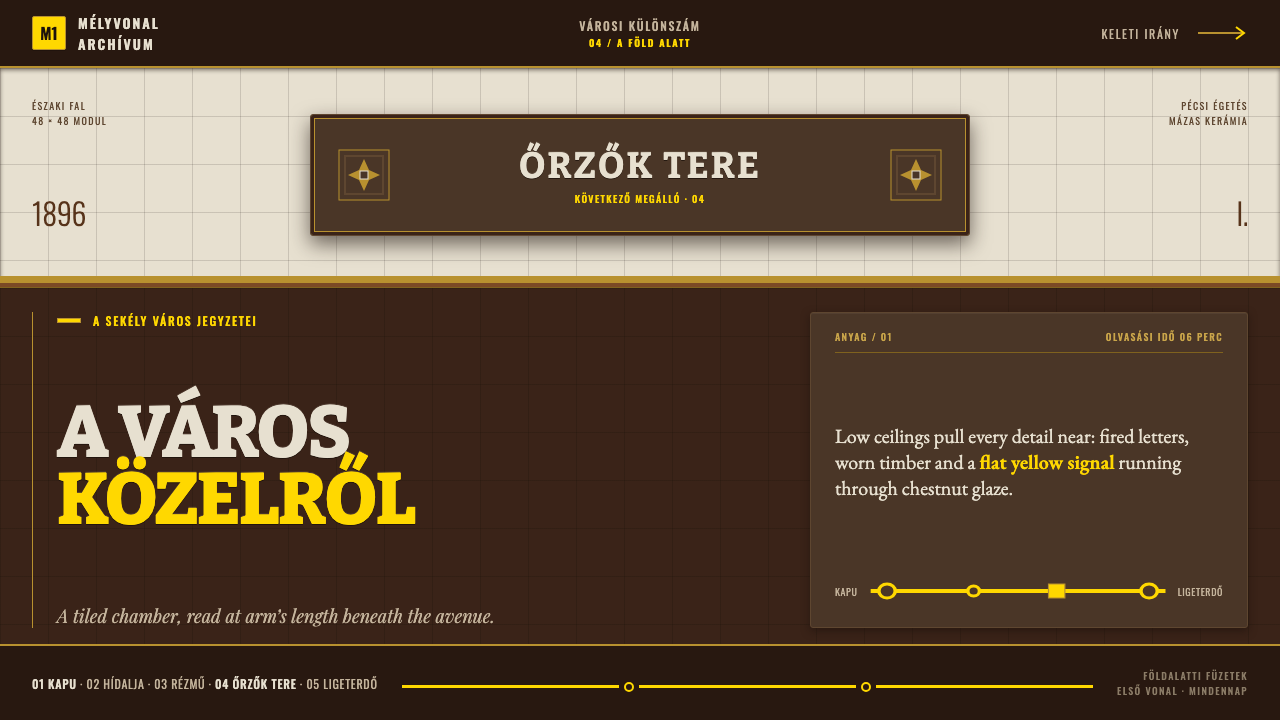 Budapest Millennium LineChestnut glaze turns transit into a room. Fired slab type and flat yellow run…
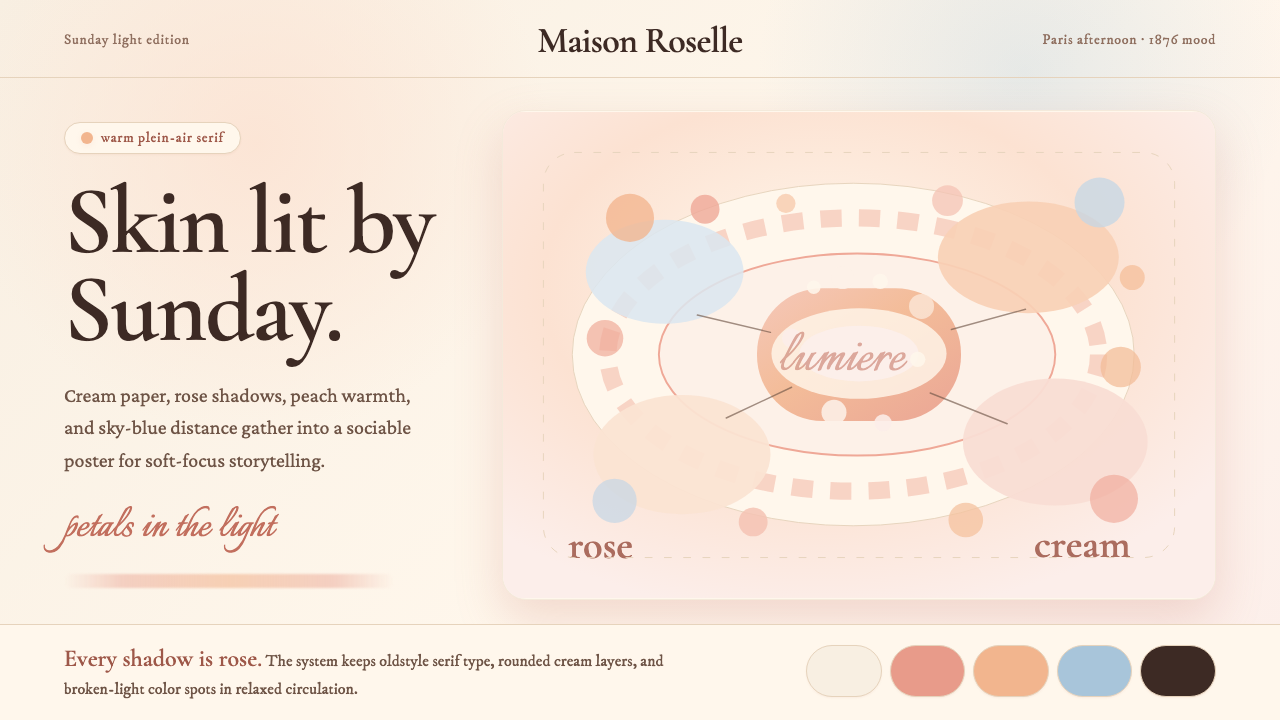 Renoir ImpressionismWarmth refuses haste. Rose shadows and Cormorant curves drift across cream.
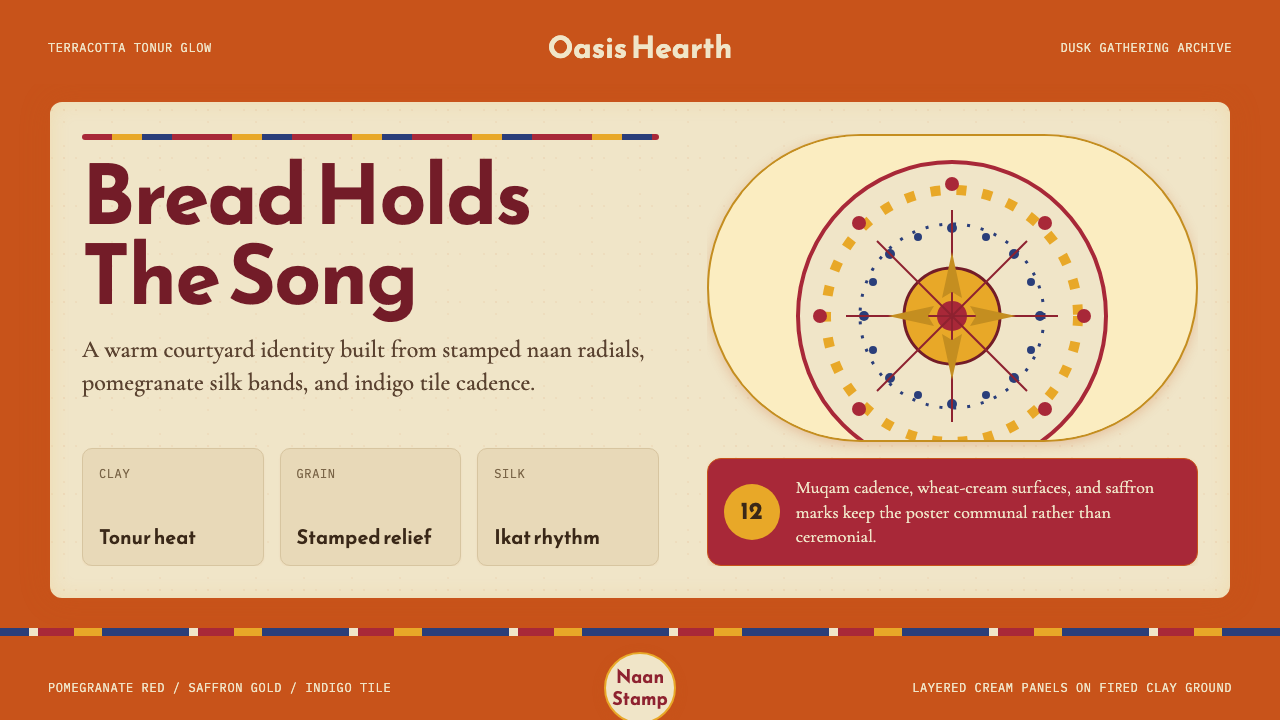 Uyghur Meshrep (Naan Oasis Gathering)Warmth gathers. Terracotta ground, saffron naan radials, and indigo ikat band…
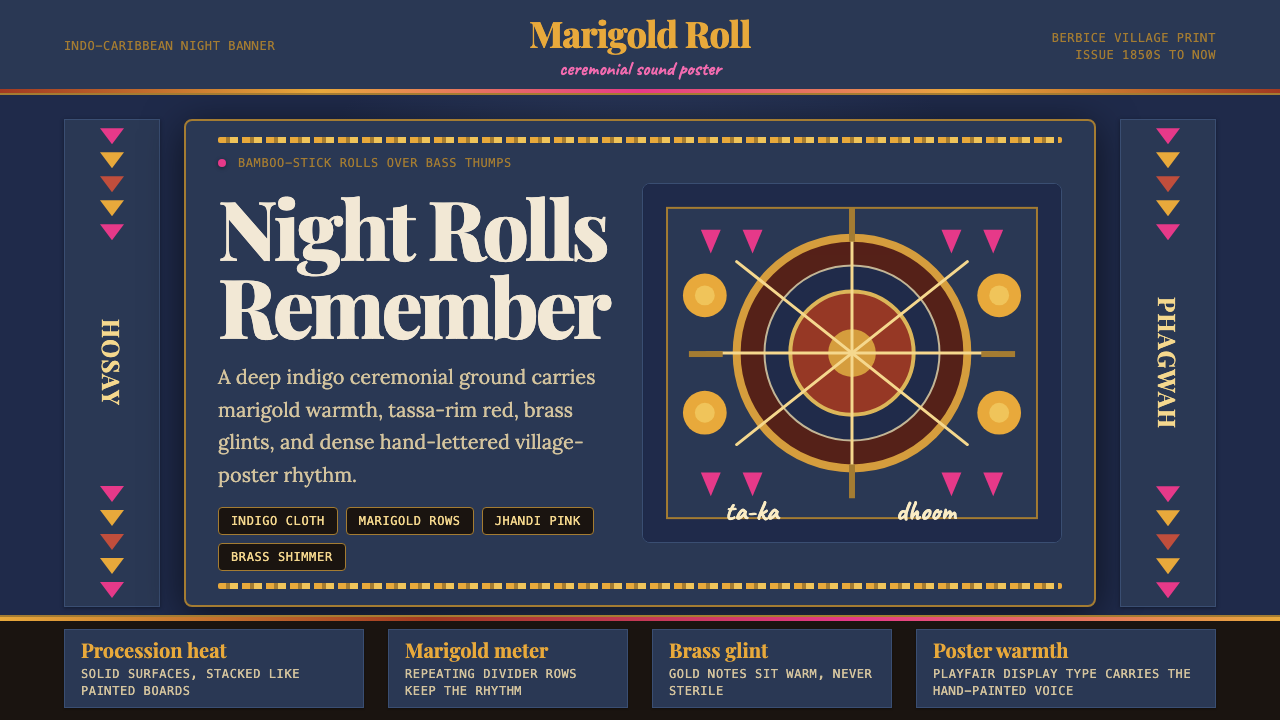 Guyanese Tassa DrumCeremony carries the beat. Indigo banners, Playfair type, and marigold rows g…
 Heinz Ketchup (1869)Nothing to hide. Tomato red and slab serif lock clear-glass honesty into a ke…
 Andean ChulloOrnament carries a code. Cochineal red stacks strict stitch bands with bead-w…