What is Atari 2600 (Woodgrain)?
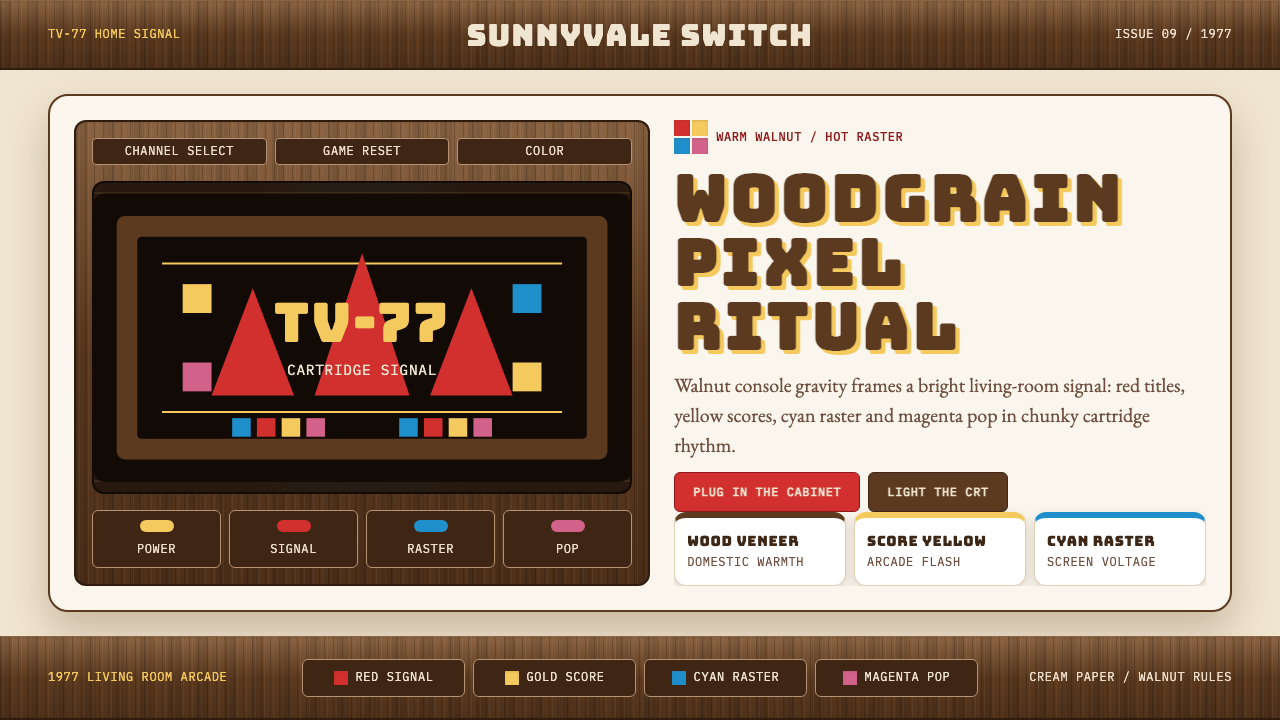
Woodgrain and wild pixels: the Atari 2600 fused living-room warmth with the raw, saturated shock of early home video games.
Atari 2600 (Woodgrain) in brief
The Atari 2600 design aesthetic is a collision between two worlds that had no business touching each other in 1977. On one side: the warm, domesticated look of hi-fi stereo equipment — woodgrain veneer, muted earth tones, the visual language of the family living room. On the other: the violent, CRT-bright palette that a chip with barely enough memory to fill a screen could produce — screaming reds, electric yellows, punchy cyans, and saturated magentas that no furniture catalog would ever feature.
What makes the style distinctive is not one or the other impulse, but the unapologetic coexistence of both. The walnut brown of the console's fascia does not soften the pixel colors — it makes them louder by contrast. The chunky, blunt display type used for game labels and brand marks carries the same energy as those color blocks: nothing tapered, nothing polished, everything confrontational in the best possible sense. The Fuji-mountain logo — that stacked, symmetrical mountain shape — anchors the whole system as a kind of pop-cultural totem, equally at home on a woodgrain panel and a neon arcade cabinet.
As a design system, Atari 2600 style reads as warm retro-CMYK Americana. It belongs to a moment when consumer electronics were designed to live on the same shelf as the record player and the bookshelf speakers — when technology was expected to look domestic rather than clinical. Reviving it today means honoring that layered contradiction: earthy ground tones, primary-register pixel color, and bold typographic confidence working together without apology.

Where does Atari 2600 (Woodgrain) come from?
Atari was founded in 1972 in Sunnyvale, California, by Nolan Bushnell and Ted Dabney, the same minds behind Pong — the coin-operated table tennis game that defined the arcade's first commercial moment. The 2600, originally sold as the Atari VCS (Video Computer System), launched in September 1977 and went on to sell approximately thirty million units over its commercial lifetime. It was not the first home console, but it was the first to achieve mass cultural penetration, transforming video games from arcade novelties into household objects.
The woodgrain veneer was a deliberate market-positioning decision. Consumer electronics in the mid-1970s were dominated by high-fidelity audio equipment — receivers, turntables, reel-to-reel decks — and that category had converged on a house aesthetic of warm wood panels, brushed metal accents, and dark earth tones. Atari's designers, working under the leadership of engineers including Jay Miner (who would later design the Amiga chipset), understood that a device intended to sit beneath the family television had to speak the same visual language as the furniture around it. The woodgrain said: this belongs here. It is not a toy.
George Opperman, Atari's in-house graphic designer during the company's most influential years, developed the visual identity that defined the brand's print and packaging output. The Fuji logo — named internally for its resemblance to Mount Fuji — was designed to be bold enough to read at arcade scale and warm enough to belong on a living-room box. Opperman's game-label artwork established the chromatic conventions of the style: saturated CMYK-register colors deployed in flat, graphic blocks rather than painterly gradations, with type that was heavy and direct rather than refined.
The CRT technology of the era was itself a design constraint that became an aesthetic. The television sets on which the 2600 was played could not render subtle color distinctions — they demanded bold, high-saturation primaries and secondaries that would survive the bloom and scan-line distortion of an analog tube. The palette that emerged from this technical limitation — roaring red, hot yellow, punchy cyan, raw magenta, against earthy woodgrain brown — was not a choice so much as a negotiation between what the hardware could produce and what the eye could parse on a phosphor screen. That negotiation produced one of the most recognizable chromatic signatures of twentieth-century consumer culture.
What defines the Atari 2600 (Woodgrain) look?
Woodgrain Ground Tone
The foundational color of the system is a warm, medium walnut brown — the hue of mid-century hi-fi cabinetry. It functions as both background and anchor, giving the louder pixel colors something domesticated to push against. The brown is never cold or gray-shifted; it reads as organic and tactile even in a flat digital context. Using it at large scale, as a dominant field rather than an accent, is essential to achieving the right tonal balance.
Retro-CMYK Pixel Palette
The accent colors are drawn from the four corners of the CMYK model — a red with nothing softened about it, a yellow that vibrates at the warmest end of the spectrum, a cyan that pops with electric clarity, and a magenta that owes nothing to pastels. These are not muted or aged; they are used at full force, the way early game cartridge labels deployed them: in flat, bounded blocks of color that refuse to blend or fade. Against the woodgrain brown, each one ignites.
Chunky Display Type
Headlines and brand marks in the Atari 2600 style use letterforms that are heavy, wide, and uncompromising — the visual equivalent of a fist rather than a brushstroke. The weight is extreme enough that counters shrink, spacing tightens, and the type mass begins to read almost as a texture block. There is no refinement of serifs or fine strokes; what exists is structural and load-bearing. The chunky type energy belongs equally to the era's arcade signage and to the product packaging that sat in the toy aisle.
Flat Graphic Color Blocks
Color in this system is applied in solid, bounded regions — there are no gradients, no soft transitions between hues, no atmospheric blending. Each color occupies its territory as a flat field, the way a screen of limited color-depth was forced to render it. Shapes are filled entirely or left empty; the boundary between color regions is always crisp. This flatness is not a minimalist preference but a technical inheritance, and it gives the style its graphic, almost silkscreen-printed quality.
The Fuji Mountain Mark
The Atari logo — three stacked vertical bars tapering outward, evoking a mountain silhouette — is a masterclass in geometric brand economy. It is symmetrical, immediately reproducible at any scale, and bold enough to hold its own against competing visual noise. In the 2600 system, the mark functions as a modular compositional anchor: it can appear in any of the palette colors on any ground, and it retains identity through sheer geometry. Its presence signals the entire system without needing to announce itself through color or weight.
Serif Body Counterpoint
Against the blunt display type, a classical serif typeface in body-copy weight introduces unexpected gravity and readability. The contrast between the heavy, blocky headline register and the refined, proportioned serif below it creates typographic tension that reads as historically layered — the warmth of mid-century print culture meeting the bluntness of early digital display. The serif does not compete with the display type; it provides a resting point, the eye's relief after the collision of wood and neon.
Domestic-Scale Composition
Layouts in this style are confident and frontal, organized around a strong central axis or a bold asymmetric block composition. There is nothing tentative about the arrangement: elements are placed as if they belong exactly where they are, in the same way that a console sits with authority beneath a television set. Margins are generous rather than cramped; the visual field breathes. The overall impression is of something designed to be read from across the room, on a shelf, in a living space — not squinted at on a desk.

Who shaped Atari 2600 (Woodgrain)?
Bushnell co-founded Atari in 1972 and drove the company's early strategic vision, including the push to bring video games from arcades into living rooms. His decision to pursue the consumer home-console market — at a time when the very concept was commercially unproven — established the product category that the 2600 would define. The choice to position the device as a hi-fi-adjacent home entertainment product, complete with woodgrain styling, was consistent with Bushnell's instinct for making technology feel approachable rather than intimidating.
Miner was the lead chip designer behind the Atari 2600's Television Interface Adaptor (TIA), the hardware component responsible for generating the console's graphics and sound output. The TIA's technical constraints — its limited color registers, its requirement for the CPU to manually feed it scanline by scanline — directly produced the aesthetic vocabulary of the era. Miner later left Atari to design the Amiga chipset, which offered a dramatically expanded color palette, but the visual culture seeded by his earlier work remained a defining reference for pixel-era aesthetics.
Opperman served as Atari's primary in-house graphic designer during the company's most culturally potent years, and his work defined the visual language audiences associate with the brand. He designed the Fuji mountain logo that became one of the most recognized marks in gaming history, and developed the chromatic and typographic conventions of Atari's game packaging and promotional materials. Opperman's instinct for bold, flat, high-saturation imagery — practical given the printing limitations of the era — produced a house style that proved durable enough to survive decades of cultural revision.
Miller was one of Atari's most prolific early game programmers and later a co-founder of Activision, the first third-party game developer for the 2600. The founding of Activision in 1979 opened the platform to independent visual creativity and led to a rapid expansion of the cartridge-label aesthetic — Activision's packaging introduced richer illustrative imagery alongside the flat color conventions Opperman had established, further developing the visual culture of the platform beyond Atari's own in-house work.
How do you use Atari 2600 (Woodgrain) today?
Applying Atari 2600 style successfully requires understanding what it is actually doing structurally: it is a collision system, not a harmony system. The woodgrain warmth and the pixel colors are in productive tension, not blended agreement. Every application decision should preserve and amplify that tension rather than resolve it. If the layout starts to feel decorative or nostalgic in a soft way, the tension has been lost — one register has surrendered to the other.
For presentation slides, the style delivers strong results on both cover and content pages when its scale hierarchy is respected. A cover slide works best as a near-full-bleed woodgrain brown field with the title in heavy display type — white or the palette's most aggressive accent color — and the Fuji mark or a geometric silhouette anchoring a corner. Content slides should treat each page as a bounded color block: section headers in chunky type on a single accent color bar, body text in a classical serif below, data or bullets in contained regions with color used to assign meaning rather than decoration.
For web interfaces, the system excels on surfaces where confident hierarchy and strong brand presence matter more than neutrality. Dashboard pages, pricing tables, and product landing pages benefit from the style's frontal compositional energy. The approach: a walnut-brown hero section with white or accent-colored type, transitioning to near-white content areas where flat color-block components replace shadowed cards. Interactive states — hover, selected, active — are distinguished by switching between palette colors rather than lightening or darkening a single hue. Navigation is typographic and direct, with no gradient backgrounds or ambient shadow effects.
For editorial and marketing work, the style performs exceptionally in contexts calling for bold cultural presence — event posters, campaign key visuals, brand identity treatments where the product wants to signal warmth and analog confidence without nostalgia cliche. An editorial spread using this language places chunky headline type over a woodgrain-brown band at full column width, drops into serif body text at comfortable reading size, and uses isolated flat color blocks — not full-width washes — to mark structural section changes. Marketing applications work well with the constraint of one dominant accent color per execution, with the others appearing only in functional roles.
The most common mistake when applying this style is treating it as mere retro-gaming pastiche — adding scan-line textures, pixel-grid overlays, or heavily distressed treatments that signal nostalgia rather than authority. Authentic Atari 2600 design was not trying to look vintage; it was trying to look contemporary and premium by the standards of its moment. The correct frame is confidence, not irony. A second common error is using the pixel accent colors at equal weight and frequency, which produces visual competition rather than the purposeful hierarchy the system requires. Choose one accent as the dominant, deploy a second sparingly for contrast or emphasis, and let the woodgrain brown carry the majority of the visual field.

Atari 2600 (Woodgrain) — FAQ
Is this a dark or light style?
It is neither in the conventional sense. The dominant field color is a medium walnut brown — warmer and more saturated than a neutral gray, but not dark enough to function as a true dark-mode equivalent. On this ground, both light type and vivid accent colors read clearly. Contemporary applications most commonly invert to a near-white field for extended reading sections, using the walnut brown as a banding or accent block color rather than a continuous background. A true dark variant is possible but should use deep charcoal or near-black rather than trying to darken the brown itself, which tends to become muddy.
Can this style work for a SaaS product, or does it read too much as gaming or nostalgia?
It works well for SaaS products that want to signal warmth, personality, and a counterintuitive premium feel — developer tools, creative platforms, productivity applications that want to distance themselves from the cold minimalism of enterprise software. The gaming and nostalgia readings are real risks, and they are mitigated primarily by typographic restraint and compositional seriousness. If the display type is chosen for weight and authority rather than pixel-era novelty, and if the layout is structured rather than playful, the woodgrain-and-color combination reads as distinctive and confident rather than retro. The risk increases when scan-line filters, pixel-art illustrations, or arcade references are added to the mix.
How do you avoid the layout looking like a video game box from the 1980s?
The main levers are typography and spatial rhythm. Video game packaging of the era was necessarily dense — it had to communicate product identity, feature claims, rating information, and brand marks in a very constrained physical space. Contemporary applications of this style have the luxury of generous margins and breathing room that the original packaging did not. Prioritize open field areas of walnut brown with one or two large typographic elements over cluttered multi-element compositions. Use the serif body text to introduce reading-oriented calm, and resist the temptation to fill every region with a different accent color. The distinction between a designed composition and a packaged product often comes down to how much the designer was willing to leave empty.
Does the Atari 2600 style suit editorial long-form content, or is it mainly for hero and marketing surfaces?
The style is strong on marketing and hero surfaces where the tension between the brown ground and the accent colors can work at full scale. In long-form editorial contexts, it requires more careful handling: the woodgrain brown should recede to the background of section headers and pull-quotes rather than dominating the reading surface, which should stay near-white for sustained readability. The serif body text carries the style's warmth into long reading without the visual noise of the pixel palette. Think of it as a style that frames the reading experience from the outside — establishing character in the masthead, section breakers, and running heads — rather than one that saturates the reading field itself.
Is the woodgrain element literal — should it use a texture — or is it purely about color?
Both approaches are historically grounded and contextually valid. The original Atari 2600 used a photographic woodgrain vinyl — a literal material texture. In print and digital contexts, working with a flat walnut brown color field, without any simulated woodgrain texture, is entirely appropriate and often cleaner: it preserves the color identity and warmth without introducing a surface detail that competes with the type or color blocks. A subtle, low-contrast woodgrain texture can be added for physical print applications — posters, packaging, merchandise — where the tactile reference feels earned. For digital screens, the flat color is typically more resolved and avoids the dated quality that overly literal texture effects tend to carry.
Related design styles
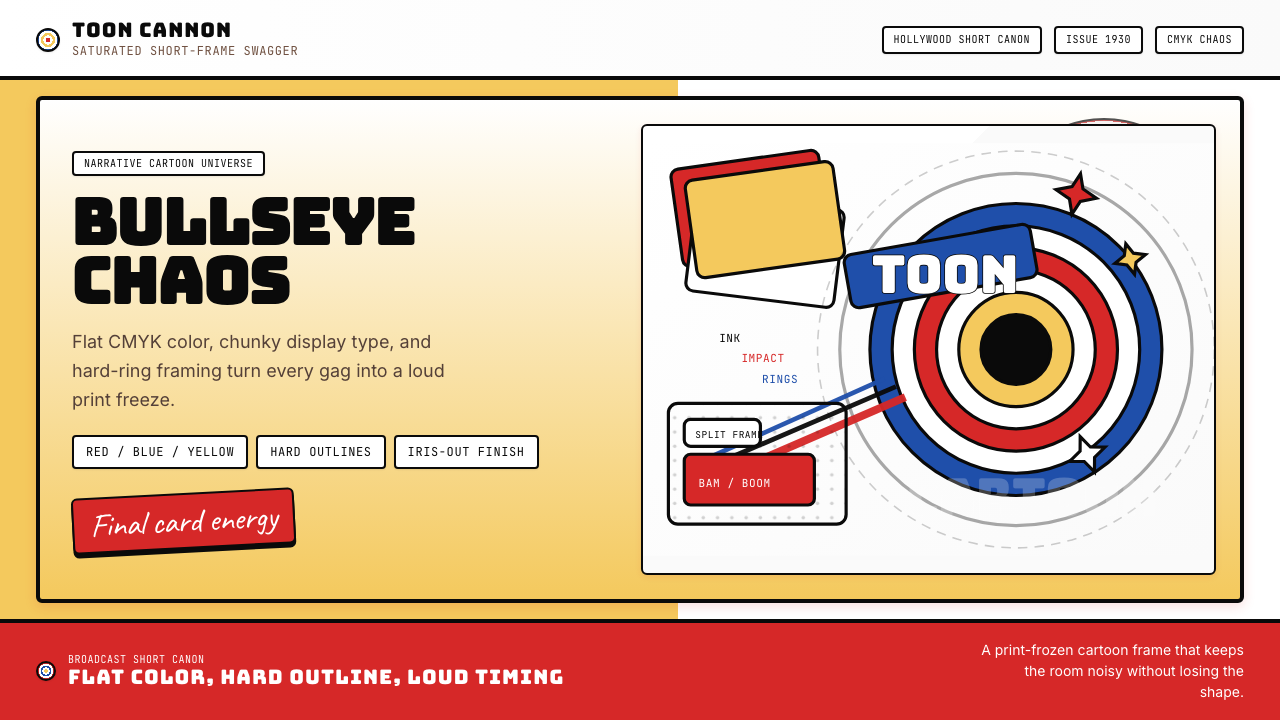 Looney Tunes (Warner Bros.)Pure cartoon chaos. Bull's-eye rings, Bungee type, and red-blue-yellow blocks.
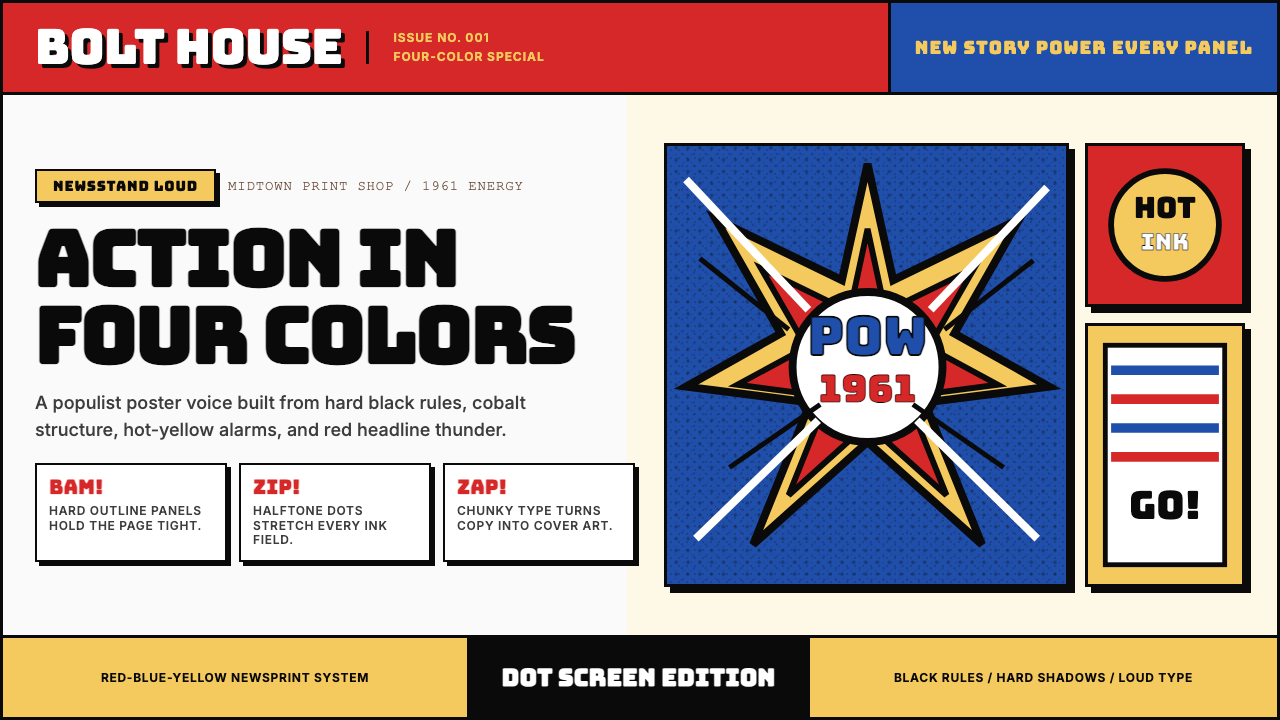 Marvel Comics (Kirby Era)Populist color hits hard. Red-blue-yellow panels, black rules, and halftone d…
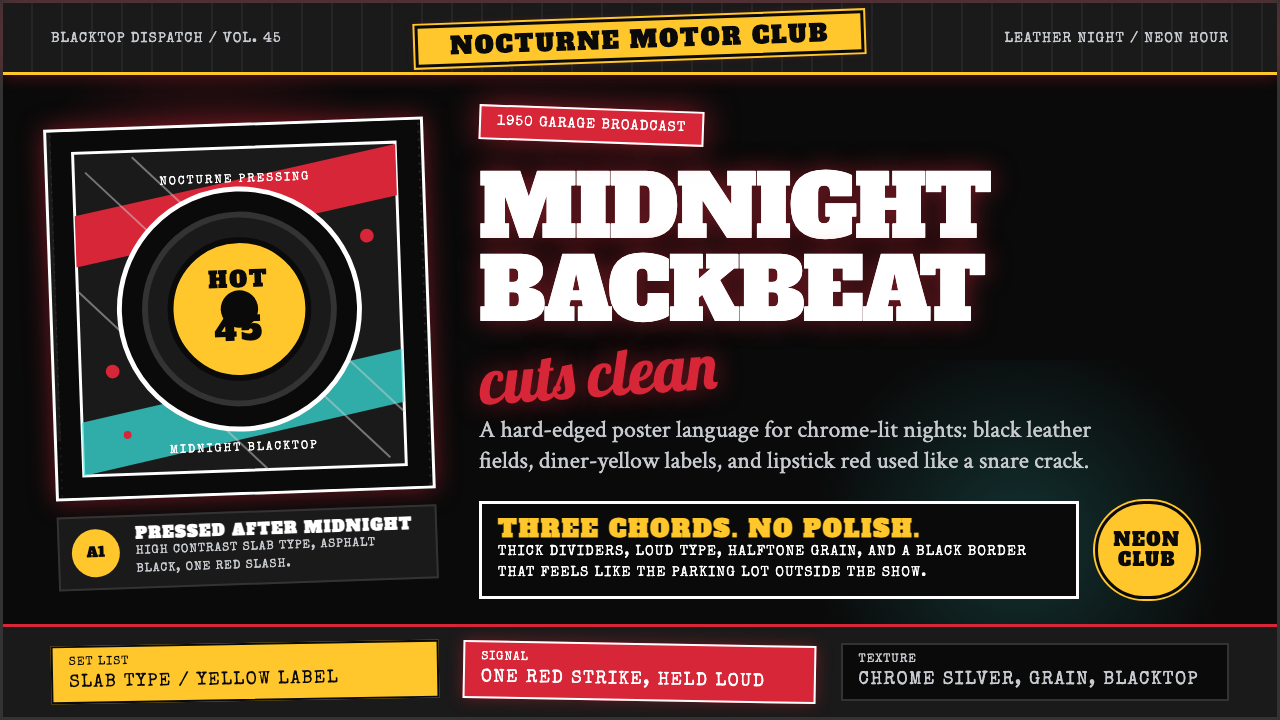 Rockabilly Greaser (1950)Loud after midnight. Asphalt black, chrome-yellow circles, and one lipstick-r…
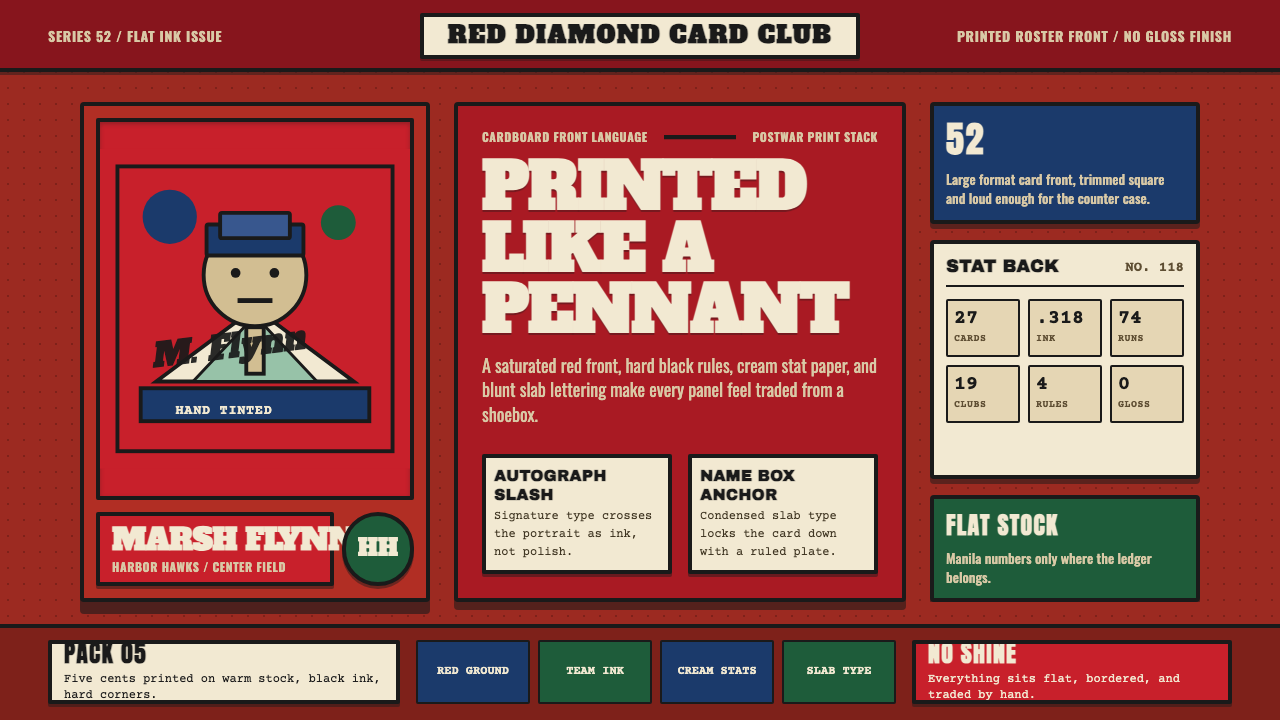 Topps Baseball CardCardboard heat. Brick-red slab panels, cream stats, and condensed type feel p…
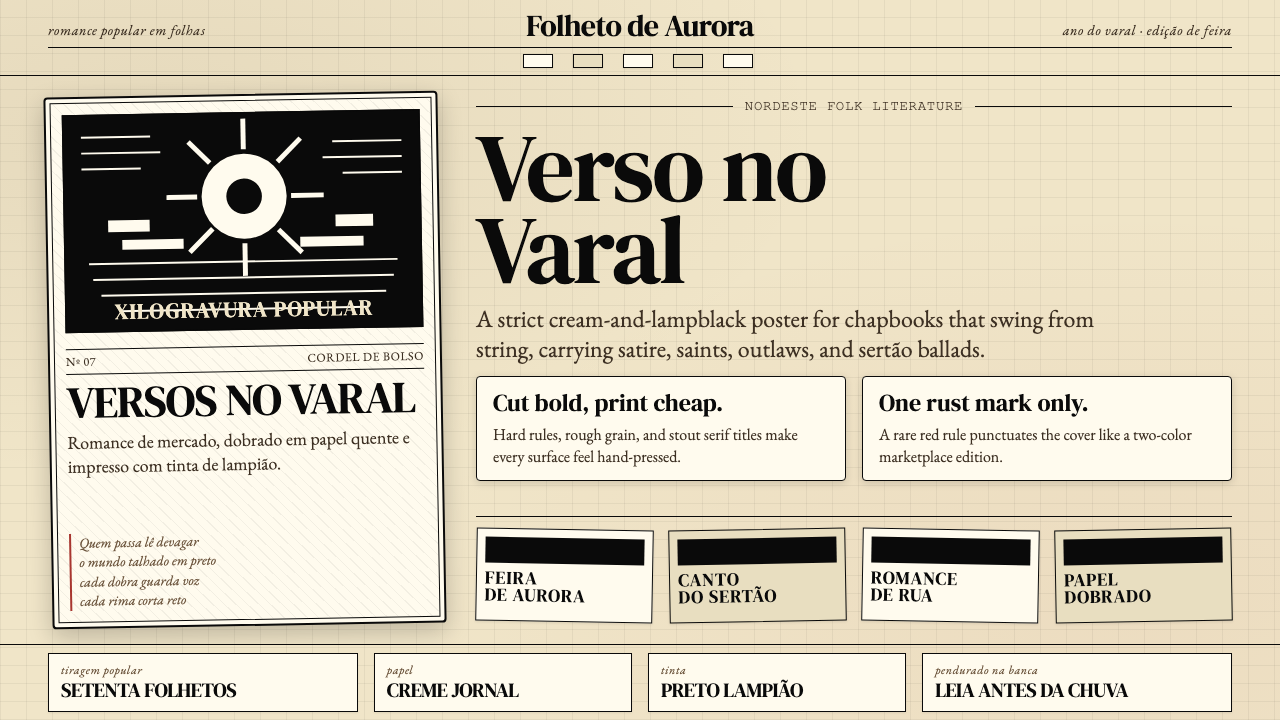 Brazilian Cordel (Northeast Folk Literature)Folk poetry, cut in lampblack. Cream newsprint, bordered chapbooks, one rust-…
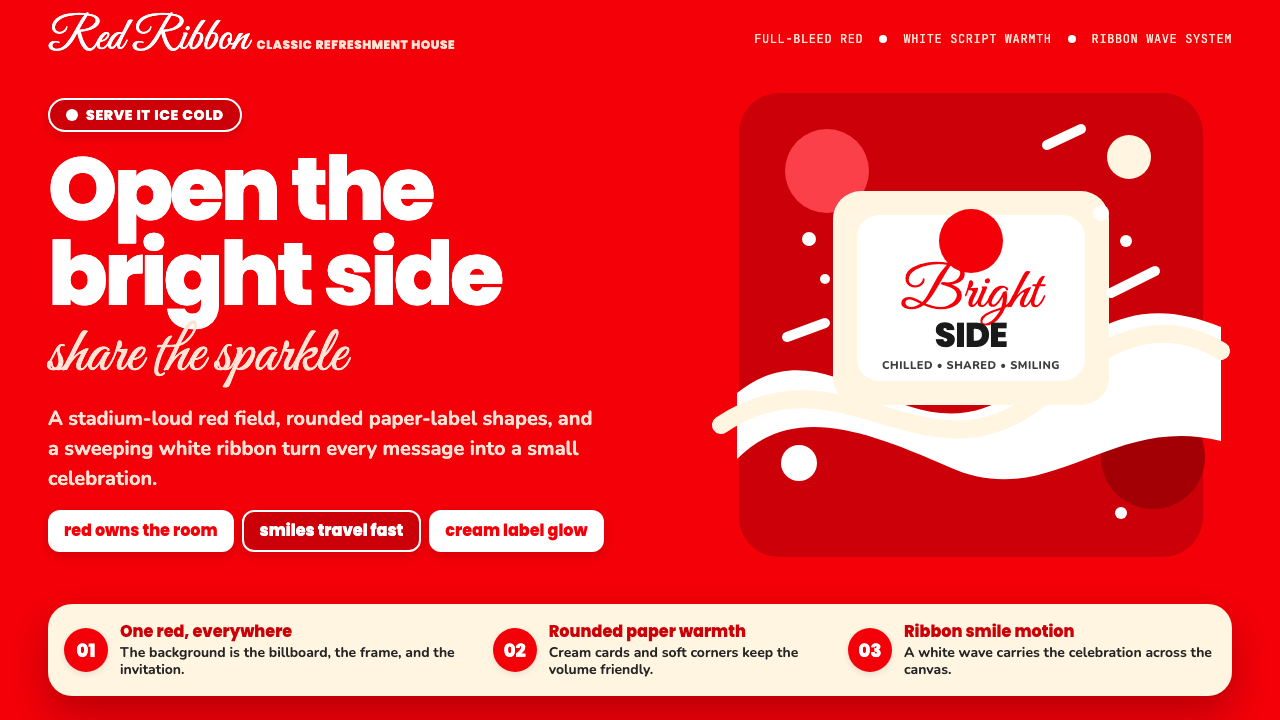 Coca-Cola ClassicHappiness goes full-bleed. Signature red, white ribbon waves, and warm rounde…