What is Coca-Cola Classic?
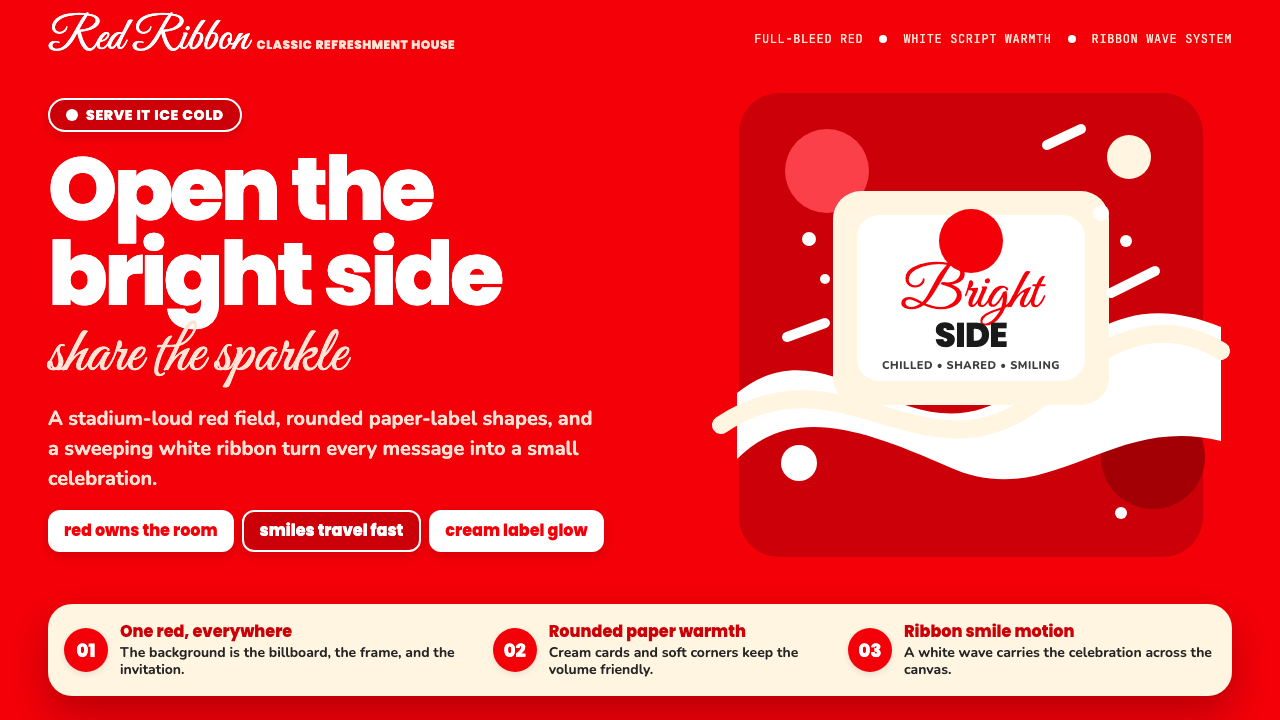
For over a century, a single shade of red and a looping script have made Coca-Cola the most emotionally charged brand identity on earth.
Coca-Cola Classic in brief
Coca-Cola Classic is not merely a brand identity — it is one of the most studied cases of how consistent visual language can fuse with collective memory to become culturally load-bearing. The system is built on three interlocking pillars: an unmodernized Spencerian script logo, a single dominant red that saturates every surface it touches, and a set of curvilinear supporting motifs — the ribbon wave, the contour bottle silhouette, and a grammar of roundness — that soften the red's intensity into something celebratory rather than aggressive.
The aesthetic is warm, unapologetically saturated, and deliberately populist. Nothing about it is neutral. Where minimalist systems withdraw to let the product speak, the Coca-Cola visual language advances — it floods the frame, it cheers, it performs happiness at full volume. The script logo is never simplified into a sans-serif; the red is never muted into a blush or a coral; the ribbon dividers are never replaced with flat rules. Every element is a committed choice, held stable across decades as a declaration that the brand's emotional promise does not need updating.
Understanding this system means recognizing that its apparent simplicity is the result of extreme discipline, not the absence of design decisions. Every curve, every wave, every degree of roundness in the supporting type has been tested against the core belief that warmth and global recognition are inseparable. The Coca-Cola Classic style is, in this sense, the anti-Bauhaus: where Bauhaus refines toward structural logic, Coca-Cola refines toward emotional resonance.

Where does Coca-Cola Classic come from?
The Coca-Cola visual system has its roots in a single act of penmanship. In 1887, Frank Mason Robinson — bookkeeper and business partner of the drink's inventor, John Stith Pemberton — wrote the name 'Coca-Cola' in the ornate, looping Spencerian script that was then the prestige hand of American commercial correspondence. Robinson's choice was not arbitrary: Spencerian script signaled professionalism and aspiration in the era of hand-written ledgers and calling cards. What Robinson could not have known was that the script he put to paper that year would remain essentially unchanged for more than thirteen decades, becoming one of the most reproduced letterforms in human history.
The red that now defines the brand arrived gradually. Early Coca-Cola advertising used a range of colors — greens, yellows, and oranges all appeared in nineteenth-century promotional materials. Red consolidated its dominance in the early twentieth century, in part because red signs were permitted on the sides of barns and buildings when other colors were not, giving the brand disproportionate outdoor presence. By the time the mid-century advertising boom arrived, red was inseparable from Coca-Cola in consumer perception, and the company systematized it accordingly. The contour bottle — the hourglass-shaped glass vessel designed in 1915 by the Root Glass Company in Terre Haute, Indiana, in response to a Coca-Cola brief requesting a bottle so distinctive it could be recognized in the dark — provided the system's defining three-dimensional form, and its silhouette entered the flat graphic language as a recurring motif.
The most consequential single creative contribution to the modern Coca-Cola identity was not made by a graphic designer but by an illustrator. Beginning in 1931, the American artist Haddon Sundblom produced a series of holiday advertisements for Coca-Cola depicting Santa Claus — round, red-suited, warm-faced — drinking the product in domestic interiors. Sundblom painted the campaign for thirty-three years, and his version of Santa, which drew on the earlier work of Thomas Nast but amplified its warmth and commercial appeal, became the globally dominant image of the figure. The Sundblom Santa did not merely sell a seasonal beverage; it demonstrated that the Coca-Cola visual system could take a pre-existing cultural icon and absorb it into its own emotional register so completely that the two became permanently identified with each other.
The identity reached its most refined and systematized form in 1969, when the design consultancy Lippincott and Margulies codified the 'Dynamic Ribbon Device' — the flowing wave element that appears beneath the logo and on packaging — establishing it as a permanent structural element of the system. This refinement introduced the disciplined relationship between the script wordmark, the ribbon, and the red field that contemporary designers recognize as canonical Coca-Cola. The system has been maintained and evolved by successive design programs through the early twenty-first century, each iteration preserving the Spencerian script, the red dominance, and the curvilinear warmth as non-negotiable constants.
What defines the Coca-Cola Classic look?
Red Dominance
The defining chromatic principle of the system is that red is not an accent — it is the ground. Surfaces bleed red from edge to edge; white and black appear as relief, not as the base. The red in question is a warm, slightly orange-leaning red — energetic and celebratory rather than aggressive or cautionary. When the system uses white, it is typically for the wordmark or typographic elements set against the red field, creating maximum contrast. The relationship is always red-first: any other color is a visitor in a red world.
Spencerian Script
The wordmark is the system's most protected element. The Spencerian script — an ornate, looping cursive style popular in nineteenth-century American business correspondence — has remained essentially unchanged since Frank Mason Robinson wrote it in 1887. Its loops and swashes carry historical weight and warm associations, and the brand has consistently resisted any impulse to rationalize or modernize it into a cleaner form. The script is not merely a logo; it is a time capsule that anchors the brand in a pre-industrial notion of handcraft and personal warmth, even as the product is manufactured at industrial scale worldwide.
Ribbon Wave
The Dynamic Ribbon Device — formalized in 1969 — is the system's primary structural divider and decorative motif. It appears as a flowing, two-tailed wave that sweeps across the lower portion of the composition, separating the main red field from complementary zones. The ribbon is always rendered in white against red, or in red against a lighter field, and its curvature echoes the contour bottle's hourglass profile. More than a decorative element, the ribbon performs a structural function: it anchors the wordmark, creates compositional movement, and introduces a sense of fluidity and warmth that a straight rule could never achieve.
Roundness and Warmth
Where angular systems use sharpness to signal precision or authority, the Coca-Cola system uses curves to signal welcome. Supporting type, when used beyond the main wordmark, tends toward rounded letterforms rather than geometric sans-serifs. Layout shapes — panels, buttons, callout containers — favor curves over hard corners. The contour bottle, reproduced as a graphic element, reinforces this bias toward organic, body-adjacent curves. The overall effect is that the visual system feels held rather than commanded — an environment that embraces rather than instructs.
Populist Celebration
The emotional register of the system is unambiguously celebratory, and this register is democratic by design. Coca-Cola advertising has historically avoided any imagery or tone that reads as exclusive, elite, or rarefied. The visual language of smiles, full-bleed red, and sweeping ribbon forms is expansive and inclusive by nature — it is designed to signal that the pleasure it represents is available to everyone. This populist warmth is as deliberate as any color choice: the system is engineered to feel neither luxury nor budget, but universally human.
Symmetry and Centering
Unlike asymmetric modernist systems, Coca-Cola Classic compositions tend toward centering and bilateral balance. The wordmark sits centrally, the ribbon extends symmetrically, and the overall framing is frontal and welcoming rather than directional and dynamic. This symmetry is not a formal principle in the Bauhaus sense — it is an emotional one. Centered compositions feel inclusive and addressed to the viewer directly, without the implicit direction of asymmetric layouts. The choice to center is a choice to make every viewer feel they are the intended audience.
Heritage Constancy
Perhaps the most unusual characteristic of the Coca-Cola visual system is its deliberate resistance to design trend cycles. While nearly every major brand identity has undergone significant visual evolution over the past century — rationalized logos, flattened color palettes, condensed typefaces — Coca-Cola has maintained the essential elements of its 1887 script and its mid-century color system with remarkable fidelity. This constancy is itself a design choice, and a powerful one: it signals that the brand's value is not contingent on contemporary taste, and that consistency over time has become the visual system's most distinctive quality.

Who shaped Coca-Cola Classic?
Robinson was the bookkeeper and business partner of Coca-Cola's inventor, John Stith Pemberton, and is credited with both naming the beverage and writing its original logo in Spencerian script in 1887. His choice of penmanship style was strategic — Spencerian script was the prestige hand of American commercial correspondence in the era before typewriters, and its use positioned the new drink as aspirational and professionally legitimate. Robinson's wordmark, produced as a functional business decision rather than an act of artistic vision, has outlasted virtually every other piece of commercial typography from its era.
Sundblom was an American commercial illustrator who, beginning in 1931, painted the series of holiday advertisements for Coca-Cola featuring Santa Claus that defined the modern visual conception of the figure. Over thirty-three years of painting the campaign, Sundblom developed a Santa whose physical warmth — rosy cheeks, laughing eyes, generous proportions, and a preference for Coca-Cola — became the globally recognized archetype. The campaign demonstrated that the Coca-Cola visual system's emotional logic extended beyond its graphic elements to encompass any imagery it chose to adopt. Sundblom's Santa became inseparable from the brand, and the brand became inseparable from Christmas.
Loewy, the Franco-American industrial designer who shaped the visual landscape of twentieth-century American commerce, contributed to the Coca-Cola visual system through his work on packaging and promotional materials. His design philosophy — that everyday objects should aspire to elegance and that commercial forms could be carriers of genuine aesthetic value — aligned naturally with Coca-Cola's ambition to make the ordinary feel extraordinary. Loewy's broader influence on American commercial aesthetics established the cultural context in which Coca-Cola's system of warmth and roundness was received as aspirational rather than merely popular.
The New York design consultancy Lippincott and Margulies codified the modern Coca-Cola identity system in 1969, formalizing the Dynamic Ribbon Device and establishing the disciplined relationship between the Spencerian wordmark, the ribbon wave, and the red ground that has defined the brand's visual language ever since. Their systematization transformed what had been an organically evolved set of visual conventions into a deliberately engineered identity that could be applied consistently across global markets and all media. This work represents one of the earliest and most influential examples of what is now called brand systems design.
How do you use Coca-Cola Classic today?
The Coca-Cola Classic style is one of the most immediately recognizable visual languages on earth, which means applying it in design work requires a clear purpose: you are not evoking a color palette, you are invoking a specific emotional register of warmth, celebration, and populist optimism. Before applying this style, establish that these associations serve the project — a food and beverage context, a consumer-facing celebration, a culturally warm campaign. The style struggles in contexts demanding neutrality, precision, or premium exclusivity.
For presentation slides, the style translates best when used boldly and without apology. A cover slide works well with a full-bleed red field, the main title set in large, rounded letterforms against it, and the ribbon wave device used as a compositional anchor at the bottom third. Avoid placing too many competing elements on a red ground — the system rewards restraint in the number of elements and exuberance in their treatment. Content slides are better served by a white or near-white ground with a red accent band or ribbon at the top or bottom, keeping the dominant red reserved for structural signal. Data slides can use red as the primary data color for the key metric or category, with supporting data rendered in a more neutral tone to preserve hierarchy without visual overload.
For web interfaces and digital dashboards, the Coca-Cola Classic system is most appropriate for consumer-facing product pages, promotional landing pages, and seasonal campaign microsites where emotional impact outweighs information density. The approach: use red as the hero background for primary sections, white for content areas, and the ribbon device as a section transition. Rounded button shapes and container borders reinforce the system's warmth. Navigation should be clean and typographically driven — the red environment is already doing significant emotional work, so interface chrome should not compete. Pricing pages can use red to draw attention to the recommended tier, but should transition quickly to more neutral zones for detailed plan comparisons.
For editorial and marketing applications, the style excels in contexts where the goal is emotional immediacy rather than sustained reading. Full-bleed red spreads with centered white type, ribbon dividers separating thematic sections, and illustrations or photography treated with high warmth and saturation all extend the system naturally. Marketing materials — posters, social cards, outdoor advertising — benefit from the system's poster-like boldness: single dominant message, centered composition, red field, white script. The style supports very little body copy; if extended text is required, it should be introduced on white sections adjacent to the red, not on the red itself.
The most common mistake when applying the Coca-Cola Classic style is confusing saturation with accuracy. The system is not simply about using a lot of red — it is about using one specific emotional quality of red, consistently, in a composition where every other element reinforces rather than competes with it. Adding gradient effects to the red, introducing multiple accent colors, or applying the ribbon device on a non-red field all undermine the system's logic. Similarly, using angular or geometric sans-serif type in place of rounded, warm letterforms misreads the system's character: the roundness of the supporting typography is not decorative, it is structural to the emotional message. Authenticity requires reading the system as a complete emotional argument, not as a collection of separable visual assets.

Coca-Cola Classic — FAQ
Is Coca-Cola Classic style suitable for luxury or premium product design?
Generally not. The Coca-Cola system is fundamentally populist — it is designed to signal warmth, accessibility, and shared pleasure rather than exclusivity or rarity. Luxury design systems typically use restraint, negative space, refined neutrals, and subtle detailing to communicate premium positioning. The Coca-Cola system's saturated red, bold script, and celebratory tone read as democratic rather than exclusive. Attempts to reconcile the two often produce something that communicates neither premium nor warmth convincingly. If warmth is the goal but the brand requires some sense of premium, consider using the curvilinear logic and warmth register of the Coca-Cola system while significantly reducing the red saturation and increasing visual breathing room.
How does the Coca-Cola Classic style differ from other warm, red-dominant brand systems?
The key distinguishing features are the Spencerian script wordmark and the ribbon wave device. Other red-dominant brand systems — whether in food, entertainment, or retail — typically use contemporary typefaces and geometric supporting elements. Coca-Cola's system is unique in its insistence on a nineteenth-century handwritten script that has never been rationalized, and in the fluidity of the ribbon device, which introduces a calligraphic quality into what might otherwise be a flat graphic system. These two elements — historical script plus flowing ribbon — produce a warmth that feels earned through time rather than designed for effect. Without both of them, you may have a red design system, but you do not have Coca-Cola.
Can the Coca-Cola Classic visual language work effectively in digital dark-mode environments?
With care. The canonical system is built on a light ground — white elements appear on red, red appears on white, and there is no concept of a dark neutral ground in the classic vocabulary. A dark adaptation is possible, but it requires recalibration: on a very dark ground, the saturated red tends to appear neon-like rather than warm and celebratory. The ribbon device and script wordmark can hold in white or in a lighter warm tone against a dark field, but the dominant red panels need to be replaced rather than darkened, lest the warmth of the system convert entirely to visual aggression. Dark-mode versions of the system work best when they borrow the curvilinear warmth and the script, but use a deep warm brown or a very dark warm neutral as the ground rather than attempting to maintain red dominance.
What is the right relationship between the script logo and supporting typography in this system?
The Spencerian script is sacred and must not be modified, stretched, redrawn, or replaced. Everything else in the typographic hierarchy — headlines, subheadings, body copy, labels — should defer to it rather than compete with it. Supporting type works best when it is clearly subordinate in scale and weight relative to the wordmark, uses rounded letterforms that echo the script's warmth without imitating its style, and avoids sharp, geometric, or heavily condensed forms that would create visual dissonance. The supporting type's job is to be legible and warm, not to be interesting. Keeping the typographic supporting cast quiet and rounded allows the Spencerian script to remain the dominant and most distinctive visual element in the system, which is where all the emotional recognition lives.
Is there a risk of the Coca-Cola Classic style reading as pastiche or parody rather than sincere homage?
Yes, and this is one of the most important practical considerations when deploying the style. Because the Coca-Cola identity is so universally recognized, applications that land too close to the original can read as mockery or unauthorized borrowing rather than design influence. The way to avoid this is to apply the system's principles — curvilinear warmth, red dominance, celebratory tone, script-like lettering — rather than its literal elements. Avoid reproducing the specific wordmark proportions or ribbon curvature too precisely; instead, internalize the emotional logic of the system and express it through original visual decisions. The Coca-Cola system is powerful precisely because it is a set of emotional commitments, not a set of copiable assets. The copies that age well are those that understood the feeling, not those that traced the curves.
Related design styles
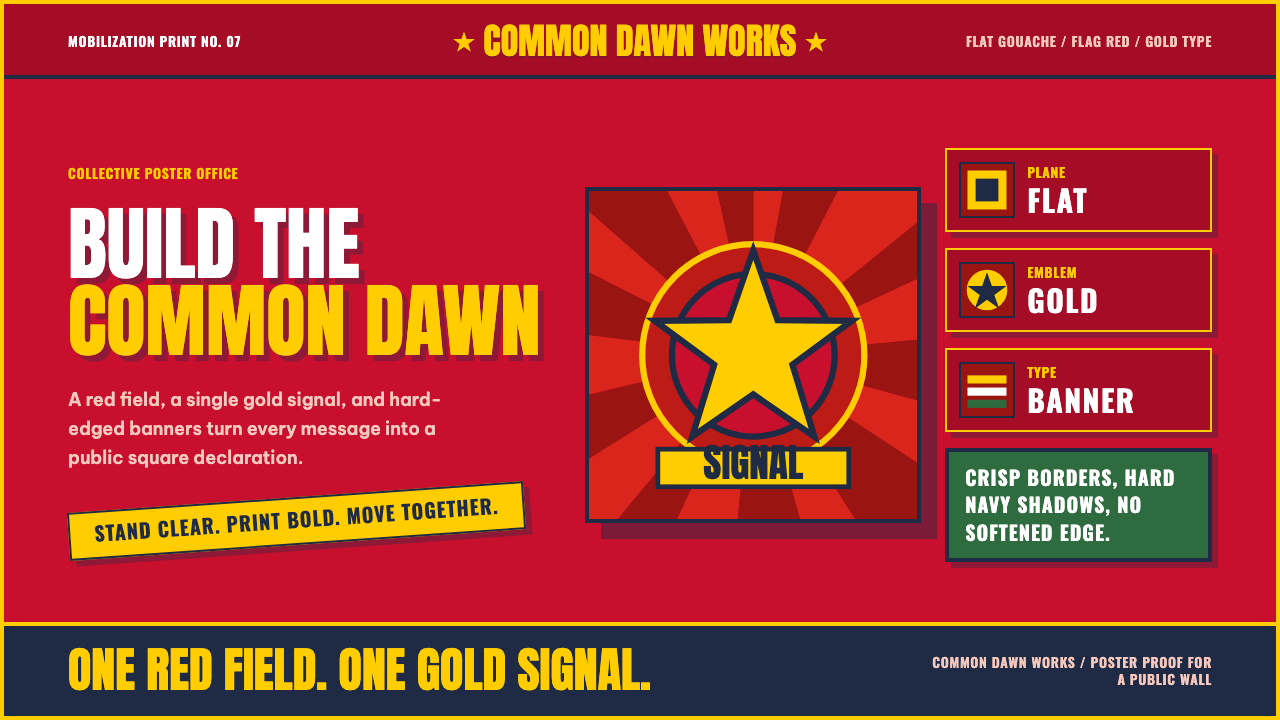 Vietnamese PropagandaFlat color commands. Flag-red fields, gold star rays, and Anton slogans hit a…
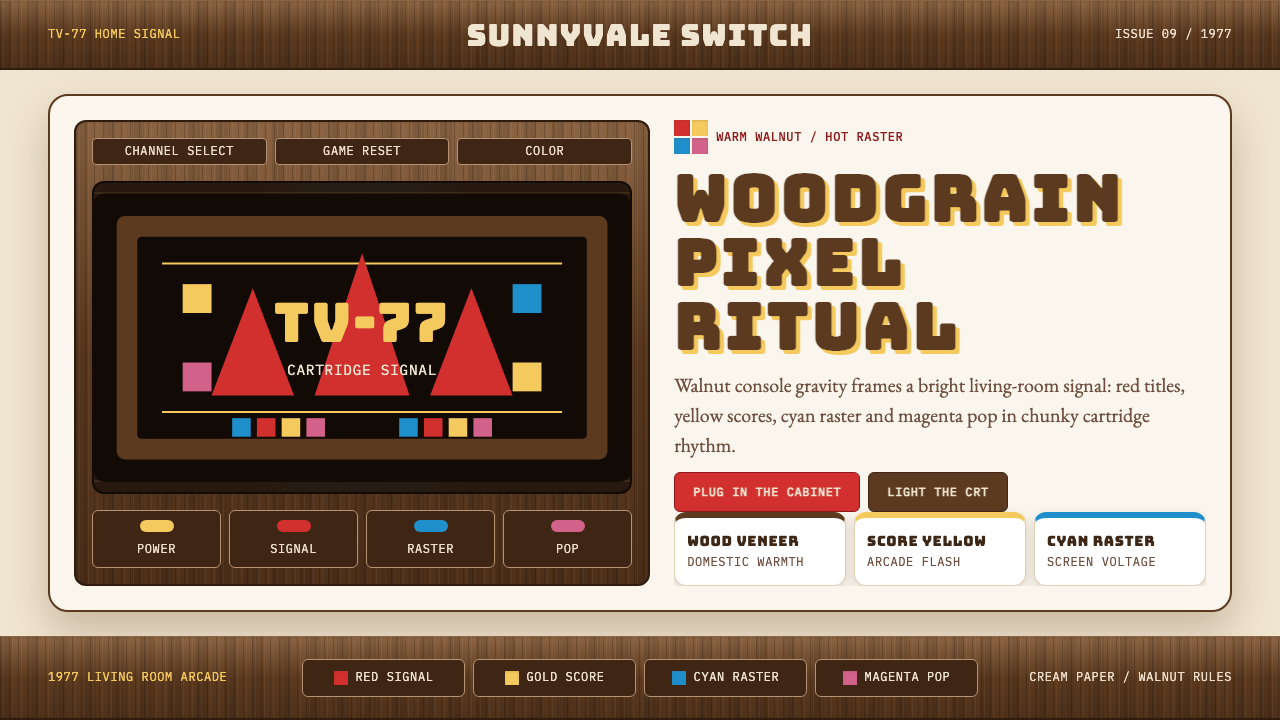 Atari 2600 (Woodgrain)Woodgrain meets raw pixels. Walnut panels frame Bungee type and CMYK raster b…
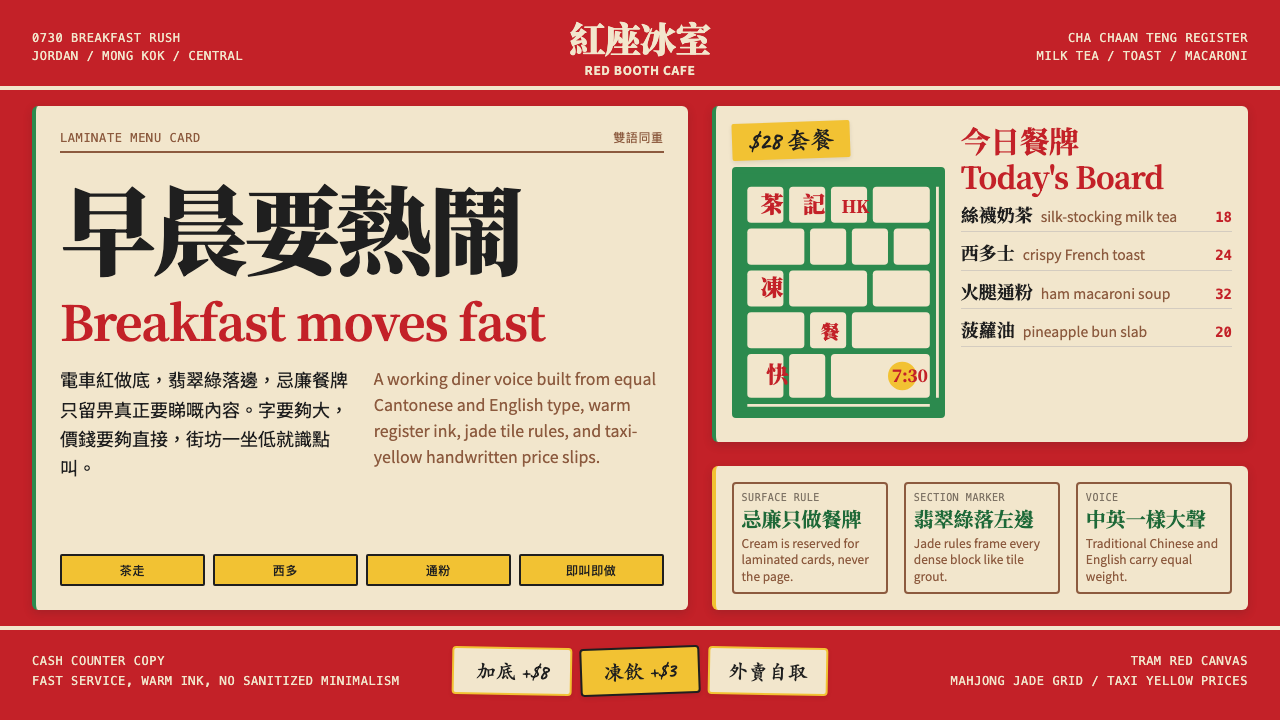 Hong Kong Cha Chaan TengDemocratic diner warmth. Tram red, jade rules, cream menu cards, equal Canton…
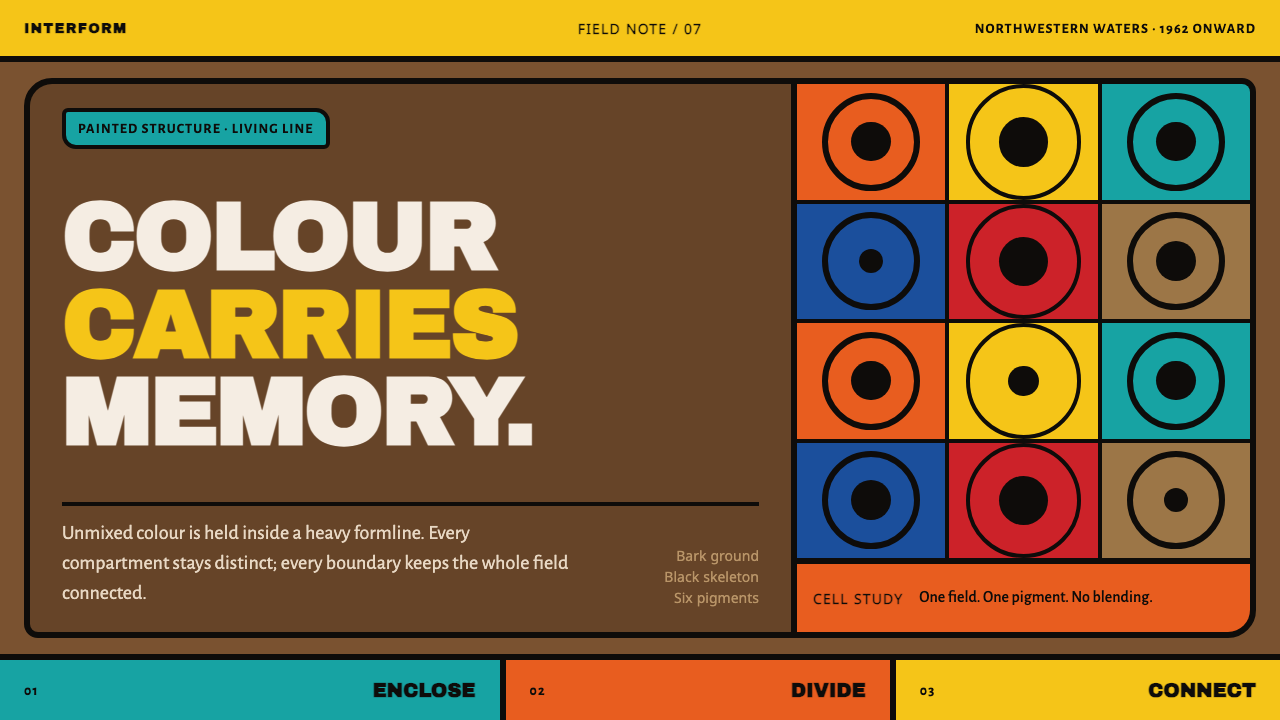 Woodland School — MorrisseauColour carries memory. Unmixed orange, yellow and turquoise lock into heavy b…
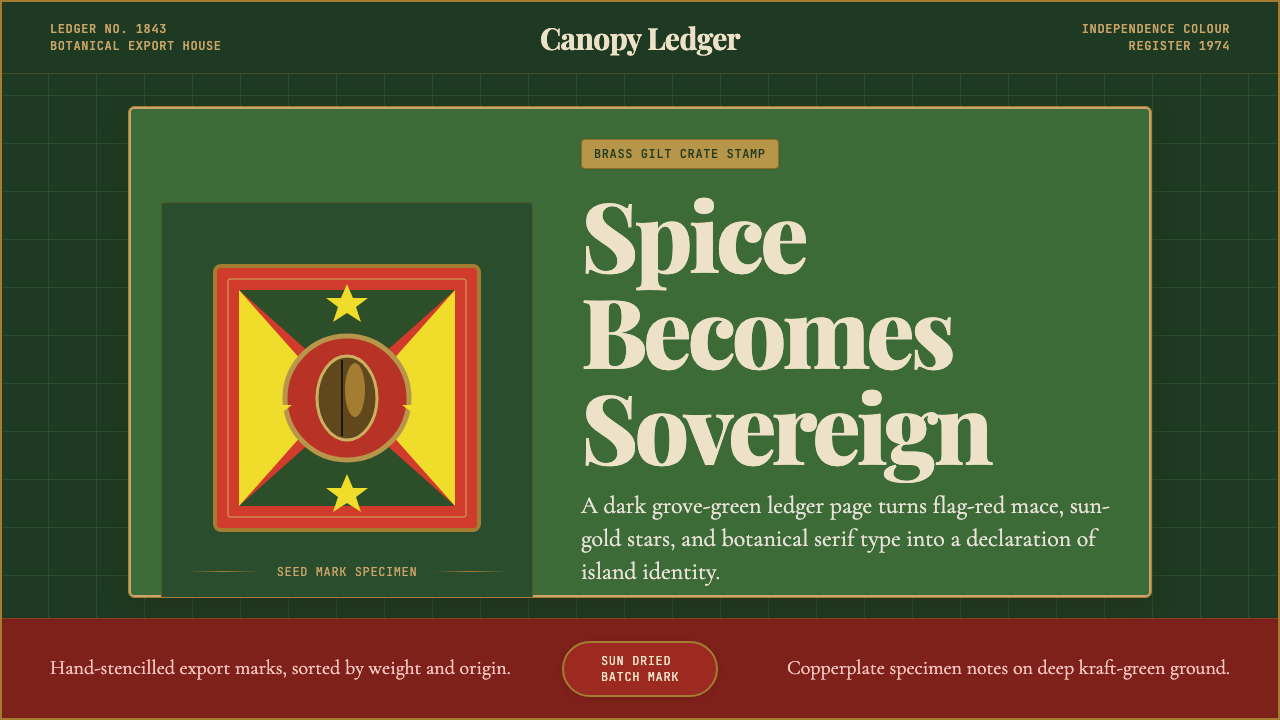 Grenadian Spice & Nutmeg FlagSpice becomes sovereign. Grove green, flag red, brass borders, and serif ledg…
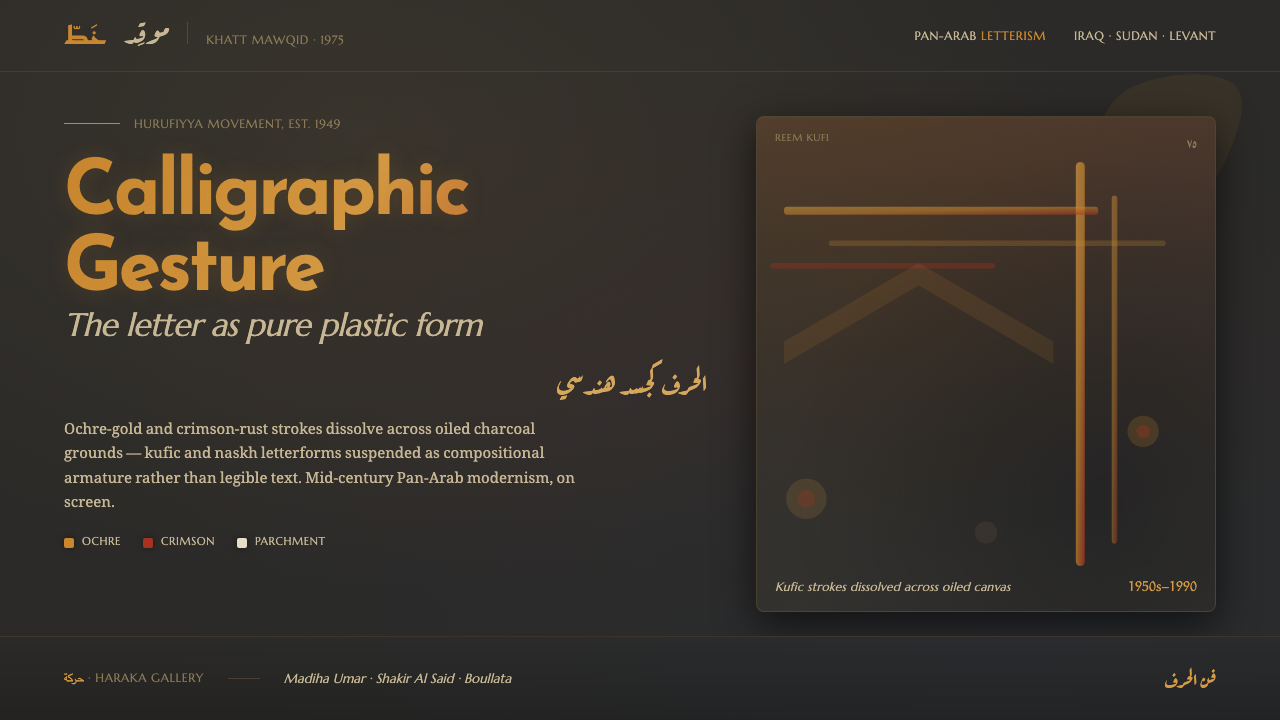 Hurufiyya Letter ArtArabic letters as pure gesture. Ochre and crimson strokes dissolve across oil…