What is Brazilian Cordel (Northeast Folk Literature)?
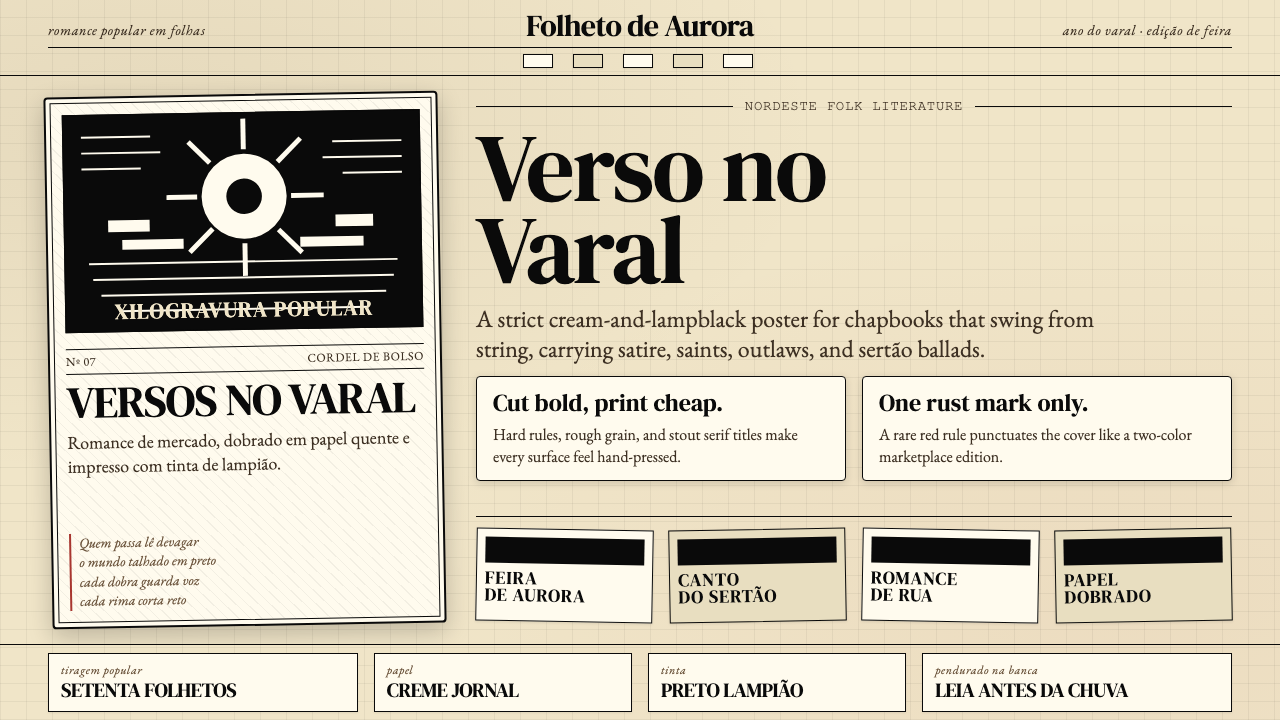
Brazilian Cordel turns lampblack ink and cream newsprint into folk epics — woodcut portraits of outlaws and saints swinging from marketplace strings across the Northeast sertão.
Brazilian Cordel (Northeast Folk Literature) in brief
Brazilian Cordel — formally known as Literatura de Cordel — is the illustrated chapbook tradition of Brazil's Northeast, where small folded paper pamphlets of narrative ballads, religious tales, and satirical verse were sold at market stalls, hung in rows from lengths of twine (cordel means 'string' in Portuguese). Each booklet's cover bears a bold black-and-white woodcut: a cangaceiro outlaw frozen mid-pose, a sertão landscape of cactus and dry river beds, a crowned saint, or a monster from popular legend. Inside, the verse runs in six-line stanzas with ABCBDB or ABCBCB rhyme schemes, printed in chunky letterpress type on paper that is cheap by design.
The aesthetic is one of enforced economy made beautiful. The palette is built from two tones: lampblack ink pressed into cream or off-white newsprint, with the rarest rust-red accent appearing on two-color covers. There are no photographs, no airbrushed gradients, no polished illustrations — only the hand-cut woodblock line, honest about every nick of the chisel. The type is a sturdy, upright serif, set tight and bold, commanding the eye the way a market barker commands a crowd. The whole visual system communicates that the content is urgent, populist, and immediate.
UNESCO recognized Cordel literature as Intangible Cultural Heritage of Humanity in 2018, acknowledging a tradition that has functioned simultaneously as oral memory, illustrated journalism, political commentary, and folk theology. As a design vocabulary, Cordel carries the authority of genuine necessity: every formal choice — the two-tone restriction, the woodcut grain, the folded paper edge — emerged from the realities of a printing economy serving a rural, largely oral-culture audience. That rootedness in material constraint is exactly what makes the aesthetic so distinctive and so resistant to superficial imitation.

See the Brazilian Cordel (Northeast Folk Literature) design system
Where does Brazilian Cordel (Northeast Folk Literature) come from?
The roots of Cordel reach back across the Atlantic. The Portuguese brought the folheto — a small printed pamphlet of popular verse — to Brazil during the colonial era, drawing on a European chapbook tradition that itself descended from the romanceiro, the body of oral narrative poetry common across the Iberian Peninsula since the medieval period. In Portugal, these booklets circulated at fairs and markets, sold by street hawkers who often chanted the verses aloud as advertisement. When this form arrived in Brazil, it did not simply transplant itself — it hybridized, absorbing the storytelling rhythms, mythological figures, and social grievances of the Northeast's own oral culture.
The tradition flourished in the arid interior of the Northeast — the sertão — during the latter half of the nineteenth century, a region defined by periodic drought, cattle culture, messianic religious movements, and the rise of the cangaceiro bandits who would become Cordel's most enduring folk heroes. The city of Juazeiro do Norte in Ceará became a spiritual and commercial center, partly because of the cult following of the priest Padre Cícero, whose miracles and controversies generated enormous demand for printed religious tracts in the Cordel format. From the 1880s through the early twentieth century, poet-printers set up small operations in Recife, Fortaleza, and across the interior, producing thousands of titles on hand-operated presses.
The golden age of Cordel ran from roughly the 1920s through the 1970s. During this period, the form developed its canonical visual identity: standardized booklet dimensions, the convention of hanging pamphlets from string at market stalls (which gave the tradition its name), and the woodcut cover image as the primary attention-getter in a marketplace where many buyers were functionally illiterate and chose their reading matter by the image. The woodcut artists — often the same poet-printers — developed a visual shorthand of instantly readable characters and scenes: the half-moon hat of the cangaceiro, the halo of the saint, the curling tail of the devil, the wings of the angel.
By the 1970s and 1980s, urbanization and the spread of radio and television eroded the mass-market role of Cordel. But the form did not disappear — it transformed. Younger artists, particularly in the academic and gallery context of Rio de Janeiro and São Paulo, began treating Cordel woodcuts as a fine-art medium. Museums collected original blocks. Scholars documented the full corpus. Contemporary Cordel artists now work in dialogue with that archive, using the visual vocabulary of the tradition to address current social and political subjects, and the form's UNESCO recognition has secured both institutional support and renewed popular interest.
What defines the Brazilian Cordel (Northeast Folk Literature) look?
Two-Tone Palette
Cordel operates with an extreme restriction: lampblack ink on cream or off-white newsprint is the default and the rule. The ground is warm — aged paper rather than pure white — and the ink is dense and flat, without tonal gradation. A rust-red accent appears on the most elaborate covers as a second color, used for borders, rules, or to flood a background panel behind the main woodcut. No other color enters the system. This two-tone discipline is not a stylistic choice but a production reality that became an aesthetic identity: cheap printing meant one or two ink passes, and the warmth of the newsprint ground became the visual signature of populist authenticity.
Woodcut Imagery
The woodcut is Cordel's defining visual element: a cover image carved directly into wood or linoleum, inked, and pressed onto paper. The technique produces a characteristic visual texture — solid black masses broken by white relief lines, edges that are slightly ragged from the grain of the wood, forms that simplify complex figures into readable silhouettes. Cordel woodcuts are never fine or delicate; they are bold, immediate, and readable at arm's length in an outdoor market setting. Faces are expressive but schematic. Bodies carry symbolic attributes — the outlaw's hat, the saint's halo — rather than realistic detail. The grain of the woodblock is a visible, welcomed element of the surface.
Declarative Border and Rule
Cordel covers are almost always framed by a bold rectangular border, often doubled or tripled as a series of concentric lines, sometimes with corner ornaments in a simple geometric or floral form. This border performs a clear function: it marks the chapbook as a complete, intentional artifact — a contained world — and distinguishes the image area from the text area. Interior pages use horizontal rules to separate sections of verse. These structural lines are never decorative in a refined sense; they are the typographical equivalent of the woodcut — thick, direct, and legible at a glance.
Upright Serif Typography
The type used in Cordel publications is consistently a sturdy, upright serif — the kind of letterpress face suited to heavy inking on absorbent paper. Letter spacing is tight, and lines are set with minimal leading, packing as many stanzas as possible onto a small page. Titles are set large and bold on the cover, often in two or three sizes to create a rough hierarchy: the poem's main title at the largest size, the poet's name below it, and a subtitle or thematic label smaller still. There is no italic for emphasis; bold weight and capitalization do all the hierarchical work.
Folded Paper Format
Cordel chapbooks are small and folded — typically eight or sixteen pages formed from a single sheet folded and cut, or several sheets nested together. The physical format carries meaning: the pamphlet is cheap enough to be disposable, small enough to carry in a pocket or hang from a string, and self-contained enough to be read in a single sitting. This format establishes a visual proportioning system — the tall, narrow page — that governs all the compositional decisions inside. Margins are narrow because paper is not wasted; images occupy as much of the cover as the border allows.
Populist Directness
Every visual choice in Cordel communicates immediately, without mediation. The woodcut images are readable from several feet away; the cover title announces its subject without teasing or withholding. There is no visual complexity for its own sake, no ambiguity of reading direction, no element that requires familiarity with design conventions to decode. This directness is structural: the audience for Cordel pamphlets historically included buyers with limited formal literacy who navigated the marketplace by image and word-of-mouth. The visual system had to work at arm's length, in strong sunlight, for an audience in motion.
Surface Texture as Authenticity
In Cordel, the visible traces of making — the woodgrain in the cut, the slight unevenness of ink distribution, the rough paper edge of the folded pamphlet — are not defects but authenticating marks. They signal handmade production, local origin, and human labor in a way that smooth, mechanically perfect surfaces cannot. Contemporary designers applying Cordel as an aesthetic must decide how to handle this: the goal is not to fake distress or artificially age a surface, but to understand that the original visual warmth came from real material constraints, and to find contemporary equivalents that carry similar honesty — slightly irregular line weights, visible paper texture, ink that reads as pressed rather than rendered.

See the Brazilian Cordel (Northeast Folk Literature) design system
Who shaped Brazilian Cordel (Northeast Folk Literature)?
Widely regarded as the founding figure of Brazilian Cordel, Leandro Gomes de Barros was born in Paraíba in 1865 and began publishing pamphlets in Recife around 1893, eventually producing over a thousand titles across his career. He established the canonical form of the Cordel booklet — its meter, its rhyme schemes, and its cover conventions — and proved that popular poetry could sustain a viable commercial printing operation in the Northeast. His subjects ranged from local political satire to adaptations of European adventure stories and original tales of supernatural encounter. The scale and influence of his output earned him the informal title 'King of the Cordel poets,' and virtually every subsequent poet worked in his shadow.
João Martins de Athayde was born in Paraíba in 1880 and became the most commercially successful Cordel publisher of the early twentieth century, establishing a printing operation in Recife that dominated the Northeast market for decades. He was a shrewd businessman as well as a poet — he purchased the rights to Leandro Gomes de Barros's catalog after that poet's death in 1918, effectively inheriting custodianship of the canonical Cordel archive. His editions standardized the physical format and printing quality of the chapbook across the region. His business model — direct distribution to market vendors, low unit price, high volume — became the template for Cordel commerce through most of the twentieth century.
José Francisco Borges, known universally as J. Borges, was born in Bezerros, Pernambuco, in 1935 and is the woodcut artist most responsible for elevating Cordel's visual dimension from craft anonymity to recognized art form. Self-taught, he began carving woodblocks in the 1960s and quickly developed a visual style of exceptional inventiveness — densely populated compositions, fluid human figures in dynamic poses, elaborate fantastical scenes combining religious, political, and folkloric elements. His prints were exhibited internationally from the 1970s onward, collected by major museums, and recognized with the Brazilian state's highest cultural honors. J. Borges demonstrated that Cordel woodcuts could bear as much artistic weight as any printmaking tradition, and his work is the reference point for understanding the visual language at its most developed.
Expedito Sebastião da Silva, known as Mestre Noza, was born in Juazeiro do Norte, Ceará, in 1911 and became one of the most revered wood sculptors and engravers associated with the Cordel tradition. Working in the shadow of Padre Cícero's religious cult that made Juazeiro a pilgrimage city, Mestre Noza produced religious and devotional imagery that fused folk Catholicism with the formal vocabulary of Cordel woodcut. His work represents the tradition's deep entanglement with Northeast popular religiosity — the same figures that appear on Cordel covers as printed characters were, in his hands, carved in three dimensions as objects of veneration. He was recognized by the Brazilian government as a living master of popular culture before his death in 1999.
How do you use Brazilian Cordel (Northeast Folk Literature) today?
Cordel is a style built on genuine scarcity, which means applying it correctly requires discipline about what to include as much as skill in execution. The system's power comes from the two-tone palette, the woodcut-like visual weight, and the warm paper ground — disturb any one of these and the coherence collapses. Before adding color, adding texture, or adding visual complexity, ask whether the addition serves the communication or dilutes the aesthetic economy that makes Cordel legible and arresting.
For presentation slides, Cordel works with particular force on cover slides and chapter dividers. A cover should commit fully to the system: a warm cream or aged-paper ground, a large woodcut-style illustration or a bold geometric woodcut motif centered or weighted to one side, a thick rectangular border, and a title set in a heavy upright serif at commanding scale. The title should declare, not suggest. Content slides carry the system through typographic restraint — sturdy serif type, generous space between text blocks, horizontal rules as section dividers rather than colored bands. Data slides take on an illustrated quality: bar charts and area charts treated as graphic objects, colored only in the two-tone palette, with annotations set as if printed from a letterpress.
For web interfaces, Cordel is most effective on pages designed for emotional impact rather than dense interaction — editorial landing pages, cultural institution sites, campaign microsites, or brand storytelling contexts. A Cordel-informed dashboard would use a warm off-white background, black as the dominant text and border color, rust-red reserved for primary calls to action or critical alerts, and an illustrated or woodcut-textured hero element as the focal point. Navigation is best kept typographic and minimal: the visual weight budget is occupied by the woodcut imagery, and competing UI chrome will undermine the composition. Pricing pages can use the bold-border, two-tone-panel approach — alternating cream and near-black sections — to create a strong rhythm without requiring additional color.
For editorial and marketing work, Cordel gives designers a clear structural logic: the image declares, the border contains, the type explains. An editorial layout following this logic places the dominant woodcut-style image large and above the fold, uses the border or a heavy ruled line to mark the transition from image to text, and keeps the body text in a readable upright serif at a comfortable measure. Marketing materials benefit from the poster sensibility of the tradition: a single bold image, a single bold claim, a single call to action, all held within a bordered field. The rust-red accent appears once — on the call to action or a critical label — and not again. This restraint is the discipline that separates Cordel-informed work from decorative pastiche.
The most common mistake when applying Cordel is the addition of color beyond the two-tone system. A third color — even a neutral — breaks the visual logic that gives the palette its strength. Equally damaging is the substitution of a smooth digital illustration for a properly textured woodcut-style image: Cordel's visual power depends on the visible evidence of pressure and tool, and a clean vector drawing, however stylized, reads as illustration rather than Cordel. Similarly, replacing the upright serif with a casual or decorative typeface removes the typographic seriousness that anchors the composition. The style is difficult to modernize through softening — every softening decision (rounder type, softer lines, lighter borders) moves the work toward folk pastiche and away from the populist urgency that is Cordel's actual emotional register.

See the Brazilian Cordel (Northeast Folk Literature) design system
Brazilian Cordel (Northeast Folk Literature) — FAQ
Is Cordel the same as other Latin American folk-print traditions?
Cordel shares the broader chapbook tradition with related forms across Latin America and the Caribbean, and its Portuguese roots connect it to the European broadside tradition. But it is distinct from Mexican lotería imagery, from Chilean arpillera textile narrative, and from Argentine gaucho literature in ways that go beyond geography. The specific combination of woodcut cover, folded-pamphlet format, regular verse meter, and marketplace distribution by hanging from string is particular to the Brazilian Northeast. The color discipline — lampblack on cream with rust-red as the sole accent — is also specific and is one of the most immediately recognizable markers of the tradition's authenticity versus adjacent folk-art influences.
How do I apply Cordel without making the design feel like a costume?
The distinction between authentic Cordel-informed work and folk pastiche comes down to structure versus decoration. Cordel's visual choices were structural — the two-tone palette was all the printing operation could afford, the border contained the image within a small format, the upright serif was the standard letterpress face available. When a designer applies the Cordel aesthetic, the most authentic results come from treating those choices as structural decisions with reasons behind them, not as decorative patterns applied over a layout. Ask: does this border serve the composition by creating a container? Does the rust-red accent appear exactly once because anything more would destabilize the economy? Does the texture feel like real material pressure, not applied distress?
Can Cordel work in a digital product with interactive elements?
Yes, but the application requires translating physical properties into digital equivalents with care. The two-tone palette translates directly: warm off-white as the ground, near-black as the primary text and border color, rust-red as the single interactive accent. The border convention translates to card components with visible, sturdy borders rather than drop shadows — hard borders rather than floating elevation. The woodcut texture requires the most thought: a full woodcut illustration is appropriate as a hero or feature element, but interface icons should follow the same visual logic — high contrast, simplified form, slightly irregular line weight — without attempting to simulate the full woodcut process on every interactive element. Animation should be minimal and mechanical rather than fluid.
What is the right way to use texture in a Cordel-inspired design?
Texture in Cordel is not applied — it is inherent. The grain of the woodblock appears in the image because the ink did not fully cover the wood between relief lines. The slight unevenness of ink on newsprint is a result of the paper's absorbency and the press pressure. When translating this to a designed artifact, the principle is that texture should appear where a real material process would have produced it: in the woodcut illustration, in the paper ground, and in the printed rules and borders — not as an overall filter applied to the entire composition. Applying a uniform paper texture overlay to a flat digital layout is the equivalent of wearing a costume; using a genuinely textured ground and a woodcut-style illustration is the equivalent of dressing in the tradition's actual clothes.
How does Cordel handle type hierarchy without multiple typefaces or colors?
Cordel achieves hierarchy through size, weight, and spacing — the same tools available to any typographer working under production constraints. A Cordel cover uses three or four type sizes: the poem title at the largest scale, a descriptive subtitle smaller, the poet's name smaller still, and a publisher mark or location detail at the smallest scale. All are set in the same typeface family, distinguished only by size and sometimes weight. Interior pages use the distinction between verse stanzas and section headers through size and a horizontal rule rather than color or typeface change. The horizontal rule — a thick black line — does the work that color would otherwise do, creating visual stops and starts that guide the reader through the content.
Related design styles
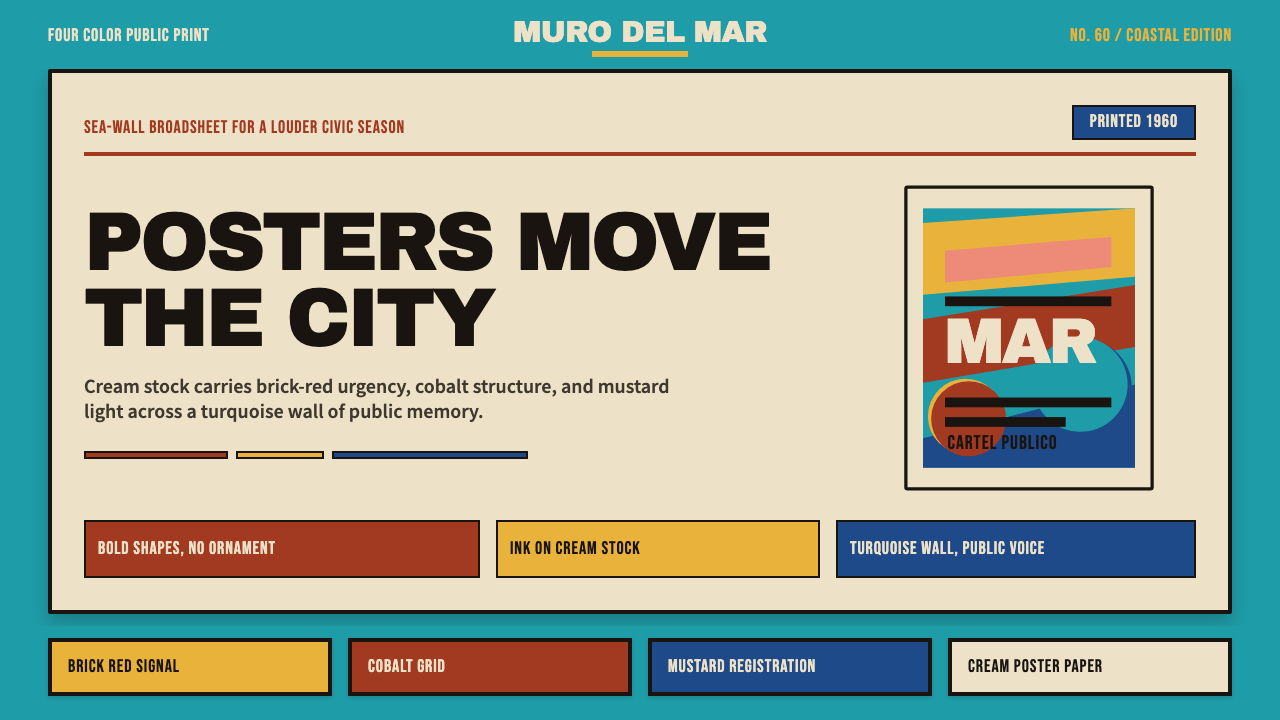 Cuban Malecón 1960 PosterPublic voice in flat ink. Turquoise wall, cream stock, brick red and cobalt b…
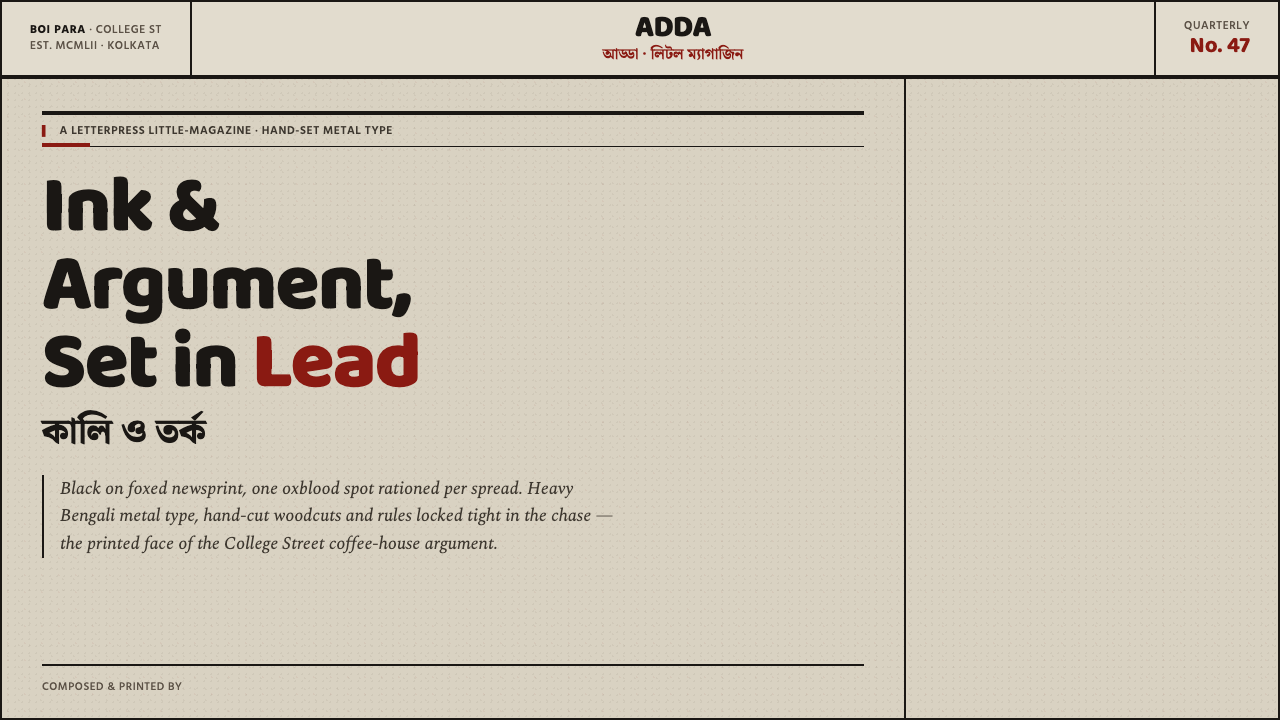 Kolkata Adda LetterpressAustere print, alive with argument. Baloo Bengali type and oxblood rules bite…
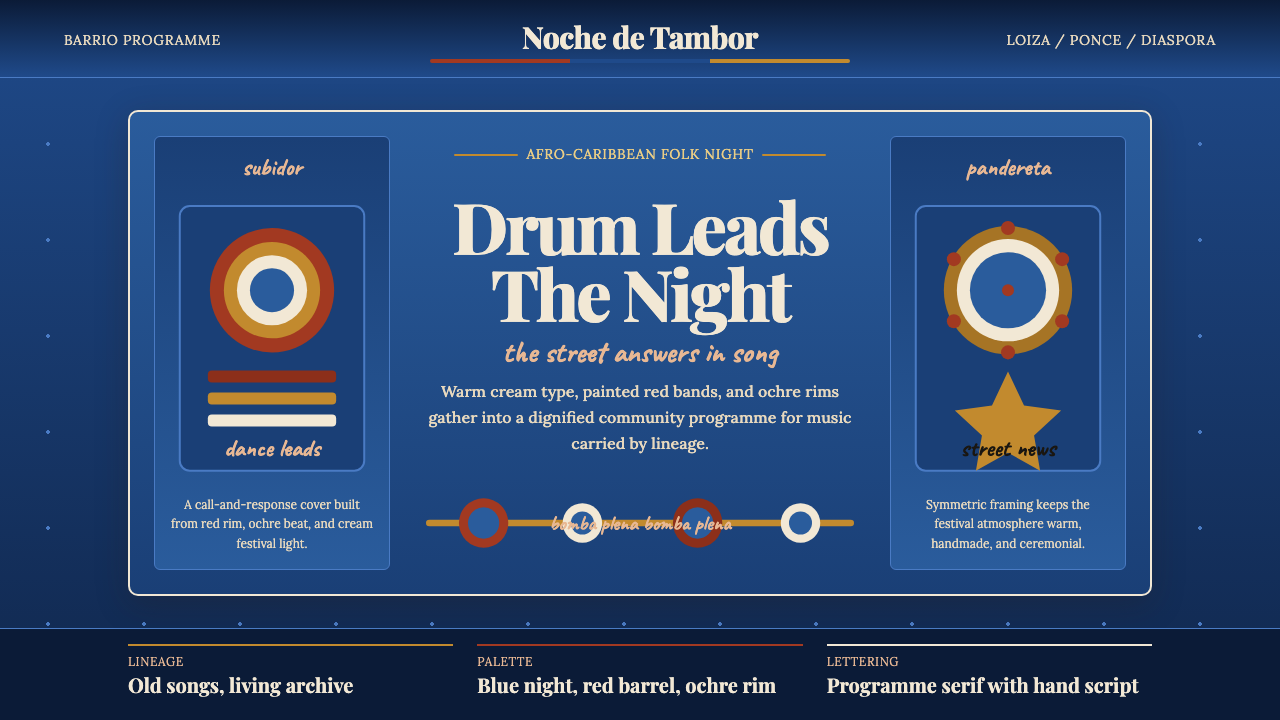 Puerto Rican Bomba & PlenaNight festival dignity. Drum-red stripes and cream Playfair type on deep trop…
 Taller de Gráfica PopularPrint that takes a side. Carbon-black blocks shout across acid-browned newspr…
 UNAM Library MosaicStone outlasts paint. Burnt-orange panels lock across volcanic gray with one…
 Algerian Casbah Poster (1954–1962)Every surface is a manifesto. Blood red, warning yellow, and stencil type hit…