What is Paris Match?
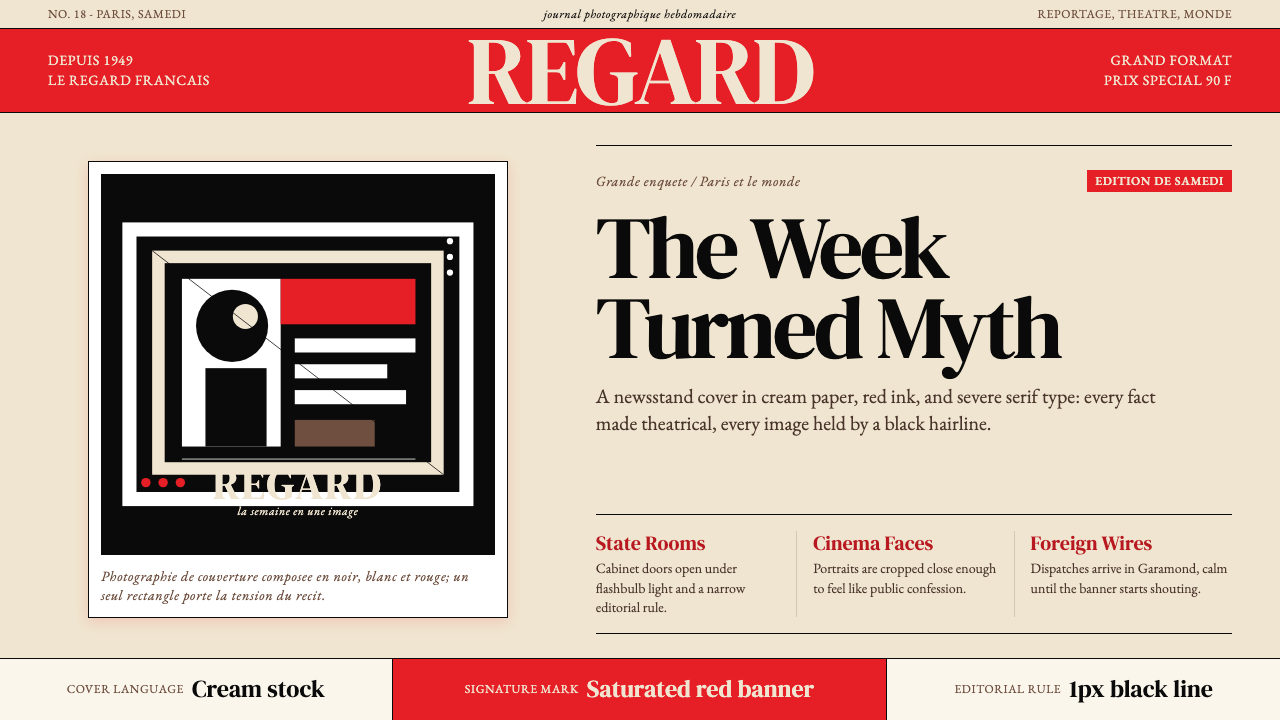
One saturated red banner, a single dramatic portrait, and the certainty that the cover must stop you cold — that is the Paris Match visual contract, unchanged since 1949.
Paris Match in brief
Paris Match is the visual language of French photojournalism elevated to a design system: cream grounds, a single monolithic slab of saturated red as wordmark, classical French serif headlines, hairline rules, and a generous, unhurried sense of typographic spacing. Every spread reads as though it has been composed on a light table by someone who understood that restraint, deployed correctly, creates more drama than decoration ever could.
At its core, the style is built on the tension between two forces: the absolute calm of cream paper and refined serif type, and the single, almost violent intrusion of the Paris-Match red. That red does not decorate — it commands. It is the one element that breaks the editorial composure, and it is precisely because everything else is so controlled that the red can carry the full weight of the cover's emotional impact.
The result is a design grammar that feels simultaneously archaic and permanently modern. Because it draws on the traditions of classical French print culture — the broadsheet, the literary magazine, the illustrated weekly — it carries the authority of an institution. Because it is structured around the photograph, an image medium that is always contemporary, it never feels like pastiche. It is, in Roland Barthes's reading, a system that naturalizes ideology through the very ordinariness of its visual conventions.

Where does Paris Match come from?
Paris Match was founded in 1949 by Jean Prouvost, a textile industrialist turned press magnate who had already run several influential French newspapers and magazines. The title revived a pre-war sports weekly, but Prouvost reconceived it entirely as a photojournalism vehicle in the model of Life and Picture Post — a large-format weekly that would use photography not merely as illustration but as the primary language of reportage. The magazine's founding coincided with the postwar rebuilding of French cultural life and with the emergence of a new generation of photographers working in the documentary tradition.
The visual identity that emerged in those first years was not the product of a single art director's manifesto but of the accumulated logic of French editorial print culture. The cream-toned paper stock, the classical serif wordmark, the red banner across the masthead — these were refinements of conventions already present in French illustrated journalism, but Prouvost's team crystallized them into something coherent and repeatable. By the mid-1950s, the Paris Match cover formula was fully legible: a single strong photograph, a red wordmark slab at top, a cover line in bold serif, and almost nothing else.
Roland Barthes gave the magazine its most famous intellectual examination in his 1957 essay collection Mythologies, where a Paris Match cover featuring a young Black soldier saluting a French flag became the central example for his analysis of how mass media images construct myths — how the visual language of a magazine cover can simultaneously present itself as innocent documentation and as ideological argument. Barthes's engagement cemented the magazine's status as a cultural object worthy of serious analysis, not merely a commercial entertainment product.
The continuity of the Paris Match visual identity across more than seven decades is itself a design achievement. While fashion magazines reinvent their covers every decade and news magazines have undergone radical redesigns, Paris Match has maintained the essential elements — the red slab, the cream field, the serif logotype, the one-image cover — with only cosmetic adjustments. This continuity creates a kind of typographic authority: the design says, implicitly, that what is inside has been deemed worth preserving in the house that has preserved the same cover since 1949. Patrick Mahé, among others, contributed to the editorial stewardship that sustained this consistency into the contemporary period.
What defines the Paris Match look?
The Red Slab
The defining element of the style is the Paris-Match-red banner that runs across the masthead. This red is not a pastel or a brick tone — it is a fully saturated, assertive primary red that reads as pure signal. It functions as both brand mark and compositional anchor: the eye enters the cover through the red, is deposited at the photograph, and returns to the red before leaving. The red slab appears as a solid rectangle, never as a gradient, never softened by transparency. Its authority depends entirely on its flatness.
Cream Ground
The background of the Paris Match system is not pure white but a warm, slightly yellowed cream — the tone of quality uncoated paper stock. This warm ground softens the otherwise stark contrast between the red slab and the page, giving the overall composition a sense of aged authority rather than clinical brightness. In interior spreads, the cream ground allows photographs to breathe and body text to remain readable across long stretches without fatiguing the eye.
Classical Serif Typography
Where many photojournalism magazines have shifted toward sans-serif modernism, Paris Match has consistently favored serif letterforms with classical French editorial proportions — high contrast between thick and thin strokes, moderate bracketed serifs, and a sense of engraved precision. Headlines are set large and with generous letterspacing, giving each word sculptural presence on the page. Subheadings and body text maintain the serif register throughout, creating a typographic environment that feels like a high-quality newspaper rather than a lifestyle magazine.
The Single-Portrait Cover
The Paris Match cover formula concentrates its visual argument in one photograph, almost always a portrait or a single decisive image rather than a collage or montage. The photograph fills most of the cover field, with the red wordmark slab overlapping the top edge and a single cover line at the bottom or side. This economy creates compositional simplicity that reproduces at any scale — on a newsstand, in a thumbnail, on a billboard. The cover is designed to be read from across a room.
Hairline Rules and Structural Lines
Interior spreads use thin rules — lines that are present but do not shout — to separate columns, mark section boundaries, and organize metadata. These rules are black, drawn at the minimum weight that remains visible on the cream ground, and used only where they perform a clear organizational function. They are never decorative. The discipline of using the thinnest possible line that still works gives Paris Match interiors their quality of restrained precision — a feeling that the page has been set by someone who trusted the white space to do most of the work.
Generous Typographic Spacing
Paris Match headlines are tracked more openly than the norm for tabloid or newsprint journalism — letters breathe, words have separation, and the overall effect is closer to a literary review than a daily paper. This generous spacing is part of what gives the magazine its sense of class: it signals that the reader is not being rushed, that the material warrants careful attention, that there is room on this page. The spacing also creates optical clarity in large serif display text, separating characters that might otherwise crowd each other at headline scale.
Controlled Drama
The overriding compositional principle of Paris Match is the management of drama through constraint. The cover achieves its emotional impact not by using many bold elements but by using one — the red — and surrounding it with everything calm. Interior pages transfer this logic: a full-bleed photograph on one side, text on white on the other, with no visual noise competing for attention. The style teaches that restraint is not absence of drama but its prerequisite.

Who shaped Paris Match?
Prouvost was the founding publisher of Paris Match and the primary architect of its editorial concept. A textile heir who had purchased and transformed several French press titles before the war, he understood that the post-1945 reading public had been shaped by photographic journalism in a way that made image-led storytelling the natural form for a mass weekly. His decision to commit fully to the photograph as the primary editorial unit — not as decoration for text, but as the text itself — established the fundamental logic that the visual style has served ever since. His publishing acumen also ensured the magazine's commercial viability, which was the condition of its aesthetic continuity.
Barthes did not design Paris Match, but his analysis of it in Mythologies (1957) shaped how the magazine's visual language has been understood and taught ever since. His close reading of a single cover — identifying how the composition of image, red banner, and logotype worked together to naturalize a particular ideological message — established the practice of treating magazine covers as semiotic systems rather than mere commercial products. For designers, Barthes's Mythologies offers a master class in how the most apparently simple visual arrangements carry enormous argumentative freight, and his engagement with Paris Match specifically demonstrated that photojournalism aesthetics were worthy objects of serious formal analysis.
Mahé served as a long-tenured editorial director of Paris Match and is one of the key figures in the contemporary stewardship of the magazine's visual identity. His role during his tenure was to maintain the essential visual grammar — the red, the cream, the serif, the single image — while adapting the formula to the changed conditions of celebrity culture, digital reproduction, and the compressed attention economy of the late twentieth and early twenty-first centuries. The fact that the Paris Match cover remained structurally legible in an era when most magazine covers became visually cacophonous is in large part a testament to the editorial discipline exercised by directors of his generation.
Cartier-Bresson was not affiliated exclusively with Paris Match, but the magazine's reliance on his decisive-moment documentary photography — and on the broader tradition of humanist photojournalism he exemplified — shaped its visual identity as profoundly as any typographic decision. The Paris Match cover formula depends on the existence of photographs that are formally strong enough to command a full cover without explanation: a single image that contains its own argument. Cartier-Bresson's work established the aesthetic standard for that kind of image, and his approach to composition — the instinctive geometric framing of a fleeting real moment — is embedded in how Paris Match has always understood what a cover photograph should be.
How do you use Paris Match today?
The Paris Match aesthetic is one of the most sophisticated editorial systems available to contemporary designers because it is built on a principle that never dates: restraint in everything except the one thing that matters. Applying it well requires identifying what that one thing is in your specific context — the hero image, the pricing tier, the product name, the data headline — and then building everything else in the composition to serve that single focal point rather than compete with it.
For presentation slides, the Paris Match approach works at its best on cover slides and section dividers where a single strong image or concept needs to land with authority. A cover slide following this logic would use a cream or near-white background, set the presentation title in a large classical serif with open tracking, and add a single horizontal red bar — not as a decorative element but as a compositional anchor at the top or bottom edge. Content slides should strip away all visual decoration: text hierarchy communicated through serif size and weight alone, no colored text beyond black and the red accent, and generous margins that give the content room to breathe. Data slides translate the formula into a diagrammatic register — clean axis labels, minimal gridlines, bars and lines colored in the style's palette of deep red against cream, with one highlighted data series in place of the cover's single hero photograph.
For web interfaces, the style is well suited to editorial platforms, digital magazine products, long-form reading experiences, and cultural institution websites where gravitas and legibility are required values. A Paris Match-derived interface would use a warm off-white background, set all body text in a high-contrast serif with generous line height, and reserve the red exclusively for navigation highlights, active states, and calls to action — never for decorative accents. The masthead or header area should reproduce the cover's logic in miniature: a red element, a logotype in classical serif, and a clear field of open space below it. Photography, where it appears, should be treated as full-bleed or sharply cropped — never with drop shadows or rounded corners that would soften the image's authority.
For editorial design and marketing work, Paris Match offers a template for high-authority brand communication where the product is positioned as a serious, culturally significant voice. A print or digital article layout would use wide outer margins for pull-quotes or metadata, with the body text column set at a comfortable but disciplined measure. Section breaks should be marked with a red rule or a red initial capital rather than a decorative ornament. Marketing pages work especially well when they commit fully to the single-hero-image principle: one full-page or full-width image, one headline, one red element, and nothing else above the fold. The impulse to add supporting content, multiple call-to-action buttons, and secondary photography directly contradicts the logic of the style.
The most common mistake when working in the Paris Match idiom is diluting the red. Because the system depends on a single saturated element breaking the calm of everything around it, any secondary use of the red — as a text highlight, as a button background, as a divider color throughout the page — immediately undermines the cover's logic by making the red ordinary. The red should appear exactly once per composition, or in a tightly controlled hierarchy where secondary uses are clearly subordinate. A related error is filling the cream field with content: the white space around the Paris Match masthead is not emptiness, it is the mechanism by which the red and the photograph become extraordinary. Remove the calm and the drama disappears with it.

Paris Match — FAQ
Is Paris Match style appropriate for brands outside editorial and journalism?
Yes, but with important caveats. The style transfers well to any brand context where authority, cultural seriousness, and a long heritage are desired values — luxury goods, cultural institutions, financial services, premium hospitality. It works less well for brands that need to project friendliness, playfulness, or accessibility. The cream-and-red palette reads as prestigious but also as slightly serious or even severe; contexts that require warmth or approachability may find the style at odds with its communication goals. The test is whether the brand genuinely wants to be read the way Paris Match reads — as an institution that has earned the right to make you stop, look, and take it seriously.
How does Paris Match style differ from generic 'editorial' design?
Generic editorial design tends to borrow surface conventions — serif type, cream backgrounds, clean layout — without committing to the specific hierarchy and discipline that makes Paris Match work. The critical differences are: the absolute primacy of the single red element (most editorial designs scatter color accents throughout the page), the commitment to a single hero image per composition (most editorial designs layer several images), and the quality of the white space (Paris Match treats negative space as load-bearing structure, not as a gap between elements). The style is not 'serif plus cream' — it is the specific logic of one overwhelming element surrounded by total restraint.
Can this style work in a digital dark-mode interface?
A dark inversion is possible but structurally compromised. The Paris Match system depends on the cream ground as a neutral field that allows both the red slab and the photograph to assert themselves without competition. On a dark background, the red loses some of its capacity to stand alone — it reads as one of several high-contrast elements rather than as the single exception to a calm rule. A dark variant works best when the saturation of the red is increased slightly to compensate, the photography is treated as very high contrast to maintain the single-hero effect, and all secondary text is kept in a warm near-white rather than a cool grey. The result will be more aggressive than the canonical light version — which may or may not be appropriate depending on context.
What is the role of photography in this design system, and how should images be selected?
Photography is not decorative in the Paris Match system — it is the primary content delivery mechanism, and the typographic and color system exists to frame and elevate it. Image selection is therefore the most critical design decision in the system. A Paris Match-derived composition requires a photograph that is compositionally self-sufficient: it should have a clear subject, strong internal contrast, and enough formal resolution that it reads as a complete statement without needing explanatory text. Images that depend on captions to be understood, images with busy or undifferentiated backgrounds, and images with ambiguous subjects all break the system's logic. The ideal image contains within itself the same quality the red slab has in the overall composition: one overwhelming thing, surrounded by clarity.
Is it possible to use this style without the red — for instance, in a brand with a different primary color?
The structural logic of Paris Match is transferable to other primary accent colors, but the substitution changes the register significantly. The Paris Match red works because red is the most physiologically activating color in the spectrum — it commands attention before the eye has made a conscious decision to look. A blue or green substitution will produce a composition that is structurally similar but tonally much calmer, losing some of the visceral urgency that defines the original. A yellow substitution risks becoming visually unstable on a cream ground. If a brand requires a different accent color, the approach should preserve the essential logic — one dominant accent, total restraint everywhere else, a single hero element — while accepting that the emotional temperature of the result will be cooler and more refined than the original. The system works; the drama may be reduced.
Related design styles
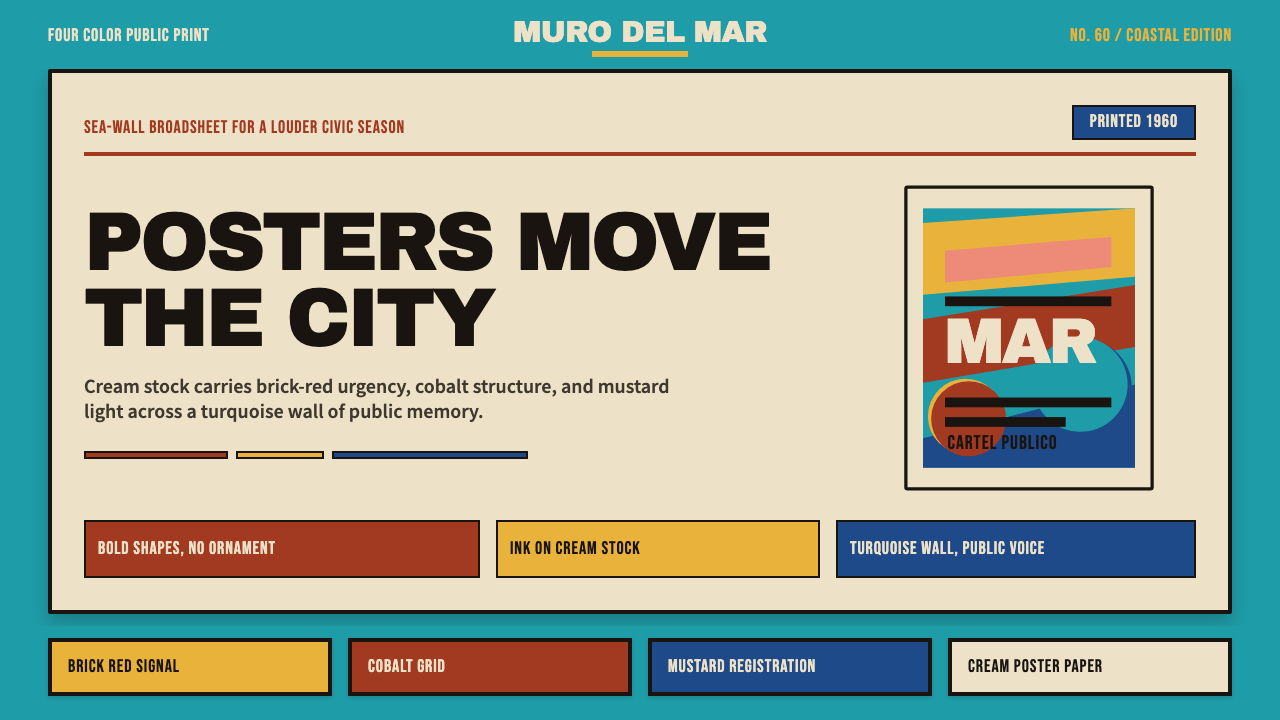 Cuban Malecón 1960 PosterPublic voice in flat ink. Turquoise wall, cream stock, brick red and cobalt b…
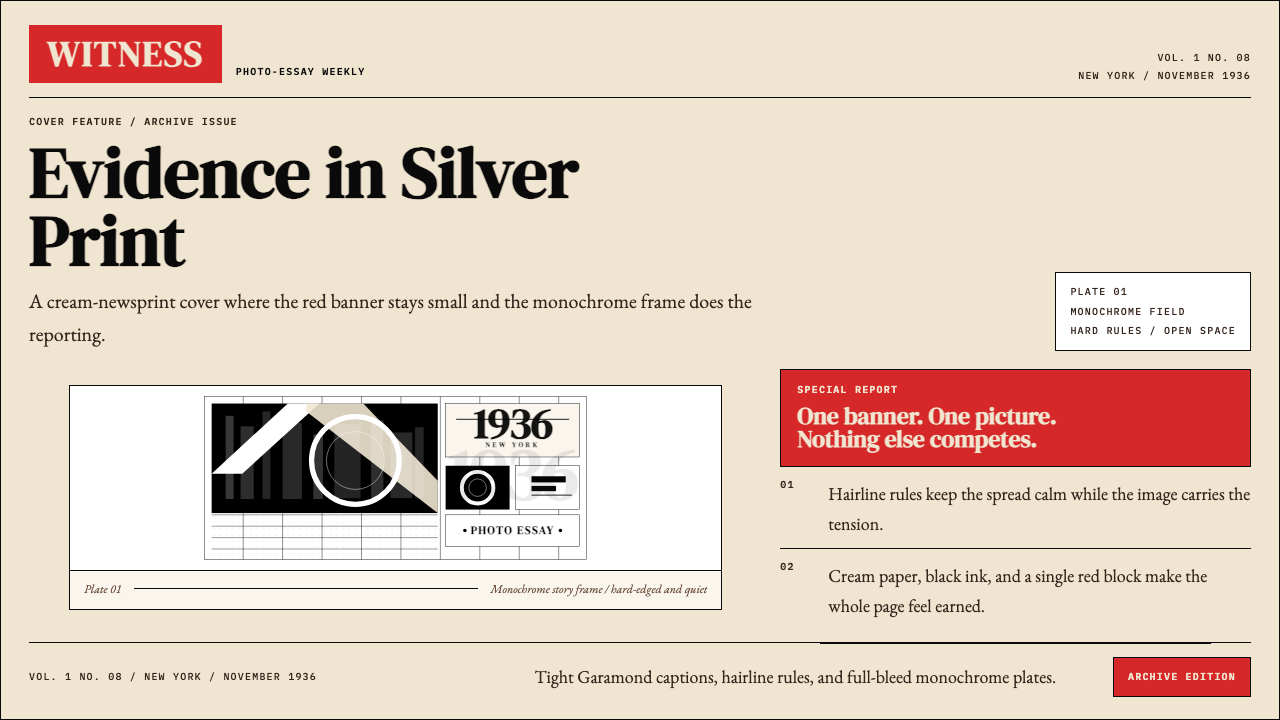 LIFE Magazine (Red-Banner)Photojournalism stripped bare. One red banner, cream newsprint, stark black p…
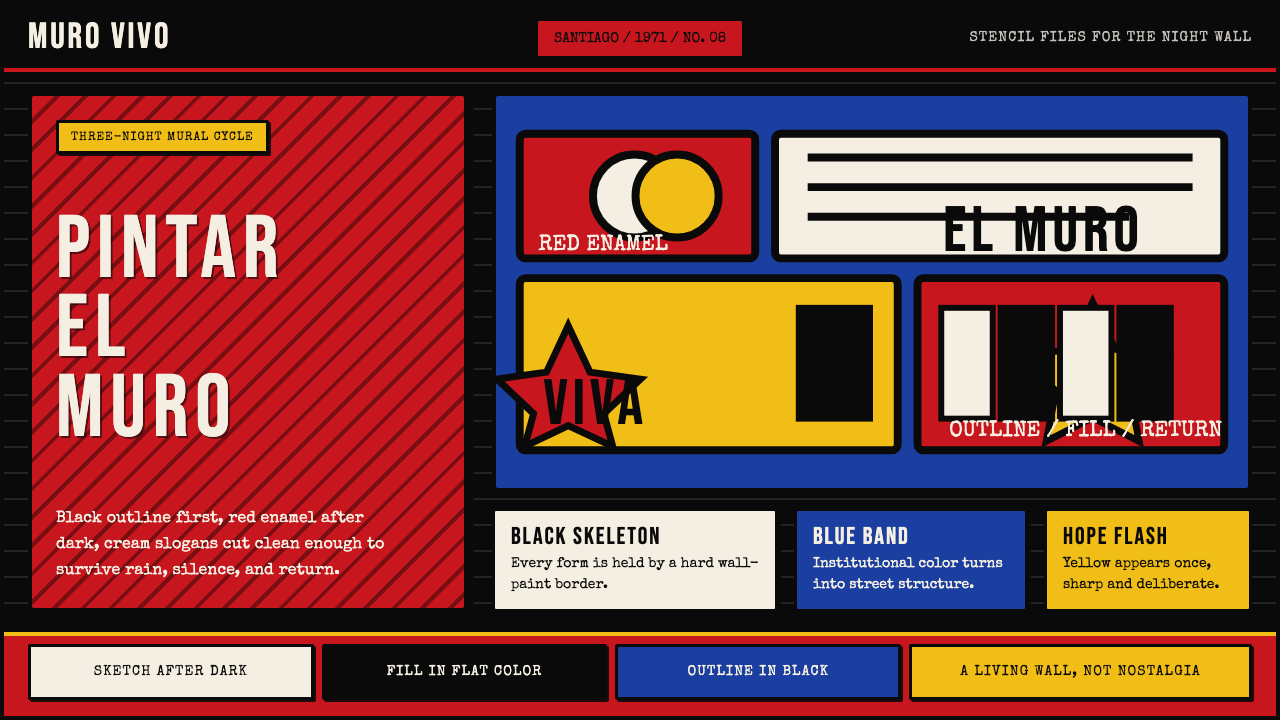 Chilean BRP Ramona Parra 1971Resistance stays alive. Blood red panels, black outlines, and stencil type re…
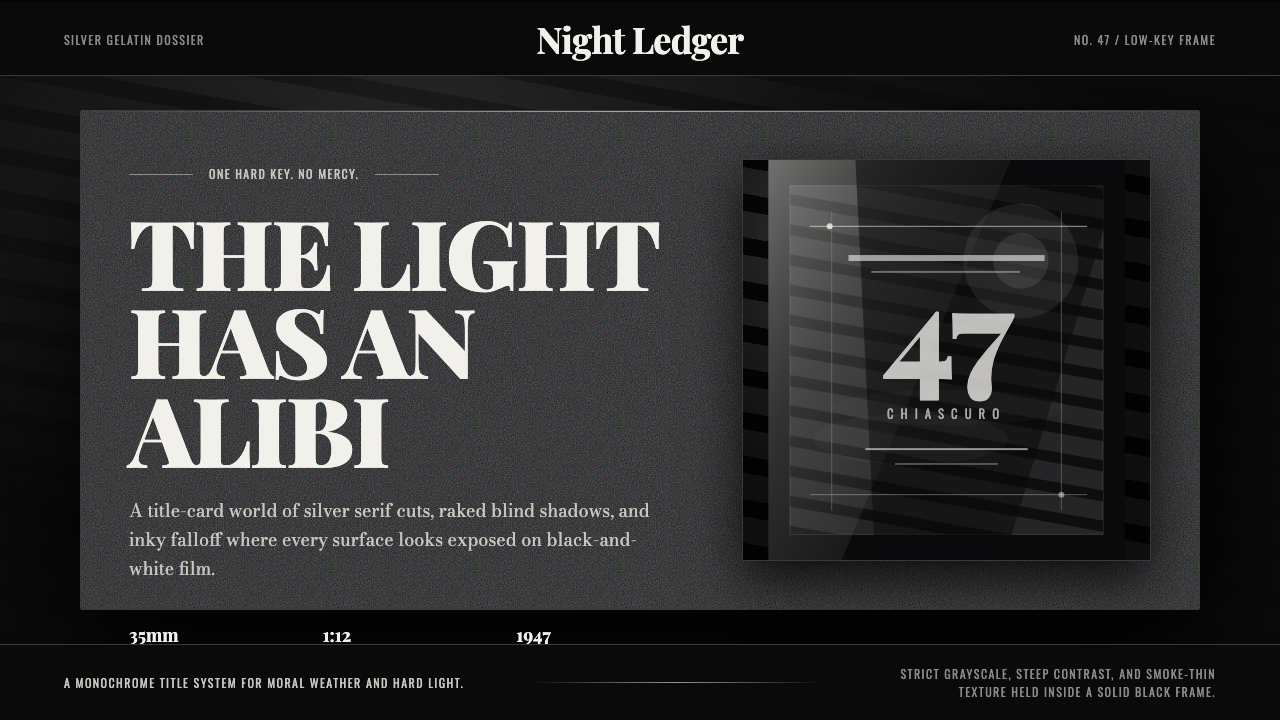 Film Noir ChiaroscuroLight is the crime. Silver serif cards, blind stripes, and grain carve drama…
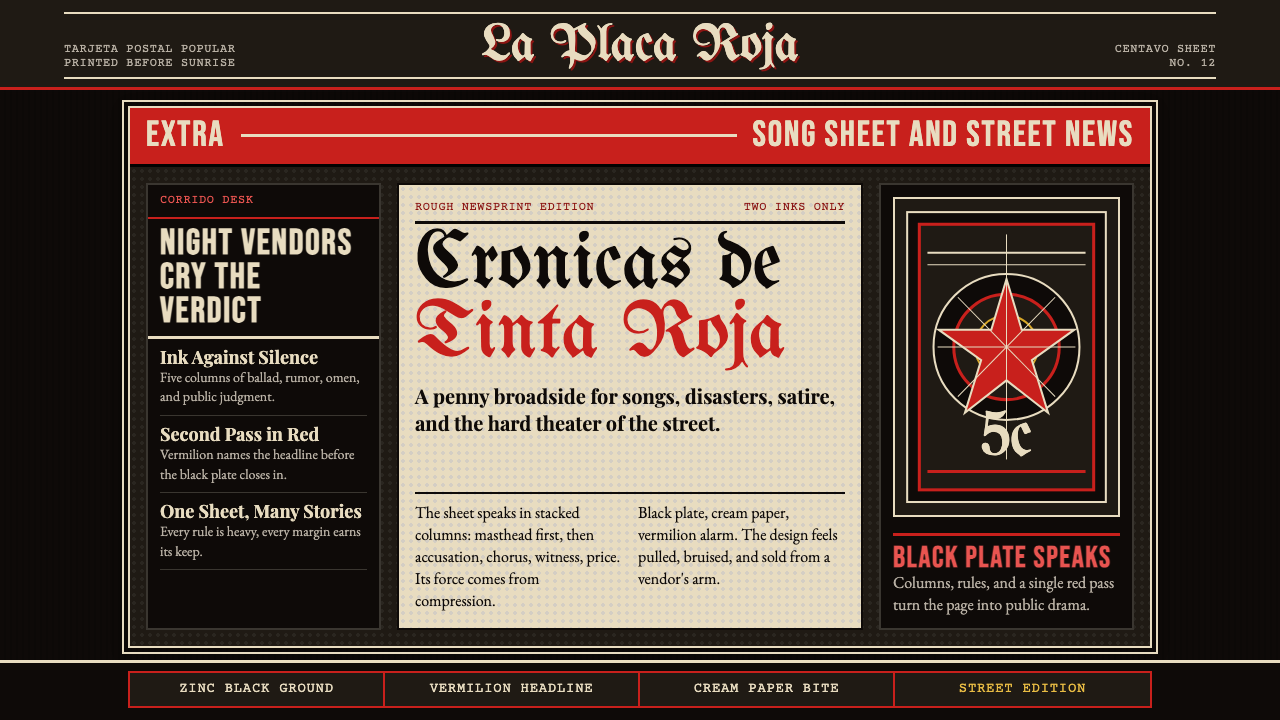 Mexican Tarjeta Postal (Posada Engraving 1900)Tabloid drama in two inks. Fraktur mastheads, vermilion rules, and cream news…
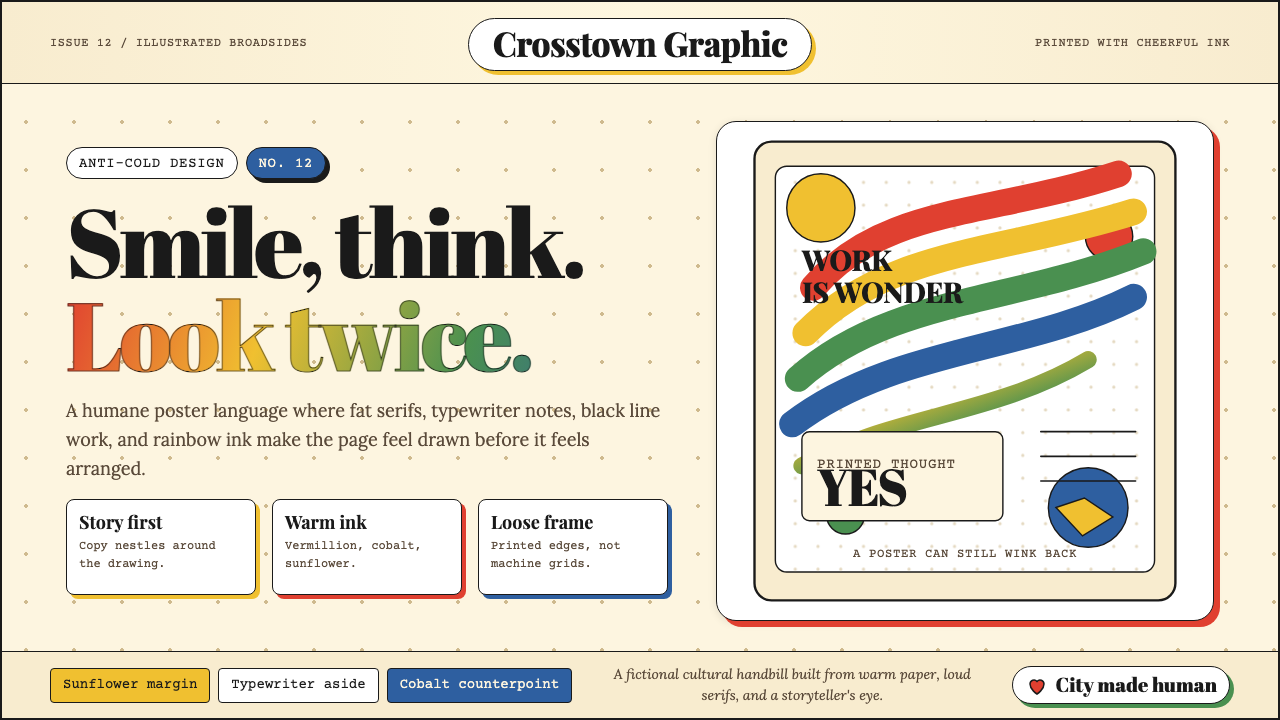 Milton Glaser / Push PinWarm counter-Swiss joy. Vermillion, cobalt and sunflower arcs orbit fat serif…