What is Cuban Malecón 1960 Poster?
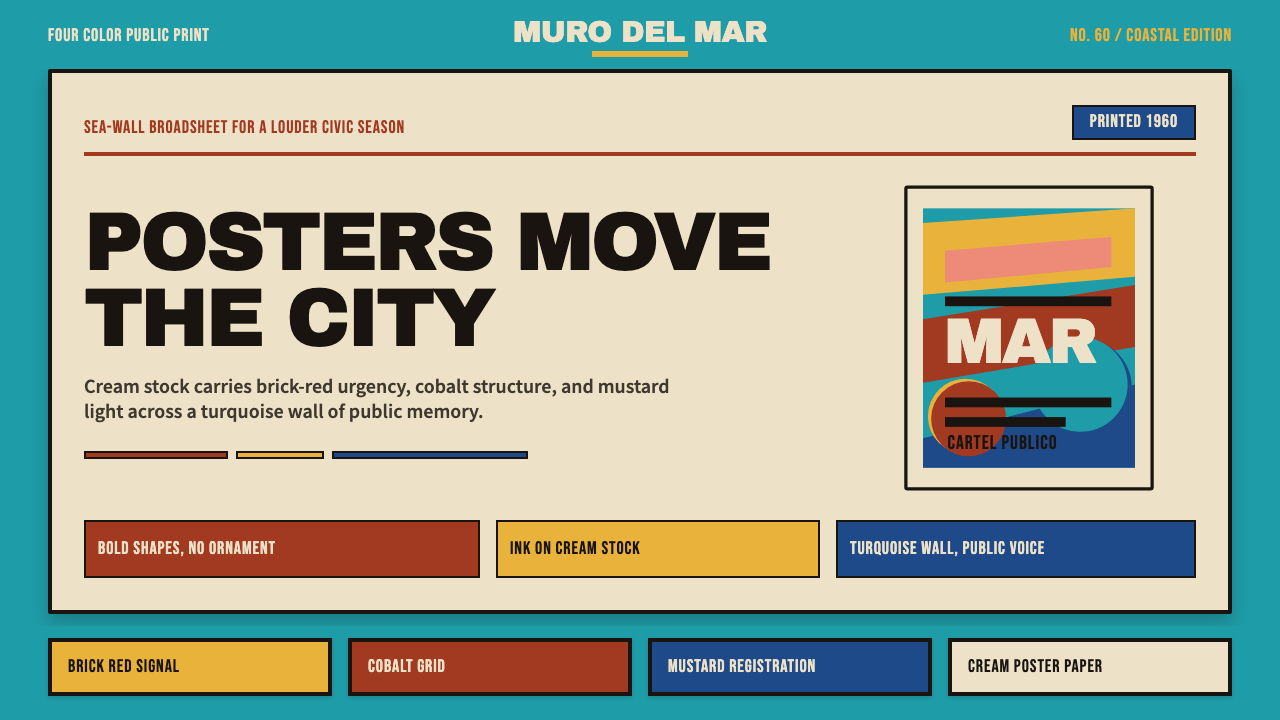
From the workshops of revolutionary Havana, the Cuban poster movement of the 1960s proved that radical politics and radical beauty could share the same sheet of silkscreened paper.
Cuban Malecón 1960 Poster in brief
Cuban Malecón 1960 Poster is a graphic design style rooted in the silk-screened posters produced by Havana's revolutionary print workshops during the 1960s and early 1970s — considered the golden era of Cuban graphic design. The style is defined by bold flat shapes, handcrafted lettering, a palette centered on turquoise, brick red, cobalt blue, and cream, and a pictorial economy that reduces complex ideas to essential silhouettes.
What makes this style distinctive is the productive constraint that gave birth to it. Working with four-color silkscreen on cream poster stock, designers had to solve every communicative challenge through flat ink and decisive form. The result was a visual language in which a single angled stripe, a boldly blocked face, or a stark typographic slogan could carry the weight of an entire political argument. Decoration for its own sake was never an option — the press run would not allow it.
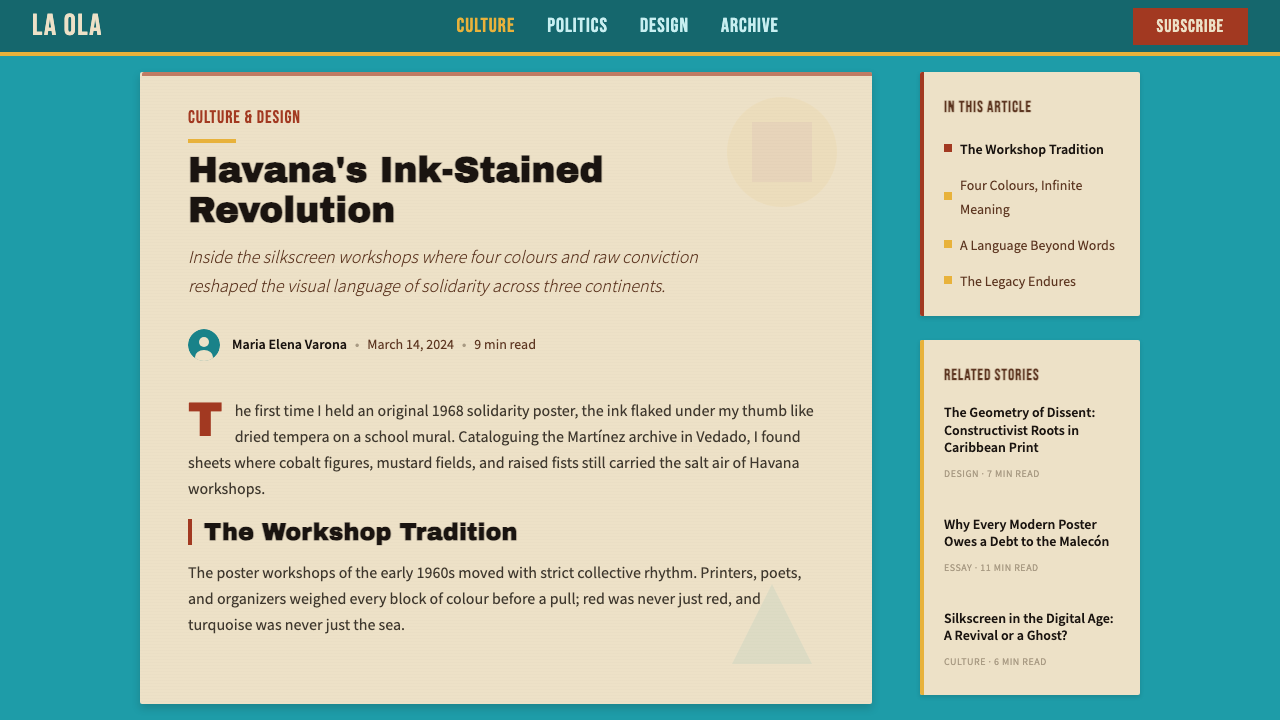
Today the style reads as optimistic, confrontational, and graphic in the truest sense: images that communicate before the viewer consciously reads them. Its vocabulary — the sea-wall turquoise, the layered flat bars of color, the confident sans lettering — carries an emotional charge that transcends its political origins and speaks to any context where boldness and clarity are primary virtues.
Where does Cuban Malecón 1960 Poster come from?
The visual movement now called Cuban poster art was born from a specific institutional moment: the founding of ICAIC (Instituto Cubano del Arte e Industria Cinematográficos) in 1959, the year of the Cuban Revolution's triumph. ICAIC's mandate was to produce film posters for revolutionary Cuba's cinema programme, and its directors — uncommonly — gave their designers almost total creative latitude. Rather than commissioning conventional illustrative film art, they invited designers to interpret each film as a graphic problem. The results were revolutionary in both senses of the word.
A second workshop, OSPAAAL (Organization of Solidarity with the Peoples of Africa, Asia and Latin America), took the poster form global. Founded in 1966, OSPAAAL produced its Tricontinental solidarity posters — printed in Havana and mailed internationally in multiple languages — to support liberation movements across three continents. These posters, which went directly to foreign recipients in folded form, had to communicate across language barriers and cultural contexts, which forced the designers toward an even more universal visual grammar: flat shapes that needed no caption, color contrasts that announced themselves from across a room.
The material conditions of Cuban printing shaped the aesthetic in ways that became inseparable from the style's identity. Cuba's economic situation after the Revolution, and particularly after the United States trade embargo tightened in the early 1960s, meant that foreign printing supplies were scarce. Designers worked with whatever inks and stocks were available, and the characteristic cream ground of Cuban posters was often simply the natural color of the available paper. The constraint of working with four or five flat colors pushed designers toward solutions that would look weak in any other system but became, under those conditions, a distinctive signature.
The style flourished between approximately 1960 and 1973, with the most internationally recognized work concentrated in that first decade. As printing technology changed and political conditions in Cuba shifted through the 1970s, the workshop output became more conventional. But the posters of the peak years — collected, exhibited, and studied worldwide — established a graphic vocabulary that has proved as durable as any modernist movement of the twentieth century.
What defines the Cuban Malecón 1960 Poster look?
Color
The palette draws from the physical world of Havana itself: the turquoise of the Malecón sea wall, the brick red of aging colonial facades, the cobalt blue of the Caribbean sky, and the warm cream of the poster stock. These four hues rarely appear together at full force — typically, one or two dominate and the others provide sharp punctuation. Mustard yellow and warm black enter as secondary elements. Every color is flat, unshaded, and fully saturated, applied as solid fields that abut cleanly at hard edges. The overall effect is sun-drenched and immediate, more like a Caribbean afternoon than a European printshop.
Flat Silhouette and Shape
Every figure, object, and motif is reduced to its most recognizable flat silhouette. The human face becomes a mask of two or three tones; a rifle becomes a stark angular form; a dove becomes a simple white wing shape against a dark ground. This radical reduction was partly a practical response to silkscreen's limitations and partly an aesthetic conviction: the essential form communicates more forcefully than the detailed rendering. Overlapping flat shapes create depth without illusion, and the interaction between those shapes — positive against negative, light against dark — does the compositional work that tonal modeling does in naturalistic traditions.
Typography and Lettering
Cuban poster typography exists on a spectrum from hand-cut lettering to bold geometric sans-serifs. The hand-cut tradition — where the designer carved letters directly into the silkscreen stencil — produced letterforms with a slightly irregular, organic energy that distinguishes Cuban work from the colder precision of European modernism. When mechanical typefaces are used, they tend toward the blocky and compressed, set at large scale to anchor the composition rather than to deliver information in the conventional reading sense. Text in this system is a visual object first and a linguistic message second.
Diagonal Composition
Where European modernist posters often favored strict horizontal-vertical grids, Cuban posters embrace the diagonal as a primary compositional tool. Angled bars of color, figures leaning into the picture plane, text set at an oblique angle — all of these devices introduce movement and urgency into what would otherwise be a static rectangular field. The diagonal implies forward momentum, which suited the revolutionary subject matter and distinguished Cuban work from the more authoritative, frontal quality of Soviet-influenced design.
Political Optimism in Composition
Despite — or perhaps because of — the difficult circumstances of their production, Cuban posters are visually optimistic. Compositions open upward: figures reach, gaze, or stride toward the upper portion of the frame. Color choices lean warm and energetic rather than somber. Even when subject matter is solemn — commemorating a fallen revolutionary, protesting an atrocity — the graphic treatment tends toward bold affirmation rather than mourning. This upward-reaching quality is a specific cultural and political inflection that separates Cuban poster work from the angrier visual traditions of protest art in other national contexts.
International Solidarity Vocabulary
OSPAAAL's output in particular developed a set of recurring visual symbols that functioned as an international solidarity language: the clenched fist, the map silhouette, the rifle carried upright, the dove transformed into geometric abstraction. These symbols were chosen for their legibility across cultures — a fist means resistance whether you read Spanish, Arabic, or Vietnamese. The Cuban poster tradition thus developed both a local aesthetic and a genuinely transnational symbol set, which is part of why the imagery feels simultaneously rooted and universal.
Handmade Energy
Even when Cuban posters are geometrically ambitious, they retain a handmade quality that digital reproduction or offset printing would have smoothed away. Slight variations in ink density, the slight irregularity of a stencil edge, the warmth of cream paper visible through a transparent color layer — all of these small imperfections are part of the visual language. When applying this style digitally, the challenge is to preserve that organic energy without resorting to artificial texture overlays, by making deliberate rather than mechanical decisions about form.
Who shaped Cuban Malecón 1960 Poster?
Rostgaard is among the most internationally recognized of the Cuban poster designers, producing work for both ICAIC and OSPAAAL that balanced visual immediacy with conceptual sophistication. His posters for film and solidarity campaigns are distinguished by a compositional boldness that simplified without reducing — a figure could be rendered in three flat tones and still carry extraordinary psychological presence. His work helped establish the specific emotional register of Cuban poster art: urgent without being shrill, political without being didactic.
Beltrán brought a strongly geometric sensibility to Cuban poster design, working with a precision that sometimes distinguished his work from the more organic tendency of his peers. Having studied in New York and absorbed influences from Swiss International Style and American modernism, he synthesized those traditions with the flat-color, high-contrast imperatives of Cuban silkscreen. His work on cultural and political posters demonstrated that the Cuban poster vocabulary was not a single fixed style but a set of shared constraints within which individual voices could develop distinct approaches.
Muñoz Bachs was the preeminent designer of ICAIC film posters through much of the golden era, producing work of remarkable range — from playful and vernacular for children's films to dramatically austere for political cinema. Where many Cuban poster designers leaned toward the monumental, Muñoz Bachs was equally comfortable with wit and lightness, producing compositions that could be charming without sacrificing graphic conviction. His prolific output across more than a decade established the ICAIC film poster as a cultural artifact in its own right, separate from the films it advertised.
Martínez occupied a unique position in Cuban graphic culture as a painter who moved fluidly between fine art and applied design. His poster work drew on the visual logic of pop art — repeated imagery, serial portraiture, flat photographic tone — and fused it with the urgency of the Cuban political context. His iconic images of Che Guevara, composed from repeated photographic silhouettes in multiple colors, proposed an alternative to the heroic-realist portrait tradition and anticipated, or paralleled, Andy Warhol's celebrity serializations by connecting them to a specifically revolutionary iconography.
The Tricontinental solidarity posters produced by OSPAAAL between 1966 and the late 1970s were rarely attributed to individual designers in the Western sense — they were workshop products, the result of collective practice within an institutional framework. This anonymity is itself significant: it reflects a political commitment to collective authorship that stood in deliberate contrast to the signature-driven culture of Western commercial design. The OSPAAAL posters are among the most widely distributed works of graphic design in history, mailed to subscribers in dozens of countries and collected by museums on every continent.
How do you use Cuban Malecón 1960 Poster today?
The Cuban Malecón 1960 Poster style translates with particular power to contexts where the goal is immediate visual impact combined with a sense of cultural seriousness. Understanding what the system is doing — using flat saturated color to create hierarchy, using silhouette to communicate before the viewer reads a word, using diagonal movement to suggest forward momentum — is more important than copying individual stylistic gestures.
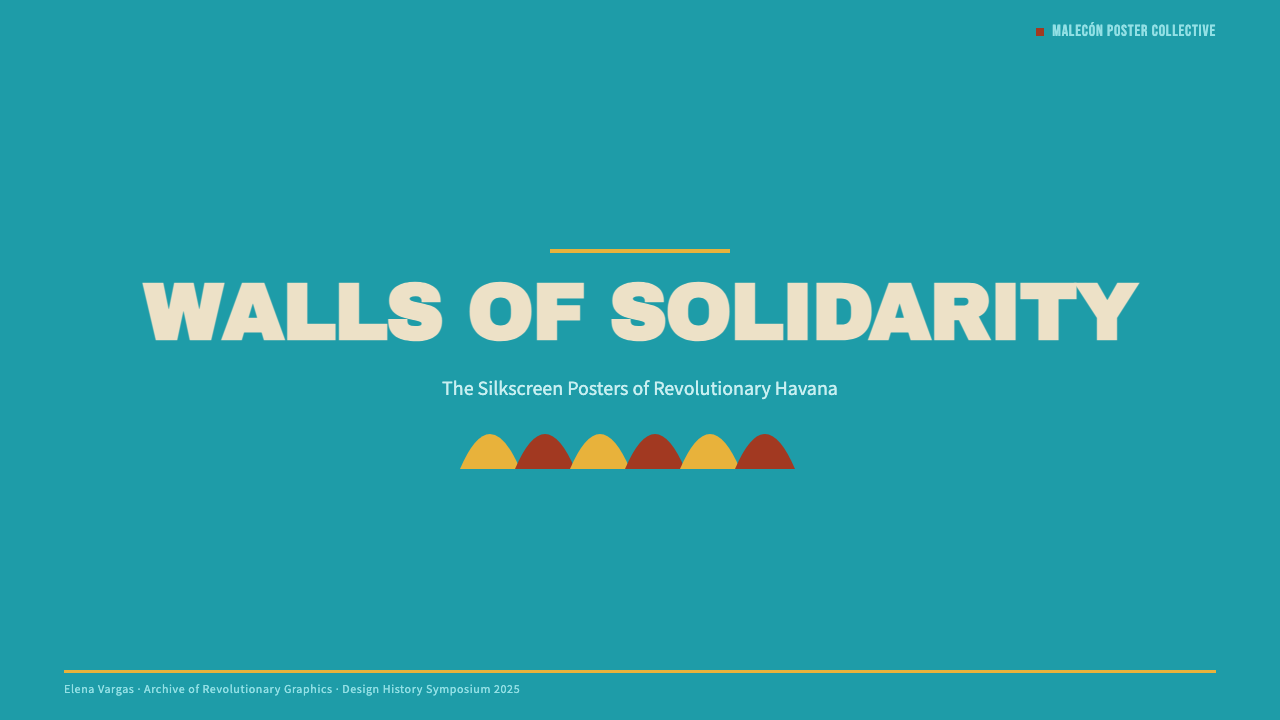
For presentation slides, the style works best on covers and section-opening spreads. A cover built in this idiom might feature a bold cropped silhouette in turquoise or brick red against a cream ground, with the title set in heavy compressed lettering at a large scale that reads as a visual element before it reads as text. Content slides should avoid trying to replicate the poster's visual density — instead, take the palette's economy: one dominant color per slide, flat bars used as section markers rather than decorative flourishes, and generous white or cream space that lets each element breathe. Data visualizations gain character when bar charts and ring charts are treated as flat geometric objects in the poster palette, without gradients or shadow.
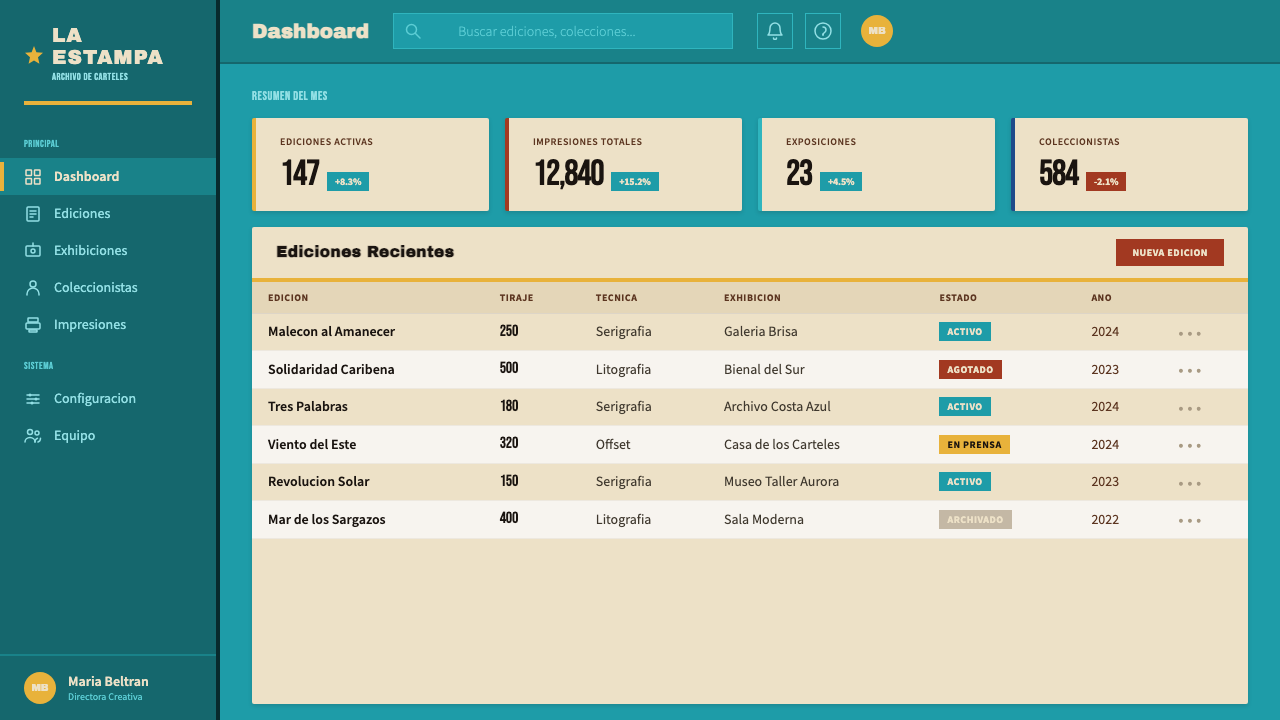
For web interfaces and dashboards, the style's flat-color discipline and strong tonal contrast provide excellent scaffolding for information hierarchy. Navigation and primary actions can take the brick red or cobalt blue that signals urgency or action; neutral surfaces work in cream or near-white; interactive elements get the saturated palette while static text stays in warm black. The approach works particularly well for mission-driven organizations, cultural institutions, social platforms, or any product where the design needs to communicate conviction as well as information.
In editorial and marketing contexts, the poster idiom's boldness suits campaign materials, event graphics, and any situation where the design needs to compete for attention in a visually crowded environment. Full-bleed section openers with a single large silhouette and minimal text, color-blocked layouts that alternate between turquoise-and-cream and brick-red-and-black, and typographic treatments that use scale contrast as the primary hierarchy device all draw directly from the source tradition. The style is equally applicable to printed materials, social media graphics, and digital editorial layouts, since flat color and hard-edge shapes reproduce reliably across media.
A common mistake is treating the palette as interchangeable — using the turquoise, red, cobalt, and mustard simultaneously and at equal weight, resulting in visual noise rather than the composed urgency of the original work. In authentic Cuban poster design, compositions are typically dominated by one or two colors, with the others appearing as sharp accents or informational punctuation. Similarly, softening the style by adding gradients, drop shadows, or rounded corners undermines its core logic. The style's power comes from commitment: flat is flat, the edge is where it is, and the color does not fade.
Cuban Malecón 1960 Poster — FAQ
How does Cuban poster style differ from Soviet Constructivism, which it superficially resembles?
The resemblance is real but the differences are significant. Soviet Constructivism (1920s) was primarily concerned with geometry as a rational, machine-age value — forms derived from industrial process, type treated as engineered information. Cuban poster art inherited that geometry but inflected it with a warmer, more humanist sensibility: figures are present and emotionally specific, the palette includes the warmth of tropical color, and the diagonal movement gives compositions an urgency that Constructivism's more architectonic layouts rarely achieved. Cuban work is also more painterly in its surface — the handmade quality of silkscreen is embraced rather than overcome. Think of Constructivism as the engineering drawing and Cuban poster as the mural.
Can this style work for commercial or non-political brands without feeling like appropriation?
Yes, with a clear-eyed understanding of what you are borrowing. The Cuban poster style is a formal visual language — flat color, silhouette, diagonal composition, bold typography — and those formal properties are separable from the political content of the original work. What you are borrowing is the graphic logic, not the political ideology. That said, the style carries strong cultural associations that will register with culturally aware audiences. Using it for contexts that have some genuine affinity with its values — collective action, cultural confidence, anti-corporate aesthetics, public communication — feels more coherent than applying it to, say, luxury goods or private financial products, where the tonal mismatch would undermine the design's credibility.
How should photography be handled within this style?
Cuban poster art of the 1960s was primarily hand-drawn and silkscreened, so photography was not a native element of the style. When photography is used in contemporary applications of this aesthetic, the approach should push images toward flatness: high-contrast duotone treatment in two of the palette's colors, aggressive silhouetting against a flat ground, or combining photography with flat color overlays that reduce the image to near-silhouette. The goal is to make photography behave like the style's other elements — flat, decisive, and defined by edge rather than tonal gradation. Full-color naturalistic photographs sitting beside flat graphic elements will produce a tonal mismatch that reads as stylistic incoherence.
Is this style appropriate for dark-background layouts?
Dark-ground versions of Cuban poster design do exist historically — some OSPAAAL posters used black or very deep color as a ground — and they work well when handled with discipline. The key shift when inverting to a dark ground is that the cream or warm white that normally anchors the palette must be replaced by a light value from within the palette itself, typically a pale turquoise or warm off-white. The turquoise and cobalt hues tend to lose their distinctiveness against very dark grounds unless their relative values are carefully managed. The style's power on dark grounds is at its greatest when a single bright element — a cream silhouette, a brick-red bar — is isolated against black, rather than trying to maintain all four palette colors simultaneously.
What distinguishes authentic applications of this style from pastiche?
Authentic application means understanding the compositional logic rather than just sampling the visual elements. The Cuban poster tradition built its power through economy — one strong image, one strong idea, all other elements subordinated. Pastiche typically shows through overloading: too many colors at full saturation, too many graphic elements competing, textures applied to add vintage feel rather than emerged from process, or the palette applied to a layout that is fundamentally still organized by conventional Western commercial grid logic. The test is whether the composition would survive as a black-and-white silhouette — if the design's strength comes from its form rather than its color, it has absorbed the style's real lesson. If removing the color would reveal a conventional layout with Cuban colors sitting on top, it has not.
Related design styles
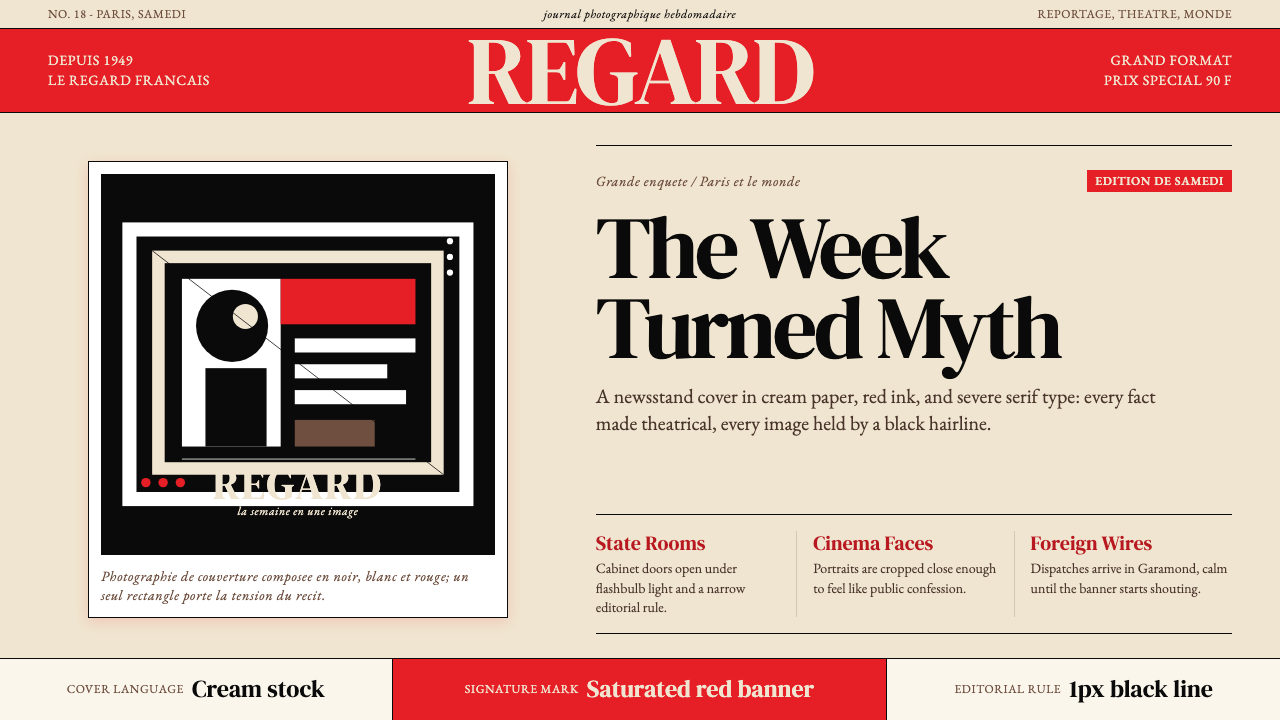 Paris MatchThe cover shouts in one red slab. Cream paper, serif headlines, and black rul…
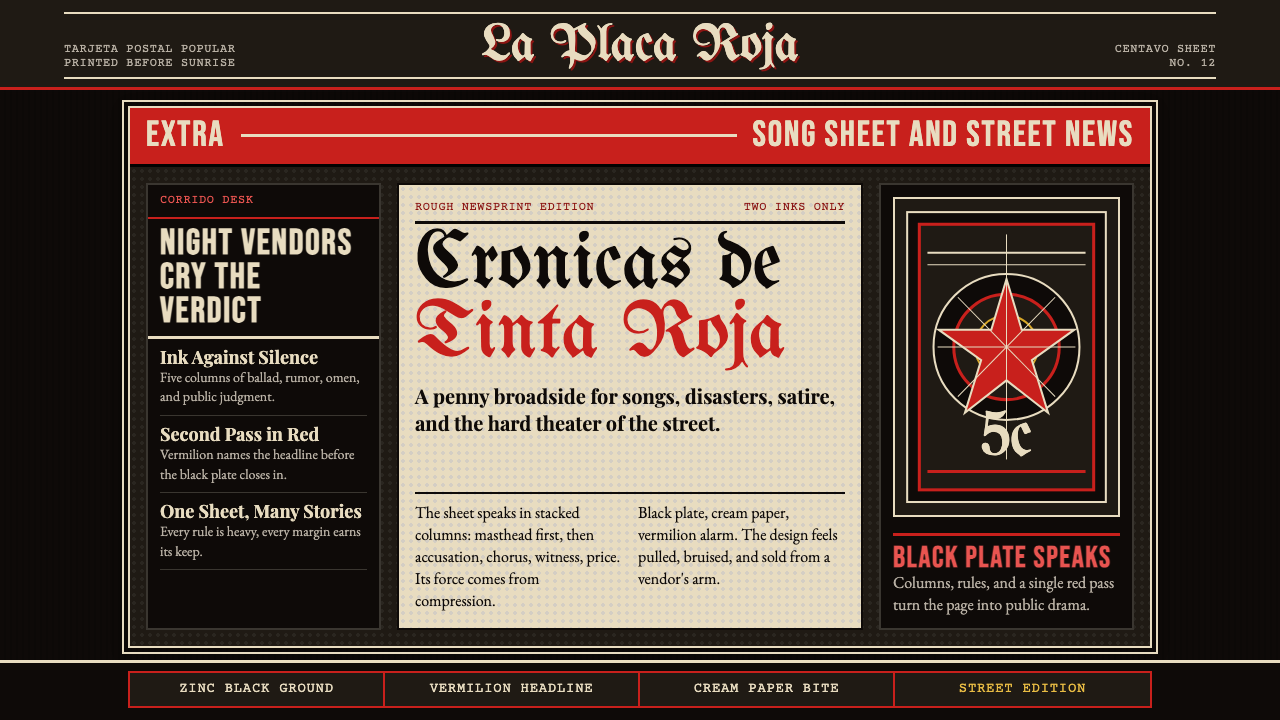 Mexican Tarjeta Postal (Posada Engraving 1900)Tabloid drama in two inks. Fraktur mastheads, vermilion rules, and cream news…
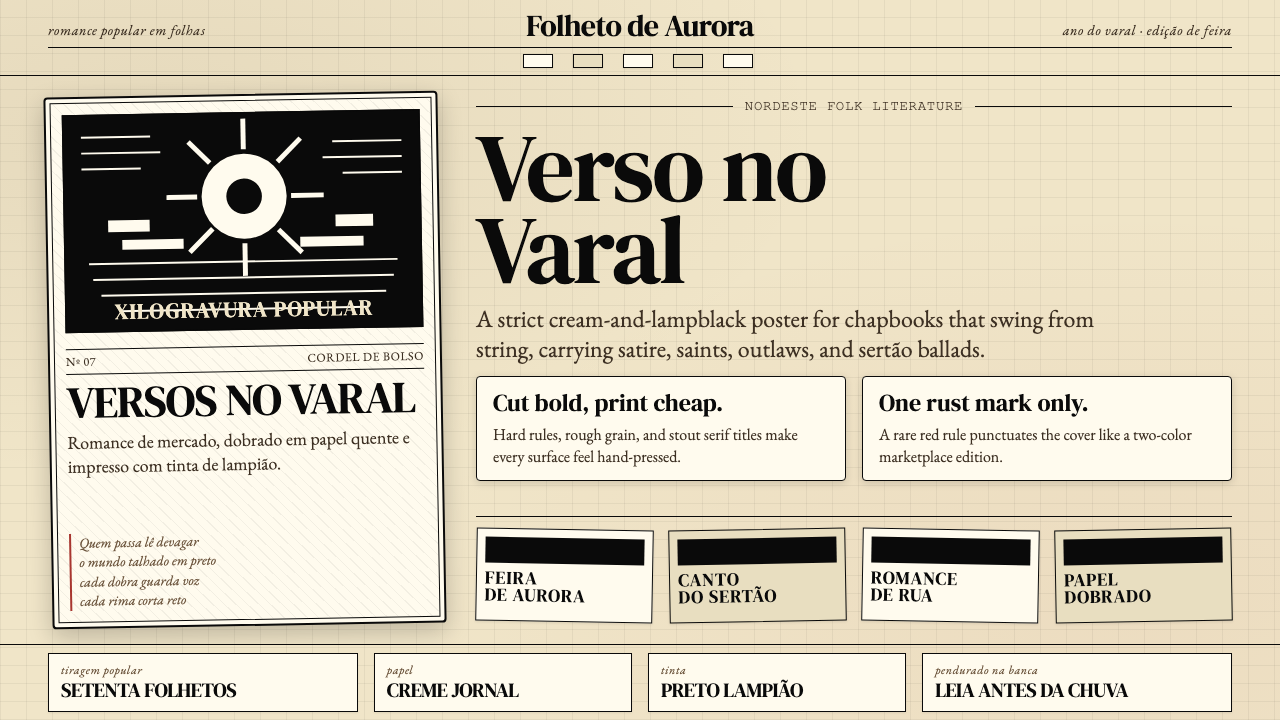 Brazilian Cordel (Northeast Folk Literature)Folk poetry, cut in lampblack. Cream newsprint, bordered chapbooks, one rust-…
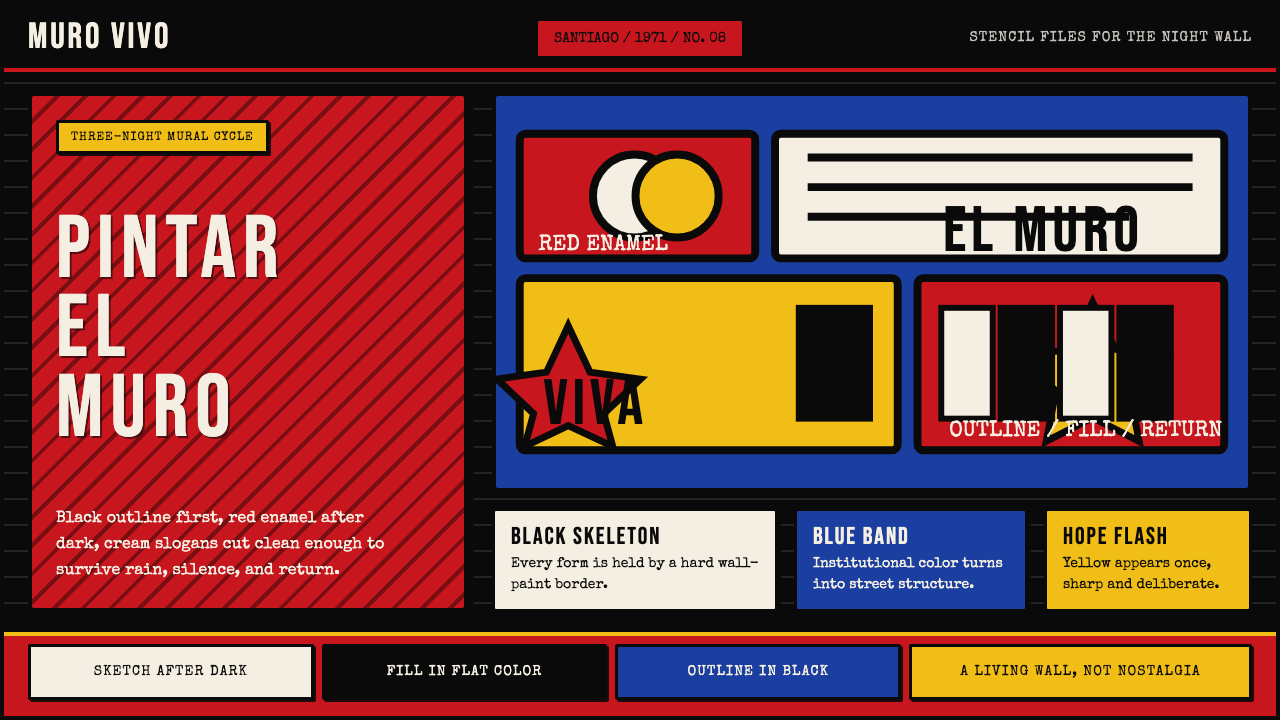 Chilean BRP Ramona Parra 1971Resistance stays alive. Blood red panels, black outlines, and stencil type re…
 Film Noir ChiaroscuroLight is the crime. Silver serif cards, blind stripes, and grain carve drama…
 LIFE Magazine (Red-Banner)Photojournalism stripped bare. One red banner, cream newsprint, stark black p…