What is Peanuts Comic Schulz (1950)?
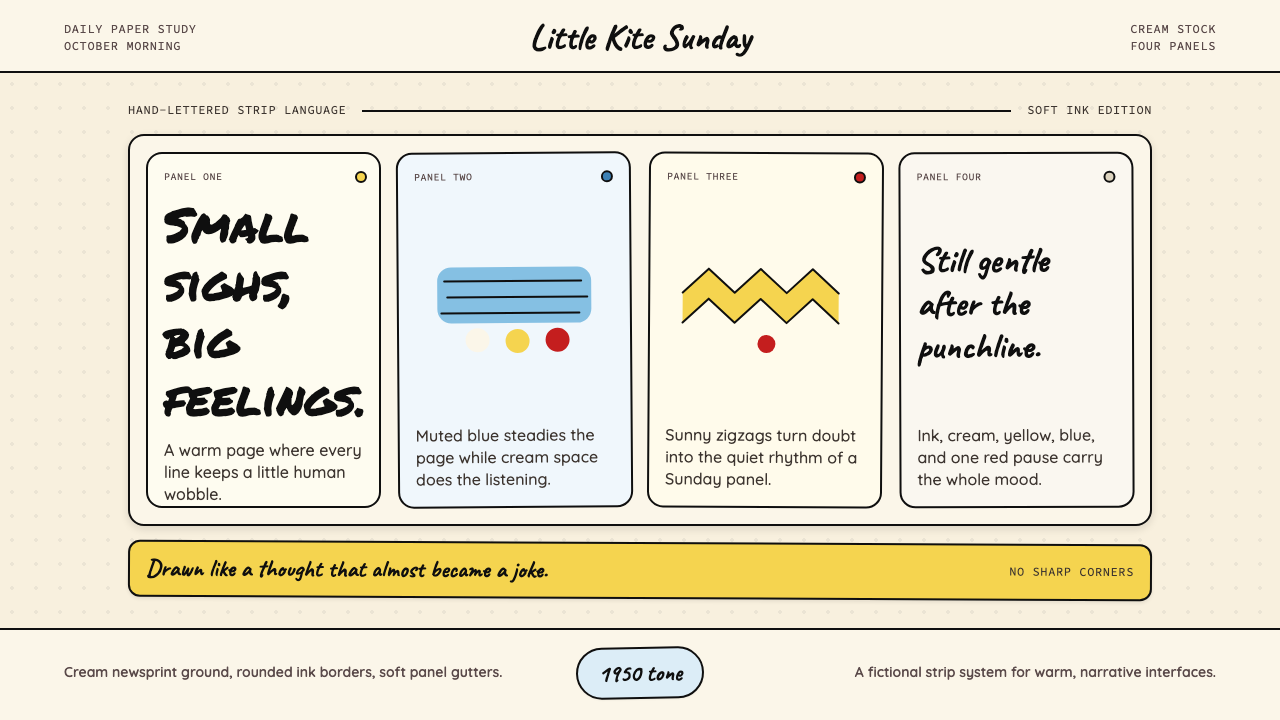
Peanuts turned the humble four-panel newspaper strip into a visual language of cream paper, wobbling ink, and a palette so warm it feels hand-held.
Peanuts Comic Schulz (1950) in brief
Peanuts Comic Schulz (1950) is a design aesthetic derived from the visual grammar Charles M. Schulz built across fifty years of daily newspaper cartooning. Its hallmarks are a warm cream ground, loosely hand-drawn panel borders with gently rounded corners, a restrained palette anchored by muted golden yellow and soft denim blue, and lettering that preserves the character of a brush-pen rather than the neutrality of typeset text. The system feels at once nostalgic and quietly melancholic — the visual equivalent of reading a Sunday strip on a childhood morning.
Unlike geometric movements that assert precision and authority, this aesthetic embraces deliberate imperfection. Ink lines vary slightly in weight; panel borders are not machine-straight; letterforms lean and breathe. These qualities are not accidents to be corrected — they are the source of the style's emotional warmth. The visual language signals handcraft, patience, and a gentle sadness that Schulz himself called the defining mood of the strip.
Color in this system is drawn from the strip's most iconic imagery: the yellow of Charlie Brown's zigzag sweater becomes the primary accent, the soft blue of Linus's security blanket becomes the secondary voice, and a desaturated Christmas red supplies emotional punctuation. All three float against cream newsprint or near-white grounds, giving the palette the faded warmth of an old printed page rather than the brightness of contemporary screen design.

Where does Peanuts Comic Schulz (1950) come from?
Peanuts debuted on October 2, 1950, in seven American newspapers. Schulz was twenty-seven years old, working from a rented studio in Saint Paul, Minnesota, and had spent the preceding years submitting single-panel gag cartoons to magazines. The strip's launch was modest — the United Feature Syndicate initially ran it under the name Peanuts against Schulz's preference, as he had envisioned a title closer to Good Ol' Charlie Brown. But within a few years the visual and narrative vocabulary Schulz was developing would become one of the most widely recognized in American popular culture.
The visual language of Peanuts emerged organically from the constraints and conventions of mid-century newspaper printing. Comics in the 1950s were reproduced on cheap newsprint using limited ink coverage. Color, when available for the Sunday strip, came from the four-color printing process of the era — a process that produced warm, slightly muddy tones quite different from saturated modern output. Schulz designed within these constraints rather than fighting them. The cream ground is the color of actual newsprint. The slightly off-register quality of the palette reflects the printing technology of the time. What might have been technical limitations became aesthetic identity.
Schulz's lettering practice was equally distinctive. He lettered every strip by hand for nearly fifty years, developing a loose, confident style that contemporary typefaces have since attempted to capture. The brush-pen letterforms have slight variations in stroke weight, occasional slant shifts, and a rhythm that makes word balloons feel like breathing rather than typesetting. This commitment to hand lettering — at a time when mechanical lettering aids were available — was a deliberate choice that kept the strip's visual language rooted in human touch.
The strip ran in up to 2,600 newspapers at its peak syndication, reaching an estimated 355 million readers in 75 countries. Its visual canon was reinforced and extended through animated television specials beginning in 1965 — A Charlie Brown Christmas, with its jazz score by Vince Guaraldi and animation by Bill Melendez, introduced a generation to the strip's emotional palette in motion. Schulz continued drawing the strip until shortly before his death in February 2000, maintaining the hand-drawn warmth of the original through five decades of design trends that passed around him. The final original strip was published posthumously on February 13, 2000.
What defines the Peanuts Comic Schulz (1950) look?
Cream Newsprint Ground
The foundational surface is not white but a warm off-white that reads as aged paper — the literal color of mid-century newsprint. This ground gives every element placed on it a softened, organic quality. Panels never feel clinical or cold. The warmth of the background sets the emotional register before a single character or line of text appears, functioning as the visual equivalent of the strip's quiet, unhurried melancholy.
Muted Accent Palette
The three accent colors — a muted golden yellow, a soft denim blue, and a desaturated brick red — are drawn directly from the strip's most recognizable visual elements. None is fully saturated; all carry a slight faded quality that evokes period printing. Yellow leads as the primary accent because it appears most frequently and carries the most warmth. Blue acts as a calming secondary voice. Red appears sparingly, reserved for emotional weight or seasonal punctuation. Mixing all three at full presence reads as period kitsch rather than authentic Schulz.
Hand-Drawn Line Quality
Lines in this system are not mechanically uniform. They vary gently in weight along their length, feature slightly rounded endpoints rather than sharp terminations, and carry an implied humanity that distinguishes them from the precision strokes of a digital design tool. Panel borders are close to rectangular but never perfectly so — the corners are slightly rounded, the edges have the small undulations of a drawn rather than a ruled line. This imprecision is intentional and must be preserved; swapping it for clean digital geometry removes the style's defining warmth.
Brush-Pen Lettering Voice
Typography in this system draws from the tradition of hand-lettered comic dialogue — loose, confident, with slight stroke-weight variations that recall an actual brush or marker moving across paper. All-caps lettering is the norm for dialogue and labels, but the letterforms are rounded and open rather than geometric and mechanical. The lettering feels personal: it has the slight inconsistency of a human hand rather than the perfect repeatability of a typeface. Word balloons and caption boxes inherit this quality — their borders are drawn shapes, not geometric primitives.
Four-Panel Grid Rhythm
The underlying compositional logic reflects the daily strip's four-panel structure — a horizontal sequence of near-equal-weight cells with consistent internal margins and minimal variation in panel size. This grid creates a quiet, breathing rhythm rather than the dynamic asymmetry of poster design or the bold hierarchy of editorial layout. It is patient and even-handed: no single panel screams louder than its neighbors. When applied to slides or web interfaces, this rhythmic evenness becomes a layout principle — multiple units of near-equal weight arranged in a horizontal or grid progression.
Quiet Melancholy Tone
Beyond color and form, the Schulz visual system carries an emotional signature that distinguishes it from merely nostalgic or retro aesthetics. The palette is warm but never cheerful; the imperfect lines suggest effort rather than effortlessness; the cream ground evokes something slightly faded and well-loved. Taken together, these qualities produce a mood that Schulz himself described as the strip's essential character — a gentle, persistent sadness that coexists peacefully with humor and affection. Designs that borrow the palette but lose this tonal restraint tend to read as nostalgic novelty rather than something genuinely felt.
Rounded, Organic Shapes
Where geometric styles favor hard corners and sharp angles, the Schulz visual language rounds every edge that plausibly could be rounded. Panel borders, speech bubbles, character silhouettes, and decorative elements all curve gently. This roundness is not a formal rule applied in isolation — it is consistent with the hand-drawn line quality and the human imperfection that runs through the entire system. Sharp geometric precision would import the logic of a different aesthetic entirely. The softness of the forms is what makes the style feel safe and approachable rather than structured and demanding.

Who shaped Peanuts Comic Schulz (1950)?
Schulz created, wrote, and drew every Peanuts strip from the debut on October 2, 1950, until his retirement announcement in December 1999 — a nearly unbroken fifty-year run. Born in Minneapolis in 1922 and raised in Saint Paul, he was a shy, introspective child whose experiences of loneliness, unrequited affection, and social awkwardness became the emotional core of his characters. He resisted assistants and ghost artists throughout his career, insisting that the hand-drawn imperfection of the strip was not a production limitation but a deliberate aesthetic choice. His studio in Santa Rosa, California — where he worked from 1969 onward — became a pilgrimage site for cartoonists worldwide. Schulz died on February 12, 2000, the night before his final strip was published.
Guaraldi was the jazz pianist and composer who scored A Charlie Brown Christmas (1965) and the subsequent animated specials. His compositions — particularly Linus and Lucy, which became the unofficial Peanuts theme — shaped the emotional register of the Schulz universe in sound as thoroughly as Schulz's visual language shaped it in image. The warm, slightly melancholy quality of Guaraldi's piano lines parallels the warmth and gentle sadness of the visual palette. The two systems reinforce each other so completely that it is nearly impossible to look at the cream-and-yellow aesthetic without hearing the music.
Mendelson was the television producer who brought Peanuts to the animated special format, partnering with Schulz and director Bill Melendez to create A Charlie Brown Christmas (1965) and dozens of subsequent specials. His decision to use child voice actors — rather than adult performers doing children's voices — was crucial in preserving the strip's emotional authenticity on screen. Mendelson also fought to retain Guaraldi's jazz score when CBS executives wanted something more conventional, a decision that proved definitive for the aesthetic character of the entire animated canon.
Melendez was the animation director responsible for bringing Schulz's characters into motion across the television specials and theatrical films. A veteran of Disney and UPA, he developed an animation style for Peanuts that honored the strip's hand-drawn imperfection — characters moved with slight hesitations, the line quality stayed loose, and the color palette respected the muted warmth of the original newsprint aesthetic. He also voiced Snoopy's distinctive unintelligible sounds throughout the specials. Melendez directed or supervised every major Peanuts animated production from 1965 until his death in 2008.
The syndication arm that distributed Peanuts to newspapers across the United States and eventually worldwide played a structural role in shaping the strip's visual constraints. Syndicate production standards for mid-century newspaper comics — column widths, ink coverage limits, color registration tolerances — became design parameters that Schulz worked within and ultimately turned to aesthetic advantage. The cream newsprint ground, the slightly muted palette, and the tolerance for minor printing variation all trace back to the physical and commercial infrastructure of newspaper syndication. The strip's eventual 2,600-paper circulation meant that Schulz's visual language was tested and refined against an enormous range of printing conditions over five decades.
How do you use Peanuts Comic Schulz (1950) today?
The Peanuts visual system is one of the warmest and most emotionally legible design languages available to contemporary practitioners. Its power comes not from formal precision but from accumulated association — audiences who grew up with the strip carry an emotional relationship to its visual cues. Applying this aesthetic correctly means respecting what generates that warmth: the cream ground, the slightly imperfect linework, the muted and purposefully faded accent palette, and the quiet horizontal rhythm of the four-panel grid. Lifting only the surface elements — a yellowish color and some handwriting-style type — without the deeper structural and emotional logic will produce pastiche rather than design.
For presentation slides, the Peanuts aesthetic works exceptionally well in contexts where warmth and approachability are more important than authority and precision. A cover slide benefits from the horizontal panel rhythm: place the title in the left two-thirds of the frame, using large hand-lettered display type, and anchor a simple rounded shape — a circle or softly cornered rectangle — in a muted golden yellow on the right. Content slides should feel like a single panel: one dominant message, body text with generous line spacing and a warm mid-weight hand-lettered typeface, and subtle panel borders drawn with slightly irregular lines rather than perfect geometric strokes. Data slides translate well when charts are rendered in the strip's three accent colors against the cream ground, with values labeled in the same hand-lettered voice as body text rather than a contrasting typeface.
For web UI, the style is best suited to editorial products, personal brand sites, independent newsletters, and consumer-facing platforms where human warmth is a differentiator. Dashboard interfaces can adopt the panel-grid logic: card components with rounded borders and a very slight texture on the cream background, accent colors reserved for status indicators and calls to action. Pricing pages work well with the strip's color-coding logic — a yellow tier, a blue tier, a red tier — each carrying the muted, non-aggressive saturation of the original palette. Navigation and body copy should use a typeface with humanist proportions and slight stroke variation; perfectly geometric sans-serifs will pull the aesthetic toward something colder and more clinical than the source material supports.
In editorial and marketing applications, the style rewards layouts that leave generous white — or cream — space and resist the temptation to fill every margin. A feature article can use a four-column grid where the leftmost column holds pull quotes or illustration captions in a lighter weight of the hand-lettered style, and the remaining columns carry body text. Section breaks marked by a gently wavy hand-drawn horizontal rule reinforce the aesthetic's organic quality. Marketing campaigns can leverage the emotional associations of the palette directly: golden yellow on cream for warmth and nostalgia, soft blue for calm and trust, muted red for urgency that does not shout. The style performs particularly well in contexts addressing childhood, creativity, vulnerability, or community — topics that resonate with the strip's core emotional register.
The most common mistake when applying the Schulz aesthetic is substituting digital cleanliness for the deliberate imperfection that defines it. Perfectly uniform letterforms, fully saturated accent colors, sharp-cornered panel borders, and crisp geometric shapes all work against the system's logic. A second frequent error is treating the warm palette as interchangeable with generic retro or vintage aesthetics — the specific combination of cream ground, muted golden yellow, soft denim blue, and desaturated red is historically grounded and emotionally precise. Replacing any of these with brighter, more saturated, or more generic vintage tones dissolves the identity. Finally, attempting to combine the Peanuts aesthetic with visual systems that operate on competing principles — sharp geometric precision, high-saturation color, aggressive typographic hierarchy — produces visual incoherence. The style asks for restraint, evenness, and a willingness to let quiet warmth do the communicative work.

Peanuts Comic Schulz (1950) — FAQ
How is the Peanuts aesthetic different from generic vintage or retro design?
Generic vintage design borrows surface cues of age — distressed textures, faded colors, worn edges — without a specific visual language behind them. The Peanuts aesthetic is precise: it derives from a specific set of production constraints (mid-century newspaper printing), a specific set of character-derived colors (Charlie Brown yellow, Linus blue, Christmas red), and a specific emotional register (gentle melancholy rather than cheerful nostalgia). The difference shows in application. Generic vintage can be applied broadly without commitment; the Schulz system requires consistency in palette, linework, and tonal restraint to function. A design that looks vaguely old but warm is retro. A design with cream ground, muted golden yellow accents, imperfect rounded line borders, and hand-lettered type in the strip's unhurried rhythm is referencing something specific.
Can this aesthetic work for professional or corporate contexts, or is it limited to casual and personal brands?
It depends on what kind of professional authority the context requires. The Schulz aesthetic signals warmth, approachability, patience, and gentle wit — qualities that work well for educators, therapists, children's product companies, independent creators, editorial brands, and any professional context where human connection is more important than institutional authority. It works less well where the context demands the visual vocabulary of precision and power: financial institutions, enterprise software, legal services, or any domain where users need to feel that everything is under tight control. The palette's softness can undermine confidence in high-stakes precision contexts. Used intentionally, however, this limitation is also a strength — it is one of the few historical design languages that communicates vulnerability and honesty alongside competence.
How do you handle dark mode with this aesthetic?
The Schulz visual system is fundamentally a light-ground aesthetic. Its emotional warmth depends heavily on the cream or off-white background — invert it to a dark ground and you lose the newsprint association that anchors the style's nostalgic character. A dark inversion is technically possible: cream text and muted golden accents on a deep warm charcoal or ink-dark navy can preserve some of the palette's warmth. But the result will read as a different aesthetic — closer to noir illustration or a moody editorial dark theme — than to Peanuts proper. If a dark mode is required, treat it as a distinct variant rather than a direct inversion: keep the accent palette, embrace warm darks rather than cold blacks, and accept that some of the original emotional register will not survive the conversion. The imperfect linework and rounded forms remain viable on dark grounds; the cream-paper warmth does not.
Does this aesthetic require custom illustration, or can it work with photography and stock imagery?
The Schulz aesthetic is at its most authentic with hand-drawn illustration — line art that reflects the strip's loose, rounded visual language. Photography can be incorporated, but it requires deliberate treatment: images processed with a warm, slightly desaturated tone that echoes the newsprint palette, hard-cropped or silhouetted rather than placed as naturalistic scene-windows, and used sparingly so that the overall layout retains its hand-drawn quality. Stock photography that is clean, brightly lit, or shot with contemporary production values will clash with the aesthetic's imperfection and faded warmth. If a photographic element is unavoidable, duotone processing using the accent palette — golden yellow over warm shadow tones, or denim blue over light values — can bring it closer to the system's visual language. The most successful applications use illustration as the primary image register and reserve photography for supporting contexts only.
What makes this style feel melancholy rather than simply warm or nostalgic?
The melancholy in the Schulz visual system comes from a specific combination of qualities that distinguish it from purely cheerful retro aesthetics. First, the palette is warm but not bright — the golden yellow is muted, not primary; the blue is soft, not vivid. Colors that have been slightly drained of their saturation carry an implicit sense of fading, of something that was once more vivid. Second, the imperfect line quality suggests effort and vulnerability rather than ease and confidence — lines that wobble slightly imply a human hand that is doing its best rather than a machine producing perfect output. Third, the horizontal evenness of the four-panel grid creates a quiet, measured rhythm that is closer to resignation than to excitement. Together these elements produce a visual mood that holds warmth and sadness simultaneously — the exact emotional register that made the strip so recognizable and so enduring for fifty years.
Related design styles
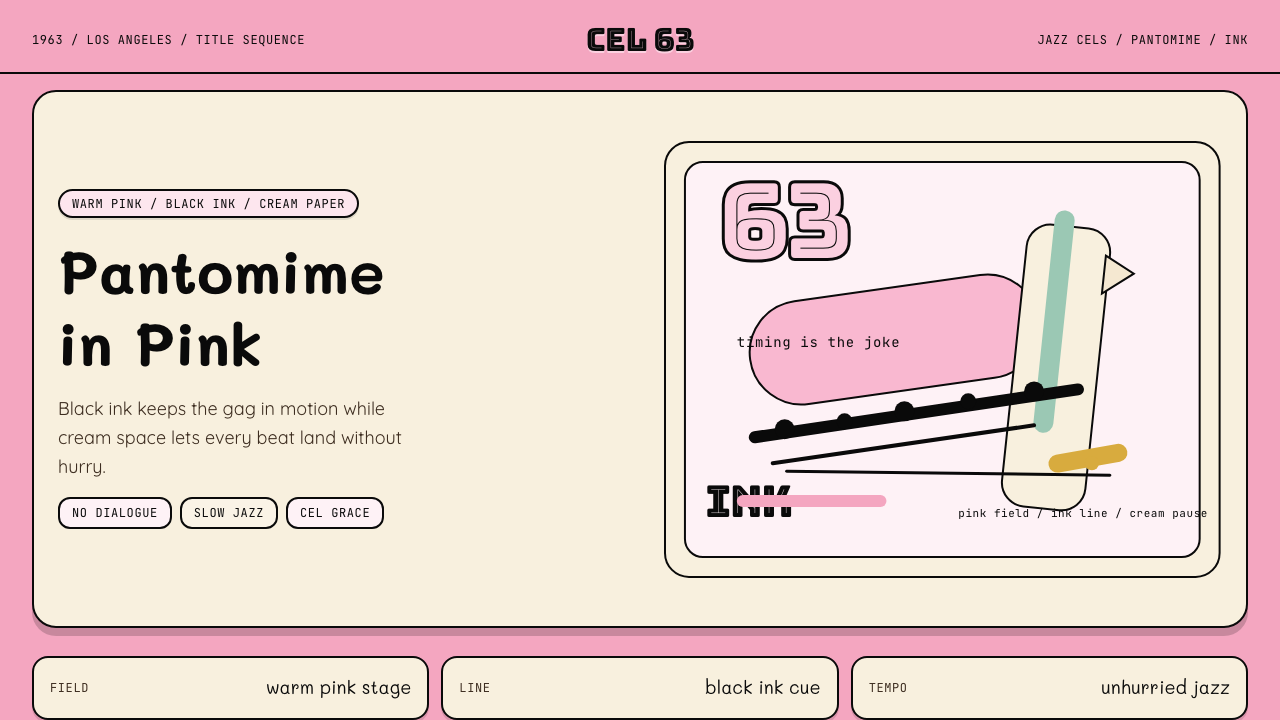 Pink Panther Cartoon (1963)Cool silence with a grin. Pink field, black ink, cream cel space.
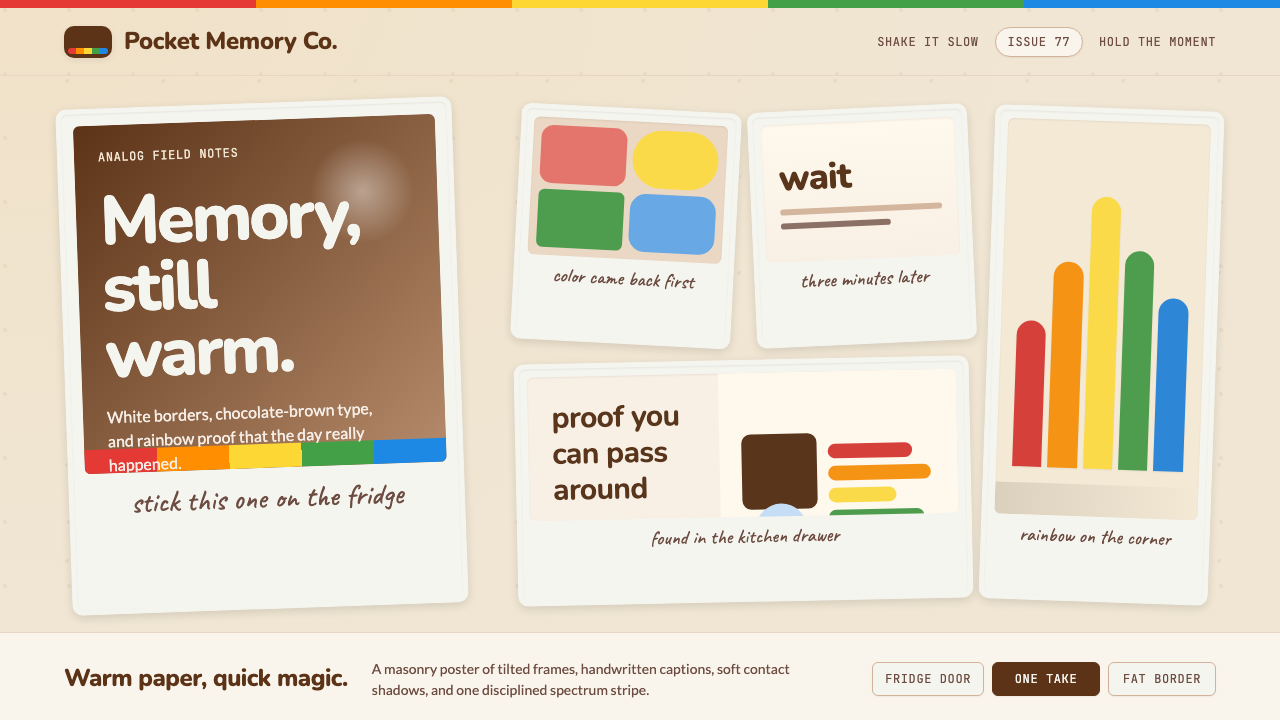 Polaroid InstantMemory made tangible. Photo-white frames tilt on aged paper with a warm rainb…
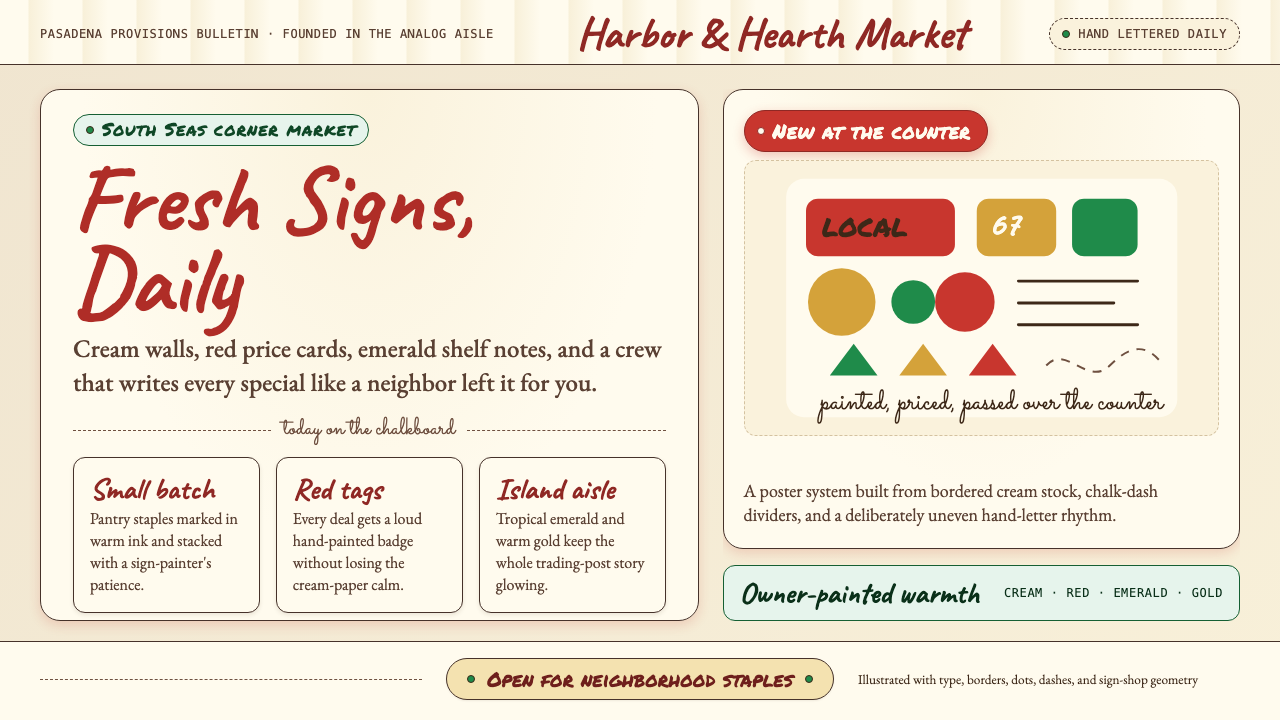 Trader Joe's Hand-LetteredHandmade grocery warmth. Cream chalkboards, red price tags, emerald accents.
 Krtek AnimationWordless wonder. Cobalt gouache stages black paper forms, guided by one red d…
 Orange Crush Soda (1906)Syrupy nostalgia. Tangerine, cream, and script make it a postcard label.
 Pepto-Bismol Pink (1901)Color is the cure. Bubblegum pink floods the field; white label cards and pil…