What is Dominican Bachata & Perico Ripiao?
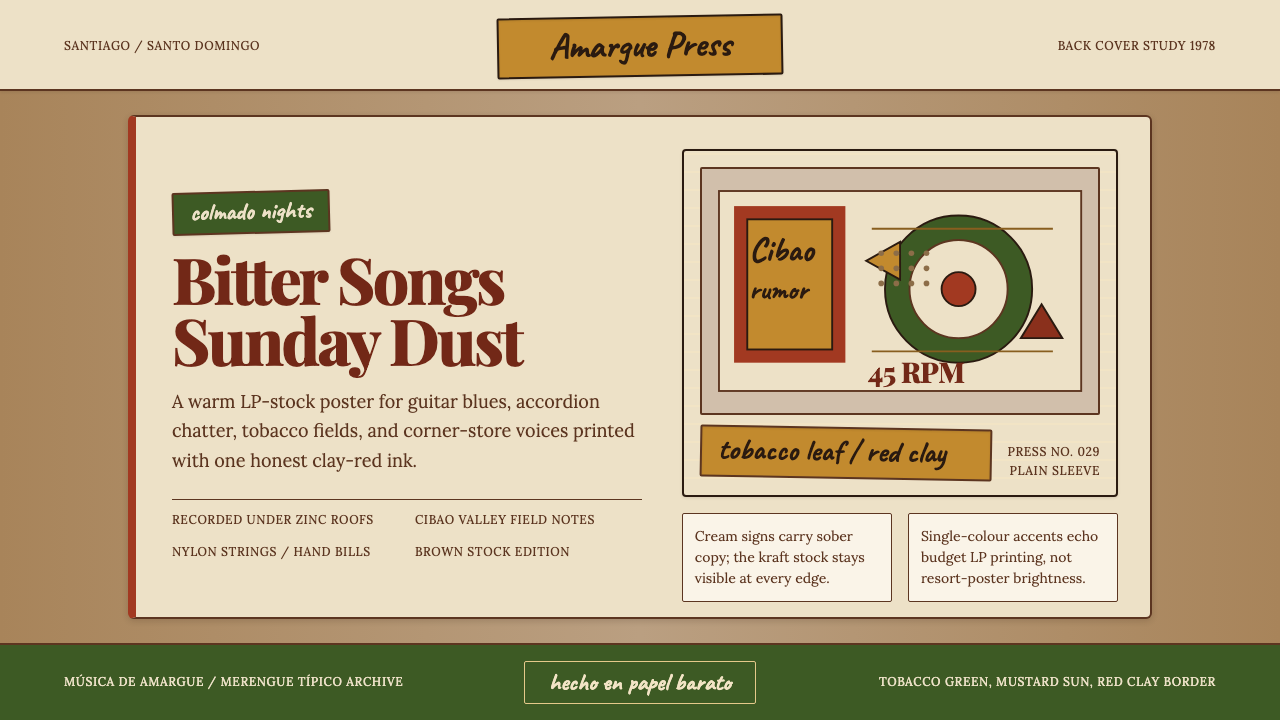
Born in the dusty Cibao Valley and the rum-soaked barrios of Santo Domingo, Dominican bachata and perico ripiao turned cheap cardboard, hand-lettered signs, and a palette of tobacco and clay into one of the most soulful visual languages in the Caribbean.
Dominican Bachata & Perico Ripiao in brief
Dominican Bachata & Perico Ripiao is a design aesthetic rooted in the visual culture of working-class Dominican music from the mid-twentieth century onward. It draws directly from the physical artifacts that surrounded these genres: LP record sleeves printed on rough brown stock, hand-painted colmado signs, mimeographed event flyers, and the weathered facades of barrio storefronts. The result is a warm, plainspoken visual system that values authenticity over polish and emotional directness over decoration.
Perico ripiao — literally 'ripped parrot,' a nickname for the accordion-driven folk music of the Cibao — predates the modern bachata genre by nearly a century, with roots traceable to the 1860s. Bachata itself emerged in the early 1960s as a guitar-trio form associated with heartbreak, poverty, and the urban barrios, long dismissed by Dominican middle-class culture as música de amargue, or 'bitterness music.' This shared history of marginalization is legible in the aesthetic: nothing aspires to opulence or official approval. The design language is honest about its humble material origins.
What distinguishes this style from other folk-influenced tropical aesthetics is its restraint. There is no explosion of neon or tourist-postcard saturation. The palette is drawn from things that genuinely existed in the environment — the brown of kraft paper, the muted terracotta of sun-dried adobe, the faded teal of shuttered windows, the near-black of strong coffee. Color is used sparingly, one anchor tone at a time, with the warmth of aged paper doing most of the compositional work.
Where does Dominican Bachata & Perico Ripiao come from?
The perico ripiao tradition takes its name from a brothel in Santiago de los Caballeros where a particular style of merengue típico was played in the late nineteenth century, accompanied by the accordion, the güira (a metal scraper), and the tambora drum. The music was rural, celebratory, and often bawdy — music for cockfighting arenas, harvest parties, and Sunday afternoon drinking. Its visual counterparts were the hand-lettered signs and crudely printed handbills that announced these gatherings, produced with whatever inks and papers were available in the Cibao's market towns.
Bachata's urban chapter began in the years after the assassination of dictator Rafael Trujillo in 1961. As rural Dominicans flooded into Santo Domingo, they brought with them the guitar-trio bolero tradition and the emotional rawness of campesino life. The first bachata recording is generally attributed to José Manuel Calderón in 1962. Through the 1960s and 1970s, the music was documented in LP releases on small local labels — Budget pressings, often with covers designed by hand, photocopied, or printed on low-cost brown or beige stock. These sleeves, with their rough typography and limited color budgets, became the accidental visual archive of a genre.
The aesthetic of these materials was shaped as much by economic necessity as by artistic intention. Small Dominican labels could not afford full-color offset printing; a single spot color on kraft-toned paper was the standard. The typefaces available were limited to whatever woodblock, transfer lettering, or typewriter fonts existed locally. Hand-painted lettering filled the gaps. The result — unintentionally — was a visual coherence rooted in constraint: every element communicated, because there was no room for anything that did not.
By the 1980s and 1990s, artists like Luis Segura, Tatico Henríquez, and Anthony Santos had elevated bachata from barrio stigma to national export. The visual culture evolved alongside the music — incorporating photographs of the artists, more elaborate lettering treatments, and eventually color photography — but the underlying warmth of the kraft-paper era persisted as a kind of cultural memory. Today, designers working in this aesthetic deliberately return to that earlier material vocabulary, treating it not as nostalgia but as a design system with its own structural integrity.
What defines the Dominican Bachata & Perico Ripiao look?
Color Palette
The palette is anchored in warm, desaturated earth tones: kraft brown, sun-dried terracotta, aged parchment, and the muted teal of weathered Caribbean shutters. Against these backgrounds, a single accent color — typically a deep brick red, a faded olive, or an oxidized turquoise — provides visual punctuation. The palette is never tourist-bright. Saturation is kept deliberately low, as if the colors have been exposed to years of tropical sunlight and humidity. Black appears for type and structural elements; white is used rarely and sparingly, as a point of contrast rather than a ground.
Typography
Type in this aesthetic draws from two distinct historical registers. The first is typewriter text: monospaced, slightly uneven, with the mechanical imperfection of keys that were struck too hard or too light. This treatment is used for credits, personnel listings, and small-print information — the kind of text that appeared on LP back covers identifying musicians and session dates. The second register is hand-painted lettering: bold, slightly irregular, with strokes that swell and thin in the manner of a sign painter's brush. These two registers coexist in tension, the mechanical and the hand-made, and their combination is central to the style's warmth.
Texture and Ground
The most distinctive visual quality of this aesthetic is the treatment of the background as a material surface rather than a neutral field. Kraft paper grain, slight print bleeding, and the off-register marks of cheap reproduction are not imperfections to be corrected — they are the ground itself. This materiality communicates authenticity and age without resorting to decorative distressing effects. The texture is subtle: it does not compete with content but instead gives the composition a physical warmth that smooth, digital-clean surfaces cannot replicate.
Frame and Border
Compositions in this style are frequently bounded by hand-painted or rough-printed edge frames — not the ruled geometric borders of European modernism, but irregular, brushy delineations that recall the work of sign painters and mural artists. These frames are never decorative in a superficial sense: they serve to concentrate the composition and signal that what is inside is complete, self-contained, finished. Double-rule borders and small repeated ornamental marks at corners echo the typographic traditions of Dominican print culture.
Composition and Space
Layout in this aesthetic is centered and stable rather than asymmetric and dynamic. This distinguishes it sharply from European modernist traditions like Bauhaus or Swiss Style, which prized asymmetric tension. The centered composition reflects the visual conventions of LP front covers, event posters, and signage, where hierarchy is communicated through scale and placement within a vertical axis. Large type at the top names the artist or event; a central visual field carries an image or ornamental block; smaller type below provides details. The arrangement is intuitive and culturally familiar rather than formally designed.
Imagery and Portraiture
When photographic imagery appears, it is typically a performer portrait printed with limited tonal range — the kind of reproduction that results when a black-and-white photograph is halftoned for cheap offset or letterpress. Faces are direct, frontal, and unretouched by contemporary standards. The portrait functions as a stamp of authenticity: this is who made this music, in this place, at this time. Non-photographic imagery tends toward simple geometric color blocks, musical instrument silhouettes, or abstract ornamental fills — elements that can be produced with limited printing resources.
Mood and Register
The emotional register of this aesthetic is simultaneously melancholic and warm — what the bachata lyrical tradition calls amargue, bitterness, rendered not as darkness but as honest acknowledgment of difficulty. The palette and material choices conspire to produce something that feels both worn and beloved, like a record sleeve handled by many hands over many years. There is no ironic distance here, no postmodern wink: the aesthetic takes its emotional material seriously, and that seriousness is what gives it its particular gravity.
Who shaped Dominican Bachata & Perico Ripiao?
Calderón is widely credited with recording the first bachata song in 1962, marking the genre's formal beginning as a recorded tradition. His work established the emotional template — guitar-led, lyrically direct, concerned with love and loss in the barrio — that would define bachata through the following decades. As the genre's earliest documented voice, his recordings also represent the first visual artifacts of the form: rough-pressed sleeves and minimal credit text that set the aesthetic precedent for everything that followed.
Known as 'El Papá de la Bachata,' Luis Segura was among the most prolific bachata recording artists of the 1970s and 1980s, releasing dozens of albums on the small Santo Domingo labels that defined the genre's visual culture during its peak era. His LP sleeves, with their characteristic brown-stock printing and hand-rendered lettering, are among the clearest surviving examples of the aesthetic in its most unself-conscious form — produced not as a style choice but as the only available option.
Tatico Henríquez was the preeminent perico ripiao accordionist of the mid-twentieth century, whose recordings bridged the older Cibao folk tradition and the emerging urban bachata scene. His visual presence on album covers — direct, unadorned, photographed against plain backgrounds — established a kind of performer-portrait convention that persisted through the genre. Henríquez died in 1976, but his recordings and their accompanying visual materials remain touchstones for the aesthetic's most authentic phase.
Anthony Santos, known as 'El Mayimbe,' represented the transitional moment in bachata's visual culture — the shift from the rough single-color LP era toward more produced, full-color presentation in the 1990s. His commercial success helped bachata achieve mainstream Dominican and international recognition, and his album artwork began incorporating more professional photography and design while retaining the emotional warmth and direct communicative register of the earlier tradition. Santos demonstrates how the aesthetic can evolve without losing its essential character.
How do you use Dominican Bachata & Perico Ripiao today?
Dominican Bachata & Perico Ripiao is a style with strong and specific emotional range. It is best suited to contexts where warmth, authenticity, and a grounded sense of cultural history are desired values — not as surface decoration but as the actual emotional register of the project. Applied carelessly, the kraft-paper warmth and typewriter credits can read as affectation; applied with understanding of what they communicate, they produce work that feels genuinely rooted rather than styled.
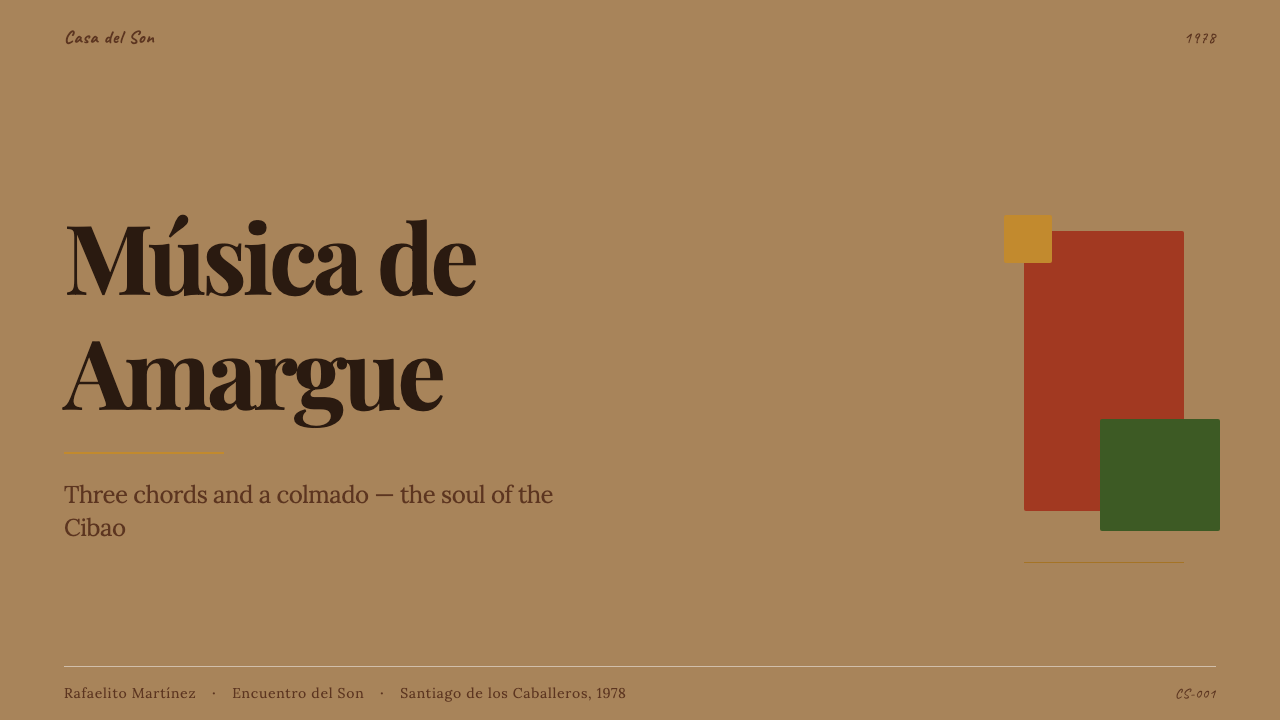
For presentation slides, the style works exceptionally well on covers and section dividers. A slide cover can anchor a large performer-portrait photograph — reproduced with reduced tonal range to suggest halftone printing — against a warm brown or parchment ground, with the title set in a bold, slightly irregular display treatment at the top and smaller typewriter-style credits below. Content slides should be treated with restraint: use the warm ground color consistently, keep type in one weight and size for body content, and reserve the accent color for a single data point or highlight per slide. Data slides benefit from the style's ability to make charts feel like printed materials — bars and labels treated as elements on a broadsheet rather than on a screen.
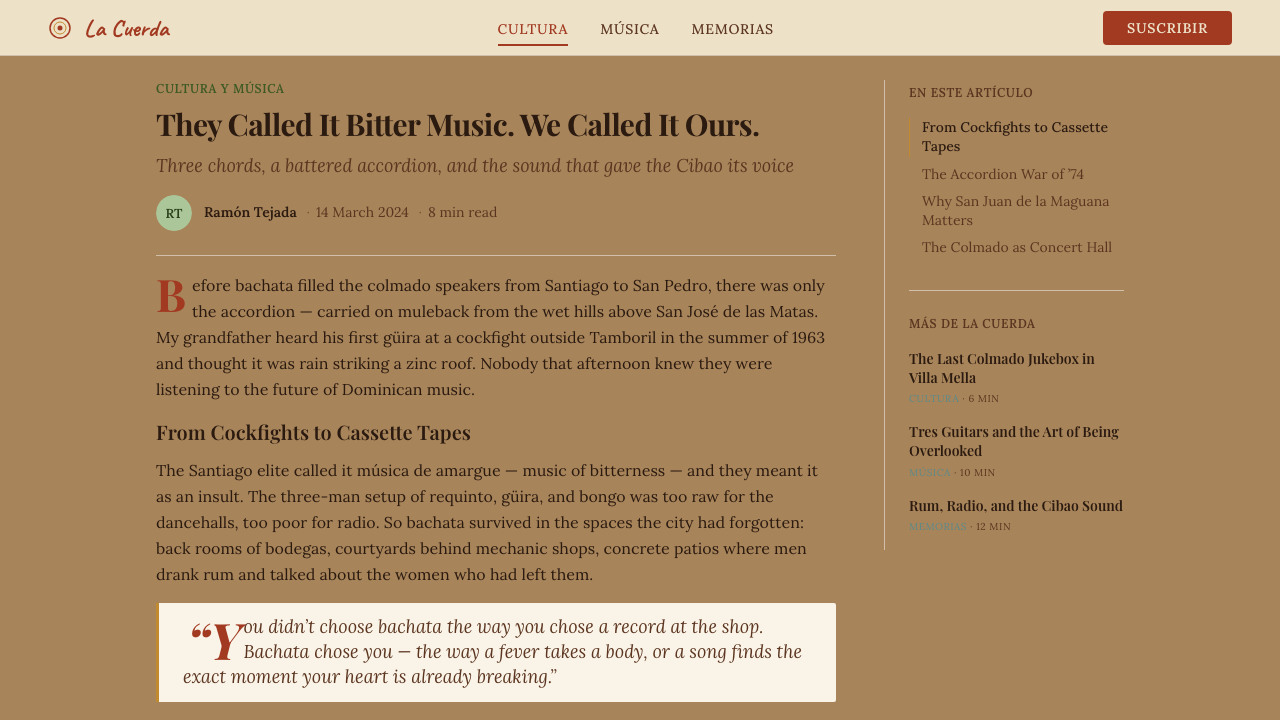
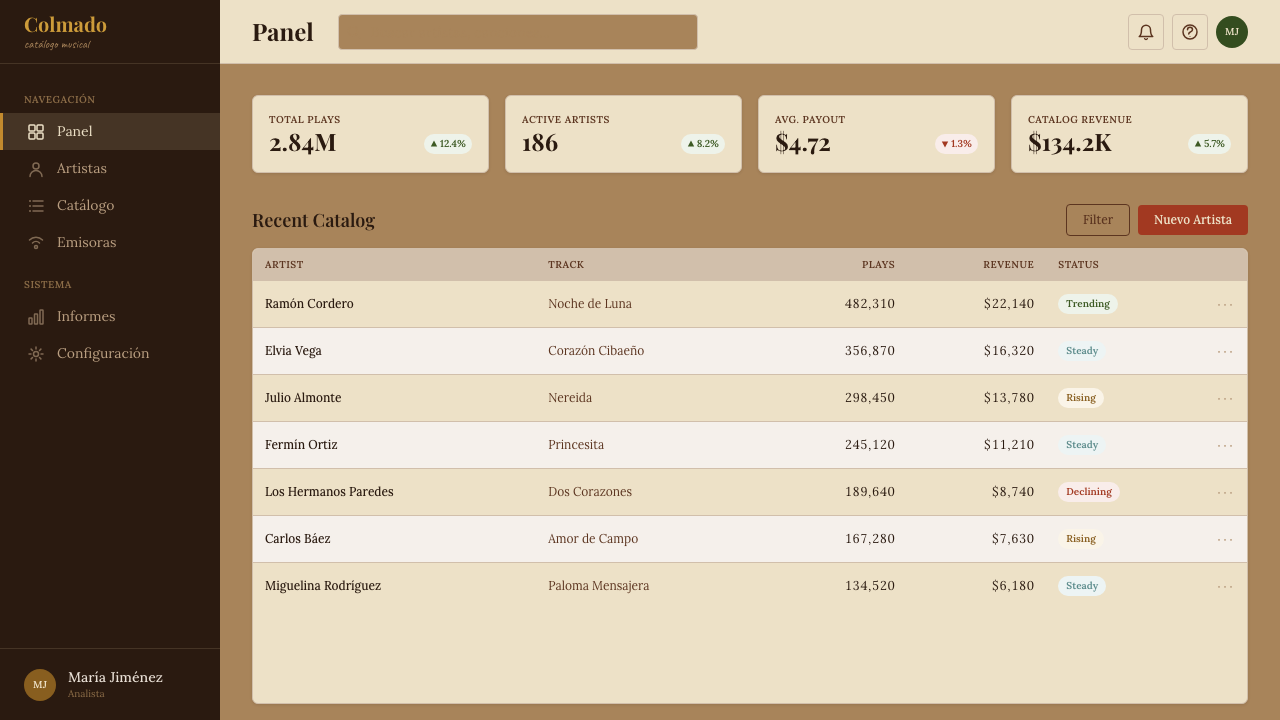
For web interfaces and digital products, this aesthetic is most at home in contexts with cultural or musical content: streaming platforms for regional music, editorial sites covering folk or roots traditions, cultural archive projects, and food or beverage brands with strong regional identity. The approach to UI components should honor the material vocabulary: card components with a warm parchment background and a single spot-color accent replace clean white cards; monospaced type for metadata and secondary information replaces standard sans-serif body text; border treatments suggest printed edges rather than digital dividers. Navigation should be typographic and spare.
For editorial and marketing applications, the style produces strong results in long-form editorial spreads, music journalism, cultural documentary contexts, and marketing materials for events with folk or roots character. A full-spread layout benefits from placing a large portrait or color block in the central field, with text set in the typewriter register for pull quotes and a bolder display treatment for headlines. The centered, hierarchical composition — headline above, detail below — works naturally for event posters, album announcement graphics, and social media materials where the visual needs to read at a distance before it is read up close.
A common mistake when applying this style is reaching for visual complexity to compensate for unfamiliarity with the aesthetic. The bachata visual tradition was born of constraint: one color, one typeface, one photograph. Introducing multiple accent colors, layering textures upon textures, or mixing hand-lettered treatments with clean geometric elements dilutes the style's structural logic. The restraint is not optional — it is the point. Work that respects the single-accent-color discipline, commits to the warm ground consistently, and allows the typewriter register to carry secondary information will read as coherent. Work that treats the individual elements as separate decorative choices will read as pastiche.
Dominican Bachata & Perico Ripiao — FAQ
How is this aesthetic different from other Caribbean or Latin American folk styles?
The most important distinction is restraint. Many Caribbean visual traditions — Haitian Vodou art, Cuban poster design, Brazilian cordel woodcuts — operate with bold color at high saturation and strong figurative imagery. Dominican bachata visual culture is unusually muted by comparison: the palette is warm but desaturated, the imagery often reduced to portraiture or simple geometric color blocks, and the overall compositional approach is centered and stable rather than dynamically gestural. It shares the material honesty and folk directness of its regional neighbors but expresses these qualities through understatement rather than exuberance.
Can this style work for digital products that have no connection to music or Dominican culture?
It can, but it requires clear thinking about why the emotional register of the style serves the product. The bachata aesthetic communicates warmth, authenticity, slight melancholy, and a sense of cultural rootedness. These are genuinely transferable values — they would suit a food delivery service with regional identity, a personal finance tool aimed at immigrant communities, a cultural archive, or a handcraft marketplace. They would not suit a SaaS analytics platform, a health monitoring dashboard, or a fintech product where precision and neutrality are the expected signals. The style is not merely decorative; it carries meaning, and that meaning needs to align with the product's intent.
How do you apply the typewriter and hand-lettered elements without the result looking like a Halloween costume version of the style?
The key is functional placement, not decorative scattering. In the original bachata sleeve materials, typewriter text appeared where typewriter text was the available tool: credits, personnel, catalog numbers, recording dates. It was never used for headlines or main titles, which were handled by hand-lettered or display type. Applying typewriter treatment to secondary, metadata-level information — and reserving display treatment for primary headings — follows the same logic. Similarly, hand-lettered elements should feel purposeful rather than applied as texture: one large display headline, not multiple small decorative flourishes scattered across the layout.
What is the right way to use the accent color in this system?
One accent color, used for one purpose per composition. In the original LP materials, the spot color — typically a deep red, a dark green, or an oxidized blue — was used either to print the artist's name, to flood a background panel behind text, or to color a simple graphic element like a border or ornamental mark. It was almost never used for more than one of these functions in the same piece. In contemporary application, the same discipline applies: choose a single accent, assign it a single role in each layout (action color, highlight, or structural element), and resist the temptation to use it for multiple functions simultaneously. The accent earns its warmth by being singular.
How does this style age — does it risk looking dated quickly?
The style is inherently resistant to rapid dating because it is not rooted in current digital trends — it is rooted in material objects from the 1960s through 1990s that already have historical distance. A design that looks like a 1975 Dominican LP sleeve looked that way in 1975 and will continue to look that way in 2035. The risk of dating exists when the style is applied shallowly, relying on surface-level trend signals (a particular grain filter, a currently fashionable font that mimics the period) rather than the underlying structural logic. Work grounded in the actual visual conventions of the tradition — centered composition, warm ground, single accent, typewriter register for secondary text — will hold its character across time because it is describing something that already existed rather than participating in a current moment.
Related design styles
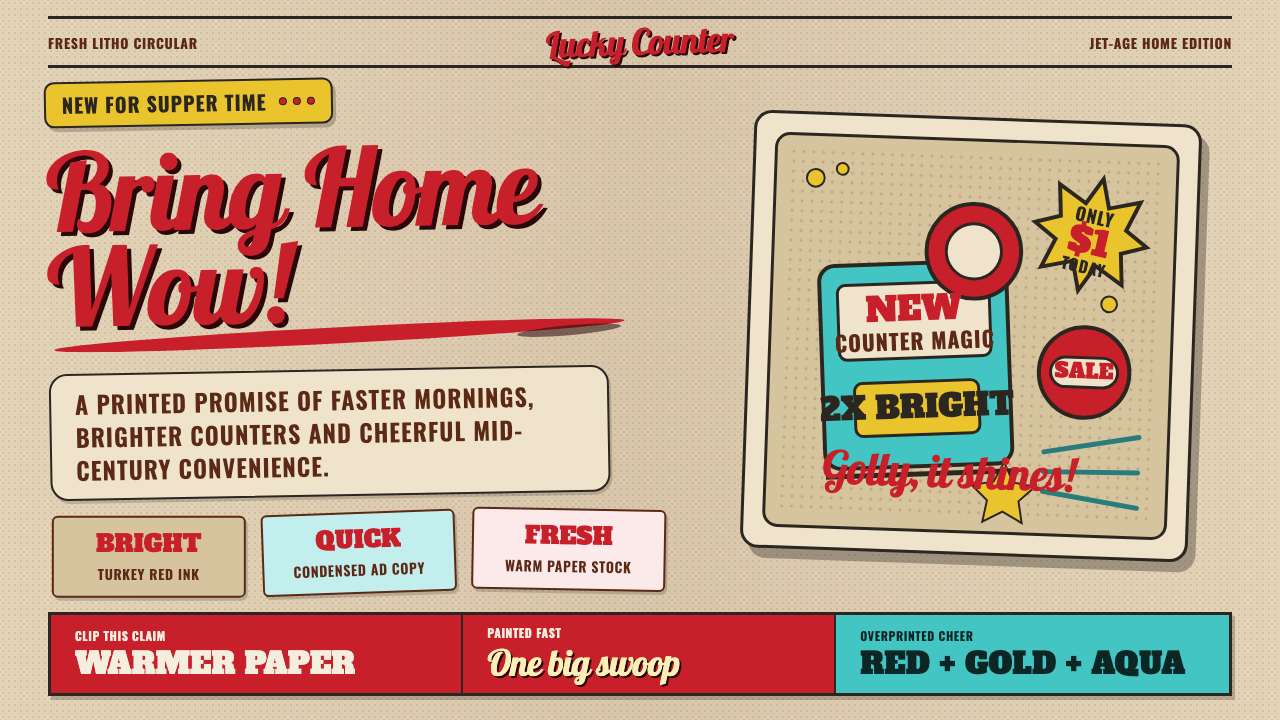 1950s Brush Script AdSells tomorrow in one swoop. Turkey red script, tan paper, starbursts, and ha…
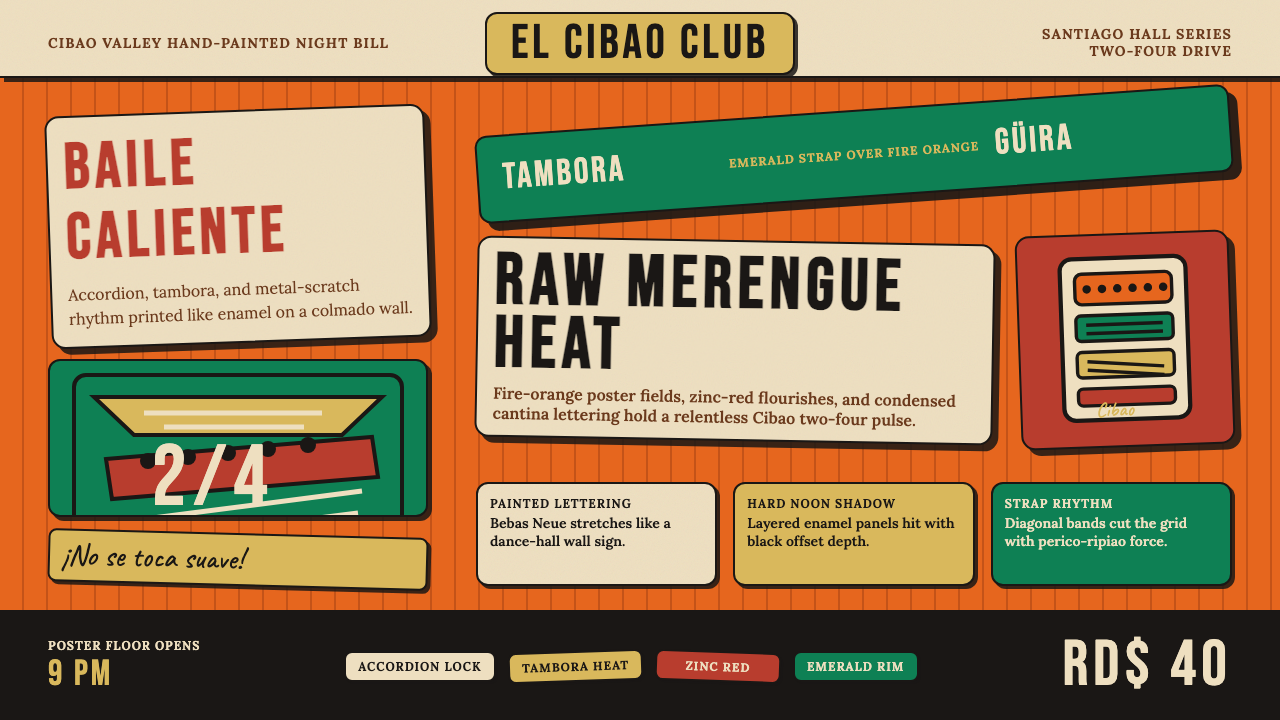 Dominican Merengue Perico RipiaoMaximalism keeps time. Fire-orange fields, Bebas Neue, and diagonal emerald s…
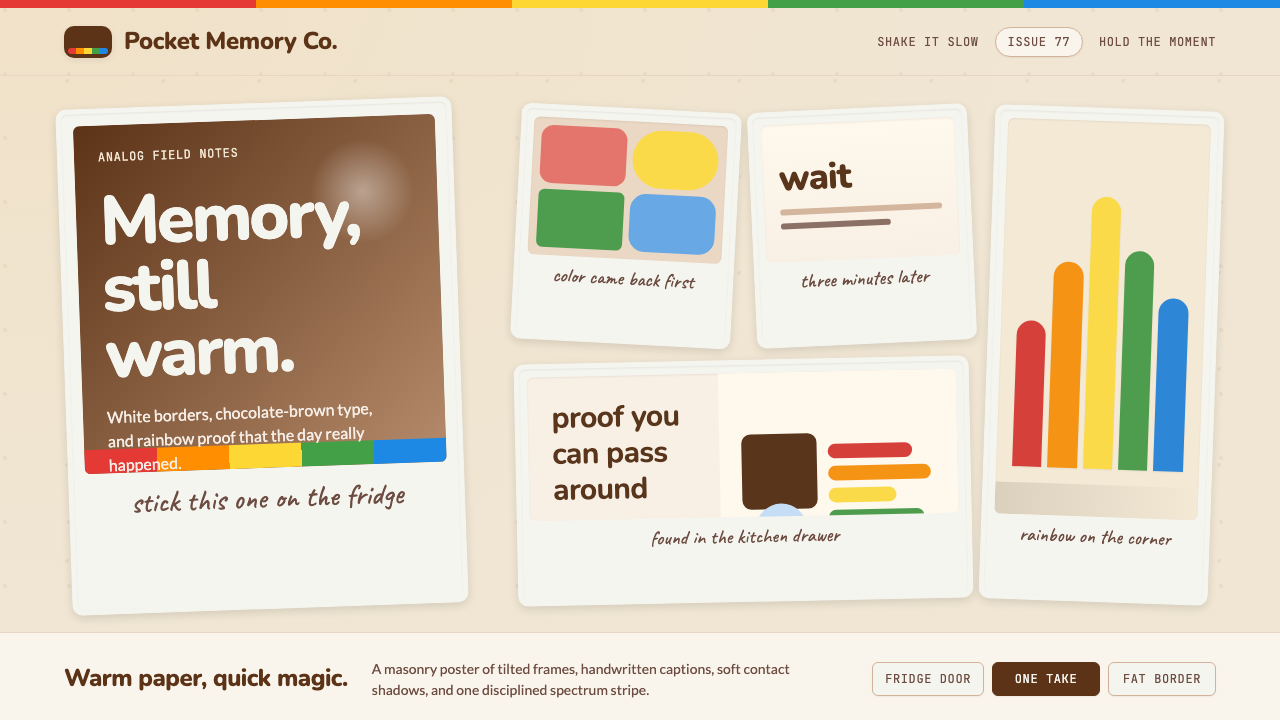 Polaroid InstantMemory made tangible. Photo-white frames tilt on aged paper with a warm rainb…
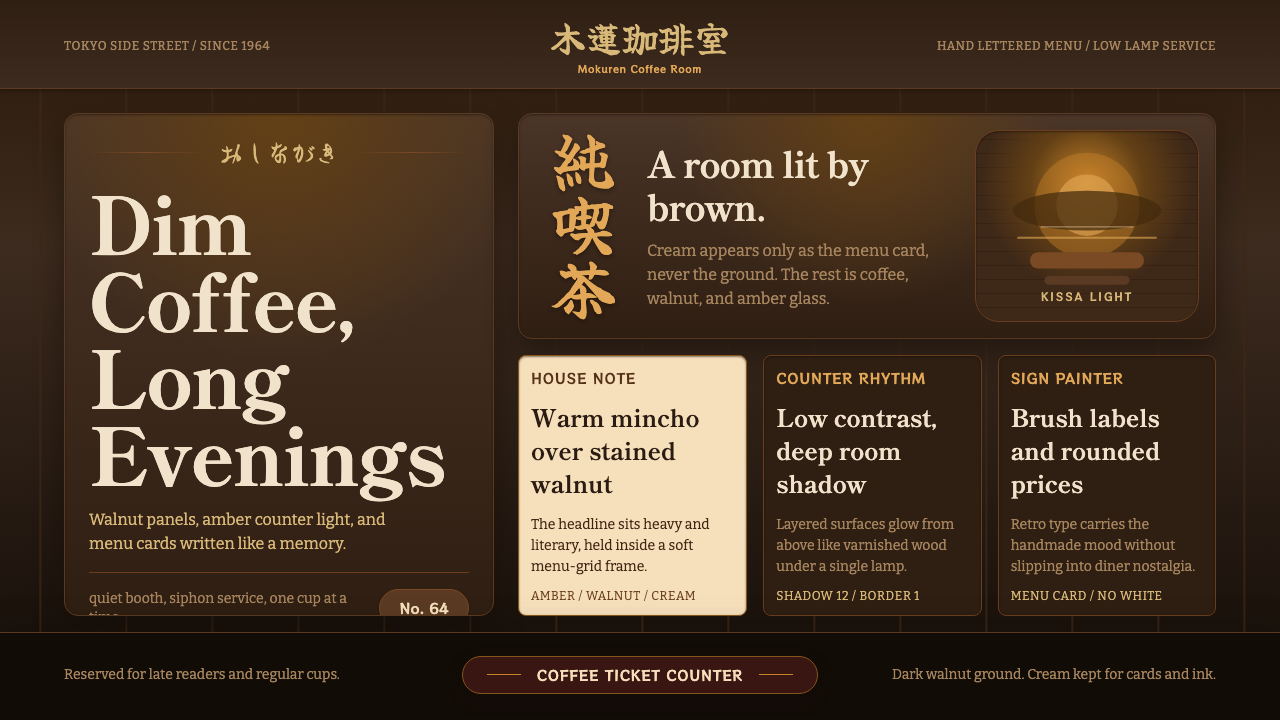 Shōwa KissatenDimness is the luxury. Walnut browns, amber glow, and Mincho type frame a men…
 Trader Joe's Hand-LetteredHandmade grocery warmth. Cream chalkboards, red price tags, emerald accents.
 1970s Earth TonesWarm maximalism stays muddy. Bulbous slabs, avocado bands, and harvest-gold r…