What is Dominican Merengue Perico Ripiao?
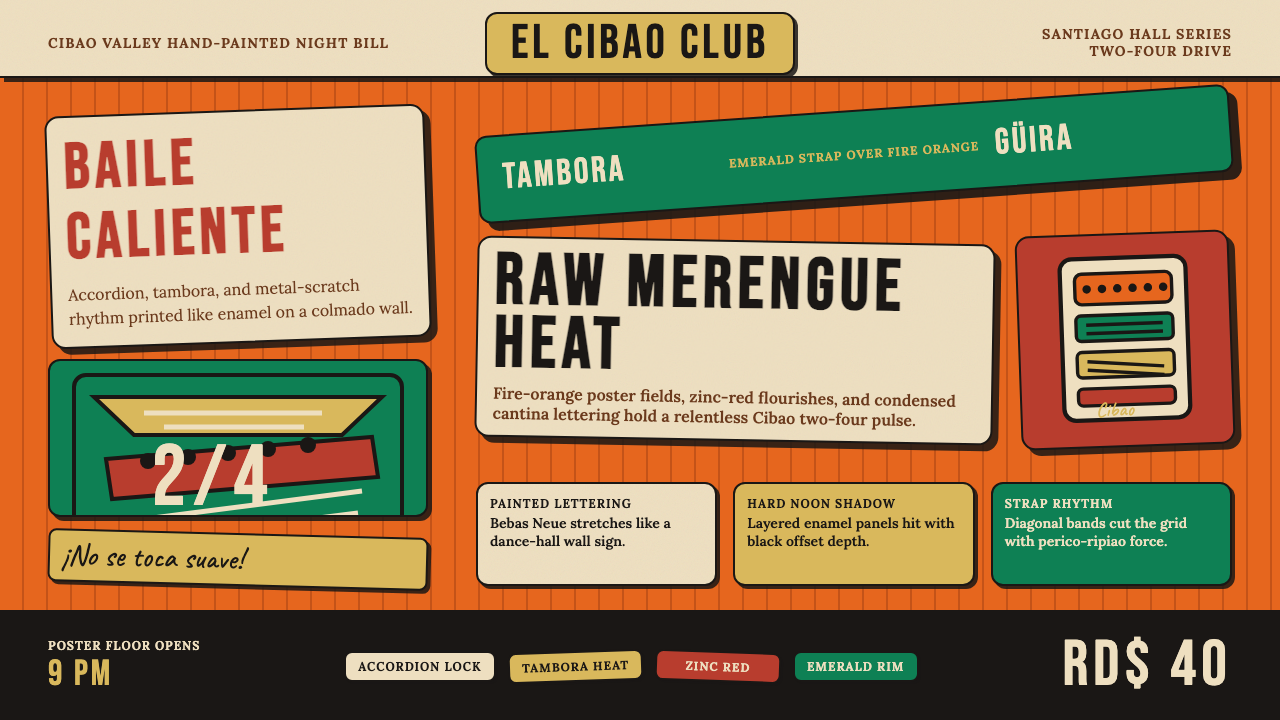
Perico ripiao is the fire-orange, hand-painted soul of Dominican merengue — a design language that turns cantina signage, dance-hall posters, and accordion-driven euphoria into a maximalist visual feast.
Dominican Merengue Perico Ripiao in brief
Dominican Merengue Perico Ripiao is a design system rooted in the raw folk tradition of perico ripiao — the original, unpolished form of merengue music born in the Cibao Valley of the Dominican Republic. Unlike the polished orchestral merengue that later dominated urban ballrooms, perico ripiao was played by small groups using just three instruments: the tambora drum, the güira metal scraper, and the button accordion. Its visual identity draws directly from the 1950s and 1960s Santo Domingo and Cibao dance-hall poster tradition — a graphic world of fire-orange grounds, hand-painted condensed lettering, emerald green banners, and zinc-red flourishes borrowed from cantina signage and colmado walls.
The aesthetic is maximalist in the truest sense: nothing is restrained, nothing whispers. Color fields are saturated to the point of vibration. Letterforms are condensed, bold, and slightly irregular — the trace of a human hand with a wide brush, not the output of a typesetting machine. Diagonal banner-strap compositions cut across the frame with the same urgency that a merengue rhythm cuts through a crowd. Every surface feels like it has been tacked up on a Cibao colmado wall and baked by Caribbean sun.
Where Bauhaus or Swiss design systems impose rational order, perico ripiao design embraces productive chaos: multiple competing type sizes, overlapping decorative borders, color fields that collide without gradient transitions, and ornamental flourishes that celebrate hand-craft over industrial precision. The system is governed not by a grid but by rhythm — the visual equivalent of the insistent two-four beat that has defined perico ripiao since the 1840s.
Where does Dominican Merengue Perico Ripiao come from?
Perico ripiao — the name is slang, likely derived from a colloquial term for a rough Cibao cantina — emerged as a distinct musical form in the Cibao Valley around the city of Santiago de los Caballeros in the first half of the nineteenth century. The two-four time signature, the tambora-güira-accordion trio, and the call-and-response vocal structure were all established by the 1840s. The music was rural, working-class, and strongly associated with the small farmers and laborers of the Cibao interior — people who danced and drank in cantinas, not in the salons of Santo Domingo's colonial elite.
The visual language of perico ripiao crystallized in the 1950s and 1960s, when the music found itself in a complex political bind. The dictator Rafael Trujillo, who ruled the Dominican Republic from 1930 until his assassination in 1961, nationalized merengue as the official music of the Dominican people — using it as a propaganda tool to construct a unified national identity. Dance-hall promoters and small record labels responded by producing vivid hand-painted posters and painted enamel signs that announced performances by key figures of the tradition. These posters — fire-orange or zinc-red grounds, diagonal banners, condensed hand-lettered type — became the graphic archive of the form.
The instruments themselves shaped the aesthetic. The güira's metallic scrape, the tambora's dense thud, and the accordion's bright, nasal squeal all register in the design's color logic: the güira suggests the metallic sheen of zinc-red and silver-white; the tambora's darkness anchors the deep shadow tones; the accordion's exuberance drives the saturated fire-orange that dominates the palette. This synesthetic reading is not a retrospective imposition — it was implicit in how dance-hall promoters actually selected paint colors and lettering styles to evoke the music's character.
After Trujillo's assassination in 1961, merengue fragmented into multiple streams. Urban orchestral merengue — with brass, piano, and slick choreography — became internationally famous in the 1980s through artists like Johnny Ventura and later Juan Luis Guerra. But perico ripiao, the raw root form, was preserved by a dedicated community of musicians and scholars, and in 2016 UNESCO inscribed merengue on its Representative List of Intangible Cultural Heritage of Humanity — a recognition that specifically honored the Cibao folk tradition as the form's authentic heart. The visual system associated with perico ripiao today draws on both the historic poster archive and a contemporary revival interest in hand-made, analog, and pre-digital graphic forms.
What defines the Dominican Merengue Perico Ripiao look?
Color
The palette is built around fire-orange as a dominant ground — a warm, sun-cured orange that sits closer to a hot enamel than to a pastel. Against it, emerald green appears as a diagonal accent or banner stripe, and zinc-red provides a secondary warm note used in lettering and border flourishes. White or near-white is used sparingly for headline lettering and contrast breaks. Black functions as the deepest shadow and the anchor for body type. The overall effect is of saturated color fields in collision — no gradients, no transitions, just flat planes of high-energy hue pressing against each other.
Typography
Letterforms are condensed, tall, and manually irregular — they read as the output of a sign-painter's brush rather than a typesetting machine. Headline type is enormous relative to the composition, often consuming a third or more of the vertical space. Interior letters sometimes vary subtly in weight and angle, preserving the evidence of human hand-work. There is no single type hierarchy imposed by rule; instead, importance is communicated through size contrast, color contrast, and the physical energy of the letterform itself. Secondary information appears in smaller condensed blocks but is never demoted to invisibility.
Diagonal Composition
The diagonal banner-strap is the system's most distinctive structural device. Where European modernist layouts organize information along horizontal and vertical axes, perico ripiao compositions introduce a bold diagonal band — typically running from upper-left to lower-right, or in the opposite direction — that carries a performer's name, a venue, or a date. This diagonal cuts across the ground color with urgency, creating visual movement that parallels the relentless forward drive of the music itself. Multiple diagonals can coexist in a single composition, layering information like stacked rhythmic patterns.
Ornamental Borders and Flourishes
Where Bauhaus strips away ornament entirely, perico ripiao celebrates it. Decorative borders — painted in contrasting colors, often featuring repeated geometric or floral motifs lifted from cantina tile work and colonial ironwork — frame text blocks, separate information zones, and emphasize performer names. Flourishes extend from letterforms, curling into the surrounding color fields. These ornamental elements are not arbitrary decoration; they are signals of hand-craft, cultural specificity, and festive occasion. Their presence communicates that this is a special event, not a routine announcement.
Texture and Surface Quality
The aesthetic deliberately preserves evidence of hand production. Brush strokes are visible in color fields — subtle variations in opacity and direction that no digital flat fill replicates. Letterforms show the small imperfections of brush work: slightly uneven baseline, minor variations in stroke width, brush-end textures at the terminals. This textural quality is what distinguishes perico ripiao from mere tropical maximalism; it insists that a human being made this thing, not a machine. In digital applications, introducing deliberate texture — grain, slight irregularity, visible ink spread — is more faithful to the source than smooth vector perfection.
Layering and Density
Perico ripiao compositions are dense. There is rarely empty space for its own sake — every zone of the composition carries information, color, or texture. Color fields overlap and collide. Type overlaps decorative bands. Illustrative elements — stars, musical notes, portrait silhouettes — appear alongside text. This density is not disorganization; it mirrors the sonic density of the music itself, in which the tambora, güira, and accordion never pause simultaneously. The compositional logic is additive rather than reductive: more is added until the festive atmosphere is achieved, not subtracted until clarity is reached.
Energy and Festivity
Above all, the system communicates celebration. The fire-orange ground, the diagonal banners, the hand-lettered exuberance, and the ornamental density all work together to say: something joyful is happening here, and you are invited. This festive register is not accidental — it is the design equivalent of the merengue's irresistible rhythmic pull. A composition in this system that feels measured or restrained has failed; the goal is not refinement but infectious euphoria.
Who shaped Dominican Merengue Perico Ripiao?
Francisco Antonio Lora — known universally as Ñico Lora — is regarded as one of the founding figures of perico ripiao, active in the Cibao Valley from the early twentieth century. His accordion playing set the template for the form's rhythmic feel and ornamentation style, and his recordings in the mid-twentieth century helped preserve the tradition at a time when urban orchestral merengue was increasingly dominant. Lora's name appears on some of the earliest surviving perico ripiao dance-hall posters, making him both a musical and a visual archetype of the form.
Tatico Henríquez was one of the most celebrated perico ripiao accordionists of the twentieth century, whose recordings in the 1960s and 1970s are considered definitive documents of the style at its expressive peak. His playing was known for its rhythmic intensity and emotional range — from driving dance energy to lyrical melancholy — and his associated poster art exemplifies the mature visual language of the tradition: dense, hand-painted, fire-ground compositions with bold condensed lettering. Henríquez died in 1976, but his recordings remain the primary reference for musicians and scholars of the form.
Doña Altagracia Arias Vanderpool — known as Fefita La Grande — is one of the few women to have achieved legendary status in the accordion-driven perico ripiao tradition, a world dominated by male performers. Her recordings from the 1960s onward combined raw Cibao folk energy with theatrical charisma, and her stage presence and promotional materials contributed a more exuberant, almost operatic dimension to the visual language of the tradition — bolder lettering, brighter color contrasts, and a sense of personal star power projected through the graphic surface.
Juan de Dios Ventura Soriano — Johnny Ventura — represents the hinge point between perico ripiao's folk roots and the urban merengue explosion of the 1960s and beyond. While he modernized the music's production and showmanship to reach international audiences, his early career was deeply rooted in the Cibao visual and musical tradition. His promotional materials from the late 1950s and 1960s are among the most visually sophisticated examples of the dance-hall poster style, and his later commercial success brought global attention to merengue as a whole — including renewed scholarly and cultural interest in its perico ripiao origins.
Rafael Leonidas Trujillo Molina — the Dominican dictator who ruled from 1930 to 1961 — is an ambivalent figure in the perico ripiao visual tradition. His regime's nationalization of merengue as official state music simultaneously elevated the form's status and commercialized its graphic production: dance-hall posters multiplied, enamel signs proliferated, and the visual language of perico ripiao became a form of state-adjacent popular culture. The richest period of the poster archive coincides almost exactly with his rule, making Trujillo an indirect patron of the form's most iconic visual documents, even as his politics represented the opposite of the music's working-class, grassroots spirit.
How do you use Dominican Merengue Perico Ripiao today?
Perico ripiao design is a high-energy, high-commitment system. Applying it effectively requires abandoning the instinct toward restraint and instead asking: does this composition feel like a dance-hall announcement? Does it vibrate? If the answer to either is no, the system is being under-applied. The key is to commit fully to the fire-orange ground, the diagonal structures, and the hand-made texture — half-measures produce something that looks merely chaotic without achieving the festive power of the source.
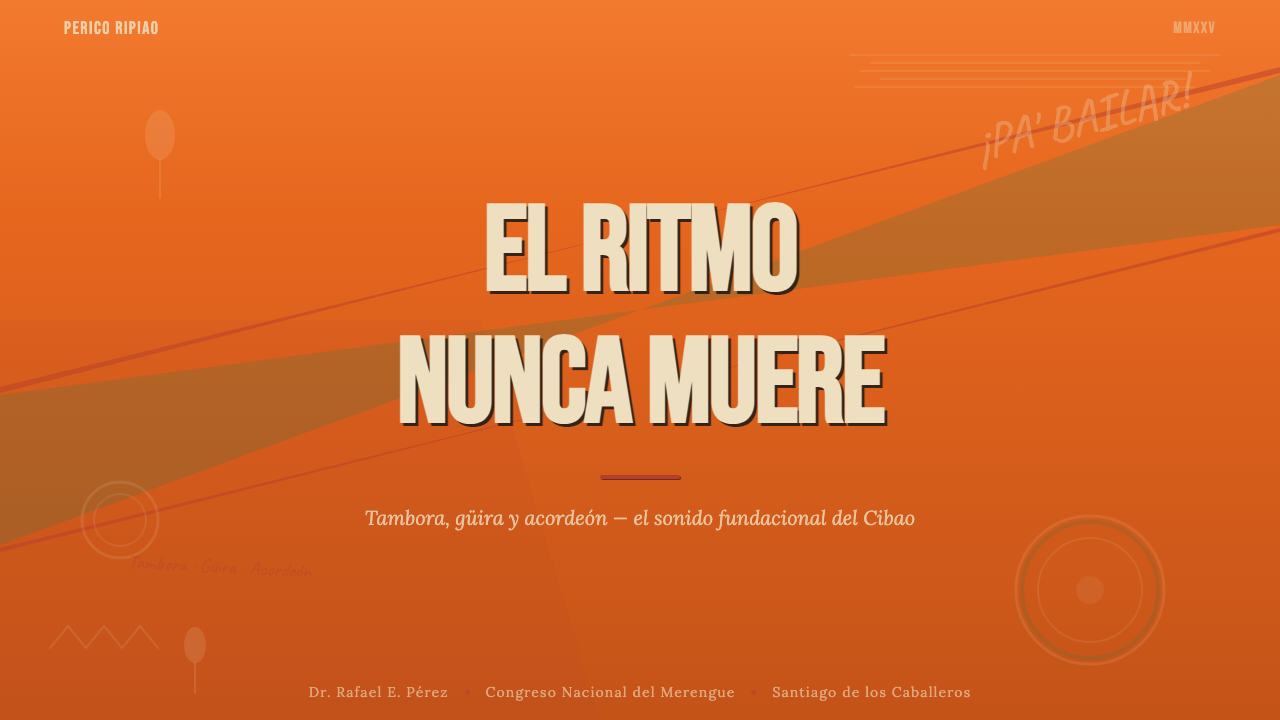
For presentation slides, this system works powerfully for covers and section dividers. A cover slide built on a deep fire-orange ground with a diagonal emerald band carrying the presentation title, large condensed lettering that fills most of the frame, and visible textural irregularity will command attention immediately. Content slides should be treated more carefully: reducing the color density while retaining the diagonal compositional logic and one dominant saturated hue per slide allows the energy to persist without overwhelming data or text. Charts and data visualizations translate well into this system when axes and bar fills are rendered in the primary palette against a cream or off-white ground — the data becomes festive without becoming illegible.
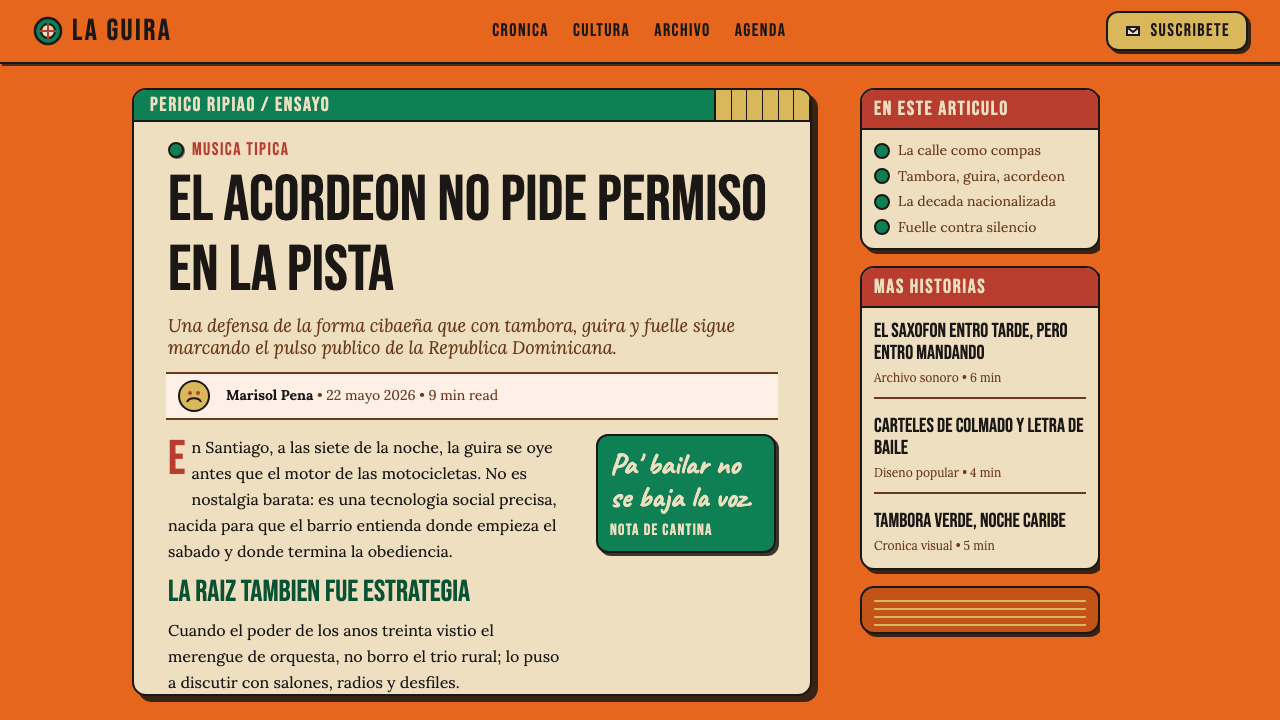
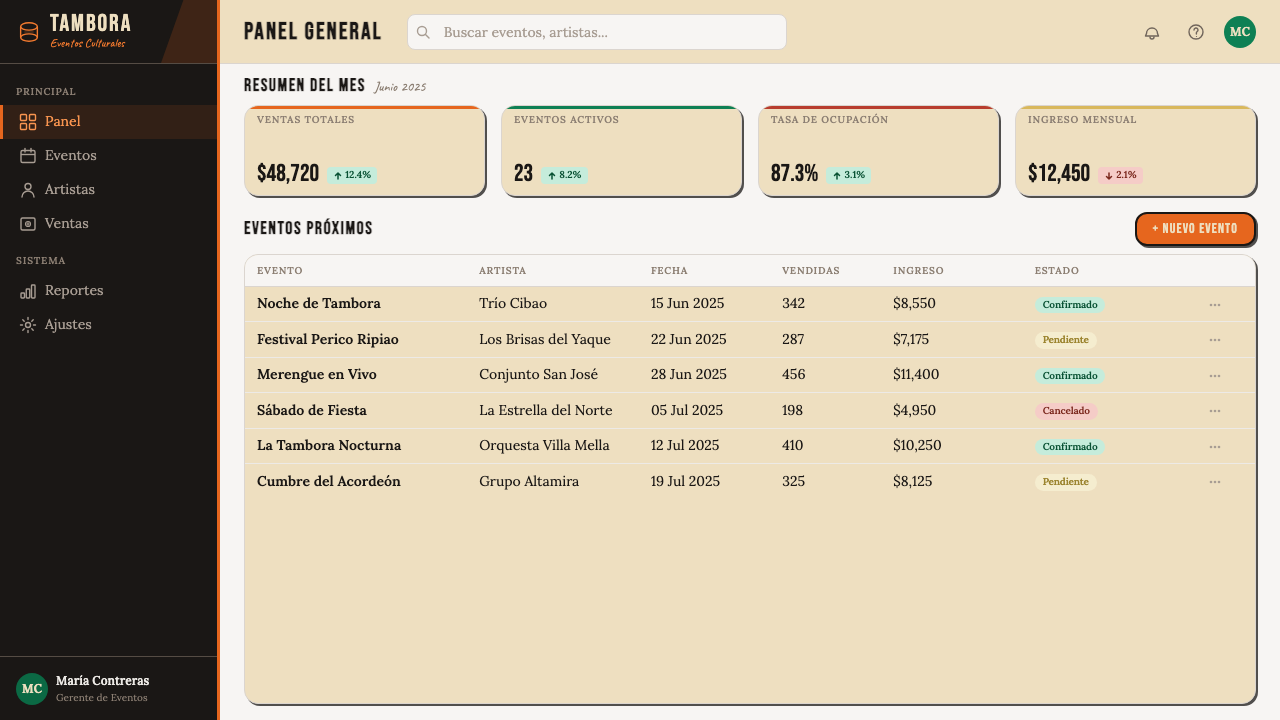
For web interfaces and digital products, perico ripiao is most at home in landing pages, event promotion sites, music or entertainment platforms, and cultural heritage projects. The system's density and maximalism are not suited to dashboard interfaces where scannability under cognitive load is paramount, but they are perfectly matched to contexts where emotional impact and immediate cultural identification are the primary goals. A hero section built with a fire-orange full-bleed ground, diagonal banner typography, and deliberately textured backgrounds will communicate energy and cultural specificity faster than any minimal layout.
For editorial and marketing work, the system excels at event posters, festival branding, album artwork, restaurant and hospitality signage, and cultural promotion materials. The historical source material — dance-hall posters and cantina signs — is itself editorial and promotional, so contemporary applications in these genres are direct extensions of the tradition. Print materials benefit from the system's origins in ink-on-paper production: allowing ink to spread slightly, printing on textured or uncoated stock, and embracing slight misregistration between color passes all add authenticity.
A common mistake when applying this system is treating the saturated palette as permission to use every color at full intensity simultaneously. The most powerful perico ripiao compositions are actually dominated by one color — fire-orange — with the other hues serving as punctuation rather than co-leads. A second error is substituting digital smoothness for hand-made irregularity: perfectly kerned type, mathematically straight diagonals, and gradient-free smooth color fills will produce something that looks like a parody of the style rather than a genuine application of it. The source's power comes specifically from evidence of hand-work, and preserving that evidence — deliberately or through actual manual production — is what separates an authentic interpretation from a superficial appropriation.
Dominican Merengue Perico Ripiao — FAQ
Is perico ripiao the same as merengue?
Perico ripiao is the founding folk form of merengue — the rural Cibao Valley tradition from which all subsequent merengue styles descend. Think of it as merengue in its most elemental state: three instruments, a relentless two-four beat, and no orchestral amplification. When people refer simply to 'merengue' in a contemporary context, they usually mean the urban orchestral form that developed from the 1960s onward — brass, piano, slick choreography — which shares the same rhythmic DNA but has a fundamentally different sonic and visual character. Perico ripiao's design language is distinct from urban merengue's more commercial aesthetic precisely because it preserves the hand-made, grassroots energy of the original.
How does this style differ from other Latin American maximalist design traditions?
Latin American maximalism is a broad category that includes Mexican cantina signage, Peruvian chicha poster art, Colombian cumbia flyer design, and Brazilian Carnaval graphics, among others. What distinguishes perico ripiao design within this family is its specific combination of: the fire-orange and emerald-green palette derived from Cibao cantina culture, the diagonal banner-strap as a primary compositional device, and the enamel-sign quality of its flat color fields — a hardness and intensity that differs from the more gradient-rich or photographic maximalism found in some other traditions. The tambora-and-accordion sonic character of the music also produces a different rhythmic feel in the composition — percussive and staccato rather than flowing and continuous.
Can this system work for digital interfaces, or is it limited to print?
The style translates to digital contexts but requires deliberate adaptation. Its original medium — hand-painted signs and printed posters — is physical and static; the challenge in digital applications is preserving the textural and compositional energy without producing interfaces that are unusable or overwhelming. The most successful digital applications treat the perico ripiao aesthetic as a surface layer — the visual first impression — rather than as the complete interface system. A landing page hero, a loading screen, a splash interstitial, or an event-announcement modal can carry the full density and energy. Navigation, data display, and transactional interfaces should be simplified, retaining the color palette and diagonal compositional logic while reducing the ornamental density to maintain usability.
What does UNESCO recognition mean for this style's cultural status?
UNESCO's 2016 inscription of merengue — with specific attention to the perico ripiao folk tradition — on its Representative List of Intangible Cultural Heritage of Humanity formalized what Dominican musicians and cultural scholars had argued for decades: that perico ripiao is not merely a precursor to be transcended by more sophisticated urban forms, but a living cultural expression with its own irreducible value. For designers working with this style, the UNESCO recognition matters in two practical ways: it signals that the tradition is actively maintained and documented, which means there is a growing archive of authoritative visual and musical material to draw from; and it frames the style within a discourse of cultural preservation and respect, which shapes how appropriation and application should be approached, particularly by designers outside the Dominican cultural context.
How should a designer handle the tension between authentic hand-made quality and digital production efficiency?
This tension is real and worth naming directly. The perico ripiao aesthetic derives its power from visible evidence of human hand-work — brush irregularity, slight misregistration, ink spread, imperfect letterforms. Digital tools by default produce the opposite: perfect curves, uniform fills, mathematically precise spacing. The practical resolution is not to pretend digital tools are analog, but to make deliberate choices that reintroduce irregularity and texture at key points. Textured brush overlays, deliberately varied letter spacing, painted-edge effects on color field boundaries, and slight rotation irregularity on diagonal elements are all techniques that restore some of the handmade quality without requiring actual manual production. The goal is not perfect simulation but sufficient evocation — enough irregularity that the composition feels made rather than generated.
Related design styles
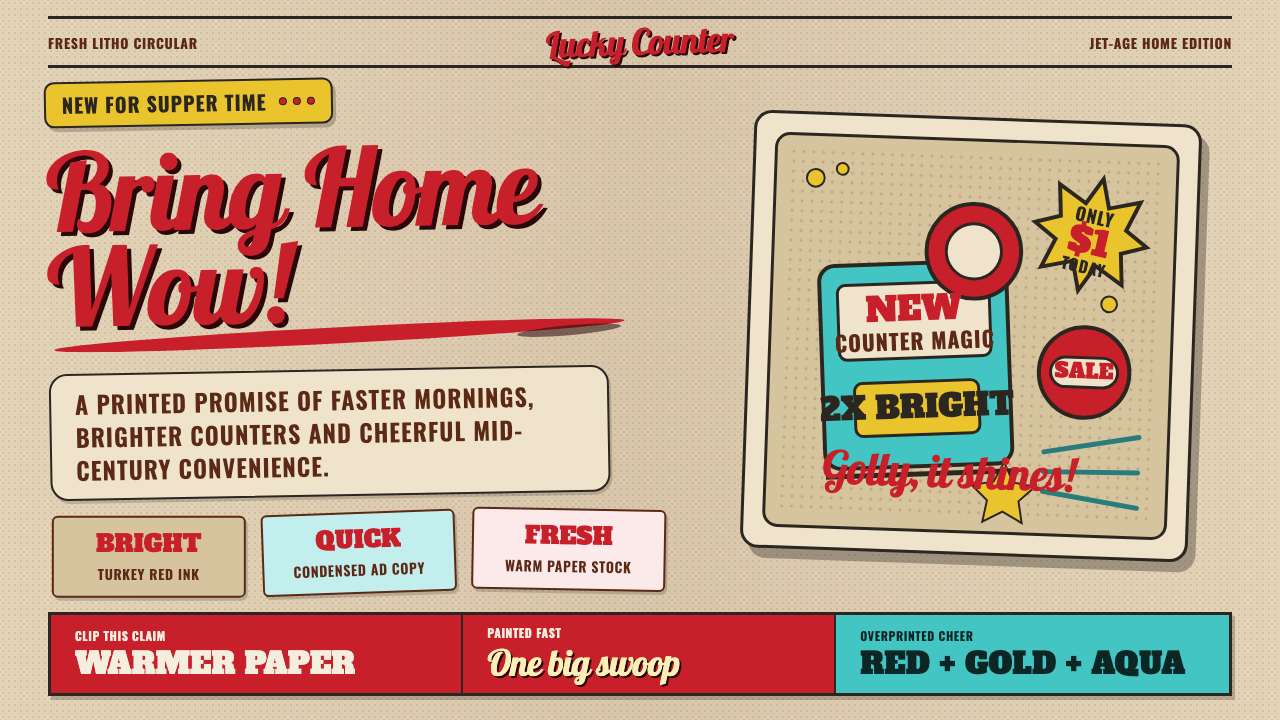 1950s Brush Script AdSells tomorrow in one swoop. Turkey red script, tan paper, starbursts, and ha…
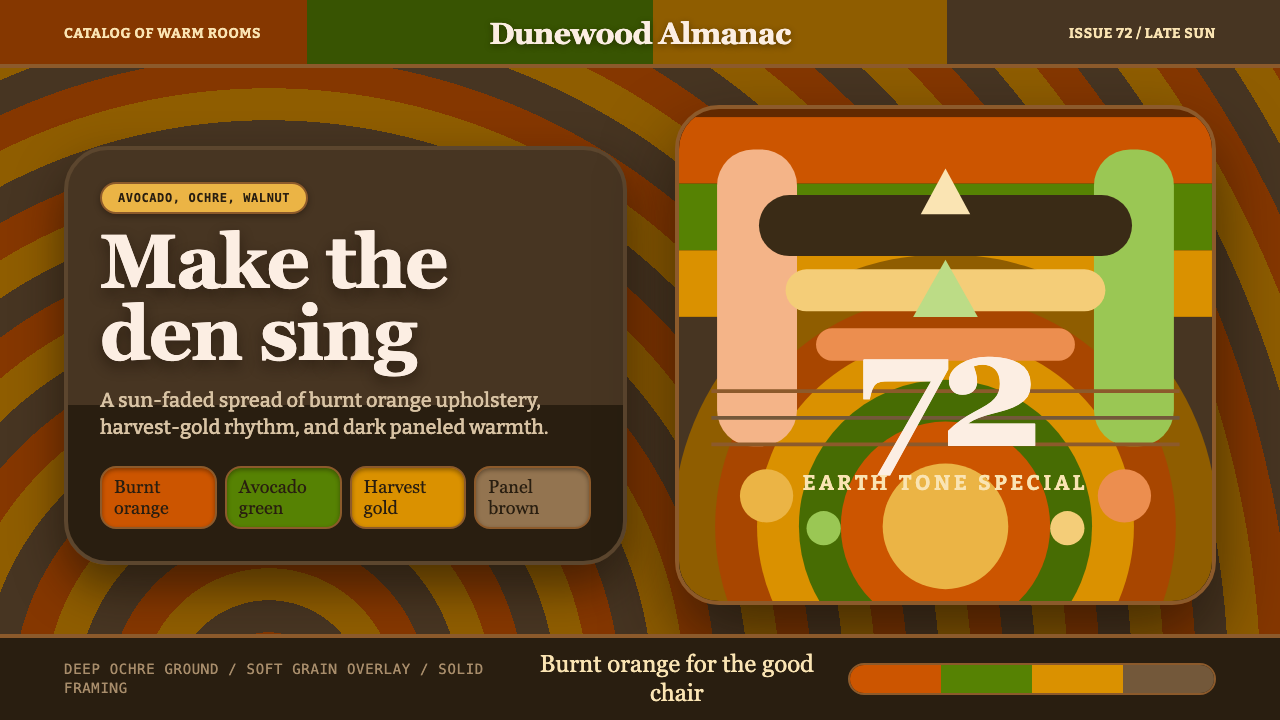 1970s Earth TonesWarm maximalism stays muddy. Bulbous slabs, avocado bands, and harvest-gold r…
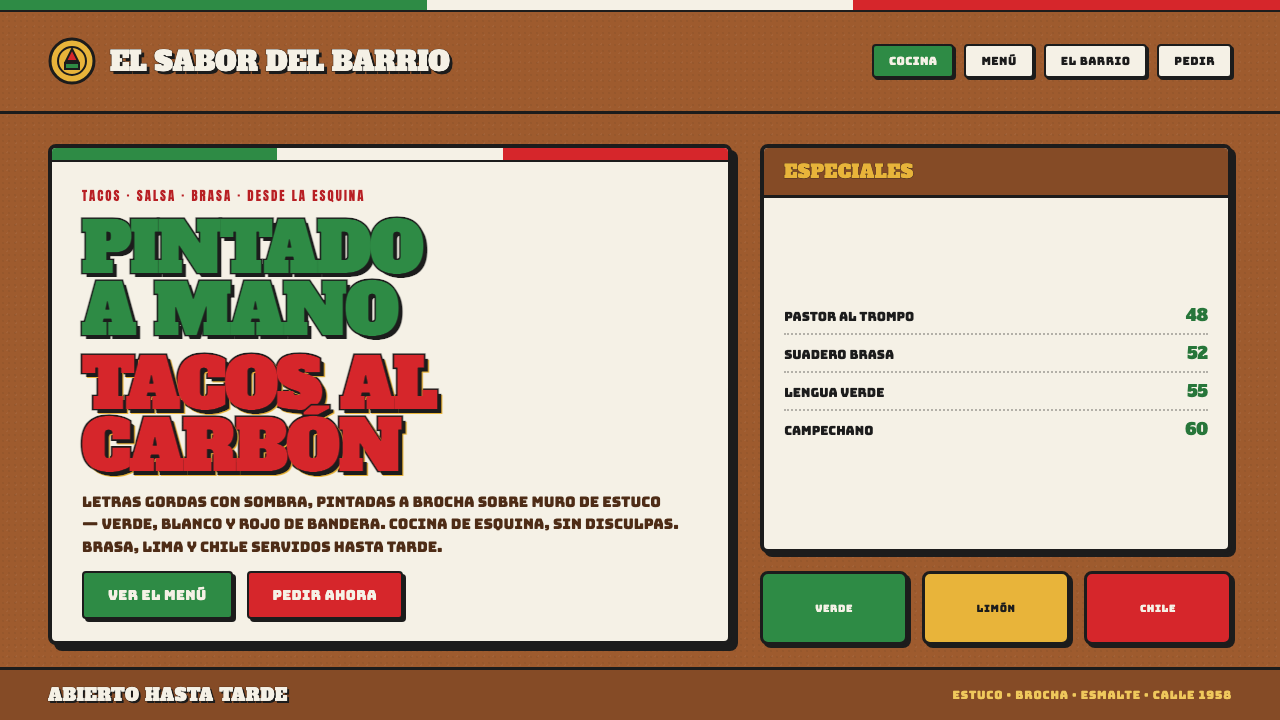 Mexican Taqueria Rotulo SignageStreet craft over polish. Fat outlined letters, hard offset shadows, flag col…
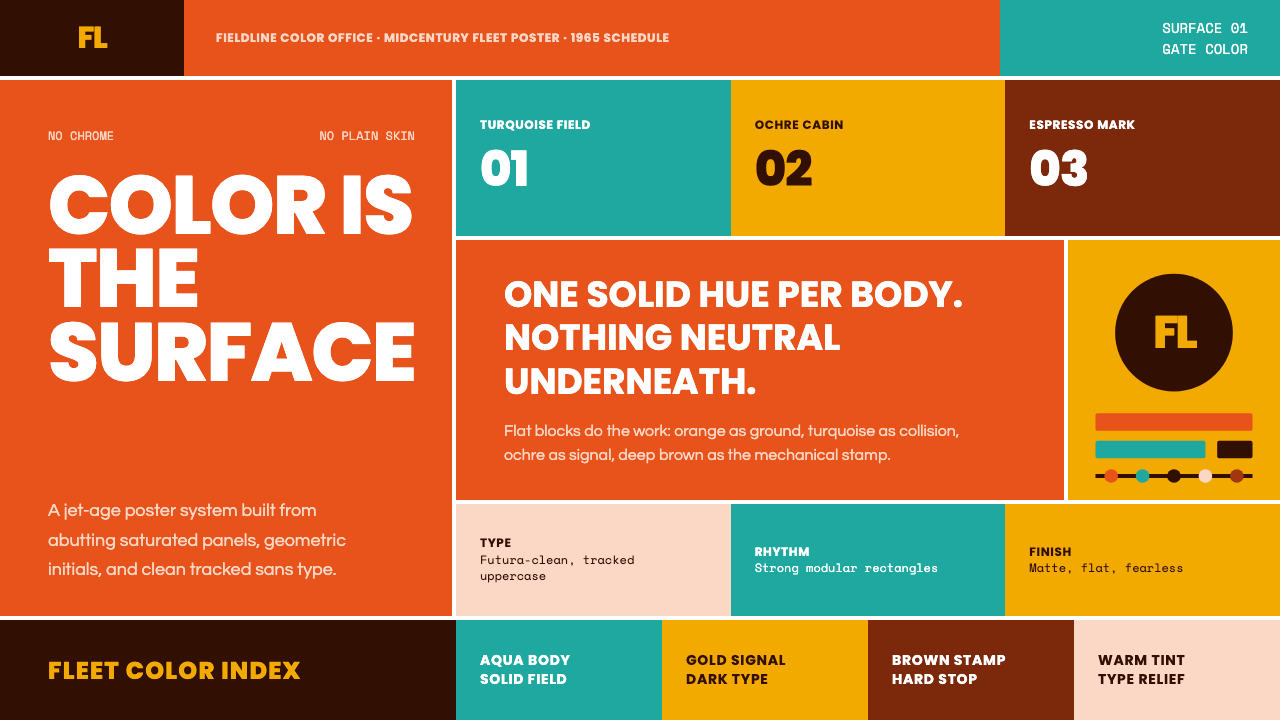 Braniff (Girard)Color becomes fuselage. Jellybean orange, turquoise blocks, and geometric san…
 KitKat (1935)A break you can hear. Pillar-box red, plump white type, and silver grooves se…
 La La Land (2016)Twilight waits for a dance. Violet dusk, rose horizons and amber bulbs frame…